

Microsoft disclosed CVE-2026-42915 on June 9, 2026, as a medium-severity Windows TCP/IP denial-of-service vulnerability affecting Windows 10, Windows 11, Windows Server 2022, and Windows Server 2025, with exploitation requiring an authorized attacker on an adjacent network. The bug is not the kind of headline-grabbing remote code execution flaw that sends admins sprinting for the nearest change window. But it sits in one of the least forgiving places in Windows: the networking stack, where a malformed assumption can become a fleet-wide outage. The real story is not that this CVE is catastrophic; it is that even “medium” TCP/IP bugs deserve adult supervision.
CVE-2026-42915 is described as an incorrect calculation of buffer size in Windows TCP/IP that allows an authorized attacker to deny service over an adjacent network. Microsoft’s severity rating lands in the “Important” rather than “Critical” class, and the CVSS 3.1 score reported by vulnerability trackers is 5.7. In practical terms, that score reflects a constrained attack: the attacker is not simply somewhere on the internet, does need low privileges, and does not gain code execution or data access.
That is reassuring, but only up to a point. Denial-of-service vulnerabilities are easy to underrate because they lack the cinematic appeal of credential theft or kernel-level remote code execution. A dead endpoint, a wedged service, or a server that stops responding at the wrong time can still be a material security incident, especially in environments where availability is the security objective.
The phrase adjacent network is doing a lot of work here. It suggests the attacker must be on the same logical or physical network segment, or in a position comparable to that, rather than sending packets from anywhere on the public internet. That lowers broad-scale worm risk, but it does not eliminate exposure inside offices, campuses, factories, labs, branch networks, guest Wi-Fi, or compromised VPN footholds.
The other important phrase is authorized attacker. This is not a drive-by packet from an anonymous stranger. It points to an attacker with some level of access already established, which makes CVE-2026-42915 more relevant to internal threat models than perimeter panic. For defenders, that means the vulnerability belongs in the same conversation as segmentation, least privilege, NAC enforcement, and how much trust the LAN still gets by default.
A desktop that can be crashed or forced into a nonresponsive state from the local network is a nuisance. A server hit the same way during authentication, file access, backup, remote management, or line-of-business traffic becomes a business interruption. A cluster node or domain-adjacent system that loses network availability at the wrong moment can create symptoms that look like everything from random instability to a storage problem.
Microsoft’s description does not provide packet-level mechanics, and that absence matters. We know the weakness category points to an incorrect buffer-size calculation, but not which protocol path, option handling, or state transition is involved. That lack of public detail reduces copycat risk in the short term, but it also leaves defenders with a generic remediation path: patch the platform, reduce adjacent-network exposure, and watch for unexplained network-triggered crashes or hangs.
This is the awkward compromise of modern vulnerability disclosure. Vendors often publish enough for risk ranking and patching, but not enough for defenders to write high-confidence detections. Attackers, meanwhile, can diff patches, fuzz related code paths, and focus on the same narrow weakness class. A sparse advisory is not a reason to dismiss the flaw; it is a reason to avoid pretending we know more than we do.
That does not mean every technical detail is public. It means the existence of the vulnerability is not speculative. This is not a rumor from a paste site, a vague bug-class claim from a conference abstract, or an unverified scanner finding. It is an entry in Microsoft’s coordinated security release process.
The distinction is important because defenders often conflate confirmed vulnerability with fully documented vulnerability. CVE-2026-42915 appears to be confirmed, but thinly described. Its root cause category is public enough to know that buffer-size calculation is involved, while the exploitation path remains undisclosed enough that most organizations cannot independently reproduce or validate it.
That combination should shape urgency. This is not a zero-day emergency based on the public record available at disclosure. It is also not optional trivia. The most sensible interpretation is that Microsoft is providing a routine Patch Tuesday fix for a real Windows networking bug whose operational impact depends heavily on network proximity and internal access.
This is one of the recurring failures of Patch Tuesday triage. Security teams are trained, correctly, to prioritize active exploitation, internet reachability, unauthenticated remote attack paths, and critical assets. But that can push availability bugs into a vague second tier where they are neither ignored nor meaningfully tracked.
A better approach is to ask what the vulnerability can do to the systems that matter. If a Windows client fleet is mostly remote and protected by consumer NAT, CVE-2026-42915 may sit behind more urgent issues. If a Windows Server 2022 or Server 2025 deployment is on a busy internal segment with broad east-west access, the calculus changes. The attacker does not need to steal data for the incident to hurt; making a service unavailable can be enough.
The June release context also matters because cumulative updates now carry more than security fixes. Recent Windows updates have bundled quality changes, servicing stack updates, AI component updates for eligible Copilot+ PCs, Secure Boot certificate work, Remote Desktop hardening, vulnerable-driver blocklist changes, and known-issue churn. That means patching is no longer a single-variable risk decision. The security benefit is real, but so is the need to test surrounding platform changes.
An adjacent-network denial-of-service bug is a perfect stress test for that architecture. It may not cross the internet, but it may cross the office floor. It may not compromise a domain controller directly, but it may disrupt a machine that users depend on for authentication flows, file access, printing, backup coordination, management tooling, or remote support.
This is where the CVSS score can mislead. Adjacent attack vector and low privileges reduce the score because they reduce universal exploitability. They do not necessarily reduce importance for organizations with flat VLANs, weak wireless segmentation, overbroad VPN access, or internal services reachable by far more users than necessary.
The attacker profile is also broader than “malicious outsider.” A compromised internal endpoint could become the launch point. A disgruntled insider might already have the necessary foothold. A poorly isolated guest network could matter if it is not really isolated. A lab network bridged into production may turn a medium Windows TCP/IP bug into a noisy operational mess.
Windows availability is especially consequential because Windows is not merely a desktop operating system in enterprise networks. It is the substrate for identity administration, management tooling, file services, endpoint security agents, remote desktop workflows, developer workstations, kiosks, industrial HMIs, and countless vendor-supported applications that were never designed for graceful failure.
A TCP/IP denial-of-service condition does not have to be permanent to matter. A forced reboot, a transient crash, or a network hang can trigger cascading operational consequences. Stateful applications may not recover cleanly. Users may retry and amplify load. Monitoring systems may generate storms of alerts. Help desks may chase symptoms rather than the underlying trigger.
That is why defenders should not read “no confidentiality impact” and “no integrity impact” as “no problem.” For many Windows environments, availability is the difference between a secure business process and a manual workaround held together with spreadsheets, phone calls, and privileged exceptions.
But incomplete detail also means defenders lack the clean signals they prefer. There is no widely published packet signature, no detailed exploit walkthrough, and no known public proof-of-concept at the time of initial reporting. Security teams cannot simply plug a CVE string into a detection rule and call the risk managed.
The likely defensive value comes from correlation rather than precision. If Windows systems begin crashing, losing network responsiveness, or producing unusual event patterns after receiving traffic from a nearby segment, CVE-2026-42915 should be on the investigation list until patched systems rule it out. That is not elegant, but real incident response rarely is.
This is also where patch-diffing risk enters the story. Once Microsoft ships fixes, the binary changes become a map for capable researchers and attackers. A vulnerability that was difficult to exploit from advisory text alone may become clearer after reverse engineering. The window between patch release and broad deployment is not theoretical; it is where many “quiet” bugs become operationally interesting.
For home users, the answer is usually simple: install updates if they are available for your supported channel. For enterprises, it is more complicated. Some Windows 10 systems are tied to hardware, applications, medical devices, manufacturing lines, or vendor certification regimes that move slowly. Those machines are precisely the ones where availability bugs are most dangerous, because they often sit in networks where “just upgrade it” is not a plan.
CVE-2026-42915 does not transform Windows 10 risk by itself. It is another tile in a mosaic that has been forming for years. The longer legacy Windows endpoints remain operational, the more security teams must compensate with segmentation, restricted lateral communication, strict inventory, and explicit decisions about who can talk to what.
The uncomfortable truth is that many organizations still patch operating systems better than they redesign networks. That leaves them dependent on monthly updates to rescue them from architectural exposure. A medium adjacent-network flaw is exactly the kind of bug that punishes that habit quietly.
The adjacent-network condition should drive admins to look at east-west reachability. Which authenticated users or machines can send traffic to those servers? Are management interfaces separated from user subnets? Are server VLANs meaningfully restricted, or are they simply named differently in the switch configuration? Are VPN clients dropped into broad internal address space with more reach than they need?
The mitigation that matters most before patching is not clever packet filtering for an undisclosed condition. It is boring network hygiene. Limit who can reach critical Windows systems. Enforce host firewalls. Reduce unnecessary inbound exposure. Make sure guest, BYOD, lab, and contractor networks are not adjacent to production systems in any practical sense.
This is also a good moment to review monitoring for Windows network stack failures. Blue screens, sudden reboots, adapter resets, clustered service failovers, and unexplained service interruptions should be traceable to timelines and source networks. If an availability attack happens and the only evidence is “users said it was slow,” the organization has already lost much of the forensic trail.
That does not argue against patching. It argues against blind patching in critical environments without rings, rollback planning, and operational awareness. The correct enterprise posture is not “delay until safe,” because safety never arrives fully formed. It is “deploy quickly through controlled rings, observe aggressively, and accelerate where exposure is high.”
For consumers and unmanaged small-business PCs, the advice is plainer. Take the cumulative update. Reboot when required. Do not try to surgically fix TCP/IP flaws through registry folklore or third-party “network hardening” utilities. The fix is in Windows servicing, not in wishful tuning.
For administrators, the best testing question is not merely whether the update installs. It is whether the update preserves the workflows the machine exists to support. Authentication, VPN, SMB, Remote Desktop, endpoint protection, backup, line-of-business apps, and monitoring agents all deserve smoke tests in the first patch ring.
CVE-2026-42915 is a good example of why judgment still matters. Its CVSS score is medium. Its attack path is constrained. Its impact is availability only. Yet its component is foundational, its affected platforms are ubiquitous, and its relevance depends heavily on network design.
A university lab with shared segments, a hospital wing with mixed clinical devices, a manufacturing floor with aging Windows systems, a managed services provider network, and a remote-first software company do not all face the same risk from the same CVE. The score is the starting point, not the answer.
Security teams should also be careful with the absence of known exploitation. It is useful information, but it is not a guarantee. Many denial-of-service bugs are unattractive to criminals because they do not monetize cleanly. They remain attractive to vandals, insiders, extortionists seeking disruption, and adversaries who want to distract defenders during a larger operation.
That creates a recurring tension. Too much technical detail can help attackers weaponize a flaw faster. Too little detail can leave defenders patching blindly and struggling to explain risk to change boards. CVE-2026-42915 lands in the middle: the public description is specific enough to identify a buffer-size calculation problem in Windows TCP/IP, but too sparse to support precise compensating controls.
For WindowsForum readers, that means the smart move is to separate confirmed facts from speculation. Confirmed: Microsoft has published the CVE, the issue affects multiple supported Windows client and server versions, the impact is denial of service, and exploitation is constrained to an authorized adjacent attacker. Not confirmed publicly: the exact protocol path, the reliable exploit method, the crash behavior, and whether defenders can detect attempts before a system is affected.
The sparse style also puts pressure on third-party vulnerability feeds and blogs. Some will summarize accurately. Others will inflate “Windows TCP/IP” into breathless claims of internet-wide risk. Readers should resist both complacency and theatrics. The facts are enough to justify patching; they are not enough to justify panic.
The most important operational task is mapping where affected Windows systems sit relative to users and devices that should not be able to influence them. If a low-privileged internal account on a nearby segment can interfere with a server’s network availability, the organization has more than a CVE problem. It has a trust-boundary problem.
Administrators should also use this as an excuse to review Windows Defender Firewall policy on servers and high-value clients. Too many environments disable or weaken host firewalls because the network is “internal.” That logic ages poorly every time an internal-only vulnerability appears.
Finally, patch reporting should distinguish between installed updates and effective coverage. A laptop that has downloaded the update but not rebooted is not remediated. A server excluded from a maintenance ring because it is “too important” is exactly the kind of system that needs an explicit risk owner. A lab machine no one inventories is not out of scope just because no one wants to own it.
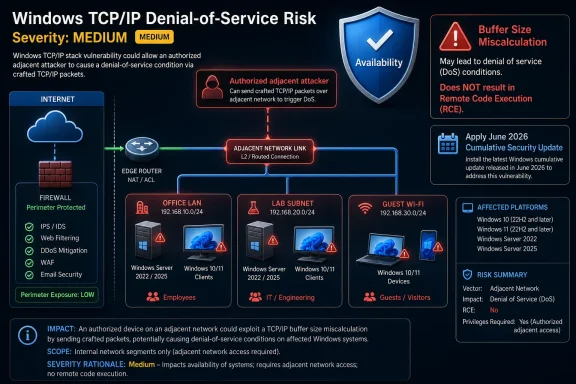 A Medium Score Can Still Mean a Bad Day on the Wire
CVE-2026-42915 is described as an incorrect calculation of buffer size in Windows TCP/IP that allows an authorized attacker to deny service over an adjacent network. Microsoft’s severity rating lands in the “Important” rather than “Critical” class, and the CVSS 3.1 score reported by vulnerability trackers is 5.7. In practical terms, that score reflects a constrained attack: the attacker is not simply somewhere on the internet, does need low privileges, and does not gain code execution or data access.That is reassuring, but only up to a point. Denial-of-service vulnerabilities are easy to underrate because they lack the cinematic appeal of credential theft or kernel-level remote code execution. A dead endpoint, a wedged service, or a server that stops responding at the wrong time can still be a material security incident, especially in environments where availability is the security objective.
The phrase adjacent network is doing a lot of work here. It suggests the attacker must be on the same logical or physical network segment, or in a position comparable to that, rather than sending packets from anywhere on the public internet. That lowers broad-scale worm risk, but it does not eliminate exposure inside offices, campuses, factories, labs, branch networks, guest Wi-Fi, or compromised VPN footholds.
The other important phrase is authorized attacker. This is not a drive-by packet from an anonymous stranger. It points to an attacker with some level of access already established, which makes CVE-2026-42915 more relevant to internal threat models than perimeter panic. For defenders, that means the vulnerability belongs in the same conversation as segmentation, least privilege, NAC enforcement, and how much trust the LAN still gets by default.
Windows TCP/IP Is Infrastructure, Not Just Code
The Windows TCP/IP stack is one of those components users never think about until it fails. It is also one of the components administrators cannot casually fence off, disable, or isolate without breaking the very reason the machine exists. That makes even relatively narrow vulnerabilities in TCP/IP operationally sensitive.A desktop that can be crashed or forced into a nonresponsive state from the local network is a nuisance. A server hit the same way during authentication, file access, backup, remote management, or line-of-business traffic becomes a business interruption. A cluster node or domain-adjacent system that loses network availability at the wrong moment can create symptoms that look like everything from random instability to a storage problem.
Microsoft’s description does not provide packet-level mechanics, and that absence matters. We know the weakness category points to an incorrect buffer-size calculation, but not which protocol path, option handling, or state transition is involved. That lack of public detail reduces copycat risk in the short term, but it also leaves defenders with a generic remediation path: patch the platform, reduce adjacent-network exposure, and watch for unexplained network-triggered crashes or hangs.
This is the awkward compromise of modern vulnerability disclosure. Vendors often publish enough for risk ranking and patching, but not enough for defenders to write high-confidence detections. Attackers, meanwhile, can diff patches, fuzz related code paths, and focus on the same narrow weakness class. A sparse advisory is not a reason to dismiss the flaw; it is a reason to avoid pretending we know more than we do.
The Confidence Signal Is Higher Than the Drama
The user-supplied metric asks a useful question: how confident should we be that this vulnerability exists and that the technical details are credible? For CVE-2026-42915, the answer is straightforward: the confidence is high, because Microsoft has acknowledged the vulnerability through the Security Update Guide and assigned it a CVE with affected Windows products and remediation context.That does not mean every technical detail is public. It means the existence of the vulnerability is not speculative. This is not a rumor from a paste site, a vague bug-class claim from a conference abstract, or an unverified scanner finding. It is an entry in Microsoft’s coordinated security release process.
The distinction is important because defenders often conflate confirmed vulnerability with fully documented vulnerability. CVE-2026-42915 appears to be confirmed, but thinly described. Its root cause category is public enough to know that buffer-size calculation is involved, while the exploitation path remains undisclosed enough that most organizations cannot independently reproduce or validate it.
That combination should shape urgency. This is not a zero-day emergency based on the public record available at disclosure. It is also not optional trivia. The most sensible interpretation is that Microsoft is providing a routine Patch Tuesday fix for a real Windows networking bug whose operational impact depends heavily on network proximity and internal access.
Patch Tuesday’s Flood Makes Triage Harder, Not Easier
CVE-2026-42915 arrived as part of Microsoft’s June 2026 Patch Tuesday, a release widely reported as unusually large, with roughly 200 vulnerabilities addressed and three publicly disclosed zero-days in the broader batch. That scale changes how individual vulnerabilities are perceived. A medium-severity TCP/IP denial-of-service flaw can vanish in a patch list dominated by critical remote code execution bugs, exploited issues, and privilege-escalation paths.This is one of the recurring failures of Patch Tuesday triage. Security teams are trained, correctly, to prioritize active exploitation, internet reachability, unauthenticated remote attack paths, and critical assets. But that can push availability bugs into a vague second tier where they are neither ignored nor meaningfully tracked.
A better approach is to ask what the vulnerability can do to the systems that matter. If a Windows client fleet is mostly remote and protected by consumer NAT, CVE-2026-42915 may sit behind more urgent issues. If a Windows Server 2022 or Server 2025 deployment is on a busy internal segment with broad east-west access, the calculus changes. The attacker does not need to steal data for the incident to hurt; making a service unavailable can be enough.
The June release context also matters because cumulative updates now carry more than security fixes. Recent Windows updates have bundled quality changes, servicing stack updates, AI component updates for eligible Copilot+ PCs, Secure Boot certificate work, Remote Desktop hardening, vulnerable-driver blocklist changes, and known-issue churn. That means patching is no longer a single-variable risk decision. The security benefit is real, but so is the need to test surrounding platform changes.
The Local Network Is Still a Dangerous Place
For years, enterprise security has been trying to kill the old assumption that the internal network is safe. CVE-2026-42915 is another reminder that the assumption refuses to die because so many systems still behave as though adjacency equals trust. Printers, conferencing devices, developer laptops, lab machines, vendor appliances, contractor endpoints, and unmanaged IoT hardware continue to share space with Windows systems that matter.An adjacent-network denial-of-service bug is a perfect stress test for that architecture. It may not cross the internet, but it may cross the office floor. It may not compromise a domain controller directly, but it may disrupt a machine that users depend on for authentication flows, file access, printing, backup coordination, management tooling, or remote support.
This is where the CVSS score can mislead. Adjacent attack vector and low privileges reduce the score because they reduce universal exploitability. They do not necessarily reduce importance for organizations with flat VLANs, weak wireless segmentation, overbroad VPN access, or internal services reachable by far more users than necessary.
The attacker profile is also broader than “malicious outsider.” A compromised internal endpoint could become the launch point. A disgruntled insider might already have the necessary foothold. A poorly isolated guest network could matter if it is not really isolated. A lab network bridged into production may turn a medium Windows TCP/IP bug into a noisy operational mess.
Availability Is a Security Property, Not an Afterthought
Denial of service is often treated as the least glamorous member of the CIA triad. Confidentiality gets breach notifications. Integrity gets scary supply-chain stories. Availability gets shrugged off until payroll, point-of-sale, clinical systems, dispatch, manufacturing, or authentication stops working.Windows availability is especially consequential because Windows is not merely a desktop operating system in enterprise networks. It is the substrate for identity administration, management tooling, file services, endpoint security agents, remote desktop workflows, developer workstations, kiosks, industrial HMIs, and countless vendor-supported applications that were never designed for graceful failure.
A TCP/IP denial-of-service condition does not have to be permanent to matter. A forced reboot, a transient crash, or a network hang can trigger cascading operational consequences. Stateful applications may not recover cleanly. Users may retry and amplify load. Monitoring systems may generate storms of alerts. Help desks may chase symptoms rather than the underlying trigger.
That is why defenders should not read “no confidentiality impact” and “no integrity impact” as “no problem.” For many Windows environments, availability is the difference between a secure business process and a manual workaround held together with spreadsheets, phone calls, and privileged exceptions.
The Missing Exploit Details Cut Both Ways
Publicly available data for CVE-2026-42915 does not indicate broad exploitation in the wild at disclosure, and the vulnerability is not described as remotely exploitable across the internet. That should prevent needless alarm. There is no basis, from the public record, to treat this as a wormable Windows TCP/IP crisis.But incomplete detail also means defenders lack the clean signals they prefer. There is no widely published packet signature, no detailed exploit walkthrough, and no known public proof-of-concept at the time of initial reporting. Security teams cannot simply plug a CVE string into a detection rule and call the risk managed.
The likely defensive value comes from correlation rather than precision. If Windows systems begin crashing, losing network responsiveness, or producing unusual event patterns after receiving traffic from a nearby segment, CVE-2026-42915 should be on the investigation list until patched systems rule it out. That is not elegant, but real incident response rarely is.
This is also where patch-diffing risk enters the story. Once Microsoft ships fixes, the binary changes become a map for capable researchers and attackers. A vulnerability that was difficult to exploit from advisory text alone may become clearer after reverse engineering. The window between patch release and broad deployment is not theoretical; it is where many “quiet” bugs become operationally interesting.
Windows 10’s Long Goodbye Makes Every Patch More Political
The affected product list includes Windows 10, which remains a special headache in 2026. By now, organizations are living with the consequences of Windows 10’s end-of-support transition, extended security options, replacement planning, and hardware eligibility debates. Every new CVE touching Windows 10 sharpens the question: is this machine still part of the managed estate, or is it becoming technical debt with a network cable?For home users, the answer is usually simple: install updates if they are available for your supported channel. For enterprises, it is more complicated. Some Windows 10 systems are tied to hardware, applications, medical devices, manufacturing lines, or vendor certification regimes that move slowly. Those machines are precisely the ones where availability bugs are most dangerous, because they often sit in networks where “just upgrade it” is not a plan.
CVE-2026-42915 does not transform Windows 10 risk by itself. It is another tile in a mosaic that has been forming for years. The longer legacy Windows endpoints remain operational, the more security teams must compensate with segmentation, restricted lateral communication, strict inventory, and explicit decisions about who can talk to what.
The uncomfortable truth is that many organizations still patch operating systems better than they redesign networks. That leaves them dependent on monthly updates to rescue them from architectural exposure. A medium adjacent-network flaw is exactly the kind of bug that punishes that habit quietly.
Server Exposure Is About Role, Not Just Version
Windows Server 2022 and Windows Server 2025 appear in the affected product set, which should focus attention on role-based risk rather than version-based panic. Not every server is equally exposed. A domain controller, Hyper-V host, file server, Remote Desktop Session Host, management server, backup server, or application front end has a different blast radius than a lightly used departmental VM.The adjacent-network condition should drive admins to look at east-west reachability. Which authenticated users or machines can send traffic to those servers? Are management interfaces separated from user subnets? Are server VLANs meaningfully restricted, or are they simply named differently in the switch configuration? Are VPN clients dropped into broad internal address space with more reach than they need?
The mitigation that matters most before patching is not clever packet filtering for an undisclosed condition. It is boring network hygiene. Limit who can reach critical Windows systems. Enforce host firewalls. Reduce unnecessary inbound exposure. Make sure guest, BYOD, lab, and contractor networks are not adjacent to production systems in any practical sense.
This is also a good moment to review monitoring for Windows network stack failures. Blue screens, sudden reboots, adapter resets, clustered service failovers, and unexplained service interruptions should be traceable to timelines and source networks. If an availability attack happens and the only evidence is “users said it was slow,” the organization has already lost much of the forensic trail.
The Patch Is Necessary, but Testing Still Matters
For supported Windows systems, the remediation path is installation of the applicable cumulative security update. That is simple to say and never quite simple to execute at scale. The June 2026 Windows updates include several moving parts beyond this CVE, and Microsoft’s April 2026 cumulative update history already shows the sort of known-issue management that admins now expect: Secure Boot certificate work, BitLocker recovery edge cases, Remote Desktop warning display issues, and vulnerable-driver blocklist changes.That does not argue against patching. It argues against blind patching in critical environments without rings, rollback planning, and operational awareness. The correct enterprise posture is not “delay until safe,” because safety never arrives fully formed. It is “deploy quickly through controlled rings, observe aggressively, and accelerate where exposure is high.”
For consumers and unmanaged small-business PCs, the advice is plainer. Take the cumulative update. Reboot when required. Do not try to surgically fix TCP/IP flaws through registry folklore or third-party “network hardening” utilities. The fix is in Windows servicing, not in wishful tuning.
For administrators, the best testing question is not merely whether the update installs. It is whether the update preserves the workflows the machine exists to support. Authentication, VPN, SMB, Remote Desktop, endpoint protection, backup, line-of-business apps, and monitoring agents all deserve smoke tests in the first patch ring.
The EPSS Era Has Not Replaced Judgment
Modern vulnerability management leans heavily on scores. CVSS tells us the theoretical characteristics of a flaw. EPSS tries to estimate the probability of exploitation. Vendor severity labels offer another axis. Scanner dashboards then compress all of that into red, orange, and green queues that executives can understand and engineers learn to distrust.CVE-2026-42915 is a good example of why judgment still matters. Its CVSS score is medium. Its attack path is constrained. Its impact is availability only. Yet its component is foundational, its affected platforms are ubiquitous, and its relevance depends heavily on network design.
A university lab with shared segments, a hospital wing with mixed clinical devices, a manufacturing floor with aging Windows systems, a managed services provider network, and a remote-first software company do not all face the same risk from the same CVE. The score is the starting point, not the answer.
Security teams should also be careful with the absence of known exploitation. It is useful information, but it is not a guarantee. Many denial-of-service bugs are unattractive to criminals because they do not monetize cleanly. They remain attractive to vandals, insiders, extortionists seeking disruption, and adversaries who want to distract defenders during a larger operation.
Microsoft’s Sparse Advisory Style Leaves Admins Filling the Gaps
Microsoft’s Security Update Guide is built for scale. It gives administrators enough structured information to identify affected products, severity, exploitability characteristics, and update availability. It is not a narrative incident report, and it rarely gives defenders all the context they want.That creates a recurring tension. Too much technical detail can help attackers weaponize a flaw faster. Too little detail can leave defenders patching blindly and struggling to explain risk to change boards. CVE-2026-42915 lands in the middle: the public description is specific enough to identify a buffer-size calculation problem in Windows TCP/IP, but too sparse to support precise compensating controls.
For WindowsForum readers, that means the smart move is to separate confirmed facts from speculation. Confirmed: Microsoft has published the CVE, the issue affects multiple supported Windows client and server versions, the impact is denial of service, and exploitation is constrained to an authorized adjacent attacker. Not confirmed publicly: the exact protocol path, the reliable exploit method, the crash behavior, and whether defenders can detect attempts before a system is affected.
The sparse style also puts pressure on third-party vulnerability feeds and blogs. Some will summarize accurately. Others will inflate “Windows TCP/IP” into breathless claims of internet-wide risk. Readers should resist both complacency and theatrics. The facts are enough to justify patching; they are not enough to justify panic.
The Practical Playbook Is Boring Because It Works
The right response to CVE-2026-42915 is not exotic. It is the same disciplined Windows security practice that separates resilient organizations from those that live in permanent surprise. Inventory first, patch in rings, reduce adjacency, monitor symptoms, and treat unsupported systems as exceptions that require compensating controls.The most important operational task is mapping where affected Windows systems sit relative to users and devices that should not be able to influence them. If a low-privileged internal account on a nearby segment can interfere with a server’s network availability, the organization has more than a CVE problem. It has a trust-boundary problem.
Administrators should also use this as an excuse to review Windows Defender Firewall policy on servers and high-value clients. Too many environments disable or weaken host firewalls because the network is “internal.” That logic ages poorly every time an internal-only vulnerability appears.
Finally, patch reporting should distinguish between installed updates and effective coverage. A laptop that has downloaded the update but not rebooted is not remediated. A server excluded from a maintenance ring because it is “too important” is exactly the kind of system that needs an explicit risk owner. A lab machine no one inventories is not out of scope just because no one wants to own it.
The June TCP/IP Bug Rewards the Teams That Already Know Their Network
CVE-2026-42915 is unlikely to be the scariest item in Microsoft’s June 2026 security release, but it is a useful measure of operational maturity. The teams that can answer where affected systems are, who can reach them, which update ring they belong to, and what outage signals would look like are already ahead. The teams that cannot answer those questions should treat this bug as a prompt, not merely a patch.- CVE-2026-42915 is a confirmed Microsoft Windows TCP/IP denial-of-service vulnerability disclosed on June 9, 2026.
- The known attack conditions are constrained because exploitation requires an authorized attacker with adjacent-network access.
- The public technical detail is limited, so defenders should avoid claims about exploit mechanics that Microsoft has not disclosed.
- The affected product family includes Windows 10, Windows 11, Windows Server 2022, and Windows Server 2025.
- The practical mitigation is to apply the applicable cumulative security update while also reducing unnecessary east-west network reachability.
- The vulnerability is medium severity on paper, but it can still matter on networks where Windows availability is tied to identity, file access, remote work, industrial systems, or business-critical applications.
References
- Primary source: MSRC
Published: 2026-06-09T07:00:00-07:00
Security Update Guide - Microsoft Security Response Center
 msrc.microsoft.com
- Related coverage: datacomm.com
- Official source: microsoft.com
MSRC - Microsoft Security Response Center
The Microsoft Security Response Center is part of the defender community and on the front line of security response evolution. For over twenty years, we have been engaged with security researchers working to protect customers and the broader ecosystem.www.microsoft.com
- Related coverage: aha.org
h isac tlp white vulnerability bulletin critical tcp ip rce on ipv6 enabled systems 8 15 2024
PDF documentwww.aha.org
- Related coverage: cert.gov.to
- Related coverage: health-isac.org
TLP White update eb890ef7 Microsoft Urges Customers to Patch Critical Windows TCP IP Bugs 1
PDF documenthealth-isac.org
- Related coverage: blog.qualys.com
Microsoft and Adobe Patch Tuesday, June 2026 Security Update Review | Qualys
Every Patch Tuesday presents a race between defenders applying fixes and attackers seeking opportunities. Microsoft’s June 2026 release is no exception…blog.qualys.com - Related coverage: techradar.com
Microsoft confirms two major Defender security issues — so update now or face possible attack | TechRadar
CISA confirms two bugs being actively exploited in the wildwww.techradar.com - Related coverage: computerweekly.com
Microsoft smashes record for biggest ever Patch Tuesday update | Computer Weekly
Microsoft has not only broken but obliterated the record for the largest ever Patch Tuesday drop, with its June 2026 update addressing approximately 200 flaws, and three zero-days.www.computerweekly.com - Related coverage: bleepingcomputer.com
Microsoft June 2026 Patch Tuesday fixes 6 zero-days, 200 flaws
Today is Microsoft's June 2026 Patch Tuesday, with security updates for 200 flaws, including five publicly disclosed zero-day vulnerabilities and one actively exploited in attacks.www.bleepingcomputer.com - Related coverage: cyberscoop.com
Microsoft breaks Patch Tuesday record with 206 vulnerabilities | CyberScoop
Fears and warnings about a roaring flood of error-riddled software have materialized. And the disease is spreading.cyberscoop.com - Related coverage: securityweek.com
Microsoft Patches 200 Vulnerabilities - SecurityWeek
Microsoft’s June 2026 Patch Tuesday updates fix roughly 200 vulnerabilities discovered in the company’s products.www.securityweek.com
- Official source: techcommunity.microsoft.com
Act now: Secure Boot certificates expire in June 2026 - Windows IT Pro Blog
Get tips to prepare for the rollout of updated certificates across your organization. techcommunity.microsoft.com

 A TCP/IP DoS vulnerability can be serious for network stability. It’s good that Microsoft addressed CVE-2026-42915 in the June 2026 patch. Keeping systems updated is really important to avoid potential network attacks or service disruptions.
