

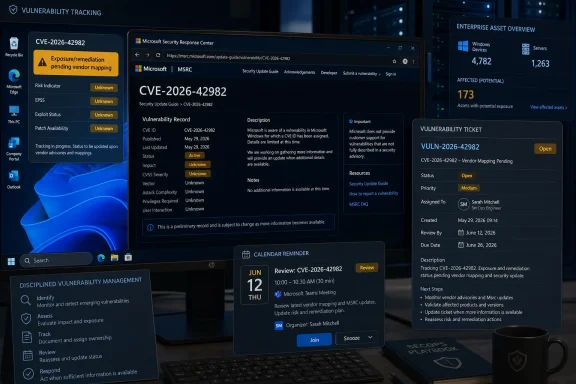
Microsoft’s record identifies CVE-2026-42982 as the “Windows Secure Kernel Mode Elevation of Privilege Vulnerability” and gives a publication timestamp of July 14, 2026, at 7:00 a.m. UTC-7. The supplied material also explains Microsoft’s technical-details confidence metric. It does not, however, provide enough verified product and update mapping for administrators to determine which devices require remediation or which package would establish a fixed state.Operational answer — based on the MSRC record available at publication: No affected-product list, KB number, Windows build, mitigation, remediation package, or exploit-status conclusion has been verified in the supplied record for CVE-2026-42982. Do not mark a device patched, vulnerable, unaffected, or outside scope yet. Open the Microsoft Security Response Center CVE page, bookmark or subscribe to the record, create a ticket with the status “exposure/remediation pending vendor mapping,” assign an owner, and set a dated review cadence.
The immediate enterprise task is therefore not speculative patch matching. It is disciplined status management.
Windows teams should preserve unknown as an explicit operational state rather than translating it into “not affected,” “not exploited,” or “remediated.” Those negative conclusions require affirmative evidence from Microsoft or another authoritative source. Until that evidence appears, CVE-2026-42982 belongs in the vulnerability queue with an owner, a review date, and clearly documented evidence gaps.
Confirmed Facts and the Current Evidence Boundary
The supplied record supports a short set of statements:
- The identifier is CVE-2026-42982.
- The title is “Windows Secure Kernel Mode Elevation of Privilege Vulnerability.”
- The stated publication time is July 14, 2026, at 7:00 a.m. UTC-7.
- Microsoft’s accompanying language explains the purpose of a technical-details confidence metric.
The title establishes the named Windows component and Microsoft’s impact classification. It does not, by itself, establish the vulnerable operation, the attacker’s starting position, the privilege ultimately obtained, the required device configuration, or the practical exploit path.
The supplied material also does not verify an affected-product matrix, a corresponding KB package, a fixed Windows build, a mitigation, or an exploitation conclusion. That wording is deliberately narrower than declaring that those fields are absent from Microsoft’s live page. The live record may change, and administrators should inspect it directly rather than treating a snapshot or secondary report as permanently complete.
This is the central evidence boundary for the article:
Unknown must remain unknown until an authoritative source answers the question. It must not be converted into either reassurance or alarm.
That rule applies to every downstream decision. A device cannot be called unaffected merely because its Windows release has not yet been mapped in the supplied material. It cannot be called vulnerable merely because it runs Windows. It cannot be called patched merely because the latest cumulative update is installed. It also cannot be described as exposed to active exploitation without a verified exploitation assessment.
The CVE title warrants tracking, but it does not supply a complete risk calculation.
“Elevation of Privilege” Is a Classification, Not an Attack Narrative
An elevation-of-privilege classification describes an increase in authority or access. It does not identify the attacker’s initial privileges, the interface through which the flaw can be reached, or the conditions necessary for successful exploitation.
Those distinctions determine operational priority. A vulnerability that requires an established local foothold presents a different response problem from one that can be reached remotely. A flaw limited to a particular configuration differs from one exposed in a default installation. A reliable exploit differs from a theoretical condition requiring narrow timing or hardware circumstances.
None of those characteristics can be inferred safely from the title of CVE-2026-42982.
Windows teams should also avoid importing technical properties from previous vulnerabilities with similar component names. Historical Secure Kernel Mode CVEs may be useful for broad research, but they do not prove that this issue shares the same root cause, prerequisites, affected releases, or result. Likewise, the words “Secure Kernel Mode” do not independently establish a bypass of virtualization-based security, Memory Integrity, Secure Boot, credential protections, or any other named Windows security feature.
The accurate description remains limited: Microsoft’s record labels CVE-2026-42982 as an elevation-of-privilege vulnerability in Windows Secure Kernel Mode. Further conclusions require further evidence.
That restraint should extend to internal communications. A ticket title such as “Secure Kernel compromise across Windows fleet” would overstate the record. A better title is:
CVE-2026-42982 — exposure and remediation pending Microsoft product/update mapping
This language keeps the issue visible without embedding an unsupported technical conclusion into dashboards, executive reports, or service-level calculations.
Microsoft’s Confidence Language Does Not Supply This CVE’s Rating
The supplied material explains Microsoft’s technical-details confidence metric as a way to express confidence that a vulnerability exists and the credibility or maturity of the associated technical information. Microsoft’s description distinguishes between cases where an undesirable impact is known, cases where research indicates a probable location or cause, and cases where the vendor or technology author has confirmed the technical finding.
That framework is useful, but the explanation of a metric is not the same as a CVE-specific result.
The supplied material does not include the actual technical-details confidence value assigned to CVE-2026-42982. As a result, the article cannot call the issue “vendor-confirmed,” cannot say Microsoft has technically confirmed the flaw’s existence at the metric’s highest confidence level, and cannot use the metric to estimate how much exploit knowledge may be available.
Administrators reviewing the live Microsoft record should distinguish among three items:
- The general description of what the metric means.
- The actual value, if any, displayed for CVE-2026-42982.
- Any technical narrative Microsoft publishes to justify or contextualize that value.
Only the second and third items can support a CVE-specific confidence judgment. The general metric language provides a framework, not the answer.
This distinction matters in automation as well. A parser or analyst should not treat the presence of confidence-related explanatory text as if it were a populated rating. If the corresponding CVE value cannot be verified, the internal field should be recorded as unknown rather than filled with an inferred result.
The WindowsForum Rule: Keep “Unknown” Separate From “No”
The most useful WindowsForum takeaway is a reporting rule that can be applied across vulnerability-management systems: unknown and no are different values.
A blank field often gets flattened into a negative answer when data passes from a vendor page to a spreadsheet, scanner, dashboard, ticket, and executive report. CVE-2026-42982 shows why that shortcut is risky. If Microsoft has not yet been mapped to an internal data field, the organization lacks the evidence needed to make the negative claim.
| Question | Correct interim status | Do not translate it into |
|---|---|---|
| Is this Windows release affected? | Unknown pending Microsoft product mapping | Not affected |
| Is this device exposed? | Unknown pending product and configuration criteria | Vulnerable or safe |
| Has this device been remediated? | Unknown pending Microsoft update mapping and validation criteria | Patched |
| Is there a relevant KB or fixed build? | Not verified in the supplied record | No update exists |
| Is a mitigation available? | Not verified in the supplied record | No mitigation exists or no mitigation is needed |
| Is exploitation occurring? | No conclusion verified in the supplied record | Not exploited or actively exploited |
| Does the confidence metric establish technical confirmation? | CVE-specific value not provided in the supplied material | Vendor-confirmed |
| Should existing security protections be disabled? | No verified basis for a configuration change | Disable features as a precaution |
This vocabulary should be preserved in enterprise tickets. If a platform requires a binary “affected/not affected” value, administrators should use a separate exception state, holding queue, or evidence-pending tag rather than forcing an unsupported selection.
An organization may choose to assign a provisional business priority based on the component name, impact category, asset criticality, or internal risk tolerance. That is an internal triage decision, not a statement that Microsoft has established exploitability or fleet-wide exposure. The ticket should identify the decision as provisional and record the assumptions behind it.
For example:
Provisional priority: Elevated monitoring due to the named component and elevation-of-privilege classification.
Exposure: Unknown pending Microsoft affected-product mapping.
Remediation: Pending Microsoft KB/build association.
Exploitation: No conclusion verified from the supplied record.
Next review: Assigned date and owner.
That format gives managers a usable status without laundering uncertainty into a technical fact.
Compact Interim Workflow for Administrators
The interim response should be concrete, repeatable, and small enough to survive normal operations. It should not depend on an invented Settings path, registry change, PowerShell command, or package identifier.
1. Open the canonical Microsoft record
Open the Microsoft Security Response Center CVE URL for CVE-2026-42982 directly. Confirm that the page is Microsoft’s record rather than a search-result summary, copied database entry, or third-party article.
Record the date and time of the review in the ticket. Because the page may be revised, a statement such as “checked” is less useful than “checked on July 14 at 3:00 p.m. Central by the assigned analyst.”
2. Bookmark or subscribe to the CVE
Bookmark the record in the team’s shared vulnerability workspace. If Microsoft offers a notification or subscription option for the record or Security Update Guide data, use it. The goal is to receive vendor changes without relying on repeated ad hoc searches.
Where automated ingestion is available, preserve the source timestamp and the organization’s ingestion timestamp separately. That makes it easier to determine whether a newly populated field came from Microsoft or from an internal enrichment process.
3. Create an evidence-pending ticket
Use the status:
Exposure/remediation pending vendor mapping
The ticket should include the confirmed identifier, title, stated publication time, source owner, last review time, next review time, and a list of unresolved fields. It should not include a guessed KB, build, affected release, or mitigation.
If the ticketing system supports structured fields, use unknown or not yet verified rather than leaving fields blank. Blank fields are easy to misread and difficult to audit.
4. Assign one accountable owner
Assign the ticket to a named vulnerability-management, Windows engineering, or security-operations owner. A shared queue can receive the alert, but a person or defined on-call role should be responsible for checking Microsoft’s record and coordinating any later deployment action.
The owner should also be responsible for resolving conflicts between sources. If a third party maps a product or KB before Microsoft does, that mapping should be labeled third-party or provisional rather than silently promoted to vendor fact.
5. Set a review cadence
Use a cadence appropriate to the organization’s exposure and staffing. A practical starting point is a review at least once each business day while the product and update mapping remains unresolved, with an additional review after Microsoft’s normal security-publication activity or any visible revision to the CVE record.
High-security environments may review more frequently. The important control is that the cadence be dated and assigned, not described vaguely as “monitor Microsoft.”
6. Preserve current security baselines
Do not disable or weaken Windows security features based only on the component name. No configuration change, Settings path, command, workaround, or remediation package has been verified in the supplied record.
Continue applying the organization’s normal approved Windows security updates and baseline policies. That routine maintenance is good practice, but it must not be presented as proof that CVE-2026-42982 has been remediated until Microsoft supplies a usable update association.
7. Prepare for vendor mapping
Ensure that the organization can quickly compare Microsoft’s eventual affected-product information with its Windows inventory. Useful existing inventory fields include Windows edition, release, architecture, installed build, update ring, support status, and asset criticality.
Collecting those ordinary inventory facts does not establish exposure. It simply reduces the time required to act once Microsoft publishes the matching criteria.
Admin Checklist
- [ ] Open the Microsoft Security Response Center record for CVE-2026-42982.
- [ ] Confirm the identifier, title, and currently displayed vendor fields.
- [ ] Record the review date, time, analyst, and source in the ticket.
- [ ] Bookmark or subscribe to the Microsoft record.
- [ ] Set ticket status to “exposure/remediation pending vendor mapping.”
- [ ] Assign a named owner or accountable on-call role.
- [ ] Set the next review date and an ongoing review cadence.
- [ ] Record affected products as unknown pending Microsoft mapping.
- [ ] Record remediation as unknown pending Microsoft KB/build mapping.
- [ ] Record exploitation as no conclusion verified from the supplied record.
- [ ] Do not enter a guessed KB, build, fixed version, Settings path, or command.
- [ ] Do not mark devices patched or unaffected based solely on current update compliance.
- [ ] Preserve existing Windows security baselines unless Microsoft publishes specific guidance.
- [ ] Prepare inventory and deployment groups for rapid comparison once mapping appears.
- [ ] Escalate any newly published Microsoft product, update, mitigation, or exploitation data for validation.
Patch Management Should Wait for a Verifiable Target
Patch compliance answers a specific question: whether an endpoint has installed an update that is required under a defined policy. CVE remediation answers a related but different question: whether an authoritative mapping establishes that a particular update or fixed build addresses a vulnerability on that product.
For CVE-2026-42982, the second question cannot yet be answered from the supplied record.
This means a fully updated device may still have an unknown CVE remediation state. That wording does not imply the device remains vulnerable. It means the evidence necessary to connect update compliance with this CVE has not been verified.
Once Microsoft publishes an association, administrators should validate all parts of the mapping:
- The affected Windows product and release.
- Any architecture or configuration conditions.
- The applicable KB package or cumulative update.
- The fixed operating-system build, if Microsoft supplies one.
- Any supersedence relationship.
- Any restart or deployment conditions Microsoft documents.
- Any exceptions, known issues, or alternate guidance.
Only then should management tooling translate installed-update or build data into a remediated state.
The same discipline applies to unaffected determinations. If Microsoft identifies a bounded set of affected products, devices outside that set may be marked unaffected only after the organization verifies that its product inventory is accurate and that the vendor’s scope is being interpreted correctly. “Not listed in our current notes” is not equivalent to “excluded by Microsoft.”
A Dated Update Plan
This article is based on the MSRC record available at publication. It should be treated as a time-bounded report, not as a permanent description of CVE-2026-42982.
WindowsForum will update the operational fields only when Microsoft publishes the relevant information. The update discipline is:
| Field | Current article status | Trigger for revision |
|---|---|---|
| Affected products | Not verified in the supplied record | Microsoft publishes product or release mapping |
| KB package | Not verified in the supplied record | Microsoft associates a KB with the CVE |
| Fixed Windows build | Not verified in the supplied record | Microsoft publishes a build or fixed-version target |
| Mitigation or workaround | Not verified in the supplied record | Microsoft publishes specific guidance |
| Exploitation status | No conclusion verified in the supplied record | Microsoft publishes or revises its assessment |
| Technical-details confidence | CVE-specific value not supplied | Microsoft displays a verifiable value for this CVE |
Each substantive revision should carry a visible update date and should distinguish newly published Microsoft data from WindowsForum analysis. If Microsoft changes a field, the article should report the change rather than silently rewriting the original evidence state.
Operational timeline
- Publication record: Microsoft’s supplied timestamp is July 14, 2026, at 7:00 a.m. UTC-7.
- At article publication: Identifier, title, timestamp, and metric-description language are the verified elements available for this report.
- Immediate enterprise action: Open and track the MSRC record; create an evidence-pending ticket; assign an owner and review cadence.
- Next vendor-data milestone: Microsoft product mapping, KB/build association, mitigation guidance, or exploitation assessment.
- After mapping: Compare Microsoft’s criteria with inventory, test the identified update through normal deployment rings, and validate endpoint state.
- After validation: Change individual assets from unknown to affected, unaffected, or remediated using documented evidence.
What Windows Teams Can Reliably Carry Forward
CVE-2026-42982 should be tracked now, but the supplied record does not yet provide a defensible device-level deployment answer. Its title and publication timestamp can be recorded. Its affected scope, remediation target, and exploitation state require further verification from Microsoft.
The most important action is to keep enterprise records honest:
- Unknown exposure is not the same as unaffected.
- Unknown exploitation status is not the same as not exploited.
- Unknown remediation mapping is not the same as no remediation.
- Current update compliance is not proof that this CVE is fixed.
- A component name is not proof of a particular exploit path or security-feature bypass.
- A metric description is not the CVE’s actual confidence rating.
The forward path is straightforward. Keep the Microsoft record under review, preserve the exact evidence state in the ticket, maintain existing security baselines, and prepare inventory and deployment processes for an authoritative product-to-update mapping.
When Microsoft publishes affected products, a KB association, a fixed build, mitigation guidance, or an exploitation assessment, WindowsForum will update those fields with a date. Until then, the defensible operational status is exposure/remediation pending vendor mapping—visible, owned, reviewed, and neither minimized nor overstated.
References
- CVE-2026-42982 Windows Secure Kernel Mode Elevation of Privilege Vulnerability MSRC · 2026-07-14T07:00:00-07:00