

CVE-2026-43300 is a newly published Linux kernel vulnerability, disclosed through kernel.org and surfaced by Microsoft’s Security Update Guide on May 8, 2026, involving a possible NULL-pointer dereference in the DRM panel driver function
The official description of CVE-2026-43300 is almost aggressively unglamorous. In the Linux kernel’s Direct Rendering Manager panel code,
That sounds like housekeeping, and in a narrow sense it is. NULL-pointer dereferences are among the oldest classes of software bug, and in kernel space they often translate into denial of service rather than clean privilege escalation. The machine trips over a missing object, the kernel complains loudly, and the affected subsystem or whole system can crash depending on context.
But dismissing the CVE because it is “just” a NULL dereference misses the rhythm of contemporary infrastructure. Linux is no longer a separate continent from Windows administration. It is the substrate beneath containers, cloud images, security appliances, CI runners, Android-adjacent embedded devices, GPU-enabled edge systems, and the WSL instances that developers casually install on Windows laptops.
Microsoft’s appearance in this story is therefore not odd. MSRC increasingly functions as a clearinghouse for vulnerabilities that matter to customers even when the vulnerable code is not a classic Windows DLL. If a Linux kernel CVE can affect Microsoft-hosted services, Azure marketplace images, first-party distributions, or customer environments managed through Microsoft tooling, it belongs in the orbit of Windows security operations.
The deeper issue is not that one driver author forgot a return statement. The issue is that kernel code is dense with lifecycle assumptions. Devices appear, bind to drivers, fail during initialization, detach, suspend, resume, and disappear again; every one of those transitions must preserve invariants that are obvious only until hardware behaves badly.
Display drivers are especially rich in these edge cases. A panel driver may depend on a DSI host, regulators, backlights, GPIOs, firmware tables, and device tree properties. The remove path is supposed to unwind everything safely, including partially initialized state. If the driver’s private data was never attached, was cleared after a failed probe, or is otherwise unavailable, the cleanup path must not pretend otherwise.
That is what makes this patch important despite its small footprint. Removal code is often treated as the less exciting sibling of initialization code, but cleanup paths are where assumptions go to die. When the kernel tears down a device, it must be more defensive than when it brings one up, because it may be unwinding from a failure that already violated the happy path.
That inversion is now routine. In the open-source kernel world, the patch is often the first authoritative artifact. In enterprise IT, the CVE record is the moment the issue becomes legible to policy engines. A Linux maintainer may see a one-line early return; a compliance team sees an unscored vulnerability attached to a kernel package.
CVE-2026-43300 currently lacks an NVD-provided CVSS score in the material available at publication time. That absence is not a declaration of safety. It means enrichment has not caught up with the record, and administrators should resist the temptation to treat “N/A” as “negligible.”
The right reading is narrower. The public description points to a possible NULL-pointer dereference in a specific DRM panel driver, with no public claim of remote exploitation, privilege escalation, or data disclosure. That suggests limited blast radius, but not zero operational relevance.
That is the good news. The less comforting news is that kernel exposure is not only about common hardware. Vulnerability scanners rarely understand hardware presence with perfect confidence, and kernel packages are shared across machines that may or may not load a specific driver. A fleet can be flagged for a vulnerability even when only a minority of devices can plausibly trigger it.
This is where sysadmins earn their keep. The practical question is not “Is the CVE real?” but “Is the vulnerable code reachable in our environment?” On traditional servers, the answer may be no. On ARM development boards, embedded Linux devices, tablets, kiosks, custom displays, lab hardware, or vendor appliances, the answer deserves more care.
Windows shops increasingly have those systems even when they do not think of themselves as Linux shops. A Windows-first enterprise may use Linux-based meeting-room controllers, digital signage, security gateways, IoT management boxes, or build machines maintained by a different team. Those systems often sit outside the neat mental boundary of “Windows patching,” but they still generate outage risk.
Microsoft’s involvement should be read as ecosystem visibility. The company ships, hosts, supports, or integrates Linux in enough places that Linux CVEs can enter Microsoft-facing guidance. Azure, WSL, Azure Kubernetes Service, Defender for Cloud, Azure Linux, marketplace images, and customer-managed Linux workloads all make the old “Microsoft equals Windows” assumption obsolete.
That does not mean every Linux kernel CVE becomes a Windows emergency. It does mean Windows administrators who also own Microsoft cloud security dashboards will increasingly see Linux kernel records in their queue. The first discipline is triage: separate what affects Windows endpoints from what affects Linux workloads managed inside a Microsoft estate.
For WindowsForum’s audience, the useful takeaway is cultural as much as technical. Microsoft’s security documentation is no longer a purely Windows patch bulletin. It is part of a broader vulnerability-management interface for hybrid infrastructure. If your team’s only response to an MSRC-linked CVE is “but we don’t run Linux,” you may be right — or you may be overlooking where Linux has quietly become operationally critical.
That ranking makes sense for exploit prioritization, but it can understate operational risk. A kernel crash on a kiosk, control panel, embedded display, or developer board can still be disruptive. If the crash is triggerable through device removal, hotplug behavior, driver unbinding, shutdown, suspend, or a failed initialization path, it may show up as an unreliable device rather than a neatly labeled security incident.
There is also a forensic asymmetry. When a network service crashes, logs may point to the request. When a kernel driver dereferences NULL during teardown, the symptom may be a panic, a frozen display, a failed reboot, or a stack trace that only kernel developers enjoy reading. The business sees downtime; the security team sees a CVE; the platform team sees a driver bug.
That is why these vulnerabilities are worth patching even when they are not worth panicking over. Stability and security share a border in kernel space. A bug that makes the kernel unsafe under weird lifecycle conditions is a bug that reduces trust in the system, even if no one is using it to break into a network.
Panel drivers, in particular, are easy to underestimate. They are often small files compared with GPU drivers, and they may serve specific pieces of hardware. But they sit at a delicate interface between platform description and electrical reality. If the kernel thinks a panel exists, a regulator is enabled, a backlight is present, or a DSI link has been attached, the cleanup path must unwind that belief precisely.
CVE-2026-43300 sits in that territory. The named function is not a glamorous attack surface. It is a remove handler — code called when the driver is being detached from the device. But remove handlers matter because the kernel must survive not only ideal hardware, but also failed probes, partial initialization, driver reloads, suspend/resume oddities, and board-specific quirks.
For enterprise Windows administrators, this may feel distant until the device is a Linux-based appliance mounted behind a conference-room screen, a factory terminal, or an ARM board in a QA lab. Display code is not only for consumer laptops. It exists anywhere Linux has to light up a panel.
This is classic defensive kernel programming. When code checks an error condition, it must either handle it fully or stop. A check that logs, detaches, or performs one cleanup action but then falls through into normal logic is often worse than no check at all, because it gives readers false confidence.
The awkwardness is that such bugs can survive review precisely because the code looks careful. A reviewer sees the NULL check and may mentally mark the edge case as handled. Only a closer read reveals that the check does not actually change the control flow enough.
That makes CVE-2026-43300 a good example of why static analysis, fuzzing, and patch review continue to find value in mature codebases. The Linux kernel is heavily reviewed, widely tested, and maintained by some of the best systems programmers in the world. It still contains ordinary mistakes because ordinary mistakes are what large C programs produce.
But WSL is still part of the broader point. Windows users now run Linux kernels as a matter of routine. Developers may have Ubuntu, Debian, Kali, or custom containers on machines governed by Windows endpoint policy. Security products then surface Linux package and kernel findings beside Windows findings, often without enough explanation for non-Linux specialists.
Cloud makes the overlap more pronounced. Azure customers may run Linux VMs, container hosts, Kubernetes nodes, and appliances while managing them through Microsoft-native portals and policy engines. A Linux kernel CVE can therefore arrive through Microsoft tooling even if remediation happens through
The key for administrators is to avoid category errors. Do not patch Windows because this CVE exists. Do not ignore Linux because the link came from Microsoft. Map the CVE to the systems that actually run affected kernel builds and then ask whether the affected driver can load in those systems.
The danger is not overreporting by itself. The danger is what overreporting does to attention. If every niche kernel fix becomes an urgent red item, administrators tune out. If every low-score or unscored item is dismissed, teams miss the occasional obscure bug that matters to their environment.
CVE-2026-43300 belongs in the middle. It should be triaged quickly, not escalated theatrically. The first question is whether affected Linux kernels are present. The second is whether the vulnerable panel driver is built, loaded, or relevant to deployed hardware. The third is whether a vendor has already shipped a stable kernel update that includes the fix.
For many organizations, the answer will be mundane: update through the normal Linux kernel maintenance channel and document why the operational risk is low. For embedded vendors or device teams, the answer may be more involved because kernel updates are tied to board support packages, regulatory validation, or appliance firmware releases.
That is where a small driver bug can linger. If the affected JDI panel driver is present in a vendor tree, the one-line fix may be easy to backport. But deploying it may require a full firmware release, QA pass, signed image, field update mechanism, and customer scheduling. The code change is tiny; the delivery chain is not.
Device makers should resist the temptation to bury such fixes because the CVE seems minor. A NULL dereference in a remove path may not be a marquee exploit, but it is a marker of lifecycle fragility. If a panel driver can crash during teardown, users may encounter it during updates, resets, service procedures, or hardware faults.
For customers buying Linux-based appliances, the lesson is familiar: demand vendor clarity. Ask whether the appliance includes the affected driver or kernel branch, whether a patched build is planned, and whether the vendor’s vulnerability statement distinguishes reachable code from bundled code. A generic “not affected” without reasoning is less useful than a narrower answer that explains the hardware path.
Administrators should therefore look for their vendor’s kernel package, not merely the upstream commit hash. Ubuntu, Debian, Fedora, Red Hat, SUSE, Arch, Alpine, Android-derived vendors, appliance makers, and cloud image publishers each have their own path from upstream stable to customer systems. The same CVE may be fixed under different package versions depending on branch and backport policy.
This also complicates version-based assumptions. A kernel reporting an older major version may still contain the fix if the vendor backported it. A newer-looking custom kernel may still lack it if the vendor did not pull the stable change. Kernel version strings are clues, not verdicts.
The cleanest operational evidence is vendor advisory plus package changelog plus rebooted runtime kernel. Installing the package is not enough if the host continues running the old kernel until the next maintenance window. That is an old Linux truth that Windows admins who live in cumulative-update land sometimes rediscover painfully.
A reasonable qualitative severity for this issue is constrained by the public facts. The flaw is a possible NULL-pointer dereference in a specific Linux DRM panel driver remove path. There is no public indication in the supplied material of remote attack, credential theft, sandbox escape, or arbitrary code execution.
That does not make it meaningless. Local denial of service, crash-on-remove conditions, or device-triggered instability can matter on systems where availability is the security property. Kiosks, industrial panels, thin clients, and field devices often care less about elegant exploit chains than about whether they keep running.
Security teams should document the rationale rather than wait passively for a number. If your environment lacks the hardware and driver, say so. If it includes devices that may use the panel, prioritize the vendor fix. If you cannot determine reachability, patch through routine kernel maintenance and avoid inventing an emergency where the evidence does not support one.
This does not mean every Windows admin must become a kernel maintainer. It does mean the first-pass vocabulary has to improve. Terms like DRM, MIPI DSI, panel driver, NULL-pointer dereference, stable backport, and runtime kernel are no longer exotic when they appear in Microsoft-adjacent security workflows.
The bigger institutional shift is ownership. If a Linux CVE appears in a Microsoft dashboard, who triages it? The Windows endpoint team? The cloud platform team? The Linux engineering group? The security operations center? Without a clear answer, minor CVEs become noisy and serious ones become slow.
CVE-2026-43300 is useful precisely because it is not dramatic. It gives teams a low-stakes opportunity to test their process. Can they identify Linux assets? Can they distinguish Windows exposure from Linux exposure? Can they tell whether a kernel driver is reachable? Can they confirm a patched kernel is actually running after reboot?
For mainstream servers and cloud workloads, this likely folds into normal kernel update cadence unless vendor guidance says otherwise. For embedded devices, ARM boards, display-equipped appliances, and environments using JDI MIPI DSI panels, it deserves more direct attention. For Windows-only endpoints, it is mostly a reminder to check whether “Windows-only” is still an accurate description.
The administrator’s job is to convert the CVE from a generic identifier into an environmental fact. That means looking beyond the headline and asking what code is present, what hardware is present, and what vendor update path applies. A small kernel bug becomes manageable once it is mapped to real systems.
Source: NVD / Linux Kernel Security Update Guide - Microsoft Security Response Center
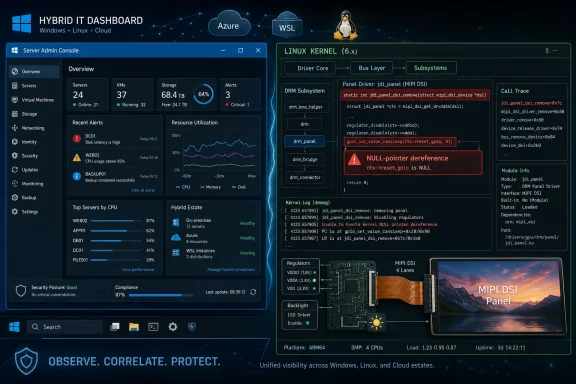
jdi_panel_dsi_remove(). It is not the kind of bug that will headline a ransomware briefing, but it is exactly the kind of low-level defect that reminds Windows administrators why Linux has become part of their patch surface. The flaw lives in display plumbing, not authentication, encryption, or network exposure, yet the path from “minor kernel crash” to “operational headache” is shorter than most dashboards admit. For WindowsForum readers, the story is less about one Japan Display panel driver and more about how modern Windows estates now inherit Linux risk through WSL, Azure images, appliances, developer workstations, and embedded fleets.
 A Small Kernel Bug Lands in a Much Larger Windows World
The official description of CVE-2026-43300 is almost aggressively unglamorous. In the Linux kernel’s Direct Rendering Manager panel code, jdi_panel_dsi_remove() checks whether a jdi pointer is NULL, but the old control flow could continue into jdi_panel_disable() and dereference that same missing object. The fix is the kind kernel maintainers have made thousands of times: if the pointer is NULL, return early instead of marching into code that assumes the structure exists.That sounds like housekeeping, and in a narrow sense it is. NULL-pointer dereferences are among the oldest classes of software bug, and in kernel space they often translate into denial of service rather than clean privilege escalation. The machine trips over a missing object, the kernel complains loudly, and the affected subsystem or whole system can crash depending on context.
But dismissing the CVE because it is “just” a NULL dereference misses the rhythm of contemporary infrastructure. Linux is no longer a separate continent from Windows administration. It is the substrate beneath containers, cloud images, security appliances, CI runners, Android-adjacent embedded devices, GPU-enabled edge systems, and the WSL instances that developers casually install on Windows laptops.
Microsoft’s appearance in this story is therefore not odd. MSRC increasingly functions as a clearinghouse for vulnerabilities that matter to customers even when the vulnerable code is not a classic Windows DLL. If a Linux kernel CVE can affect Microsoft-hosted services, Azure marketplace images, first-party distributions, or customer environments managed through Microsoft tooling, it belongs in the orbit of Windows security operations.
The Bug Is Boring Because the Kernel Is Supposed to Be Boring
The vulnerable logic is easy to understand because it violates an elementary rule. A function checksif (!jdi), which is programmer shorthand for “this pointer may not exist.” Yet after that check, execution can still flow into a call that takes &jdi->base, effectively treating the missing structure as if it were present.The deeper issue is not that one driver author forgot a return statement. The issue is that kernel code is dense with lifecycle assumptions. Devices appear, bind to drivers, fail during initialization, detach, suspend, resume, and disappear again; every one of those transitions must preserve invariants that are obvious only until hardware behaves badly.
Display drivers are especially rich in these edge cases. A panel driver may depend on a DSI host, regulators, backlights, GPIOs, firmware tables, and device tree properties. The remove path is supposed to unwind everything safely, including partially initialized state. If the driver’s private data was never attached, was cleared after a failed probe, or is otherwise unavailable, the cleanup path must not pretend otherwise.
That is what makes this patch important despite its small footprint. Removal code is often treated as the less exciting sibling of initialization code, but cleanup paths are where assumptions go to die. When the kernel tears down a device, it must be more defensive than when it brings one up, because it may be unwinding from a failure that already violated the happy path.
CVE Assignment Has Become a Patch-Queue Lens
The CVE’s publication date matters because it shows the increasingly formal pipeline between kernel fixes and enterprise vulnerability management. The underlying fix appears in stable kernel channels before many administrators ever see the CVE number. Then the CVE entry lands in NVD or vendor portals, scanners ingest it, and suddenly a tiny patch in a niche driver becomes a ticket with a severity placeholder.That inversion is now routine. In the open-source kernel world, the patch is often the first authoritative artifact. In enterprise IT, the CVE record is the moment the issue becomes legible to policy engines. A Linux maintainer may see a one-line early return; a compliance team sees an unscored vulnerability attached to a kernel package.
CVE-2026-43300 currently lacks an NVD-provided CVSS score in the material available at publication time. That absence is not a declaration of safety. It means enrichment has not caught up with the record, and administrators should resist the temptation to treat “N/A” as “negligible.”
The right reading is narrower. The public description points to a possible NULL-pointer dereference in a specific DRM panel driver, with no public claim of remote exploitation, privilege escalation, or data disclosure. That suggests limited blast radius, but not zero operational relevance.
The Affected Code Path Is Narrow, but Narrow Is Not the Same as Irrelevant
The driver named in the CVE is tied to a JDI MIPI DSI panel. That immediately narrows the field. Most rack servers, Windows desktops, and cloud VMs are not exercising this panel driver. A headless Azure Linux VM running a web service is unlikely to care whetherjdi_panel_dsi_remove() returns early.That is the good news. The less comforting news is that kernel exposure is not only about common hardware. Vulnerability scanners rarely understand hardware presence with perfect confidence, and kernel packages are shared across machines that may or may not load a specific driver. A fleet can be flagged for a vulnerability even when only a minority of devices can plausibly trigger it.
This is where sysadmins earn their keep. The practical question is not “Is the CVE real?” but “Is the vulnerable code reachable in our environment?” On traditional servers, the answer may be no. On ARM development boards, embedded Linux devices, tablets, kiosks, custom displays, lab hardware, or vendor appliances, the answer deserves more care.
Windows shops increasingly have those systems even when they do not think of themselves as Linux shops. A Windows-first enterprise may use Linux-based meeting-room controllers, digital signage, security gateways, IoT management boxes, or build machines maintained by a different team. Those systems often sit outside the neat mental boundary of “Windows patching,” but they still generate outage risk.
MSRC’s Role Signals Customer Exposure, Not Microsoft Ownership
The source link supplied through Microsoft’s Security Update Guide may confuse readers expecting a Windows vulnerability. CVE-2026-43300 is not described as a flaw in Windows, nor is the vulnerable function part of the NT kernel. The code belongs to the Linux kernel’s DRM panel subsystem.Microsoft’s involvement should be read as ecosystem visibility. The company ships, hosts, supports, or integrates Linux in enough places that Linux CVEs can enter Microsoft-facing guidance. Azure, WSL, Azure Kubernetes Service, Defender for Cloud, Azure Linux, marketplace images, and customer-managed Linux workloads all make the old “Microsoft equals Windows” assumption obsolete.
That does not mean every Linux kernel CVE becomes a Windows emergency. It does mean Windows administrators who also own Microsoft cloud security dashboards will increasingly see Linux kernel records in their queue. The first discipline is triage: separate what affects Windows endpoints from what affects Linux workloads managed inside a Microsoft estate.
For WindowsForum’s audience, the useful takeaway is cultural as much as technical. Microsoft’s security documentation is no longer a purely Windows patch bulletin. It is part of a broader vulnerability-management interface for hybrid infrastructure. If your team’s only response to an MSRC-linked CVE is “but we don’t run Linux,” you may be right — or you may be overlooking where Linux has quietly become operationally critical.
NULL Dereferences Usually Crash Systems, and Crashes Still Matter
Security teams often rank vulnerabilities by attacker value. Remote code execution is king, privilege escalation is serious, information disclosure varies by context, and denial of service is sometimes treated as the low end of the scale. NULL-pointer dereferences often land in that last bucket.That ranking makes sense for exploit prioritization, but it can understate operational risk. A kernel crash on a kiosk, control panel, embedded display, or developer board can still be disruptive. If the crash is triggerable through device removal, hotplug behavior, driver unbinding, shutdown, suspend, or a failed initialization path, it may show up as an unreliable device rather than a neatly labeled security incident.
There is also a forensic asymmetry. When a network service crashes, logs may point to the request. When a kernel driver dereferences NULL during teardown, the symptom may be a panic, a frozen display, a failed reboot, or a stack trace that only kernel developers enjoy reading. The business sees downtime; the security team sees a CVE; the platform team sees a driver bug.
That is why these vulnerabilities are worth patching even when they are not worth panicking over. Stability and security share a border in kernel space. A bug that makes the kernel unsafe under weird lifecycle conditions is a bug that reduces trust in the system, even if no one is using it to break into a network.
The Display Stack Is a Strange Place for Enterprise Risk to Hide
The Linux DRM subsystem has become a large and sophisticated part of the kernel because modern graphics are complicated. It is not just about drawing pixels. DRM coordinates modesetting, panels, bridges, connectors, backlights, GPU memory, hotplug events, and increasingly complex device topologies.Panel drivers, in particular, are easy to underestimate. They are often small files compared with GPU drivers, and they may serve specific pieces of hardware. But they sit at a delicate interface between platform description and electrical reality. If the kernel thinks a panel exists, a regulator is enabled, a backlight is present, or a DSI link has been attached, the cleanup path must unwind that belief precisely.
CVE-2026-43300 sits in that territory. The named function is not a glamorous attack surface. It is a remove handler — code called when the driver is being detached from the device. But remove handlers matter because the kernel must survive not only ideal hardware, but also failed probes, partial initialization, driver reloads, suspend/resume oddities, and board-specific quirks.
For enterprise Windows administrators, this may feel distant until the device is a Linux-based appliance mounted behind a conference-room screen, a factory terminal, or an ARM board in a QA lab. Display code is not only for consumer laptops. It exists anywhere Linux has to light up a panel.
The Patch Teaches an Old Lesson About Error Paths
The fix described in the CVE is conceptually simple: whenjdi is NULL, detach the DSI device and return early. That change aligns the code with what its own guard condition already implied. If the driver data is missing, the function should not call into disable logic that expects valid panel state.This is classic defensive kernel programming. When code checks an error condition, it must either handle it fully or stop. A check that logs, detaches, or performs one cleanup action but then falls through into normal logic is often worse than no check at all, because it gives readers false confidence.
The awkwardness is that such bugs can survive review precisely because the code looks careful. A reviewer sees the NULL check and may mentally mark the edge case as handled. Only a closer read reveals that the check does not actually change the control flow enough.
That makes CVE-2026-43300 a good example of why static analysis, fuzzing, and patch review continue to find value in mature codebases. The Linux kernel is heavily reviewed, widely tested, and maintained by some of the best systems programmers in the world. It still contains ordinary mistakes because ordinary mistakes are what large C programs produce.
The Windows Angle Is WSL, Cloud, and the Patch Dashboard
On a conventional Windows 11 laptop using WSL, this specific panel driver is unlikely to be the most relevant Linux kernel risk. WSL abstracts much of the hardware environment, and its kernel is managed through Microsoft’s distribution path rather than a generic distro kernel installed on bare metal. A display panel remove handler for JDI hardware is not the scenario most WSL users should lose sleep over.But WSL is still part of the broader point. Windows users now run Linux kernels as a matter of routine. Developers may have Ubuntu, Debian, Kali, or custom containers on machines governed by Windows endpoint policy. Security products then surface Linux package and kernel findings beside Windows findings, often without enough explanation for non-Linux specialists.
Cloud makes the overlap more pronounced. Azure customers may run Linux VMs, container hosts, Kubernetes nodes, and appliances while managing them through Microsoft-native portals and policy engines. A Linux kernel CVE can therefore arrive through Microsoft tooling even if remediation happens through
apt, dnf, zypper, vendor firmware, or a managed image update.The key for administrators is to avoid category errors. Do not patch Windows because this CVE exists. Do not ignore Linux because the link came from Microsoft. Map the CVE to the systems that actually run affected kernel builds and then ask whether the affected driver can load in those systems.
Scanners Will Overreport Before They Understand Reachability
Vulnerability scanners are good at finding package versions and less good at modeling kernel hardware reachability. If a distribution kernel includes the affected source, a scanner may flag the machine even if the module is never loaded and the hardware does not exist. This is not scanner incompetence; it is the inevitable result of trying to reduce kernel complexity to asset inventory.The danger is not overreporting by itself. The danger is what overreporting does to attention. If every niche kernel fix becomes an urgent red item, administrators tune out. If every low-score or unscored item is dismissed, teams miss the occasional obscure bug that matters to their environment.
CVE-2026-43300 belongs in the middle. It should be triaged quickly, not escalated theatrically. The first question is whether affected Linux kernels are present. The second is whether the vulnerable panel driver is built, loaded, or relevant to deployed hardware. The third is whether a vendor has already shipped a stable kernel update that includes the fix.
For many organizations, the answer will be mundane: update through the normal Linux kernel maintenance channel and document why the operational risk is low. For embedded vendors or device teams, the answer may be more involved because kernel updates are tied to board support packages, regulatory validation, or appliance firmware releases.
Embedded and Appliance Vendors Have the Harder Problem
General-purpose Linux distributions are built for patch flow. A kernel stable update lands, maintainers build packages, users reboot, and life continues. Embedded systems rarely enjoy that simplicity. They run vendor kernels, long-term support branches, board-specific patches, and sometimes ancient device trees that no one wants to touch.That is where a small driver bug can linger. If the affected JDI panel driver is present in a vendor tree, the one-line fix may be easy to backport. But deploying it may require a full firmware release, QA pass, signed image, field update mechanism, and customer scheduling. The code change is tiny; the delivery chain is not.
Device makers should resist the temptation to bury such fixes because the CVE seems minor. A NULL dereference in a remove path may not be a marquee exploit, but it is a marker of lifecycle fragility. If a panel driver can crash during teardown, users may encounter it during updates, resets, service procedures, or hardware faults.
For customers buying Linux-based appliances, the lesson is familiar: demand vendor clarity. Ask whether the appliance includes the affected driver or kernel branch, whether a patched build is planned, and whether the vendor’s vulnerability statement distinguishes reachable code from bundled code. A generic “not affected” without reasoning is less useful than a narrower answer that explains the hardware path.
Stable Kernel Backports Are the Real Remediation Signal
The CVE record lists multiple stable kernel commit references, which indicates the fix has been carried across supported branches rather than left only in upstream development. That matters more than the CVE prose. In kernel security, remediation is usually not a standalone patch file applied by administrators; it is a distribution or vendor kernel update that quietly includes dozens or hundreds of fixes.Administrators should therefore look for their vendor’s kernel package, not merely the upstream commit hash. Ubuntu, Debian, Fedora, Red Hat, SUSE, Arch, Alpine, Android-derived vendors, appliance makers, and cloud image publishers each have their own path from upstream stable to customer systems. The same CVE may be fixed under different package versions depending on branch and backport policy.
This also complicates version-based assumptions. A kernel reporting an older major version may still contain the fix if the vendor backported it. A newer-looking custom kernel may still lack it if the vendor did not pull the stable change. Kernel version strings are clues, not verdicts.
The cleanest operational evidence is vendor advisory plus package changelog plus rebooted runtime kernel. Installing the package is not enough if the host continues running the old kernel until the next maintenance window. That is an old Linux truth that Windows admins who live in cumulative-update land sometimes rediscover painfully.
The Absence of a CVSS Score Should Slow the Panic, Not the Process
At publication, NVD had not assigned CVSS 4.0, 3.x, or 2.0 metrics in the supplied record. That leaves security tools and teams in an awkward state. Some dashboards treat unscored vulnerabilities as informational; others inflate them until enrichment arrives; still others inherit vendor or third-party scores that may not match the official record later.A reasonable qualitative severity for this issue is constrained by the public facts. The flaw is a possible NULL-pointer dereference in a specific Linux DRM panel driver remove path. There is no public indication in the supplied material of remote attack, credential theft, sandbox escape, or arbitrary code execution.
That does not make it meaningless. Local denial of service, crash-on-remove conditions, or device-triggered instability can matter on systems where availability is the security property. Kiosks, industrial panels, thin clients, and field devices often care less about elegant exploit chains than about whether they keep running.
Security teams should document the rationale rather than wait passively for a number. If your environment lacks the hardware and driver, say so. If it includes devices that may use the panel, prioritize the vendor fix. If you cannot determine reachability, patch through routine kernel maintenance and avoid inventing an emergency where the evidence does not support one.
Linux CVEs Are Now Part of Windows Operational Literacy
There was a time when a Windows administrator could plausibly treat Linux kernel internals as someone else’s problem. That time is over in many organizations. The boundary has been eroded by cloud adoption, DevOps tooling, containers, hybrid identity, endpoint development environments, and Microsoft’s own embrace of Linux where customers demanded it.This does not mean every Windows admin must become a kernel maintainer. It does mean the first-pass vocabulary has to improve. Terms like DRM, MIPI DSI, panel driver, NULL-pointer dereference, stable backport, and runtime kernel are no longer exotic when they appear in Microsoft-adjacent security workflows.
The bigger institutional shift is ownership. If a Linux CVE appears in a Microsoft dashboard, who triages it? The Windows endpoint team? The cloud platform team? The Linux engineering group? The security operations center? Without a clear answer, minor CVEs become noisy and serious ones become slow.
CVE-2026-43300 is useful precisely because it is not dramatic. It gives teams a low-stakes opportunity to test their process. Can they identify Linux assets? Can they distinguish Windows exposure from Linux exposure? Can they tell whether a kernel driver is reachable? Can they confirm a patched kernel is actually running after reboot?
The Practical Read Is Patch Normally and Triage Specifically
The most defensible response to CVE-2026-43300 is neither alarm nor indifference. Treat it as a kernel stability and denial-of-service class issue with narrow hardware relevance, then let asset context decide urgency. The fix exists; the challenge is making sure the right systems receive it through the right channel.For mainstream servers and cloud workloads, this likely folds into normal kernel update cadence unless vendor guidance says otherwise. For embedded devices, ARM boards, display-equipped appliances, and environments using JDI MIPI DSI panels, it deserves more direct attention. For Windows-only endpoints, it is mostly a reminder to check whether “Windows-only” is still an accurate description.
The administrator’s job is to convert the CVE from a generic identifier into an environmental fact. That means looking beyond the headline and asking what code is present, what hardware is present, and what vendor update path applies. A small kernel bug becomes manageable once it is mapped to real systems.
The JDI Panel Fix Is a Test of Hybrid Patch Discipline
This CVE does not demand a war room, but it does reward disciplined hygiene.- Organizations should identify whether any managed Linux systems run kernels that include the affected DRM panel driver.
- Teams should prioritize vendor kernel updates over manually applying upstream commits unless they maintain their own kernel builds.
- Administrators should remember that installing a fixed kernel package does not remediate a running host until it boots into that fixed kernel.
- Windows-focused teams should check whether Microsoft security tooling is surfacing Linux findings from Azure, WSL, containers, or appliances rather than assuming a Windows vulnerability.
- Embedded and appliance owners should ask vendors whether the affected driver is present and reachable on their hardware, not merely whether the CVE appears in a bundled source tree.
- Security teams should document why the issue is low priority where the relevant hardware is absent, instead of relying on the temporary absence of an NVD score.
Source: NVD / Linux Kernel Security Update Guide - Microsoft Security Response Center
