

CVE-2026-43503 is a Linux kernel networking vulnerability published by NVD on May 23, 2026, in which socket-buffer fragment-transfer paths failed to preserve the
The Linux networking stack is built around
But optimization turns into liability when reference metadata falls out of sync with reality. CVE-2026-43503 is about exactly that mismatch. Several skb helper paths moved fragment descriptors from one skb to another without also carrying over the flag that says those fragments are shared or externally backed.
That flag matters because later code asks a simple question before writing into packet data: is this memory safe to modify in place? If
This is the kind of bug that looks small in a diff and enormous in a threat model. The destination skb did not become dangerous because it contained malicious data; it became dangerous because it contained honest page references with a dishonest label.
The original omission was in fragment-transfer helpers: the destination skb received fragment descriptors, but not the
The scope then widened. The updated CVE text points to similar omissions in GRO receive paths, list receive paths, TCP MTU probing, and segmentation. These are the places where the network stack tries to be clever for very good reasons. Generic Receive Offload, for example, reduces overhead by combining packets before they climb higher in the stack; segmentation later breaks larger buffers back down for transmission.
Every one of those transformations depends on metadata discipline. A page fragment that was unsafe to write before coalescing remains unsafe after coalescing. A fragment pulled from a frag list into a new segment remains shared if the original was shared. The CPU cost of preserving that truth is tiny; the cost of forgetting it can be root-owned file cache corruption.
That is why the shared-fragment marker matters. If ESP input sees a nonlinear skb and believes its fragments are private, it may decrypt or authenticate in place. If the fragments actually point to shared or page-cache-backed memory, an operation that was supposed to modify packet data can instead modify memory associated with a file.
The reported trigger chain is particularly uncomfortable: a single nftables
The reference to
Security work often proceeds in layers. The first patch blocks the most visible path. The second patch finds a neighboring helper with the same assumption. The third patch discovers that an optimization in a different subsystem reintroduced the same state mismatch. That pattern is not evidence of incompetence; it is evidence that a vulnerability class has been discovered.
The risk for defenders is treating each CVE as a separate small fire. In reality, shared-fragment handling is a design surface. Once user-controlled data can become page-backed skb fragments, every later path that writes into an skb must either trust exact metadata or force a copy. CVE-2026-43503 shows that the metadata route is brittle when many helpers independently reshape packets.
That is why this bug should not be dismissed because NVD had not yet assigned a CVSS score at the time of the record. The absence of an NVD score is not the absence of impact. It means enrichment lagged behind kernel.org’s advisory text, while the technical description already laid out a plausible path to writing into page cache associated with a root-owned read-only file.
WSL is the obvious case. Windows Subsystem for Linux relies on a real Linux kernel in WSL 2, serviced through Microsoft’s update channels rather than a traditional distro kernel package. A vulnerability in the Linux kernel is therefore not automatically irrelevant on a Windows workstation, though exploitability depends on whether the affected kernel version, configuration, namespaces, networking features, and reachable code paths exist in that environment.
Then there are containers. A Windows developer laptop may build Linux containers all day. A CI runner may be Windows-managed but Linux-executing. Azure Kubernetes nodes, network appliances, security gateways, VPN concentrators, storage boxes, and embedded management controllers may all depend on Linux kernels whose patch cadence is invisible to the person who thinks of the environment as “mostly Windows.”
The practical lesson is that OS boundaries no longer map cleanly to operational boundaries. A Windows shop can carry Linux kernel risk through developer tooling, virtualization stacks, appliances, edge devices, and cloud workloads. CVE-2026-43503 is not a reason to panic about every Windows endpoint; it is a reason to inventory where Linux networking code is actually running.
That makes it a metadata integrity issue. The page is not merely bytes; it has provenance. It may have come from a pipe, a socket, a splice operation, a page cache mapping, or another skb. Whether the kernel may write into it depends not only on address validity but on ownership and sharing state.
This is where performance and security collide. Zero-copy and copy-avoidance features exist because modern workloads cannot afford to copy every buffer at every boundary. But once the kernel relies on shared references, the metadata describing those references becomes as critical as bounds checks. A missing flag can be functionally equivalent to a missing permission check.
The Linux kernel has long used copy-on-write concepts to manage this tension. If a writer sees shared data, it detours through a copy path such as
Each helper has slightly different rules. Some move descriptors directly. Some build a new skb. Some chain an incoming skb onto a frag list. Some linearize data into fresh head storage and therefore do not need the marker because no paged frags survive. Some segment one skb into many and must merge flags from both a head skb and later frag-list members.
That variety is exactly why the bug class is sticky. A human reviewer can inspect one helper and say, “yes, this path propagates the flag.” But another helper that looks similar may copy only GSO metadata, or may change which skb becomes the source of fragments halfway through a loop. The code is not just moving data; it is moving data through a state machine of packet shapes.
The CVE text’s careful distinction around
Kernel CVEs routinely expose the weakness of score-first triage. A bug can have no final NVD score and still carry a credible local privilege escalation path. Another bug can score high but be unreachable in a given deployment because the subsystem is disabled, the module is absent, or the attacker lacks a prerequisite capability. The score is an input, not a substitute for engineering judgment.
For CVE-2026-43503, the engineering signal is strong enough to act on before enrichment. The affected area is kernel networking; the described impact includes page-cache writes to root-owned read-only files under specific conditions; and stable kernel references were added as the record changed. That is more actionable than waiting for a number.
Enterprise defenders should treat “awaiting enrichment” as a workflow state, not a risk state. Patch priority should be driven by kernel exposure, use of IPsec/ESP and netfilter duplication features, local user access, container density, and whether untrusted users can run code on the host. In multi-user Linux systems, container hosts, VPN gateways, and developer machines, those conditions deserve attention.
A hardened server with minimal local users and no relevant IPsec path may face a different risk profile from a shared research machine, container host, or VPN endpoint. A desktop running untrusted local applications faces a different profile again. The vulnerability is local in character as described, but local privilege escalation remains a high-value class because attackers often arrive first as a low-privilege user, a compromised service account, or code running inside a container boundary.
Container environments deserve special mention. Container escape narratives are often oversold, but Linux kernel vulnerabilities are the layer where container isolation becomes real or illusory. If an attacker can reach a vulnerable kernel primitive from inside a container, namespace separation may not save the host. Whether CVE-2026-43503 is reachable from a particular container setup is a configuration question, but it is exactly the kind of question platform teams should ask.
The same goes for appliances. Many security and networking products expose polished management UIs while hiding ordinary Linux kernels underneath. Their vendors may backport fixes without changing visible version numbers, or they may lag behind upstream. Admins should not assume that because a device is “not a general-purpose server,” a kernel skb bug is irrelevant.
That simplicity is deceptive. The invariant is easy to state: if an skb contains shared frags, its metadata must say so. The hard part is ensuring that every helper preserving references also preserves the marker. Kernel fast paths accrete over years, and the same conceptual operation may be implemented through several code paths for performance, layout, or legacy reasons.
This is also why backports matter. A fix in the latest mainline kernel is not enough for the real world, where enterprise distributions, long-term support kernels, Android-derived kernels, appliance kernels, and cloud vendor kernels all carry their own patch stacks. Stable commit references in the CVE record are the beginning of remediation, not the end.
For admins, the operational answer is boring and correct: install the kernel updates from your distribution or vendor as they become available, then reboot into the fixed kernel. Live patching may eventually cover some deployments, but networking and skb internals are not an area where teams should assume a live patch exists or covers all relevant paths unless the vendor explicitly says so.
Reducing exposure can still help. Systems that do not need IPsec should avoid loading or enabling unnecessary IPsec paths. Hosts that do not need nftables duplication, TEE-style packet mirroring, or unusual local packet reflection rules should not carry them casually. Container hosts should minimize unprivileged access to networking features and keep user namespaces, capabilities, and module-loading policy under review.
But mitigation should be framed honestly. Disabling one packet path may reduce one known trigger while leaving another theoretical or later-discovered path. The whole point of this CVE is that the bug is not one command-line feature; it is an invariant violation across skb transformations. The durable fix is corrected kernel code.
For Windows-centric teams running WSL, the mitigation story is different. Users should ensure WSL’s kernel is updated through Microsoft’s servicing path and avoid assuming that the Linux distribution inside WSL controls the kernel. Updating Ubuntu, Debian, Fedora, or another WSL userland package set does not necessarily update the WSL kernel itself. The kernel boundary sits below the distro.
Developer workstations are one category. WSL 2 instances, Docker Desktop backends, local Kubernetes clusters, and embedded build environments all complicate the old endpoint model. If a developer can run arbitrary Linux workloads on a Windows-managed laptop, then the Linux kernel servicing path belongs in endpoint security discussions.
Cloud and edge systems are another. VPN gateways, Kubernetes nodes, service mesh sidecars, observability agents, packet brokers, storage nodes, and ingress controllers may all encounter network paths where skb behavior matters. The business owner may think of these as applications, but the risk lives in the host kernel.
Security teams should also pressure vendors for specificity. “Not affected” is useful only if the vendor explains the kernel branch, backport status, and relevant configuration. “Fixed in latest firmware” is better, but still requires deployment. Appliances are notorious for turning kernel CVEs into procurement and maintenance problems rather than simple package updates.
A scanner result from May 23 may not tell the same story as the record on May 26. A distro advisory may split or combine the affected fixes differently. A vendor kernel may carry one patch but not another. Treating CVE text as static is a mistake, especially during the first week of disclosure.
This is where mature patch management separates itself from checkbox compliance. Teams need a way to correlate CVE records, upstream stable commits, distribution advisories, and the kernels actually booted in production. The
It is also worth watching for regressions. Networking fast-path fixes can be delicate, and changes in GRO, segmentation, or skb copying can affect performance and corner-case behavior. That is not an argument against patching; it is an argument for staging updates intelligently on high-throughput network systems while still moving quickly.
The useful question is narrower: can an untrusted actor on this system cause the kernel to process shared skb fragments through one of the affected paths and then reach an in-place writer that assumes those fragments are private? Most administrators will not answer that by reading kernel source. They will answer it by reducing exposure, applying vendor kernels, and prioritizing systems where untrusted local code and complex networking meet.
For many enterprise fleets, that points first to multi-user Linux servers, container hosts, VPN/IPsec endpoints, developer systems with WSL or local containers, and appliances that process mirrored or duplicated traffic. It points less urgently to locked-down single-purpose Linux systems with no local untrusted execution and a narrow network role, though those systems still need routine kernel maintenance.
The article-worthy part of CVE-2026-43503 is not that one bit was missed. It is that one bit encoded the boundary between “safe to write here” and “copy first.” In a kernel optimized to avoid copies, that boundary is one of the most important security controls left.
SKBFL_SHARED_FRAG marker, allowing later in-place writers to treat shared page-backed memory as private. The bug is not a Windows vulnerability, but it matters to WindowsForum readers because Linux now sits under WSL, containers, appliances, hypervisors, VPN gateways, and a large share of enterprise infrastructure. Its real lesson is less about one obscure flag than about what happens when modern kernels optimize data movement so aggressively that metadata becomes a security boundary. When the kernel forgets what memory is shared, the attacker does not need to break memory protection; the attacker only needs the kernel to mislabel it.
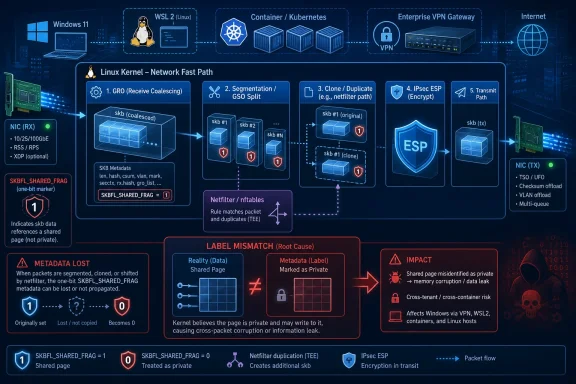 A One-Bit Bug With Page-Cache Consequences
The Linux networking stack is built around sk_buff, usually shortened to skb, the data structure that carries packets through the kernel. An skb can contain packet data in a linear head area, but it can also reference page fragments rather than copying every byte. That design is the difference between a high-throughput kernel and a slow one: if the kernel can move references to pages instead of copying page contents, network receive, transmit, tunneling, encryption, segmentation, and coalescing become dramatically cheaper.But optimization turns into liability when reference metadata falls out of sync with reality. CVE-2026-43503 is about exactly that mismatch. Several skb helper paths moved fragment descriptors from one skb to another without also carrying over the flag that says those fragments are shared or externally backed.
That flag matters because later code asks a simple question before writing into packet data: is this memory safe to modify in place? If
skb_has_shared_frag() says no shared fragment exists, a writer can avoid copying and alter the pages directly. If the pages are actually shared with file-backed page cache or another owner, that write can land somewhere the writer never should have reached.This is the kind of bug that looks small in a diff and enormous in a threat model. The destination skb did not become dangerous because it contained malicious data; it became dangerous because it contained honest page references with a dishonest label.
The Kernel’s Fast Path Became the Attack Surface
The vulnerable paths named in the CVE description are not exotic debugging leftovers. They sit in the performance-sensitive plumbing that makes Linux networking scale. Helpers such as__pskb_copy_fclone() and skb_shift() exist because packet data is constantly split, cloned, trimmed, shifted, coalesced, segmented, and routed through subsystems that want slightly different shapes of the same bytes.The original omission was in fragment-transfer helpers: the destination skb received fragment descriptors, but not the
SKBFL_SHARED_FRAG bit from skb_shinfo()->flags. In plain English, the packet still pointed at the same externally owned or page-cache-backed pages, but the new wrapper forgot to say so. That is a classic invariant failure: the data moved, the warning label did not.The scope then widened. The updated CVE text points to similar omissions in GRO receive paths, list receive paths, TCP MTU probing, and segmentation. These are the places where the network stack tries to be clever for very good reasons. Generic Receive Offload, for example, reduces overhead by combining packets before they climb higher in the stack; segmentation later breaks larger buffers back down for transmission.
Every one of those transformations depends on metadata discipline. A page fragment that was unsafe to write before coalescing remains unsafe after coalescing. A fragment pulled from a frag list into a new segment remains shared if the original was shared. The CPU cost of preserving that truth is tiny; the cost of forgetting it can be root-owned file cache corruption.
ESP Is Where the Abstraction Leaks
The CVE description calls out ESP input in both IPv4 and IPv6 as one concrete in-place writer affected by the mismatch. ESP, the Encapsulating Security Payload portion of IPsec, handles encrypted packet payloads. Like much kernel crypto and networking code, it wants to avoid unnecessary copies because copying is expensive and packet paths are hot.That is why the shared-fragment marker matters. If ESP input sees a nonlinear skb and believes its fragments are private, it may decrypt or authenticate in place. If the fragments actually point to shared or page-cache-backed memory, an operation that was supposed to modify packet data can instead modify memory associated with a file.
The reported trigger chain is particularly uncomfortable: a single nftables
dup to <local> rule, or another caller using nf_dup_ipv4() or xt_TEE, can create the copied skb shape that strips the marker before ESP input sees it. That does not make exploitation automatic on every Linux box. It does mean the vulnerable primitive crosses subsystem boundaries: netfilter duplication, skb copying, ESP processing, and page-cache-backed fragments all line up.The reference to
authencesn-ESN stray writes is a reminder that cryptographic packet handling is not only about confidentiality and authentication. Kernel crypto code is still memory-writing code. If it is handed a buffer that lies about ownership, it can faithfully perform its job in the wrong place.Dirty Frag Was a Warning, Not a Closed Chapter
The timing of CVE-2026-43503 places it in the aftermath of the so-called Dirty Frag discussion, where Linux page-cache write primitives involving shared skb fragments drew public attention. Earlier CVEs in that cluster described ways that shared page fragments could be written through networking paths that should have copied or detached them first. CVE-2026-43503 reads like a follow-on hardening and correctness fix, but it is more than housekeeping.Security work often proceeds in layers. The first patch blocks the most visible path. The second patch finds a neighboring helper with the same assumption. The third patch discovers that an optimization in a different subsystem reintroduced the same state mismatch. That pattern is not evidence of incompetence; it is evidence that a vulnerability class has been discovered.
The risk for defenders is treating each CVE as a separate small fire. In reality, shared-fragment handling is a design surface. Once user-controlled data can become page-backed skb fragments, every later path that writes into an skb must either trust exact metadata or force a copy. CVE-2026-43503 shows that the metadata route is brittle when many helpers independently reshape packets.
That is why this bug should not be dismissed because NVD had not yet assigned a CVSS score at the time of the record. The absence of an NVD score is not the absence of impact. It means enrichment lagged behind kernel.org’s advisory text, while the technical description already laid out a plausible path to writing into page cache associated with a root-owned read-only file.
The Windows Angle Is Infrastructure, Not Brand Loyalty
For a Windows audience, the temptation is to file this under “Linux problem” and move on. That would be too narrow. The modern Windows estate is full of Linux, even when the endpoints run Windows 11 and the admins live in Microsoft Intune, Defender, Azure, and PowerShell.WSL is the obvious case. Windows Subsystem for Linux relies on a real Linux kernel in WSL 2, serviced through Microsoft’s update channels rather than a traditional distro kernel package. A vulnerability in the Linux kernel is therefore not automatically irrelevant on a Windows workstation, though exploitability depends on whether the affected kernel version, configuration, namespaces, networking features, and reachable code paths exist in that environment.
Then there are containers. A Windows developer laptop may build Linux containers all day. A CI runner may be Windows-managed but Linux-executing. Azure Kubernetes nodes, network appliances, security gateways, VPN concentrators, storage boxes, and embedded management controllers may all depend on Linux kernels whose patch cadence is invisible to the person who thinks of the environment as “mostly Windows.”
The practical lesson is that OS boundaries no longer map cleanly to operational boundaries. A Windows shop can carry Linux kernel risk through developer tooling, virtualization stacks, appliances, edge devices, and cloud workloads. CVE-2026-43503 is not a reason to panic about every Windows endpoint; it is a reason to inventory where Linux networking code is actually running.
Metadata Is Now Part of Memory Safety
Traditional memory-safety bugs are easy to explain: a buffer overflows, a pointer dangles, a use-after-free gives an attacker control. CVE-2026-43503 is subtler. The memory may still be valid. The pointer may still point to a real page. The bug is that the kernel loses the semantic fact that the page is shared.That makes it a metadata integrity issue. The page is not merely bytes; it has provenance. It may have come from a pipe, a socket, a splice operation, a page cache mapping, or another skb. Whether the kernel may write into it depends not only on address validity but on ownership and sharing state.
This is where performance and security collide. Zero-copy and copy-avoidance features exist because modern workloads cannot afford to copy every buffer at every boundary. But once the kernel relies on shared references, the metadata describing those references becomes as critical as bounds checks. A missing flag can be functionally equivalent to a missing permission check.
The Linux kernel has long used copy-on-write concepts to manage this tension. If a writer sees shared data, it detours through a copy path such as
skb_cow_data() before modifying contents. CVE-2026-43503 is dangerous because it can hide shared data from that decision point. The copy-on-write defense still exists; the attacker’s opportunity is to make the kernel skip it.Fragment Transfer Is a Hard Place to Police
The updated CVE description is notable for how many helpers it names. This is not just__pskb_copy_fclone() and skb_shift(). It also calls out skb_gro_receive(), skb_gro_receive_list(), tcp_clone_payload(), and skb_segment(). That breadth tells us something important about kernel maintenance: correctness here is not centralized in one neat abstraction.Each helper has slightly different rules. Some move descriptors directly. Some build a new skb. Some chain an incoming skb onto a frag list. Some linearize data into fresh head storage and therefore do not need the marker because no paged frags survive. Some segment one skb into many and must merge flags from both a head skb and later frag-list members.
That variety is exactly why the bug class is sticky. A human reviewer can inspect one helper and say, “yes, this path propagates the flag.” But another helper that looks similar may copy only GSO metadata, or may change which skb becomes the source of fragments halfway through a loop. The code is not just moving data; it is moving data through a state machine of packet shapes.
The CVE text’s careful distinction around
skb_copy() and skb_copy_expand() is also telling. Those helpers share skb_copy_header(), but because they linearize all paged data into fresh head storage and emerge with nr_frags == 0, skb_has_shared_frag() returning false is correct. That is not a contradiction. It is the difference between copying bytes and transferring references.Scoring Lag Should Not Become Patch Lag
At the time described by the NVD record, NIST had not provided CVSS 4.0, 3.x, or 2.0 vector strings. In many organizations, that creates a dangerous pause. Vulnerability management systems are often tuned around severity labels, and “N/A” can be misread as “not important yet.”Kernel CVEs routinely expose the weakness of score-first triage. A bug can have no final NVD score and still carry a credible local privilege escalation path. Another bug can score high but be unreachable in a given deployment because the subsystem is disabled, the module is absent, or the attacker lacks a prerequisite capability. The score is an input, not a substitute for engineering judgment.
For CVE-2026-43503, the engineering signal is strong enough to act on before enrichment. The affected area is kernel networking; the described impact includes page-cache writes to root-owned read-only files under specific conditions; and stable kernel references were added as the record changed. That is more actionable than waiting for a number.
Enterprise defenders should treat “awaiting enrichment” as a workflow state, not a risk state. Patch priority should be driven by kernel exposure, use of IPsec/ESP and netfilter duplication features, local user access, container density, and whether untrusted users can run code on the host. In multi-user Linux systems, container hosts, VPN gateways, and developer machines, those conditions deserve attention.
Exploitability Lives in Configuration Details
The CVE description is explicit about one possible path, but it does not mean every Linux installation can be exploited in the same way. Kernel exploitation depends on enabled features, loaded modules, namespace policy, packet paths, nftables or iptables rules, IPsec configuration, and whether unprivileged users can arrange the necessary skb shapes. That complexity should make admins cautious, not complacent.A hardened server with minimal local users and no relevant IPsec path may face a different risk profile from a shared research machine, container host, or VPN endpoint. A desktop running untrusted local applications faces a different profile again. The vulnerability is local in character as described, but local privilege escalation remains a high-value class because attackers often arrive first as a low-privilege user, a compromised service account, or code running inside a container boundary.
Container environments deserve special mention. Container escape narratives are often oversold, but Linux kernel vulnerabilities are the layer where container isolation becomes real or illusory. If an attacker can reach a vulnerable kernel primitive from inside a container, namespace separation may not save the host. Whether CVE-2026-43503 is reachable from a particular container setup is a configuration question, but it is exactly the kind of question platform teams should ask.
The same goes for appliances. Many security and networking products expose polished management UIs while hiding ordinary Linux kernels underneath. Their vendors may backport fixes without changing visible version numbers, or they may lag behind upstream. Admins should not assume that because a device is “not a general-purpose server,” a kernel skb bug is irrelevant.
The Patch Is Conceptually Simple Because the Invariant Is Simple
The fix described in the CVE is not a grand redesign. It setsSKBFL_SHARED_FRAG on the destination whenever fragment descriptors are actually moved from a source that carries the marker. In segmentation paths, it folds the relevant flag from the skb currently supplying fragments. In GRO list paths, both the accumulator and chained skb need to preserve the truth.That simplicity is deceptive. The invariant is easy to state: if an skb contains shared frags, its metadata must say so. The hard part is ensuring that every helper preserving references also preserves the marker. Kernel fast paths accrete over years, and the same conceptual operation may be implemented through several code paths for performance, layout, or legacy reasons.
This is also why backports matter. A fix in the latest mainline kernel is not enough for the real world, where enterprise distributions, long-term support kernels, Android-derived kernels, appliance kernels, and cloud vendor kernels all carry their own patch stacks. Stable commit references in the CVE record are the beginning of remediation, not the end.
For admins, the operational answer is boring and correct: install the kernel updates from your distribution or vendor as they become available, then reboot into the fixed kernel. Live patching may eventually cover some deployments, but networking and skb internals are not an area where teams should assume a live patch exists or covers all relevant paths unless the vendor explicitly says so.
Mitigation Is a Narrow Bridge, Not a Destination
When kernel patches are not immediately available, teams look for mitigations. That instinct is reasonable, but CVE-2026-43503 does not lend itself to one clean universal toggle. The described path involves skb fragment metadata, ESP input, and packet duplication mechanisms, but the broader issue includes multiple frag-transfer helpers and future consumers that might rely on the same marker.Reducing exposure can still help. Systems that do not need IPsec should avoid loading or enabling unnecessary IPsec paths. Hosts that do not need nftables duplication, TEE-style packet mirroring, or unusual local packet reflection rules should not carry them casually. Container hosts should minimize unprivileged access to networking features and keep user namespaces, capabilities, and module-loading policy under review.
But mitigation should be framed honestly. Disabling one packet path may reduce one known trigger while leaving another theoretical or later-discovered path. The whole point of this CVE is that the bug is not one command-line feature; it is an invariant violation across skb transformations. The durable fix is corrected kernel code.
For Windows-centric teams running WSL, the mitigation story is different. Users should ensure WSL’s kernel is updated through Microsoft’s servicing path and avoid assuming that the Linux distribution inside WSL controls the kernel. Updating Ubuntu, Debian, Fedora, or another WSL userland package set does not necessarily update the WSL kernel itself. The kernel boundary sits below the distro.
The Administrator’s Job Is to Find the Hidden Linux
The best immediate response to CVE-2026-43503 is inventory. Not vulnerability-scanner inventory in the abstract, but a concrete map of Linux kernels that process untrusted traffic or run untrusted code. Many organizations will find more of them than expected.Developer workstations are one category. WSL 2 instances, Docker Desktop backends, local Kubernetes clusters, and embedded build environments all complicate the old endpoint model. If a developer can run arbitrary Linux workloads on a Windows-managed laptop, then the Linux kernel servicing path belongs in endpoint security discussions.
Cloud and edge systems are another. VPN gateways, Kubernetes nodes, service mesh sidecars, observability agents, packet brokers, storage nodes, and ingress controllers may all encounter network paths where skb behavior matters. The business owner may think of these as applications, but the risk lives in the host kernel.
Security teams should also pressure vendors for specificity. “Not affected” is useful only if the vendor explains the kernel branch, backport status, and relevant configuration. “Fixed in latest firmware” is better, but still requires deployment. Appliances are notorious for turning kernel CVEs into procurement and maintenance problems rather than simple package updates.
This CVE Rewards Teams That Read Past the Score
The most concrete lesson from CVE-2026-43503 is that the record changed. It was first described around preserving the shared-frag marker during coalescing, then modified to cover propagation through a wider set of frag-transfer helpers. References were added and removed as the kernel.org record evolved. That is not unusual for living kernel CVEs, but it is operationally important.A scanner result from May 23 may not tell the same story as the record on May 26. A distro advisory may split or combine the affected fixes differently. A vendor kernel may carry one patch but not another. Treating CVE text as static is a mistake, especially during the first week of disclosure.
This is where mature patch management separates itself from checkbox compliance. Teams need a way to correlate CVE records, upstream stable commits, distribution advisories, and the kernels actually booted in production. The
uname -r output after reboot matters more than the package version downloaded before a maintenance window.It is also worth watching for regressions. Networking fast-path fixes can be delicate, and changes in GRO, segmentation, or skb copying can affect performance and corner-case behavior. That is not an argument against patching; it is an argument for staging updates intelligently on high-throughput network systems while still moving quickly.
The Useful Kernel Question Is Smaller Than the Scary One
The public conversation around bugs like this tends to oscillate between panic and dismissal. Panic says every Linux system is doomed. Dismissal says the bug is too obscure to matter. Both are lazy.The useful question is narrower: can an untrusted actor on this system cause the kernel to process shared skb fragments through one of the affected paths and then reach an in-place writer that assumes those fragments are private? Most administrators will not answer that by reading kernel source. They will answer it by reducing exposure, applying vendor kernels, and prioritizing systems where untrusted local code and complex networking meet.
For many enterprise fleets, that points first to multi-user Linux servers, container hosts, VPN/IPsec endpoints, developer systems with WSL or local containers, and appliances that process mirrored or duplicated traffic. It points less urgently to locked-down single-purpose Linux systems with no local untrusted execution and a narrow network role, though those systems still need routine kernel maintenance.
The article-worthy part of CVE-2026-43503 is not that one bit was missed. It is that one bit encoded the boundary between “safe to write here” and “copy first.” In a kernel optimized to avoid copies, that boundary is one of the most important security controls left.
The Practical Reading of CVE-2026-43503 Is Patch, Reboot, Verify
There is a tidy operational path through the noise, and it starts by resisting the urge to wait for NVD to finish scoring the record. Kernel.org has already described the resolved vulnerability and the affected skb behavior. Distribution and vendor fixes are the artifacts that matter now.- Systems running Linux kernels that include the affected skb paths should be updated through the appropriate distribution, vendor, or platform kernel channel.
- Hosts that process untrusted local workloads and complex networking should move ahead of low-risk infrastructure in the patch queue.
- WSL 2 users should remember that updating the Linux distribution inside WSL is not the same as updating the WSL kernel.
- Container platforms should treat this as a host-kernel issue, not as something fixed inside individual container images.
- Network appliances and VPN gateways should be checked against vendor advisories because their Linux kernels may be hidden behind firmware branding.
- After patching, administrators should verify the running kernel version after reboot rather than assuming the installed package is active.
References
- Primary source: NVD / Linux Kernel
Published: 2026-05-27T01:01:26-07:00
NVD - CVE-2026-43503
 nvd.nist.gov
- Security advisory: MSRC
Published: 2026-05-27T01:01:26-07:00
Original feed URL
Security Update Guide - Microsoft Security Response Center
 msrc.microsoft.com
- Related coverage: cvefeed.io
CVE-2026-43503 - net: skbuff: propagate shared-frag marker through frag-transfer helpers
In the Linux kernel, the following vulnerability has been resolved: net: skbuff: propagate shared-frag marker through frag-transfer helpers Two frag-transfer helpers (__pskb_copy_fclone() and skb_shift()) fail to propagate the SKBFL_SHARED_FRAG bit in skb_shinfo()->flags when moving frags...cvefeed.io - Related coverage: app.opencve.io
Linux CVEs and Security Vulnerabilities - OpenCVE
Explore the latest vulnerabilities and security issues of Linux in the CVE databaseapp.opencve.io - Related coverage: vuldb.com
CVE-2026-43503 Linux Kernel net skb_try_coalesce infinite loop (EUVD-2026-31536 / Nessus ID 316553)
A vulnerability was detected in Linux Kernel up to 7.0.9. This vulnerability is cataloged as CVE-2026-43503. It is suggested to upgrade the affected component.vuldb.com - Related coverage: vulnerability.circl.lu
Vulnerability-Lookup
Vulnerability-Lookup - Fast vulnerability lookup correlation from different sources.vulnerability.circl.lu
- Related coverage: support.bull.com
