

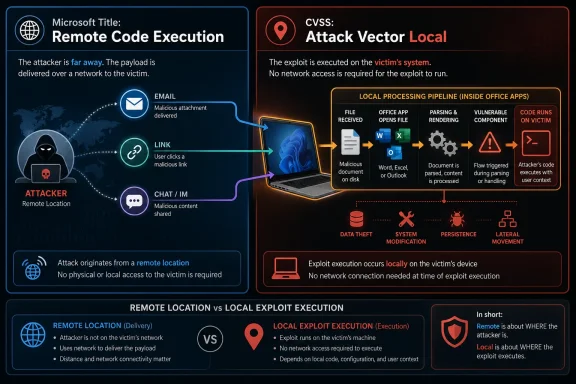
Microsoft’s Title Describes the Ambition, CVSS Describes the Path
The important distinction is that “remote code execution” is not always shorthand for “network attack.” In everyday security reporting, RCE means an attacker can get code to execute on a target system they do not control. That attacker may send a malicious document, lure a victim into opening it, or rely on preview and parsing behavior inside a local application.
CVSS, by contrast, is not trying to write a headline. Its Attack Vector metric asks how close the attacker must be to the vulnerable component at the moment exploitation occurs. If the vulnerable Office code is triggered by a file being opened or processed on the victim’s device, CVSS can classify that path as Local even when the attacker is sitting across the internet.
That is why Microsoft’s own explanation matters. “Remote” refers to the attacker’s location. “Local” refers to where the exploit mechanics execute. The payload may arrive through email, chat, a download link, a shared drive, or some other remote delivery route, but the vulnerable code path is exercised when Office handles content locally.
This is not mere semantics. Patch teams often sort vulnerabilities by vector, and “AV:L” can sound less urgent than “AV:N.” But an Office document bug that can be delivered from anywhere and triggered by common user workflows is not the same operational problem as a vulnerability that requires an attacker to already have hands-on keyboard access.
The Office Threat Model Has Always Lived in the Inbox
Office vulnerabilities occupy a peculiar place in Windows security because the attack surface is not just the application; it is the workflow around the application. Word, Excel, PowerPoint, Outlook, and the Office file parsers sit at the intersection of email, document exchange, collaboration platforms, and legacy file formats that enterprises cannot simply abandon.
That is why an Office RCE with a Local attack vector can still be a practical remote threat. The attacker does not need to be physically present. They need to persuade the target environment to process attacker-controlled content in a vulnerable local application.
This is also why “local” in CVSS should not be read as “low-risk” by default. A malicious attachment opened by a victim is local from the parser’s point of view. A document previewed by a shell extension or mail client can also be local from the vulnerable component’s point of view. The victim machine is doing the work, but the attacker may have shaped every byte that gets processed.
For administrators, the useful question is not whether the word “remote” is philosophically pure. It is whether the vulnerability enables code execution across a trust boundary. If an external sender can place a malicious Office file in front of an internal user and obtain execution in that user’s context, most defenders will experience that as remote compromise.
CVSS Is a Scoring Language, Not a Newspaper Headline
CVSS exists to normalize vulnerability severity across products and vendors. It is valuable precisely because it forces analysts to answer constrained questions: network or local, privileges required or not, user interaction or not, scope changed or unchanged, confidentiality impact, integrity impact, availability impact. That structure makes large-scale risk management possible.
But every structured scoring system loses nuance at the edges. The Attack Vector field does not tell the whole delivery story. It tells you where the vulnerable component must be reached from in order to trigger the flaw. In a file-format vulnerability, the attacker’s bytes may travel across the internet, but the vulnerable parser may only be invoked once the file is handled locally.
That creates the familiar Office paradox: a bug can be “remote code execution” in impact language and “local” in CVSS mechanics. Neither description is necessarily wrong. They answer different questions.
The title says what the attacker can ultimately accomplish: code execution on a victim’s system from a remote position. The vector says how the exploit is carried out: by causing local software to process malicious content. Confusing the two leads to bad prioritization in both directions, either panic over every RCE label or complacency over every AV:L score.
“Local” Does Not Mean the Attacker Is Already Inside
A common mistake in vulnerability triage is to equate AV:L with post-compromise activity. Sometimes that is accurate. A local privilege escalation bug, for example, may require an attacker to already have code execution on the machine. But Office content vulnerabilities can be different because the local action may be performed by the victim or by a trusted application on the victim’s behalf.
In that scenario, the attacker’s job is social, logistical, and technical. They craft a file or content stream, deliver it through a channel the organization already permits, and rely on normal user behavior or automated processing to reach the vulnerable code. The “local” part is the last mile.
That last mile still matters. A vulnerability with AV:N and no user interaction is generally more wormable and more urgent than one requiring a victim to open a document. But the difference is one of exploitability, not harmlessness. Many of the most damaging real-world intrusions have begun with a document, a link, or a preview pane rather than a direct network service exploit.
For Windows administrators, the right interpretation is therefore layered. AV:L lowers the probability of fully automated internet-scale exploitation. It does not eliminate the risk of targeted phishing, malicious attachments, drive-by document delivery, or compromise through trusted collaboration channels.
The Word “Remote” Has Been Stretched by Real-World Attacks
The security industry uses “remote code execution” in a broader way than CVSS uses “Network.” In common usage, RCE means the attacker can cause arbitrary code to run on a system without already being that system’s legitimate operator. That can happen through a network daemon, a browser renderer, a document parser, an image codec, a decompression library, or a scripting engine.
This broader usage is not accidental. From the victim’s perspective, the boundary crossed is remote control. The machine ends up executing attacker-influenced instructions because of input supplied from outside the machine’s trust boundary.
That said, broad terminology can become sloppy. A direct pre-authentication network RCE against a server and a user-assisted Office document RCE are not the same class of operational emergency. One may be scanned and exploited at scale in minutes. The other may require delivery, targeting, and interaction. Both deserve patching, but they do not deserve identical response playbooks.
Microsoft’s phrasing tries to preserve the impact category while CVSS preserves the exploit condition. The awkwardness is that administrators often consume the title first and the vector second, while security tools may ingest the vector and flatten the title into a severity queue. The human reader is left to reconcile two systems that were never designed to be prose-compatible.
For Patch Triage, the Preview Pane Detail Often Matters More Than the Label
In Office vulnerabilities, one of the most consequential details is whether previewing content is enough to trigger exploitation. If a vulnerable document must be opened explicitly, defenders can lean harder on attachment controls, user training, and protected view. If preview functionality is a valid attack path, the risk calculation changes because the user’s “interaction” may be minimal.
That distinction is especially important in Outlook-heavy environments. Users live in previews. They triage email quickly. They click messages without intending to open attachments, and enterprise mail flows routinely place untrusted documents close to sensitive desktops.
Even when Microsoft classifies an attack vector as Local, administrators should read the FAQ language carefully. The mechanics of triggering the vulnerable parser can make a supposedly user-assisted bug far more reachable than the word “local” suggests. In Office, the boundary between “opened,” “previewed,” “indexed,” and “processed” has always been the dangerous middle ground.
The safer operational assumption is that content-handling vulnerabilities deserve prompt patching on endpoints where untrusted documents are routine. That includes knowledge-worker laptops, shared terminal environments, jump boxes used for administrative email, and any machine where Office is installed mainly because “someone might need it someday.”
The Severity Conversation Should Separate Exploitability from Blast Radius
There are two different questions hiding inside every vulnerability title. The first is how easy it is to trigger. The second is what happens after it triggers. CVSS tries to encode both, but the title usually emphasizes the second.
Remote code execution is a blast-radius phrase. It says the bug may let an attacker run code, typically in the context of the vulnerable application or user. For Office, that can mean access to local files, credentials exposed to the user context, network shares, browser tokens, mail data, and whatever downstream privileges the compromised account can reach.
Attack Vector is an exploitability phrase. It says something about the route into the vulnerable component. Local means the vulnerable operation is not directly reachable as a network service. It does not say the attacker must already be sitting at the keyboard, and it does not say the malicious input originated locally.
This distinction is why a well-run patch process should not sort only by base score or only by title. A critical network RCE on an exposed server may demand emergency action. A critical Office RCE may demand accelerated endpoint patching, mail filtering, protected view hardening, attachment detonation, and monitoring for suspicious child processes from Office applications. The response is different, but it is not optional.
Microsoft’s Naming Is Imperfect, but the Alternative May Be Worse
There is a case for calling these vulnerabilities arbitrary code execution instead of remote code execution. ACE is often more precise when exploitation depends on a local parser handling malicious content. It avoids implying that the vulnerable component is listening on the network.
But ACE has its own problem: it is less familiar to many administrators, less searchable in enterprise tooling, and less immediately alarming to decision-makers. RCE has become the common operational shorthand for “attacker-controlled code may run where it should not.” Microsoft’s choice reflects that industry convention, even when CVSS paints a more mechanical picture.
The downside is alert fatigue and confusion. If everything that can be delivered remotely but executed locally is called RCE, the phrase covers a wide range of threats. A browser zero-click, a malicious Office document, a server-side deserialization bug, and a local file parser flaw may all wear the same broad label.
That puts more burden on the advisory text. Microsoft’s FAQ-style clarification is doing real work here: it tells readers that the attacker can be remote, but the exploit is carried out through local execution or local processing. The title gets attention; the CVSS vector and FAQ should determine the response.
The Practical Reading for Windows Shops Is Straightforward
For an IT team, CVE-2026-45463 should not be dismissed because AV:L appears in the vector. The more useful interpretation is that exploitation likely depends on a local Office-related action, such as opening or processing malicious content, rather than a direct packet hitting a listening service. That reduces some forms of mass exploitation but leaves document-borne compromise firmly on the table.
Administrators should treat this as an endpoint exposure issue. Patch Office through the organization’s normal Microsoft 365 Apps, Office LTSC, or supported Office servicing channel. Confirm that update compliance covers the applications actually installed, not merely the Windows operating system.
Security teams should also look beyond patch state. Office child-process behavior remains a durable detection area. Word or Excel spawning script interpreters, command shells, archive utilities, or unexpected network tools is still suspicious, regardless of which particular CVE is in the news this month.
The right posture is boring but effective: reduce the number of systems with Office installed, keep supported builds current, harden attachment handling, limit macro and add-in exposure, and make sure endpoint detection can see the process tree when a document goes bad. CVE labels change; those controls keep paying rent.
The Real Lesson Is That Vulnerability Metadata Needs Translation
The confusion around CVE-2026-45463 is not a user failure. It is a metadata failure. Vendors, scoring systems, scanners, dashboards, and security teams all use overlapping terms with slightly different meanings, then expect administrators to make fast decisions under pressure.
A title is optimized for recognition. A CVSS vector is optimized for scoring consistency. A vendor FAQ is optimized for explanation. A patch dashboard is optimized for prioritization. None of these views is sufficient alone.
That is why mature vulnerability management increasingly looks like translation work. Security teams translate vendor language into business risk. Endpoint teams translate business risk into deployment rings. Help desks translate deployment rings into user disruption. Executives translate all of it into acceptable exposure windows.
The industry often pretends that a single number can do this job. It cannot. CVSS is useful, but it is not a substitute for understanding whether a vulnerability touches a widely used application, a common file type, a high-risk workflow, or a population of users routinely exposed to untrusted content.
The Patch Queue Should Read This One as an Office Content Risk
The concrete takeaway from Microsoft’s wording is that “remote” and “local” are describing different sides of the same event. The attacker may be remote. The trigger happens locally. The result may be code execution on the victim’s system.
For WindowsForum readers, that means this is less of a contradiction than a reminder to slow down when reading vulnerability metadata. RCE tells you the class of impact. AV:L tells you something about the attack path. Neither should be read in isolation.
- CVE-2026-45463 can be called remote code execution because the attacker does not need to be physically or locally present at the victim’s machine.
- The CVSS Local attack vector means the vulnerable Office code is exploited through local processing of content, not by directly attacking a network-exposed service.
- A malicious document or similar content path can still be operationally remote if it is delivered by email, download, messaging, or collaboration tools.
- AV:L should reduce assumptions about wormability, but it should not be treated as a reason to defer Office patches.
- The most relevant enterprise controls are Office patch compliance, attachment filtering, preview and protected-view policy, and detection of suspicious Office-spawned processes.
The broader lesson is that Microsoft’s wording is clumsy only if we expect vulnerability titles to carry the precision of a scoring standard. They do not. CVE-2026-45463 is best understood as an Office code-execution flaw whose attacker may be remote but whose exploit path runs through local content handling, and that is exactly the kind of gray-zone risk modern Windows security teams will keep seeing as more attacks move through documents, previews, collaboration platforms, and the everyday software users trust most.