

Microsoft Gives ASP.NET Core a Patch Tuesday Availability Problem
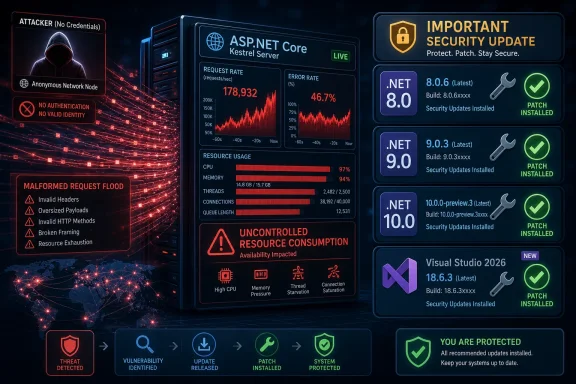
CVE-2026-45591 is not being pitched as a remote-code-execution fire drill. Microsoft’s own description is concise: uncontrolled resource consumption in ASP.NET Core allows an unauthorized attacker to deny service over a network. That combination matters because it places the bug in the operational layer of modern applications, where an attacker does not need credentials, user interaction, or a foothold to create trouble.
The CVSS vector tells a familiar story for service operators. The attack vector is network, attack complexity is low, privileges required are none, and user interaction is none. Confidentiality and integrity are scored as unaffected, while availability is scored high. In plain English: the bug is not about stealing data or modifying records; it is about making the application or service unavailable.
Microsoft rates the vulnerability Important, with a CVSS 3.1 base score of 7.5 and temporal score of 6.5. The downgrade from base to temporal reflects the context around the disclosure: exploitation is marked unproven, remediation is available, and the report confidence is confirmed. That is not a contradiction. It is Microsoft saying both that the vulnerability is real and that it has not seen the signals that would justify treating it like an active incident.
The affected product list is broad enough to make this a developer-platform story rather than a niche runtime bug. The fixes land across .NET 8.0, 9.0, and 10.0 on Windows, Linux, and macOS, plus corresponding ASP.NET Core releases and Visual Studio 2026 version 18.6. That footprint matters for WindowsForum readers because many Windows shops no longer run “Windows-only” application stacks. A single ASP.NET Core estate may span IIS-hosted apps, Linux containers, Azure App Service, CI runners, and developer workstations.
A Confirmed Bug Is Not the Same Thing as a Weaponized Bug
The user-facing snippet around report confidence is more than CVSS boilerplate. Report Confidence measures how certain the vendor and community are that a vulnerability exists and how credible the available technical details are. For CVE-2026-45591, Microsoft marks that field as Confirmed, meaning the vendor has acknowledged the flaw or the technical record is detailed enough to substantiate it.
That should be separated from exploit maturity. Microsoft also marks Exploit Code Maturity as Unproven, publicly disclosed as No, exploited as No, and exploitation assessment as Exploitation Less Likely. Those labels do not mean “ignore it.” They mean defenders have a patching window rather than an emergency response window.
This is where vulnerability triage often goes wrong. Teams see “not exploited” and unconsciously translate it into “not urgent.” But for an Internet-facing ASP.NET Core application, availability is a business-critical security property. A bug that lets an unauthenticated remote party tie up resources can become painful without ever becoming a flashy proof-of-concept on GitHub.
The deeper lesson is that CVSS is a prioritization aid, not a substitute for asset context. An internal line-of-business app behind a VPN, a public authentication gateway, and a high-volume API endpoint do not carry the same risk profile even if the same runtime appears in all three places. CVE-2026-45591’s scoring gives administrators the outline; their deployment topology supplies the urgency.
The Web Stack Has Become the Patch Surface
ASP.NET Core sits in an awkward but powerful position. It is an application framework, a runtime dependency, a hosting model, and in many deployments the front line between business logic and hostile traffic. That makes a denial-of-service flaw in ASP.NET Core different from a bug in a rarely used desktop component. The affected code may be pulled into services that are expected to be continuously reachable.
Microsoft’s update matrix also highlights how .NET servicing has changed the Windows patch conversation. The update is not just a Windows Update item for servers with the right role installed. It touches platform-specific .NET installations on Windows, Linux, and macOS; ASP.NET Core runtime lines; and Visual Studio. The modern .NET estate is a supply chain of runtime installations, SDKs, container bases, package references, and deployment artifacts.
That creates an uncomfortable gap between “the patch exists” and “the application is protected.” Framework-dependent applications may benefit when the hosting runtime is updated. Self-contained deployments, container images, and pinned build pipelines may require rebuilding and redeploying. Developers may need Visual Studio updates, while production servers need runtime updates, and the two may not be managed by the same team.
For sysadmins, this is the practical edge of the story. Patching the OS image is necessary but may not be sufficient. If an organization ships ASP.NET Core applications inside containers, the base image needs to be refreshed and the service redeployed. If it ships self-contained binaries, the runtime incorporated into the application needs to be updated through the build pipeline. If developers keep old SDKs around, the next hotfix build can quietly reintroduce old assumptions.
The Severity Is “Important,” but the Exposure Is Environmental
Microsoft’s Important rating is defensible. There is no confidentiality impact, no integrity impact, no privilege escalation, and no evidence of exploitation at publication. In the usual Patch Tuesday hierarchy, this does not sit beside an actively exploited Windows zero-day or a wormable remote-code-execution bug.
But availability vulnerabilities are notoriously dependent on where they land. A denial-of-service bug in a backend admin portal may be annoying. The same bug in a public payment endpoint, identity broker, API gateway, or customer portal can become an outage. Security teams that rank every DoS issue below every code-execution issue often learn too late that downtime is the most visible security failure an organization can suffer.
The uncontrolled resource consumption classification is especially important. CWE-400 is a broad bucket, but it points toward a class of failure where crafted inputs or request patterns force a service to spend disproportionate CPU, memory, connection, parsing, buffering, or other resources. These bugs can be hard to reason about because they may not crash instantly. They may degrade performance, exhaust a thread pool, saturate memory, or starve legitimate requests.
That nuance matters for detection. A service under resource-consumption attack may look like ordinary load, a bad client, a deployment regression, or a capacity planning error. If exploit code is not public, defenders may not know exactly what request pattern to hunt for. The most useful telemetry is therefore not only security telemetry. It is application latency, request rate, memory pressure, garbage collection behavior, connection counts, thread pool starvation, reverse proxy errors, and autoscaling anomalies.
The Patch Is Simple; the Inventory Is Not
Microsoft’s fixed build numbers are straightforward. .NET 8.0 moves to 8.0.28, .NET 9.0 to 9.0.17, and .NET 10.0 to 10.0.9. Visual Studio 2026 version 18.6 is fixed at 18.6.3. In a small environment, that is a checklist. In a real enterprise, it is an inventory problem disguised as a checklist.
The first question is not “Did we install the update?” It is “Where does ASP.NET Core exist in our estate?” That includes production servers, staging systems, developer laptops, build agents, container registries, golden VM images, base images, and disaster-recovery environments. ASP.NET Core can be present because the app explicitly targets it, because a workload installed it, because Visual Studio brought it along, or because a container image inherited it.
Windows administrators should also resist the temptation to treat this as someone else’s problem because Linux appears in the affected list. Cross-platform .NET has blurred ownership boundaries. A Windows-centric shop may run Linux containers in AKS, deploy .NET services to cloud-hosted Linux, and still develop and manage everything from Windows workstations and Visual Studio. The vulnerability follows the runtime, not the org chart.
The second question is whether applications are framework-dependent or self-contained. A framework-dependent app relies on a shared runtime installed on the host. A self-contained app ships the runtime with the application. The former rewards host patching; the latter rewards build discipline. That distinction is now central to .NET security operations.
Visual Studio Belongs in the Blast Radius
The inclusion of Visual Studio 2026 version 18.6 is easy to overlook because server operators naturally focus on production runtime versions. But developer tooling is part of the patch surface for application frameworks. If a fixed SDK or workload component is required, unpatched development environments can keep generating artifacts from a vulnerable toolchain or leave developers testing against a different runtime than production.
This is not just hygiene theater. Build machines and developer workstations are increasingly privileged parts of the software supply chain. They hold signing credentials, deployment rights, package feeds, source access, and production secrets far more often than security teams like to admit. While CVE-2026-45591 is an availability issue rather than a supply-chain compromise, the affected tooling entry is a reminder that patching developer environments is no longer optional background maintenance.
Organizations that manage Visual Studio through endpoint management should treat 18.6.3 as part of the same campaign as the runtime updates. Organizations that let developers self-update should at least verify versions through inventory. The risk is not that every developer laptop is suddenly a denial-of-service target. The risk is drift: patched production, unpatched build hosts, and confusing test results when a service behaves differently across environments.
Microsoft’s combined .NET servicing model helps by packaging security and non-security fixes into predictable monthly releases. But predictable does not mean automatic. Enterprises still need rings, test environments, compatibility checks, and rollback plans. The best patching process for a framework vulnerability is one that assumes developers and operations both own a piece of the outcome.
“Less Likely” Is a Window, Not a Waiver
Microsoft’s exploitation assessment of “less likely” is valuable because it helps teams avoid panic. It says there was no public disclosure, no known exploitation, and no proven exploit code at the time of publication. That gives defenders room to test, schedule, and deploy thoughtfully.
But “less likely” is also a temporal statement. It describes the state of knowledge at release, not a permanent property of the bug. Once a patch ships, attackers can compare old and new code, study the changed behavior, and search for vulnerable deployments. That does not guarantee exploit development, but it changes the economics. Public patches are also public clues.
This is particularly true for denial-of-service bugs, where exploitation may not require delicate memory corruption or a complex chain. A resource-consumption issue can sometimes be rediscovered by stress testing, fuzzing inputs, or probing request patterns. Microsoft has not published the root cause in the short advisory text, and that restraint reduces immediate attacker guidance. It does not eliminate the incentive to reverse-engineer.
The right operational response is therefore calm acceleration. Patch the Internet-facing and business-critical ASP.NET Core services first. Patch development and build environments next. Then clean up internal systems, old staging hosts, and forgotten images. The absence of exploitation buys sequence; it does not justify indefinite delay.
The Real Risk Is the Long Tail of .NET Deployments
Every mature .NET shop has a long tail. There are services nobody wants to touch, APIs waiting for a rewrite, staging boxes with production-like access, test runners that have not been rebuilt in months, and container images that still work because nobody has asked them to do anything new. CVE-2026-45591 is the kind of vulnerability that finds that long tail.
The fixed versions make unsupported or loosely supported deployments stand out. If an application is on a supported .NET line, the path is clear: move to the serviced build. If it is pinned to something older, the security conversation changes from patching to modernization. Unsupported runtimes are not just missing this fix; they are missing the entire premise of predictable servicing.
For Windows administrators, the uncomfortable part is that application owners may not know their runtime mode. A service may have been created by a team that has since reorganized. A container may have been built from a base image nobody tracks. A production binary may be self-contained because that made deployment easier three years ago. These are not exotic failures. They are the normal sediment of successful software.
The security team’s job is to turn the CVE into a discovery exercise. Search for installed runtimes. Query container registries. Check build definitions. Ask application teams for target frameworks. Validate that redeployed services actually report the expected runtime. The difference between a patched estate and a patched dashboard is usually verification.
Availability Bugs Force Security and Operations to Share a Desk
CVE-2026-45591 is a useful reminder that not every security issue ends in data theft. Sometimes the attacker’s goal is to make the service stop serving. That puts security teams in direct conversation with SREs, network engineers, application developers, and support desks.
Mitigation should not stop at patching. Rate limiting, request size limits, connection limits, reverse proxy controls, circuit breakers, and autoscaling guardrails all matter for resource-consumption failures. These controls are not substitutes for Microsoft’s fix, but they reduce the blast radius of the next bug in the same class. A service that can be knocked over by one malformed traffic pattern is usually vulnerable to more than one problem.
Observability matters just as much. If an exploit attempt looks like a traffic spike, defenders need enough context to distinguish malicious load from product success. That means retaining request metadata, correlating proxy logs with application metrics, and alerting on saturation signals before users start filing tickets. Availability security is measured in minutes, not postmortem prose.
The interesting shift is cultural. Security teams have spent years teaching organizations that confidentiality and integrity are security concerns. Availability has always been in the triad, but it often gets delegated to operations until an incident makes it visible. ASP.NET Core DoS vulnerabilities sit at the boundary where the distinction collapses.
The June Fix Turns Runtime Hygiene Into a Production Control
The most concrete guidance from CVE-2026-45591 is not mysterious: install the June 9, 2026 servicing updates for affected .NET and ASP.NET Core versions, update Visual Studio 2026 version 18.6 to 18.6.3, and rebuild or redeploy applications where the runtime is bundled. The more strategic guidance is that .NET runtime hygiene should be treated like a production control, not a developer preference.
Teams that already maintain runtime inventories will handle this cleanly. Teams that do not will spend the next few days discovering how many ways ASP.NET Core can enter an environment. That discovery is useful beyond this single CVE. The same map will matter for the next Kestrel issue, the next framework bug, and the next SDK-level fix.
The advisory’s report-confidence field deserves special attention because it cuts through one common misunderstanding. Microsoft is not saying the bug is speculative. It is saying the vulnerability is confirmed, while exploit activity is not. That distinction should guide the tempo: verify exposure, prioritize reachable services, patch deliberately, and do not wait for exploitation reports to make the decision for you.
The Numbers Administrators Should Carry Into Change Control
CVE-2026-45591 is not the loudest kind of Patch Tuesday vulnerability, but it has enough operational detail to support a clean change-control case. The essentials are concrete, bounded, and actionable.
- The vulnerability was released on June 9, 2026, and is an Important-rated ASP.NET Core denial-of-service issue caused by uncontrolled resource consumption.
- The CVSS 3.1 base score is 7.5, with network attack vector, low attack complexity, no privileges required, no user interaction, and high availability impact.
- Microsoft lists the issue as not publicly disclosed and not exploited at publication, with exploitation assessed as less likely.
- The fixed .NET builds are 8.0.28, 9.0.17, and 10.0.9, with ASP.NET Core 8.0, 9.0, and 10.0 covered by the corresponding updates.
- Visual Studio 2026 version 18.6 is also affected, with version 18.6.3 listed as the fixed build.
- Self-contained applications, container images, build agents, and developer workstations need explicit attention because host patching alone may not update every vulnerable runtime copy.
CVE-2026-45591 will probably not be remembered as the dramatic vulnerability of June 2026, and that is exactly why it is a useful test of security maturity. The organizations that handle it well will be the ones that know where their runtimes live, understand how their ASP.NET Core applications are packaged, and can move from advisory to deployed fix without confusing “not exploited” with “not important.” The next framework flaw may not arrive with such a forgiving exploitability assessment, so the work done now is not just remediation; it is rehearsal.