

Microsoft patched CVE-2026-45595, a Windows Mark of the Web security feature bypass vulnerability rated Important, as part of the June 9, 2026 Patch Tuesday release for supported Windows systems. The bug matters less because it is glamorous than because it touches one of Windows’ quietest lines of defense: the metadata that tells the operating system a file came from an untrusted place. In a month crowded with roughly 200 Microsoft fixes, this is the kind of vulnerability administrators can easily skim past. They should not.
Mark of the Web is not a sandbox, not an antivirus engine, and not a magic shield. It is closer to a warning label that Windows attaches to files arriving from the internet or another untrusted zone, usually through an alternate data stream on NTFS called
The signal is deceptively important. Windows SmartScreen, Microsoft Office Protected View, macro-blocking behavior, archive extraction workflows, and assorted “are you sure?” prompts all depend, directly or indirectly, on knowing whether a file came from outside the trust boundary. If the label is missing, stripped, mishandled, or ignored, the operating system can treat hostile content like local content.
That is why CVE-2026-45595 lands in the “security feature bypass” category rather than remote code execution. A bypass of Mark of the Web does not necessarily run code by itself. But it can remove friction from the first click in an attack chain, and modern intrusion campaigns are built from exactly that kind of friction removal.
That does not make it irrelevant. Patch triage often overweights CVSS base scores and underweights where a vulnerability sits in the attack path. Mark of the Web sits near the front door of many Windows compromise attempts: the emailed attachment, the downloaded archive, the shared file, the lure document, the shortcut, the installer, the developer project.
A security feature bypass is a force multiplier. It makes something else easier. When defenders ask whether a bug is “only” a bypass, the better question is what defenses the bypass deprives them of.
That matters because a vulnerability’s urgency is not only a function of severity. It is also a function of certainty. A confirmed issue with limited technical detail is different from a speculative weakness described in a research thread, and both are different from a fully documented bug with proof-of-concept code circulating.
For CVE-2026-45595, the fact that it appears in Microsoft’s Security Update Guide means Microsoft is acknowledging the vulnerability and shipping remediation through the normal Windows servicing pipeline. That does not automatically mean public exploit code exists. It does mean administrators should treat the issue as real rather than theoretical.
Windows has accumulated multiple layers of user-protection logic around the assumption that origin metadata is reliable. That makes MOTW a tempting target. If an attacker can deliver a malicious file without the internet-zone label surviving the trip, the downstream protections may never wake up.
This is also why third-party tools matter. Compression utilities, collaboration platforms, sync clients, browsers, email gateways, and file transfer products all participate in the messy life cycle of downloaded content. Microsoft can patch Windows, but defenders still need to understand whether their real-world file flows preserve the trust markings that Windows expects.
A successful MOTW bypass can change the user experience of an attack. A malicious document may open with fewer warnings. A script or shortcut may encounter less resistance. A downloaded payload may look less foreign to Windows than it really is. The user still may need to click, but the operating system may ask fewer questions before honoring that click.
In enterprise environments, those prompts and blocks are not cosmetic. They are compensating controls for the reality that people open files. Removing them does not guarantee compromise, but it can raise the success rate of phishing and social engineering campaigns.
Developers pull archives from the web. Finance teams receive spreadsheets. HR opens resumes. Support desks exchange diagnostic bundles. Administrators download tools. Engineers move files between browsers, Teams, SharePoint, OneDrive, email, ZIP utilities, and remote management systems. Every hop is an opportunity for origin metadata to be preserved, transformed, or lost.
That is why CVE-2026-45595 should be handled as both a patching item and a process reminder. Organizations that rely heavily on “downloaded from the internet” protections should verify that their standard file paths still trigger the expected warnings after patching. The right test is not abstract compliance; it is opening the kind of files employees actually receive.
The affected component label is also useful. This is not merely an Office issue, a browser issue, or a third-party archiver issue. It is categorized under Windows Mark of the Web itself, which means administrators should look first to Windows cumulative updates rather than expecting an application-only fix.
That said, endpoint security teams should avoid thinking of the patch as the entire answer. MOTW bypasses often reveal how much an organization depends on user-facing prompts instead of stronger controls such as attachment detonation, application control, script restrictions, macro policy, and least privilege.
Security teams should also review detection logic around internet-origin files. If telemetry captures alternate data streams, SmartScreen events, Office Protected View behavior, or suspicious execution from download directories, this is a useful moment to confirm those signals are still flowing. If the organization has no visibility into those events, CVE-2026-45595 is a reminder of that blind spot.
The patch also belongs in phishing-risk conversations. Many security awareness programs train users to notice Windows warnings, Office banners, and blocked macros. That training still has value, but it should not be the only line of defense. A warning that can be bypassed is not a policy; it is a speed bump.
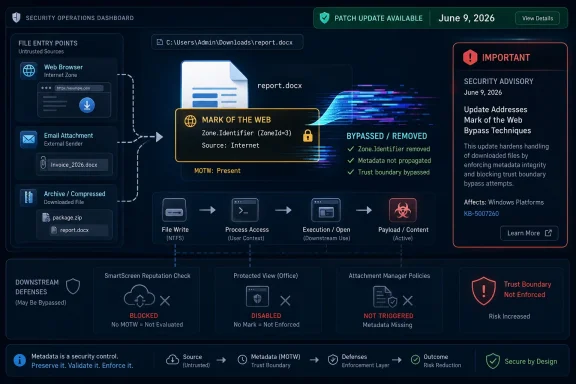 Microsoft’s Small Warning Label Has Become a Big Security Boundary
Mark of the Web is not a sandbox, not an antivirus engine, and not a magic shield. It is closer to a warning label that Windows attaches to files arriving from the internet or another untrusted zone, usually through an alternate data stream on NTFS called Zone.Identifier. That label then becomes a signal consumed by other parts of the Microsoft ecosystem.The signal is deceptively important. Windows SmartScreen, Microsoft Office Protected View, macro-blocking behavior, archive extraction workflows, and assorted “are you sure?” prompts all depend, directly or indirectly, on knowing whether a file came from outside the trust boundary. If the label is missing, stripped, mishandled, or ignored, the operating system can treat hostile content like local content.
That is why CVE-2026-45595 lands in the “security feature bypass” category rather than remote code execution. A bypass of Mark of the Web does not necessarily run code by itself. But it can remove friction from the first click in an attack chain, and modern intrusion campaigns are built from exactly that kind of friction removal.
The June Patch Flood Makes This One Easier to Miss
June 2026 Patch Tuesday was unusually large, with public reporting counting about 200 Microsoft vulnerabilities addressed in the day’s release. The headlines naturally gravitated toward critical remote code execution bugs, privilege escalation flaws, and the three publicly disclosed zero-days that Microsoft patched that day. CVE-2026-45595 was not one of the headline zero-days.That does not make it irrelevant. Patch triage often overweights CVSS base scores and underweights where a vulnerability sits in the attack path. Mark of the Web sits near the front door of many Windows compromise attempts: the emailed attachment, the downloaded archive, the shared file, the lure document, the shortcut, the installer, the developer project.
A security feature bypass is a force multiplier. It makes something else easier. When defenders ask whether a bug is “only” a bypass, the better question is what defenses the bypass deprives them of.
Report Confidence Is the Quiet Metric Behind the Noise
The user-facing detail that deserves attention here is Microsoft’s inclusion of the report-confidence concept: the degree of confidence in the existence of the vulnerability and the credibility of known technical details. In plain English, this metric asks whether defenders and attackers are dealing with rumor, partial evidence, or a confirmed vendor-acknowledged flaw.That matters because a vulnerability’s urgency is not only a function of severity. It is also a function of certainty. A confirmed issue with limited technical detail is different from a speculative weakness described in a research thread, and both are different from a fully documented bug with proof-of-concept code circulating.
For CVE-2026-45595, the fact that it appears in Microsoft’s Security Update Guide means Microsoft is acknowledging the vulnerability and shipping remediation through the normal Windows servicing pipeline. That does not automatically mean public exploit code exists. It does mean administrators should treat the issue as real rather than theoretical.
Mark of the Web Keeps Being Rediscovered by Attackers
This is not the first time Mark of the Web has been in the blast radius. In recent years, attackers and researchers have repeatedly found ways to dodge, strip, confuse, or bypass MOTW handling through archives, shortcuts, file formats, extraction tools, Office behavior, and Windows shell interactions. The repeated pattern is the point.Windows has accumulated multiple layers of user-protection logic around the assumption that origin metadata is reliable. That makes MOTW a tempting target. If an attacker can deliver a malicious file without the internet-zone label surviving the trip, the downstream protections may never wake up.
This is also why third-party tools matter. Compression utilities, collaboration platforms, sync clients, browsers, email gateways, and file transfer products all participate in the messy life cycle of downloaded content. Microsoft can patch Windows, but defenders still need to understand whether their real-world file flows preserve the trust markings that Windows expects.
A Bypass Is Not a Breach, But It Can Be the First Domino
The temptation with CVE-2026-45595 is to rank it below bugs that promise direct code execution or SYSTEM privileges. That is reasonable for emergency patch queues. It is dangerous if it turns into complacency.A successful MOTW bypass can change the user experience of an attack. A malicious document may open with fewer warnings. A script or shortcut may encounter less resistance. A downloaded payload may look less foreign to Windows than it really is. The user still may need to click, but the operating system may ask fewer questions before honoring that click.
In enterprise environments, those prompts and blocks are not cosmetic. They are compensating controls for the reality that people open files. Removing them does not guarantee compromise, but it can raise the success rate of phishing and social engineering campaigns.
The Practical Risk Lives in File Handling Workflows
For home users, the advice is familiar: install the cumulative update, be suspicious of unexpected downloads, and do not assume that a lack of a warning means a file is safe. The more interesting case is enterprise IT, where MOTW behavior intersects with business workflows that are often poorly documented.Developers pull archives from the web. Finance teams receive spreadsheets. HR opens resumes. Support desks exchange diagnostic bundles. Administrators download tools. Engineers move files between browsers, Teams, SharePoint, OneDrive, email, ZIP utilities, and remote management systems. Every hop is an opportunity for origin metadata to be preserved, transformed, or lost.
That is why CVE-2026-45595 should be handled as both a patching item and a process reminder. Organizations that rely heavily on “downloaded from the internet” protections should verify that their standard file paths still trigger the expected warnings after patching. The right test is not abstract compliance; it is opening the kind of files employees actually receive.
Microsoft’s Classification Tells Defenders Where to Look
The “Important” rating is easy to misread. Microsoft reserves “Critical” for vulnerabilities with more direct or severe exploitation characteristics, especially those that can enable remote code execution without much user interaction. An Important MOTW bypass can still be valuable to an attacker because it lowers a barrier rather than delivering the payload alone.The affected component label is also useful. This is not merely an Office issue, a browser issue, or a third-party archiver issue. It is categorized under Windows Mark of the Web itself, which means administrators should look first to Windows cumulative updates rather than expecting an application-only fix.
That said, endpoint security teams should avoid thinking of the patch as the entire answer. MOTW bypasses often reveal how much an organization depends on user-facing prompts instead of stronger controls such as attachment detonation, application control, script restrictions, macro policy, and least privilege.
The Admin Playbook Should Be Boring, Fast, and Verified
The best response to CVE-2026-45595 is not panic. It is disciplined patch management. Deploy the June 2026 Windows security updates through the usual ringed rollout process, watch for regressions, and accelerate where users handle untrusted files at scale.Security teams should also review detection logic around internet-origin files. If telemetry captures alternate data streams, SmartScreen events, Office Protected View behavior, or suspicious execution from download directories, this is a useful moment to confirm those signals are still flowing. If the organization has no visibility into those events, CVE-2026-45595 is a reminder of that blind spot.
The patch also belongs in phishing-risk conversations. Many security awareness programs train users to notice Windows warnings, Office banners, and blocked macros. That training still has value, but it should not be the only line of defense. A warning that can be bypassed is not a policy; it is a speed bump.
The MOTW Lesson Hidden Inside CVE-2026-45595
CVE-2026-45595 is a reminder that Windows security often depends on small pieces of state moving correctly through large, messy workflows. The most concrete conclusions are straightforward:- Microsoft patched CVE-2026-45595 on June 9, 2026, as part of the June Patch Tuesday Windows security updates.
- The vulnerability is a Mark of the Web security feature bypass, meaning it can weaken protections that depend on Windows recognizing internet-origin files.
- The bug is rated Important, but that rating should not cause defenders to ignore its role in phishing and file-delivery attack chains.
- The report-confidence framing matters because Microsoft’s acknowledgement turns this from a speculative concern into a confirmed servicing item.
- Administrators should validate real file-handling workflows after patching, especially where users receive archives, documents, shortcuts, scripts, or installers from outside the organization.
- MOTW should be treated as one layer in a defense stack, not as the control that makes untrusted files safe.
References
- Primary source: MSRC
Published: 2026-06-09T07:00:00-07:00
Security Update Guide - Microsoft Security Response Center
 msrc.microsoft.com
- Related coverage: techrepublic.com
New Windows Flaw Lets Attackers Bypass Mark of the Web
Microsoft patched a Windows Remote Assistance flaw that lets attackers bypass Mark of the Web, weakening protections against malicious downloads and phishing files.www.techrepublic.com
- Related coverage: threat-modeling.com
Windows BitLocker Security Feature Bypass — YellowKey (CVE-2026-45585): PoC Publicly Released, Mitigation Available - Threat-Modeling.com
Microsoft has acknowledged a security feature bypass vulnerability in Windows BitLocker, publicly known as “YellowKey” and tracked as CVE-2026-45585. The vulnerability affects Windows 11 (24H2, ... <a title="Windows BitLocker Security Feature Bypass — YellowKey (CVE-2026-45585): PoC Publicly... threat-modeling.com
- Related coverage: ibm.com
Security Bulletin: IBM Maximo Application Suite - Predict Component component uses pyasn1-0.6.2-py3-none-any.whl which is vulnerable to this CVE-2026-30922
IBM Maximo Application Suite - Predict Component was using vulnerable library pyasn1-0.6.2-py3-none-any.whl which is vulnerable to CVE-2026-30922. This bulletin contains information addressing the vulnerability.www.ibm.com
- Related coverage: ctrlaltnod.com
Microsoft Patches Windows Remote Assistance MOTW Bypass Flaw
Microsoft patched CVE-2026-20824, a Windows Remote Assistance vulnerability allowing attackers to bypass Mark of the Web security protections.www.ctrlaltnod.com - Related coverage: cert.europa.eu
- Related coverage: aha.org
- Official source: microsoft.com
MSRC - Microsoft Security Response Center
The Microsoft Security Response Center is part of the defender community and on the front line of security response evolution. For over twenty years, we have been engaged with security researchers working to protect customers and the broader ecosystem.www.microsoft.com
- Official source: learn.microsoft.com
Security Advisories and Bulletins | Microsoft Learn
learn.microsoft.com - Official source: msrc-ppe.microsoft.com
- Related coverage: api.urlscan.io

api.msrc.microsoft.com - urlscan.io
urlscan.io - Website scanner for suspicious and malicious URLs
api.urlscan.io
- Related coverage: sra.io
- Related coverage: cert.gov.vu
Advisory 118 CVE 2026 21509 Microsoft Office Security Feature Bypass Vulnerability
PDF documentcert.gov.vu
- Related coverage: computerweekly.com
Microsoft smashes record for biggest ever Patch Tuesday update | Computer Weekly
Microsoft has not only broken but obliterated the record for the largest ever Patch Tuesday drop, with its June 2026 update addressing approximately 200 flaws, and three zero-days.www.computerweekly.com - Related coverage: securityweek.com
Microsoft Patches 200 Vulnerabilities - SecurityWeek
Microsoft’s June 2026 Patch Tuesday updates fix roughly 200 vulnerabilities discovered in the company’s products.www.securityweek.com
- Related coverage: bleepingcomputer.com
Microsoft June 2026 Patch Tuesday fixes 6 zero-days, 200 flaws
Today is Microsoft's June 2026 Patch Tuesday, with security updates for 200 flaws, including five publicly disclosed zero-day vulnerabilities and one actively exploited in attacks.www.bleepingcomputer.com - Related coverage: rapid7.com
Rapid7 Vulnerability Database
Rapid7's VulnDB is curated repository of vetted computer software exploits and exploitable vulnerabilities.www.rapid7.com - Related coverage: socradar.io
CVE-2025-48595: June 2026 Android Security Update Fixes Framework Zero-Day
Google's June 2026 Android Security Bulletin includes a fix for an Android Framework elevation of privilege zero-day tracked as CVE-2025-48595...socradar.io
