

Microsoft disclosed CVE-2026-45606 on June 9, 2026, as a denial-of-service vulnerability in the Windows UxTheme Library, uxtheme.dll, caused by an out-of-bounds read that a local authorized attacker could use to disrupt service. The score is not headline-grabbing: CVSS 5.5, “Important,” local attack vector, low privileges required, no confidentiality or integrity impact, and no public disclosure or active exploitation listed at publication. But the bug is interesting precisely because it lives in one of those quiet Windows components that almost nobody thinks about until it breaks. UxTheme is part of the visual plumbing of Windows, and this CVE is a reminder that even aesthetic infrastructure is still attack surface.
UxTheme is the library behind the visual style machinery that lets Windows draw themed controls, window chrome, and UI elements in a consistent way. For most users, it is invisible, and for many administrators it is the kind of DLL that appears only in crash dumps, application compatibility reports, and old customization folklore. That obscurity makes the vulnerability easy to dismiss.
Microsoft’s description is terse: an out-of-bounds read in Microsoft UxTheme Library allows an authorized attacker to deny service locally. That sentence does three important things. It confirms the class of bug, constrains the attack to local execution, and limits the impact to availability.
The absence of a confidentiality or integrity impact matters. This is not a code execution bug, not a privilege escalation, and not a data theft advisory. It is a denial-of-service issue in a user-interface library, and the CVSS vector says the attacker needs low privileges and no user interaction once positioned locally.
Still, “local denial of service” should not be translated as “irrelevant.” On a single-user gaming PC, the realistic outcome may be annoyance. On shared workstations, kiosks, jump boxes, VDI pools, lab machines, or systems that depend on interactive sessions, a reliable UI-level crash can become operational disruption.
That does not make it urgent in the same way as a wormable network service bug. The attacker first needs a foothold. But Windows fleets are full of low-privileged footholds: standard user accounts, remote app sessions, developer workstations, student lab accounts, contractor desktops, and compromised but non-admin endpoints.
Availability bugs also tend to be underestimated because they do not fit the dramatic “steal data or own the box” pattern. In practice, crashing a process, desktop component, or UI-dependent workflow can be enough to interrupt incident response, deny access to a management console, or force repeated user disruption. In environments where productivity depends on session stability, “just a crash” becomes a help desk multiplier.
The “high availability” element of the vector is the key phrase. Microsoft is saying the confidentiality and integrity blast radius is effectively nil, but the affected component can be made unavailable in a meaningful way. For administrators, that points to prioritization rather than panic.
That matters because vulnerability advisories often contain a strange mix of certainty and opacity. We may know a bug exists, but not exactly how an attacker would reach it. We may know the affected component, but not the call path. We may know the impact, but not the proof-of-concept details.
Here, the public technical details are limited, but the classification is firm. The vulnerable component is UxTheme. The weakness class is out-of-bounds read. The impact is denial of service. The exploitation assessment says it was not publicly disclosed and not exploited at publication, while Microsoft rated exploitation of the latest software release as less likely.
That combination gives defenders enough to act without feeding copy-paste exploit development. It also means the patch should be treated as a normal security update, not as an optional cosmetic fix. The fact that the bug touches visual theming does not make it less part of the trusted operating system surface.
That breadth is not surprising. UxTheme is not a niche add-on. It is common Windows infrastructure, and common infrastructure tends to follow the operating system everywhere.
Microsoft’s June 2026 security release assigns the fixes through the month’s cumulative update machinery. The relevant fixed builds include the June 2026 builds for Windows 10, Windows 11, and the supported server lines. The updates require a restart for the Windows platforms listed, which is the normal operational tax of patching core OS components.
The advisory does not list workarounds or mitigations for CVE-2026-45606. That is another practical signal. If you are exposed, the meaningful answer is patching, not a registry toggle or group policy workaround.
That is rational triage. A 9.8 network-facing remote code execution vulnerability deserves more immediate attention than a 5.5 local denial-of-service issue. Nobody should invert the risk stack simply because uxtheme.dll has an interesting name.
But large Patch Tuesday drops also create a different problem: organizations often patch only what screams. If a CVE is not in the Known Exploited Vulnerabilities catalog, not rated critical, and not remote code execution, it can get deferred into the fog of “next maintenance window.” For CVE-2026-45606, that is probably acceptable in a well-managed environment with tight low-privilege user controls. It is less acceptable on shared systems where untrusted local users are expected.
The right posture is neither alarm nor neglect. Treat it as part of the cumulative Windows baseline. If your organization already deploys June updates quickly, this CVE is covered. If your Windows patching is selective, manual, or delayed, this is another reason selective patching has become a losing strategy.
That is why local denial-of-service bugs keep showing up in real risk discussions. Attackers do not always need to escalate privileges to make defenders miserable. They can crash tools, interrupt sessions, create noise, and force reboots at inconvenient times.
For VDI and Remote Desktop Services environments, the local-versus-remote distinction can blur from the user’s perspective. The attacker may be “local” to a session on the server while operating remotely over an interactive channel. A vulnerability in a UI library can therefore matter more in hosted desktops than it would on a single unmanaged laptop.
This does not mean CVE-2026-45606 should be treated like a remote desktop protocol flaw. It means administrators should map “local” to their actual access model. If untrusted or semi-trusted users can run code on a machine, local bugs are reachable.
That distinction is important. The bug class alone does not define the risk. The same weakness category can be benign, exploitable for memory disclosure, or part of a larger crash chain depending on context. Microsoft’s scoring says this one is an availability problem.
The absence of public technical detail also means outsiders should be careful about overclaiming. We do not know from the advisory whether a crafted theme asset, malformed UI resource, particular API call, or application behavior is the trigger. We know the component, the bug class, the privilege model, and the outcome.
That is enough for patch prioritization, not enough for exploit theater. The safer editorial line is to resist inventing an attack path Microsoft did not publish.
The fix arrives through the June 2026 Windows updates. Those updates apply across a long list of Windows 10, Windows 11, and Windows Server versions, with restart required for the operating system packages. That makes this an ordinary cumulative update deployment problem.
Ordinary does not mean trivial. Restart coordination still matters for servers, VDI hosts, kiosk fleets, and production workstations. But the security decision is simple: if the system is affected, install the applicable June update.
The more interesting question is whether organizations have inventory good enough to know where UxTheme exposure matters most. In most cases, every supported Windows machine is in scope. The practical prioritization comes from usage pattern, not from whether the DLL exists.
Theme modders should resist the temptation to treat this as an invitation to patch or replace system files. UxTheme has a long history in Windows customization culture, especially around third-party themes and patched DLLs. Security updates are exactly the moment when modified system components become a liability.
If you have replaced or modified theme-related system files, the safest path is to restore the normal Windows servicing state and let the cumulative update apply cleanly. Unsupported DLL modifications complicate troubleshooting, make update failures harder to diagnose, and can leave a machine in a half-patched state.
For most consumer systems, the risk is less “someone will target this CVE against me” and more “I postponed updates for months and accumulated avoidable exposure.” CVE-2026-45606 is one more entry in that larger argument.
The operational risk is most relevant where low-privileged local users are normal. Shared workstations, training rooms, call centers, education labs, healthcare kiosks, engineering labs, and pooled desktops are better examples than locked-down single-user executive laptops.
Security teams should also watch for one subtle pattern: denial-of-service CVEs sometimes become useful in chains. A crash can suppress a process, interrupt monitoring, disrupt a user session, or create a timing window for another action. There is no public evidence that CVE-2026-45606 is being used that way, but defenders should avoid assuming availability bugs have no adversarial value.
In mature environments, the response is boring by design. Confirm June 2026 cumulative update deployment, check failed installs, reboot pending systems, and move on to higher-risk vulnerabilities.
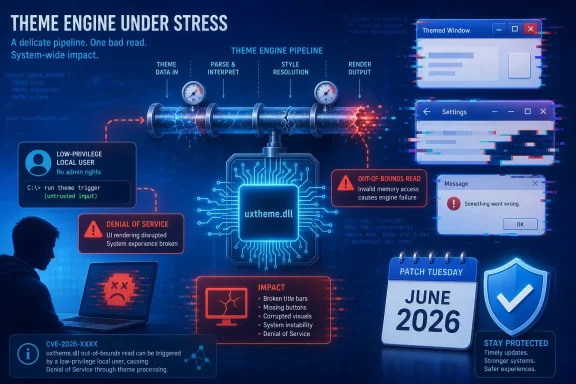 The Theme Engine Is Not Just Cosmetic
UxTheme is the library behind the visual style machinery that lets Windows draw themed controls, window chrome, and UI elements in a consistent way. For most users, it is invisible, and for many administrators it is the kind of DLL that appears only in crash dumps, application compatibility reports, and old customization folklore. That obscurity makes the vulnerability easy to dismiss.Microsoft’s description is terse: an out-of-bounds read in Microsoft UxTheme Library allows an authorized attacker to deny service locally. That sentence does three important things. It confirms the class of bug, constrains the attack to local execution, and limits the impact to availability.
The absence of a confidentiality or integrity impact matters. This is not a code execution bug, not a privilege escalation, and not a data theft advisory. It is a denial-of-service issue in a user-interface library, and the CVSS vector says the attacker needs low privileges and no user interaction once positioned locally.
Still, “local denial of service” should not be translated as “irrelevant.” On a single-user gaming PC, the realistic outcome may be annoyance. On shared workstations, kiosks, jump boxes, VDI pools, lab machines, or systems that depend on interactive sessions, a reliable UI-level crash can become operational disruption.
CVSS 5.5 Hides a Very Specific Kind of Risk
The CVSS vector for CVE-2026-45606 is unusually clean: local attack vector, low attack complexity, low privileges required, no user interaction, unchanged scope, no confidentiality loss, no integrity loss, and high availability impact. That combination tells defenders this is not a speculative theoretical condition buried under exotic prerequisites. If an attacker already has local low-privileged access, exploitation is supposed to be straightforward enough to rate attack complexity as low.That does not make it urgent in the same way as a wormable network service bug. The attacker first needs a foothold. But Windows fleets are full of low-privileged footholds: standard user accounts, remote app sessions, developer workstations, student lab accounts, contractor desktops, and compromised but non-admin endpoints.
Availability bugs also tend to be underestimated because they do not fit the dramatic “steal data or own the box” pattern. In practice, crashing a process, desktop component, or UI-dependent workflow can be enough to interrupt incident response, deny access to a management console, or force repeated user disruption. In environments where productivity depends on session stability, “just a crash” becomes a help desk multiplier.
The “high availability” element of the vector is the key phrase. Microsoft is saying the confidentiality and integrity blast radius is effectively nil, but the affected component can be made unavailable in a meaningful way. For administrators, that points to prioritization rather than panic.
Microsoft’s Confidence Signal Is Doing Real Work Here
The user-submitted text highlights the Report Confidence metric, and that is the right lens for this CVE. Microsoft’s advisory marks the report confidence as confirmed, which means the vendor is not merely relaying a rumor, a third-party claim, or an ambiguous crash report. The vulnerability has been accepted into the security update process as real.That matters because vulnerability advisories often contain a strange mix of certainty and opacity. We may know a bug exists, but not exactly how an attacker would reach it. We may know the affected component, but not the call path. We may know the impact, but not the proof-of-concept details.
Here, the public technical details are limited, but the classification is firm. The vulnerable component is UxTheme. The weakness class is out-of-bounds read. The impact is denial of service. The exploitation assessment says it was not publicly disclosed and not exploited at publication, while Microsoft rated exploitation of the latest software release as less likely.
That combination gives defenders enough to act without feeding copy-paste exploit development. It also means the patch should be treated as a normal security update, not as an optional cosmetic fix. The fact that the bug touches visual theming does not make it less part of the trusted operating system surface.
The Attack Surface Runs Through Familiar Windows Versions
CVE-2026-45606 affects a broad set of supported Windows client and server releases, including Windows 10, Windows 11, Windows Server 2016, Windows Server 2019, Windows Server 2022, Windows Server 2025, and Extended Security Update-era Windows Server 2012 and 2012 R2 systems. The affected list also includes newer Windows 11 branches in the June 2026 update data, including 25H2 and 26H1 entries.That breadth is not surprising. UxTheme is not a niche add-on. It is common Windows infrastructure, and common infrastructure tends to follow the operating system everywhere.
Microsoft’s June 2026 security release assigns the fixes through the month’s cumulative update machinery. The relevant fixed builds include the June 2026 builds for Windows 10, Windows 11, and the supported server lines. The updates require a restart for the Windows platforms listed, which is the normal operational tax of patching core OS components.
The advisory does not list workarounds or mitigations for CVE-2026-45606. That is another practical signal. If you are exposed, the meaningful answer is patching, not a registry toggle or group policy workaround.
The June Patch Tuesday Context Makes This One Easy to Miss
June 2026 Patch Tuesday is large: Microsoft’s release data lists 206 Microsoft CVEs, plus hundreds of republished non-Microsoft CVEs. That is the kind of month where a medium-severity local denial-of-service bug can disappear beneath critical Windows, Office, Azure, Exchange, Hyper-V, HTTP.sys, DHCP, and Secure Boot entries.That is rational triage. A 9.8 network-facing remote code execution vulnerability deserves more immediate attention than a 5.5 local denial-of-service issue. Nobody should invert the risk stack simply because uxtheme.dll has an interesting name.
But large Patch Tuesday drops also create a different problem: organizations often patch only what screams. If a CVE is not in the Known Exploited Vulnerabilities catalog, not rated critical, and not remote code execution, it can get deferred into the fog of “next maintenance window.” For CVE-2026-45606, that is probably acceptable in a well-managed environment with tight low-privilege user controls. It is less acceptable on shared systems where untrusted local users are expected.
The right posture is neither alarm nor neglect. Treat it as part of the cumulative Windows baseline. If your organization already deploys June updates quickly, this CVE is covered. If your Windows patching is selective, manual, or delayed, this is another reason selective patching has become a losing strategy.
Local Bugs Still Matter in Multi-User Windows
The Windows desktop is often discussed as if every machine has one trusted human sitting in front of it. Enterprise reality is messier. Local execution can mean a standard employee account, a compromised browser session, a low-privileged malware foothold, a remote desktop session, a scheduled task running with constrained rights, or a user inside a shared environment.That is why local denial-of-service bugs keep showing up in real risk discussions. Attackers do not always need to escalate privileges to make defenders miserable. They can crash tools, interrupt sessions, create noise, and force reboots at inconvenient times.
For VDI and Remote Desktop Services environments, the local-versus-remote distinction can blur from the user’s perspective. The attacker may be “local” to a session on the server while operating remotely over an interactive channel. A vulnerability in a UI library can therefore matter more in hosted desktops than it would on a single unmanaged laptop.
This does not mean CVE-2026-45606 should be treated like a remote desktop protocol flaw. It means administrators should map “local” to their actual access model. If untrusted or semi-trusted users can run code on a machine, local bugs are reachable.
The Out-of-Bounds Read Label Is Narrow but Not Harmless
An out-of-bounds read means software reads memory outside the intended boundary of a buffer or object. In many vulnerability classes, that can lead to information disclosure. In this case, Microsoft assigns no confidentiality impact and a high availability impact, so the practical consequence is disruption rather than leakage.That distinction is important. The bug class alone does not define the risk. The same weakness category can be benign, exploitable for memory disclosure, or part of a larger crash chain depending on context. Microsoft’s scoring says this one is an availability problem.
The absence of public technical detail also means outsiders should be careful about overclaiming. We do not know from the advisory whether a crafted theme asset, malformed UI resource, particular API call, or application behavior is the trigger. We know the component, the bug class, the privilege model, and the outcome.
That is enough for patch prioritization, not enough for exploit theater. The safer editorial line is to resist inventing an attack path Microsoft did not publish.
No Workaround Means the Patch Is the Plan
For administrators, CVE-2026-45606 is refreshingly uncomplicated. There are no special mitigations in the advisory. There is no workaround table to evaluate. There is no browser preview-pane caveat, no feature disablement, no service-side nuance, no “only if this role is installed” qualifier.The fix arrives through the June 2026 Windows updates. Those updates apply across a long list of Windows 10, Windows 11, and Windows Server versions, with restart required for the operating system packages. That makes this an ordinary cumulative update deployment problem.
Ordinary does not mean trivial. Restart coordination still matters for servers, VDI hosts, kiosk fleets, and production workstations. But the security decision is simple: if the system is affected, install the applicable June update.
The more interesting question is whether organizations have inventory good enough to know where UxTheme exposure matters most. In most cases, every supported Windows machine is in scope. The practical prioritization comes from usage pattern, not from whether the DLL exists.
Home Users Should Let Windows Update Do Its Job
For home users and Windows enthusiasts, this is not a reason to panic or start hunting uxtheme.dll manually. The vulnerability is local, not reported as exploited, and not rated critical. The sensible move is to install the June 2026 cumulative update when offered, then reboot.Theme modders should resist the temptation to treat this as an invitation to patch or replace system files. UxTheme has a long history in Windows customization culture, especially around third-party themes and patched DLLs. Security updates are exactly the moment when modified system components become a liability.
If you have replaced or modified theme-related system files, the safest path is to restore the normal Windows servicing state and let the cumulative update apply cleanly. Unsupported DLL modifications complicate troubleshooting, make update failures harder to diagnose, and can leave a machine in a half-patched state.
For most consumer systems, the risk is less “someone will target this CVE against me” and more “I postponed updates for months and accumulated avoidable exposure.” CVE-2026-45606 is one more entry in that larger argument.
Enterprise IT Should File This Under Baseline Hygiene
Enterprise defenders should prioritize actively exploited bugs, internet-facing remote code execution, domain-impacting flaws, and privilege escalations before a local UxTheme denial-of-service issue. But they should not carve CVE-2026-45606 out of the June update bundle as irrelevant. The affected component is core Windows, the confidence is confirmed, and the fix is available.The operational risk is most relevant where low-privileged local users are normal. Shared workstations, training rooms, call centers, education labs, healthcare kiosks, engineering labs, and pooled desktops are better examples than locked-down single-user executive laptops.
Security teams should also watch for one subtle pattern: denial-of-service CVEs sometimes become useful in chains. A crash can suppress a process, interrupt monitoring, disrupt a user session, or create a timing window for another action. There is no public evidence that CVE-2026-45606 is being used that way, but defenders should avoid assuming availability bugs have no adversarial value.
In mature environments, the response is boring by design. Confirm June 2026 cumulative update deployment, check failed installs, reboot pending systems, and move on to higher-risk vulnerabilities.
The Practical Read on a Quiet UxTheme Bug
CVE-2026-45606 is not the star of June 2026 Patch Tuesday, but it is a useful test of whether an organization treats Windows patching as a baseline discipline rather than a monthly scramble for the scariest CVE. The facts are concrete enough to support action and narrow enough to avoid drama.- Microsoft published CVE-2026-45606 on June 9, 2026, for the Microsoft UxTheme Library, uxtheme.dll.
- The vulnerability is an out-of-bounds read that can allow a local authorized attacker to cause denial of service.
- The CVSS base score is 5.5, with low attack complexity, low privileges required, and high availability impact.
- Microsoft listed the issue as not publicly disclosed and not exploited at publication, with exploitation less likely for the latest software release.
- The affected Windows footprint is broad, and the fix is delivered through the June 2026 Windows security updates.
- Microsoft lists no workaround or mitigation, so installing the applicable cumulative update is the practical remediation.
References
- Primary source: MSRC
Published: 2026-06-09T07:00:00-07:00
Security Update Guide - Microsoft Security Response Center
 msrc.microsoft.com
