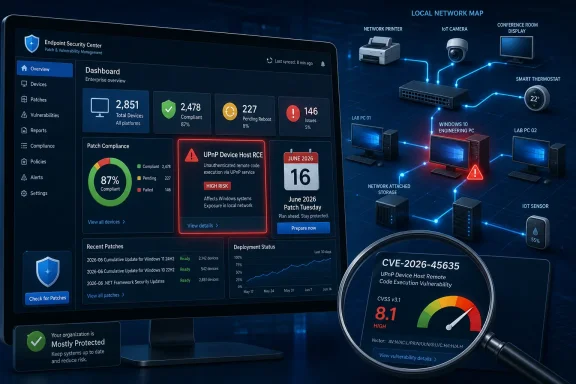
Microsoft disclosed CVE-2026-45635 on June 9, 2026 as an Important-rated Windows UPnP Device Host remote code execution vulnerability affecting the Universal Plug and Play stack, with public listings placing it in the June 2026 Patch Tuesday batch and assigning it a high CVSS score of 8.1. The headline is not that UPnP is suddenly new or exotic; it is that an old convenience layer remains security-relevant on modern Windows estates. For administrators, the most useful reading of this bug is not panic, but prioritization: patch quickly, verify exposure, and treat “local network” services as part of the attack surface rather than background plumbing.
June 2026 Patch Tuesday was not a small housekeeping release. Reporting on the bundle counted roughly 200 Microsoft fixes, including dozens of remote code execution issues and several publicly disclosed zero-days. In that crowd, CVE-2026-45635 could easily look like one more row in a spreadsheet.
That would be the wrong instinct. Windows UPnP Device Host sits in the category of components that rarely attract attention until something goes wrong. It is not as visible as Remote Desktop, Exchange, or the browser, but it lives in the same uncomfortable security neighborhood: network discovery, device interaction, COM-era plumbing, XML-ish protocols, and a long tail of legacy assumptions.
Microsoft’s own naming tells us the core risk. This is a remote code execution vulnerability in Windows UPnP Device Host, not a mere denial-of-service nuisance or information leak. Public vulnerability aggregators list it as high severity, and at least one public Patch Tuesday roundup places it beside another UPnP Device Host RCE, CVE-2026-45599, in the same monthly release.
The important qualifier is that Microsoft has not, at least in the public surface available at disclosure time, provided a rich technical teardown. That means defenders should avoid inventing exploit mechanics. But they should also avoid the opposite error: assuming a sparse advisory equals a low-priority bug.
That design made sense for homes, small offices, media devices, printers, cameras, routers, and PCs that needed to find one another. Microsoft’s UPnP architecture documentation describes a model built on IP, TCP, UDP, HTTP, XML, SOAP-style control, discovery, description, control, eventing, and presentation. In other words, it is not a single tiny switch; it is a framework for making devices discoverable and controllable.
Windows exposes two broad ideas here. The Control Point API lets applications discover and control UPnP devices. The Device Host API lets Windows-hosted software present device-like functionality to the network while the host handles UPnP-specific duties such as discovery, description, control, and eventing.
That distinction matters because CVE-2026-45635 names the Device Host side. The vulnerable component is not merely a passive consumer of device advertisements; it is part of the machinery that can publish hosted device functionality and handle incoming UPnP-based interactions. A flaw there naturally raises more serious questions than a purely local misconfiguration.
But severity labels compress too much. A remote code execution bug in a network-adjacent Windows service can be operationally important even when it misses the vendor’s Critical bar. CVSS scoring, exploitability notes, authentication requirements, network placement, and whether the service is enabled in a given estate all determine real-world urgency.
The specific metric language supplied with this vulnerability points to confidence in the vulnerability and the credibility of the known technical details. That is a subtle but valuable part of the scoring model. A vulnerability whose existence is vendor-acknowledged carries a different planning weight from a rumor, a half-reproduced crash, or a speculative research note.
Here, the existence of the issue is not the mystery. Microsoft assigned the CVE and shipped guidance through the Security Update Guide. The mystery is the missing depth: the exact root cause, reachable code path, practical exploitation constraints, and whether reliable exploitation requires a narrow configuration.
That asymmetry is common on Patch Tuesday. Defenders often get just enough to justify action and not enough to model the exploit like an attacker. The safest reading is conservative: if the affected component is present and exposed to untrusted network traffic, the advisory deserves prompt remediation.
For CVE-2026-45635, vendor acknowledgement is the anchor. Microsoft’s advisory is the event that turns a possible bug into a managed vulnerability. That should raise confidence that the issue is real, even if it leaves defenders with limited operational texture.
The second part of the metric is more uncomfortable: it also hints at how much technical knowledge might be available to would-be attackers. A vulnerability with a detailed public proof of concept is one kind of emergency. A vulnerability with only a vendor advisory is another. But the latter can move into the former category quickly, especially when a patch exists and attackers can compare pre-patch and post-patch binaries.
Patch diffing is not magic, but it is routine. When the updated component is known, the affected DLL is named in public reporting, and the class of bug is remote code execution, skilled researchers have a starting point. That does not mean weaponization is inevitable by Friday. It does mean the clock starts on disclosure day, not on the day a blog post explains the bug.
The local network is also where attackers often land after the first compromise. Phishing gets a foothold. A stolen credential opens a VPN session. A vulnerable edge appliance drops a shell. From there, discovery protocols and host services become part of lateral movement, reconnaissance, and privilege-building.
A UPnP Device Host RCE is therefore not simply a “home network” story. It is a Windows fleet hygiene story. Workstations, kiosks, lab machines, imaging stations, and older server roles may carry services that administrators stopped thinking about years ago.
This is where WindowsForum readers should be especially skeptical of default assumptions. The machines most likely to surprise you are not the pristine Intune-managed laptops that reboot nightly. They are the specialty systems in closets, the vendor-managed boxes, the old Windows Server instance under an application no one wants to touch, and the workstation that doubles as a controller for some irreplaceable piece of hardware.
The more interesting work comes around verification. Administrators should know where the UPnP Device Host service is running, whether it is required, and which network zones can reach systems that expose UPnP-related functionality. If the service is unnecessary, disabling it may reduce attack surface, but that decision belongs in change control rather than a late-night panic script.
Consumer and small-business users face a simpler version of the same problem. Install Windows updates, reboot, and do not expose unnecessary discovery or device-sharing services to networks you do not trust. The habit of joining public or semi-public networks and clicking through Windows sharing prompts remains one of the small ways convenience becomes risk.
Enterprise defenders should also watch for vendor appliances or products that embed or depend on Windows. Publicly available third-party patch notices often list Microsoft CVEs that affect Windows-based medical, industrial, or security products. Those environments may not consume Patch Tuesday the same way a normal laptop fleet does, and they may require vendor-certified update bundles.
Security debt often accumulates in precisely these places. Protocols that reduce friction for legitimate discovery can also increase the number of parsers, listeners, state machines, callbacks, and trust transitions exposed to local traffic. The attack surface is not one glamorous login page; it is a web of old assumptions.
Microsoft’s Device Host API documentation makes clear that the host handles discovery, description, control, eventing, and presentation for hosted devices. Each of those verbs has security consequences. Discovery means receiving and responding to network messages. Description means parsing and serving structured data. Control means routing actions. Eventing means subscription state. Presentation means another surface for interaction.
None of this makes UPnP uniquely doomed. Windows is full of legacy-capable subsystems that remain useful because compatibility matters. But compatibility and automatic discovery are exactly why defenders should keep such services visible in inventories and baselines.
CVE-2026-45635 is a good example of why asset context beats generic severity scoring. The same CVE can mean different things across three environments. A fully patched laptop fleet with UPnP-related services restricted by firewall policy is one risk. A flat lab network with unpatched Windows hosts and device discovery enabled is another. A vendor-controlled Windows appliance on a medical or industrial subnet is another still.
The lack of public exploit details should shape communications. Security teams should not claim active exploitation unless they have evidence. They should not describe the root cause beyond what is known. But they can accurately say that Microsoft has shipped a fix for a high-severity Windows UPnP Device Host remote code execution vulnerability and that remote code execution in a network-facing component warrants priority handling.
This is also a reminder that vulnerability maturity cuts both ways. High confidence in existence supports urgent remediation. Low public detail may reduce immediate commodity-exploit risk, but it also prevents defenders from crafting precise compensating controls.
UPnP Device Host vulnerabilities are particularly likely to intersect with oddball systems because UPnP exists to support device-oriented use cases. Media systems, device controllers, lab tools, imaging equipment, conference-room PCs, and embedded Windows installations may not look like high-value assets, but they can be network-adjacent footholds.
The uncomfortable question for administrators is not “Do we have Windows?” It is “Where do we have Windows doing device-host-like things that the central endpoint dashboard barely understands?” That question is less glamorous than reading exploit code, but it is usually more productive.
Network segmentation also deserves a reality check. If workstations, device networks, and server management planes can all talk freely because it was easier during deployment, a local-network RCE is more serious than the abstract rating suggests. Segmentation failures turn proximity bugs into movement bugs.
The right operational question is not whether UPnP is good or bad. The question is whether a given environment intentionally uses it. If the answer is yes, it should be patched, monitored, and segmented like any other network-capable service. If the answer is no, it should not be quietly available merely because no one has filed a ticket to remove it.
Security teams can turn this advisory into a useful review without overreacting. Look at service state. Look at firewall profiles. Look at where device discovery is allowed. Look at unmanaged VLANs and specialist Windows boxes. Then make the environment match the policy rather than the other way around.
For home users, the same principle compresses into a simpler rule: keep Windows updated and be cautious about trusting networks. UPnP has historically been most associated with home convenience, but modern Windows devices move between home, office, hotel, school, and hotspot networks constantly. The network context changes faster than the service inventory.
 Microsoft’s Quiet UPnP Bug Lands in a Very Loud Patch Tuesday
June 2026 Patch Tuesday was not a small housekeeping release. Reporting on the bundle counted roughly 200 Microsoft fixes, including dozens of remote code execution issues and several publicly disclosed zero-days. In that crowd, CVE-2026-45635 could easily look like one more row in a spreadsheet.That would be the wrong instinct. Windows UPnP Device Host sits in the category of components that rarely attract attention until something goes wrong. It is not as visible as Remote Desktop, Exchange, or the browser, but it lives in the same uncomfortable security neighborhood: network discovery, device interaction, COM-era plumbing, XML-ish protocols, and a long tail of legacy assumptions.
Microsoft’s own naming tells us the core risk. This is a remote code execution vulnerability in Windows UPnP Device Host, not a mere denial-of-service nuisance or information leak. Public vulnerability aggregators list it as high severity, and at least one public Patch Tuesday roundup places it beside another UPnP Device Host RCE, CVE-2026-45599, in the same monthly release.
The important qualifier is that Microsoft has not, at least in the public surface available at disclosure time, provided a rich technical teardown. That means defenders should avoid inventing exploit mechanics. But they should also avoid the opposite error: assuming a sparse advisory equals a low-priority bug.
UPnP Is Convenience Wearing a Network Badge
Universal Plug and Play was designed to make networks feel less like networks. Devices could appear, announce themselves, describe their capabilities, and allow software to interact with them without hand-editing configuration files or teaching every user the difference between ports, protocols, and service discovery.That design made sense for homes, small offices, media devices, printers, cameras, routers, and PCs that needed to find one another. Microsoft’s UPnP architecture documentation describes a model built on IP, TCP, UDP, HTTP, XML, SOAP-style control, discovery, description, control, eventing, and presentation. In other words, it is not a single tiny switch; it is a framework for making devices discoverable and controllable.
Windows exposes two broad ideas here. The Control Point API lets applications discover and control UPnP devices. The Device Host API lets Windows-hosted software present device-like functionality to the network while the host handles UPnP-specific duties such as discovery, description, control, and eventing.
That distinction matters because CVE-2026-45635 names the Device Host side. The vulnerable component is not merely a passive consumer of device advertisements; it is part of the machinery that can publish hosted device functionality and handle incoming UPnP-based interactions. A flaw there naturally raises more serious questions than a purely local misconfiguration.
The Scariest Words Are Not Always “Critical”
Microsoft rated CVE-2026-45635 as Important rather than Critical, according to public Patch Tuesday listings. That label will tempt some patch queues to demote it behind scarier-looking CVEs. In many enterprise environments, “Critical” means immediate escalation, while “Important” becomes next-cycle work unless exploitation is known.But severity labels compress too much. A remote code execution bug in a network-adjacent Windows service can be operationally important even when it misses the vendor’s Critical bar. CVSS scoring, exploitability notes, authentication requirements, network placement, and whether the service is enabled in a given estate all determine real-world urgency.
The specific metric language supplied with this vulnerability points to confidence in the vulnerability and the credibility of the known technical details. That is a subtle but valuable part of the scoring model. A vulnerability whose existence is vendor-acknowledged carries a different planning weight from a rumor, a half-reproduced crash, or a speculative research note.
Here, the existence of the issue is not the mystery. Microsoft assigned the CVE and shipped guidance through the Security Update Guide. The mystery is the missing depth: the exact root cause, reachable code path, practical exploitation constraints, and whether reliable exploitation requires a narrow configuration.
That asymmetry is common on Patch Tuesday. Defenders often get just enough to justify action and not enough to model the exploit like an attacker. The safest reading is conservative: if the affected component is present and exposed to untrusted network traffic, the advisory deserves prompt remediation.
Report Confidence Is a Defender’s Reality Check
The user-supplied description of the confidence metric captures a frustrating truth of vulnerability management. Sometimes the world knows a vulnerability exists before anyone outside the vendor knows exactly why. Sometimes researchers can infer the dangerous neighborhood but not the precise failing instruction. Sometimes attackers learn faster than defenders because they can diff patches, fuzz adjacent inputs, and test hypotheses without waiting for a white paper.For CVE-2026-45635, vendor acknowledgement is the anchor. Microsoft’s advisory is the event that turns a possible bug into a managed vulnerability. That should raise confidence that the issue is real, even if it leaves defenders with limited operational texture.
The second part of the metric is more uncomfortable: it also hints at how much technical knowledge might be available to would-be attackers. A vulnerability with a detailed public proof of concept is one kind of emergency. A vulnerability with only a vendor advisory is another. But the latter can move into the former category quickly, especially when a patch exists and attackers can compare pre-patch and post-patch binaries.
Patch diffing is not magic, but it is routine. When the updated component is known, the affected DLL is named in public reporting, and the class of bug is remote code execution, skilled researchers have a starting point. That does not mean weaponization is inevitable by Friday. It does mean the clock starts on disclosure day, not on the day a blog post explains the bug.
The Local Network Is Not a Trust Boundary Anymore
UPnP risk is often waved away with a familiar phrase: “It’s only on the local network.” That phrase has aged badly. Modern enterprise networks are full of unmanaged devices, VPN clients, developer laptops, conference-room gear, lab equipment, medical systems, building controls, IoT appliances, and guest segments that are not as segmented as diagrams suggest.The local network is also where attackers often land after the first compromise. Phishing gets a foothold. A stolen credential opens a VPN session. A vulnerable edge appliance drops a shell. From there, discovery protocols and host services become part of lateral movement, reconnaissance, and privilege-building.
A UPnP Device Host RCE is therefore not simply a “home network” story. It is a Windows fleet hygiene story. Workstations, kiosks, lab machines, imaging stations, and older server roles may carry services that administrators stopped thinking about years ago.
This is where WindowsForum readers should be especially skeptical of default assumptions. The machines most likely to surprise you are not the pristine Intune-managed laptops that reboot nightly. They are the specialty systems in closets, the vendor-managed boxes, the old Windows Server instance under an application no one wants to touch, and the workstation that doubles as a controller for some irreplaceable piece of hardware.
The Patch Is the Centerpiece, Not the Whole Playbook
For most organizations, the primary response is straightforward: apply the June 2026 Windows security updates that cover the affected platforms. That sounds banal because it is. Banal is good when the alternative is a custom mitigation based on incomplete exploit details.The more interesting work comes around verification. Administrators should know where the UPnP Device Host service is running, whether it is required, and which network zones can reach systems that expose UPnP-related functionality. If the service is unnecessary, disabling it may reduce attack surface, but that decision belongs in change control rather than a late-night panic script.
Consumer and small-business users face a simpler version of the same problem. Install Windows updates, reboot, and do not expose unnecessary discovery or device-sharing services to networks you do not trust. The habit of joining public or semi-public networks and clicking through Windows sharing prompts remains one of the small ways convenience becomes risk.
Enterprise defenders should also watch for vendor appliances or products that embed or depend on Windows. Publicly available third-party patch notices often list Microsoft CVEs that affect Windows-based medical, industrial, or security products. Those environments may not consume Patch Tuesday the same way a normal laptop fleet does, and they may require vendor-certified update bundles.
UPnP’s Security Debt Comes From Its Original Promise
The original promise of UPnP was frictionless interoperability. Devices would describe themselves. Control points would find them. Hosted services would answer in standardized ways. Users would not need to understand the network.Security debt often accumulates in precisely these places. Protocols that reduce friction for legitimate discovery can also increase the number of parsers, listeners, state machines, callbacks, and trust transitions exposed to local traffic. The attack surface is not one glamorous login page; it is a web of old assumptions.
Microsoft’s Device Host API documentation makes clear that the host handles discovery, description, control, eventing, and presentation for hosted devices. Each of those verbs has security consequences. Discovery means receiving and responding to network messages. Description means parsing and serving structured data. Control means routing actions. Eventing means subscription state. Presentation means another surface for interaction.
None of this makes UPnP uniquely doomed. Windows is full of legacy-capable subsystems that remain useful because compatibility matters. But compatibility and automatic discovery are exactly why defenders should keep such services visible in inventories and baselines.
Sparse Advisories Reward Prepared Teams
When Microsoft publishes a sparse advisory, mature teams do not wait for perfect information. They map the affected component to assets, check exposure, patch according to risk, and monitor for signs that exploitation is becoming practical. Less mature teams argue over the missing details until the maintenance window passes.CVE-2026-45635 is a good example of why asset context beats generic severity scoring. The same CVE can mean different things across three environments. A fully patched laptop fleet with UPnP-related services restricted by firewall policy is one risk. A flat lab network with unpatched Windows hosts and device discovery enabled is another. A vendor-controlled Windows appliance on a medical or industrial subnet is another still.
The lack of public exploit details should shape communications. Security teams should not claim active exploitation unless they have evidence. They should not describe the root cause beyond what is known. But they can accurately say that Microsoft has shipped a fix for a high-severity Windows UPnP Device Host remote code execution vulnerability and that remote code execution in a network-facing component warrants priority handling.
This is also a reminder that vulnerability maturity cuts both ways. High confidence in existence supports urgent remediation. Low public detail may reduce immediate commodity-exploit risk, but it also prevents defenders from crafting precise compensating controls.
The Real Exposure Is Hidden in Exceptions
Every Patch Tuesday creates a list of exceptions. Machines that cannot reboot. Systems that need vendor approval. Servers waiting for a test cycle. Remote sites with fragile bandwidth. Laptops offline during the window. These exceptions are where Important-rated bugs often live long enough to matter.UPnP Device Host vulnerabilities are particularly likely to intersect with oddball systems because UPnP exists to support device-oriented use cases. Media systems, device controllers, lab tools, imaging equipment, conference-room PCs, and embedded Windows installations may not look like high-value assets, but they can be network-adjacent footholds.
The uncomfortable question for administrators is not “Do we have Windows?” It is “Where do we have Windows doing device-host-like things that the central endpoint dashboard barely understands?” That question is less glamorous than reading exploit code, but it is usually more productive.
Network segmentation also deserves a reality check. If workstations, device networks, and server management planes can all talk freely because it was easier during deployment, a local-network RCE is more serious than the abstract rating suggests. Segmentation failures turn proximity bugs into movement bugs.
The June Fix Should Trigger an Inventory Habit
CVE-2026-45635 should be handled as part of the June 2026 security update cycle, but its larger lesson is inventory discipline. Windows services that sound obsolete often remain present because applications rely on them, administrators forgot them, or default images carried them forward for years.The right operational question is not whether UPnP is good or bad. The question is whether a given environment intentionally uses it. If the answer is yes, it should be patched, monitored, and segmented like any other network-capable service. If the answer is no, it should not be quietly available merely because no one has filed a ticket to remove it.
Security teams can turn this advisory into a useful review without overreacting. Look at service state. Look at firewall profiles. Look at where device discovery is allowed. Look at unmanaged VLANs and specialist Windows boxes. Then make the environment match the policy rather than the other way around.
For home users, the same principle compresses into a simpler rule: keep Windows updated and be cautious about trusting networks. UPnP has historically been most associated with home convenience, but modern Windows devices move between home, office, hotel, school, and hotspot networks constantly. The network context changes faster than the service inventory.
The Practical Reading for WindowsForum Readers
CVE-2026-45635 is not the biggest Windows vulnerability name of the year, and it may never become a household exploit label. But it belongs in the category of bugs that reward fast, boring competence. The danger is not that every Windows PC is suddenly doomed; the danger is that organizations will miss the exposure because the component feels old, quiet, and peripheral.- Microsoft disclosed CVE-2026-45635 on June 9, 2026 as a Windows UPnP Device Host remote code execution vulnerability in the June Patch Tuesday release.
- Public vulnerability listings place the issue at high severity, with a CVSS score reported as 8.1 and Microsoft severity reported as Important.
- The most defensible immediate action is to apply the June 2026 Windows security updates and confirm that affected systems actually reboot into the patched state.
- Administrators should review whether UPnP Device Host functionality is required, especially on flat networks, lab systems, kiosks, vendor-managed Windows appliances, and specialty workstations.
- The absence of detailed public exploit mechanics should not be mistaken for proof of safety, because vendor acknowledgement and released patches give attackers material to analyze.
- The local network should be treated as an attack surface, not a trusted sanctuary.
References
- Primary source: MSRC
Published: 2026-06-09T07:00:00-07:00
Security Update Guide - Microsoft Security Response Center
 msrc.microsoft.com
- Related coverage: thewindowsupdate.com
- Related coverage: datacomm.com
- Related coverage: rapid7.com
Rapid7 Vulnerability Database
Rapid7's VulnDB is curated repository of vetted computer software exploits and exploitable vulnerabilities.www.rapid7.com - Related coverage: sentinelone.com
CVE-2026-32156: Windows UPnP Use-After-Free Vulnerability
CVE-2026-32156 is a use-after-free vulnerability in Windows UPnP Device Host. Learn about its impact, affected versions, and mitigation methods.www.sentinelone.com
- Related coverage: netservicesgroup.com
CVE-2026-32077 Windows UPnP Device Host Elevation of Privilege Vulnerability - Network Services Group
Added Security Only packages to Windows Server 2012 security updates. This is an informational change only.www.netservicesgroup.com
- Related coverage: mindray.com
- Related coverage: buildings.honeywell.com
The purpose of this document is to identify the patches that have been delivered by Microsoft® which have been tested against Pro-Watch
PDF documentbuildings.honeywell.com
- Related coverage: stack.watch
- Related coverage: bleepingcomputer.com
Microsoft June 2026 Patch Tuesday fixes 6 zero-days, 200 flaws
Today is Microsoft's June 2026 Patch Tuesday, with security updates for 200 flaws, including five publicly disclosed zero-day vulnerabilities and one actively exploited in attacks.www.bleepingcomputer.com