

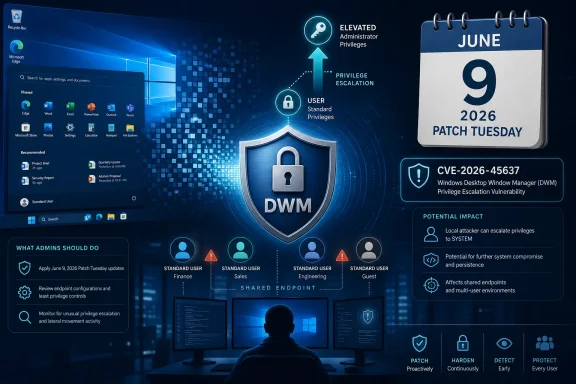
CVE-2026-45637 is an Important-rated Microsoft DWM Core Library elevation-of-privilege vulnerability patched in Microsoft’s June 9, 2026 Patch Tuesday release, affecting Windows systems through the Desktop Window Manager component and carrying a reported CVSS base score of 7.8. It is not the loudest vulnerability in this month’s bundle, and that is precisely why it deserves attention. Local privilege escalation bugs rarely make for cinematic breach headlines, but they are the connective tissue of real intrusions: the step between “I have a foothold” and “I own the box.” The useful lesson here is not that DWM suddenly became exotic; it is that Windows’ graphical plumbing remains part of the security boundary administrators cannot afford to treat as mere desktop decoration.
Microsoft’s DWM Core Library sits in the machinery that makes modern Windows feel like modern Windows. Desktop Window Manager is responsible for compositing windows, visual effects, and the display pipeline that users experience as the desktop. In enterprise risk terms, that sounds almost mundane, which is why DWM vulnerabilities can be underestimated.
CVE-2026-45637 is an elevation-of-privilege issue, meaning it does not give an attacker an initial route into a machine by itself. The attacker already needs some level of local access or code execution. But in Windows security, “local” is not a synonym for “low priority.” Malware delivered through phishing, a malicious document, a compromised browser process, or an abused helpdesk tool often begins with limited rights and then hunts for a local privilege escalation primitive.
That is where a bug like this matters. If exploitation succeeds, an attacker can potentially move from an ordinary user context toward higher privileges, depending on the vulnerable path and the surrounding protections. Microsoft has not published deep technical internals for this CVE, so defenders should resist filling in the blanks with folklore. The operational conclusion is simpler: patch it because privilege escalation is what turns compromise into control.
For CVE-2026-45637, the existence of the vulnerability is not speculative. It appears in Microsoft’s Security Update Guide and in June 2026 Patch Tuesday reporting as a Microsoft DWM Core Library elevation-of-privilege vulnerability. That puts it in a different category from “someone posted a crash on social media” or “a researcher hinted at a bug class.” The vendor has shipped a fix.
But confirmation of existence is not the same thing as public exploitability detail. As of this Patch Tuesday cycle, public roundups list the bug as not publicly disclosed before release and not known to be exploited in the wild. That distinction matters. It lowers the immediate emergency compared with an actively exploited zero-day, but it does not lower the need to deploy the update on normal security timelines.
A confirmed, patched local privilege escalation bug creates a familiar race. Defenders get the fix first, but attackers get the same patch diff. Once update packages are available, skilled researchers and adversaries can compare old and new binaries and infer what changed. The absence of a public exploit on release day is not a permanent state of nature.
That does not automatically mean a single catastrophic design failure exists in DWM. Large Windows components often generate clusters because related code is audited together, fuzzed together, or touched by the same internal hardening effort. When one flaw is found in a subsystem, both Microsoft and outside researchers tend to look nearby.
Still, clusters matter to administrators because they change the patching calculus. A lone local bug might be mentally filed under “workstation hygiene.” A cluster in a core graphical component should instead remind IT teams that endpoint hardening and update compliance are inseparable. DWM runs on the machines users actually touch: laptops, desktops, jump boxes, engineering workstations, kiosks, and, in many cases, servers with desktop experience enabled.
The broader Windows history reinforces the point. DWM and adjacent graphics components have appeared in prior privilege-escalation advisories, including bugs that security teams took seriously because graphics and windowing code sit close to sensitive kernel-adjacent boundaries. The desktop is not just pixels. It is a privileged mediation layer between user processes, sessions, memory objects, handles, and presentation surfaces.
Remote code execution bugs tend to win headlines because they can be entry points. Elevation-of-privilege bugs tend to win intrusions because they are force multipliers. An attacker who lands on a workstation as a standard user may be boxed in by application control, credential isolation, EDR, and least privilege. Give that attacker a reliable local elevation path and the entire defensive geometry changes.
A CVSS 7.8 score is typical for many local privilege escalation issues with high confidentiality, integrity, and availability impact after exploitation. It tells us the bug is not remotely reachable over the network in the way a wormable service bug might be. It also tells us the outcome can be serious if the attacker satisfies the prerequisites.
The best way to read “Important” here is not “less important than critical.” It is “important in a different phase of the attack chain.” Enterprises that patch only the front door and ignore the stairwell eventually learn that attackers do not respect the distinction.
Shared Windows devices are especially interesting. Lab machines, call-center desktops, classroom PCs, point-of-sale terminals, and contractor workstations often have multiple users, inconsistent hygiene, and a larger chance that untrusted code runs at some point. A local elevation bug has more opportunities to matter when “local user” is not a single trusted employee with a tightly managed software profile.
Developer and administrator workstations deserve even more attention. These systems often hold credentials, source code, deployment tools, SSH keys, VPN access, cloud sessions, and privileged management consoles. A local bug on a developer laptop can be more strategically valuable than a remote bug on a low-value server.
Then there are Windows servers configured with graphical components or used interactively by administrators. Server Core reduces some exposure by removing unnecessary surface area, but not every organization has completed that transition. Legacy operational habits — logging into servers with full desktops, browsing from admin boxes, installing vendor tools interactively — continue to create opportunities for local bugs to become enterprise events.
That chain-oriented view is why local privilege escalation bugs maintain their market value. They reduce the attacker’s dependence on social engineering after the first step. They let malware escape low-integrity sandboxes, tamper with security tools, dump credentials, install persistence, or interact with protected system resources.
For ransomware operators, privilege escalation is frequently the road from nuisance to leverage. For espionage actors, it is the way to survive reboots, hide better, and harvest secrets from more sensitive contexts. For commodity malware, it is a way to turn a broad but shallow infection into a more durable foothold.
This is also why patch prioritization systems should not score solely on remote reachability. A local EoP with no public exploit may rank below a critical RCE in the first 24 hours. But if that EoP affects a broad Windows fleet and lands in a month with multiple other exploitable client-side bugs, it belongs much higher than the word “local” suggests.
For CVE-2026-45637, the confidence story strengthens the patch case. Microsoft has acknowledged the issue through the Security Update Guide, and independent Patch Tuesday coverage has picked it up in the June 2026 release inventory. That means security teams can treat the vulnerability as real even without exploit code or root-cause details.
At the same time, the limited public technical detail constrains what defenders can responsibly say. We should not invent an exploit path, name a vulnerable function, or claim a particular privilege outcome beyond the published elevation-of-privilege impact. The responsible position is to accept the vendor-confirmed risk while acknowledging that the exploit mechanics remain opaque.
That uncertainty is not unusual. Microsoft often provides sparse public descriptions for Windows internals bugs, partly to avoid arming attackers and partly because the Security Update Guide is designed for operational triage rather than vulnerability research. Administrators may dislike the lack of detail, but they do not need a full proof-of-concept to know what to do next.
The question is whether it can be safely ignored while teams chase the flashier entries. The answer is no. DWM is widely deployed, the bug is privilege-related, and it lives on the endpoint side of the Windows estate where initial access frequently happens.
Patch teams should stage the June cumulative updates through rings, as usual, but they should not let the absence of known exploitation become an excuse for indefinite delay. Pilot devices, IT workstations, high-risk user groups, and exposed administrative endpoints should move early. Broad workstation rollout should follow once application compatibility checks clear.
Organizations that have mature vulnerability management should also look for compensating signals. Are there EDR detections around suspicious child processes, token manipulation, abnormal DWM-adjacent crashes, or post-exploitation behavior? Are users running with local administrator rights unnecessarily? Are privileged accounts logging into everyday desktops? The patch is the fix, but the surrounding hygiene determines how much damage a missed patch can do.
For Windows 10 systems still receiving updates through supported channels or extended security arrangements, the June 2026 update belongs in the normal deployment pipeline. For systems outside support, the problem is structural rather than tactical. Unsupported Windows machines do not merely miss one DWM fix; they accumulate an expanding archive of known weaknesses.
That matters because attackers do not need every endpoint to be vulnerable. They need one useful endpoint in the right place. A forgotten Windows box in a lab, warehouse, branch office, or vendor-managed corner of the network can become the path of least resistance.
The DWM angle adds a practical reminder: “server exposure” is not the only exposure. Client estates age, drift, and quietly fall out of compliance. A vulnerability in a desktop-facing component is a test of endpoint governance as much as patch engineering.
The more interesting work is using this CVE to audit assumptions. If a local elevation-of-privilege bug in a core Windows component causes panic, it may mean too many users have too much local freedom, too many admin workflows depend on interactive desktop logons, or too many endpoints lack reliable update telemetry. A single CVE can be a useful diagnostic for the health of the entire management stack.
Security teams should also avoid over-rotating on exploit availability. Public exploit code is a lagging indicator. By the time a weaponized proof-of-concept is widely circulated, defenders have already lost the quiet window in which patching is easiest.
For WindowsForum readers, the home-lab lesson is the same in miniature. Snapshots are not patching. Antivirus is not patching. Running as a standard user helps, but it does not erase local privilege escalation risk. If a system matters enough to keep on the network, it matters enough to keep current.
 The Bug Is Local, but the Consequences Are Not
Microsoft’s DWM Core Library sits in the machinery that makes modern Windows feel like modern Windows. Desktop Window Manager is responsible for compositing windows, visual effects, and the display pipeline that users experience as the desktop. In enterprise risk terms, that sounds almost mundane, which is why DWM vulnerabilities can be underestimated.CVE-2026-45637 is an elevation-of-privilege issue, meaning it does not give an attacker an initial route into a machine by itself. The attacker already needs some level of local access or code execution. But in Windows security, “local” is not a synonym for “low priority.” Malware delivered through phishing, a malicious document, a compromised browser process, or an abused helpdesk tool often begins with limited rights and then hunts for a local privilege escalation primitive.
That is where a bug like this matters. If exploitation succeeds, an attacker can potentially move from an ordinary user context toward higher privileges, depending on the vulnerable path and the surrounding protections. Microsoft has not published deep technical internals for this CVE, so defenders should resist filling in the blanks with folklore. The operational conclusion is simpler: patch it because privilege escalation is what turns compromise into control.
Microsoft’s Silence Is Also a Signal
The user-supplied MSRC text about “confidence” is not boilerplate fluff. It describes a vulnerability scoring dimension that tries to capture how certain the industry is that a flaw exists and how credible the available technical information is. In CVSS language, this is the report confidence idea: a vulnerability acknowledged by the vendor carries more weight than rumor, partial reverse engineering, or a vague third-party claim.For CVE-2026-45637, the existence of the vulnerability is not speculative. It appears in Microsoft’s Security Update Guide and in June 2026 Patch Tuesday reporting as a Microsoft DWM Core Library elevation-of-privilege vulnerability. That puts it in a different category from “someone posted a crash on social media” or “a researcher hinted at a bug class.” The vendor has shipped a fix.
But confirmation of existence is not the same thing as public exploitability detail. As of this Patch Tuesday cycle, public roundups list the bug as not publicly disclosed before release and not known to be exploited in the wild. That distinction matters. It lowers the immediate emergency compared with an actively exploited zero-day, but it does not lower the need to deploy the update on normal security timelines.
A confirmed, patched local privilege escalation bug creates a familiar race. Defenders get the fix first, but attackers get the same patch diff. Once update packages are available, skilled researchers and adversaries can compare old and new binaries and infer what changed. The absence of a public exploit on release day is not a permanent state of nature.
DWM Has Become a Recurring Patch Tuesday Character
One notable feature of the June 2026 update is not merely that DWM appears, but that it appears repeatedly. Patch Tuesday reporting lists multiple DWM Core Library issues in the same release, including several elevation-of-privilege vulnerabilities and information disclosure flaws. CVE-2026-45637 is part of a cluster, not an isolated cameo.That does not automatically mean a single catastrophic design failure exists in DWM. Large Windows components often generate clusters because related code is audited together, fuzzed together, or touched by the same internal hardening effort. When one flaw is found in a subsystem, both Microsoft and outside researchers tend to look nearby.
Still, clusters matter to administrators because they change the patching calculus. A lone local bug might be mentally filed under “workstation hygiene.” A cluster in a core graphical component should instead remind IT teams that endpoint hardening and update compliance are inseparable. DWM runs on the machines users actually touch: laptops, desktops, jump boxes, engineering workstations, kiosks, and, in many cases, servers with desktop experience enabled.
The broader Windows history reinforces the point. DWM and adjacent graphics components have appeared in prior privilege-escalation advisories, including bugs that security teams took seriously because graphics and windowing code sit close to sensitive kernel-adjacent boundaries. The desktop is not just pixels. It is a privileged mediation layer between user processes, sessions, memory objects, handles, and presentation surfaces.
“Important” Is Not a Permission Slip to Wait
Microsoft’s “Important” severity label often creates a dangerous psychological gap. Many patch teams triage “Critical” as urgent and “Important” as negotiable. That habit is understandable when administrators are drowning in hundreds of CVEs, but it is not always aligned with attacker behavior.Remote code execution bugs tend to win headlines because they can be entry points. Elevation-of-privilege bugs tend to win intrusions because they are force multipliers. An attacker who lands on a workstation as a standard user may be boxed in by application control, credential isolation, EDR, and least privilege. Give that attacker a reliable local elevation path and the entire defensive geometry changes.
A CVSS 7.8 score is typical for many local privilege escalation issues with high confidentiality, integrity, and availability impact after exploitation. It tells us the bug is not remotely reachable over the network in the way a wormable service bug might be. It also tells us the outcome can be serious if the attacker satisfies the prerequisites.
The best way to read “Important” here is not “less important than critical.” It is “important in a different phase of the attack chain.” Enterprises that patch only the front door and ignore the stairwell eventually learn that attackers do not respect the distinction.
The Real Risk Lives on Shared and High-Value Endpoints
For consumers, the advice is straightforward: install the June 2026 cumulative update when offered, avoid running unknown software, and do not assume administrator prompts are the only line between safety and compromise. Windows Update will be the practical delivery mechanism for most home systems. The bigger complexity sits in managed environments.Shared Windows devices are especially interesting. Lab machines, call-center desktops, classroom PCs, point-of-sale terminals, and contractor workstations often have multiple users, inconsistent hygiene, and a larger chance that untrusted code runs at some point. A local elevation bug has more opportunities to matter when “local user” is not a single trusted employee with a tightly managed software profile.
Developer and administrator workstations deserve even more attention. These systems often hold credentials, source code, deployment tools, SSH keys, VPN access, cloud sessions, and privileged management consoles. A local bug on a developer laptop can be more strategically valuable than a remote bug on a low-value server.
Then there are Windows servers configured with graphical components or used interactively by administrators. Server Core reduces some exposure by removing unnecessary surface area, but not every organization has completed that transition. Legacy operational habits — logging into servers with full desktops, browsing from admin boxes, installing vendor tools interactively — continue to create opportunities for local bugs to become enterprise events.
Attackers Chain What Defenders Triage Separately
The most misleading way to evaluate CVE-2026-45637 is as a standalone event. Real-world intrusions are assembled from pieces. One vulnerability gets code running. Another bypasses a prompt. Another steals a token. Another elevates privileges. Another disables protection. Another moves laterally.That chain-oriented view is why local privilege escalation bugs maintain their market value. They reduce the attacker’s dependence on social engineering after the first step. They let malware escape low-integrity sandboxes, tamper with security tools, dump credentials, install persistence, or interact with protected system resources.
For ransomware operators, privilege escalation is frequently the road from nuisance to leverage. For espionage actors, it is the way to survive reboots, hide better, and harvest secrets from more sensitive contexts. For commodity malware, it is a way to turn a broad but shallow infection into a more durable foothold.
This is also why patch prioritization systems should not score solely on remote reachability. A local EoP with no public exploit may rank below a critical RCE in the first 24 hours. But if that EoP affects a broad Windows fleet and lands in a month with multiple other exploitable client-side bugs, it belongs much higher than the word “local” suggests.
The Confidence Metric Cuts Both Ways
The report-confidence language supplied with the CVE is useful because it separates three states defenders often blur together: rumor, corroboration, and vendor confirmation. A rumor may justify monitoring. Corroboration may justify mitigation. Vendor confirmation with a shipped fix justifies patch deployment.For CVE-2026-45637, the confidence story strengthens the patch case. Microsoft has acknowledged the issue through the Security Update Guide, and independent Patch Tuesday coverage has picked it up in the June 2026 release inventory. That means security teams can treat the vulnerability as real even without exploit code or root-cause details.
At the same time, the limited public technical detail constrains what defenders can responsibly say. We should not invent an exploit path, name a vulnerable function, or claim a particular privilege outcome beyond the published elevation-of-privilege impact. The responsible position is to accept the vendor-confirmed risk while acknowledging that the exploit mechanics remain opaque.
That uncertainty is not unusual. Microsoft often provides sparse public descriptions for Windows internals bugs, partly to avoid arming attackers and partly because the Security Update Guide is designed for operational triage rather than vulnerability research. Administrators may dislike the lack of detail, but they do not need a full proof-of-concept to know what to do next.
Patch Tuesday Scale Makes Triage Harder, Not Optional
June 2026’s Patch Tuesday is unusually crowded, with reporting placing the Microsoft fixes at around 200 vulnerabilities, plus a very large number of Chromium issues flowing into Edge. That scale changes the defender’s problem. The question is not whether CVE-2026-45637 is the single scariest item in the release. It almost certainly is not.The question is whether it can be safely ignored while teams chase the flashier entries. The answer is no. DWM is widely deployed, the bug is privilege-related, and it lives on the endpoint side of the Windows estate where initial access frequently happens.
Patch teams should stage the June cumulative updates through rings, as usual, but they should not let the absence of known exploitation become an excuse for indefinite delay. Pilot devices, IT workstations, high-risk user groups, and exposed administrative endpoints should move early. Broad workstation rollout should follow once application compatibility checks clear.
Organizations that have mature vulnerability management should also look for compensating signals. Are there EDR detections around suspicious child processes, token manipulation, abnormal DWM-adjacent crashes, or post-exploitation behavior? Are users running with local administrator rights unnecessarily? Are privileged accounts logging into everyday desktops? The patch is the fix, but the surrounding hygiene determines how much damage a missed patch can do.
Windows 10’s Afterlife Raises the Stakes
CVE-2026-45637 also lands in a Windows ecosystem still dealing with the long tail of Windows 10. Many organizations remain in transition, balancing Windows 11 adoption, hardware refresh cycles, application certification, and extended support realities. Vulnerabilities in core Windows components become more awkward when the installed base is fragmented across supported, extended, and legacy configurations.For Windows 10 systems still receiving updates through supported channels or extended security arrangements, the June 2026 update belongs in the normal deployment pipeline. For systems outside support, the problem is structural rather than tactical. Unsupported Windows machines do not merely miss one DWM fix; they accumulate an expanding archive of known weaknesses.
That matters because attackers do not need every endpoint to be vulnerable. They need one useful endpoint in the right place. A forgotten Windows box in a lab, warehouse, branch office, or vendor-managed corner of the network can become the path of least resistance.
The DWM angle adds a practical reminder: “server exposure” is not the only exposure. Client estates age, drift, and quietly fall out of compliance. A vulnerability in a desktop-facing component is a test of endpoint governance as much as patch engineering.
Administrators Should Treat This as a Hygiene Test
The recommended response to CVE-2026-45637 is not exotic. Deploy the Microsoft security update. Verify installation. Watch for failures. Confirm that high-value endpoints are not lagging behind. That sounds boring because good vulnerability management is often boring.The more interesting work is using this CVE to audit assumptions. If a local elevation-of-privilege bug in a core Windows component causes panic, it may mean too many users have too much local freedom, too many admin workflows depend on interactive desktop logons, or too many endpoints lack reliable update telemetry. A single CVE can be a useful diagnostic for the health of the entire management stack.
Security teams should also avoid over-rotating on exploit availability. Public exploit code is a lagging indicator. By the time a weaponized proof-of-concept is widely circulated, defenders have already lost the quiet window in which patching is easiest.
For WindowsForum readers, the home-lab lesson is the same in miniature. Snapshots are not patching. Antivirus is not patching. Running as a standard user helps, but it does not erase local privilege escalation risk. If a system matters enough to keep on the network, it matters enough to keep current.
The DWM Fix Says More Than Its CVE Page Does
CVE-2026-45637 is one line in a very large June update, but it points to several concrete lessons for Windows environments.- Microsoft patched CVE-2026-45637 on June 9, 2026 as an Important-rated DWM Core Library elevation-of-privilege vulnerability with a reported CVSS base score of 7.8.
- Public reporting at release time did not identify the bug as publicly disclosed before the patch or actively exploited in the wild.
- The vulnerability should be treated as a post-compromise privilege escalation risk rather than an initial-access bug.
- DWM’s repeated appearance in the June 2026 vulnerability list makes endpoint patch compliance especially important this month.
- Administrators should prioritize high-value workstations, shared desktops, and systems used for privileged administration during rollout.
- The lack of public technical detail is not a reason to wait, because vendor confirmation and an available fix are enough to drive action.
References
- Primary source: MSRC
Published: 2026-06-09T07:00:00-07:00
Security Update Guide - Microsoft Security Response Center
 msrc.microsoft.com
- Related coverage: datacomm.com
- Related coverage: rapid7.com
Rapid7 Vulnerability Database
Rapid7's VulnDB is curated repository of vetted computer software exploits and exploitable vulnerabilities.www.rapid7.com - Official source: microsoft.com
MSRC - Microsoft Security Response Center
The Microsoft Security Response Center is part of the defender community and on the front line of security response evolution. For over twenty years, we have been engaged with security researchers working to protect customers and the broader ecosystem.www.microsoft.com
- Related coverage: thewindowsupdate.com
- Related coverage: api.urlscan.io

api.msrc.microsoft.com - urlscan.io
urlscan.io - Website scanner for suspicious and malicious URLs
api.urlscan.io

- Related coverage: threats.kaspersky.com
Kaspersky Threats — KLA91030
threats.kaspersky.com
- Related coverage: sra.io
- Related coverage: bleepingcomputer.com
Microsoft June 2026 Patch Tuesday fixes 6 zero-days, 200 flaws
Today is Microsoft's June 2026 Patch Tuesday, with security updates for 200 flaws, including five publicly disclosed zero-day vulnerabilities and one actively exploited in attacks.www.bleepingcomputer.com - Related coverage: elevenforum.com
Microsoft June / July 2026 Security Updates | Windows 11 Forum
June 2026 Security Updates This release consists of the following 206 Microsoft CVEs: Tag CVE Base Score CVSS Vector Exploitability FAQs? Workarounds...www.elevenforum.com
