

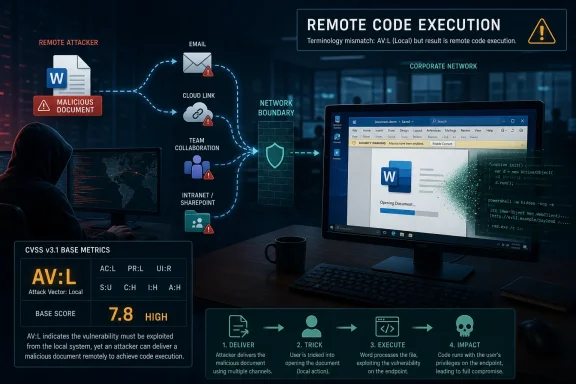
Microsoft describes CVE-2026-45643 as a Microsoft Word Remote Code Execution vulnerability even though its CVSS attack vector is local because “remote” identifies the attacker’s position, while “local” identifies where the malicious code must run to trigger exploitation. The apparent contradiction is really a taxonomy problem. Microsoft is telling administrators that an attacker does not need physical access to the machine, while CVSS is telling vulnerability managers that exploitation depends on code or content being opened on the victim’s system.
That distinction matters because Word vulnerabilities live in the messy middle between network intrusion and user-assisted compromise. They are not “remote” in the wormable sense of a listening service being hit over TCP. But they are very much remote in the everyday enterprise sense: a hostile document, template, attachment, previewed file, or link can arrive from outside the organization and execute code once Word processes it locally.
The phrase “Remote Code Execution” has always carried a certain drama in Windows security. It evokes unauthenticated packets, exposed services, and bugs that can be exploited from across the internet without the victim doing much of anything. For administrators who live by CVSS vectors, seeing
In this case, Microsoft’s own explanation is straightforward: the word “Remote” refers to the location of the attacker, not the mechanics of the exploit. The attacker may be remote from the victim’s machine, but the exploit path still requires something to execute or be processed locally. That is why Microsoft says the vulnerability can be thought of as arbitrary code execution even though the title remains Remote Code Execution.
This is not a new quirk. Office vulnerabilities have long strained the vocabulary of security scoring because productivity software is built to open content that came from somewhere else. A Word document is local when it is opened from the Downloads folder, but the decision to place it there may have been made by a phisher, a compromised partner, or a malicious website half a world away.
The important operational point is that
That is where Office bugs create confusion. If a crafted Word file must be opened on the victim’s machine, CVSS may classify the attack vector as local because the vulnerable parsing operation happens locally. The malicious document can still be emailed remotely, downloaded remotely, synced remotely, or staged through a cloud service. CVSS does not turn every remotely delivered lure into
This is why “local” in a CVSS vector can be misleading when read casually. In normal IT language, “local” sounds like someone sitting at the keyboard or malware already running on the endpoint. In CVSS language, it can mean the vulnerable action is initiated from the local system rather than through a network protocol endpoint exposed by the vulnerable software.
The Microsoft wording tries to preserve the attacker-centric view. If a threat actor sends a malicious document to a finance employee and code runs when Word processes it, the attacker was remote. The fact that Word did the dangerous work locally does not make the campaign local in any practical sense for defenders.
That distinction is more than semantics. Patch prioritization, email filtering, endpoint detection, and user awareness all depend on understanding where the real exposure lies. A sysadmin who downgrades the issue simply because of
For attackers, document formats remain attractive because they sit at the intersection of business necessity and human trust. People are expected to open resumes, invoices, legal drafts, statements of work, shipping notices, and meeting notes. Security teams can warn users not to open unknown attachments, but the modern office is still built around opening documents from people you do not fully control.
That makes Word vulnerabilities qualitatively different from a local privilege escalation that requires the attacker already to have code running on the machine. A privilege escalation vulnerability is usually a second-stage tool. A document-handling RCE can be an initial access route, even if the CVSS vector says local, because the victim’s normal workflow supplies the local action the exploit needs.
The same pattern has shown up for years across Office, PDF readers, archive utilities, image libraries, shortcut files, and scripting engines. The attacker does not need to touch the machine physically. They need to convince a target, an application, or a workflow to process hostile content.
This is why “remote” in Microsoft’s title is not marketing inflation so much as threat-model shorthand. It says the bug can be weaponized by an attacker who is not already at the console. It does not say the vulnerable parser is reachable over the network like SMB, RDP, or HTTP.
User interaction is not a reliable mitigation. Attackers do not need a 100 percent success rate; they need one person in the right department to open one plausible file at the wrong time. In organizations with thousands of employees, contractors, shared mailboxes, and external collaboration channels, “requires user interaction” is often closer to “requires normal business behavior.”
The distinction is especially important for Word because opening files is not reckless behavior in most environments. Legal teams exchange redlines. HR departments receive resumes. Finance teams receive invoices. Sales and procurement teams trade forms with organizations they may not know well. A vulnerability that activates through ordinary document handling fits naturally into that flow.
The modern Microsoft 365 ecosystem adds another wrinkle. Documents may arrive through Outlook, Teams, SharePoint, OneDrive, third-party portals, or browser downloads. They may be previewed, synced, scanned, indexed, or converted. The exploitability of a given CVE depends on the details Microsoft publishes and the affected versions, but the general risk model is clear: document processing is a perimeter.
That does not mean every Word RCE deserves panic. It does mean defenders should resist the false comfort of “local” when the vulnerable application’s job is to ingest untrusted external content. In Office security, the local machine is often where the remote attack finally becomes real.
A title like “Microsoft Word Remote Code Execution Vulnerability” is optimized for recognition, not nuance. It tells everyone immediately that the affected product is Word and the impact is code execution. It does not try to encode the delivery mechanism, user interaction requirement, preview behavior, or CVSS subtleties into the headline.
CVSS, meanwhile, is optimized for comparability. Its vector string is a compressed technical statement, not a narrative of how attacks happen in the wild. It can say
The result is a recurring mismatch. Titles use “remote” because the attacker can be remote. Vectors use “local” because the vulnerable operation occurs locally. Security teams then have to translate both into a practical priority: how likely is this to be exploited, how exposed are our users, how fast can we patch, and what compensating controls buy time?
Microsoft could reduce confusion by being more explicit in advisory summaries. A sentence explaining that the attacker may deliver a malicious file remotely but exploitation occurs when the file is processed locally would save many readers a trip through CVSS semantics. To Microsoft’s credit, its published explanation for this class of discrepancy says exactly that. The problem is that the title and vector are what most people see first.
An endpoint-triggered Word RCE belongs in the same mental bucket as malicious document campaigns, attachment filtering bypasses, and unsafe file-handling paths. The attack may begin outside the network, but the exploit condition is satisfied when Word or a related component processes content on the user’s device. That is a familiar pattern for defenders, and it maps to controls they already operate.
Patching remains the primary answer. If Microsoft has issued an update for the affected Word versions, the cleanest mitigation is to deploy it quickly across Microsoft 365 Apps, Office LTSC, or whatever supported channel is in use. The awkward wording of the advisory should not distract from that routine conclusion.
But patching is rarely instantaneous across large fleets. Some organizations stage Office updates, validate add-ins, or hold back channels for compatibility. In that window, the compensating controls matter: attachment detonation, Safe Links and Safe Attachments where available, endpoint attack surface reduction rules, application control, blocking risky file types, and restricting child-process creation from Office applications.
The exact control mix varies by environment, but the strategic lesson is the same. Treat Word as a high-risk content interpreter, not as a passive document viewer. The fact that its exploit path is local only tells you where the interpreter runs.
For ordinary Windows users, the actionable advice is simpler. Keep Office updated, avoid opening unexpected attachments, be especially wary of documents that ask for unusual actions, and do not treat a file as safe just because it arrived through a familiar brand or cloud-sharing service. If Word opens a document in Protected View or displays a security warning, that friction exists for a reason.
The macro era trained users to look for “Enable Content” prompts, but modern document exploitation is broader than macros. Vulnerabilities in parsers and document-handling components may not look like the old malware playbook. A file can be dangerous because of how the application reads it, not because it contains a visible script the user knowingly enables.
That is why automatic updates are so important for Microsoft 365 Apps. The average person cannot be expected to distinguish CVSS attack vectors, exploit prerequisites, and advisory naming conventions. The platform has to absorb as much of that burden as possible through rapid patching and safer defaults.
Still, terminology matters because it shapes behavior. If users or small-business admins dismiss “local” as harmless, they may delay updates that close a realistic remote-delivery path. The safest interpretation is boring but effective: if Microsoft ships a Word code-execution fix, install it.
Email, browsers, collaboration platforms, file sync clients, endpoint search indexers, and preview handlers all move untrusted content into local processing paths. The attack chain is remote in origin but local in execution. That is not an edge case anymore; it is a dominant model for initial access.
A more useful vocabulary would distinguish between network-reachable, content-triggered, local post-compromise, and physical-access vulnerabilities. Word RCEs like CVE-2026-45643 are best understood as content-triggered. The attacker’s leverage comes from getting a target system to process a crafted artifact.
This vocabulary would also help executives and risk committees. A vulnerability that is not network-reachable can still be urgent if the vulnerable software is heavily exposed to inbound content. Conversely, a true local privilege escalation may be less urgent for initial-access prevention but very important for containing malware that has already landed.
Until advisories adopt clearer labels, defenders have to do the translation themselves.
The most important practical question is not whether the word “remote” is philosophically perfect. It is whether untrusted Word documents routinely reach users who have access to valuable data. In most organizations, the answer is yes.
That puts the vulnerability in a serious category even if exploitation requires local processing. Code execution in the context of the current user can be enough to steal documents, access cloud tokens, read email, stage persistence, or move laterally depending on privileges and defenses. The initial code may not be SYSTEM, but it does not have to be SYSTEM to hurt.
This is also where least privilege earns its keep. If users run without local admin rights, if Office child-process behavior is constrained, if endpoint detection can see suspicious spawning patterns, and if identity tokens are protected, the blast radius changes. A Word RCE is still bad, but it becomes one layer in a defense-in-depth test rather than a guaranteed domain incident.
Microsoft’s label should therefore prompt action, not semantic debate. Patch the affected Office builds, review exposure to untrusted documents, and verify that Office hardening policies are actually deployed rather than merely documented.
The clearer interpretation is that Microsoft Word is the local execution environment for a remotely staged attack. The attacker may never touch the victim’s keyboard or authenticate to the machine. The victim, the application, or an automated workflow supplies the local processing step.
That is why the RCE label remains meaningful. The outcome is code execution caused by an attacker who can operate remotely. The CVSS vector remains meaningful too, because the vulnerable operation is not simply a packet hitting a listening Word service over the network.
The confusion is not a sign that the advisory is fake or that the vulnerability is harmless. It is a sign that our scoring systems compress attack chains into fields that need interpretation. For security professionals, that interpretation is part of the job.
That distinction matters because Word vulnerabilities live in the messy middle between network intrusion and user-assisted compromise. They are not “remote” in the wormable sense of a listening service being hit over TCP. But they are very much remote in the everyday enterprise sense: a hostile document, template, attachment, previewed file, or link can arrive from outside the organization and execute code once Word processes it locally.
 Microsoft’s Wording Is Awkward, but the Risk Is Real
The phrase “Remote Code Execution” has always carried a certain drama in Windows security. It evokes unauthenticated packets, exposed services, and bugs that can be exploited from across the internet without the victim doing much of anything. For administrators who live by CVSS vectors, seeing AV:L next to an RCE title looks like Microsoft is trying to have it both ways.In this case, Microsoft’s own explanation is straightforward: the word “Remote” refers to the location of the attacker, not the mechanics of the exploit. The attacker may be remote from the victim’s machine, but the exploit path still requires something to execute or be processed locally. That is why Microsoft says the vulnerability can be thought of as arbitrary code execution even though the title remains Remote Code Execution.
This is not a new quirk. Office vulnerabilities have long strained the vocabulary of security scoring because productivity software is built to open content that came from somewhere else. A Word document is local when it is opened from the Downloads folder, but the decision to place it there may have been made by a phisher, a compromised partner, or a malicious website half a world away.
The important operational point is that
AV:L should not be read as “attacker must already be logged on to the box.” It often means the vulnerable component is attacked through local processing: the target application consumes a crafted file, script, object, or document on the endpoint. In Word’s case, that distinction can be the difference between a vulnerability that sounds limited and one that belongs high on a patching list.CVSS Describes the Exploit Path, Not the Whole Attack Story
CVSS is useful because it forces a vulnerability into a common grammar. Attack vector, attack complexity, privileges required, user interaction, scope, and impact all give defenders a shared way to compare unlike flaws. But the grammar is deliberately narrow: it scores the technical conditions required to exploit the vulnerability, not the entire social, delivery, and intrusion chain around it.That is where Office bugs create confusion. If a crafted Word file must be opened on the victim’s machine, CVSS may classify the attack vector as local because the vulnerable parsing operation happens locally. The malicious document can still be emailed remotely, downloaded remotely, synced remotely, or staged through a cloud service. CVSS does not turn every remotely delivered lure into
AV:N.This is why “local” in a CVSS vector can be misleading when read casually. In normal IT language, “local” sounds like someone sitting at the keyboard or malware already running on the endpoint. In CVSS language, it can mean the vulnerable action is initiated from the local system rather than through a network protocol endpoint exposed by the vulnerable software.
The Microsoft wording tries to preserve the attacker-centric view. If a threat actor sends a malicious document to a finance employee and code runs when Word processes it, the attacker was remote. The fact that Word did the dangerous work locally does not make the campaign local in any practical sense for defenders.
That distinction is more than semantics. Patch prioritization, email filtering, endpoint detection, and user awareness all depend on understanding where the real exposure lies. A sysadmin who downgrades the issue simply because of
AV:L may miss the far more relevant fact: Word documents are one of the oldest and most reliable bridges between external attackers and internal endpoints.Word Remains a Boundary Between Trust and Content
Microsoft Word is not just a text editor. It is a complex document runtime with parsing engines, embedded objects, templates, links, metadata, compatibility layers, and decades of file-format history. That complexity is why Word has repeatedly appeared in security advisories even as Microsoft has hardened macros, Protected View, Mark of the Web handling, and default blocking behavior.For attackers, document formats remain attractive because they sit at the intersection of business necessity and human trust. People are expected to open resumes, invoices, legal drafts, statements of work, shipping notices, and meeting notes. Security teams can warn users not to open unknown attachments, but the modern office is still built around opening documents from people you do not fully control.
That makes Word vulnerabilities qualitatively different from a local privilege escalation that requires the attacker already to have code running on the machine. A privilege escalation vulnerability is usually a second-stage tool. A document-handling RCE can be an initial access route, even if the CVSS vector says local, because the victim’s normal workflow supplies the local action the exploit needs.
The same pattern has shown up for years across Office, PDF readers, archive utilities, image libraries, shortcut files, and scripting engines. The attacker does not need to touch the machine physically. They need to convince a target, an application, or a workflow to process hostile content.
This is why “remote” in Microsoft’s title is not marketing inflation so much as threat-model shorthand. It says the bug can be weaponized by an attacker who is not already at the console. It does not say the vulnerable parser is reachable over the network like SMB, RDP, or HTTP.
The User-Interaction Trap Is Still an Attack Surface
Many Office RCE advisories include some form of user interaction, and that also tends to soften the perceived risk. If the victim must open a file, click a link, or preview a document, some administrators mentally reclassify the vulnerability as a training problem. That is a mistake.User interaction is not a reliable mitigation. Attackers do not need a 100 percent success rate; they need one person in the right department to open one plausible file at the wrong time. In organizations with thousands of employees, contractors, shared mailboxes, and external collaboration channels, “requires user interaction” is often closer to “requires normal business behavior.”
The distinction is especially important for Word because opening files is not reckless behavior in most environments. Legal teams exchange redlines. HR departments receive resumes. Finance teams receive invoices. Sales and procurement teams trade forms with organizations they may not know well. A vulnerability that activates through ordinary document handling fits naturally into that flow.
The modern Microsoft 365 ecosystem adds another wrinkle. Documents may arrive through Outlook, Teams, SharePoint, OneDrive, third-party portals, or browser downloads. They may be previewed, synced, scanned, indexed, or converted. The exploitability of a given CVE depends on the details Microsoft publishes and the affected versions, but the general risk model is clear: document processing is a perimeter.
That does not mean every Word RCE deserves panic. It does mean defenders should resist the false comfort of “local” when the vulnerable application’s job is to ingest untrusted external content. In Office security, the local machine is often where the remote attack finally becomes real.
The Naming Problem Is Bigger Than This CVE
Security advisories have to serve multiple audiences at once, and none of those audiences reads them the same way. Vulnerability managers want severity, exploitability, affected builds, and remediation status. SOC analysts want detection opportunities. Executives want business risk. Desktop administrators want to know whether a Microsoft 365 Apps update will close the hole before Monday morning.A title like “Microsoft Word Remote Code Execution Vulnerability” is optimized for recognition, not nuance. It tells everyone immediately that the affected product is Word and the impact is code execution. It does not try to encode the delivery mechanism, user interaction requirement, preview behavior, or CVSS subtleties into the headline.
CVSS, meanwhile, is optimized for comparability. Its vector string is a compressed technical statement, not a narrative of how attacks happen in the wild. It can say
AV:L and UI:R, but it cannot fully capture the business reality that a malicious Word file can be delivered by email to every employee before lunch.The result is a recurring mismatch. Titles use “remote” because the attacker can be remote. Vectors use “local” because the vulnerable operation occurs locally. Security teams then have to translate both into a practical priority: how likely is this to be exploited, how exposed are our users, how fast can we patch, and what compensating controls buy time?
Microsoft could reduce confusion by being more explicit in advisory summaries. A sentence explaining that the attacker may deliver a malicious file remotely but exploitation occurs when the file is processed locally would save many readers a trip through CVSS semantics. To Microsoft’s credit, its published explanation for this class of discrepancy says exactly that. The problem is that the title and vector are what most people see first.
Enterprise Defenders Should Read “Local” as “Endpoint-Triggered”
For enterprise IT, the useful translation of CVE-2026-45643 is not “this is only local.” It is “this is endpoint-triggered.” That framing lines up better with how the risk is likely to appear in a real environment.An endpoint-triggered Word RCE belongs in the same mental bucket as malicious document campaigns, attachment filtering bypasses, and unsafe file-handling paths. The attack may begin outside the network, but the exploit condition is satisfied when Word or a related component processes content on the user’s device. That is a familiar pattern for defenders, and it maps to controls they already operate.
Patching remains the primary answer. If Microsoft has issued an update for the affected Word versions, the cleanest mitigation is to deploy it quickly across Microsoft 365 Apps, Office LTSC, or whatever supported channel is in use. The awkward wording of the advisory should not distract from that routine conclusion.
But patching is rarely instantaneous across large fleets. Some organizations stage Office updates, validate add-ins, or hold back channels for compatibility. In that window, the compensating controls matter: attachment detonation, Safe Links and Safe Attachments where available, endpoint attack surface reduction rules, application control, blocking risky file types, and restricting child-process creation from Office applications.
The exact control mix varies by environment, but the strategic lesson is the same. Treat Word as a high-risk content interpreter, not as a passive document viewer. The fact that its exploit path is local only tells you where the interpreter runs.
Consumers Should Not Need to Parse CVSS to Stay Safe
Home users and small businesses are even more likely to be confused by this terminology. “Remote code execution” sounds catastrophic. “Attack vector: local” sounds like the attacker needs to be sitting in the room. Neither impression is complete.For ordinary Windows users, the actionable advice is simpler. Keep Office updated, avoid opening unexpected attachments, be especially wary of documents that ask for unusual actions, and do not treat a file as safe just because it arrived through a familiar brand or cloud-sharing service. If Word opens a document in Protected View or displays a security warning, that friction exists for a reason.
The macro era trained users to look for “Enable Content” prompts, but modern document exploitation is broader than macros. Vulnerabilities in parsers and document-handling components may not look like the old malware playbook. A file can be dangerous because of how the application reads it, not because it contains a visible script the user knowingly enables.
That is why automatic updates are so important for Microsoft 365 Apps. The average person cannot be expected to distinguish CVSS attack vectors, exploit prerequisites, and advisory naming conventions. The platform has to absorb as much of that burden as possible through rapid patching and safer defaults.
Still, terminology matters because it shapes behavior. If users or small-business admins dismiss “local” as harmless, they may delay updates that close a realistic remote-delivery path. The safest interpretation is boring but effective: if Microsoft ships a Word code-execution fix, install it.
Security Teams Need Better Language Than “Remote Versus Local”
The industry’s habit of dividing vulnerabilities into remote and local buckets made more sense when the archetypes were cleaner. A remote bug attacked a network service. A local bug required shell access. A client-side document bug sits between those poles, and modern work has made that middle ground enormous.Email, browsers, collaboration platforms, file sync clients, endpoint search indexers, and preview handlers all move untrusted content into local processing paths. The attack chain is remote in origin but local in execution. That is not an edge case anymore; it is a dominant model for initial access.
A more useful vocabulary would distinguish between network-reachable, content-triggered, local post-compromise, and physical-access vulnerabilities. Word RCEs like CVE-2026-45643 are best understood as content-triggered. The attacker’s leverage comes from getting a target system to process a crafted artifact.
This vocabulary would also help executives and risk committees. A vulnerability that is not network-reachable can still be urgent if the vulnerable software is heavily exposed to inbound content. Conversely, a true local privilege escalation may be less urgent for initial-access prevention but very important for containing malware that has already landed.
Until advisories adopt clearer labels, defenders have to do the translation themselves.
AV:L is a starting point, not a verdict. Product context supplies the missing half of the story.The Patch Priority Lives in the Workflow, Not the Acronym
The right priority for CVE-2026-45643 depends on where Word sits in an organization’s workflow. A kiosk fleet that never opens Office documents has a different exposure profile from a law firm, university, accounting department, or government agency that lives inside Word files. CVSS gives a common baseline, but exposure determines urgency.The most important practical question is not whether the word “remote” is philosophically perfect. It is whether untrusted Word documents routinely reach users who have access to valuable data. In most organizations, the answer is yes.
That puts the vulnerability in a serious category even if exploitation requires local processing. Code execution in the context of the current user can be enough to steal documents, access cloud tokens, read email, stage persistence, or move laterally depending on privileges and defenses. The initial code may not be SYSTEM, but it does not have to be SYSTEM to hurt.
This is also where least privilege earns its keep. If users run without local admin rights, if Office child-process behavior is constrained, if endpoint detection can see suspicious spawning patterns, and if identity tokens are protected, the blast radius changes. A Word RCE is still bad, but it becomes one layer in a defense-in-depth test rather than a guaranteed domain incident.
Microsoft’s label should therefore prompt action, not semantic debate. Patch the affected Office builds, review exposure to untrusted documents, and verify that Office hardening policies are actually deployed rather than merely documented.
The CVE Teaches a Small Lesson With a Large Blast Radius
CVE-2026-45643 is a useful reminder that vulnerability language is not neutral. A single word in a title can imply internet-scale danger. A single letter in a CVSS vector can imply local-only inconvenience. In client-side software, both readings can be wrong when taken alone.The clearer interpretation is that Microsoft Word is the local execution environment for a remotely staged attack. The attacker may never touch the victim’s keyboard or authenticate to the machine. The victim, the application, or an automated workflow supplies the local processing step.
That is why the RCE label remains meaningful. The outcome is code execution caused by an attacker who can operate remotely. The CVSS vector remains meaningful too, because the vulnerable operation is not simply a packet hitting a listening Word service over the network.
The confusion is not a sign that the advisory is fake or that the vulnerability is harmless. It is a sign that our scoring systems compress attack chains into fields that need interpretation. For security professionals, that interpretation is part of the job.
What the Word Advisory Really Tells Windows Defenders
CVE-2026-45643 is less a contradiction than a warning label for how modern endpoint compromise works. The attacker can be remote, the lure can be remote, and the business impact can be remote-driven, while the exploitable action still happens on the local Windows machine.- Microsoft’s “Remote Code Execution” title describes the attacker’s position and the impact, not necessarily a network-reachable service.
- The CVSS
AV:Lmetric means the exploit is triggered through local processing on the target system, such as opening or handling malicious content. - Word vulnerabilities should be evaluated as content-triggered endpoint risks because Word routinely processes files that originate outside the organization.
- “Requires user interaction” should not be treated as a major comfort when the interaction is normal business behavior.
- The practical response is to deploy the relevant Office update, harden Office behavior, and reduce exposure to untrusted documents.
- Administrators should translate advisory language into workflow risk instead of relying on the title or CVSS vector in isolation.
References
- Primary source: MSRC
Published: 2026-06-09T07:00:00-07:00
Security Update Guide - Microsoft Security Response Center
 msrc.microsoft.com
- Official source: microsoft.com
MSRC - Microsoft Security Response Center
The Microsoft Security Response Center is part of the defender community and on the front line of security response evolution. For over twenty years, we have been engaged with security researchers working to protect customers and the broader ecosystem.www.microsoft.com
- Related coverage: datacomm.com
- Related coverage: threats.kaspersky.com
Kaspersky Threats — KLA90842
threats.kaspersky.com
- Related coverage: techradar.com
Microsoft quietly patches LNK vulnerability that's been weaponized for years | TechRadar
The November Patch Tuesday fixed an age-old bugwww.techradar.com
