

As of June 9, 2026, CVE-2026-45648 is listed by Microsoft as a Windows Active Directory Domain Services remote code execution vulnerability, but the public advisory material available around it exposes more about scoring confidence than about the bug’s root cause, exploit path, or operational blast radius. That is not comforting, but it is also not unusual. Active Directory vulnerabilities often arrive first as sparse vendor entries because the thing being protected is not merely a server role; it is the security spine of the Windows enterprise. The right reading is not panic, and it is not complacency: it is disciplined patch triage under incomplete disclosure.
The most important words in the CVE name are not “remote code execution,” although those are the ones guaranteed to raise blood pressure. The most important words are “Active Directory Domain Services,” because that is where ordinary Windows vulnerability management becomes institutional risk management.
A domain controller is not just another Windows Server waiting for the monthly cumulative update. It is the broker of identity, policy, Kerberos tickets, LDAP queries, computer trust, service accounts, and the quiet assumptions that let a Windows estate function. A remote code execution flaw in that neighborhood is therefore not simply a bug that might compromise a host. It is a bug class that can, depending on exploitability and privilege context, threaten the machinery that decides who is allowed to be trusted.
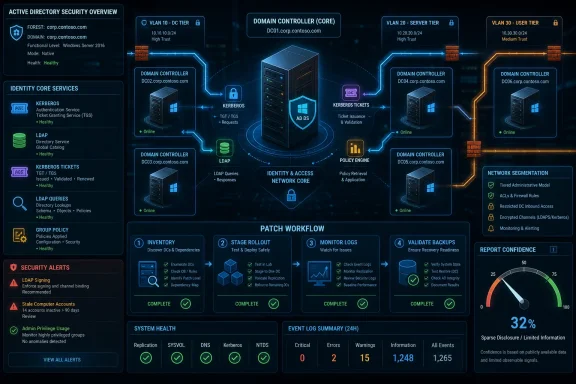
The user-facing snippet attached to CVE-2026-45648 describes the Report Confidence idea: how certain the ecosystem is that the vulnerability exists and how credible the known technical details are. That language is sometimes mistaken for a mitigation note or an exploitability assessment. It is neither. It is a scoring concept, and in Microsoft’s context it often appears when the Security Update Guide is exposing structured CVSS-related metadata rather than telling administrators the story they actually want to hear.
That distinction matters. A confirmed vendor CVE with thin public detail can still be urgent; a detailed third-party blog post with an exploit diagram can still contain conjecture. The patching decision should not wait for a perfect narrative if the affected component is a domain controller-facing service.
That is useful, but it does not answer the administrator’s most pressing question: “Can someone use this against my domain controllers?” Report Confidence says something narrower. It says how solid the report is, not whether exploit code is widely available, whether the attack is pre-authentication, whether a firewall boundary blocks it, or whether Microsoft has observed exploitation in the wild.
This is where CVE reading becomes a craft. A Windows AD DS RCE with high confidence and no exploit details can be more operationally important than a lower-impact vulnerability with a polished write-up. The lack of a public recipe may reduce opportunistic exploitation in the short term, but it does not reduce the strategic value of the target.
The phrase “would-be attackers” in the metric description is doing real work. Public technical detail is a gift to defenders and attackers alike. The more precise the write-up, the easier it becomes for a blue team to validate exposure — and for a red team, criminal crew, or state actor to operationalize a working exploit.
That does not mean every AD DS RCE becomes instant domain compromise. Exploitability details matter enormously. Authentication requirements, network adjacency, protocol exposure, memory corruption reliability, default configuration, role dependency, and post-exploitation privilege all shape real-world risk. Microsoft’s public labels compress all of that complexity into a line item that rarely satisfies the people responsible for weekends and maintenance windows.
But the default enterprise posture should be conservative. Domain controllers usually sit behind internal network boundaries, yet those boundaries have become less reassuring in the age of VPN compromise, stolen credentials, unmanaged devices, cloud-to-on-prem connectors, exposed hybrid identity plumbing, and ransomware affiliates that specialize in moving laterally once they get a foothold. “Internal only” is not the same as “safe.”
The practical question is therefore not whether CVE-2026-45648 has a beautiful public exploit chain today. The question is whether your AD tiering model assumes that no one hostile can reach the vulnerable service. For many organizations, the honest answer is no.
There are good reasons vendors do not always publish those details immediately. Patches are diffed. Binaries are compared. Security researchers, criminals, and nation-state teams routinely reverse-engineer updates to infer the vulnerability from the fix. A detailed advisory can shorten that process.
There are also bad side effects. Defenders are left to prioritize from labels, scores, and affected product lists. Security teams must translate “remote code execution” into change tickets, outage risk, compensating controls, and executive briefings without knowing whether the likely exploit path is common in their environment.
That ambiguity is the permanent bargain of Patch Tuesday. Microsoft gives enough information to justify action, but often not enough to let every organization produce a bespoke risk model before the maintenance window closes. For Active Directory, that bargain generally favors patching first and litigating the root cause later.
The recent history of Windows Server updates is full of reminders that domain controller patches are uniquely stressful. Fixes for serious vulnerabilities can introduce authentication regressions, LSASS instability, Kerberos changes, LDAP signing shifts, or compatibility surprises for legacy applications. The cure is necessary, but it is not frictionless.
This creates the classic enterprise dilemma. Delay too long, and attackers may reverse-engineer the fix or exploit newly public knowledge. Deploy too quickly, and an authentication outage can become a business outage. Neither risk is theoretical.
The mature answer is not to avoid patching. It is to make domain controller patching a rehearsed operational discipline. Organizations that treat AD updates as emergency improvisation will keep rediscovering the same failure modes under pressure.
Those answers matter more than the abstract severity score. A domain controller reachable from a flat workstation network has a different risk profile from one protected by tiered administration, segmented management networks, strict firewall rules, and monitored protocol access. The vulnerability may be the same; the exploit opportunity is not.
Active Directory hardening has always suffered from a cultural problem: it is treated as plumbing until it breaks. Sysadmins know how much depends on it, but business leaders often see it only as a login substrate. That invisibility becomes dangerous when an AD DS RCE appears and every deferred design decision becomes part of the risk calculation.
A good response to CVE-2026-45648 therefore starts with patching but should not end there. The update closes a known defect. Architecture decides how many chances an attacker gets before the next one appears.
A responsible rollout begins with inventory. Administrators need to know which Windows Server versions are functioning as domain controllers, which are global catalogs, which hold FSMO roles, which support legacy authentication flows, and which exist primarily because no one was willing to decommission an old site topology.
Then comes staged deployment. Patch one or more representative domain controllers first, monitor authentication, replication, directory service logs, Kerberos behavior, LDAP-dependent applications, and LSASS health, then expand. If the organization has only one domain controller, the security problem is already wrapped inside an availability problem.
Backups matter, but so does restore realism. A system-state backup that no one has tested is a comfort object. For AD, recovery planning must account for authoritative and non-authoritative restore scenarios, tombstone lifetime, replication state, and the ugly possibility that compromise and corruption are discovered late.
You can block broad access to domain controllers, and in many environments you should. You can restrict management paths, segment clients, limit LDAP exposure, require secure binds, harden Kerberos, reduce NTLM dependency, and monitor anomalous authentication traffic. Those controls are valuable. They are not substitutes for a vendor fix when the vulnerable code remains reachable by systems that must authenticate.
The danger is that “mitigation available” becomes a political excuse for deferral. In identity infrastructure, partial compensating controls often protect the clean diagram rather than the messy estate. A forgotten subnet, a branch office VPN, an appliance with hard-coded domain access, or a compromised admin workstation can reopen the path.
That is why the absence of public exploit detail should not be overinterpreted. Attackers do not need Microsoft to publish a tutorial if they can diff patches, fuzz exposed services, or buy access from someone who already has. Time is part of the attack surface.
For CVE-2026-45648, the visible advisory information does not provide enough to responsibly describe a specific exploit chain. That restraint is important. Guessing at packet formats, protocol handlers, or memory corruption primitives would produce drama, not defense.
But lack of detail is not lack of motion. Once a patch exists, the delta between vulnerable and fixed code becomes research material. Attackers with Windows internals expertise do not need the public advisory to be verbose; sometimes the binary tells them enough.
That is the asymmetry administrators live with. Defenders need certainty to justify disruption. Attackers need only a plausible lead and time.
The second move is to tighten reachability. Domain controllers should not be treated as general-purpose servers reachable from every VLAN for every protocol. Client authentication requires access, but administration, replication, LDAP queries, RPC flows, and name resolution should be understood and constrained rather than inherited from years of firewall exceptions.
The third move is to increase telemetry. Watch for unusual LDAP, Kerberos, Netlogon, RPC, LSASS, and directory service behavior. A vulnerability does not need public exploit code to produce detectable pre-exploitation noise. Failed requests, crashes, malformed traffic, service instability, and authentication anomalies can all become early warning signals.
The fourth move is to prepare rollback without making rollback the plan. Security updates sometimes cause regressions, but uninstalling a domain controller patch after a serious RCE disclosure may reopen a worse problem. Enterprises need test coverage and vendor escalation paths, not a reflexive retreat to vulnerable builds.
The Report Confidence text in the CVE material underscores that scoring systems include uncertainty as a formal concept. That is healthy. But it also exposes a weakness in how enterprises consume vulnerability data. Too often, teams want a single number to settle a multi-dimensional argument.
For a WindowsForum audience, the better approach is to read CVE-2026-45648 as a signal about where to focus. AD DS is a crown-jewel service. Remote code execution is a high-impact vulnerability class. Sparse public detail means defenders should avoid technical speculation but accelerate basic hygiene.
In other words: do not invent facts, but do not wait for a fully illustrated exploit chain to take the advisory seriously.
The best AD teams already know this. They maintain privileged access workstations, tiered administration, minimal DC logon rights, strong backup discipline, auditing, and clear ownership. They do not let every application team negotiate permanent exceptions directly against domain controllers. They treat identity infrastructure as security infrastructure, not legacy plumbing.
The worst environments discover their directory topology during an incident. They find unsupported servers, undocumented trusts, stale service accounts, unmanaged branch controllers, and brittle applications that break when old authentication assumptions are challenged. A remote code execution advisory in AD DS then becomes less a patching problem than an archeological dig.
Microsoft can fix a vulnerability. It cannot fix that estate design with a cumulative update.
CVE-2026-45648 may become clearer as Microsoft, researchers, and defenders publish more detail, but administrators do not need to know the full exploit anatomy to understand the stakes. Active Directory remains the trust fabric of most Windows enterprises, and any remote code execution flaw in that fabric is a reminder that identity security is no longer a back-office specialty. The organizations that fare best will be the ones that patch quickly, segment deliberately, monitor intelligently, and treat every AD vulnerability as a rehearsal for the one that arrives with exploit code already in circulation.
 Microsoft’s Sparse Advisory Still Says the Important Part Out Loud
The most important words in the CVE name are not “remote code execution,” although those are the ones guaranteed to raise blood pressure. The most important words are “Active Directory Domain Services,” because that is where ordinary Windows vulnerability management becomes institutional risk management.A domain controller is not just another Windows Server waiting for the monthly cumulative update. It is the broker of identity, policy, Kerberos tickets, LDAP queries, computer trust, service accounts, and the quiet assumptions that let a Windows estate function. A remote code execution flaw in that neighborhood is therefore not simply a bug that might compromise a host. It is a bug class that can, depending on exploitability and privilege context, threaten the machinery that decides who is allowed to be trusted.
The user-facing snippet attached to CVE-2026-45648 describes the Report Confidence idea: how certain the ecosystem is that the vulnerability exists and how credible the known technical details are. That language is sometimes mistaken for a mitigation note or an exploitability assessment. It is neither. It is a scoring concept, and in Microsoft’s context it often appears when the Security Update Guide is exposing structured CVSS-related metadata rather than telling administrators the story they actually want to hear.
That distinction matters. A confirmed vendor CVE with thin public detail can still be urgent; a detailed third-party blog post with an exploit diagram can still contain conjecture. The patching decision should not wait for a perfect narrative if the affected component is a domain controller-facing service.
Report Confidence Is a Thermometer, Not a Fire Alarm
The Report Confidence metric exists because vulnerability reports move through phases. A bug may begin as a crash, a rumor, a single researcher’s claim, a proof of concept, or a vendor-confirmed defect. Over time, confidence increases as reproducibility, root-cause analysis, code review, exploitation evidence, or vendor acknowledgement appears.That is useful, but it does not answer the administrator’s most pressing question: “Can someone use this against my domain controllers?” Report Confidence says something narrower. It says how solid the report is, not whether exploit code is widely available, whether the attack is pre-authentication, whether a firewall boundary blocks it, or whether Microsoft has observed exploitation in the wild.
This is where CVE reading becomes a craft. A Windows AD DS RCE with high confidence and no exploit details can be more operationally important than a lower-impact vulnerability with a polished write-up. The lack of a public recipe may reduce opportunistic exploitation in the short term, but it does not reduce the strategic value of the target.
The phrase “would-be attackers” in the metric description is doing real work. Public technical detail is a gift to defenders and attackers alike. The more precise the write-up, the easier it becomes for a blue team to validate exposure — and for a red team, criminal crew, or state actor to operationalize a working exploit.
Active Directory Turns Server Bugs Into Estate-Wide Problems
Active Directory’s centrality is why Microsoft advisories involving AD DS, LDAP, Kerberos, Netlogon, DNS on domain controllers, certificate services, and group policy deserve a different mental queue from client-side bugs. The same CVSS number can mean very different things depending on where the vulnerable code runs. On a workstation, remote code execution is bad. On a domain controller, it may become a shortcut to the keys of the kingdom.That does not mean every AD DS RCE becomes instant domain compromise. Exploitability details matter enormously. Authentication requirements, network adjacency, protocol exposure, memory corruption reliability, default configuration, role dependency, and post-exploitation privilege all shape real-world risk. Microsoft’s public labels compress all of that complexity into a line item that rarely satisfies the people responsible for weekends and maintenance windows.
But the default enterprise posture should be conservative. Domain controllers usually sit behind internal network boundaries, yet those boundaries have become less reassuring in the age of VPN compromise, stolen credentials, unmanaged devices, cloud-to-on-prem connectors, exposed hybrid identity plumbing, and ransomware affiliates that specialize in moving laterally once they get a foothold. “Internal only” is not the same as “safe.”
The practical question is therefore not whether CVE-2026-45648 has a beautiful public exploit chain today. The question is whether your AD tiering model assumes that no one hostile can reach the vulnerable service. For many organizations, the honest answer is no.
The Missing Root Cause Is Part of the Security Model
Microsoft’s sparse disclosure style frustrates administrators because it often withholds the one thing technical teams crave: the mechanism. Is this parsing? Authorization logic? LDAP handling? Replication? A malformed request? A memory corruption issue? A bad assumption in a domain service boundary?There are good reasons vendors do not always publish those details immediately. Patches are diffed. Binaries are compared. Security researchers, criminals, and nation-state teams routinely reverse-engineer updates to infer the vulnerability from the fix. A detailed advisory can shorten that process.
There are also bad side effects. Defenders are left to prioritize from labels, scores, and affected product lists. Security teams must translate “remote code execution” into change tickets, outage risk, compensating controls, and executive briefings without knowing whether the likely exploit path is common in their environment.
That ambiguity is the permanent bargain of Patch Tuesday. Microsoft gives enough information to justify action, but often not enough to let every organization produce a bespoke risk model before the maintenance window closes. For Active Directory, that bargain generally favors patching first and litigating the root cause later.
Patch Tuesday Has Become an Identity Infrastructure Event
For years, Windows patching was treated as a fleet hygiene exercise: update the endpoints, stage the servers, watch for regressions, and move on. That model is increasingly inadequate for domain controllers. The identity layer has become both the primary target and the primary blast amplifier.The recent history of Windows Server updates is full of reminders that domain controller patches are uniquely stressful. Fixes for serious vulnerabilities can introduce authentication regressions, LSASS instability, Kerberos changes, LDAP signing shifts, or compatibility surprises for legacy applications. The cure is necessary, but it is not frictionless.
This creates the classic enterprise dilemma. Delay too long, and attackers may reverse-engineer the fix or exploit newly public knowledge. Deploy too quickly, and an authentication outage can become a business outage. Neither risk is theoretical.
The mature answer is not to avoid patching. It is to make domain controller patching a rehearsed operational discipline. Organizations that treat AD updates as emergency improvisation will keep rediscovering the same failure modes under pressure.
The Real Exposure Is Usually Architectural
The uncomfortable truth is that many organizations cannot answer basic questions about their domain controller exposure quickly enough when a CVE like this lands. Which DCs are reachable from which network segments? Which sites still allow broad LDAP or RPC access? Which legacy appliances bind to domain controllers with stale service accounts? Which monitoring tools would notice unusual pre-authentication traffic?Those answers matter more than the abstract severity score. A domain controller reachable from a flat workstation network has a different risk profile from one protected by tiered administration, segmented management networks, strict firewall rules, and monitored protocol access. The vulnerability may be the same; the exploit opportunity is not.
Active Directory hardening has always suffered from a cultural problem: it is treated as plumbing until it breaks. Sysadmins know how much depends on it, but business leaders often see it only as a login substrate. That invisibility becomes dangerous when an AD DS RCE appears and every deferred design decision becomes part of the risk calculation.
A good response to CVE-2026-45648 therefore starts with patching but should not end there. The update closes a known defect. Architecture decides how many chances an attacker gets before the next one appears.
Domain Controllers Need a Different Change Window
The phrase “install the security update” is technically correct and operationally incomplete. Domain controllers are clustered by function, not by convenience. They replicate, advertise services, issue tickets, enforce policy, and support applications that may have been written around assumptions no one has documented in a decade.A responsible rollout begins with inventory. Administrators need to know which Windows Server versions are functioning as domain controllers, which are global catalogs, which hold FSMO roles, which support legacy authentication flows, and which exist primarily because no one was willing to decommission an old site topology.
Then comes staged deployment. Patch one or more representative domain controllers first, monitor authentication, replication, directory service logs, Kerberos behavior, LDAP-dependent applications, and LSASS health, then expand. If the organization has only one domain controller, the security problem is already wrapped inside an availability problem.
Backups matter, but so does restore realism. A system-state backup that no one has tested is a comfort object. For AD, recovery planning must account for authoritative and non-authoritative restore scenarios, tombstone lifetime, replication state, and the ugly possibility that compromise and corruption are discovered late.
Workarounds Are Usually Second-Class Citizens for AD RCEs
Administrators naturally ask whether there is a mitigation short of patching. Sometimes there is: disable a protocol, block a port, enforce signing, constrain access, or change a registry setting. For Active Directory vulnerabilities, however, mitigations often collide with the basic reason domain controllers exist.You can block broad access to domain controllers, and in many environments you should. You can restrict management paths, segment clients, limit LDAP exposure, require secure binds, harden Kerberos, reduce NTLM dependency, and monitor anomalous authentication traffic. Those controls are valuable. They are not substitutes for a vendor fix when the vulnerable code remains reachable by systems that must authenticate.
The danger is that “mitigation available” becomes a political excuse for deferral. In identity infrastructure, partial compensating controls often protect the clean diagram rather than the messy estate. A forgotten subnet, a branch office VPN, an appliance with hard-coded domain access, or a compromised admin workstation can reopen the path.
That is why the absence of public exploit detail should not be overinterpreted. Attackers do not need Microsoft to publish a tutorial if they can diff patches, fuzz exposed services, or buy access from someone who already has. Time is part of the attack surface.
The Exploitability Gap Will Not Stay Empty Forever
A newly disclosed vulnerability often moves through a predictable cycle. First comes the vendor entry. Then come scanner plugins, third-party summaries, exploitability speculation, patch diffing, lab reproduction, proof-of-concept code, and finally opportunistic exploitation if the conditions are favorable. Not every CVE completes that journey, but critical Windows infrastructure bugs are attractive enough that defenders should assume serious people will look.For CVE-2026-45648, the visible advisory information does not provide enough to responsibly describe a specific exploit chain. That restraint is important. Guessing at packet formats, protocol handlers, or memory corruption primitives would produce drama, not defense.
But lack of detail is not lack of motion. Once a patch exists, the delta between vulnerable and fixed code becomes research material. Attackers with Windows internals expertise do not need the public advisory to be verbose; sometimes the binary tells them enough.
That is the asymmetry administrators live with. Defenders need certainty to justify disruption. Attackers need only a plausible lead and time.
What Security Teams Should Do Before the Exploit Blog Arrives
The first operational move is to identify whether any affected systems are domain controllers and whether all domain controllers are in the same patch state. Mixed patch levels are common in real environments, especially where branch offices, demoted servers, lab domains, or disaster recovery sites are poorly tracked. Those forgotten systems can become the easiest target.The second move is to tighten reachability. Domain controllers should not be treated as general-purpose servers reachable from every VLAN for every protocol. Client authentication requires access, but administration, replication, LDAP queries, RPC flows, and name resolution should be understood and constrained rather than inherited from years of firewall exceptions.
The third move is to increase telemetry. Watch for unusual LDAP, Kerberos, Netlogon, RPC, LSASS, and directory service behavior. A vulnerability does not need public exploit code to produce detectable pre-exploitation noise. Failed requests, crashes, malformed traffic, service instability, and authentication anomalies can all become early warning signals.
The fourth move is to prepare rollback without making rollback the plan. Security updates sometimes cause regressions, but uninstalling a domain controller patch after a serious RCE disclosure may reopen a worse problem. Enterprises need test coverage and vendor escalation paths, not a reflexive retreat to vulnerable builds.
The CVSS Line Is Not the Risk Decision
CVSS is useful because it gives the industry a shared severity language. It is dangerous when used as a substitute for environment-specific thinking. A vulnerability score cannot know whether your domain controllers are segmented, whether your help desk uses privileged accounts on workstations, whether your SIEM sees DC traffic, or whether your business can tolerate an authentication outage.The Report Confidence text in the CVE material underscores that scoring systems include uncertainty as a formal concept. That is healthy. But it also exposes a weakness in how enterprises consume vulnerability data. Too often, teams want a single number to settle a multi-dimensional argument.
For a WindowsForum audience, the better approach is to read CVE-2026-45648 as a signal about where to focus. AD DS is a crown-jewel service. Remote code execution is a high-impact vulnerability class. Sparse public detail means defenders should avoid technical speculation but accelerate basic hygiene.
In other words: do not invent facts, but do not wait for a fully illustrated exploit chain to take the advisory seriously.
The Patch Is Only the First Test of AD Discipline
CVE-2026-45648 is a useful stress test for the state of an organization’s identity operations. If the team can rapidly identify affected domain controllers, validate backups, stage patches, monitor authentication, and communicate risk, then the vulnerability becomes another managed event. If not, the CVE is revealing an operational weakness that existed before Microsoft named the bug.The best AD teams already know this. They maintain privileged access workstations, tiered administration, minimal DC logon rights, strong backup discipline, auditing, and clear ownership. They do not let every application team negotiate permanent exceptions directly against domain controllers. They treat identity infrastructure as security infrastructure, not legacy plumbing.
The worst environments discover their directory topology during an incident. They find unsupported servers, undocumented trusts, stale service accounts, unmanaged branch controllers, and brittle applications that break when old authentication assumptions are challenged. A remote code execution advisory in AD DS then becomes less a patching problem than an archeological dig.
Microsoft can fix a vulnerability. It cannot fix that estate design with a cumulative update.
The AD DS Advisory Leaves Administrators With Five Practical Moves
CVE-2026-45648 should be handled as a serious identity-infrastructure event even while public technical detail remains limited. The useful response is concrete, boring, and fast.- Inventory every domain controller, including branch, lab, disaster recovery, and legacy systems that may not appear in ordinary server patch dashboards.
- Prioritize the relevant Microsoft security update for domain controllers, using staged deployment rather than indefinite deferral.
- Review which networks, applications, appliances, and administrative workstations can reach domain controller services, then remove access that exists only by inertia.
- Monitor for abnormal directory service behavior, LSASS instability, authentication failures, malformed traffic patterns, and unexpected LDAP or RPC activity.
- Validate system-state backup and Active Directory recovery procedures before the organization has to rely on them under incident conditions.
CVE-2026-45648 may become clearer as Microsoft, researchers, and defenders publish more detail, but administrators do not need to know the full exploit anatomy to understand the stakes. Active Directory remains the trust fabric of most Windows enterprises, and any remote code execution flaw in that fabric is a reminder that identity security is no longer a back-office specialty. The organizations that fare best will be the ones that patch quickly, segment deliberately, monitor intelligently, and treat every AD vulnerability as a rehearsal for the one that arrives with exploit code already in circulation.
References
- Primary source: MSRC
Published: 2026-06-09T07:00:00-07:00
Security Update Guide - Microsoft Security Response Center
 msrc.microsoft.com
- Related coverage: deepwatch.com
Block Netlogon RCE Hacks: CVE-2026-41089 Patch Guide
Prevent Domain Controller takeovers. Use Deepwatch to patch CVE-2026-41089, secure RPC ports, and isolate Windows Netlogon traffic now.www.deepwatch.com - Related coverage: tomshardware.com
Microsoft's April patch puts Windows domain controllers into reboot loops — third known issue from KB5082063 is affecting Windows Server 2016 through 2025 | Tom's Hardware
Microsoft has confirmed the issuewww.tomshardware.com - Official source: support.microsoft.com
KB5066014—Netlogon RPC Hardening (CVE-2025-49716) - Microsoft Support
 support.microsoft.com
- Related coverage: bleepingcomputer.com
Critical Windows Netlogon RCE flaw now exploited in attacks
The Centre for Cybersecurity Belgium (CCB), the country's national authority for cybersecurity, warned on Friday that threat actors are now exploiting a recently patched critical Windows Netlogon vulnerability (CVE-2026-41089) in attacks.www.bleepingcomputer.com - Related coverage: windowsreport.com
Critical Windows Netlogon Bug CVE-2026-41089 Now Exploited in the Wild
Belgium’s cybersecurity agency warns attackers are actively exploiting the critical Windows Netlogon vulnerability CVE-2026-41089. windowsreport.com
- Related coverage: secpod.com
- Related coverage: unit42.paloaltonetworks.com
Microsoft WSUS Remote Code Execution (CVE-2025-59287) Actively Exploited in the Wild (Updated November 3)
CVE-2025-59287 is a critical RCE vulnerability identified in Microsoft’s WSUS. Our observations from cases show a consistent methodology.unit42.paloaltonetworks.com - Related coverage: caloes.ca.gov
- Related coverage: cyber.gov.au
ACSC Advisory 2020 012 Windows DNS Server Remote Code Execution Vulnerability CVE 2020 1350
PDF documentwww.cyber.gov.au
- Official source: microsoft.com
MSRC - Microsoft Security Response Center
The Microsoft Security Response Center is part of the defender community and on the front line of security response evolution. For over twenty years, we have been engaged with security researchers working to protect customers and the broader ecosystem.www.microsoft.com
- Official source: learn.microsoft.com
Security Advisories and Bulletins | Microsoft Learn
learn.microsoft.com - Related coverage: threats.kaspersky.com
Kaspersky Threats — KLA90966
threats.kaspersky.com
- Related coverage: deepwiki.com
MSRC API Reference | microsoft/MSRC-Microsoft-Security-Updates-API | DeepWiki
This document provides technical reference information for the Microsoft Security Response Center (MSRC) CVRF API that underlies the MsrcSecurityUpdates PowerShell module. This covers the REST API enddeepwiki.com - Official source: docs.github.com
Browsing security advisories in the GitHub Advisory Database - GitHub Docs
You can browse the GitHub Advisory Database to find CVEs and GitHub-originated advisories affecting the open source world. docs.github.com
- Related coverage: howtofix.guide
Microsoft Defender CVE-2026-41091 and CVE-2026-45498 Exploited
Microsoft Defender CVE-2026-41091 and CVE-2026-45498 are exploited. Verify Engine 1.1.26040.8, Platform 4.18.26040.7, and update endpoints.howtofix.guide - Related coverage: sra.io
- Related coverage: windowsforum.com
CVE-2026-23660 Elevation of Privilege in Windows Admin Center Azure Portal | Windows Forum
Microsoft’s security tracker lists CVE-2026-23660 as an Elevation of Privilege vulnerability in “Windows Admin Center in Azure Portal,” but public technical...windowsforum.com - Related coverage: cljdoc.org
*Vulnerability* Object — threatgrid/ctim 1.3.30
threatgrid/ctim: Cisco Threat Intelligence Model Documentation for threatgrid/ctim v1.3.30 on cljdoc.cljdoc.org - Related coverage: first.org
CVSS v2 Complete Documentation
 www.first.org
