

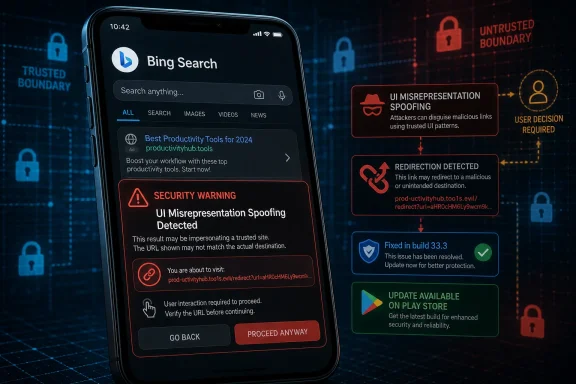
Microsoft disclosed CVE-2026-45650 on June 9, 2026, as an Important-severity spoofing flaw in Microsoft Bing Search for Android, fixed in build 33.3, where a crafted URL could cause user-interface misrepresentation and expose limited sensitive information after user interaction.
That is a small sentence in the language of Patch Tuesday, but a large one in the language of trust. Bing on Android is not a kernel driver, an Exchange server, or a domain controller; it is a consumer-facing search app that sits between a user and the web’s answers. When that layer can misrepresent critical information, the damage is less about system takeover than about steering attention, belief, and clicks.
CVE-2026-45650 is a spoofing vulnerability, not a remote-code-execution barnburner. Microsoft rates it Important rather than Critical, gives it a CVSS 3.1 base score of 4.3, and says exploitation is “less likely.” On paper, that puts it in the kind of middle tier that administrators often file behind louder bugs with higher scores and scarier acronyms.
But the affected product matters. Microsoft Bing Search for Android is a mobile app used in a context where the user is usually moving fast, consuming snippets, following links, and making decisions from compressed visual signals. A spoofing flaw in that environment is not merely cosmetic; it is a weakness in the user’s ability to tell what the app is actually showing them.
Microsoft’s own description is terse: user interface misrepresentation of critical information in Microsoft Bing could allow an unauthorized attacker to perform spoofing over a network. The mechanics Microsoft chose to disclose are equally spare. Successful exploitation requires the user to click a specially crafted URL, and the disclosed impact is limited to some loss of confidentiality, with no integrity or availability impact.
That restraint is important. There is no public evidence from Microsoft’s advisory that this flaw was exploited in the wild, publicly disclosed before the fix, or capable of letting an attacker modify data or knock services offline. The story is not that Bing for Android suddenly became a disaster. The story is that the modern attack surface now includes the thin layer of visual confidence users rely on before they decide what to trust.
The CVSS vector says a lot in a compact string. The attack vector is network, attack complexity is low, privileges required are none, and user interaction is required. That means the attacker does not need an account or a foothold on the device, but does need the victim to participate by clicking a crafted URL.
That participation requirement lowers the score, and rightly so. A one-click lure is not the same as wormable code execution. But phishing, malvertising, search poisoning, SMS lures, QR-code campaigns, and social-media scams are all built around getting users to click things. In real life, “user interaction required” is not a rare precondition; it is the business model of a large portion of cybercrime.
The limited confidentiality impact is also worth reading carefully. Microsoft says an attacker who successfully exploited the issue could view some sensitive information, but not all resources in the impacted component would be disclosed. The attacker could not change the disclosed information and could not limit access to the resource.
That makes this a narrow bug, but not a meaningless one. A spoofing vulnerability that reveals limited information can still help an attacker confirm a target, tailor a follow-up lure, or make a fake page feel more credible. In the hierarchy of compromise, it may be an opening move rather than the checkmate.
For consumers, the practical advice is simple: update the Bing app from the Play Store and make sure automatic app updates are working. For enterprise IT, the answer depends on how Android devices are managed. Organizations using mobile device management should verify app inventory, confirm the fixed build is deployed, and decide whether Bing Search for Android is permitted, required, or merely tolerated on corporate devices.
The lack of a Windows platform entry is also clarifying. This is not a Bing search engine vulnerability in the broadest possible sense, nor a Windows Search bug, nor an Edge vulnerability. It is specifically tied to Microsoft’s Android search app as described in the advisory.
That product boundary should prevent overreaction, but it should not produce indifference. Mobile apps often sit outside the patch muscle memory that Windows administrators have built over decades. Servers have dashboards, endpoints have agents, and Patch Tuesday has process; consumer-style mobile apps can remain in a grayer zone, especially on bring-your-own-device fleets.
In that gray zone, an “Important” mobile spoofing bug can linger longer than it should. The fix exists, the build number is clear, and the affected app is identifiable. The remaining question is whether organizations have the operational visibility to know who is still running the vulnerable version.
That does not mean public exploit code exists. Microsoft separately lists exploit code maturity as Unproven, meaning no public exploit code is known or the exploit is theoretical at publication time. The distinction is subtle but important: Microsoft is confident the vulnerability is real, while also saying public weaponization has not been demonstrated.
Confirmed report confidence raises the floor under the advisory. This is not rumor, ambiguous research, or a speculative class of weakness. Microsoft, acting as the assigning CNA, has acknowledged the flaw and shipped an official fix.
At the same time, the lack of public technical detail keeps the ceiling low for defenders trying to model exploitation. We know the class of bug, the affected app, the fixed build, the required user action, and the broad impact. We do not know the exact interface element being misrepresented, the nature of the sensitive information exposed, or the shape of a malicious URL.
That is normal for many vendor advisories, especially where more detail could help copycat attackers while users are still updating. But it creates an uncomfortable asymmetry. Defenders must act on a confirmed vulnerability without having enough detail to write precise detections, while attackers can often probe the diff between vulnerable and fixed app behavior.
CWE-451, the weakness Microsoft maps here, is about misrepresentation of critical information in a user interface. In plain English, the software can show something important in a way that leads the user to believe the wrong thing. That might involve origin, identity, destination, content, or another trust signal.
On mobile, UI trust is especially fragile. Screens are small, browser and app chrome is compressed, URLs are often hidden or truncated, and users are conditioned to move from app to app through deep links. A specially crafted URL can be more persuasive on a phone because the phone is designed to reduce friction.
That is why spoofing bugs deserve more respect than their scores sometimes receive. They attack the boundary between what the system knows and what the user thinks the system knows. Once that boundary blurs, even technically limited flaws can be chained into convincing social-engineering campaigns.
For Bing Search on Android, the obvious risk is not that every user becomes compromised by merely searching the web. Microsoft says user interaction is required. The risk is that a crafted link could use the app’s trusted interface to make a malicious or misleading state look legitimate enough for the next click.
Boring is good. Security teams should prefer vulnerabilities that are fixed before exploitation is known. The problem is that mobile-app patching often lacks the ceremony that surrounds desktop and server patching, so boring fixes can become neglected fixes.
For personally owned devices, the path is mostly user behavior and Play Store settings. If automatic updates are enabled and the device checks in normally, many users will receive the fixed build without ever reading the advisory. If updates are disabled, storage is tight, the device is unmanaged, or the app is sideloaded in some unusual environment, the fix may not arrive promptly.
For managed Android fleets, this is a test of policy hygiene. Administrators should be able to ask which devices have Bing Search for Android installed and which build they are running. If that question cannot be answered, the problem is larger than this CVE.
There is also a governance question hiding here. Many organizations regulate browsers and email clients aggressively but pay less attention to search assistants, mobile discovery apps, and companion apps. Yet these apps increasingly mediate identity, web navigation, AI answers, shopping, and authentication-adjacent flows.
There are reasons for that. If Microsoft disclosed the exact UI element and proof-of-concept flow on release day, it could shorten the path from advisory to weaponized lure. The company has to balance customer awareness against attacker enablement, especially for a mobile app that may update at different speeds across the user base.
Still, sparse advisories carry costs. Security teams trying to communicate risk internally are left explaining why a 4.3-score Android app issue deserves attention. Without concrete examples, the bug can sound abstract: spoofing, UI misrepresentation, limited confidentiality loss. Those words do not always compete well against ransomware headlines.
This is where Microsoft’s exploitability fields matter. Not publicly disclosed, not exploited, exploitation less likely, official fix available, report confidence confirmed. Taken together, they describe a real, patched flaw that should be remediated promptly but not treated as an active crisis.
That is the tone administrators should borrow. Do not panic users. Do not ignore the update. Do not imply that Bing search results as a whole are compromised. Do verify build 33.3 or later where the app is present.
A spoofing flaw in a mobile search app sits at the edge of that ecosystem, but edges are where users make decisions. They click search results, approve sign-ins, follow support links, scan QR codes, and move between personal and work contexts. Attackers do not need every layer to be broken; they need one trusted layer to say the wrong thing at the right time.
For WindowsForum readers, the connection to Windows is practical rather than platform-specific. Many Windows shops are now mixed-device shops, and many Microsoft accounts move fluidly between desktop and mobile. A compromised decision made on a phone can affect the same identity, cloud data, or workflow used on a Windows PC.
That does not mean CVE-2026-45650 is secretly a Windows vulnerability. It means Windows administrators can no longer define Microsoft security by Windows Update alone. The Microsoft stack users actually touch includes mobile apps that may not be patched by WSUS, Intune policies that may or may not inventory consumer apps, and user journeys that cross devices constantly.
The advisory is therefore a small reminder of a larger shift. Microsoft’s security perimeter is as much about product surfaces and user interfaces as it is about binaries and ports. A clean patching process for Windows is necessary, but it is not sufficient.
But less likely is not impossible. It is a prioritization signal, not a permission slip. The risk for low-to-medium scoring vulnerabilities is that organizations translate “less likely” into “never,” and “Important” into “whenever.”
Attackers often operate in that gap. They do not always need the highest-severity bug if a lower-severity bug is easier to deliver, less monitored, or more believable to users. A spoofing flaw requiring a click can be useful in a campaign where the click is already assumed.
The temporal score of 3.8 reflects the official fix and unproven exploit code, but the base conditions remain notable: network attack vector, low complexity, no privileges required. The weakness is gated by user interaction and limited impact, not by attacker access.
That is the practical balance. This is not a drop-everything emergency, but it is exactly the kind of update that should disappear quickly from an environment with competent mobile-app management. If it remains present weeks later, the lingering risk says more about process than about the CVE.
Consumer apps installed on corporate-owned Android devices should be visible through management tooling. BYOD devices may be more complicated, especially if the app sits outside a managed work profile. Organizations that allow personal devices to access company resources need to decide whether app-level vulnerabilities like this fall inside their monitoring expectations.
There is also a communication challenge. Telling users to “update Bing” may confuse those who think of Bing as a website rather than an app. The affected product is the Android search app, not the general concept of Bing search in a browser.
Clear wording helps. Security teams should say that Microsoft fixed a spoofing issue in the Bing Search app for Android, that users should update the app through the Play Store, and that no known exploitation was reported by Microsoft at publication. That is accurate, calm, and actionable.
The broader programmatic answer is to treat mobile app versions as first-class security data. If a product can receive a CVE, it should be something an organization can inventory, update, and retire. That is easy to say and unevenly implemented.
CVE-2026-45650 will probably not be remembered as one of the defining Microsoft vulnerabilities of 2026, and that is precisely why it is useful: it shows how much of modern security work now lives in the unglamorous middle, where confirmed flaws have modest scores, real fixes, sparse details, and a dependency on users and administrators doing the ordinary thing quickly. The next wave of Microsoft risk will not arrive only through Windows kernels and enterprise servers; it will keep arriving through the apps, interfaces, and trust cues that users touch before they ever think about security.
That is a small sentence in the language of Patch Tuesday, but a large one in the language of trust. Bing on Android is not a kernel driver, an Exchange server, or a domain controller; it is a consumer-facing search app that sits between a user and the web’s answers. When that layer can misrepresent critical information, the damage is less about system takeover than about steering attention, belief, and clicks.
 Microsoft’s Quiet Bing Fix Is Really About Trust at the Edge
CVE-2026-45650 is a spoofing vulnerability, not a remote-code-execution barnburner. Microsoft rates it Important rather than Critical, gives it a CVSS 3.1 base score of 4.3, and says exploitation is “less likely.” On paper, that puts it in the kind of middle tier that administrators often file behind louder bugs with higher scores and scarier acronyms.But the affected product matters. Microsoft Bing Search for Android is a mobile app used in a context where the user is usually moving fast, consuming snippets, following links, and making decisions from compressed visual signals. A spoofing flaw in that environment is not merely cosmetic; it is a weakness in the user’s ability to tell what the app is actually showing them.
Microsoft’s own description is terse: user interface misrepresentation of critical information in Microsoft Bing could allow an unauthorized attacker to perform spoofing over a network. The mechanics Microsoft chose to disclose are equally spare. Successful exploitation requires the user to click a specially crafted URL, and the disclosed impact is limited to some loss of confidentiality, with no integrity or availability impact.
That restraint is important. There is no public evidence from Microsoft’s advisory that this flaw was exploited in the wild, publicly disclosed before the fix, or capable of letting an attacker modify data or knock services offline. The story is not that Bing for Android suddenly became a disaster. The story is that the modern attack surface now includes the thin layer of visual confidence users rely on before they decide what to trust.
A Medium Score Can Still Describe a Useful Attack
Security teams have been trained, for understandable reasons, to sort by severity. Criticals get emergency meetings, Highs get accelerated patching, and Mediums can drift into the next maintenance window. CVE-2026-45650 resists that neat triage because the score captures technical blast radius better than it captures user deception.The CVSS vector says a lot in a compact string. The attack vector is network, attack complexity is low, privileges required are none, and user interaction is required. That means the attacker does not need an account or a foothold on the device, but does need the victim to participate by clicking a crafted URL.
That participation requirement lowers the score, and rightly so. A one-click lure is not the same as wormable code execution. But phishing, malvertising, search poisoning, SMS lures, QR-code campaigns, and social-media scams are all built around getting users to click things. In real life, “user interaction required” is not a rare precondition; it is the business model of a large portion of cybercrime.
The limited confidentiality impact is also worth reading carefully. Microsoft says an attacker who successfully exploited the issue could view some sensitive information, but not all resources in the impacted component would be disclosed. The attacker could not change the disclosed information and could not limit access to the resource.
That makes this a narrow bug, but not a meaningless one. A spoofing vulnerability that reveals limited information can still help an attacker confirm a target, tailor a follow-up lure, or make a fake page feel more credible. In the hierarchy of compromise, it may be an opening move rather than the checkmate.
The Android App Is the Patch Boundary
The affected product listed by Microsoft is Microsoft Bing Search for Android, with build 33.3 identified as the fixed build. That detail matters because remediation is not a Windows Update exercise. This is a mobile-app update distributed through the Android app ecosystem.For consumers, the practical advice is simple: update the Bing app from the Play Store and make sure automatic app updates are working. For enterprise IT, the answer depends on how Android devices are managed. Organizations using mobile device management should verify app inventory, confirm the fixed build is deployed, and decide whether Bing Search for Android is permitted, required, or merely tolerated on corporate devices.
The lack of a Windows platform entry is also clarifying. This is not a Bing search engine vulnerability in the broadest possible sense, nor a Windows Search bug, nor an Edge vulnerability. It is specifically tied to Microsoft’s Android search app as described in the advisory.
That product boundary should prevent overreaction, but it should not produce indifference. Mobile apps often sit outside the patch muscle memory that Windows administrators have built over decades. Servers have dashboards, endpoints have agents, and Patch Tuesday has process; consumer-style mobile apps can remain in a grayer zone, especially on bring-your-own-device fleets.
In that gray zone, an “Important” mobile spoofing bug can linger longer than it should. The fix exists, the build number is clear, and the affected app is identifiable. The remaining question is whether organizations have the operational visibility to know who is still running the vulnerable version.
Report Confidence Is the Metric That Changes the Mood
The user-supplied metric text points to a detail many readers skip: report confidence. In CVSS, report confidence measures how much trust we should place in the existence of the vulnerability and the credibility of the technical details. For CVE-2026-45650, Microsoft marks report confidence as Confirmed.That does not mean public exploit code exists. Microsoft separately lists exploit code maturity as Unproven, meaning no public exploit code is known or the exploit is theoretical at publication time. The distinction is subtle but important: Microsoft is confident the vulnerability is real, while also saying public weaponization has not been demonstrated.
Confirmed report confidence raises the floor under the advisory. This is not rumor, ambiguous research, or a speculative class of weakness. Microsoft, acting as the assigning CNA, has acknowledged the flaw and shipped an official fix.
At the same time, the lack of public technical detail keeps the ceiling low for defenders trying to model exploitation. We know the class of bug, the affected app, the fixed build, the required user action, and the broad impact. We do not know the exact interface element being misrepresented, the nature of the sensitive information exposed, or the shape of a malicious URL.
That is normal for many vendor advisories, especially where more detail could help copycat attackers while users are still updating. But it creates an uncomfortable asymmetry. Defenders must act on a confirmed vulnerability without having enough detail to write precise detections, while attackers can often probe the diff between vulnerable and fixed app behavior.
Spoofing Is the Oldest Web Problem in a Newer Wrapper
Spoofing vulnerabilities have never had the cinematic appeal of remote code execution. They do not always produce shells, dropped payloads, or dramatic incident-response timelines. Instead, they exploit a more basic dependency: the user believes the interface.CWE-451, the weakness Microsoft maps here, is about misrepresentation of critical information in a user interface. In plain English, the software can show something important in a way that leads the user to believe the wrong thing. That might involve origin, identity, destination, content, or another trust signal.
On mobile, UI trust is especially fragile. Screens are small, browser and app chrome is compressed, URLs are often hidden or truncated, and users are conditioned to move from app to app through deep links. A specially crafted URL can be more persuasive on a phone because the phone is designed to reduce friction.
That is why spoofing bugs deserve more respect than their scores sometimes receive. They attack the boundary between what the system knows and what the user thinks the system knows. Once that boundary blurs, even technically limited flaws can be chained into convincing social-engineering campaigns.
For Bing Search on Android, the obvious risk is not that every user becomes compromised by merely searching the web. Microsoft says user interaction is required. The risk is that a crafted link could use the app’s trusted interface to make a malicious or misleading state look legitimate enough for the next click.
The Official Fix Lowers Urgency, Not Responsibility
Microsoft lists the remediation level as Official Fix. In CVSS terms, that lowers the temporal score because the vendor has provided a complete solution. In operational terms, it means the right response is boring: update the app.Boring is good. Security teams should prefer vulnerabilities that are fixed before exploitation is known. The problem is that mobile-app patching often lacks the ceremony that surrounds desktop and server patching, so boring fixes can become neglected fixes.
For personally owned devices, the path is mostly user behavior and Play Store settings. If automatic updates are enabled and the device checks in normally, many users will receive the fixed build without ever reading the advisory. If updates are disabled, storage is tight, the device is unmanaged, or the app is sideloaded in some unusual environment, the fix may not arrive promptly.
For managed Android fleets, this is a test of policy hygiene. Administrators should be able to ask which devices have Bing Search for Android installed and which build they are running. If that question cannot be answered, the problem is larger than this CVE.
There is also a governance question hiding here. Many organizations regulate browsers and email clients aggressively but pay less attention to search assistants, mobile discovery apps, and companion apps. Yet these apps increasingly mediate identity, web navigation, AI answers, shopping, and authentication-adjacent flows.
Microsoft’s Advisory Says Less Than Defenders Want
The advisory’s FAQ confirms that the user would need to click a specially crafted URL. It also says successful exploitation could disclose some sensitive information, while leaving integrity and availability unaffected. That is useful, but it leaves defenders with a broad sketch rather than a playbook.There are reasons for that. If Microsoft disclosed the exact UI element and proof-of-concept flow on release day, it could shorten the path from advisory to weaponized lure. The company has to balance customer awareness against attacker enablement, especially for a mobile app that may update at different speeds across the user base.
Still, sparse advisories carry costs. Security teams trying to communicate risk internally are left explaining why a 4.3-score Android app issue deserves attention. Without concrete examples, the bug can sound abstract: spoofing, UI misrepresentation, limited confidentiality loss. Those words do not always compete well against ransomware headlines.
This is where Microsoft’s exploitability fields matter. Not publicly disclosed, not exploited, exploitation less likely, official fix available, report confidence confirmed. Taken together, they describe a real, patched flaw that should be remediated promptly but not treated as an active crisis.
That is the tone administrators should borrow. Do not panic users. Do not ignore the update. Do not imply that Bing search results as a whole are compromised. Do verify build 33.3 or later where the app is present.
The Real Audience Is Not Just Bing Users
The narrow affected product may tempt readers to treat this as a niche mobile issue. That would miss the broader lesson. Microsoft’s ecosystem now spans Windows, Edge, Bing, Copilot, Android apps, iOS apps, cloud services, browser extensions, and identity services; the trust boundary is no longer just the operating system.A spoofing flaw in a mobile search app sits at the edge of that ecosystem, but edges are where users make decisions. They click search results, approve sign-ins, follow support links, scan QR codes, and move between personal and work contexts. Attackers do not need every layer to be broken; they need one trusted layer to say the wrong thing at the right time.
For WindowsForum readers, the connection to Windows is practical rather than platform-specific. Many Windows shops are now mixed-device shops, and many Microsoft accounts move fluidly between desktop and mobile. A compromised decision made on a phone can affect the same identity, cloud data, or workflow used on a Windows PC.
That does not mean CVE-2026-45650 is secretly a Windows vulnerability. It means Windows administrators can no longer define Microsoft security by Windows Update alone. The Microsoft stack users actually touch includes mobile apps that may not be patched by WSUS, Intune policies that may or may not inventory consumer apps, and user journeys that cross devices constantly.
The advisory is therefore a small reminder of a larger shift. Microsoft’s security perimeter is as much about product surfaces and user interfaces as it is about binaries and ports. A clean patching process for Windows is necessary, but it is not sufficient.
Attackers Love the Space Between “Less Likely” and “Ignored”
Microsoft’s exploitability assessment says exploitation is less likely. That should be taken seriously. It reflects Microsoft’s view at publication time and is more grounded than speculation from the outside.But less likely is not impossible. It is a prioritization signal, not a permission slip. The risk for low-to-medium scoring vulnerabilities is that organizations translate “less likely” into “never,” and “Important” into “whenever.”
Attackers often operate in that gap. They do not always need the highest-severity bug if a lower-severity bug is easier to deliver, less monitored, or more believable to users. A spoofing flaw requiring a click can be useful in a campaign where the click is already assumed.
The temporal score of 3.8 reflects the official fix and unproven exploit code, but the base conditions remain notable: network attack vector, low complexity, no privileges required. The weakness is gated by user interaction and limited impact, not by attacker access.
That is the practical balance. This is not a drop-everything emergency, but it is exactly the kind of update that should disappear quickly from an environment with competent mobile-app management. If it remains present weeks later, the lingering risk says more about process than about the CVE.
The Fix Is Simple; the Inventory May Not Be
The most direct remediation is updating Microsoft Bing Search for Android to build 33.3 or later. For many readers, that will be a Play Store update and nothing more. But the administrative question is whether anyone can prove it happened.Consumer apps installed on corporate-owned Android devices should be visible through management tooling. BYOD devices may be more complicated, especially if the app sits outside a managed work profile. Organizations that allow personal devices to access company resources need to decide whether app-level vulnerabilities like this fall inside their monitoring expectations.
There is also a communication challenge. Telling users to “update Bing” may confuse those who think of Bing as a website rather than an app. The affected product is the Android search app, not the general concept of Bing search in a browser.
Clear wording helps. Security teams should say that Microsoft fixed a spoofing issue in the Bing Search app for Android, that users should update the app through the Play Store, and that no known exploitation was reported by Microsoft at publication. That is accurate, calm, and actionable.
The broader programmatic answer is to treat mobile app versions as first-class security data. If a product can receive a CVE, it should be something an organization can inventory, update, and retire. That is easy to say and unevenly implemented.
The 4.3 Score Hides a Very Specific Set of Decisions
The concrete readout from CVE-2026-45650 is compact enough to fit into a security ticket, but it deserves a more deliberate interpretation. This is a confirmed, fixed, user-interaction spoofing flaw in a Microsoft Android app, with limited confidentiality impact and no known exploitation at release.- Microsoft disclosed CVE-2026-45650 on June 9, 2026, and identified Microsoft Bing Search for Android as the affected product.
- The fixed build listed by Microsoft is 33.3, distributed through the app’s normal Android update channel.
- The vulnerability is a UI misrepresentation issue that could allow spoofing after a user clicks a specially crafted URL.
- Microsoft rates the issue Important with a CVSS 3.1 base score of 4.3 and a temporal score of 3.8.
- Microsoft says the vulnerability was not publicly disclosed, was not known to be exploited, and is less likely to be exploited at publication time.
- The most practical response is to update the Android app and verify managed-device inventory rather than treating the issue as a Windows patch emergency.
CVE-2026-45650 will probably not be remembered as one of the defining Microsoft vulnerabilities of 2026, and that is precisely why it is useful: it shows how much of modern security work now lives in the unglamorous middle, where confirmed flaws have modest scores, real fixes, sparse details, and a dependency on users and administrators doing the ordinary thing quickly. The next wave of Microsoft risk will not arrive only through Windows kernels and enterprise servers; it will keep arriving through the apps, interfaces, and trust cues that users touch before they ever think about security.
References
- Primary source: MSRC
Published: 2026-06-09T07:00:00-07:00
Security Update Guide - Microsoft Security Response Center
 msrc.microsoft.com
