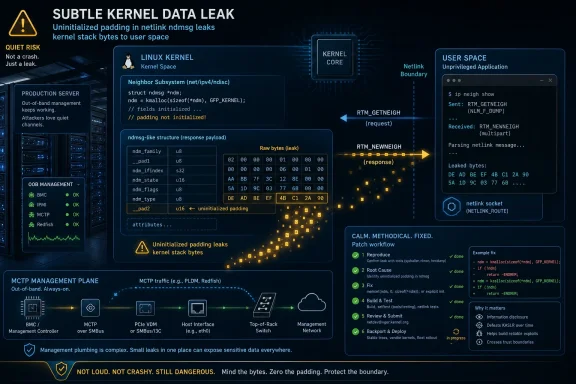
CVE-2026-45930 is a Linux kernel information-disclosure flaw published by NVD on May 27, 2026, after kernel.org reported that MCTP netlink replies to RTM_GETNEIGH could expose uninitialized padding bytes in ndmsg response data. The bug is not the kind of remote-code-execution thunderclap that sends help desks into all-hands mode. Its importance is quieter: it shows how even a few careless bytes at the boundary between kernel and user space can matter. For WindowsForum readers, the lesson is not “Linux is broken,” but that modern infrastructure risk increasingly lives in obscure management plumbing that most users never knowingly touch.
The core issue in CVE-2026-45930 is straightforward. In Linux’s MCTP networking code, certain netlink response messages were not fully initialized before being sent back to user space. Specifically, a request path involving RTM_GETNEIGH could return uninitialized data in the padding bytes of an
That sounds almost comically minor until you remember where the data comes from. Kernel memory is not ordinary application memory. It is the operating system’s privileged workspace, and the industry has spent decades learning that even small unintended disclosures can become useful to attackers when chained with other bugs.
The fix is equally unglamorous: zero-initialize the relevant netlink data in MCTP link, address, and neighbor response messages. In security terms, this is not a dramatic rewrite. It is a reminder that defensive programming often means making sure the boring paths are boring all the way down.
The vulnerability was reported by Syed Faraz Abrar of Zellic and Pumpkin of the DEVCORE Research Team working with Trend Micro’s Zero Day Initiative. That lineage matters because it places the bug in the professional vulnerability-research pipeline rather than the rumor mill. As of publication, NVD had marked the record as awaiting enrichment, with no CVSS score assigned by NIST.
That absence should not be misread as proof of harmlessness. NVD’s enrichment lag is common, especially for fresh kernel CVEs, and the initial record already identifies the vulnerable behavior and upstream fixes. What administrators have today is enough to begin triage, but not enough to slot the issue neatly into a risk dashboard without judgment.
The likely practical severity depends heavily on exposure. This is not described as a remote network packet causing arbitrary kernel memory disclosure over the internet. It is a local user-space interface returning uninitialized padding through netlink, tied to MCTP neighbor-query behavior. That distinction matters.
Still, local information disclosure in the kernel is not a category to wave away. Kernel address leaks and memory layout hints have historically helped bypass exploit mitigations such as address-space layout randomization. A few bytes here, a race there, a separate write primitive somewhere else: serious exploits are often assembled from parts that looked unimpressive in isolation.
That makes it sound niche, and it is. But niche is not the same as irrelevant. MCTP sits in the world of servers, firmware-adjacent management, embedded systems, baseboard management controllers, and hardware monitoring. It is one of those infrastructural layers that can be nearly invisible in day-to-day operations while still being important to fleets of machines.
For Windows-centric IT pros, the nearest analogy is not SMB or RDP. It is the collection of lower-level manageability features that vendors increasingly rely on to monitor, inventory, and control hardware beneath the operating system’s everyday surface. These layers are not where users click, but they are where administrators and firmware ecosystems increasingly operate.
That is why a kernel CVE in MCTP deserves coverage on a Windows community site. Modern estates are heterogeneous. Windows endpoints coexist with Linux appliances, Hyper-V hosts talk to Linux guests, Windows admins manage Kubernetes nodes, and server hardware does not care which GUI you prefer. A flaw in a Linux management protocol can still end up on the risk register of a Microsoft-heavy shop.
CVE-2026-45930 sits at that boundary. A response message prepared inside the kernel was apparently leaving some padding bytes untouched, allowing whatever happened to be in that memory location to ride along into user space. The payload is not a documented field. It is the space around the documented field.
This is why “padding byte” should not lull anyone to sleep. Padding exists because structures need alignment, compatibility, or room for layout constraints. But when a structure crosses a privilege boundary, every byte in the structure becomes part of the security contract. If the kernel sends it, user space can read it.
The fix, zeroing the structure before filling it, is standard hygiene. It also reflects a broader truth: secure systems often depend less on heroic detection and more on eliminating ambiguity. If a byte is not supposed to carry meaning, it should carry zero.
But “not panic” is not “ignore.” Kernel information leaks are especially awkward because they can erode assumptions that other mitigations rely on. On hardened systems, attackers often need a kernel pointer, heap clue, or layout hint before they can make a second bug reliable. Disclosure bugs can become the reconnaissance stage of a larger exploit.
The right posture is to patch through normal kernel update channels, prioritizing systems that actually enable or rely on MCTP. For many general-purpose desktops, the vulnerable code may not be built, loaded, or reachable in any meaningful way. For server platforms, appliances, lab systems, and custom kernels, the calculus changes.
The two kernel.org stable references attached to the CVE indicate that the fix has been integrated into stable kernel history. Distribution maintainers will now do what distribution maintainers do: backport, package, test, and release on their own schedules. That means administrators should track vendor advisories rather than manually assuming that an upstream commit hash equals coverage on their installed system.
For Windows shops, the hard part is not typing
The vulnerability also exposes the limits of CVE-driven operations. A CVE record can tell you that a bug exists. It cannot tell you whether your vendor has silently backported the fix, whether your kernel configuration includes the affected subsystem, whether a container has meaningful access to the relevant netlink interface, or whether an attacker with local code execution could reach the path in your environment.
That work remains local. The administrator’s job is to convert a public vulnerability record into an environmental decision. That is less satisfying than a universal severity label, but it is more accurate.
The practical exposure will depend on namespace configuration, privileges, capabilities, and whether the relevant MCTP netlink operations are reachable from the workload. Most tightly configured containers should not be handed broad networking powers casually. Unfortunately, real-world container deployments often drift toward privilege for convenience.
Virtual machines are cleaner boundaries. A Linux guest kernel affected by the bug leaks its own kernel memory to its own user space, not the Windows or Hyper-V host beneath it. That still matters for multi-user Linux guests, appliance VMs, and shared development boxes, but it is a different risk model from a host-kernel container issue.
For Windows administrators running WSL, the likely question is whether this affects day-to-day Windows security. The answer is probably “not directly” for ordinary users, but the better answer is to update the WSL kernel through Microsoft’s servicing path when fixes become available. WSL has made Linux kernel patching a Windows-admin concern, even when the vulnerable subsystem is far from the common developer workflow.
That creates a familiar lag between “fixed upstream” and “fixed where you live.” It also creates a familiar confusion: the visible kernel version may not change in the way administrators expect. Enterprise Linux distributions often backport individual patches into older kernel branches while preserving a stable version string for compatibility.
The correct move is to follow the distribution’s security tracker or vendor advisory, then verify package changelogs or build metadata. If the vendor identifies CVE-2026-45930 as fixed, that is generally more meaningful than trying to compare upstream kernel versions by eye. If the vendor says a product is not affected because MCTP is not enabled, that is also useful, but it should be documented rather than assumed.
For custom kernels, the obligation is harsher. Teams that build their own kernels inherit the work of tracking stable patches, evaluating configuration exposure, and rebuilding images. A vulnerability like this is a useful test of whether the custom-kernel process is disciplined or merely historical.
Security teams have already learned to ask whether an application embeds OpenSSL, Log4j, SQLite, or curl. They should also ask where kernels live in the estate and who patches them. The kernel is not just on servers called “linux-prod-01.” It is in appliances, developer stacks, cloud images, containers, network operating systems, and management controllers.
CVE-2026-45930 is not the biggest vulnerability of the year. It is not even necessarily a high-severity vulnerability once scoring lands. But it is a useful specimen because it connects several modern risk patterns: obscure protocol support, privileged boundary mistakes, upstream fixes, delayed enrichment, and vendor-dependent remediation.
That is the world administrators actually manage. The headline may be a few uninitialized bytes. The workflow is asset discovery, vendor tracking, kernel servicing, and deciding which systems can wait for the next maintenance window.
There is also a process lesson. The report came through named researchers and a recognized disclosure channel, then landed as an upstream kernel fix and a CVE entry. That is how vulnerability handling is supposed to work: find, report, fix, publish. The friction comes afterward, when the ecosystem has to translate that orderly upstream process into thousands of downstream decisions.
The awkward part is that the vulnerability is both narrow and real. It is narrow because it concerns a specific protocol subsystem and a specific netlink response behavior. It is real because kernel memory disclosure is never a purely cosmetic defect. The best security programs can hold both ideas at once.
That nuance is where many patch conversations fail. Overstating a bug causes unnecessary fire drills. Understating it lets low-grade weaknesses accumulate until one of them becomes the missing link in a serious chain. CVE-2026-45930 belongs in the middle: patch it, understand it, do not mythologize it.
The lasting lesson of CVE-2026-45930 is that operating-system security is still won and lost at the seams: between kernel and user space, between upstream and vendor builds, between Windows estates and the Linux components they quietly depend on. This particular flaw should fade as distributions absorb the patch, but the pattern will not. As hardware management stacks grow more networked, more programmable, and more deeply integrated into server operations, the obscure subsystems will keep producing important bugs — and the administrators who already know where those subsystems live will be the ones who patch calmly instead of discovering their inventory during the incident.
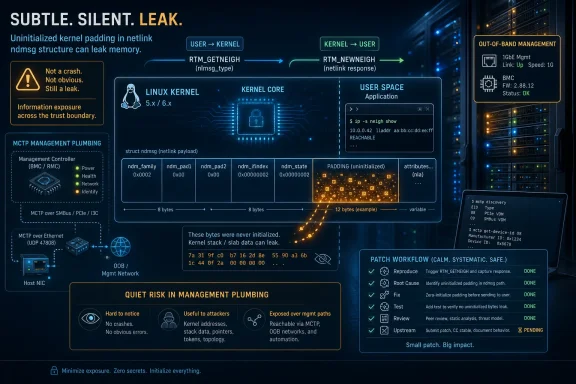 A Small Leak in a Very Privileged Place
The core issue in CVE-2026-45930 is straightforward. In Linux’s MCTP networking code, certain netlink response messages were not fully initialized before being sent back to user space. Specifically, a request path involving RTM_GETNEIGH could return uninitialized data in the padding bytes of an ndmsg structure.That sounds almost comically minor until you remember where the data comes from. Kernel memory is not ordinary application memory. It is the operating system’s privileged workspace, and the industry has spent decades learning that even small unintended disclosures can become useful to attackers when chained with other bugs.
The fix is equally unglamorous: zero-initialize the relevant netlink data in MCTP link, address, and neighbor response messages. In security terms, this is not a dramatic rewrite. It is a reminder that defensive programming often means making sure the boring paths are boring all the way down.
The vulnerability was reported by Syed Faraz Abrar of Zellic and Pumpkin of the DEVCORE Research Team working with Trend Micro’s Zero Day Initiative. That lineage matters because it places the bug in the professional vulnerability-research pipeline rather than the rumor mill. As of publication, NVD had marked the record as awaiting enrichment, with no CVSS score assigned by NIST.
The Missing CVSS Score Is Part of the Story
Security teams love numbers because numbers travel well. A CVSS 9.8 gets routed, escalated, and patched with a clarity that a paragraph of kernel implementation detail rarely achieves. CVE-2026-45930 does not yet have that convenience.That absence should not be misread as proof of harmlessness. NVD’s enrichment lag is common, especially for fresh kernel CVEs, and the initial record already identifies the vulnerable behavior and upstream fixes. What administrators have today is enough to begin triage, but not enough to slot the issue neatly into a risk dashboard without judgment.
The likely practical severity depends heavily on exposure. This is not described as a remote network packet causing arbitrary kernel memory disclosure over the internet. It is a local user-space interface returning uninitialized padding through netlink, tied to MCTP neighbor-query behavior. That distinction matters.
Still, local information disclosure in the kernel is not a category to wave away. Kernel address leaks and memory layout hints have historically helped bypass exploit mitigations such as address-space layout randomization. A few bytes here, a race there, a separate write primitive somewhere else: serious exploits are often assembled from parts that looked unimpressive in isolation.
MCTP Is the Kind of Subsystem Most People Ignore Until It Matters
MCTP, the Management Component Transport Protocol, is not part of the average desktop user’s vocabulary. It is a protocol for communication among management controllers and managed devices inside a platform. In Linux, MCTP support lives under the networking stack and provides a socket-based interface through AF_MCTP, with physical transport bindings handled by driver code.That makes it sound niche, and it is. But niche is not the same as irrelevant. MCTP sits in the world of servers, firmware-adjacent management, embedded systems, baseboard management controllers, and hardware monitoring. It is one of those infrastructural layers that can be nearly invisible in day-to-day operations while still being important to fleets of machines.
For Windows-centric IT pros, the nearest analogy is not SMB or RDP. It is the collection of lower-level manageability features that vendors increasingly rely on to monitor, inventory, and control hardware beneath the operating system’s everyday surface. These layers are not where users click, but they are where administrators and firmware ecosystems increasingly operate.
That is why a kernel CVE in MCTP deserves coverage on a Windows community site. Modern estates are heterogeneous. Windows endpoints coexist with Linux appliances, Hyper-V hosts talk to Linux guests, Windows admins manage Kubernetes nodes, and server hardware does not care which GUI you prefer. A flaw in a Linux management protocol can still end up on the risk register of a Microsoft-heavy shop.
Netlink Is a Boundary, and Boundaries Are Where Bugs Become Security Bugs
Netlink is one of Linux’s major communication channels between user space and the kernel. Tools use it to ask the kernel about networking state, configure interfaces, retrieve neighbor information, and perform other privileged bookkeeping tasks. It is not glamorous, but it is foundational.CVE-2026-45930 sits at that boundary. A response message prepared inside the kernel was apparently leaving some padding bytes untouched, allowing whatever happened to be in that memory location to ride along into user space. The payload is not a documented field. It is the space around the documented field.
This is why “padding byte” should not lull anyone to sleep. Padding exists because structures need alignment, compatibility, or room for layout constraints. But when a structure crosses a privilege boundary, every byte in the structure becomes part of the security contract. If the kernel sends it, user space can read it.
The fix, zeroing the structure before filling it, is standard hygiene. It also reflects a broader truth: secure systems often depend less on heroic detection and more on eliminating ambiguity. If a byte is not supposed to carry meaning, it should carry zero.
This Is Not a Panic Patch, but It Is a Patch
The most important practical point is that CVE-2026-45930 is not currently framed as a widespread remote compromise scenario. There is no public scoring from NVD yet, and the description centers on uninitialized data returned via a query path. That points toward information disclosure, not direct takeover.But “not panic” is not “ignore.” Kernel information leaks are especially awkward because they can erode assumptions that other mitigations rely on. On hardened systems, attackers often need a kernel pointer, heap clue, or layout hint before they can make a second bug reliable. Disclosure bugs can become the reconnaissance stage of a larger exploit.
The right posture is to patch through normal kernel update channels, prioritizing systems that actually enable or rely on MCTP. For many general-purpose desktops, the vulnerable code may not be built, loaded, or reachable in any meaningful way. For server platforms, appliances, lab systems, and custom kernels, the calculus changes.
The two kernel.org stable references attached to the CVE indicate that the fix has been integrated into stable kernel history. Distribution maintainers will now do what distribution maintainers do: backport, package, test, and release on their own schedules. That means administrators should track vendor advisories rather than manually assuming that an upstream commit hash equals coverage on their installed system.
The Real Risk Is Uneven Visibility
Enterprise patching is often described as a race against attackers, but in cases like this it is also a race against inventory gaps. Do you know which systems in your estate have MCTP enabled? Do you know which appliances ship a Linux kernel with the affected code? Do you know whether your vendor backports security fixes without bumping the visible kernel version?For Windows shops, the hard part is not typing
uname -r on a Linux server. The hard part is finding all the places where Linux exists without being treated as a managed Linux server. Network appliances, storage arrays, hypervisor-side components, security tools, out-of-band management systems, and embedded controllers can all complicate the picture.The vulnerability also exposes the limits of CVE-driven operations. A CVE record can tell you that a bug exists. It cannot tell you whether your vendor has silently backported the fix, whether your kernel configuration includes the affected subsystem, whether a container has meaningful access to the relevant netlink interface, or whether an attacker with local code execution could reach the path in your environment.
That work remains local. The administrator’s job is to convert a public vulnerability record into an environmental decision. That is less satisfying than a universal severity label, but it is more accurate.
Containers and Virtualization Make the Boundary More Interesting
The Linux kernel is shared across containers. That fact has shaped container security for years, and it is relevant here even if CVE-2026-45930 is not a classic container escape. If a containerized process has access to a kernel interface that leaks information, the leak belongs to the host kernel.The practical exposure will depend on namespace configuration, privileges, capabilities, and whether the relevant MCTP netlink operations are reachable from the workload. Most tightly configured containers should not be handed broad networking powers casually. Unfortunately, real-world container deployments often drift toward privilege for convenience.
Virtual machines are cleaner boundaries. A Linux guest kernel affected by the bug leaks its own kernel memory to its own user space, not the Windows or Hyper-V host beneath it. That still matters for multi-user Linux guests, appliance VMs, and shared development boxes, but it is a different risk model from a host-kernel container issue.
For Windows administrators running WSL, the likely question is whether this affects day-to-day Windows security. The answer is probably “not directly” for ordinary users, but the better answer is to update the WSL kernel through Microsoft’s servicing path when fixes become available. WSL has made Linux kernel patching a Windows-admin concern, even when the vulnerable subsystem is far from the common developer workflow.
The Vendor Pipeline Now Matters More Than the Upstream Commit
Kernel.org can fix a bug quickly, but most organizations do not run raw upstream kernels. They run Ubuntu, Debian, Red Hat, SUSE, Amazon Linux, Oracle Linux, Android-derived kernels, appliance kernels, or vendor-modified builds. Each has its own backporting and advisory process.That creates a familiar lag between “fixed upstream” and “fixed where you live.” It also creates a familiar confusion: the visible kernel version may not change in the way administrators expect. Enterprise Linux distributions often backport individual patches into older kernel branches while preserving a stable version string for compatibility.
The correct move is to follow the distribution’s security tracker or vendor advisory, then verify package changelogs or build metadata. If the vendor identifies CVE-2026-45930 as fixed, that is generally more meaningful than trying to compare upstream kernel versions by eye. If the vendor says a product is not affected because MCTP is not enabled, that is also useful, but it should be documented rather than assumed.
For custom kernels, the obligation is harsher. Teams that build their own kernels inherit the work of tracking stable patches, evaluating configuration exposure, and rebuilding images. A vulnerability like this is a useful test of whether the custom-kernel process is disciplined or merely historical.
Windows Admins Should Read This as a Supply-Chain Signal
It would be easy for a WindowsForum audience to file this under “Linux kernel trivia.” That would miss the operational point. Most Windows environments now depend on Linux somewhere, even if only as infrastructure beneath a product that arrives with a polished web console and a vendor logo.Security teams have already learned to ask whether an application embeds OpenSSL, Log4j, SQLite, or curl. They should also ask where kernels live in the estate and who patches them. The kernel is not just on servers called “linux-prod-01.” It is in appliances, developer stacks, cloud images, containers, network operating systems, and management controllers.
CVE-2026-45930 is not the biggest vulnerability of the year. It is not even necessarily a high-severity vulnerability once scoring lands. But it is a useful specimen because it connects several modern risk patterns: obscure protocol support, privileged boundary mistakes, upstream fixes, delayed enrichment, and vendor-dependent remediation.
That is the world administrators actually manage. The headline may be a few uninitialized bytes. The workflow is asset discovery, vendor tracking, kernel servicing, and deciding which systems can wait for the next maintenance window.
The Patch Says More About Discipline Than Drama
The code-level lesson here is old and still stubbornly relevant: initialize what you return. If kernel code constructs a message for user space, it should not rely on every field and padding byte being overwritten by later assignments. Defensive zeroing is cheap compared with the investigative cost of a disclosure bug.There is also a process lesson. The report came through named researchers and a recognized disclosure channel, then landed as an upstream kernel fix and a CVE entry. That is how vulnerability handling is supposed to work: find, report, fix, publish. The friction comes afterward, when the ecosystem has to translate that orderly upstream process into thousands of downstream decisions.
The awkward part is that the vulnerability is both narrow and real. It is narrow because it concerns a specific protocol subsystem and a specific netlink response behavior. It is real because kernel memory disclosure is never a purely cosmetic defect. The best security programs can hold both ideas at once.
That nuance is where many patch conversations fail. Overstating a bug causes unnecessary fire drills. Understating it lets low-grade weaknesses accumulate until one of them becomes the missing link in a serious chain. CVE-2026-45930 belongs in the middle: patch it, understand it, do not mythologize it.
The Few Bytes That Should Drive the Ticket
The practical response to CVE-2026-45930 should be concrete rather than theatrical. One short ticket with the right ownership beats a dozen Slack threads about whether an unscored CVE “counts.”- Administrators should check distribution and appliance-vendor advisories for CVE-2026-45930 rather than relying only on upstream kernel commit references.
- Systems using MCTP, server hardware-management paths, custom kernels, or embedded Linux builds should receive higher triage priority than ordinary desktops with no apparent exposure.
- Container hosts should be reviewed for workloads that have unnecessary network administration privileges or broad access to kernel networking interfaces.
- Security teams should avoid treating the missing NVD score as a safe harbor, because enrichment delay is not the same as low severity.
- Custom-kernel maintainers should confirm that the zero-initialization fix has been merged into their maintained branch and shipped in the next image.
- Windows-heavy organizations should include Linux-based appliances, WSL kernels, cloud images, and infrastructure components in the patch review rather than limiting the search to named Linux servers.
The lasting lesson of CVE-2026-45930 is that operating-system security is still won and lost at the seams: between kernel and user space, between upstream and vendor builds, between Windows estates and the Linux components they quietly depend on. This particular flaw should fade as distributions absorb the patch, but the pattern will not. As hardware management stacks grow more networked, more programmable, and more deeply integrated into server operations, the obscure subsystems will keep producing important bugs — and the administrators who already know where those subsystems live will be the ones who patch calmly instead of discovering their inventory during the incident.
References
- Primary source: NVD / Linux Kernel
Published: 2026-05-28T01:02:41-07:00
NVD - CVE-2026-45930
 nvd.nist.gov
- Security advisory: MSRC
Published: 2026-05-28T01:02:41-07:00
Original feed URL
Security Update Guide - Microsoft Security Response Center
 msrc.microsoft.com
- Related coverage: korg.docs.kernel.org
- Related coverage: kernel.org

The Linux Kernel Archives
www.kernel.org
- Related coverage: kernel.googlesource.com
- Related coverage: android.googlesource.com
- Official source: github.com
GitHub - gregkh/linux: Linux kernel stable tree mirror
Linux kernel stable tree mirror. Contribute to gregkh/linux development by creating an account on GitHub. github.com
- Related coverage: gitlab.com
freedesktop-sdk / mirrors / kernel / linux / kernel / git / stable / linux · GitLab
git.kernel.org: pub/scm/linux/kernel/git/stable/linux.gitgitlab.com - Related coverage: arstechnica.com
Microsoft issues emergency update for macOS and Linux ASP.NET threat - Ars Technica
When authentication fails, things can go very, very wrong.arstechnica.com - Related coverage: tinylab.org
- Related coverage: bootlin.com
- Related coverage: www2.gov.bc.ca
- Related coverage: phoronix.com
Linux 5.15 Adding Management Component Transport Protocol (MCTP) - Phoronix
Linux 5.15 is positioned now to see a Management Component Transport Protocol (MCTP) implementation with the code now queued in net-next with this being a protocol for communication between management controllers and managed devices.www.phoronix.com
- Related coverage: docs.linuxkernel.org.cn
- Related coverage: cateee.net
- Related coverage: man.archlinux.org
mctp(7) — Arch manual pages
man.archlinux.org
- Related coverage: manpages.ubuntu.com
Ubuntu Manpage: mctp - Management Component Transport Protocol
Management Component Transport Protocol manpages.ubuntu.com
- Related coverage: docs.kernel.org

Networking — The Linux Kernel documentation
docs.kernel.org