

CVE-2026-45986 is a newly published Linux kernel vulnerability from kernel.org, recorded by NVD on May 27, 2026, covering a memory leak in the
The vulnerability description is almost comically terse: add
The affected code sits in the Linux kernel’s crypto subsystem, specifically the
Memory leaks in kernel space occupy a strange middle ground in vulnerability triage. They usually do not promise instant code execution, privilege escalation, or data disclosure by themselves. But they can still become availability problems, and in tightly scoped embedded or virtualized environments, resource exhaustion is not a theoretical nuisance. It is downtime by another name.
The ccree fix is narrow: if a final hash mapping operation fails, the code now unwinds the previously mapped result buffer. That sounds like hygiene, and it is. But operating systems are made of hygiene. Every missing cleanup call is a tiny bet that nothing will go wrong at exactly the wrong time.
That would be a mistake, though not because this particular bug is known to be catastrophic. The better reading is that the public record is still thin. We know the affected component, the fix shape, the publication date, and the stable kernel references. We do not yet have a complete NVD analysis of attack vector, privileges required, exploit complexity, or affected product mappings.
This is where vulnerability management often becomes theater. A CVSS score can be useful, but it is not a substitute for knowing whether a vulnerable driver is present, built, loaded, reachable, and used in production. A memory leak in a crypto driver on hardware you do not own is noise. The same leak in a fleet of appliances, edge devices, Android-derived systems, or specialized Linux hosts with the affected accelerator is a very different conversation.
The kernel’s own CVE flow has also changed the vulnerability landscape. More Linux fixes now receive CVE identifiers even when they are small, highly specific, or discovered through routine maintenance rather than dramatic exploitation. That is good for transparency, but it also means administrators must get better at reading the shape of a bug rather than reacting only to the existence of a CVE.
That model is efficient for kernel development, but it is awkward for enterprise security operations. A Windows administrator used to Microsoft’s Patch Tuesday cadence expects consolidated bulletins, product tables, exploitability notes, and fairly explicit remediation language. Linux kernel maintenance is more distributed. The fix may land upstream, then flow through stable trees, then arrive in Ubuntu, Debian, Red Hat, SUSE, Android, appliance firmware, cloud images, and container hosts on timelines that do not line up neatly.
The result is a visibility gap. A CVE can be public before an administrator knows whether their vendor build is affected. Conversely, a vendor may have already incorporated the fix before the CVE appears in NVD. Both scenarios are common enough that treating NVD publication as the beginning of the remediation clock is often too simplistic.
CVE-2026-45986 illustrates this perfectly. The NVD entry points to multiple stable kernel commits, suggesting the fix has been carried into several supported kernel lines. But the public NVD page, at least at initial publication, does not provide a polished severity rating or a clean list of affected distributions. That leaves defenders doing the unglamorous work: checking kernel versions, distro changelogs, config options, and hardware exposure.
But narrowing the blast radius is not the same as dismissing the issue. Hardware crypto engines show up in the kinds of systems that are easy to forget and hard to patch: embedded boards, appliances, industrial devices, network equipment, development kits, and cloud-adjacent infrastructure. Those systems often run Linux kernels customized by vendors, with driver configurations that do not map cleanly to mainstream desktop distributions.
The technical issue is also straightforward enough to be credible. A function maps resources for a final MAC digest operation. A later step fails. The code returns without unmapping something it already mapped. Over time, or under repeated triggering, that missing cleanup can leak memory or related kernel resources.
Whether an attacker can trigger that repeatedly from an unprivileged context is the question that determines practical severity. The current public record does not establish that. Without that path, this looks more like a robustness fix with security implications than a ready-made exploit primitive. With that path, it becomes a potential local denial-of-service issue on affected systems.
That does not mean CVE-2026-45986 threatens Windows 11 laptops through WSL in any straightforward way. WSL kernels are supplied and serviced differently from a random upstream Linux kernel, and the affected hardware driver is unlikely to be relevant in most WSL scenarios. The point is broader: the Windows admin’s perimeter has moved.
In many organizations, Linux is no longer a separate empire run by a different team. It is the invisible substrate behind developer tooling, cloud workloads, VPN appliances, monitoring systems, authentication gateways, and backup infrastructure. A vulnerability in a Linux hardware crypto driver may be irrelevant to the Windows desktop fleet and still relevant to the business systems those desktops depend on.
That is the security lesson here. Platform boundaries remain useful for assigning ownership, but they are increasingly useless as a risk boundary. Attackers do not care which team owns the kernel under the appliance.
That bias is understandable, but it is also dangerous. Availability is one of the three legs of the security stool, and resource exhaustion remains one of the oldest ways to turn a small bug into a real outage. A kernel memory leak is especially sensitive because kernel memory is not ordinary application memory. You cannot always restart a process to claw it back. Sometimes the practical recovery step is rebooting the machine.
In an enterprise server, a slow leak may be tolerable if the triggering path is rare. In an embedded device with limited memory, it may be much more serious. In a multi-tenant or adversarial environment, repeatability is everything. If a local user, container workload, or exposed service can force the vulnerable path often enough, a “potential memory leak” can become a denial-of-service primitive.
The public CVE text does not prove that CVE-2026-45986 is easily triggerable. That is exactly why the right response is measured patching, not panic. But measured patching still means patching.
The stable kernel process is not glamorous, but it is one of the most important pieces of security infrastructure in computing. Most users do not run Linus Torvalds’ latest tree. They run vendor kernels derived from stable or long-term branches, with additional patches layered on top. The value of a fix depends not only on the upstream commit, but on whether it reaches those maintained lines.
For administrators, the practical question is therefore not “Is there a CVE?” but “Has my supplier incorporated the relevant stable fix?” On a mainstream Linux distribution, the answer may arrive through a normal kernel package update. On an appliance, it may require a firmware release. On a cloud image, it may depend on the image publisher. On an embedded device abandoned by its vendor, the answer may be unpleasant.
That is why small kernel CVEs expose supply-chain maturity. A severe headline vulnerability tests incident response. A modest driver memory leak tests inventory, patch channels, and whether anyone knows which kernels are actually running.
This lag creates a practical problem. Automated vulnerability scanners may flag the CVE without useful prioritization, or they may miss the nuance of whether the affected driver is compiled into a given kernel. Ticketing systems may generate work items that say little more than “Linux kernel vulnerability,” leaving engineers to determine whether the system is actually exposed.
The wrong reaction is to wait passively for NVD to finish the job. The right reaction is to use NVD as one signal among several. Kernel commit messages, distro advisories, package changelogs, kernel configuration, hardware inventory, and runtime module state all matter. A vulnerability record is a starting point, not a diagnosis.
This is especially true for Linux kernel CVEs because many of them are driver-specific. A scanner that sees a kernel version may not know whether the vulnerable driver is enabled, reachable, or relevant. That mismatch creates both false urgency and false comfort.
First, the affected code must be present in the kernel build. Many systems will not include the driver at all. Second, the relevant hardware or platform path must exist. A built-but-unused driver is not the same risk as an active crypto accelerator serving real workloads. Third, there must be a way to reach the failing path repeatedly enough to matter. Without that, the bug may remain a correctness issue more than an exploitable security condition.
That last point is where public information is still incomplete. The CVE text describes the fix, not an exploit scenario. It does not say remote attackers can trigger the condition. It does not say unprivileged users can exhaust memory. It does not say secrets are exposed. A careful article should not invent those claims.
But careful does not mean complacent. Kernel error-path bugs are often patched precisely because they are difficult to reason about safely. The responsible assumption is that fixed kernels are preferable to vulnerable ones, especially on systems where uptime and resource predictability matter.
That includes virtualization hosts, developer workstations running Linux guests, security appliances, storage devices, container platforms, build servers, and edge hardware. It also includes products that do not advertise themselves as Linux systems on the front panel but ship a Linux kernel inside. Those are often the places where driver-level CVEs hide from asset systems.
The rise of WSL adds nuance but probably not urgency here. WSL has made Linux more visible on Windows machines, but the typical WSL environment is not exercising obscure hardware crypto drivers directly. Still, organizations that allow custom WSL kernels or specialized developer hardware should not wave the question away without checking.
The bigger Windows lesson is cultural. Windows administrators have learned to read Microsoft advisories with discipline. They now need the same literacy for Linux advisories, because the systems they protect increasingly depend on both.
For mainstream servers that do not use the affected driver, this CVE may sit low in the queue. For embedded or Arm-based systems with hardware crypto acceleration, it deserves closer attention. For internet-facing appliances or shared environments, administrators should be more conservative, because availability bugs become more interesting when attackers can repeatedly prod the vulnerable path.
Testing matters because kernel updates are not free. Even small stable updates can affect drivers, storage, networking, or vendor modules. The answer is not to skip them; it is to maintain a patch process that can absorb routine kernel fixes without turning every update into a bespoke emergency.
The absence of a CVSS score should not block triage. It should force better triage.
The facts are narrow enough to keep the response grounded, but concrete enough to drive action:
ccree crypto driver’s cc_mac_digest() path when final hash request mapping fails. It is not yet scored by NVD, and that absence matters almost as much as the bug itself. This is the kind of quiet kernel flaw that rarely produces splashy exploit headlines, but it does expose the uneasy bargain modern platforms make with hardware-accelerated cryptography. For WindowsForum readers, the story is not “Linux panic”; it is a reminder that Windows estates increasingly depend on Linux kernels in places administrators do not always inventory.
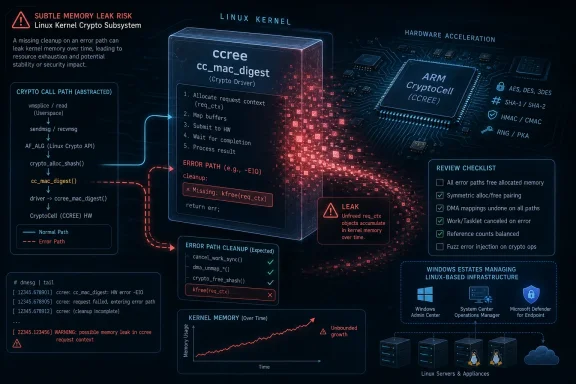 A Small Leak in a Deep Part of the Stack Is Still a Security Event
The vulnerability description is almost comically terse: add cc_unmap_result() if cc_map_hash_request_final() fails, preventing a potential memory leak. That sentence will not move markets, trigger emergency board calls, or send desktop users scrambling for recovery media. It also does not need to do any of those things to matter.The affected code sits in the Linux kernel’s crypto subsystem, specifically the
ccree driver, which supports hardware crypto acceleration associated with Arm CryptoCell-style engines. In practical terms, this is not the generic Linux crypto API failing at the surface; it is a driver-specific cleanup bug in an error path. The uncomfortable phrase is error path, because kernel security history is littered with vulnerabilities that lived not in the common successful case, but in the paths developers hoped would almost never run.Memory leaks in kernel space occupy a strange middle ground in vulnerability triage. They usually do not promise instant code execution, privilege escalation, or data disclosure by themselves. But they can still become availability problems, and in tightly scoped embedded or virtualized environments, resource exhaustion is not a theoretical nuisance. It is downtime by another name.
The ccree fix is narrow: if a final hash mapping operation fails, the code now unwinds the previously mapped result buffer. That sounds like hygiene, and it is. But operating systems are made of hygiene. Every missing cleanup call is a tiny bet that nothing will go wrong at exactly the wrong time.
The Absence of a Score Is Not the Same as the Absence of Risk
NVD lists CVE-2026-45986 as awaiting enrichment, with no CVSS 4.0, 3.x, or 2.0 score assigned at publication. That means security teams looking for a neat severity bucket will not find one yet. The temptation will be to treat “N/A” as “not urgent,” especially in organizations that feed CVSS numbers directly into ticket priority.That would be a mistake, though not because this particular bug is known to be catastrophic. The better reading is that the public record is still thin. We know the affected component, the fix shape, the publication date, and the stable kernel references. We do not yet have a complete NVD analysis of attack vector, privileges required, exploit complexity, or affected product mappings.
This is where vulnerability management often becomes theater. A CVSS score can be useful, but it is not a substitute for knowing whether a vulnerable driver is present, built, loaded, reachable, and used in production. A memory leak in a crypto driver on hardware you do not own is noise. The same leak in a fleet of appliances, edge devices, Android-derived systems, or specialized Linux hosts with the affected accelerator is a very different conversation.
The kernel’s own CVE flow has also changed the vulnerability landscape. More Linux fixes now receive CVE identifiers even when they are small, highly specific, or discovered through routine maintenance rather than dramatic exploitation. That is good for transparency, but it also means administrators must get better at reading the shape of a bug rather than reacting only to the existence of a CVE.
Kernel CVEs Are Becoming More Like Patch Notes With Legal Weight
The wording of CVE-2026-45986 follows a now-familiar pattern: “In the Linux kernel, the following vulnerability has been resolved.” The phrasing is important. It reflects a world in which the upstream fix is often the canonical vulnerability disclosure. The commit is the advisory, the advisory is the commit, and downstream vendors must translate that into distro packages, appliance firmware, and enterprise guidance.That model is efficient for kernel development, but it is awkward for enterprise security operations. A Windows administrator used to Microsoft’s Patch Tuesday cadence expects consolidated bulletins, product tables, exploitability notes, and fairly explicit remediation language. Linux kernel maintenance is more distributed. The fix may land upstream, then flow through stable trees, then arrive in Ubuntu, Debian, Red Hat, SUSE, Android, appliance firmware, cloud images, and container hosts on timelines that do not line up neatly.
The result is a visibility gap. A CVE can be public before an administrator knows whether their vendor build is affected. Conversely, a vendor may have already incorporated the fix before the CVE appears in NVD. Both scenarios are common enough that treating NVD publication as the beginning of the remediation clock is often too simplistic.
CVE-2026-45986 illustrates this perfectly. The NVD entry points to multiple stable kernel commits, suggesting the fix has been carried into several supported kernel lines. But the public NVD page, at least at initial publication, does not provide a polished severity rating or a clean list of affected distributions. That leaves defenders doing the unglamorous work: checking kernel versions, distro changelogs, config options, and hardware exposure.
The Bug Lives Where Crypto Meets Hardware, and That Narrows the Blast Radius
Theccree driver is not a component most Linux users think about. It is a hardware crypto driver, not a user-facing application, and not something a typical Windows desktop user will encounter directly. That fact should lower the temperature of the discussion.But narrowing the blast radius is not the same as dismissing the issue. Hardware crypto engines show up in the kinds of systems that are easy to forget and hard to patch: embedded boards, appliances, industrial devices, network equipment, development kits, and cloud-adjacent infrastructure. Those systems often run Linux kernels customized by vendors, with driver configurations that do not map cleanly to mainstream desktop distributions.
The technical issue is also straightforward enough to be credible. A function maps resources for a final MAC digest operation. A later step fails. The code returns without unmapping something it already mapped. Over time, or under repeated triggering, that missing cleanup can leak memory or related kernel resources.
Whether an attacker can trigger that repeatedly from an unprivileged context is the question that determines practical severity. The current public record does not establish that. Without that path, this looks more like a robustness fix with security implications than a ready-made exploit primitive. With that path, it becomes a potential local denial-of-service issue on affected systems.
Windows Shops Cannot Pretend Linux Is Somebody Else’s Problem
The obvious objection from a WindowsForum reader is fair: this is a Linux kernel CVE, not a Windows bug. But the modern Windows estate is no longer a pure Windows estate. Windows administrators now routinely manage Linux through WSL, Hyper-V guests, Azure images, container hosts, Kubernetes nodes, security appliances, NAS devices, routers, CI runners, and embedded systems sitting just outside the formal endpoint inventory.That does not mean CVE-2026-45986 threatens Windows 11 laptops through WSL in any straightforward way. WSL kernels are supplied and serviced differently from a random upstream Linux kernel, and the affected hardware driver is unlikely to be relevant in most WSL scenarios. The point is broader: the Windows admin’s perimeter has moved.
In many organizations, Linux is no longer a separate empire run by a different team. It is the invisible substrate behind developer tooling, cloud workloads, VPN appliances, monitoring systems, authentication gateways, and backup infrastructure. A vulnerability in a Linux hardware crypto driver may be irrelevant to the Windows desktop fleet and still relevant to the business systems those desktops depend on.
That is the security lesson here. Platform boundaries remain useful for assigning ownership, but they are increasingly useless as a risk boundary. Attackers do not care which team owns the kernel under the appliance.
Memory Leaks Are Boring Until Availability Becomes the Payload
Security culture tends to rank vulnerabilities by drama. Remote code execution gets attention. Privilege escalation gets attention. Information disclosure gets attention when secrets are involved. Memory leaks, by contrast, often get filed under “stability” unless someone can draw a clean line to exploitation.That bias is understandable, but it is also dangerous. Availability is one of the three legs of the security stool, and resource exhaustion remains one of the oldest ways to turn a small bug into a real outage. A kernel memory leak is especially sensitive because kernel memory is not ordinary application memory. You cannot always restart a process to claw it back. Sometimes the practical recovery step is rebooting the machine.
In an enterprise server, a slow leak may be tolerable if the triggering path is rare. In an embedded device with limited memory, it may be much more serious. In a multi-tenant or adversarial environment, repeatability is everything. If a local user, container workload, or exposed service can force the vulnerable path often enough, a “potential memory leak” can become a denial-of-service primitive.
The public CVE text does not prove that CVE-2026-45986 is easily triggerable. That is exactly why the right response is measured patching, not panic. But measured patching still means patching.
The Stable Kernel Machine Is Doing Its Job, Quietly
One of the reassuring details in the CVE record is the presence of multiple stable kernel references. That indicates the fix was not merely tossed into a development branch and forgotten. It has been backported across stable lines, which is how Linux fixes reach the real world.The stable kernel process is not glamorous, but it is one of the most important pieces of security infrastructure in computing. Most users do not run Linus Torvalds’ latest tree. They run vendor kernels derived from stable or long-term branches, with additional patches layered on top. The value of a fix depends not only on the upstream commit, but on whether it reaches those maintained lines.
For administrators, the practical question is therefore not “Is there a CVE?” but “Has my supplier incorporated the relevant stable fix?” On a mainstream Linux distribution, the answer may arrive through a normal kernel package update. On an appliance, it may require a firmware release. On a cloud image, it may depend on the image publisher. On an embedded device abandoned by its vendor, the answer may be unpleasant.
That is why small kernel CVEs expose supply-chain maturity. A severe headline vulnerability tests incident response. A modest driver memory leak tests inventory, patch channels, and whether anyone knows which kernels are actually running.
NVD Enrichment Lag Is Now Part of the Operating Environment
NVD’s “awaiting enrichment” status has become familiar to security teams. It means the entry exists, but the extra analysis administrators often rely on has not yet arrived. For CVE-2026-45986, that includes the missing CVSS score and formal weakness mapping.This lag creates a practical problem. Automated vulnerability scanners may flag the CVE without useful prioritization, or they may miss the nuance of whether the affected driver is compiled into a given kernel. Ticketing systems may generate work items that say little more than “Linux kernel vulnerability,” leaving engineers to determine whether the system is actually exposed.
The wrong reaction is to wait passively for NVD to finish the job. The right reaction is to use NVD as one signal among several. Kernel commit messages, distro advisories, package changelogs, kernel configuration, hardware inventory, and runtime module state all matter. A vulnerability record is a starting point, not a diagnosis.
This is especially true for Linux kernel CVEs because many of them are driver-specific. A scanner that sees a kernel version may not know whether the vulnerable driver is enabled, reachable, or relevant. That mismatch creates both false urgency and false comfort.
The Practical Risk Depends on Three Conditions, Not the CVE Name
CVE identifiers flatten complexity. They make bugs searchable, trackable, and auditable, but they also invite a misleading sameness. CVE-2026-45986 is not just “a Linux kernel CVE.” It is a specific cleanup failure in a specific crypto driver, and its operational relevance depends on three conditions.First, the affected code must be present in the kernel build. Many systems will not include the driver at all. Second, the relevant hardware or platform path must exist. A built-but-unused driver is not the same risk as an active crypto accelerator serving real workloads. Third, there must be a way to reach the failing path repeatedly enough to matter. Without that, the bug may remain a correctness issue more than an exploitable security condition.
That last point is where public information is still incomplete. The CVE text describes the fix, not an exploit scenario. It does not say remote attackers can trigger the condition. It does not say unprivileged users can exhaust memory. It does not say secrets are exposed. A careful article should not invent those claims.
But careful does not mean complacent. Kernel error-path bugs are often patched precisely because they are difficult to reason about safely. The responsible assumption is that fixed kernels are preferable to vulnerable ones, especially on systems where uptime and resource predictability matter.
The Windows-Relevant Impact Is Mostly in Infrastructure, Not Desktops
For Windows desktop administrators, CVE-2026-45986 is unlikely to become a helpdesk event. It will not change Group Policy, break Windows Update, or force emergency action on ordinary Windows endpoints. The more relevant question is what Linux-backed infrastructure sits around those endpoints.That includes virtualization hosts, developer workstations running Linux guests, security appliances, storage devices, container platforms, build servers, and edge hardware. It also includes products that do not advertise themselves as Linux systems on the front panel but ship a Linux kernel inside. Those are often the places where driver-level CVEs hide from asset systems.
The rise of WSL adds nuance but probably not urgency here. WSL has made Linux more visible on Windows machines, but the typical WSL environment is not exercising obscure hardware crypto drivers directly. Still, organizations that allow custom WSL kernels or specialized developer hardware should not wave the question away without checking.
The bigger Windows lesson is cultural. Windows administrators have learned to read Microsoft advisories with discipline. They now need the same literacy for Linux advisories, because the systems they protect increasingly depend on both.
Patch Triage Should Start With Inventory, Not Alarm
The practical response to CVE-2026-45986 should be boring, which is another way of saying mature. Start by identifying systems that run Linux kernels with theccree driver enabled or available. Then check whether the relevant stable fix has landed in the kernel packages or firmware used by those systems. If the system comes from a vendor, watch that vendor’s advisory channel rather than assuming upstream status equals local remediation.For mainstream servers that do not use the affected driver, this CVE may sit low in the queue. For embedded or Arm-based systems with hardware crypto acceleration, it deserves closer attention. For internet-facing appliances or shared environments, administrators should be more conservative, because availability bugs become more interesting when attackers can repeatedly prod the vulnerable path.
Testing matters because kernel updates are not free. Even small stable updates can affect drivers, storage, networking, or vendor modules. The answer is not to skip them; it is to maintain a patch process that can absorb routine kernel fixes without turning every update into a bespoke emergency.
The absence of a CVSS score should not block triage. It should force better triage.
The Small ccree Fix Says More About Your Fleet Than About Linux
This is not the Linux kernel vulnerability that will dominate security briefings. That is precisely why it is useful. CVE-2026-45986 is a compact test of whether an organization can process a low-drama kernel CVE intelligently.The facts are narrow enough to keep the response grounded, but concrete enough to drive action:
- CVE-2026-45986 was published by NVD on May 27, 2026, and was sourced from kernel.org.
- The flaw is a memory leak in the Linux kernel’s
ccreecrypto driver, specifically in thecc_mac_digest()cleanup path after a final hash request mapping failure. - NVD had not assigned a CVSS score at initial publication, so severity must be judged through exposure, configuration, and vendor patch status.
- The most relevant systems are likely Linux-based devices or hosts using the affected hardware crypto driver, not ordinary Windows desktops.
- Windows administrators should treat this as an infrastructure inventory and vendor-patching issue, especially where Linux underpins appliances, cloud workloads, or developer platforms.
- The fix appears in stable kernel references, so downstream remediation depends on when distributions, vendors, and firmware suppliers carry those patches into supported releases.
References
- Primary source: NVD / Linux Kernel
Published: 2026-05-28T01:07:18-07:00
NVD - CVE-2026-45986
 nvd.nist.gov
- Security advisory: MSRC
Published: 2026-05-28T01:07:18-07:00
Original feed URL
Security Update Guide - Microsoft Security Response Center
 msrc.microsoft.com
- Related coverage: korg.docs.kernel.org
- Related coverage: stackoverflow.com
git - How do I obtain the sources for a specific linux kernel version without cloning the full repository? - Stack Overflow
Following answers from there: How to clone git repository with specific revision/changeset?

It seems I can obtain a specific release of the kernel source.
But not being familiar with the way the ...stackoverflow.com
- Related coverage: kernel.org

The Linux Kernel Archives
www.kernel.org
- Related coverage: opennet.ru
- Related coverage: kernel.googlesource.com
- Related coverage: archives.kernel-recipes.org
