

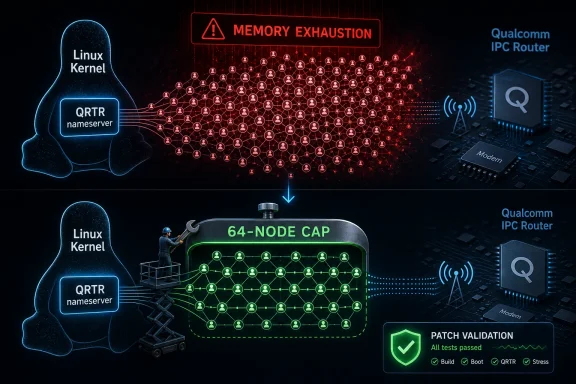
CVE-2026-46003 is a newly published Linux kernel denial-of-service flaw, disclosed by NVD on May 27, 2026, in the QRTR nameserver code used around Qualcomm IPC Router networking, where unbounded node registration could allow memory exhaustion. The fix is almost comically small: cap the total number of QRTR nameserver nodes at 64. But the lesson is larger than the patch. Once a subsystem moves from specialist hardware plumbing into the mainline kernel, its assumptions become part of everyone’s attack surface.
The vulnerability description reads like the kind of bug that should have been caught by instinct: the nameserver “doesn't limit the number of nodes it handles.” A malicious client can register random nodes until the kernel allocates enough state to hurt itself. The remediation adds a constant, tracks a count, refuses new nodes after the limit, and decrements the count when a node is removed.
That is not exotic exploitation. It is not speculative execution, not a cryptographic break, and not a heap feng shui masterpiece. It is the older, more durable class of kernel bug: a trusted internal registry that assumes the world will behave.
The QRTR nameserver sits in a niche corner of Linux networking, but niche is not the same as irrelevant. QRTR, short for Qualcomm IPC Router, exists to let the application processor communicate with subsystems such as modems, DSPs, sensors, and WLAN hardware on Qualcomm platforms. In modern computing, those are not fringe devices. They are phones, ARM laptops, embedded gateways, routers, developer boards, automotive systems, and increasingly Windows-adjacent hardware environments where Linux is both host and guest, appliance and infrastructure.
The vulnerability has not yet received an NVD CVSS score. That absence matters less than some scanners will pretend and more than some vendors will admit. Without enrichment, security teams do not get a neat severity badge; with the patch in hand, they still get the operational truth: affected kernels can be driven toward memory exhaustion if an attacker can reach the relevant QRTR path.
That makes QRTR a borderland technology. It is not merely “networking” in the Ethernet-and-TCP sense, and it is not merely “driver code” in the old one-device-one-module sense. It is an internal communications fabric between Linux and other processors on the same system-on-chip.
Those boundaries are exactly where modern security risk likes to hide. The OS no longer runs alone on a machine; it brokers requests among radios, accelerators, secure enclaves, management controllers, and firmware services. A bug in that broker can look obscure until it becomes the path by which an unprivileged actor destabilizes the whole system.
The QRTR nameserver was migrated into the kernel years ago to remove dependency on a user-space daemon for certain Qualcomm WLAN configurations. That was a reasonable engineering move: fewer moving parts, earlier availability, and better integration with in-kernel clients. But moving a nameservice into the kernel also raises the cost of sloppy accounting. A user-space daemon that leaks memory can often be restarted; kernel memory pressure is a system problem.
CVE-2026-46003 is a reminder that mainlining hardware support is not just a driver enablement story. It is a security inheritance story. When platform plumbing becomes generic kernel code, its limits, counters, and failure modes need to be designed as though hostile inputs will eventually arrive.
A cap that is too low breaks legitimate hardware. A cap that is too high gives an attacker more room to burn memory. A cap that does not exist is not flexibility; it is optimism coded into a data structure.
The interesting part is that Linux already had related limits in the same neighborhood. The patch context shows existing maximums for servers and lookups, while the node count itself lacked an equivalent ceiling. That is how real bugs often survive: not because nobody believes in limits, but because one dimension of a state machine escapes the same discipline applied elsewhere.
This matters for defenders because the fix is not a feature toggle. Administrators are not being asked to configure a policy, tune a sysctl, or deploy a new daemon. The secure behavior comes from the kernel update itself. If your kernel tree has the backport, the nameserver refuses to grow beyond the new node ceiling; if it does not, the old behavior remains.
There is also a philosophical shift here. A hard-coded maximum is sometimes criticized as inelegant, but in kernel security it can be the difference between a controlled failure and an unbounded one. The point is not that 64 is a magic number. The point is that some defensible boundary now exists where none did before.
On Qualcomm-based Linux systems, QRTR is part of the machinery that lets user space and kernel clients discover and communicate with services exposed by other subsystems. If an attacker can create QRTR traffic or induce repeated node registrations, the nameserver’s unbounded tracking becomes a memory pressure lever. Memory exhaustion in kernel space is rarely graceful; it can degrade performance, kill workloads, trigger the out-of-memory killer, or panic the machine depending on configuration and timing.
That makes the vulnerability more relevant to shared and embedded environments than to the average desktop tower. A single-user workstation with no Qualcomm QRTR hardware path exposed is not the obvious priority. A fleet of ARM edge devices, cellular gateways, industrial Linux appliances, or developer systems with Qualcomm radios is a different story.
The WindowsForum audience should also resist the temptation to treat this as “Linux-only, therefore someone else’s problem.” Windows shops increasingly run Linux in WSL, containers, hypervisors, security appliances, build systems, network devices, and cloud images. The question is not whether your primary desktop OS is Windows. The question is whether Linux kernels you operate, ship, monitor, or depend on include QRTR support and whether the vulnerable path can be reached.
Even where CVE-2026-46003 is not directly exploitable, it may become a useful reliability signal. Systems that compile in broad hardware support without a clear inventory of reachable subsystems are harder to reason about. The more modular and cross-platform the kernel becomes, the more defenders must understand which “irrelevant” subsystems are actually present.
A missing score is not a low score. It is an unfinished administrative record.
The kernel.org-sourced description is already enough to make a practical decision. The vulnerability is a memory-exhaustion denial-of-service in kernel QRTR nameserver handling. The fix is available in stable commits referenced from the CVE. The affected area is relatively narrow, but the consequence is broad enough to justify patching where QRTR is enabled or Qualcomm platform support is present.
This is where automated vulnerability management tends to stumble. Tools want a CVSS value, a CPE mapping, and a vendor advisory. Kernel reality is messier: downstream distributions backport fixes without bumping major versions, embedded vendors freeze kernels for years, and cloud images may carry patches that do not match upstream release numbers in a simple way.
The right operational question is therefore not “What is the score?” It is “Does my kernel contain the fix?” If the answer is unknown, that is already useful information about the maturity of the environment.
That means version checking by headline release can mislead. A system running a nominally older LTS kernel may already have the fix. A custom embedded build based on a newer-looking tree may not. The only reliable answer comes from the vendor’s changelog, the distro security tracker, or inspecting the source package.
There was also evidence during the patch’s path that at least one stable branch needed manual backport work because the patch did not apply cleanly. That is not scandalous; it is normal kernel maintenance. But it is another reason security teams should not assume that “Cc: stable” means every long-term kernel instantly receives the same change at the same time.
For enterprise Linux users, the patch cadence will depend on distribution policy. Red Hat-family, SUSE-family, Debian-family, Ubuntu, Android-derived, Yocto-based, and vendor BSP kernels all handle kernel CVEs differently. Some will issue an advisory. Some will silently fold the patch into a routine kernel update. Some embedded vendors may lag until a customer asks the uncomfortable question.
For Windows-heavy IT departments, this is where asset ownership gets muddy. The Linux kernel may be inside a firewall appliance, a VPN box, an IoT management bridge, an ARM dev kit, a container host, or a vendor-supplied telemetry collector. Those systems often fall between desktop patch management and server patch management, which is exactly where small kernel DoS bugs linger.
That matters because Qualcomm-based Linux devices are often not administered like general-purpose servers. They may be managed by firmware update bundles, carrier images, board-support packages, OEM portals, or appliance vendors. A central vulnerability scanner may see an IP address and an SSH banner, but not the kernel config that determines QRTR exposure.
The most exposed environments are likely those where local code execution is already plausible: multi-tenant embedded Linux, research boards, phone-like Linux devices, modems and gateways, or systems that allow untrusted applications to interact with platform IPC. The vulnerability is less frightening where QRTR is absent, compiled out, or unreachable.
But “less frightening” is not “irrelevant.” Kernel configuration drift is real. Generic distro kernels often include wide driver support because that is what makes them useful across many machines. Embedded kernels often carry vendor patches that are hard to audit. Developer boards often become production prototypes with debug assumptions still intact.
This CVE should push teams toward a boring but valuable inventory exercise: identify systems with QRTR enabled, map them to kernel vendors, and verify whether the node-limit patch has landed. That is not glamorous security work. It is the work that prevents a niche bug from becoming a surprise outage.
That hierarchy is sometimes rational and sometimes lazy. In the kernel, denial of service can be an ugly primitive. If a low-privilege actor can reliably exhaust memory, it can take down services, corrupt operational assumptions, trigger watchdog resets, or create openings when systems restart in degraded modes. In embedded and edge environments, a reboot is not always benign; it may interrupt connectivity, safety monitoring, remote management, or revenue-generating workloads.
The QRTR flaw is especially representative because it turns service discovery into a resource-consumption attack. Nameservers and registries are supposed to remember who exists. If they remember without limit, they become memory amplifiers.
The fix also demonstrates a pattern worth looking for elsewhere. Any kernel subsystem that tracks clients, nodes, lookups, endpoints, queues, flows, handles, or registrations needs explicit maximums. If those maximums are per-node but not global, or global but not per-client, an attacker will search for the missing dimension.
A good kernel hardening story is rarely a single heroic patch. It is many small conversions of “this should not happen” into “this cannot grow past here.”
That third layer is the one most likely to cause pain. Kernel CVEs arrive in a steady stream, many with sparse early metadata, many fixed upstream before vulnerability databases finish categorizing them. If a security process cannot handle “new CVE, no score yet, upstream fix exists, applicability depends on kernel config,” it will either overreact or underreact.
Overreaction means emergency-patching every Linux kernel in sight for a niche subsystem with limited exposure. Underreaction means ignoring a kernel memory-exhaustion issue because no one assigned it a number yet. The mature response is targeted verification.
Start with systems that plausibly use Qualcomm IPC Router: ARM laptops, Qualcomm-based development kits, embedded gateways, cellular devices, routers, Android-adjacent Linux systems, and custom kernels built for Qualcomm SoCs. Then check distribution and vendor kernel advisories. Where you own the kernel build, confirm whether the QRTR nameserver node cap is present in
The mitigation story is otherwise straightforward: update to a kernel containing the fix. Disabling QRTR may be possible on systems that do not need it, but that is a configuration and compatibility decision, not a universal prescription. On platforms where QRTR is required for modem, WLAN, or subsystem communication, ripping it out is not mitigation; it is self-inflicted outage.
CVE-2026-46003 is a clean example of that bargain. The affected code is not a famous server daemon. It is not OpenSSH, Samba, systemd, or a container runtime. It is a nameserver inside a kernel networking subsystem for Qualcomm IPC. Yet if it is enabled and reachable, it can affect the availability of the whole machine.
This is why enterprise security has to evolve past application-centric patching. The kernel is no longer just the thing underneath the software stack; it is the integration layer for a swarm of processors and firmware endpoints. A bug in a subsystem you did not know you were using can become a fleet reliability issue.
For Windows administrators, the lesson is not to become full-time kernel archaeologists. It is to make sure Linux assets are first-class citizens in patch governance. WSL images, container hosts, appliances, developer boards, and embedded control systems all need ownership, update channels, and a way to answer whether a given kernel fix is present.
The old mental split between “Windows estate” and “Linux estate” is increasingly fake. Modern infrastructure is mixed at the hardware, virtualization, container, and appliance layers. A Windows shop can still be exposed to Linux kernel bugs because Linux is inside the devices that connect, secure, build, and monitor the Windows environment.
 A Tiny Kernel Patch Exposes a Familiar Linux Problem
The vulnerability description reads like the kind of bug that should have been caught by instinct: the nameserver “doesn't limit the number of nodes it handles.” A malicious client can register random nodes until the kernel allocates enough state to hurt itself. The remediation adds a constant, tracks a count, refuses new nodes after the limit, and decrements the count when a node is removed.That is not exotic exploitation. It is not speculative execution, not a cryptographic break, and not a heap feng shui masterpiece. It is the older, more durable class of kernel bug: a trusted internal registry that assumes the world will behave.
The QRTR nameserver sits in a niche corner of Linux networking, but niche is not the same as irrelevant. QRTR, short for Qualcomm IPC Router, exists to let the application processor communicate with subsystems such as modems, DSPs, sensors, and WLAN hardware on Qualcomm platforms. In modern computing, those are not fringe devices. They are phones, ARM laptops, embedded gateways, routers, developer boards, automotive systems, and increasingly Windows-adjacent hardware environments where Linux is both host and guest, appliance and infrastructure.
The vulnerability has not yet received an NVD CVSS score. That absence matters less than some scanners will pretend and more than some vendors will admit. Without enrichment, security teams do not get a neat severity badge; with the patch in hand, they still get the operational truth: affected kernels can be driven toward memory exhaustion if an attacker can reach the relevant QRTR path.
QRTR Is Not Glamorous, Which Is Why It Matters
The Linux kernel is full of small subsystems that most users never knowingly touch. QRTR is one of them. It is a transport and service-discovery mechanism rooted in Qualcomm’s platform architecture, designed so Linux can talk to firmware-backed services that live outside the main CPU’s ordinary process model.That makes QRTR a borderland technology. It is not merely “networking” in the Ethernet-and-TCP sense, and it is not merely “driver code” in the old one-device-one-module sense. It is an internal communications fabric between Linux and other processors on the same system-on-chip.
Those boundaries are exactly where modern security risk likes to hide. The OS no longer runs alone on a machine; it brokers requests among radios, accelerators, secure enclaves, management controllers, and firmware services. A bug in that broker can look obscure until it becomes the path by which an unprivileged actor destabilizes the whole system.
The QRTR nameserver was migrated into the kernel years ago to remove dependency on a user-space daemon for certain Qualcomm WLAN configurations. That was a reasonable engineering move: fewer moving parts, earlier availability, and better integration with in-kernel clients. But moving a nameservice into the kernel also raises the cost of sloppy accounting. A user-space daemon that leaks memory can often be restarted; kernel memory pressure is a system problem.
CVE-2026-46003 is a reminder that mainlining hardware support is not just a driver enablement story. It is a security inheritance story. When platform plumbing becomes generic kernel code, its limits, counters, and failure modes need to be designed as though hostile inputs will eventually arrive.
The 64-Node Limit Is a Security Boundary Wearing an Engineering Hat
The patch chooses 64 as the maximum number of QRTR nameserver nodes. The commit commentary says the value is based on current platform requirements and can be increased later if requirements change. That is a perfectly normal kernel-development compromise, and it is also the central tradeoff.A cap that is too low breaks legitimate hardware. A cap that is too high gives an attacker more room to burn memory. A cap that does not exist is not flexibility; it is optimism coded into a data structure.
The interesting part is that Linux already had related limits in the same neighborhood. The patch context shows existing maximums for servers and lookups, while the node count itself lacked an equivalent ceiling. That is how real bugs often survive: not because nobody believes in limits, but because one dimension of a state machine escapes the same discipline applied elsewhere.
This matters for defenders because the fix is not a feature toggle. Administrators are not being asked to configure a policy, tune a sysctl, or deploy a new daemon. The secure behavior comes from the kernel update itself. If your kernel tree has the backport, the nameserver refuses to grow beyond the new node ceiling; if it does not, the old behavior remains.
There is also a philosophical shift here. A hard-coded maximum is sometimes criticized as inelegant, but in kernel security it can be the difference between a controlled failure and an unbounded one. The point is not that 64 is a magic number. The point is that some defensible boundary now exists where none did before.
The Exploit Story Is Probably Local, but the Blast Radius Is Systemwide
Nothing in the published description suggests a remote Internet worm scenario. The attacker model is more likely a malicious local client or compromised component able to interact with QRTR and register bogus nodes. That still leaves plenty of practical concern.On Qualcomm-based Linux systems, QRTR is part of the machinery that lets user space and kernel clients discover and communicate with services exposed by other subsystems. If an attacker can create QRTR traffic or induce repeated node registrations, the nameserver’s unbounded tracking becomes a memory pressure lever. Memory exhaustion in kernel space is rarely graceful; it can degrade performance, kill workloads, trigger the out-of-memory killer, or panic the machine depending on configuration and timing.
That makes the vulnerability more relevant to shared and embedded environments than to the average desktop tower. A single-user workstation with no Qualcomm QRTR hardware path exposed is not the obvious priority. A fleet of ARM edge devices, cellular gateways, industrial Linux appliances, or developer systems with Qualcomm radios is a different story.
The WindowsForum audience should also resist the temptation to treat this as “Linux-only, therefore someone else’s problem.” Windows shops increasingly run Linux in WSL, containers, hypervisors, security appliances, build systems, network devices, and cloud images. The question is not whether your primary desktop OS is Windows. The question is whether Linux kernels you operate, ship, monitor, or depend on include QRTR support and whether the vulnerable path can be reached.
Even where CVE-2026-46003 is not directly exploitable, it may become a useful reliability signal. Systems that compile in broad hardware support without a clear inventory of reachable subsystems are harder to reason about. The more modular and cross-platform the kernel becomes, the more defenders must understand which “irrelevant” subsystems are actually present.
NVD’s Missing Score Should Not Become an Excuse for Delay
The NVD entry is marked “Awaiting Enrichment,” with no CVSS 4.0, 3.x, or 2.0 score from NIST at publication time. That is increasingly common in the kernel CVE pipeline, where records can appear before the vulnerability databases have filled in severity, product mapping, and weakness metadata. It creates a dangerous pause for organizations whose patch queues are driven by numeric thresholds.A missing score is not a low score. It is an unfinished administrative record.
The kernel.org-sourced description is already enough to make a practical decision. The vulnerability is a memory-exhaustion denial-of-service in kernel QRTR nameserver handling. The fix is available in stable commits referenced from the CVE. The affected area is relatively narrow, but the consequence is broad enough to justify patching where QRTR is enabled or Qualcomm platform support is present.
This is where automated vulnerability management tends to stumble. Tools want a CVSS value, a CPE mapping, and a vendor advisory. Kernel reality is messier: downstream distributions backport fixes without bumping major versions, embedded vendors freeze kernels for years, and cloud images may carry patches that do not match upstream release numbers in a simple way.
The right operational question is therefore not “What is the score?” It is “Does my kernel contain the fix?” If the answer is unknown, that is already useful information about the maturity of the environment.
Stable Backports Are the Real Patch, Not the CVE Record
The CVE references several stable kernel commits, which is the important part for administrators and vendors. Linux kernel security is ultimately a backport business. The same fix may land in multiple stable branches with different commit IDs, and downstream distributions may apply the patch to their own kernel packages while preserving older version strings.That means version checking by headline release can mislead. A system running a nominally older LTS kernel may already have the fix. A custom embedded build based on a newer-looking tree may not. The only reliable answer comes from the vendor’s changelog, the distro security tracker, or inspecting the source package.
There was also evidence during the patch’s path that at least one stable branch needed manual backport work because the patch did not apply cleanly. That is not scandalous; it is normal kernel maintenance. But it is another reason security teams should not assume that “Cc: stable” means every long-term kernel instantly receives the same change at the same time.
For enterprise Linux users, the patch cadence will depend on distribution policy. Red Hat-family, SUSE-family, Debian-family, Ubuntu, Android-derived, Yocto-based, and vendor BSP kernels all handle kernel CVEs differently. Some will issue an advisory. Some will silently fold the patch into a routine kernel update. Some embedded vendors may lag until a customer asks the uncomfortable question.
For Windows-heavy IT departments, this is where asset ownership gets muddy. The Linux kernel may be inside a firewall appliance, a VPN box, an IoT management bridge, an ARM dev kit, a container host, or a vendor-supplied telemetry collector. Those systems often fall between desktop patch management and server patch management, which is exactly where small kernel DoS bugs linger.
The Qualcomm Angle Makes This a Supply-Chain Inventory Test
CVE-2026-46003 is attached to QRTR, and QRTR is closely tied to Qualcomm platforms. That narrows the likely affected population, but it also pushes the problem into hardware supply-chain territory. Many organizations do not have a good searchable inventory of which devices in their estate contain Qualcomm SoCs, which kernels they run, and which kernel options are enabled.That matters because Qualcomm-based Linux devices are often not administered like general-purpose servers. They may be managed by firmware update bundles, carrier images, board-support packages, OEM portals, or appliance vendors. A central vulnerability scanner may see an IP address and an SSH banner, but not the kernel config that determines QRTR exposure.
The most exposed environments are likely those where local code execution is already plausible: multi-tenant embedded Linux, research boards, phone-like Linux devices, modems and gateways, or systems that allow untrusted applications to interact with platform IPC. The vulnerability is less frightening where QRTR is absent, compiled out, or unreachable.
But “less frightening” is not “irrelevant.” Kernel configuration drift is real. Generic distro kernels often include wide driver support because that is what makes them useful across many machines. Embedded kernels often carry vendor patches that are hard to audit. Developer boards often become production prototypes with debug assumptions still intact.
This CVE should push teams toward a boring but valuable inventory exercise: identify systems with QRTR enabled, map them to kernel vendors, and verify whether the node-limit patch has landed. That is not glamorous security work. It is the work that prevents a niche bug from becoming a surprise outage.
Memory Exhaustion Bugs Still Deserve Respect
Security culture often ranks vulnerabilities by narrative drama. Remote code execution gets the headlines. Privilege escalation gets the urgent patch window. Denial-of-service issues, especially local ones, get filed under “availability” and pushed behind shinier threats.That hierarchy is sometimes rational and sometimes lazy. In the kernel, denial of service can be an ugly primitive. If a low-privilege actor can reliably exhaust memory, it can take down services, corrupt operational assumptions, trigger watchdog resets, or create openings when systems restart in degraded modes. In embedded and edge environments, a reboot is not always benign; it may interrupt connectivity, safety monitoring, remote management, or revenue-generating workloads.
The QRTR flaw is especially representative because it turns service discovery into a resource-consumption attack. Nameservers and registries are supposed to remember who exists. If they remember without limit, they become memory amplifiers.
The fix also demonstrates a pattern worth looking for elsewhere. Any kernel subsystem that tracks clients, nodes, lookups, endpoints, queues, flows, handles, or registrations needs explicit maximums. If those maximums are per-node but not global, or global but not per-client, an attacker will search for the missing dimension.
A good kernel hardening story is rarely a single heroic patch. It is many small conversions of “this should not happen” into “this cannot grow past here.”
This Is a Patch Management Story Disguised as a Kernel Networking Bug
For administrators, CVE-2026-46003 has three layers. The first is technical: unbounded QRTR nameserver nodes can exhaust memory. The second is environmental: only systems with relevant QRTR support and reachable attack paths are likely to care. The third is procedural: many organizations will not know which bucket their systems fall into.That third layer is the one most likely to cause pain. Kernel CVEs arrive in a steady stream, many with sparse early metadata, many fixed upstream before vulnerability databases finish categorizing them. If a security process cannot handle “new CVE, no score yet, upstream fix exists, applicability depends on kernel config,” it will either overreact or underreact.
Overreaction means emergency-patching every Linux kernel in sight for a niche subsystem with limited exposure. Underreaction means ignoring a kernel memory-exhaustion issue because no one assigned it a number yet. The mature response is targeted verification.
Start with systems that plausibly use Qualcomm IPC Router: ARM laptops, Qualcomm-based development kits, embedded gateways, cellular devices, routers, Android-adjacent Linux systems, and custom kernels built for Qualcomm SoCs. Then check distribution and vendor kernel advisories. Where you own the kernel build, confirm whether the QRTR nameserver node cap is present in
net/qrtr/ns.c or equivalent backport code.The mitigation story is otherwise straightforward: update to a kernel containing the fix. Disabling QRTR may be possible on systems that do not need it, but that is a configuration and compatibility decision, not a universal prescription. On platforms where QRTR is required for modem, WLAN, or subsystem communication, ripping it out is not mitigation; it is self-inflicted outage.
The Kernel’s Small Subsystems Are Now Enterprise Risk
Linux succeeded partly because it absorbed the world’s hardware. That success has a cost. The kernel now contains deep support for platforms, buses, accelerators, radios, and firmware ecosystems that many administrators never consciously deploy but still inherit through distribution kernels and vendor devices.CVE-2026-46003 is a clean example of that bargain. The affected code is not a famous server daemon. It is not OpenSSH, Samba, systemd, or a container runtime. It is a nameserver inside a kernel networking subsystem for Qualcomm IPC. Yet if it is enabled and reachable, it can affect the availability of the whole machine.
This is why enterprise security has to evolve past application-centric patching. The kernel is no longer just the thing underneath the software stack; it is the integration layer for a swarm of processors and firmware endpoints. A bug in a subsystem you did not know you were using can become a fleet reliability issue.
For Windows administrators, the lesson is not to become full-time kernel archaeologists. It is to make sure Linux assets are first-class citizens in patch governance. WSL images, container hosts, appliances, developer boards, and embedded control systems all need ownership, update channels, and a way to answer whether a given kernel fix is present.
The old mental split between “Windows estate” and “Linux estate” is increasingly fake. Modern infrastructure is mixed at the hardware, virtualization, container, and appliance layers. A Windows shop can still be exposed to Linux kernel bugs because Linux is inside the devices that connect, secure, build, and monitor the Windows environment.
The 64-Node Fix Leaves Administrators With Five Concrete Jobs
The practical response to CVE-2026-46003 is not panic; it is disciplined narrowing. This is a kernel availability flaw in a specific subsystem, and the difference between noise and risk is knowing where that subsystem lives in your environment.- Identify Linux systems that run on Qualcomm hardware or include QRTR support in their kernel configuration.
- Check whether your distribution, appliance vendor, or board-support package has shipped the QRTR nameserver node-limit fix.
- Treat the lack of an NVD CVSS score as incomplete metadata, not as evidence that the bug is harmless.
- Prioritize patch validation on embedded, edge, cellular, router, and ARM systems where QRTR is more likely to be present and operational.
- For custom kernels, verify the actual source or patch set rather than relying only on release numbers.
- Where QRTR is unnecessary, consider removing or disabling it through normal kernel configuration controls during the next maintenance cycle.
References
- Primary source: NVD / Linux Kernel
Published: 2026-05-28T01:12:51-07:00
NVD - CVE-2026-46003
 nvd.nist.gov
- Security advisory: MSRC
Published: 2026-05-28T01:12:51-07:00
Original feed URL
Security Update Guide - Microsoft Security Response Center
 msrc.microsoft.com
- Related coverage: deepwiki.com
Qualcomm-Specific Components | qualcomm-linux/meta-qcom | DeepWiki
This document provides a high-level overview of the software components specific to Qualcomm platforms included in the `meta-qcom` layer. These components are essential for inter-processor communicatideepwiki.com - Related coverage: kernelconfig.io
config_qrtr_mhi - kernelconfig.io
CONFIG_QRTR_MHI - qrtr-mhi.ko - Say Y here to support MHI based ipcrouter channelswww.kernelconfig.io - Related coverage: kernel.org

The Linux Kernel Archives
www.kernel.org
- Related coverage: software.opensuse.org
- Related coverage: archives.kernel-recipes.org
