

CVE-2026-46026 is a Linux kernel flaw published by NVD on May 27, 2026, after kernel.org assigned a vulnerability record to an unbounded lookup path in the QRTR name service code used by Qualcomm IPC Router support. The bug is not a remote Internet panic button, and NVD has not yet assigned CVSS scoring. But it is another example of a very modern kernel-security problem: narrow subsystem code, built for real hardware integration, can still become a local denial-of-service primitive when resource accounting is treated as implicit rather than explicit.
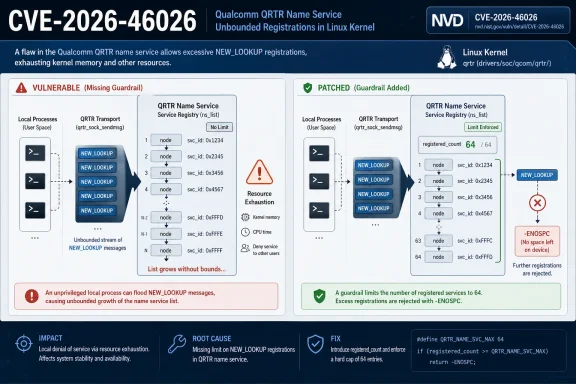
The fix for CVE-2026-46026 is almost comically modest: add a counter, define a maximum, refuse additional lookup registrations once the system reaches that ceiling, and decrement the counter when lookups are removed. In patch form, this is not the sort of change that makes security teams spill coffee. It is a resource limit.
That is exactly why it matters.
QRTR, the Qualcomm IPC Router support in Linux, exists to let the application processor talk to other subsystems on Qualcomm platforms: modems, DSPs, wireless components, and similar pieces of silicon plumbing. The affected code lives in the QRTR name service, where clients can register interest in services by sending lookup requests. Before the patch, the kernel accepted those lookup requests from local clients without a hard global cap.
The vulnerability description is blunt: a malicious local client could flood
This is the kind of vulnerability that sits in the gap between “not catastrophic” and “not ignorable.” It does not need speculative execution, packet-smuggling wizardry, or a Hollywood exploit chain. It needs a local process with access to the relevant kernel interface and the patience to ask the kernel for too much of a thing the kernel forgot to ration.
QRTR is part of that binding layer. It is a messaging and service-discovery mechanism for communication between Linux and Qualcomm subsystems. The name service component exists so clients can find services rather than hard-code every endpoint. On platforms where the modem, Wi-Fi subsystem, DSP, or sensor hub participates in this architecture, QRTR is not optional decoration. It is part of how the system becomes useful.
That is why QRTR vulnerabilities deserve more attention than their niche names suggest. The attack surface is not “the Internet,” but it may be a local application boundary on devices that are otherwise trusted to run unattended. In embedded Linux and appliance-like systems, a local denial of service can be more than an inconvenience; it can be a reboot loop, a vanished modem, an unavailable management plane, or a service device that fails in a way nobody nearby knows how to diagnose.
The important distinction is exposure. A general-purpose x86 workstation without QRTR support enabled is probably not where this CVE becomes operationally interesting. A Qualcomm-based Linux system with QRTR name service enabled is much closer to the intended blast radius. For administrators, the question is not whether “Linux is vulnerable” in the abstract. It is whether this subsystem is built, loaded, reachable, and relevant on the machines they actually operate.
Local-only bugs live in a strange place in security triage. They are easy to dismiss because they require an attacker to already have some foothold. They are also easy to abuse precisely because local code can often make calls repeatedly, cheaply, and at machine speed. If the kernel allocates memory or list entries for each request and never says “enough,” a non-privileged local actor may be able to pressure the system in ways the original subsystem designer did not expect.
The CVE-2026-46026 patch adds
That choice says something about the maintainers’ view of the bug. This is not a complicated correctness repair. It is admission that “only local clients can do this” was not a sufficient safety property. The system needed a budget.
The patch note also says the name server allows at most one local observer, making a global lookup count sufficient. That matters because the correctness of the limit is tied to the architecture of the component. If there were many independent observers, a single global cap might create fairness or starvation problems. Here, the maintainers appear to be saying the model is constrained enough that a global ceiling is the simplest safe answer.
The patch says 64 was chosen based on current platform requirements and can be increased later if requirements change. That is a pragmatic kernel-maintainer sentence: small enough to stop a flood, large enough not to break known hardware, and explicit enough that future breakage has somewhere to point. It is also a reminder that kernel security is full of trade-offs that look arbitrary from the outside because they are grounded in hardware nobody wants to regress.
A too-low limit can be a bug. A too-high limit can fail to mitigate abuse. No limit at all can become a CVE.
The best reading of the 64-lookup cap is not that 64 is magic. It is that the kernel now has an enforceable invariant where it previously had trust. That is a healthier posture. If a future platform genuinely needs more registered lookups, the constant can be revisited through review, testing, and justification. Until then, a malicious local client cannot keep asking forever.
That ambiguity is familiar with Linux kernel CVEs. The kernel project now assigns CVEs at high volume for fixed issues, including bugs that vary widely in exploitability and operational impact. Some are urgent. Some are platform-specific. Some are only meaningful under rare configurations. The CVE label alone is no longer enough to convey risk.
For CVE-2026-46026, the available facts point toward local denial of service rather than data theft or privilege escalation. The description does not claim code execution, information disclosure, or remote reachability. It describes unbounded lookup creation by a malicious local client. That should shape triage.
But “local DoS” should not be confused with “irrelevant.” On a shared Linux host, local resource exhaustion can be an abuse vector. On an embedded or appliance-style system, the local threat model may include container escapes, compromised service accounts, vendor daemons, third-party packages, or management scripts with narrower privileges than root. On a device fleet, anything that can reliably degrade a subsystem may become operationally significant even if it does not hand an attacker the keys to the kingdom.
For administrators, that backport chain is more useful than the CVE prose. It tells you the fix is not confined to a future mainline release. It also tells you that the patch was considered appropriate for stable kernels, which usually means maintainers judged it to be sufficiently safe and relevant for existing users.
The complication is that Linux distribution kernels are not identical to upstream stable kernels. Ubuntu, Debian, Fedora, SUSE, Red Hat Enterprise Linux, Android-derived trees, router firmware, and vendor BSPs all carry their own patch streams. A commit appearing in upstream stable does not automatically mean a given product image has it. Conversely, some vendors may carry the fix under a different patch identifier before a scanner recognizes the CVE.
This is where security work becomes inventory work. The right question is not simply “is my kernel version before or after X?” The better question is whether the specific QRTR name service patch is present in the kernel source or package build that your device uses. For conventional servers, your distribution advisory should answer that. For embedded systems, you may need to ask the vendor directly or inspect the source drop.
Windows administrators now commonly own Linux appliances, WSL installations, container hosts, network gear, hypervisors, Android-adjacent devices, CI runners, NAS boxes, and cloud images. Even when Windows is the dominant desktop and identity platform, Linux often runs the infrastructure edges. Qualcomm-based devices add another layer: many are managed like appliances, not like servers, so kernel updates may be slow, opaque, or vendor-gated.
CVE-2026-46026 is unlikely to be the Linux bug that wakes every Windows admin at 3 a.m. But it is precisely the sort of small kernel CVE that exposes whether an organization has a credible answer for non-Windows patching. If your vulnerability process can only handle Microsoft Patch Tuesday and a handful of browser updates, it will struggle with embedded Linux fixes that arrive through vendor firmware channels.
That does not mean every Windows shop should become a kernel-development house. It does mean asset classification matters. A Qualcomm-based gateway in a branch office, an ARM Linux device used for field operations, or a lab system running vendor-provided Linux images can be part of your risk surface even if nobody thinks of it as a “Linux server.”
That configuration dependency should temper broad claims. This is not a universal Linux remote vulnerability. It is a flaw in a specific networking subsystem associated with Qualcomm IPC Router support. A scanner that screams about every Linux host without checking QRTR exposure is creating work, not insight.
On the other hand, configuration-specific bugs are exactly where embedded fleets get messy. Vendor kernels often enable broad hardware support. Appliances may run old kernel branches with selective backports. Documentation may not tell customers which kernel options are enabled. Firmware updates may bundle dozens of unrelated fixes without mapping them cleanly to CVEs.
For IT teams, the practical path is to identify affected device classes first, not chase every kernel in the building. Look for Qualcomm-based Linux systems, devices that rely on modem or wireless subsystems using QRTR, and kernels built with QRTR name service support. Then check whether the vendor has shipped a kernel containing the lookup-limit fix.
Modern systems run layered trust models. Containers are local. Browser sandboxes are local. Service accounts are local. App stores, plugins, automation agents, CI jobs, and vendor daemons all create situations where a process may be allowed to run without being allowed to damage the host. A kernel interface that lets such a process consume unbounded resources can violate those assumptions.
CVE-2026-46026 does not by itself prove a practical exploit chain against a specific product. But the primitive is easy to understand. A client sends repeated lookup messages. The kernel records them. Without a cap, the list can grow. With the patch, the sixty-fifth attempt hits the wall.
That wall is the security boundary.
There is also an engineering lesson here for subsystem maintainers. If a code path allocates state on behalf of a caller, it needs an accounting model. “Only local callers can reach it” is an access-control statement, not a resource-management statement. Both are necessary. One does not replace the other.
CVE-2026-46026 fits that world. It is real. It has a clear fix. It has a plausible abuse case. It also does not deserve to be treated like a remotely exploitable wormable vulnerability across every Linux system on earth.
The correct response is not cynicism. It is better classification.
Security teams should resist both extremes. Ignoring kernel CVEs because many are low-impact is lazy. Treating every kernel CVE as a universal emergency is unsustainable. The mature response is to ask: Is the code present? Is the interface reachable? What privilege is required? What failure mode follows? Is a vendor patch available? Is there compensating isolation?
For this CVE, those questions lead to a measured answer. Patch when your vendor ships the fix. Prioritize devices where QRTR is actually used. Do not invent remote impact that the record does not claim. Do not assume local denial of service is harmless on embedded or shared systems.
It is a policy bug. The kernel allowed an operation without a sufficient quota.
That matters because memory-safe rewrites, compiler hardening, and sanitizers do not automatically solve quota problems. A perfectly memory-safe program can still accept infinite work. A bounds-checked allocation can still be repeated until the machine is unhealthy. A reference-counted object can still be created too many times.
This is especially relevant for subsystems that mediate hardware discovery, service registration, or message routing. They often begin life with a small set of expected clients and a cooperative hardware model. Over time, they become general kernel interfaces with less predictable callers. The assumptions age faster than the code.
QRTR name service appears to have crossed that line in a small but concrete way. The patch does not redesign the subsystem. It simply gives the subsystem a maximum. In resource-management terms, that is the difference between hope and enforcement.
On Linux systems you control directly, confirm whether QRTR support is built into the kernel or present as modules, and whether the name service component is enabled in the relevant kernel configuration. On managed distributions, wait for the distribution security advisory or kernel update rather than trying to splice upstream stable patches into production kernels. On vendor appliances, ask for firmware status rather than relying on upstream version strings.
For Qualcomm-based embedded devices, the most important signal may come from the vendor’s BSP or firmware release notes. Those products frequently trail mainline Linux and carry downstream modifications. A mainline stable commit may need adaptation before it lands in the product image.
There is also a monitoring angle, though it is less clean. The patch adds a rate-limited error message when the lookup limit is exceeded. Seeing that message after patching may indicate either a misbehaving client or an attempted flood. Before patching, however, the absence of a log message does not prove absence of abuse; the old code did not have the same guardrail.
A laptop vendor shipping a Qualcomm-based Linux image, an embedded gateway manufacturer, or a router vendor cannot simply point to kernel.org and call the job done. They need to integrate the patch, test it against their platform’s actual QRTR service patterns, and make sure the 64-lookup ceiling does not break legitimate workloads. The patch note suggests 64 matches current platform requirements, but vendors with unusual service-discovery behavior still need to validate that assumption.
That validation should not be treated as optional. Resource limits can create new failure modes if set below real-world demand. The right vendor response is not to remove the cap or quietly raise it without explanation. It is to test, document, and ship.
Customers should be especially cautious with devices whose firmware support has become irregular. The vulnerability is not likely to justify ripping out hardware on its own, but it is another data point in the lifecycle conversation. A device that cannot receive timely kernel fixes is a device whose risk grows even when each individual CVE looks modest.
 The Bug Is Small, but the Pattern Is Not
The fix for CVE-2026-46026 is almost comically modest: add a counter, define a maximum, refuse additional lookup registrations once the system reaches that ceiling, and decrement the counter when lookups are removed. In patch form, this is not the sort of change that makes security teams spill coffee. It is a resource limit.That is exactly why it matters.
QRTR, the Qualcomm IPC Router support in Linux, exists to let the application processor talk to other subsystems on Qualcomm platforms: modems, DSPs, wireless components, and similar pieces of silicon plumbing. The affected code lives in the QRTR name service, where clients can register interest in services by sending lookup requests. Before the patch, the kernel accepted those lookup requests from local clients without a hard global cap.
The vulnerability description is blunt: a malicious local client could flood
NEW_LOOKUP messages over the same socket. Because each lookup consumed kernel-managed state, the absence of a ceiling created a resource-exhaustion risk. The repair limits the maximum number of lookups to 64 globally, a value the patch notes say was chosen around current platform requirements.This is the kind of vulnerability that sits in the gap between “not catastrophic” and “not ignorable.” It does not need speculative execution, packet-smuggling wizardry, or a Hollywood exploit chain. It needs a local process with access to the relevant kernel interface and the patience to ask the kernel for too much of a thing the kernel forgot to ration.
QRTR Is Not Obscure to the Machines That Need It
For many desktop WindowsForum readers, QRTR may sound like a Linux-side curiosity from the Qualcomm ecosystem. That instinct is understandable, but it is increasingly incomplete. Qualcomm hardware is not limited to Android phones; it shows up in laptops, development boards, embedded gateways, routers, automotive-ish platforms, and edge devices where Linux is the OS that binds the hardware together.QRTR is part of that binding layer. It is a messaging and service-discovery mechanism for communication between Linux and Qualcomm subsystems. The name service component exists so clients can find services rather than hard-code every endpoint. On platforms where the modem, Wi-Fi subsystem, DSP, or sensor hub participates in this architecture, QRTR is not optional decoration. It is part of how the system becomes useful.
That is why QRTR vulnerabilities deserve more attention than their niche names suggest. The attack surface is not “the Internet,” but it may be a local application boundary on devices that are otherwise trusted to run unattended. In embedded Linux and appliance-like systems, a local denial of service can be more than an inconvenience; it can be a reboot loop, a vanished modem, an unavailable management plane, or a service device that fails in a way nobody nearby knows how to diagnose.
The important distinction is exposure. A general-purpose x86 workstation without QRTR support enabled is probably not where this CVE becomes operationally interesting. A Qualcomm-based Linux system with QRTR name service enabled is much closer to the intended blast radius. For administrators, the question is not whether “Linux is vulnerable” in the abstract. It is whether this subsystem is built, loaded, reachable, and relevant on the machines they actually operate.
The Kernel Patch Makes an Assumption Explicit
The original code already restricted lookups to local clients. That is a meaningful boundary, and it should reduce panic. But it is not the same thing as resource control.Local-only bugs live in a strange place in security triage. They are easy to dismiss because they require an attacker to already have some foothold. They are also easy to abuse precisely because local code can often make calls repeatedly, cheaply, and at machine speed. If the kernel allocates memory or list entries for each request and never says “enough,” a non-privileged local actor may be able to pressure the system in ways the original subsystem designer did not expect.
The CVE-2026-46026 patch adds
QRTR_NS_MAX_LOOKUPS with a value of 64. It also introduces a global lookup_count in the QRTR name service state and checks that count before allocating and recording another lookup. When the limit is hit, the function returns -ENOSPC, the traditional “no space left” signal, rather than continuing to grow the list.That choice says something about the maintainers’ view of the bug. This is not a complicated correctness repair. It is admission that “only local clients can do this” was not a sufficient safety property. The system needed a budget.
The patch note also says the name server allows at most one local observer, making a global lookup count sufficient. That matters because the correctness of the limit is tied to the architecture of the component. If there were many independent observers, a single global cap might create fairness or starvation problems. Here, the maintainers appear to be saying the model is constrained enough that a global ceiling is the simplest safe answer.
The Number 64 Is Both Practical and Political
Security people often talk about limits as though the number itself is the main story. It usually is not. The interesting part is the willingness to make the limit visible.The patch says 64 was chosen based on current platform requirements and can be increased later if requirements change. That is a pragmatic kernel-maintainer sentence: small enough to stop a flood, large enough not to break known hardware, and explicit enough that future breakage has somewhere to point. It is also a reminder that kernel security is full of trade-offs that look arbitrary from the outside because they are grounded in hardware nobody wants to regress.
A too-low limit can be a bug. A too-high limit can fail to mitigate abuse. No limit at all can become a CVE.
The best reading of the 64-lookup cap is not that 64 is magic. It is that the kernel now has an enforceable invariant where it previously had trust. That is a healthier posture. If a future platform genuinely needs more registered lookups, the constant can be revisited through review, testing, and justification. Until then, a malicious local client cannot keep asking forever.
NVD Has the Record, but Not the Severity
As of publication, NVD lists CVE-2026-46026 as awaiting enrichment. That means the record exists, the description and references are present, but NVD has not yet assigned its own CVSS vector or base score. In practical terms, anyone trying to feed this CVE into a vulnerability management dashboard should expect noisy ambiguity.That ambiguity is familiar with Linux kernel CVEs. The kernel project now assigns CVEs at high volume for fixed issues, including bugs that vary widely in exploitability and operational impact. Some are urgent. Some are platform-specific. Some are only meaningful under rare configurations. The CVE label alone is no longer enough to convey risk.
For CVE-2026-46026, the available facts point toward local denial of service rather than data theft or privilege escalation. The description does not claim code execution, information disclosure, or remote reachability. It describes unbounded lookup creation by a malicious local client. That should shape triage.
But “local DoS” should not be confused with “irrelevant.” On a shared Linux host, local resource exhaustion can be an abuse vector. On an embedded or appliance-style system, the local threat model may include container escapes, compromised service accounts, vendor daemons, third-party packages, or management scripts with narrower privileges than root. On a device fleet, anything that can reliably degrade a subsystem may become operationally significant even if it does not hand an attacker the keys to the kingdom.
The Stable Backports Tell Administrators Where to Look
The CVE record references multiple stable kernel commits, which indicates the fix has been carried into more than one supported kernel line. That is standard Linux stable practice: once an upstream fix is accepted and tagged for stable, maintainers adapt it into the kernel branches that distributions and device vendors actually ship.For administrators, that backport chain is more useful than the CVE prose. It tells you the fix is not confined to a future mainline release. It also tells you that the patch was considered appropriate for stable kernels, which usually means maintainers judged it to be sufficiently safe and relevant for existing users.
The complication is that Linux distribution kernels are not identical to upstream stable kernels. Ubuntu, Debian, Fedora, SUSE, Red Hat Enterprise Linux, Android-derived trees, router firmware, and vendor BSPs all carry their own patch streams. A commit appearing in upstream stable does not automatically mean a given product image has it. Conversely, some vendors may carry the fix under a different patch identifier before a scanner recognizes the CVE.
This is where security work becomes inventory work. The right question is not simply “is my kernel version before or after X?” The better question is whether the specific QRTR name service patch is present in the kernel source or package build that your device uses. For conventional servers, your distribution advisory should answer that. For embedded systems, you may need to ask the vendor directly or inspect the source drop.
Windows Shops Still Have a Linux Problem
A WindowsForum audience may reasonably ask why a Linux kernel CVE belongs here. The answer is that Windows environments have not been Windows-only for a long time.Windows administrators now commonly own Linux appliances, WSL installations, container hosts, network gear, hypervisors, Android-adjacent devices, CI runners, NAS boxes, and cloud images. Even when Windows is the dominant desktop and identity platform, Linux often runs the infrastructure edges. Qualcomm-based devices add another layer: many are managed like appliances, not like servers, so kernel updates may be slow, opaque, or vendor-gated.
CVE-2026-46026 is unlikely to be the Linux bug that wakes every Windows admin at 3 a.m. But it is precisely the sort of small kernel CVE that exposes whether an organization has a credible answer for non-Windows patching. If your vulnerability process can only handle Microsoft Patch Tuesday and a handful of browser updates, it will struggle with embedded Linux fixes that arrive through vendor firmware channels.
That does not mean every Windows shop should become a kernel-development house. It does mean asset classification matters. A Qualcomm-based gateway in a branch office, an ARM Linux device used for field operations, or a lab system running vendor-provided Linux images can be part of your risk surface even if nobody thinks of it as a “Linux server.”
The Real Attack Surface Is Configuration
The most important operational caveat is that QRTR must be present and usable for this vulnerability to matter. The QRTR subsystem is controlled by kernel configuration and platform needs. Some kernels may build it as a module. Some may not include it at all. Some devices may include QRTR support because their modem or wireless stack depends on it, while others have no reason to expose it.That configuration dependency should temper broad claims. This is not a universal Linux remote vulnerability. It is a flaw in a specific networking subsystem associated with Qualcomm IPC Router support. A scanner that screams about every Linux host without checking QRTR exposure is creating work, not insight.
On the other hand, configuration-specific bugs are exactly where embedded fleets get messy. Vendor kernels often enable broad hardware support. Appliances may run old kernel branches with selective backports. Documentation may not tell customers which kernel options are enabled. Firmware updates may bundle dozens of unrelated fixes without mapping them cleanly to CVEs.
For IT teams, the practical path is to identify affected device classes first, not chase every kernel in the building. Look for Qualcomm-based Linux systems, devices that rely on modem or wireless subsystems using QRTR, and kernels built with QRTR name service support. Then check whether the vendor has shipped a kernel containing the lookup-limit fix.
A Local Flood Is Still a Security Boundary Failure
There is a persistent bad habit in vulnerability triage: if an exploit requires local access, it gets demoted into irrelevance. That view made more sense when systems were single-purpose, users were trusted, and local code execution was almost equivalent to ownership. It makes less sense in 2026.Modern systems run layered trust models. Containers are local. Browser sandboxes are local. Service accounts are local. App stores, plugins, automation agents, CI jobs, and vendor daemons all create situations where a process may be allowed to run without being allowed to damage the host. A kernel interface that lets such a process consume unbounded resources can violate those assumptions.
CVE-2026-46026 does not by itself prove a practical exploit chain against a specific product. But the primitive is easy to understand. A client sends repeated lookup messages. The kernel records them. Without a cap, the list can grow. With the patch, the sixty-fifth attempt hits the wall.
That wall is the security boundary.
There is also an engineering lesson here for subsystem maintainers. If a code path allocates state on behalf of a caller, it needs an accounting model. “Only local callers can reach it” is an access-control statement, not a resource-management statement. Both are necessary. One does not replace the other.
CVE Inflation Makes Context More Valuable, Not Less
The Linux kernel CVE stream has become more aggressive, and that has frustrated both administrators and security vendors. There are good reasons for the shift: fixed bugs should be traceable, downstreams need identifiers, and users deserve visibility into defects that may affect them. But the result is a flood of CVEs whose severity depends heavily on configuration, hardware, and deployment model.CVE-2026-46026 fits that world. It is real. It has a clear fix. It has a plausible abuse case. It also does not deserve to be treated like a remotely exploitable wormable vulnerability across every Linux system on earth.
The correct response is not cynicism. It is better classification.
Security teams should resist both extremes. Ignoring kernel CVEs because many are low-impact is lazy. Treating every kernel CVE as a universal emergency is unsustainable. The mature response is to ask: Is the code present? Is the interface reachable? What privilege is required? What failure mode follows? Is a vendor patch available? Is there compensating isolation?
For this CVE, those questions lead to a measured answer. Patch when your vendor ships the fix. Prioritize devices where QRTR is actually used. Do not invent remote impact that the record does not claim. Do not assume local denial of service is harmless on embedded or shared systems.
The Fix Also Shows Why Kernel Review Cannot Stop at Memory Safety
When people talk about kernel vulnerabilities, they often jump to memory corruption: use-after-free, out-of-bounds writes, double frees, type confusion. Those are still serious, and they still dominate many exploit discussions. But CVE-2026-46026 is not that kind of bug.It is a policy bug. The kernel allowed an operation without a sufficient quota.
That matters because memory-safe rewrites, compiler hardening, and sanitizers do not automatically solve quota problems. A perfectly memory-safe program can still accept infinite work. A bounds-checked allocation can still be repeated until the machine is unhealthy. A reference-counted object can still be created too many times.
This is especially relevant for subsystems that mediate hardware discovery, service registration, or message routing. They often begin life with a small set of expected clients and a cooperative hardware model. Over time, they become general kernel interfaces with less predictable callers. The assumptions age faster than the code.
QRTR name service appears to have crossed that line in a small but concrete way. The patch does not redesign the subsystem. It simply gives the subsystem a maximum. In resource-management terms, that is the difference between hope and enforcement.
Patch Management Starts with Knowing Whether QRTR Exists
Administrators looking for a simple mitigation checklist will be disappointed, because the right answer depends on kernel build and device role. There is no universal registry key, no one-line Windows-style advisory, and no single product family that captures the whole exposure. The most useful work is inventory.On Linux systems you control directly, confirm whether QRTR support is built into the kernel or present as modules, and whether the name service component is enabled in the relevant kernel configuration. On managed distributions, wait for the distribution security advisory or kernel update rather than trying to splice upstream stable patches into production kernels. On vendor appliances, ask for firmware status rather than relying on upstream version strings.
For Qualcomm-based embedded devices, the most important signal may come from the vendor’s BSP or firmware release notes. Those products frequently trail mainline Linux and carry downstream modifications. A mainline stable commit may need adaptation before it lands in the product image.
There is also a monitoring angle, though it is less clean. The patch adds a rate-limited error message when the lookup limit is exceeded. Seeing that message after patching may indicate either a misbehaving client or an attempted flood. Before patching, however, the absence of a log message does not prove absence of abuse; the old code did not have the same guardrail.
The Kernel’s Small Fix Leaves Big Questions for Vendors
For upstream Linux, the story is straightforward: identify the missing bound, add the bound, backport the fix. For vendors, the story is more complicated.A laptop vendor shipping a Qualcomm-based Linux image, an embedded gateway manufacturer, or a router vendor cannot simply point to kernel.org and call the job done. They need to integrate the patch, test it against their platform’s actual QRTR service patterns, and make sure the 64-lookup ceiling does not break legitimate workloads. The patch note suggests 64 matches current platform requirements, but vendors with unusual service-discovery behavior still need to validate that assumption.
That validation should not be treated as optional. Resource limits can create new failure modes if set below real-world demand. The right vendor response is not to remove the cap or quietly raise it without explanation. It is to test, document, and ship.
Customers should be especially cautious with devices whose firmware support has become irregular. The vulnerability is not likely to justify ripping out hardware on its own, but it is another data point in the lifecycle conversation. A device that cannot receive timely kernel fixes is a device whose risk grows even when each individual CVE looks modest.
The 64-Lookup Lesson for CVE-2026-46026
The practical story of this vulnerability is short, but its implications are wider than the patch size suggests. CVE-2026-46026 is less about QRTR alone than about a class of kernel bugs where trusted local plumbing becomes abusable because nobody wrote down the limit.- CVE-2026-46026 affects the Linux kernel QRTR name service path for lookup registration, not the whole Linux networking stack.
- The documented abuse scenario is a malicious local client flooding
NEW_LOOKUPmessages over the same socket. - The upstream fix limits QRTR name service lookups to 64 globally and returns an error once that ceiling is reached.
- NVD had not assigned CVSS scoring at the time of the record’s initial publication, so severity should be based on exposure and configuration rather than the CVE label alone.
- Systems most likely to care are Qualcomm-based Linux devices or kernels built with QRTR name service support enabled.
- The right operational response is to track vendor kernel updates, verify whether QRTR is present, and prioritize embedded or shared systems where local denial of service has real consequences.
References
- Primary source: NVD / Linux Kernel
Published: 2026-05-28T01:12:40-07:00
NVD - CVE-2026-46026
 nvd.nist.gov
- Security advisory: MSRC
Published: 2026-05-28T01:12:40-07:00
Original feed URL
Security Update Guide - Microsoft Security Response Center
 msrc.microsoft.com
- Related coverage: cateee.net
- Related coverage: deepwiki.com
QRTR and Communication Components | qualcomm-linux/meta-qcom | DeepWiki
This document explains the Qualcomm IPC Router (QRTR) and related communication components provided by the `meta-qcom` layer. These components enable essential communication between the Linux applicatdeepwiki.com - Related coverage: windowsnews.ai
Linux Kernel CVE-2026-43491: QRTR Memory Exhaustion DoS Patched - Windows News
CVE-2026-43491 is a critical Linux kernel vulnerability causing denial of service via QRTR memory exhaustion. Learn how it impacts WSL2 and how to apply the...windowsnews.ai - Related coverage: codebrowser.dev

ns.c source code [linux/net/qrtr/ns.c] - Codebrowser
Source code of linux/net/qrtr/ns.c linux v6.19-r on KDAB Codebrowser
codebrowser.dev

- Related coverage: android.googlesource.com
