

CVE-2026-46032 is a newly published Linux kernel KVM vulnerability, disclosed by NVD on May 27, 2026, affecting AMD nested virtualization code where a failed CR3 restore during nested VM exit could leave a guest running with corrupted virtual CPU state. The bug is narrow, deeply technical, and easy to misread as harmless housekeeping. It is not a Windows vulnerability, but it matters to WindowsForum readers because Windows workloads increasingly live inside Linux-backed virtualization stacks, from Proxmox labs to cloud hosts and nested Hyper-V testbeds. The real story is less about one malformed control register and more about the fragility of pretending a hypervisor can always recover from impossible CPU state.
The vulnerability sits in KVM’s AMD SVM path, specifically the nested SVM logic used when one virtual machine is itself running another hypervisor-aware guest. In that world, the host Linux kernel is L0, the first guest hypervisor is L1, and a nested guest is L2. The bug appears when KVM is unwinding from a nested guest exit back into the L1 environment and fails to restore L1’s CR3, the control register that points to the active page-table hierarchy.
That sounds like a small internal error until you remember what CR3 represents. On x86 systems, CR3 is not just another bookkeeping value; it is the address-space anchor that tells the CPU how to translate virtual addresses into physical memory. Running with a bad or partially restored CR3 is the kind of condition where continuing execution can turn a precise fault into a mess of corrupted assumptions.
The kernel fix is blunt because the hardware contract is blunt. AMD’s architecture expects shutdown behavior when illegal host state is loaded or an exception occurs while loading host state on a VM exit. KVM’s previous path could return an error from
The patch changes the posture from “return an error and hope the caller notices” to “inject a triple fault and keep cleaning up vCPU state.” In virtualization terms, that is the difference between allowing a sick virtual CPU to limp onward and terminating it in the same spirit as the hardware would. The patch also removes the return value from the VM-exit helper, which is a telling cleanup: an error path that is mostly unchecked is not really an error path at all.
Nested virtualization works by making one hypervisor believe it has access to the CPU virtualization machinery while another hypervisor remains in charge underneath. Every VM entry, VM exit, intercept, control block, and register transition becomes a negotiation between what the guest thinks happened and what the real host must emulate. KVM has become very good at that dance, but bugs like this show why the dance is inherently unforgiving.
The AMD side of this stack uses SVM, with data structures such as the VMCB carrying guest and host state. When an L2 guest exits, KVM has to synthesize the right outcome for L1. It must update virtual machine control state, restore the right address space, reconcile pending exceptions, and resume execution in a way that matches what real hardware would have done if L1 had been the true host.
That last phrase matters: matches what real hardware would have done. Virtualization bugs often arise not because the hypervisor does something obviously absurd, but because it deviates slightly from architectural behavior in a rare corner case. In the common path, nobody notices. In a nested failure path involving CR3 restoration, the mismatch can become a security issue.
Kernel CVEs increasingly arrive this way. The upstream Linux community fixes a bug, the CVE record is populated with the patch description, and formal scoring follows later or unevenly across vendor advisories. For administrators trained to triage by score, this creates a dangerous limbo. A bug in an esoteric nested virtualization path may look ignorable until one realizes that “esoteric” is often where cloud tenants, lab builders, and adversarial test cases live.
The language in the description is more informative than the missing score. “Continues to run L1 with corrupted state” is not cosmetic. “A sane recovery is not possible” is stronger still. The fix does not add a graceful retry or better validation; it forces a shutdown-style event because the code cannot safely reconstruct what execution would mean after the failed restore.
That does not automatically make this a remote host takeover. The provided record does not establish a working exploit, a privilege-escalation chain, or a cross-tenant cloud escape. But it does establish that KVM’s behavior diverged from hardware semantics in a state-corruption path. In hypervisor land, that is enough to deserve attention before the severity badge catches up.
The second correction is more subtle: Windows can still be part of the risk model. Windows Server with Hyper-V enabled inside a KVM guest is a common pattern in labs and test environments. So is running Windows development VMs under Proxmox while enabling nested virtualization for WSL 2, Hyper-V containers, Credential Guard experiments, or virtualization-based security testing. These setups are exactly where “L1” may be a Windows hypervisor environment presented by KVM.
In that scenario, the Linux host is the system that needs the kernel update. The Windows guest may be the trigger surface if it can run nested virtualization instructions and drive the nested exit path. That does not make every Windows VM dangerous; it means administrators should inventory which guests have nested virtualization exposed and which hosts run AMD processors with KVM’s SVM module in use.
For homelab users, the likely consequence of ignoring this class of bug is instability rather than espionage. For cloud and managed hosting providers, the calculus is stricter. Any bug in a hypervisor path that can be exercised from a guest deserves a prompt patching decision, particularly where customers can enable nested virtualization or upload their own hypervisor-like workloads.
The more relevant question is not merely “Do we have AMD?” but “Do we expose nested virtualization?” Many KVM installations run guests without giving them hardware virtualization capabilities. In those cases, the vulnerable path may be unreachable by ordinary guest workloads. Conversely, an environment designed for nested Hyper-V, Android emulators, malware sandboxes, security research, or network appliance labs may deliberately expose SVM to guests.
This is where configuration management matters. It is easy to forget that a single VM definition can include CPU passthrough or host-model features that expose virtualization capabilities to the guest. It is also easy for lab defaults to drift into production because they made a workload faster or allowed a developer tool to work. Nested virtualization is one of those toggles whose convenience often outlives the project that justified it.
The patch references stable kernel commits, so downstream distributions are likely to absorb the fix through their usual kernel update channels. The hard part for administrators is not understanding the C code; it is mapping which running hosts, kernels, CPU families, and guest configurations make the fix urgent. That mapping is almost always messier than the vulnerability description.
That design choice is important. The patch does not pretend to preserve uptime for L1 after a failed CR3 load. It acknowledges that the only faithful recovery is no recovery. The guest should see a catastrophic CPU event because that is closer to what real hardware would do when host-state restoration fails.
This may sound harsh to operators who think of patches in terms of avoiding crashes. Here, the fix may intentionally make a rare bad state end more decisively. The objective is not to keep every virtual machine alive at all costs; it is to prevent KVM from running a virtual CPU after the hypervisor no longer has a coherent architectural foundation for doing so.
Security engineering often looks like this. The safe behavior is not always the smooth behavior. Sometimes the correct patch converts undefined continuation into explicit termination, because undefined continuation is where attackers and data corruption both get room to improvise.
Removing the return value is therefore more than tidying. It is a statement that the function should own the failure semantics rather than delegate them to scattered call sites. If the only valid response to a failed host CR3 restore is to triple fault the guest and continue cleanup, then the API should encode that reality. Optional error handling is the wrong abstraction for mandatory shutdown behavior.
This is a recurring theme in kernel hardening. Many older internal interfaces were built when the dominant question was “Can we make the normal path fast and readable?” Modern vulnerability handling asks a harsher question: “What happens when the impossible input arrives from an untrusted boundary?” In virtualization, the guest is often that boundary, even when the code path feels like internal CPU plumbing.
The shift is not unique to KVM. File systems, networking stacks, GPU drivers, and eBPF subsystems have all gone through versions of the same reckoning. Return codes that nobody checks, warnings that should have been containment, and state machines that assume callers are well-behaved become security debt once untrusted actors can steer execution into the edge case.
Homelab and small-business operators have a different experience. A Proxmox or custom KVM host is often both production and playground. The same box may run a domain controller, a firewall VM, a Windows 11 gaming VM, a Kubernetes lab, and a nested Hyper-V test machine. Patching the host kernel means scheduling downtime, checking DKMS modules, rebooting, and hoping the GPU passthrough stack still behaves afterward.
That friction is real, but it does not argue for ignoring the bug. It argues for treating nested virtualization as a feature with a lifecycle. If a VM no longer needs nested SVM exposed, turn it off. If a lab requires it, isolate it from workloads that cannot tolerate crashes. If the host is Internet-adjacent or multi-user, patch sooner rather than later.
The risk is not evenly distributed. A single-user desktop KVM setup with nested virtualization disabled is not in the same position as a hosting platform selling nested virtualization to customers. But the patch belongs in the normal kernel update stream for both. The main difference is urgency, not relevance.
Those questions give the version number meaning. A vulnerable kernel on a host that never exposes nested virtualization may be a lower operational risk. A vulnerable kernel on a lab cluster where users can launch arbitrary nested hypervisors is a different matter. A vulnerable kernel underneath production Windows Server guests with Hyper-V enabled for testing should be patched with a clear maintenance plan.
Administrators should also watch for vendor-specific advisories. Enterprise distributions backport fixes, so the upstream kernel version alone may mislead. A RHEL, Ubuntu, Debian, SUSE, Oracle, or Proxmox kernel can contain the fix without matching the upstream version where it first appeared. Conversely, a self-built or pinned kernel can remain vulnerable long after the patch exists.
The practical work is boring but important: check vendor kernel changelogs, confirm whether the stable commits are included, reboot into the fixed kernel, and verify that the running kernel is the one you think it is. Hypervisor vulnerabilities are especially unforgiving of “installed but not booted” patch states.
That is the modern virtualization bargain. Running Windows on KVM gives administrators flexibility, automation, cost control, and hardware choice. It also means Windows availability and isolation depend on kernel code written for the host. When the host’s nested virtualization state machine mishandles an impossible CPU transition, the guest operating system’s own patch status is beside the point.
This is especially important for WindowsForum’s enthusiast audience. The community is full of capable users who run combinations that vendors rarely test deeply: Windows 11 with GPU passthrough on a Ryzen host, nested Hyper-V inside Proxmox, WSL 2 inside a Windows VM, virtualized domain labs, and security sandboxes stacked three layers deep. Those setups are powerful precisely because they lean on advanced virtualization features. They are also where corner cases stop being theoretical.
None of this means users should abandon nested virtualization. It means nested virtualization should be treated like an exposed service, not a harmless checkbox. If you would not casually expose a management port, do not casually expose hardware virtualization features to guests that do not need them.
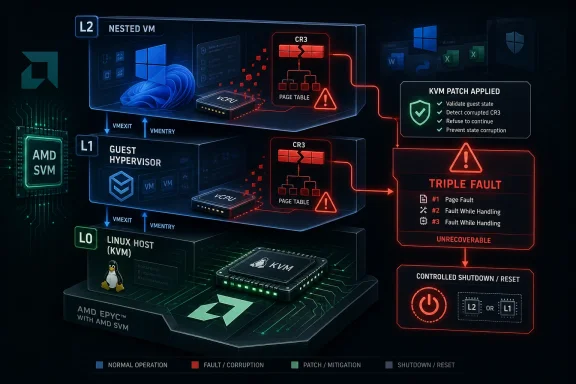 The Kernel Patch Treats Corruption as a Stop Sign, Not a Warning Light
The vulnerability sits in KVM’s AMD SVM path, specifically the nested SVM logic used when one virtual machine is itself running another hypervisor-aware guest. In that world, the host Linux kernel is L0, the first guest hypervisor is L1, and a nested guest is L2. The bug appears when KVM is unwinding from a nested guest exit back into the L1 environment and fails to restore L1’s CR3, the control register that points to the active page-table hierarchy.That sounds like a small internal error until you remember what CR3 represents. On x86 systems, CR3 is not just another bookkeeping value; it is the address-space anchor that tells the CPU how to translate virtual addresses into physical memory. Running with a bad or partially restored CR3 is the kind of condition where continuing execution can turn a precise fault into a mess of corrupted assumptions.
The kernel fix is blunt because the hardware contract is blunt. AMD’s architecture expects shutdown behavior when illegal host state is loaded or an exception occurs while loading host state on a VM exit. KVM’s previous path could return an error from
nested_svm_vmexit(), but most callers did not reliably act on that return value. The result was a theoretical path where L1 could continue after KVM already knew its state restoration had failed.The patch changes the posture from “return an error and hope the caller notices” to “inject a triple fault and keep cleaning up vCPU state.” In virtualization terms, that is the difference between allowing a sick virtual CPU to limp onward and terminating it in the same spirit as the hardware would. The patch also removes the return value from the VM-exit helper, which is a telling cleanup: an error path that is mostly unchecked is not really an error path at all.
Nested Virtualization Is Where Abstractions Go to Be Cross-Examined
Most desktop users will never knowingly touch nSVM. Many Windows enthusiasts, however, touch it without always naming it. Run Hyper-V inside a Windows VM on a Linux host, build an EVE-NG or GNS3 lab inside Proxmox, test Windows Server virtualization features inside a cloud instance, or create a nested CI environment for kernel and driver testing, and suddenly nested virtualization is not exotic anymore.Nested virtualization works by making one hypervisor believe it has access to the CPU virtualization machinery while another hypervisor remains in charge underneath. Every VM entry, VM exit, intercept, control block, and register transition becomes a negotiation between what the guest thinks happened and what the real host must emulate. KVM has become very good at that dance, but bugs like this show why the dance is inherently unforgiving.
The AMD side of this stack uses SVM, with data structures such as the VMCB carrying guest and host state. When an L2 guest exits, KVM has to synthesize the right outcome for L1. It must update virtual machine control state, restore the right address space, reconcile pending exceptions, and resume execution in a way that matches what real hardware would have done if L1 had been the true host.
That last phrase matters: matches what real hardware would have done. Virtualization bugs often arise not because the hypervisor does something obviously absurd, but because it deviates slightly from architectural behavior in a rare corner case. In the common path, nobody notices. In a nested failure path involving CR3 restoration, the mismatch can become a security issue.
The Absence of a CVSS Score Is Not a Safety Signal
At publication time, NVD lists CVE-2026-46032 as awaiting enrichment, with no NVD-provided CVSS score. That means administrators do not yet have the familiar high, medium, or critical badge to paste into a ticket. It does not mean the issue is unimportant, unexploitable, or irrelevant to production environments.Kernel CVEs increasingly arrive this way. The upstream Linux community fixes a bug, the CVE record is populated with the patch description, and formal scoring follows later or unevenly across vendor advisories. For administrators trained to triage by score, this creates a dangerous limbo. A bug in an esoteric nested virtualization path may look ignorable until one realizes that “esoteric” is often where cloud tenants, lab builders, and adversarial test cases live.
The language in the description is more informative than the missing score. “Continues to run L1 with corrupted state” is not cosmetic. “A sane recovery is not possible” is stronger still. The fix does not add a graceful retry or better validation; it forces a shutdown-style event because the code cannot safely reconstruct what execution would mean after the failed restore.
That does not automatically make this a remote host takeover. The provided record does not establish a working exploit, a privilege-escalation chain, or a cross-tenant cloud escape. But it does establish that KVM’s behavior diverged from hardware semantics in a state-corruption path. In hypervisor land, that is enough to deserve attention before the severity badge catches up.
The Windows Angle Runs Through the Host, Not the Guest
For Windows users, the first practical correction is simple: CVE-2026-46032 is not fixed by Windows Update. It is in the Linux kernel’s KVM implementation, specifically the AMD nested SVM path. A Windows 11 or Windows Server guest running on a vulnerable Linux host is not itself the vulnerable component, even if that guest is the workload you care about.The second correction is more subtle: Windows can still be part of the risk model. Windows Server with Hyper-V enabled inside a KVM guest is a common pattern in labs and test environments. So is running Windows development VMs under Proxmox while enabling nested virtualization for WSL 2, Hyper-V containers, Credential Guard experiments, or virtualization-based security testing. These setups are exactly where “L1” may be a Windows hypervisor environment presented by KVM.
In that scenario, the Linux host is the system that needs the kernel update. The Windows guest may be the trigger surface if it can run nested virtualization instructions and drive the nested exit path. That does not make every Windows VM dangerous; it means administrators should inventory which guests have nested virtualization exposed and which hosts run AMD processors with KVM’s SVM module in use.
For homelab users, the likely consequence of ignoring this class of bug is instability rather than espionage. For cloud and managed hosting providers, the calculus is stricter. Any bug in a hypervisor path that can be exercised from a guest deserves a prompt patching decision, particularly where customers can enable nested virtualization or upload their own hypervisor-like workloads.
AMD Hosts Carry the Interesting Exposure
The vulnerability is specific to KVM’s nSVM path, which points to AMD virtualization rather than Intel VMX. That matters for triage. If your virtualization fleet is entirely Intel-backed, this particular SVM bug should not be the same exposure, although equivalent classes of nested virtualization bugs can exist elsewhere. If your fleet includes EPYC-based servers, Ryzen-based lab boxes, or AMD-powered mini-PC clusters, the issue belongs on your patch radar.The more relevant question is not merely “Do we have AMD?” but “Do we expose nested virtualization?” Many KVM installations run guests without giving them hardware virtualization capabilities. In those cases, the vulnerable path may be unreachable by ordinary guest workloads. Conversely, an environment designed for nested Hyper-V, Android emulators, malware sandboxes, security research, or network appliance labs may deliberately expose SVM to guests.
This is where configuration management matters. It is easy to forget that a single VM definition can include CPU passthrough or host-model features that expose virtualization capabilities to the guest. It is also easy for lab defaults to drift into production because they made a workload faster or allowed a developer tool to work. Nested virtualization is one of those toggles whose convenience often outlives the project that justified it.
The patch references stable kernel commits, so downstream distributions are likely to absorb the fix through their usual kernel update channels. The hard part for administrators is not understanding the C code; it is mapping which running hosts, kernels, CPU families, and guest configurations make the fix urgent. That mapping is almost always messier than the vulnerability description.
Triple Fault Is the Least Bad Ending
A triple fault has a dramatic name, and in bare-metal folklore it often means the machine resets because the processor could not handle a fault while trying to handle a fault. In a virtualized system, injecting a triple fault into a guest is also a way to terminate execution cleanly when the emulated CPU state is no longer trustworthy. It is a controlled crash rather than an improvised continuation.That design choice is important. The patch does not pretend to preserve uptime for L1 after a failed CR3 load. It acknowledges that the only faithful recovery is no recovery. The guest should see a catastrophic CPU event because that is closer to what real hardware would do when host-state restoration fails.
This may sound harsh to operators who think of patches in terms of avoiding crashes. Here, the fix may intentionally make a rare bad state end more decisively. The objective is not to keep every virtual machine alive at all costs; it is to prevent KVM from running a virtual CPU after the hypervisor no longer has a coherent architectural foundation for doing so.
Security engineering often looks like this. The safe behavior is not always the smooth behavior. Sometimes the correct patch converts undefined continuation into explicit termination, because undefined continuation is where attackers and data corruption both get room to improvise.
The Bug Exposes an Old Kernel Habit: Trusting Callers to Care
The most revealing line in the CVE description is not the CR3 detail. It is the note thatnested_svm_vmexit() returned an error code that was ignored by most callers. That is a common software smell, but in kernel virtualization code it has higher stakes. If a function can detect an unrecoverable architectural failure, then a caller that ignores that signal is not a minor cleanup problem; it is a correctness boundary breach.Removing the return value is therefore more than tidying. It is a statement that the function should own the failure semantics rather than delegate them to scattered call sites. If the only valid response to a failed host CR3 restore is to triple fault the guest and continue cleanup, then the API should encode that reality. Optional error handling is the wrong abstraction for mandatory shutdown behavior.
This is a recurring theme in kernel hardening. Many older internal interfaces were built when the dominant question was “Can we make the normal path fast and readable?” Modern vulnerability handling asks a harsher question: “What happens when the impossible input arrives from an untrusted boundary?” In virtualization, the guest is often that boundary, even when the code path feels like internal CPU plumbing.
The shift is not unique to KVM. File systems, networking stacks, GPU drivers, and eBPF subsystems have all gone through versions of the same reckoning. Return codes that nobody checks, warnings that should have been containment, and state machines that assume callers are well-behaved become security debt once untrusted actors can steer execution into the edge case.
Cloud Providers Will Patch Quietly, Homelabs Will Notice Loudly
Large cloud providers tend not to announce every KVM nested virtualization patch unless customer action is required. They roll host kernels, live-migrate workloads where possible, reboot hosts where necessary, and bury the incident in maintenance windows. Customers may never see the CVE unless they run nested virtualization or maintain compliance evidence that tracks host-layer vulnerabilities.Homelab and small-business operators have a different experience. A Proxmox or custom KVM host is often both production and playground. The same box may run a domain controller, a firewall VM, a Windows 11 gaming VM, a Kubernetes lab, and a nested Hyper-V test machine. Patching the host kernel means scheduling downtime, checking DKMS modules, rebooting, and hoping the GPU passthrough stack still behaves afterward.
That friction is real, but it does not argue for ignoring the bug. It argues for treating nested virtualization as a feature with a lifecycle. If a VM no longer needs nested SVM exposed, turn it off. If a lab requires it, isolate it from workloads that cannot tolerate crashes. If the host is Internet-adjacent or multi-user, patch sooner rather than later.
The risk is not evenly distributed. A single-user desktop KVM setup with nested virtualization disabled is not in the same position as a hosting platform selling nested virtualization to customers. But the patch belongs in the normal kernel update stream for both. The main difference is urgency, not relevance.
Security Teams Should Ask About Capability, Not Just Version
The lazy vulnerability response is to ask whether a version is affected and stop there. For CVE-2026-46032, a better response starts with capability. Does the host use KVM on AMD hardware? Is thekvm_amd module loaded? Is nested virtualization enabled globally? Do any guests expose SVM or CPU host passthrough? Are untrusted users allowed to create or control guests?Those questions give the version number meaning. A vulnerable kernel on a host that never exposes nested virtualization may be a lower operational risk. A vulnerable kernel on a lab cluster where users can launch arbitrary nested hypervisors is a different matter. A vulnerable kernel underneath production Windows Server guests with Hyper-V enabled for testing should be patched with a clear maintenance plan.
Administrators should also watch for vendor-specific advisories. Enterprise distributions backport fixes, so the upstream kernel version alone may mislead. A RHEL, Ubuntu, Debian, SUSE, Oracle, or Proxmox kernel can contain the fix without matching the upstream version where it first appeared. Conversely, a self-built or pinned kernel can remain vulnerable long after the patch exists.
The practical work is boring but important: check vendor kernel changelogs, confirm whether the stable commits are included, reboot into the fixed kernel, and verify that the running kernel is the one you think it is. Hypervisor vulnerabilities are especially unforgiving of “installed but not booted” patch states.
The Small Patch Carries a Larger Warning for Virtualized Windows
Windows professionals have spent years learning that the operating system boundary is no longer the only boundary that matters. Credential Guard, VBS, WSL 2, Hyper-V, container isolation, cloud desktops, and nested labs all move trust decisions into layers below or beside Windows itself. A Linux KVM bug can therefore become a Windows operations issue without ever touching the Windows codebase.That is the modern virtualization bargain. Running Windows on KVM gives administrators flexibility, automation, cost control, and hardware choice. It also means Windows availability and isolation depend on kernel code written for the host. When the host’s nested virtualization state machine mishandles an impossible CPU transition, the guest operating system’s own patch status is beside the point.
This is especially important for WindowsForum’s enthusiast audience. The community is full of capable users who run combinations that vendors rarely test deeply: Windows 11 with GPU passthrough on a Ryzen host, nested Hyper-V inside Proxmox, WSL 2 inside a Windows VM, virtualized domain labs, and security sandboxes stacked three layers deep. Those setups are powerful precisely because they lean on advanced virtualization features. They are also where corner cases stop being theoretical.
None of this means users should abandon nested virtualization. It means nested virtualization should be treated like an exposed service, not a harmless checkbox. If you would not casually expose a management port, do not casually expose hardware virtualization features to guests that do not need them.
The Patch Queue Now Has a Clear Set of Winners and Losers
For teams deciding what to do today, the answer depends less on the CVE’s pending score than on where nested SVM sits in the environment. This is a narrow bug, but narrow does not mean negligible. Its blast radius is defined by hardware, kernel version, and guest capability.- Systems running Linux KVM on AMD hardware should be checked for vendor kernel updates that include the CVE-2026-46032 fix.
- Hosts that expose nested virtualization to guests should be prioritized ahead of hosts where nested SVM is disabled or unused.
- Windows guests are not directly patched for this issue, but Windows workloads using nested Hyper-V on KVM may be part of the trigger surface.
- Administrators should not treat the absence of an NVD CVSS score as a reason to defer triage indefinitely.
- Where nested virtualization is no longer required, disabling it reduces exposure and simplifies future vulnerability response.
- After installing a fixed kernel, operators should confirm the host has actually rebooted into that kernel rather than merely staging the package.
References
- Primary source: NVD / Linux Kernel
Published: 2026-05-28T01:09:02-07:00
NVD - CVE-2026-46032
 nvd.nist.gov
- Security advisory: MSRC
Published: 2026-05-28T01:09:02-07:00
Original feed URL
Security Update Guide - Microsoft Security Response Center
 msrc.microsoft.com
- Official source: csrc.nist.gov
Draft NISTIR 8221, A Methodology for Determining Forensic Data Requirements for Detecting Hypervisor Attacks
Hardware/Server Virtualization is a key feature of data centers used for cloud computing services and enterprise computing that enables ubiquitous access to shared system resources. Server virtualization is typically performed by a hypervisor, which provides mechanisms to abstract hardware and...csrc.nist.gov
