

A Tiny Locking Fix Exposes a Big Bluetooth Truth
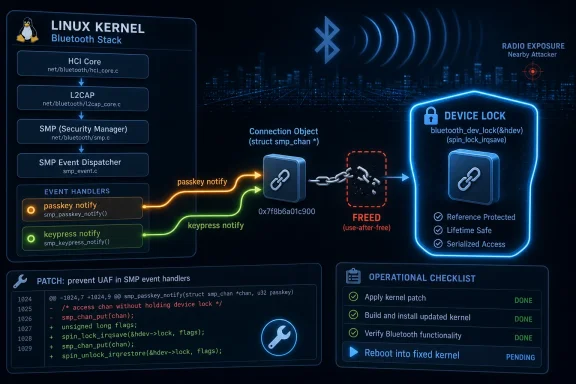
The vulnerability description is almost comically compact. In two Bluetooth HCI event handlers, hci_user_passkey_notify_evt() and hci_keypress_notify_evt(), the kernel looked up an hci_conn object and then continued using its fields without holding the relevant device lock for the full duration of that use. If another thread freed the connection at the wrong moment, the handler could dereference memory that no longer belonged to it.
That is the classic shape of a use-after-free bug: not a missing password check, not a bad cryptographic primitive, not an obvious remote shell, but a race between lifetime and access. Kernel security is full of these bugs because the kernel is a world of shared objects, interrupts, callbacks, timers, workqueues, and hardware events arriving on schedules humans do not control.
The patch extends the hci_dev_lock critical section so that the connection lookup and subsequent field access remain protected. It also preserves existing keypress notification behavior by funneling early exits through a common unlock path. In plain English, the fix says: if the handler needs the connection, it must keep the device lock while it is still touching the connection.
That sounds boring. It is not. The difference between “look up under lock, use later” and “look up and use under lock” is often the difference between a benign event handler and a crashable kernel path.
The Vulnerability Lives in the Pairing Ceremony, Not the Data Plane
CVE-2026-46056 sits in Bluetooth Secure Simple Pairing passkey handling. That matters because passkey events are part of the trust-building ceremony between devices, not the steady-state data exchange that follows once everything is paired and connected.
The affected handlers process events related to user passkey notification and keypress notification. Those are the bits of Bluetooth UX that users recognize as a six-digit code appearing on-screen, a typing indicator during passkey entry, or a pairing prompt that asks whether two devices should trust each other. Under the surface, the host controller interface is delivering events upward, and the Linux Bluetooth stack is mapping those events to management behavior and user-space notifications.
That pairing path is also inherently messy. Devices appear, disappear, time out, reconnect, fail authentication, and sometimes vanish while the operating system is still processing the previous event. Laptops go to sleep. Headphones power down. USB Bluetooth dongles are unplugged. Radios reset. A handler that assumes a connection remains valid across an unlocked window is making a bet against a hostile scheduler and an unreliable physical world.
The CVE text does not claim active exploitation, and NVD had not assigned a CVSS score at the time the record was published. That absence should not be overread. “Awaiting enrichment” means the vulnerability record is still being processed; it does not mean the bug is harmless, nor does it mean it is catastrophic.
The Kernel’s CVE Factory Is Working as Designed
Linux kernel CVEs can feel strange to administrators used to vendor advisories that arrive with severity banners, exploitability notes, affected product tables, and mitigation checklists. The kernel process increasingly emits CVEs for resolved flaws as part of a high-volume maintenance stream. Many entries read like patch commit messages because that is, functionally, what they are.
CVE-2026-46056 follows that pattern. The record says the vulnerability has been resolved in the Linux kernel. It describes the race, identifies the handlers, and points to stable commits. It does not yet offer NVD scoring, a polished attacker narrative, or a neatly bounded list of distributions.
That makes the bug easy to dismiss and easy to misunderstand. Security teams that triage solely by CVSS may ignore it until a score appears. Desktop users may see “Bluetooth” and assume it only matters if they are pairing headphones in a coffee shop. Embedded vendors may not notice until their scanner flags a kernel build months later.
The more accurate view is that this is a kernel maintenance vulnerability with a narrow technical fix and a potentially broad distribution footprint. Whether it matters to a given system depends on kernel version, Bluetooth exposure, hardware configuration, distribution backports, and whether the vulnerable code path is reachable in practice.
Race Conditions Are Where “Local” and “Remote” Stop Being Clean Categories
Bluetooth bugs are hard to classify because the attacker model is neither purely local nor purely remote in the traditional network sense. An attacker may need radio proximity. They may need to trigger pairing-related behavior. They may need the target’s Bluetooth stack to process specific events at just the wrong time. Those constraints are real.
But physical proximity is not the same as local account access. A Bluetooth radio can be reached from outside the operating system’s normal network perimeter. In offices, airports, labs, hospitals, factories, and conferences, radio adjacency is abundant. The old comfort phrase “requires nearby attacker” is less comforting in environments where nearby strangers are the default.
Use-after-free flaws also resist simple severity instincts. Some produce reliable privilege escalation. Some produce denial of service. Some are theoretically exploitable but practically miserable. Some become useful only when paired with heap grooming, information leaks, or predictable object reuse. The CVE record for CVE-2026-46056 does not yet establish which bucket this one belongs in.
That uncertainty should push administrators toward disciplined patching rather than panic. The responsible conclusion is not “drop everything,” but “do not let Bluetooth-capable Linux kernels drift indefinitely because the advisory lacks a dramatic score.”
The Fix Is Surgical Because the Bug Is About Object Lifetime
The patch’s core idea is not a Bluetooth redesign. It is a locking correction. The kernel already had a device lock; the vulnerable pattern was that the lock did not cover all connection usage in the relevant handlers.
That distinction matters for operational risk. Surgical fixes tend to be easier for stable maintainers to backport because they alter a small region of code and preserve visible behavior. The CVE text explicitly says the existing keypress notification behavior is kept unchanged, with early exits routed through a common unlock path. That is the sort of phrasing maintainers use when they are trying to reduce regression risk while correcting lifetime safety.
It also tells us something about why the bug existed. This was not necessarily a careless omission in an obvious critical path. It was the kind of boundary bug that appears when code evolves: a lookup is protected, later access expands, early returns accumulate, and eventually a connection object is used outside the safest possible lifetime window.
Kernel developers have spent years tightening these patterns across networking, filesystems, GPU drivers, USB, Wi-Fi, and Bluetooth. The same lesson repeats: the lock that makes the pointer valid must cover the period in which the pointer is actually used, not merely the moment it is found.
Stable Trees Turn a Patch Into a Fleet Problem
The references attached to the CVE point to multiple stable kernel commits, which is what administrators should expect for a fix that needs to land across supported branches. The presence of several stable references is not evidence of several separate vulnerabilities. It is evidence that the same fix, or equivalent fixes, had to be carried into multiple maintained kernel lines.
That is where life gets complicated for real systems. Most Linux users do not run an upstream kernel from kernel.org. They run a distribution kernel with vendor patches, configuration choices, backported fixes, and sometimes delayed security metadata. A scanner may say a CVE applies because a version number appears vulnerable, while the distribution has already backported the fix. The reverse can also happen: an upstream fix exists, but the user’s vendor branch has not yet shipped it.
For enterprise Linux, the right question is rarely “what upstream version fixed this?” It is “has my vendor shipped the fix for my supported kernel package, and is that package installed on the machines with Bluetooth enabled?” Those are different questions, and they require distribution-specific answers.
Rolling-release users face a different problem. They may receive the fix quickly, but they are also more exposed to regressions from fast-moving stable updates. Recent Bluetooth regressions in various kernel lines have reminded users that a security fix can travel alongside unrelated changes that break real hardware. For Bluetooth, this is especially painful because failures are visible immediately: mice stop working, headphones vanish, controllers refuse to initialize, and laptops suddenly lose a basic convenience feature.
Windows Shops Still Need to Care About a Linux Bluetooth CVE
At first glance, CVE-2026-46056 looks outside the WindowsForum center of gravity. It is a Linux kernel bug, not a Windows Bluetooth stack issue. But modern Windows environments are rarely Windows-only.
Developers run Linux laptops. Security teams run Kali, Ubuntu, Fedora, Arch, Debian, and custom kernels. Cloud appliances and network devices run Linux underneath. Conference room systems, kiosks, thin clients, hypervisors, lab machines, and build infrastructure may include Bluetooth hardware even when nobody thinks of them as Bluetooth devices. Some Windows administrators also manage Linux endpoints through the same asset and vulnerability platforms they use for Microsoft estates.
The practical crossover is inventory. If your asset database treats Bluetooth as a peripheral detail rather than an attack surface, this CVE is a reminder to tighten the model. A Linux server in a rack may have no Bluetooth adapter and no exposure. A developer workstation may have one enabled by default. A mini PC behind a display may have a combo Wi-Fi/Bluetooth module nobody documented.
There is also a WSL-adjacent lesson, though not a direct WSL panic. Windows Subsystem for Linux does not mean Windows is running a general-purpose Linux kernel Bluetooth stack in the same way a native Linux desktop does. But the growth of Linux tooling inside Windows shops has blurred responsibility lines. The people reading vulnerability reports now need to understand both ecosystems well enough not to dismiss the wrong thing.
The Absence of a Score Is Not the Absence of Risk
NVD had not assigned CVSS 4.0, CVSS 3.x, or CVSS 2.0 scores when the record was published. That will frustrate dashboards, but it should not paralyze triage.
CVSS is useful when it describes a well-understood vulnerability. It is less useful during the first hours or days after a terse kernel CVE lands. A race in a Bluetooth event handler can be difficult to score before exploitability is studied. Does it require pairing? Does it require user interaction? Can an unauthenticated nearby device trigger the relevant event sequence? Is the realistic outcome a crash, or is controlled memory reuse plausible? The CVE text alone does not answer all of that.
This is where mature security operations separate urgency from certainty. A missing score should not be converted into a zero. It should be converted into a provisional risk posture: identify exposed systems, check vendor advisories, prioritize laptops and Bluetooth-enabled endpoints, and apply fixed kernels when available through normal channels.
For many environments, the highest-value mitigation may be mundane. If Bluetooth is not needed on a class of systems, disable it. That reduces exposure not only to CVE-2026-46056 but to the next Bluetooth parsing, pairing, driver, firmware, or management bug.
The Real Blast Radius Depends on Hardware, Policy, and Reachability
A vulnerability in the Linux Bluetooth stack does not automatically threaten every Linux system equally. Reachability is the first divider. Systems without Bluetooth hardware, systems with Bluetooth disabled in firmware, and systems where the kernel Bluetooth stack is not loaded have a different risk profile from laptops with active radios.
The second divider is workflow. Devices that frequently pair with new peripherals are more exposed to pairing-path bugs than locked-down systems that never enter discovery or pairing flows. Developer laptops, help desk machines, lab benches, conference devices, and personal Linux desktops are more interesting than headless servers with no adapter.
The third divider is update channel. Some distributions will backport the fix without changing the kernel’s headline version in a way that simple scanners understand. Others will ship it in a point update. Custom kernels, embedded vendor trees, and long-lived appliance builds may lag. The systems most likely to be forgotten are often the systems least likely to receive quick kernel refreshes.
Finally, there is user behavior. Bluetooth pairing prompts are social surfaces as well as technical surfaces. Users who accept unexpected pairing requests make attack preconditions easier. Administrators can reduce that risk with policy, training, and device management, but the cleanest answer remains keeping the kernel stack fixed.
This Is Another Reminder That Memory Safety Is Still Kernel Security’s Long War
CVE-2026-46056 is not spectacular, and that is exactly why it is representative. Modern kernel security is dominated by thousands of small lifetime, bounds, locking, and reference-counting corrections. Each one looks narrow. Together they define the practical security of the platform.
Bluetooth is especially vulnerable to this pattern because it is both old and constantly extended. Classic Bluetooth, Bluetooth Low Energy, vendor-specific controller behavior, management interfaces, authentication flows, privacy features, audio profiles, and quirky adapters all meet in a stack that must handle hostile timing and unreliable hardware. The result is a large asynchronous state machine with many opportunities for race conditions.
The Linux kernel has made progress with hardening, sanitizers, fuzzing, syzkaller reports, refcount improvements, and more systematic stable backports. But C remains C, object lifetimes remain hard, and drivers remain a vast frontier. A single missing lock boundary can become a CVE because the kernel cannot afford to touch freed memory even once.
There is a temptation to view memory-safety discussions as abstract language-war material. Bugs like this make the argument concrete. The problem is not that kernel developers do not understand locking. The problem is that the operating system’s lowest layers are forced to encode complex lifetimes manually across a concurrency model that punishes every incomplete assumption.
Administrators Should Patch, But They Should Also Reduce the Radio Surface
For IT teams, the response should be pragmatic. Track the CVE, watch your distribution’s kernel advisories, deploy fixed packages, and reboot into the updated kernel. Kernel patches do not help if systems are left running the old image for weeks.
At the same time, this is a good moment to revisit Bluetooth policy. Many enterprises have Bluetooth enabled everywhere because it shipped that way, not because anyone made an explicit decision. That may be acceptable for mobile users with headsets and keyboards, but it is harder to justify on fixed workstations, lab systems, kiosks, servers, and sensitive administrative endpoints.
Linux makes Bluetooth relatively easy to disable at several layers: firmware setup, kernel module policy, system service configuration, rfkill state, desktop policy, or endpoint management tooling. The best layer depends on the environment. The key is to decide deliberately rather than letting a combo wireless card define the attack surface.
Security teams should also tune scanners to recognize vendor backports. If a distribution marks the issue fixed in a package release, do not chase upstream version numerology blindly. Conversely, do not assume an upstream fix protects a custom kernel until the relevant patch is present in that tree.
The Small Patch Leaves a Short Checklist for Real Machines
CVE-2026-46056 is not a reason to declare Bluetooth unusable, but it is a reason to treat Bluetooth as kernel-exposed infrastructure rather than a harmless convenience feature. The fix is straightforward; the operational work is making sure the right machines actually receive it.
- Systems with active Linux Bluetooth adapters should be prioritized ahead of headless machines with no Bluetooth hardware or disabled radios.
- Distribution kernel advisories matter more than upstream version strings because vendors often backport fixes into older supported kernels.
- Machines must be rebooted into the fixed kernel before the vulnerability is meaningfully remediated.
- Bluetooth should be disabled on Linux endpoints and appliances that do not need it for a documented business purpose.
- Security teams should avoid treating NVD’s temporary lack of a CVSS score as evidence that the flaw has no operational importance.
- Custom kernels, embedded devices, and appliances deserve special attention because they often lag behind upstream stable fixes.
The broader story is not that one Bluetooth passkey handler briefly got its locking wrong. It is that the Linux kernel’s security posture is built from thousands of these small corrections, each one tightening a race window that most users will never see. CVE-2026-46056 will likely disappear into distribution changelogs and scanner databases, but the pattern will remain: radios are local until they are not, memory bugs are theoretical until they are reachable, and the safest endpoint is the one whose kernel is current and whose unnecessary hardware is quiet.
References
- CVE-2026-46056 Bluetooth: hci_event: fix potential UAF in SSP passkey handlers NVD / Linux Kernel · 2026-05-28T01:10:41-07:00