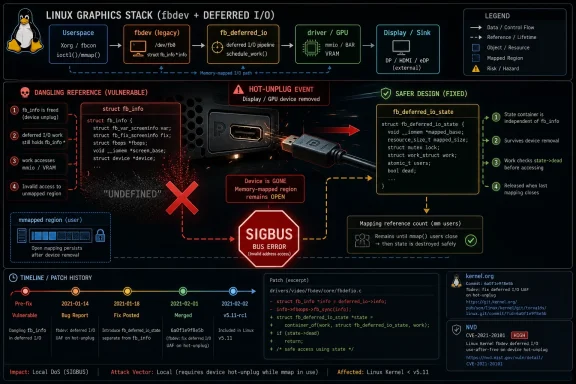
CVE-2026-46065 is a newly published Linux kernel vulnerability, disclosed by kernel.org and listed by NVD on May 27, 2026, that fixes a framebuffer deferred-I/O lifetime bug triggered when graphics memory remains mapped after device hot-unplug. The dry wording hides a familiar class of kernel mistake: one object dies while another part of the system still assumes it is alive. In this case, the object is
The Linux framebuffer subsystem, usually shortened to fbdev, is not where most modern graphics attention goes. Contemporary Linux display work lives in DRM and KMS, Mesa, Wayland compositors, vendor drivers, and the sprawling graphics stack that makes monitors light up on modern hardware. But fbdev remains part of the kernel’s long tail: boot consoles, embedded systems, virtual displays, simple framebuffers, USB display adapters, compatibility paths, and odd administrative environments where “old” does not mean “unused.”
CVE-2026-46065 lands in that long tail. The affected area is deferred I/O, a mechanism used when writes to a memory-mapped framebuffer should not necessarily be pushed immediately to hardware. That design makes sense for devices where direct writes are expensive, asynchronous, or mediated through a slower path. It also creates a lifetime problem: user space can keep a mapping open while the device underneath disappears.
The kernel fix reframes ownership. Instead of tying deferred-I/O state too tightly to
That is an unglamorous patch. It is also exactly the kind of patch that matters.
This is the sort of bug kernel developers have spent decades trying to eliminate. The hard part is not recognizing that use-after-free and stale-pointer patterns are dangerous; it is making every subsystem robust against them when the kernel supports long-lived file descriptors, memory mappings, removable devices, suspend/resume cycles, virtualized hardware, and drivers written across multiple eras of kernel architecture.
The fix’s decision to return SIGBUS is telling. SIGBUS is the Unix way of saying that a memory access through a mapping can no longer be satisfied. It is not pleasant for the application, but it is honest. Once the device and its framebuffer state are gone, the kernel’s safest answer is to make the mapping fault predictably rather than pretend the old backing object still exists.
For administrators, that distinction matters. A clean fault is a contained failure. Undefined state is where reliability bugs, privilege-boundary bugs, and exploit research all begin to overlap.
The practical risk will depend on exploitability, reachable drivers, local access requirements, and whether an attacker can deliberately create or influence the hot-unplug-plus-mapping sequence. Many Linux kernel CVEs never become broadly weaponized because the trigger path is obscure, hardware-specific, or requires local privileges that already narrow the threat model. Others begin as “just a race” or “just undefined state” and turn out to be exploitable in exactly the environments defenders forgot to model.
This one should be treated as a kernel maintenance issue first and a panic item second. There is no public scoring yet, and the description does not claim a known exploit. But the ingredients are familiar enough to merit attention: a long-standing lifetime bug, user-space memory mappings, device removal, and kernel structures being freed while references may survive.
Security teams should resist the false binary of “critical” versus “ignore.” Kernel CVEs often live in the gray zone where fleet exposure, hardware profile, and local-user threat models decide whether a bug is operationally significant.
Fbdev’s persistence is a reminder that operating systems are geological formations. New display layers settle on top of old ones. Boot paths remain. Fallback paths remain. Embedded boards remain. Virtual machines and appliances remain. Enterprise images carry conservative kernel configurations because predictability matters more than architectural purity.
That persistence is why a bug in fbdev can still earn a CVE in 2026. The kernel’s attack surface is not defined only by what laptop users see in a settings panel. It is defined by enabled code, reachable devices, default modules, container host behavior, virtualization stacks, and all the compatibility glue that lets Linux run everywhere from server closets to lab benches.
The lesson for WindowsForum readers is broader than Linux. Windows has its own legacy layers, compatibility shims, graphics paths, driver frameworks, and device lifetime complexities. Mature operating systems do not become secure by becoming modern in marketing copy. They become secure by retiring unsafe assumptions one object lifetime at a time.
This is a common kernel hardening pattern. When user space can hold a reference, the kernel needs a structure whose lifetime matches that reference. If the real device disappears, the reference should point to a valid “dead” state rather than a freed live state. The difference is between a controlled error path and memory corruption territory.
The CVE description says that when
That kind of fix rarely makes headlines because it does not announce a flashy mitigation or a new security subsystem. Yet this is how kernels actually get safer: a thousand places where “this should never happen” becomes “if this happens, fail closed.”
This distinction is important for distribution users. A CVE against the Linux kernel does not map cleanly to a single version number in the way an application CVE often does. Distribution kernels carry backports. Enterprise kernels may include fixes without changing their headline version. Vendor kernels for embedded devices may lag stable releases while carrying their own driver patches.
The right question is not “am I running version X?” but “has my vendor shipped the specific fbdev deferred-I/O fix for my kernel stream?” For rolling distributions, that usually means updating to the latest kernel package once the fix lands. For enterprise distributions, it means watching vendor advisories. For appliances and embedded systems, it may mean waiting for a board vendor that treats graphics as plumbing and security as an afterthought.
That lag is where old subsystem bugs become operational headaches. The systems most likely to use obscure framebuffer paths are not always the systems with the fastest patch pipelines.
But local kernel bugs matter. Multi-user Linux systems still exist. Developer workstations run untrusted code. CI workers, lab machines, shared GPU hosts, kiosks, thin clients, and embedded consoles all complicate the neat assumption that “local access” is harmless. Even on a single-user machine, the boundary between browser sandbox, container, desktop session, and kernel is the difference between compromise and containment.
The hot-unplug angle makes exploitability more environment-dependent. An attacker may need access to a removable framebuffer-like device, a driver that uses deferred I/O, or a way to race teardown against an active mapping. That is a narrower condition than a universally reachable syscall bug. It is also exactly the sort of condition that varies wildly between a cloud VM, a Raspberry Pi-like board, a kiosk, a USB display setup, and a developer laptop.
Administrators should therefore avoid both extremes. This is not the kind of CVE that justifies ripping systems offline based on the current public record. It is also not one to wave away because fbdev sounds old-fashioned. The affected code sits in kernel space, and the fix is available. That combination usually answers the prioritization question.
The most obvious overlap is virtualization and development. A Windows developer workstation may run Linux VMs for build pipelines, test harnesses, or security research. Those VMs may not expose physical hot-plug graphics in the same way bare metal does, but they often run distribution kernels whose CVE posture is part of the organization’s risk surface. If the VM template is stale, every clone inherits the same old kernel.
The second overlap is hardware-adjacent IT. USB display adapters, console devices, industrial panels, signage systems, and appliance-like Linux boxes are common in environments that otherwise standardize on Windows desktops. These are exactly the places where framebuffer-era assumptions can persist. They are also the places where patch visibility is poor because the device is seen as “equipment,” not as a Linux host.
The third overlap is security process. Windows administrators have learned to track driver updates, kernel mitigations, and vendor advisories because the operating system boundary is porous. Linux demands the same discipline, but its diversity makes the workflow messier. CVE-2026-46065 is a useful reminder that kernel risk is not limited to the shiny subsystems in current architectural diagrams.
For kernel CVEs sourced from upstream fixes, that is normal. The public record often begins as a patch description, then accumulates distribution advisories, package versions, severity ratings, and scanner logic. During that gap, vulnerability management tools may disagree. One scanner may flag the CVE broadly based on kernel version; another may wait for distribution OVAL data; a third may miss a backported fix because the package version did not obviously change.
This is where mature operations matter. A sysadmin who simply sorts by CVSS will not see much yet. A sysadmin who understands the affected subsystem can ask better questions: Is fbdev enabled? Are deferred-I/O framebuffer drivers present? Are users able to access the relevant device nodes? Is hot-unplug realistic? Has the distribution backported the patch?
The best answer, of course, is still to update. But good triage explains why a kiosk fleet might deserve attention sooner than a headless server pool.
CVE-2026-46065 appears to require a framebuffer deferred-I/O mapping that survives device teardown. That points toward local interaction with a relevant framebuffer device and a hot-unplug or removal path. On a headless server with no exposed fbdev devices, the operational risk may be low. On a device that uses deferred framebuffer updates as part of its normal display behavior, the risk deserves more attention.
Containerized environments add another layer. Containers share the host kernel, so kernel CVEs are always worth noting, but device node exposure is the hinge. A container that cannot access framebuffer devices is differently positioned from a privileged container or hardware-control container that can. The same logic applies to sandboxes, remote desktop stacks, and lab automation rigs.
This is not special pleading for this CVE. It is the basic discipline kernel security demands: identify the code path, identify who can reach it, and patch on a schedule that reflects both the technical exposure and the business role of the system.
For Linux desktops and workstations, especially those used by developers, researchers, or power users who attach unusual display hardware, the update case is straightforward. These machines are local-code execution playgrounds by design. They compile things, test things, run containers, load drivers, and accumulate peripherals. Kernel hygiene is not optional on that class of system.
For servers, exposure review should be targeted. Headless production servers are less likely to care about fbdev, but they may still have framebuffer support in the kernel or device nodes present for console handling. The practical priority depends on access controls and whether untrusted users can run local code.
For embedded and appliance systems, the uncomfortable question is vendor responsiveness. If the product uses a long-term kernel with fbdev paths and supports physical display hardware, the fix may matter. If the vendor’s security process is opaque, asset owners may need compensating controls: restrict local access, reduce exposed device nodes, and monitor for kernel update availability.
CVE-2026-46065 will probably not be remembered as one of the defining Linux bugs of 2026, and that is precisely why it is useful. It shows the kernel community doing the necessary maintenance work in a compatibility layer most users never think about, while reminding administrators that forgotten code paths do not stop being security boundaries. The future of platform security will be shaped not only by memory-safe rewrites and headline mitigations, but by fixes like this one: careful lifetime accounting, predictable failure, and the steady removal of undefined behavior from places where real machines still depend on it.
struct fb_info, the aging but still consequential framebuffer structure that sits beneath more Linux systems than many desktop users realize. The real story is not that fbdev suddenly became exciting; it is that old compatibility layers keep becoming security boundaries.
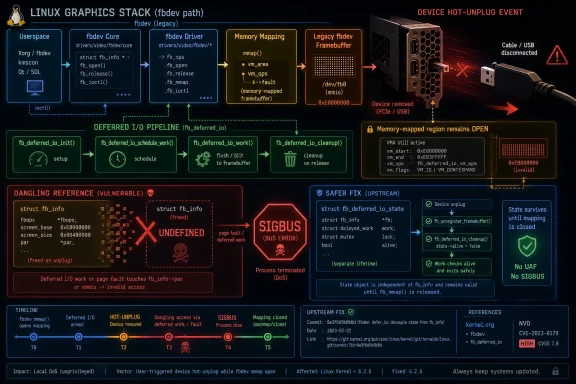 A Small Framebuffer Bug Exposes a Big Kernel Truth
The Linux framebuffer subsystem, usually shortened to fbdev, is not where most modern graphics attention goes. Contemporary Linux display work lives in DRM and KMS, Mesa, Wayland compositors, vendor drivers, and the sprawling graphics stack that makes monitors light up on modern hardware. But fbdev remains part of the kernel’s long tail: boot consoles, embedded systems, virtual displays, simple framebuffers, USB display adapters, compatibility paths, and odd administrative environments where “old” does not mean “unused.”CVE-2026-46065 lands in that long tail. The affected area is deferred I/O, a mechanism used when writes to a memory-mapped framebuffer should not necessarily be pushed immediately to hardware. That design makes sense for devices where direct writes are expensive, asynchronous, or mediated through a slower path. It also creates a lifetime problem: user space can keep a mapping open while the device underneath disappears.
The kernel fix reframes ownership. Instead of tying deferred-I/O state too tightly to
struct fb_info, the patch introduces separate state in struct fb_deferred_io_state, allocated when deferred I/O is initialized and retained until the final mapping is closed. If the original framebuffer object is destroyed in the meantime, the state is invalidated by clearing its info pointer, and later access results in SIGBUS rather than wandering through undefined kernel state.That is an unglamorous patch. It is also exactly the kind of patch that matters.
Hot-Unplug Is Where Lifetime Bugs Go to Become Security Bugs
The key scenario is device hot-unplug. A process has mapped graphics memory, a framebuffer device goes away, and the kernel frees thefb_info instance that described it. If user space later touches the still-existing mapping, the old code could operate on undefined state because the mapping outlived the structure it depended on.This is the sort of bug kernel developers have spent decades trying to eliminate. The hard part is not recognizing that use-after-free and stale-pointer patterns are dangerous; it is making every subsystem robust against them when the kernel supports long-lived file descriptors, memory mappings, removable devices, suspend/resume cycles, virtualized hardware, and drivers written across multiple eras of kernel architecture.
The fix’s decision to return SIGBUS is telling. SIGBUS is the Unix way of saying that a memory access through a mapping can no longer be satisfied. It is not pleasant for the application, but it is honest. Once the device and its framebuffer state are gone, the kernel’s safest answer is to make the mapping fault predictably rather than pretend the old backing object still exists.
For administrators, that distinction matters. A clean fault is a contained failure. Undefined state is where reliability bugs, privilege-boundary bugs, and exploit research all begin to overlap.
The CVSS Silence Should Not Be Mistaken for Safety
At publication, NVD had not assigned CVSS 4.0, CVSS 3.x, or CVSS 2.0 scores to CVE-2026-46065. That absence is procedural, not reassuring. NVD records often appear before enrichment is complete, especially when the source is kernel.org and the description comes directly from an upstream fix.The practical risk will depend on exploitability, reachable drivers, local access requirements, and whether an attacker can deliberately create or influence the hot-unplug-plus-mapping sequence. Many Linux kernel CVEs never become broadly weaponized because the trigger path is obscure, hardware-specific, or requires local privileges that already narrow the threat model. Others begin as “just a race” or “just undefined state” and turn out to be exploitable in exactly the environments defenders forgot to model.
This one should be treated as a kernel maintenance issue first and a panic item second. There is no public scoring yet, and the description does not claim a known exploit. But the ingredients are familiar enough to merit attention: a long-standing lifetime bug, user-space memory mappings, device removal, and kernel structures being freed while references may survive.
Security teams should resist the false binary of “critical” versus “ignore.” Kernel CVEs often live in the gray zone where fleet exposure, hardware profile, and local-user threat models decide whether a bug is operationally significant.
Fbdev Is Legacy, but Legacy Is Not Optional
It is tempting to dismiss fbdev as a historical artifact. On a polished modern Linux desktop, users interact with Wayland or X11, accelerated drivers, compositors, and GPU APIs that seem far removed from a framebuffer abstraction. But kernels do not get to delete compatibility simply because the fashionable path moved elsewhere.Fbdev’s persistence is a reminder that operating systems are geological formations. New display layers settle on top of old ones. Boot paths remain. Fallback paths remain. Embedded boards remain. Virtual machines and appliances remain. Enterprise images carry conservative kernel configurations because predictability matters more than architectural purity.
That persistence is why a bug in fbdev can still earn a CVE in 2026. The kernel’s attack surface is not defined only by what laptop users see in a settings panel. It is defined by enabled code, reachable devices, default modules, container host behavior, virtualization stacks, and all the compatibility glue that lets Linux run everywhere from server closets to lab benches.
The lesson for WindowsForum readers is broader than Linux. Windows has its own legacy layers, compatibility shims, graphics paths, driver frameworks, and device lifetime complexities. Mature operating systems do not become secure by becoming modern in marketing copy. They become secure by retiring unsafe assumptions one object lifetime at a time.
The Patch Moves the Boundary to the Mapping, Not the Device
The important design change in the fix is subtle. The old logic effectively made deferred-I/O state depend on the lifetime of the framebuffer information object. The new logic gives active mappings their own state container, which survives until the mapping itself is closed. That does not keep the device alive; it keeps the bookkeeping coherent long enough to fail safely.This is a common kernel hardening pattern. When user space can hold a reference, the kernel needs a structure whose lifetime matches that reference. If the real device disappears, the reference should point to a valid “dead” state rather than a freed live state. The difference is between a controlled error path and memory corruption territory.
The CVE description says that when
fb_info and its deferred-I/O data go away, the new state’s info field is cleared to invalidate the mapping. Any subsequent access then produces SIGBUS. In plain English, the kernel stops promising that the framebuffer exists, but it also stops leaving a dangling path back into freed memory.That kind of fix rarely makes headlines because it does not announce a flashy mitigation or a new security subsystem. Yet this is how kernels actually get safer: a thousand places where “this should never happen” becomes “if this happens, fail closed.”
Stable Backports Show the Bug Was Not a New Regression
The references attached to the CVE point to multiple stable kernel commits, and mailing-list traffic shows backports across supported stable lines. The upstream fix also identifies the original deferred-I/O support as old enough to matter across a very long stretch of kernel history. That does not automatically mean every deployed kernel is vulnerable in a meaningful way, but it does mean the bug is not confined to a short-lived development branch.This distinction is important for distribution users. A CVE against the Linux kernel does not map cleanly to a single version number in the way an application CVE often does. Distribution kernels carry backports. Enterprise kernels may include fixes without changing their headline version. Vendor kernels for embedded devices may lag stable releases while carrying their own driver patches.
The right question is not “am I running version X?” but “has my vendor shipped the specific fbdev deferred-I/O fix for my kernel stream?” For rolling distributions, that usually means updating to the latest kernel package once the fix lands. For enterprise distributions, it means watching vendor advisories. For appliances and embedded systems, it may mean waiting for a board vendor that treats graphics as plumbing and security as an afterthought.
That lag is where old subsystem bugs become operational headaches. The systems most likely to use obscure framebuffer paths are not always the systems with the fastest patch pipelines.
The Risk Is Local, Situational, and Still Worth Fixing
Nothing in the public description suggests a remote network attack. This is a local kernel bug involving user-space mappings and device lifetime. That narrows the immediate blast radius, especially for locked-down servers with no relevant framebuffer devices exposed to untrusted users.But local kernel bugs matter. Multi-user Linux systems still exist. Developer workstations run untrusted code. CI workers, lab machines, shared GPU hosts, kiosks, thin clients, and embedded consoles all complicate the neat assumption that “local access” is harmless. Even on a single-user machine, the boundary between browser sandbox, container, desktop session, and kernel is the difference between compromise and containment.
The hot-unplug angle makes exploitability more environment-dependent. An attacker may need access to a removable framebuffer-like device, a driver that uses deferred I/O, or a way to race teardown against an active mapping. That is a narrower condition than a universally reachable syscall bug. It is also exactly the sort of condition that varies wildly between a cloud VM, a Raspberry Pi-like board, a kiosk, a USB display setup, and a developer laptop.
Administrators should therefore avoid both extremes. This is not the kind of CVE that justifies ripping systems offline based on the current public record. It is also not one to wave away because fbdev sounds old-fashioned. The affected code sits in kernel space, and the fix is available. That combination usually answers the prioritization question.
Windows Shops Should Still Pay Attention
A Linux framebuffer CVE might look outside the usual WindowsForum beat, but modern Windows environments are rarely Windows-only. WSL, Hyper-V labs, Linux build servers, container hosts, network appliances, NAS boxes, Kubernetes nodes, security tools, and embedded Linux devices all sit inside Windows-centric organizations. The people responsible for Windows endpoint hygiene often inherit Linux kernel exposure through the side door.The most obvious overlap is virtualization and development. A Windows developer workstation may run Linux VMs for build pipelines, test harnesses, or security research. Those VMs may not expose physical hot-plug graphics in the same way bare metal does, but they often run distribution kernels whose CVE posture is part of the organization’s risk surface. If the VM template is stale, every clone inherits the same old kernel.
The second overlap is hardware-adjacent IT. USB display adapters, console devices, industrial panels, signage systems, and appliance-like Linux boxes are common in environments that otherwise standardize on Windows desktops. These are exactly the places where framebuffer-era assumptions can persist. They are also the places where patch visibility is poor because the device is seen as “equipment,” not as a Linux host.
The third overlap is security process. Windows administrators have learned to track driver updates, kernel mitigations, and vendor advisories because the operating system boundary is porous. Linux demands the same discipline, but its diversity makes the workflow messier. CVE-2026-46065 is a useful reminder that kernel risk is not limited to the shiny subsystems in current architectural diagrams.
The NVD Record Is a Starting Gun, Not the Finish Line
NVD publication gives defenders a common identifier, but it does not complete the analysis. As of the record’s initial publication, the entry was still awaiting enrichment, with no NVD CVSS score and no weakness enumeration filled in. That leaves vendors, distributions, and security teams to do the first round of triage themselves.For kernel CVEs sourced from upstream fixes, that is normal. The public record often begins as a patch description, then accumulates distribution advisories, package versions, severity ratings, and scanner logic. During that gap, vulnerability management tools may disagree. One scanner may flag the CVE broadly based on kernel version; another may wait for distribution OVAL data; a third may miss a backported fix because the package version did not obviously change.
This is where mature operations matter. A sysadmin who simply sorts by CVSS will not see much yet. A sysadmin who understands the affected subsystem can ask better questions: Is fbdev enabled? Are deferred-I/O framebuffer drivers present? Are users able to access the relevant device nodes? Is hot-unplug realistic? Has the distribution backported the patch?
The best answer, of course, is still to update. But good triage explains why a kiosk fleet might deserve attention sooner than a headless server pool.
The Real Severity Depends on Reachability
Kernel vulnerability management often fails because teams confuse theoretical affectedness with practical reachability. A monolithic kernel source tree contains code for countless architectures, buses, drivers, and device classes. A CVE may be real while only a subset of systems can plausibly hit the vulnerable path.CVE-2026-46065 appears to require a framebuffer deferred-I/O mapping that survives device teardown. That points toward local interaction with a relevant framebuffer device and a hot-unplug or removal path. On a headless server with no exposed fbdev devices, the operational risk may be low. On a device that uses deferred framebuffer updates as part of its normal display behavior, the risk deserves more attention.
Containerized environments add another layer. Containers share the host kernel, so kernel CVEs are always worth noting, but device node exposure is the hinge. A container that cannot access framebuffer devices is differently positioned from a privileged container or hardware-control container that can. The same logic applies to sandboxes, remote desktop stacks, and lab automation rigs.
This is not special pleading for this CVE. It is the basic discipline kernel security demands: identify the code path, identify who can reach it, and patch on a schedule that reflects both the technical exposure and the business role of the system.
The Practical Work Starts Before the Score Arrives
The immediate response should be boring, which is usually good security. Track the kernel packages your distributions ship, look for advisories that mention CVE-2026-46065 or the fbdev deferred-I/O fix, and apply normal kernel updates once available. Reboot planning matters because a fixed kernel package does not protect a host still running the old kernel image.For Linux desktops and workstations, especially those used by developers, researchers, or power users who attach unusual display hardware, the update case is straightforward. These machines are local-code execution playgrounds by design. They compile things, test things, run containers, load drivers, and accumulate peripherals. Kernel hygiene is not optional on that class of system.
For servers, exposure review should be targeted. Headless production servers are less likely to care about fbdev, but they may still have framebuffer support in the kernel or device nodes present for console handling. The practical priority depends on access controls and whether untrusted users can run local code.
For embedded and appliance systems, the uncomfortable question is vendor responsiveness. If the product uses a long-term kernel with fbdev paths and supports physical display hardware, the fix may matter. If the vendor’s security process is opaque, asset owners may need compensating controls: restrict local access, reduce exposed device nodes, and monitor for kernel update availability.
The Small CVE That Teaches the Fleet Lesson
CVE-2026-46065 is not merely a note about framebuffer internals; it is a test of whether an organization understands its Linux footprint well enough to patch intelligently. The useful actions are concrete.- Systems running vendor-supported Linux kernels should be updated when packages containing the fbdev deferred-I/O fix become available.
- Administrators should confirm that rebooted hosts are actually running the fixed kernel, not merely storing it on disk.
- Machines with removable or unusual display hardware deserve closer attention than ordinary headless servers.
- Container and VM hosts should be reviewed for framebuffer device exposure, especially where privileged workloads or hardware pass-through are used.
- Embedded systems, kiosks, and appliances should not be excluded from review simply because they are not managed like traditional servers.
- Vulnerability teams should not wait for an NVD score before tracking vendor advisories and kernel package status.
CVE-2026-46065 will probably not be remembered as one of the defining Linux bugs of 2026, and that is precisely why it is useful. It shows the kernel community doing the necessary maintenance work in a compatibility layer most users never think about, while reminding administrators that forgotten code paths do not stop being security boundaries. The future of platform security will be shaped not only by memory-safe rewrites and headline mitigations, but by fixes like this one: careful lifetime accounting, predictable failure, and the steady removal of undefined behavior from places where real machines still depend on it.
References
- Primary source: NVD / Linux Kernel
Published: 2026-05-28T01:09:51-07:00
NVD - CVE-2026-46065
 nvd.nist.gov
- Security advisory: MSRC
Published: 2026-05-28T01:09:51-07:00
Original feed URL
Security Update Guide - Microsoft Security Response Center
 msrc.microsoft.com