

A One-Line Fix Exposes a Familiar Kernel Weakness
The ucan bug sits in the Controller Area Network world, a corner of Linux that most desktop users never think about and many industrial users cannot avoid. CAN is the durable bus protocol behind cars, embedded controllers, industrial equipment, test benches, and plenty of USB adapters that let Linux hosts talk to those environments. The affected driver is not glamorous, but it is exactly the kind of driver that makes Linux the default operating system for hardware-adjacent work.
The vulnerability description is plain: USB drivers bind to USB interfaces, so device-managed resources should be attached to the interface device, not the parent USB device. If that sounds bureaucratic, that is because kernel object lifetime often does. The security relevance comes from what happens when the driver is unbound, reprobed, deferred, or reconfigured without someone physically yanking the USB device out of the port.
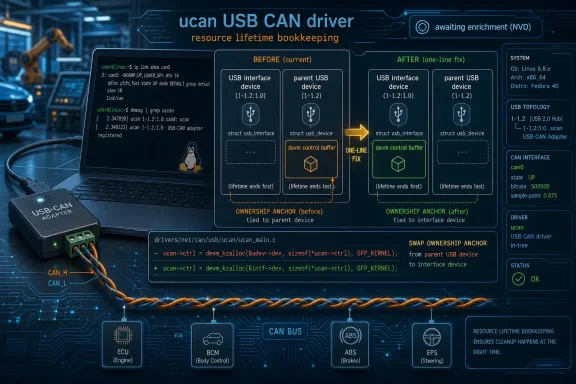
In this case, the ucan driver allocated a control transfer buffer using the parent USB device as the devres owner. The patch changes that ownership to the USB interface. That makes the buffer go away when the driver unbinds from the interface, which is the lifecycle the driver actually participates in.
This is not the kind of CVE that should send ordinary Linux users scrambling for emergency mitigations. NVD had not assigned a CVSS score at publication time, and the public description points to memory leakage rather than a demonstrated privilege escalation or remote compromise. But dismissing it as “just a leak” misses the real story: resource lifetime bugs are one of the operating system’s oldest and most stubborn failure modes.
The Security Bug Is in the Ownership Model
The phrase devres lifetime will make sense to kernel developers and sound like accounting software to everyone else. In Linux, device-managed resources are meant to simplify cleanup. Allocate memory, register a resource, bind it to a device, and the kernel can automatically release it when that device goes away.
The trick is that “the device” must be the right device. A USB device can contain multiple interfaces, and Linux USB drivers commonly bind to interfaces, not necessarily to the entire physical USB device. A composite USB gadget might expose several logical functions through one plug. Even a simpler device still has separate layers of representation inside the kernel.
The ucan bug is rooted in that distinction. The buffer was managed as though its lifetime belonged to the USB device as a whole, while the driver’s operational lifetime belonged to a particular interface. If the interface driver is unbound while the USB device remains present, the automatic cleanup does not happen at the point the driver author intended.
That is how a correctness bug becomes a security record. The vulnerability is not that a remote attacker can immediately seize a machine through a CAN adapter. The vulnerability is that a kernel driver can retain memory past the intended teardown point, especially under conditions such as probe deferral or configuration changes. In kernel space, “past the intended teardown point” is never a phrase to take lightly.
The public patch makes the diagnosis unusually clear. The allocation used &udev->dev; the fix uses &intf->dev. The buffer remains the same size, the data structure remains the same, and the driver logic is not rewritten. The ownership anchor changes, and with it the cleanup behavior.
Why Small Kernel CVEs Keep Mattering
The Linux kernel’s CVE stream has changed in recent years, and administrators have had to adjust their expectations. More fixes are being assigned CVEs after they land, including fixes that look at first glance like routine hardening or cleanup. That can make vulnerability feeds feel noisier, especially when many records arrive without a completed NVD enrichment pass or severity score.
CVE-2026-46103 is a perfect example of the new normal. It arrived in NVD as “awaiting enrichment,” with no NIST CVSS 4.0, 3.x, or 2.0 assessment at the time the record was published. The most useful information is not a score; it is the upstream kernel description and the stable-branch references.
That does not make the record useless. It means the operational question shifts from “What is the score?” to “Do I run this driver, and when will my distribution ship the relevant stable kernel fix?” For most Linux users, the answer will be simple: take the kernel update from your vendor when it arrives. For organizations using USB CAN adapters in labs, vehicles, manufacturing lines, or embedded development fleets, the answer deserves a little more attention.
The danger of CVSS-driven patch triage is that it can flatten nuance. A high-scoring remote code execution bug in a widely exposed service deserves a different response from a low-visibility driver cleanup. But an unscored kernel lifetime fix in hardware used by production engineering teams is not irrelevant merely because NVD has not finished its paperwork.
CAN Hardware Lives Where Windows Admins Still Have to Care
WindowsForum readers may reasonably ask why a Linux CAN driver CVE belongs in their threat model. The answer is that modern Windows estates rarely stop at Windows. WSL, Hyper-V guests, Linux build servers, appliance VMs, developer laptops, lab machines, container hosts, and industrial gateways all pull Linux into environments managed by Windows-oriented IT teams.
CAN hardware makes that overlap more concrete. A Windows-heavy engineering shop may still use Linux machines to test automotive modules, flash embedded controllers, collect telemetry, or drive validation rigs. Those machines might be treated as lab equipment rather than production servers, which often means they are patched less consistently than domain-joined desktops.
That is the uncomfortable part. The systems closest to physical devices are often the systems furthest from centralized endpoint hygiene. They live under desks, in racks near test fixtures, in manufacturing cells, or on carts with labels that made sense three reorganizations ago. They are important enough to keep running and obscure enough to fall out of routine maintenance.
CVE-2026-46103 does not prove that those environments are exposed to a catastrophic exploit. It does underline why “niche driver” is not the same as “irrelevant driver.” A USB CAN adapter attached to a Linux box may be a minor peripheral in software terms, but it can be part of a major workflow in industrial terms.
The Patch Is Boring Because the Failure Mode Is Old
There is a certain humility in the patch. No new subsystem is introduced. No elaborate mitigation framework appears. The fix simply attaches a devm allocation to the object whose lifetime actually matches the driver’s binding.
That kind of bug has a long history because it emerges from abstractions doing what they promised, but at the wrong layer. Device-managed resources are supposed to make cleanup less error-prone. USB’s interface model is supposed to make composite and multi-function devices manageable. Put those abstractions together carelessly, and cleanup happens on the wrong clock.
The failure mode is especially easy to miss because the common path looks fine. Plug the device in, bind the driver, use it, unplug the device, and the parent USB device disappears along with everything beneath it. The leak appears in less theatrical paths: unbind the driver without unplugging the device, encounter probe deferral, switch configurations, or otherwise disturb the interface-level binding while the parent device stays alive.
That is why these fixes often arrive from maintainers who understand the subsystem’s teardown behavior rather than from splashy vulnerability research. Kernel security is not only about finding novel exploitation primitives. It is also about maintainers noticing that a resource survives one lifecycle transition too many.
Awaiting Enrichment Should Not Mean Awaiting Thought
NVD’s “awaiting enrichment” status is easy to misread. It does not mean the CVE is fake, and it does not mean the issue is severe. It means NVD has received the record and has not yet completed its own mapping, scoring, weakness classification, and related metadata.
For administrators, this creates an awkward interval. Security scanners may flag the CVE before distributions publish advisories. Vendor portals may lag upstream stable commits. Asset teams may see a CVE ID and little else. That gap is now a routine part of Linux kernel vulnerability management.
The practical response is to resist both extremes. Panic is not justified by the public facts. Ignoring the issue because it lacks a score is equally lazy. The right move is to check whether your kernels include the ucan driver, whether your systems use USB CAN hardware, and whether your distribution has pulled in the relevant stable update.
This is also a reminder that scanner output is not a patching strategy. A vulnerability feed can tell you that a record exists. It cannot tell you whether a lab machine has a UCAN adapter connected, whether a custom kernel has the driver built in, or whether a vendor-maintained appliance will ever receive the stable patch without pressure.
The Risk Is Local, Conditional, and Still Worth Fixing
The public record does not describe a remote attack path. It does not describe arbitrary code execution. It does not describe an exploit that crosses the network and lands on a default desktop installation. Any responsible reading has to start there.
But local, conditional bugs still matter in kernel space. Driver unbinds can be triggered by administrative actions, test automation, device resets, and configuration changes. Development and lab environments are unusually likely to exercise those paths because engineers plug, unplug, reflash, reload, and reprobe hardware constantly.
Memory leaks are also not all equal. A small leak on a rarely used path may be operationally harmless. A leak in a looped test harness, unstable probe sequence, or repeatedly reconfigured USB environment can become a reliability problem. Reliability problems in kernel space are security-adjacent because denial of service, resource exhaustion, and undefined teardown states often share borders.
The available facts point to a cleanup correctness fix rather than an emergency incident. That distinction matters. The patch should be absorbed through normal kernel update channels, prioritized for systems that actually use the ucan driver, and documented in environments where USB CAN hardware is part of production or validation work.
The Stable Branch Trail Matters More Than the CVE Page
The NVD entry lists multiple kernel stable references, which is a strong signal that the fix has been propagated across supported lines rather than left only in a development tree. That matters because most users do not run mainline kernel builds. They run distribution kernels with vendor backports, enterprise kernels with long support windows, or appliance kernels maintained by someone else.
The original patch also carries a stable tag reaching back to the 4.19 era. That does not automatically mean every 4.19-derived vendor kernel is affected or fixed in the same way, but it tells administrators where to look. The bug traces to the introduction of the Theobroma Systems UCAN driver, and the fix is intended for stable maintenance rather than future-only cleanup.
For enterprise Linux teams, the hard part is translation. Upstream commit IDs are useful to kernel maintainers, but operations teams need package versions. A distro may backport the fix without changing to a headline kernel version that looks new. Conversely, a system may report a kernel version that appears old while carrying vendor-specific patches.
That is why the answer is not simply “upgrade to kernel X.” The answer is to follow your distribution’s advisory stream, verify the changelog when necessary, and treat vendor backport status as the source of truth. On custom kernels, the burden shifts back to whoever owns the build pipeline.
Windows Shops Need a Linux Peripheral Inventory
The broader lesson for Windows-centric organizations is not that they must become Linux kernel experts overnight. It is that peripheral-driven Linux risk often hides outside the neat categories used by endpoint management. USB CAN adapters, serial converters, lab acquisition devices, SDR dongles, and programming probes all depend on kernel drivers that may never appear in a conventional application inventory.
A Windows admin can know every installed MSI package in the estate and still have no idea which Linux boxes are loading which hardware drivers. That blind spot becomes more important as engineering, manufacturing, and security teams share infrastructure. The host may be a Linux workstation, the identity provider may be Microsoft Entra ID, the ticket may live in a Windows-oriented service desk, and the hardware may be a USB device bought for a single project five years ago.
CVE-2026-46103 is a useful prompt because the specific remediation is manageable. If you do not use UCAN hardware, this is probably a low-priority kernel maintenance item. If you do, you have a concrete reason to confirm update status. If you do not know whether you use it, that is the real finding.
The same pattern will repeat. Kernel CVEs will keep arriving for drivers that look obscure until someone realizes they sit under a revenue-generating test process or a safety-critical validation bench. Inventory is not glamorous, but neither is debugging a lab outage caused by an unpatched kernel on a machine nobody owns.
The Tiny UCAN Patch Leaves a Practical Checklist
The most important thing about CVE-2026-46103 is its scale. It is narrow, specific, and apparently fixed upstream with a minimal change. That makes it a good test of whether an organization can handle a kernel CVE without either overreacting or losing it in the noise.
- Systems that do not use the Linux ucan USB CAN driver are unlikely to face meaningful exposure from this specific issue.
- Systems that do use UCAN-compatible USB CAN hardware should receive a kernel update from their distribution or vendor once the fix is available.
- Administrators should not wait for a CVSS score before classifying whether the affected driver exists in their environment.
- Custom kernel users need to verify the stable patch directly, because distribution backport assumptions do not apply to self-maintained builds.
- Windows-centric IT teams should treat Linux lab and engineering machines as managed assets, not as invisible accessories to hardware projects.
The key is proportion. This is not a stop-the-world vulnerability based on the public information available. It is also not meaningless. It is a small kernel lifetime bug in a class of systems where small lifetime mistakes have a habit of turning into long-lived operational debt.
Linux security in 2026 will keep looking like this: a steady flow of narrowly scoped CVEs, many without immediate scoring, many fixed before most users understand the affected subsystem, and many relevant only to the slice of the world that depends on a particular driver. The organizations that handle that flow best will not be the ones that panic fastest; they will be the ones that know what they run, know who patches it, and can turn a one-line upstream fix into quiet, boring assurance before the next obscure driver becomes today’s ticket.
References
- CVE-2026-46103 can: ucan: fix devres lifetime NVD / Linux Kernel · 2026-05-28T01:08:28-07:00