

CVE-2026-46109 is a newly published Linux kernel vulnerability from kernel.org, added to NVD on May 28, 2026, that fixes a memory leak in the USB ULPI registration path when early error handling fails before device registration completes. The bug is not a headline-grabbing remote-code-execution flaw, and NVD has not yet assigned a CVSS score. But it is a useful case study in how kernel security now really moves: through tiny ownership fixes, stable-branch backports, and vulnerability records that often arrive before enrichment catches up. For WindowsForum readers running Linux servers, WSL-adjacent tooling, embedded boards, or mixed USB-heavy test environments, the practical lesson is simple: low-drama kernel CVEs still deserve disciplined patch tracking.
The vulnerability sits in the Linux kernel’s ULPI support code, inside the USB subsystem. ULPI, short for UTMI+ Low Pin Interface, is not something most desktop users think about, but it matters in hardware designs where USB controller logic talks to an external physical-layer transceiver. That makes this less about someone plugging a sinister thumb drive into a laptop and more about how kernel drivers handle device discovery, registration, and cleanup.
The flaw is a memory leak on specific error paths in
That is mundane by exploit-marketing standards, but kernel development is built out of mundane details. A single missing
This particular CVE also has a small irony baked into it. The leak was introduced by a previous fix for a double-free bug in the same neighborhood of code. That earlier change removed a
The right answer in that earlier case was to let the release callback do its job. Once
But by removing that manual free, the code lost cleanup coverage for failures that occur before device registration. The same pointer had two different ownership regimes depending on how far the function got. Fail early, and the caller still needs to free it. Fail later, and the device model must free it. The new CVE exists in that gap.
This is the kind of bug that static analysis tools, careful review, and kernel sanitizers are supposed to catch, but it is also the kind of bug that slips through because the code is locally reasonable at each step. Nobody set out to leak memory. The leak emerged because an earlier patch correctly narrowed one cleanup path without fully restoring the symmetry of the others.
That is why kernel CVEs often read like commit messages rather than dramatic advisories. The vulnerability record says what changed because, in many cases, the patch is the most honest description of the bug. There is no need for theatrical language when the problem is a mismatched object lifetime.
For vulnerability management teams, that creates an awkward middle state. The CVE exists, the kernel fix exists, and stable commit references exist, but the database field that many dashboards use for prioritization is blank. If your scanner workflow treats “no CVSS score” as “no urgency,” it is already making a policy decision without admitting it.
This has become more visible as Linux kernel CVEs arrive in greater numbers and with more granular scope. A fix for a memory leak, reference leak, double free, use-after-free, race condition, or bounds issue may become a CVE even if exploitability is narrow or unclear. That is not necessarily inflation; it is a sign that the kernel security pipeline is mapping code hygiene into public vulnerability tracking more aggressively than it did a decade ago.
The problem is that enterprise tooling often wants a single severity number, while kernel reality often starts with a patch and a careful reading of affected code paths. CVE-2026-46109 is a good example. Without an NVD vector, administrators need to ask sharper questions: which kernels include the buggy code, whether the affected subsystem is built or loaded, whether the device path is reachable, and whether repeated failure can create meaningful resource exhaustion.
That is slower than sorting by CVSS. It is also closer to how real risk works.
That temptation is understandable, but it is not safe as a blanket rule. In kernel space, unreclaimed memory can become a denial-of-service condition if an attacker or misbehaving device can trigger the leak many times. The key question is not whether one allocation is leaked, but whether the leak is reachable, repeatable, and large enough over time to matter.
For CVE-2026-46109, the public description points to early ULPI registration failures. That likely limits the practical exposure compared with bugs reachable through common network traffic or ordinary filesystem operations. Many systems will not use ULPI hardware at all, and many desktop or cloud workloads will never exercise this path.
But “limited” is not the same as “irrelevant.” Embedded Linux devices, development boards, appliances, industrial hardware, and custom USB controller designs are exactly the places where uncommon kernel subsystems become operationally important. Those systems are also often slower to receive kernel updates, which gives small bugs a long afterlife.
A leak in a rarely used driver path may not trouble a typical Windows user experimenting with Linux in a VM. It may matter quite a bit to the vendor maintaining a fleet of ARM-based devices with external USB PHYs and a long-term-support kernel. Severity is not just a property of the code; it is a property of the code in a deployment.
The ULPI layer is lower-level than the USB mass-storage and HID paths that most users recognize. It deals with the relationship between USB controller logic and external transceivers, not with the file contents of a thumb drive. Still, it belongs to the same uncomfortable class of kernel code: hardware-facing routines that must keep ownership, references, and cleanup exact even when initialization fails halfway through.
This is where the phrase error path should make administrators pay attention. Security bugs do not only live in the mainline success case. They often live where hardware returns an unexpected value, a firmware description is missing, a device tree node does not match assumptions, or initialization aborts after some resources have been acquired but before others have been registered.
Those are hard paths to test exhaustively. They depend on timing, hardware configuration, firmware data, and uncommon failure modes. The code may run perfectly for years on the developer’s machine and still mishandle a corner case on a particular board.
CVE-2026-46109 is small, but it sits squarely in that pattern. The bug is not in the obvious happy path. It is in the cleanup choreography when registration fails early.
This is not necessarily a bad thing. The Linux kernel is too widely deployed, too privileged, and too deeply embedded in infrastructure for memory-management bugs to remain invisible simply because they look small. A public CVE gives downstream distributions a common handle for tracking the fix, backporting it, and telling customers whether they are affected.
But it does change the workload for defenders. Security teams can no longer assume every CVE maps neatly to an urgent exploit scenario. Many kernel CVEs now require triage that looks more like engineering review: read the affected file, identify the subsystem, check configuration, inspect whether your distribution backported the fix, and decide whether the risk is practical in your environment.
That creates friction with patch-management systems built around severity scores. If a CVE has no NVD score yet, the dashboard may understate it. If a third-party database later assigns a conservative score, it may overstate it for systems that do not expose the subsystem. If a scanner only keys off upstream kernel versions, it may miss distribution backports or report false positives.
The fix for that problem is not to ignore low-level kernel CVEs. The fix is to build a process that can handle them without panic. CVE-2026-46109 is exactly the sort of record that separates mature vulnerability management from spreadsheet-driven compliance theater.
Windows administrators routinely manage Linux appliances, Linux-based network devices, NAS platforms, hypervisors, containers, CI runners, Android-derived devices, and embedded boards. Developers run Linux inside WSL, VMs, cloud build agents, and test rigs. Security teams track Linux kernel advisories because the same organization that standardizes on Windows clients may still depend on Linux at the edge, in the datacenter, or inside vendor appliances.
The important distinction is scope. This CVE should not be treated as a Windows endpoint vulnerability. It should not cause panic among users whose only Linux exposure is a WSL distribution on a laptop. WSL 2 uses a Microsoft-supplied Linux kernel, but the practical relevance of a physical USB ULPI registration path depends on what is built, exposed, and reachable in that kernel environment.
For mixed estates, the better response is inventory rather than alarm. Identify Linux systems with USB controller hardware, embedded boards, custom kernels, or vendor-maintained images. Check whether the kernel branch has received the relevant stable fix. If the affected code is present but the subsystem is not used, document that fact instead of pretending the CVE does not exist.
That discipline pays off beyond this one issue. The same inventory needed to evaluate CVE-2026-46109 is the inventory needed to evaluate the next USB, PCI, network driver, filesystem, or BPF kernel CVE. Small bugs become useful drills.
That is where many administrators get tripped up. A system may report an older-looking kernel version while still carrying the fix because the distribution backported it. Conversely, a custom or vendor kernel may carry a version number that looks modern but lack a specific stable patch. Version strings are clues, not proof.
For mainstream distributions, the right path is usually boring: wait for the vendor kernel update, read the advisory, install the package, and reboot when required. For custom kernels, appliances, and embedded products, the work is more direct. Someone has to verify whether the relevant patch is present in
This is especially true for long-lived embedded systems. A board support package can freeze a kernel for years while selectively backporting fixes. That model is common, practical, and sometimes necessary, but it also means CVE handling becomes a supply-chain question. You are not just asking whether Linux fixed the bug. You are asking whether the maintainer of your particular kernel line picked up the exact lifetime-management fix.
The comforting part is that this vulnerability appears to have a clear corrective shape. The patch adds cleanup on early error paths where the allocation remains the caller’s responsibility. There is no sprawling mitigation strategy, no configuration maze, and no userland workaround pretending to be a fix. The answer is to run a kernel that contains the corrected cleanup logic.
The useful triage starts with reachability. Can an unprivileged local user trigger ULPI registration failures? Can a malicious peripheral influence the relevant path? Is the code used only during boot or probe? Is the affected driver built into the kernel, built as a module, or absent? Does the platform even have ULPI hardware?
The public description does not establish a broad attack path. It describes a memory leak caused by missing frees when two early registration functions fail. That makes it more likely to be a reliability and denial-of-service concern in specific environments than a universal emergency.
Still, defenders should avoid the opposite mistake: assuming that obscure equals impossible. Hardware-facing bugs have a way of becoming relevant in labs, factories, kiosks, vehicle systems, medical devices, and other places where the operating system is invisible until it fails. An IT department may not think it owns Linux USB PHY code, but a vendor appliance in the rack may depend on it.
The right sentence for this CVE is not “drop everything.” It is “patch through normal kernel channels, and pay special attention if you ship or manage devices that use ULPI-based USB hardware.” That is less dramatic, but it is more useful.
For a high-profile actively exploited bug, that gap may be filled quickly by vendor advisories, emergency directives, and public exploit analysis. For a kernel memory leak in a subsystem few people recognize, the gap may last long enough that many organizations never revisit the record after the initial scanner import.
That is a process failure waiting to happen. A CVE without a CVSS score is not a non-vulnerability. It is a vulnerability with missing convenience metadata. Mature teams should have a holding pattern for these cases: assign an internal provisional severity, track the upstream fix, monitor distribution advisories, and revise the record when NVD or vendors add more detail.
The Linux kernel’s own CVE assignment practices make this even more important. Kernel.org is often the first authoritative source for the description and fix references. NVD enrichment may lag behind the practical fix. If your process requires NVD to tell you whether a kernel patch matters, you may be waiting on the wrong clock.
CVE-2026-46109 is a low-stress example of that problem. There is no public score yet, but there is enough information to act rationally. The fix exists. The subsystem is identifiable. The affected behavior is described. That is enough to begin triage.
This is why fixes for double frees and memory leaks can chase each other. Remove a free in one branch, and another branch leaks. Add a free too broadly, and a later callback frees the same object again. The compiler will not necessarily save you because the problem is semantic: who owns the object at this exact point in this exact path?
The kernel has patterns for this, but patterns still rely on human discipline. Functions need clear labels for cleanup paths. Callers need to know when ownership transfers. Reviewers need to reason about every
That is why a memory leak CVE can be more educational than a spectacular exploit chain. It shows the day-to-day work of keeping a privileged, hardware-facing operating system from accumulating undefined behavior in its corners. Security is not only the patch that blocks the worm. It is also the patch that makes an initialization failure boring again.
There is no useful userland mitigation for a kernel memory leak in this kind of low-level registration path. Blacklisting a module may be possible in some environments, but only if the subsystem is unused and modular. On systems that actually require ULPI support, the mitigation is the fix.
Security teams should also resist the urge to overfit their response to the absence of a CVSS score. NVD enrichment will eventually make the record easier for dashboards to display, but it will not change the underlying code. Your exposure depends on kernel lineage, configuration, hardware, and update status.
That makes this a good candidate for quiet, documented remediation. Patch it, record why it matters or does not matter in your environment, and move on. The industry has enough manufactured emergencies; it does not need to turn every kernel cleanup bug into a fire drill.
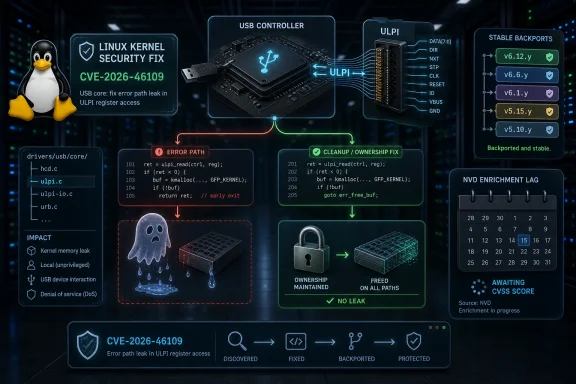 A Small USB Fix Exposes a Large Kernel Truth
The vulnerability sits in the Linux kernel’s ULPI support code, inside the USB subsystem. ULPI, short for UTMI+ Low Pin Interface, is not something most desktop users think about, but it matters in hardware designs where USB controller logic talks to an external physical-layer transceiver. That makes this less about someone plugging a sinister thumb drive into a laptop and more about how kernel drivers handle device discovery, registration, and cleanup.The flaw is a memory leak on specific error paths in
ulpi_register(). The kernel allocates a ULPI structure, then proceeds through steps that can fail before the device has been fully registered. If either ulpi_of_register() or ulpi_read_id() fails before device_register() is reached, the allocation can be left behind instead of freed.That is mundane by exploit-marketing standards, but kernel development is built out of mundane details. A single missing
kfree() is not glamorous, yet the difference between robust kernel code and fragile kernel code is often whether every failure path mirrors the success path’s ownership rules. In kernel space, cleanup is not clerical work; it is part of the security boundary.This particular CVE also has a small irony baked into it. The leak was introduced by a previous fix for a double-free bug in the same neighborhood of code. That earlier change removed a
kfree(ulpi) call to avoid freeing the same object twice when device_register() failed. The new fix restores freeing only on the earlier paths where the object has not yet been handed to the device model.The Previous Fix Solved One Lifetime Problem and Revealed Another
The kernel patch history matters here because it shows why these bugs are so easy to create and so hard to eliminate. The earlier commit, identified in the CVE description as01af542392b5, fixed a double-free condition in ulpi_register_interface(). In plain English, one error path had already transferred cleanup responsibility to the device release mechanism, but the function still tried to free the same allocation afterward.The right answer in that earlier case was to let the release callback do its job. Once
device_register() has entered the picture, the kernel device model owns part of the object lifecycle. Calling kfree() manually at the wrong point can turn a cleanup path into memory corruption.But by removing that manual free, the code lost cleanup coverage for failures that occur before device registration. The same pointer had two different ownership regimes depending on how far the function got. Fail early, and the caller still needs to free it. Fail later, and the device model must free it. The new CVE exists in that gap.
This is the kind of bug that static analysis tools, careful review, and kernel sanitizers are supposed to catch, but it is also the kind of bug that slips through because the code is locally reasonable at each step. Nobody set out to leak memory. The leak emerged because an earlier patch correctly narrowed one cleanup path without fully restoring the symmetry of the others.
That is why kernel CVEs often read like commit messages rather than dramatic advisories. The vulnerability record says what changed because, in many cases, the patch is the most honest description of the bug. There is no need for theatrical language when the problem is a mismatched object lifetime.
NVD Has the Record, but Not Yet the Verdict
As of the NVD publication on May 28, 2026, CVE-2026-46109 is marked as awaiting enrichment. That means NVD has received the record and basic description from kernel.org, but has not yet supplied its own CVSS vector, severity score, or weakness classification. The page shows no NVD CVSS 4.0, 3.x, or 2.0 score.For vulnerability management teams, that creates an awkward middle state. The CVE exists, the kernel fix exists, and stable commit references exist, but the database field that many dashboards use for prioritization is blank. If your scanner workflow treats “no CVSS score” as “no urgency,” it is already making a policy decision without admitting it.
This has become more visible as Linux kernel CVEs arrive in greater numbers and with more granular scope. A fix for a memory leak, reference leak, double free, use-after-free, race condition, or bounds issue may become a CVE even if exploitability is narrow or unclear. That is not necessarily inflation; it is a sign that the kernel security pipeline is mapping code hygiene into public vulnerability tracking more aggressively than it did a decade ago.
The problem is that enterprise tooling often wants a single severity number, while kernel reality often starts with a patch and a careful reading of affected code paths. CVE-2026-46109 is a good example. Without an NVD vector, administrators need to ask sharper questions: which kernels include the buggy code, whether the affected subsystem is built or loaded, whether the device path is reachable, and whether repeated failure can create meaningful resource exhaustion.
That is slower than sorting by CVSS. It is also closer to how real risk works.
Memory Leaks Are Not Automatically Boring
There is a temptation to dismiss memory leaks as the least interesting class of kernel vulnerability. Compared with a use-after-free or a write-what-where primitive, a leaked allocation sounds almost polite. The machine does not immediately crash; the attacker does not instantly gain code execution; the bug may only matter if the error path can be triggered repeatedly.That temptation is understandable, but it is not safe as a blanket rule. In kernel space, unreclaimed memory can become a denial-of-service condition if an attacker or misbehaving device can trigger the leak many times. The key question is not whether one allocation is leaked, but whether the leak is reachable, repeatable, and large enough over time to matter.
For CVE-2026-46109, the public description points to early ULPI registration failures. That likely limits the practical exposure compared with bugs reachable through common network traffic or ordinary filesystem operations. Many systems will not use ULPI hardware at all, and many desktop or cloud workloads will never exercise this path.
But “limited” is not the same as “irrelevant.” Embedded Linux devices, development boards, appliances, industrial hardware, and custom USB controller designs are exactly the places where uncommon kernel subsystems become operationally important. Those systems are also often slower to receive kernel updates, which gives small bugs a long afterlife.
A leak in a rarely used driver path may not trouble a typical Windows user experimenting with Linux in a VM. It may matter quite a bit to the vendor maintaining a fleet of ARM-based devices with external USB PHYs and a long-term-support kernel. Severity is not just a property of the code; it is a property of the code in a deployment.
The USB Subsystem Keeps Reminding Us That Hardware Is an Attack Surface
USB is often treated as a convenience layer, but it is really a sprawling hardware and software negotiation stack. Every device insertion, bus reset, descriptor read, PHY interaction, and registration step forces the kernel to parse state from an environment that may be buggy, hostile, or simply weird. That makes error paths unusually important.The ULPI layer is lower-level than the USB mass-storage and HID paths that most users recognize. It deals with the relationship between USB controller logic and external transceivers, not with the file contents of a thumb drive. Still, it belongs to the same uncomfortable class of kernel code: hardware-facing routines that must keep ownership, references, and cleanup exact even when initialization fails halfway through.
This is where the phrase error path should make administrators pay attention. Security bugs do not only live in the mainline success case. They often live where hardware returns an unexpected value, a firmware description is missing, a device tree node does not match assumptions, or initialization aborts after some resources have been acquired but before others have been registered.
Those are hard paths to test exhaustively. They depend on timing, hardware configuration, firmware data, and uncommon failure modes. The code may run perfectly for years on the developer’s machine and still mishandle a corner case on a particular board.
CVE-2026-46109 is small, but it sits squarely in that pattern. The bug is not in the obvious happy path. It is in the cleanup choreography when registration fails early.
The Kernel’s CVE Pipeline Now Turns Maintenance Into Security News
One reason this kind of vulnerability feels odd to some readers is that it blurs the boundary between ordinary maintenance and security response. The fix is a couple of cleanup calls. The description is copied from the kernel commit language. The public CVE arrives with no enriched score. Yet it is now part of the vulnerability record that scanners, vendors, and compliance programs consume.This is not necessarily a bad thing. The Linux kernel is too widely deployed, too privileged, and too deeply embedded in infrastructure for memory-management bugs to remain invisible simply because they look small. A public CVE gives downstream distributions a common handle for tracking the fix, backporting it, and telling customers whether they are affected.
But it does change the workload for defenders. Security teams can no longer assume every CVE maps neatly to an urgent exploit scenario. Many kernel CVEs now require triage that looks more like engineering review: read the affected file, identify the subsystem, check configuration, inspect whether your distribution backported the fix, and decide whether the risk is practical in your environment.
That creates friction with patch-management systems built around severity scores. If a CVE has no NVD score yet, the dashboard may understate it. If a third-party database later assigns a conservative score, it may overstate it for systems that do not expose the subsystem. If a scanner only keys off upstream kernel versions, it may miss distribution backports or report false positives.
The fix for that problem is not to ignore low-level kernel CVEs. The fix is to build a process that can handle them without panic. CVE-2026-46109 is exactly the sort of record that separates mature vulnerability management from spreadsheet-driven compliance theater.
Windows Shops Still Have Reasons to Care
At first glance, a Linux USB ULPI memory leak may seem outside the WindowsForum lane. Most Windows desktops do not run the Linux kernel, and ULPI hardware is not part of the everyday PC troubleshooting vocabulary. But modern IT estates rarely divide cleanly along operating-system lines anymore.Windows administrators routinely manage Linux appliances, Linux-based network devices, NAS platforms, hypervisors, containers, CI runners, Android-derived devices, and embedded boards. Developers run Linux inside WSL, VMs, cloud build agents, and test rigs. Security teams track Linux kernel advisories because the same organization that standardizes on Windows clients may still depend on Linux at the edge, in the datacenter, or inside vendor appliances.
The important distinction is scope. This CVE should not be treated as a Windows endpoint vulnerability. It should not cause panic among users whose only Linux exposure is a WSL distribution on a laptop. WSL 2 uses a Microsoft-supplied Linux kernel, but the practical relevance of a physical USB ULPI registration path depends on what is built, exposed, and reachable in that kernel environment.
For mixed estates, the better response is inventory rather than alarm. Identify Linux systems with USB controller hardware, embedded boards, custom kernels, or vendor-maintained images. Check whether the kernel branch has received the relevant stable fix. If the affected code is present but the subsystem is not used, document that fact instead of pretending the CVE does not exist.
That discipline pays off beyond this one issue. The same inventory needed to evaluate CVE-2026-46109 is the inventory needed to evaluate the next USB, PCI, network driver, filesystem, or BPF kernel CVE. Small bugs become useful drills.
Stable Backports Are the Real Patch Notes
The CVE record lists multiple stable kernel commit references, which is the most important practical signal in the advisory. Linux kernel fixes do not matter only when they land in the mainline tree. They matter when they are backported into the stable series that distributions and vendors actually ship.That is where many administrators get tripped up. A system may report an older-looking kernel version while still carrying the fix because the distribution backported it. Conversely, a custom or vendor kernel may carry a version number that looks modern but lack a specific stable patch. Version strings are clues, not proof.
For mainstream distributions, the right path is usually boring: wait for the vendor kernel update, read the advisory, install the package, and reboot when required. For custom kernels, appliances, and embedded products, the work is more direct. Someone has to verify whether the relevant patch is present in
drivers/usb/common/ulpi.c or whether the vendor has merged an equivalent change.This is especially true for long-lived embedded systems. A board support package can freeze a kernel for years while selectively backporting fixes. That model is common, practical, and sometimes necessary, but it also means CVE handling becomes a supply-chain question. You are not just asking whether Linux fixed the bug. You are asking whether the maintainer of your particular kernel line picked up the exact lifetime-management fix.
The comforting part is that this vulnerability appears to have a clear corrective shape. The patch adds cleanup on early error paths where the allocation remains the caller’s responsibility. There is no sprawling mitigation strategy, no configuration maze, and no userland workaround pretending to be a fix. The answer is to run a kernel that contains the corrected cleanup logic.
The Risk Lives in Reachability, Not in the CVE Name
CVE names create the illusion that every vulnerability is comparable. They are not. CVE-2026-46109 and a remotely exploitable kernel network bug may both be kernel CVEs, but they do not present the same operational risk.The useful triage starts with reachability. Can an unprivileged local user trigger ULPI registration failures? Can a malicious peripheral influence the relevant path? Is the code used only during boot or probe? Is the affected driver built into the kernel, built as a module, or absent? Does the platform even have ULPI hardware?
The public description does not establish a broad attack path. It describes a memory leak caused by missing frees when two early registration functions fail. That makes it more likely to be a reliability and denial-of-service concern in specific environments than a universal emergency.
Still, defenders should avoid the opposite mistake: assuming that obscure equals impossible. Hardware-facing bugs have a way of becoming relevant in labs, factories, kiosks, vehicle systems, medical devices, and other places where the operating system is invisible until it fails. An IT department may not think it owns Linux USB PHY code, but a vendor appliance in the rack may depend on it.
The right sentence for this CVE is not “drop everything.” It is “patch through normal kernel channels, and pay special attention if you ship or manage devices that use ULPI-based USB hardware.” That is less dramatic, but it is more useful.
NVD Enrichment Lag Is Now Part of the Story
The “awaiting enrichment” status on the NVD page is not a footnote. It is increasingly part of the operational reality of vulnerability management. CVE publication and NVD analysis are related but separate steps, and the gap between them can leave defenders with incomplete metadata during the window when they are expected to make decisions.For a high-profile actively exploited bug, that gap may be filled quickly by vendor advisories, emergency directives, and public exploit analysis. For a kernel memory leak in a subsystem few people recognize, the gap may last long enough that many organizations never revisit the record after the initial scanner import.
That is a process failure waiting to happen. A CVE without a CVSS score is not a non-vulnerability. It is a vulnerability with missing convenience metadata. Mature teams should have a holding pattern for these cases: assign an internal provisional severity, track the upstream fix, monitor distribution advisories, and revise the record when NVD or vendors add more detail.
The Linux kernel’s own CVE assignment practices make this even more important. Kernel.org is often the first authoritative source for the description and fix references. NVD enrichment may lag behind the practical fix. If your process requires NVD to tell you whether a kernel patch matters, you may be waiting on the wrong clock.
CVE-2026-46109 is a low-stress example of that problem. There is no public score yet, but there is enough information to act rationally. The fix exists. The subsystem is identifiable. The affected behavior is described. That is enough to begin triage.
The Patch Is Tiny Because the Ownership Model Is Not
The actual code-level idea behind the fix is straightforward: if allocation succeeds but registration fails before the device model takes responsibility, free the allocation before returning. That sounds like programming 101, but kernel object lifetimes are rarely that simple. The same object can pass through multiple layers of ownership, reference counting, callbacks, and release functions.This is why fixes for double frees and memory leaks can chase each other. Remove a free in one branch, and another branch leaks. Add a free too broadly, and a later callback frees the same object again. The compiler will not necessarily save you because the problem is semantic: who owns the object at this exact point in this exact path?
The kernel has patterns for this, but patterns still rely on human discipline. Functions need clear labels for cleanup paths. Callers need to know when ownership transfers. Reviewers need to reason about every
goto err_... label, not just the success case. Automated tools help, but they do not eliminate the need for careful thought.That is why a memory leak CVE can be more educational than a spectacular exploit chain. It shows the day-to-day work of keeping a privileged, hardware-facing operating system from accumulating undefined behavior in its corners. Security is not only the patch that blocks the worm. It is also the patch that makes an initialization failure boring again.
The Sensible Response Is Patch Discipline, Not Panic
For most organizations, CVE-2026-46109 should enter the normal Linux kernel patch cycle. If you rely on vendor kernels, take the vendor update when it arrives. If you maintain custom kernels, verify that the stable fix or an equivalent patch has been applied. If you operate embedded devices, ask the vendor whether their kernel tree includes the corrected ULPI cleanup logic.There is no useful userland mitigation for a kernel memory leak in this kind of low-level registration path. Blacklisting a module may be possible in some environments, but only if the subsystem is unused and modular. On systems that actually require ULPI support, the mitigation is the fix.
Security teams should also resist the urge to overfit their response to the absence of a CVSS score. NVD enrichment will eventually make the record easier for dashboards to display, but it will not change the underlying code. Your exposure depends on kernel lineage, configuration, hardware, and update status.
That makes this a good candidate for quiet, documented remediation. Patch it, record why it matters or does not matter in your environment, and move on. The industry has enough manufactured emergencies; it does not need to turn every kernel cleanup bug into a fire drill.
The Clues This CVE Leaves for Admins Who Read Past the Score
CVE-2026-46109 is not the kind of vulnerability that rewards skimming. Its importance is in the details: the subsystem, the error path, the previous double-free fix, and the lack of NVD enrichment at publication time. Read correctly, it gives administrators a compact checklist for handling the next low-level kernel CVE with less confusion.- The vulnerability affects Linux kernel USB ULPI registration cleanup, not Windows endpoints or ordinary USB file handling.
- The bug is a memory leak on early error paths before
device_register()takes over object lifetime management. - The issue follows a prior double-free fix, illustrating how kernel ownership bugs can shift from one failure branch to another.
- NVD had not assigned a CVSS score when the record was published on May 28, 2026, so teams should not wait for a number before beginning triage.
- The practical priority is highest for custom kernels, embedded Linux devices, USB-controller development platforms, and vendor appliances that may use ULPI hardware.
- The durable fix is to run a kernel branch or vendor build that includes the stable patch or an equivalent cleanup change.
References
- Primary source: NVD / Linux Kernel
Published: 2026-05-29T01:03:39-07:00
NVD - CVE-2026-46109
 nvd.nist.gov
- Security advisory: MSRC
Published: 2026-05-29T01:03:39-07:00
Original feed URL
Security Update Guide - Microsoft Security Response Center
 msrc.microsoft.com
- Related coverage: spinics.net

Re: [PATCH] usb: ulpi: fix memory leak on ulpi_register() error paths — Linux Kernel
Linux Kernel: Re: [PATCH] usb: ulpi: fix memory leak on ulpi_register() error paths
www.spinics.net
- Related coverage: security.snyk.io
CVE-2026-31759 in kernel-debug | CVE-2026-31759 | Snyk
Medium severity (5.5) CVE-2026-31759 in kernel-debug | CVE-2026-31759security.snyk.io - Related coverage: labs.cloudsecurityalliance.org
NVD Enrichment Triage: Enterprise Vulnerability Programs Must Adapt
PDF documentlabs.cloudsecurityalliance.org
