

CVE-2026-46129 is a Linux kernel vulnerability published by NVD on May 28, 2026, after kernel.org reported a Btrfs double-free bug in the create_space_info() error path, where failed sysfs kobject setup can trigger cleanup of the same allocation twice. The flaw is narrow, technical, and currently lacks an NVD severity score, but it is the kind of kernel memory-management mistake that deserves attention before a scanner turns it into dashboard noise. For WindowsForum readers, the story is not that Windows itself is suddenly at risk; it is that modern Windows environments increasingly sit beside Linux filesystems, Linux VMs, WSL deployments, NAS appliances, and container hosts where a “Linux-only” CVE may still land on an administrator’s desk.
The most important thing about CVE-2026-46129 is also the easiest thing to miss: this is not a glamorous remote-code-execution bulletin, not a wormable protocol flaw, and not a headline-grabbing cloud breakout. It is a double free in a specific Btrfs error path, triggered when
That phrasing sounds like it belongs in a maintainer’s inbox rather than a security queue. But the Linux kernel is an ecosystem where mundane lifecycle mistakes can become security-relevant because the kernel owns memory, privilege boundaries, device access, filesystem state, and the assumptions every process above it depends on.
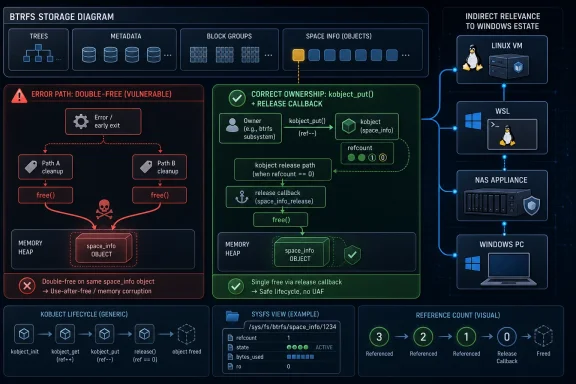
The CVE description lays out the sequence clearly.
That is the entire bug in miniature: one ownership model hands memory back, while the older-looking caller still thinks it owns the pointer. Kernel bugs often begin not with exotic attacker creativity, but with two cleanup paths both believing they are the responsible adult in the room.
CVE-2026-46129 is specifically about the Linux kernel’s Btrfs filesystem code, not a userspace Btrfs tool and not Microsoft’s NTFS stack. Btrfs tracks filesystem allocation through space info structures, and it exposes parts of its internal state through sysfs, Linux’s virtual filesystem interface for kernel objects and device attributes.
That sysfs detail matters. The bug sits at the boundary between Btrfs’s own lifecycle and the kernel’s kobject lifecycle. Kobjects are reference-counted kernel objects used heavily in sysfs; once code hands an object into that model, cleanup is no longer just a matter of sprinkling
The fix described in the CVE is conceptually modest: keep the direct free for the earlier failure path, but once
This is why the CVE is useful even before NVD enriches it with a CVSS vector. It tells administrators that the fixed kernels are correcting a real memory-lifecycle bug, while also telling exploit writers very little about practical reachability, reliability, or privilege impact.
Both instincts are bad operational hygiene. A missing score is a metadata gap, not a risk determination. NVD has the record, the description, the affected component, the publication and modification dates, and references to stable kernel commits; what it does not yet have is the standardized vector string that many vulnerability-management systems use to rank the issue.
For enterprises, that means CVE-2026-46129 should be triaged by exposure and asset role rather than by a number that has not been assigned. A lab VM using ext4 and running no Btrfs module is not the same concern as a storage host, backup appliance, Linux workstation, or container node where Btrfs is actually mounted or available.
The absence of a CVSS score also matters because double-free bugs can range from mostly theoretical crash risks to high-impact local privilege escalation issues. The CVE text alone does not establish weaponization, public exploitation, or a reliable privilege-escalation primitive. It establishes a memory safety defect in kernel code and a set of stable fixes.
That distinction is where mature patching lives. You do not need to panic to patch quickly, and you do not need a published exploit to treat kernel memory corruption as worth scheduling.
They also make Btrfs a place where correctness is not optional. Filesystems are among the least forgiving parts of an operating system because bugs can affect availability, integrity, and recovery paths simultaneously. A crash in a browser tab is an annoyance; a kernel bug in filesystem initialization can become an outage, a data-access problem, or a difficult-to-reproduce boot and mount failure.
CVE-2026-46129 does not say that ordinary file reads or writes corrupt data. It says a specific error path during creation of space information can free the same structure twice. That is a narrower claim, and responsible analysis should not inflate it.
But administrators should also resist the opposite minimization. Error paths matter in kernel code because they are often under-tested, because they are reached during resource pressure or partial initialization, and because filesystem mount and setup operations frequently happen with elevated privilege and broad system consequences.
The bug’s location also makes it a reminder of how much filesystem state is now observable and configurable through kernel object interfaces. The sysfs layer is not a decorative status panel. It is part of the kernel’s object model, and when a subsystem exposes itself through that model, it has to follow the model’s lifetime rules.
Yet Windows administrators increasingly operate mixed estates where that boundary is less comforting than it once was. Windows shops run Linux VMs on Hyper-V, Linux workloads in Azure and other clouds, container platforms with Linux nodes, WSL2 instances, and NAS devices that may use Linux filesystems under vendor interfaces.
WSL2 deserves a careful sentence. The default WSL2 experience is not a Btrfs-on-bare-metal deployment, and many users will never touch Btrfs inside WSL at all. But WSL2 is a Linux kernel environment, custom kernels exist, and serious developer workstations often grow beyond the default path, especially when engineers experiment with filesystems, loop devices, disk images, and storage tooling.
For most WindowsForum readers, the practical exposure is more likely to be adjacent infrastructure than the Windows PC itself. The Linux backup server under the desk, the Proxmox or home-lab host, the Synology-like appliance, the cloud VM with Btrfs volumes, or the CI runner using Linux images is where this CVE belongs in the asset inventory.
That is the larger lesson: Windows security operations can no longer draw the perimeter around
CVE-2026-46129 fits that pattern. The record is clear enough for kernel people: it names the subsystem, shows the failing call chain, explains the double free, and lists stable references. It is less friendly to a Windows admin staring at a scanner report that says “Linux kernel” and offers no NVD score.
This is where CVE handling becomes editorial as much as technical. A scanner can tell you that an identifier exists. It cannot tell you whether the vulnerable code is reachable in your environment, whether the relevant filesystem is mounted, whether a vendor has backported the fix without changing the upstream version number, or whether the affected kernel is hidden inside an appliance.
A kernel CVE should therefore start a conversation, not end one. What kernel line are we actually running? Is Btrfs built in or loaded as a module? Are any Btrfs filesystems mounted? Is this system internet-facing, multi-user, or used by untrusted workloads? Does the distribution vendor already ship a patched package?
Those questions sound basic because they are. The problem is that vulnerability operations often skip them in favor of score-driven queue sorting. CVE-2026-46129 is a useful corrective because its missing score forces the human part of the process back into view.
Linux distribution kernels routinely carry patches that make naïve version checks misleading. A server might report an older base kernel while containing a vendor backport for the specific CVE. Conversely, a self-built or appliance kernel might lag behind even if the product’s web UI looks current.
That distinction is especially important for Windows-heavy environments where Linux systems are not always managed with the same discipline as domain-joined clients. The Windows endpoint fleet may be covered by Intune, WSUS, Configuration Manager, Defender, or third-party patch tooling, while the handful of Linux boxes are maintained by whoever remembers they exist.
For CVE-2026-46129, the cleanest operational answer is not to chase commit hashes by hand unless you maintain kernels yourself. It is to update through your distribution or appliance vendor, then verify that the vendor’s advisory or changelog addresses the CVE or includes the relevant Btrfs stable fix.
If you do maintain custom kernels, this is exactly the kind of patch you do not want to “get to later” because it looks small. Memory-lifecycle fixes in filesystems are rarely controversial from a functionality standpoint, and delaying them tends to buy very little except future ambiguity.
A double free is a class of bug that security researchers take seriously because it can sometimes be shaped into privilege escalation or denial of service. But exploitability depends on allocator behavior, object size, timing, reachable triggers, kernel configuration, hardening features, and whether an unprivileged local user can force the failing path with useful control.
The described trigger begins with
This is also why the “local versus remote” distinction is likely to matter. Nothing in the description suggests a network-facing remote exploit. The relevant code path appears tied to Btrfs initialization and sysfs registration, making local system access, filesystem control, or mount-related privileges the more plausible area of concern.
For shared Linux hosts, developer jump boxes, CI runners, university systems, and container platforms, “local” is not a comforting word. Local users and workloads are exactly what those systems have. But for a single-purpose appliance with no shell access and a vendor-managed kernel, the risk calculus looks different.
In this case,
The CVE’s proposed cleanup division is therefore precise. If the failure occurs before sysfs/kobject ownership comes into play, direct
This is mundane engineering, but mundane engineering is what keeps kernels alive. Modern operating systems are layers of ownership transfer: device model objects, reference-counted files, dentries, inodes, sockets, buffers, bios, work queues, and filesystem-specific structures. A single ambiguous cleanup path can turn defensive error handling into memory corruption.
It is tempting to see this as a Btrfs-specific embarrassment. It is fairer to see it as a reminder that the Linux kernel’s internal APIs are powerful but unforgiving. The bug is in Btrfs, but the design lesson belongs to every subsystem that crosses from local allocation into generic kernel object management.
A filesystem-related kernel crash can be more than downtime. It can interrupt backups, stall replication, prevent a host from mounting volumes cleanly, or leave administrators wondering whether the problem is hardware, firmware, memory, kernel code, or the filesystem’s on-disk state. Even when data integrity is not directly implicated, the operational drag can be considerable.
CVE-2026-46129’s description does not claim data loss, and there is no basis to present it as a corruption bug. But because the flaw sits in Btrfs space-info creation, it naturally belongs to the mount and initialization world, where failures are often discovered during boot, attach, recovery, or maintenance windows.
That makes patch timing important. A bug reachable during unusual failure conditions may stay invisible for months and then appear precisely when the system is under resource pressure or being recovered. Administrators know this pattern well: the path nobody tests is the one the production outage takes.
For storage hosts, the conservative path is straightforward. Patch through the supported vendor channel, ensure Btrfs volumes mount normally after reboot, and treat kernel updates as change-controlled infrastructure work rather than a casual package refresh.
Those systems may run Linux kernels with Btrfs enabled while presenting a Windows-friendly management layer to the administrator. They may not expose enough detail to tell whether CVE-2026-46129 is relevant. They may also backport fixes silently, bundle them into firmware updates, or wait for quarterly release trains.
This is where Windows-centric IT teams should resist the urge to treat “Linux kernel CVE” as someone else’s category. If the appliance stores domain backups, hosts VMs, terminates VPNs, collects logs, or participates in incident response, its kernel is part of your Windows security posture whether or not it appears in Active Directory.
The practical move is to ask vendors specific questions. Does the product ship a Linux kernel with Btrfs enabled or mounted? Is CVE-2026-46129 applicable? If applicable, which firmware, image, or package release includes the fix? If not applicable, is that because Btrfs is absent, disabled, unreachable, or already patched?
Those answers are not bureaucratic niceties. They are how a small kernel bug avoids becoming another unmanaged exception in the risk register.
This is not scanner incompetence so much as the natural friction between upstream kernel commits and downstream packaging. The Linux kernel is not shipped to most enterprises as a single upstream artifact. It is transformed by distributions, cloud providers, appliance vendors, and long-term support maintainers.
The result is that a Windows administrator may see CVE-2026-46129 appear on a mixed-estate dashboard before the relevant Linux team has a neat answer. That is frustrating, but it is also normal. The right response is to move from identifier to evidence: package version, vendor advisory, running kernel, loaded modules, mounted filesystems, and fix status.
There is another trap here. If Btrfs is not mounted, some teams may immediately close the ticket. That may be reasonable for a tightly controlled server where the module is absent or disabled, but less reasonable for systems where local users can load modules, mount disk images, run privileged containers, or otherwise change filesystem exposure.
Scanners are starting points. For CVE-2026-46129, the final answer will come from configuration and vendor patch state, not from the existence of the CVE alone.
That does not mean the Linux kernel is uniquely careless. Windows, BSD, embedded RTOS stacks, hypervisors, drivers, and firmware have all wrestled with the same class of problems. When code manages memory manually at high privilege, error paths become security boundaries.
What makes this CVE interesting is not that it proves Btrfs is unsafe or that Linux is somehow uniquely fragile. It is that the flaw is so legible. One cleanup path frees through a kobject release callback; another cleanup path frees directly. The bug is simple enough to explain in a paragraph and serious enough to earn a CVE.
That clarity should make it easier for administrators to act without theatrics. Patch it. Verify it. Do not pretend it is a remote apocalypse, and do not dismiss it because no CVSS score has appeared yet.
A developer using Windows may build containers against Linux bases. A sysadmin may run Hyper-V guests for monitoring or backup. A security team may collect telemetry on a Linux appliance. A home-lab enthusiast may store Windows images on a Btrfs NAS. A cloud engineer may manage both Windows Server and Linux nodes from the same console.
In all those scenarios, the clean separation between “Windows patching” and “Linux patching” is mostly organizational fiction. The failure of one layer can affect the reliability and security of the other. That is especially true for storage, identity, backup, and build infrastructure.
The right WindowsForum takeaway is therefore not “Windows users are vulnerable.” It is mixed-platform administrators need mixed-platform muscle memory. A Linux kernel CVE does not need to target Windows directly to matter to a Windows estate.
For administrators sorting the ticket today, the concrete takeaways are limited but useful:
 A Small Btrfs Bug Exposes a Big Patch-Management Habit
The most important thing about CVE-2026-46129 is also the easiest thing to miss: this is not a glamorous remote-code-execution bulletin, not a wormable protocol flaw, and not a headline-grabbing cloud breakout. It is a double free in a specific Btrfs error path, triggered when kobject_init_and_add() fails during creation of Btrfs space information structures.That phrasing sounds like it belongs in a maintainer’s inbox rather than a security queue. But the Linux kernel is an ecosystem where mundane lifecycle mistakes can become security-relevant because the kernel owns memory, privilege boundaries, device access, filesystem state, and the assumptions every process above it depends on.
The CVE description lays out the sequence clearly.
create_space_info() calls into btrfs_sysfs_add_space_info_type(), which calls kobject_init_and_add(). If that setup fails, the kobject machinery drops its reference, the release callback frees space_info, and then the caller returns to an error path that frees space_info again.That is the entire bug in miniature: one ownership model hands memory back, while the older-looking caller still thinks it owns the pointer. Kernel bugs often begin not with exotic attacker creativity, but with two cleanup paths both believing they are the responsible adult in the room.
The Real Vulnerability Is a Broken Contract Over Ownership
Double-free vulnerabilities are security-significant because allocators are not philosophical systems. They do not care that a second free was accidental, or that the first free happened only in a rare failure path. Once memory is returned to the allocator, later use of that stale object can corrupt allocator metadata, poison future allocations, crash the kernel, or, in more dangerous circumstances, help an attacker shape memory in ways the original code never intended.CVE-2026-46129 is specifically about the Linux kernel’s Btrfs filesystem code, not a userspace Btrfs tool and not Microsoft’s NTFS stack. Btrfs tracks filesystem allocation through space info structures, and it exposes parts of its internal state through sysfs, Linux’s virtual filesystem interface for kernel objects and device attributes.
That sysfs detail matters. The bug sits at the boundary between Btrfs’s own lifecycle and the kernel’s kobject lifecycle. Kobjects are reference-counted kernel objects used heavily in sysfs; once code hands an object into that model, cleanup is no longer just a matter of sprinkling
kfree() calls at every exit label.The fix described in the CVE is conceptually modest: keep the direct free for the earlier failure path, but once
btrfs_sysfs_add_space_info_type() has called kobject_put(), allow the kobject release callback to own the cleanup. That is not a new mitigation bolted onto the kernel. It is a correction to an ownership contract.This is why the CVE is useful even before NVD enriches it with a CVSS vector. It tells administrators that the fixed kernels are correcting a real memory-lifecycle bug, while also telling exploit writers very little about practical reachability, reliability, or privilege impact.
NVD’s “Awaiting Enrichment” Is Not a Permission Slip to Ignore It
At publication, NVD lists CVE-2026-46129 as awaiting enrichment and provides no CVSS 4.0, 3.x, or 2.0 score. That can be misread in two opposite ways. One camp treats “N/A” as “not serious,” while another treats any kernel CVE as a red-alert event until proven otherwise.Both instincts are bad operational hygiene. A missing score is a metadata gap, not a risk determination. NVD has the record, the description, the affected component, the publication and modification dates, and references to stable kernel commits; what it does not yet have is the standardized vector string that many vulnerability-management systems use to rank the issue.
For enterprises, that means CVE-2026-46129 should be triaged by exposure and asset role rather than by a number that has not been assigned. A lab VM using ext4 and running no Btrfs module is not the same concern as a storage host, backup appliance, Linux workstation, or container node where Btrfs is actually mounted or available.
The absence of a CVSS score also matters because double-free bugs can range from mostly theoretical crash risks to high-impact local privilege escalation issues. The CVE text alone does not establish weaponization, public exploitation, or a reliable privilege-escalation primitive. It establishes a memory safety defect in kernel code and a set of stable fixes.
That distinction is where mature patching lives. You do not need to panic to patch quickly, and you do not need a published exploit to treat kernel memory corruption as worth scheduling.
Btrfs Remains Powerful Precisely Where Administrators Cannot Afford Sloppiness
Btrfs has long been attractive because it offers features traditional Linux filesystems bolted on awkwardly or delegated to other layers: snapshots, checksums, subvolumes, compression, send/receive replication, and flexible storage management. Those features make it especially appealing on developer machines, Linux desktops, home servers, backup targets, and some NAS-oriented deployments.They also make Btrfs a place where correctness is not optional. Filesystems are among the least forgiving parts of an operating system because bugs can affect availability, integrity, and recovery paths simultaneously. A crash in a browser tab is an annoyance; a kernel bug in filesystem initialization can become an outage, a data-access problem, or a difficult-to-reproduce boot and mount failure.
CVE-2026-46129 does not say that ordinary file reads or writes corrupt data. It says a specific error path during creation of space information can free the same structure twice. That is a narrower claim, and responsible analysis should not inflate it.
But administrators should also resist the opposite minimization. Error paths matter in kernel code because they are often under-tested, because they are reached during resource pressure or partial initialization, and because filesystem mount and setup operations frequently happen with elevated privilege and broad system consequences.
The bug’s location also makes it a reminder of how much filesystem state is now observable and configurable through kernel object interfaces. The sysfs layer is not a decorative status panel. It is part of the kernel’s object model, and when a subsystem exposes itself through that model, it has to follow the model’s lifetime rules.
The Windows Angle Is Indirect, but It Is Not Imaginary
A Windows desktop running stock Windows 11 is not suddenly vulnerable because of CVE-2026-46129. NTFS, ReFS, and the Windows storage stack are separate from the Linux kernel’s Btrfs code. Microsoft’s client OS does not become a Btrfs kernel just because a Linux CVE exists.Yet Windows administrators increasingly operate mixed estates where that boundary is less comforting than it once was. Windows shops run Linux VMs on Hyper-V, Linux workloads in Azure and other clouds, container platforms with Linux nodes, WSL2 instances, and NAS devices that may use Linux filesystems under vendor interfaces.
WSL2 deserves a careful sentence. The default WSL2 experience is not a Btrfs-on-bare-metal deployment, and many users will never touch Btrfs inside WSL at all. But WSL2 is a Linux kernel environment, custom kernels exist, and serious developer workstations often grow beyond the default path, especially when engineers experiment with filesystems, loop devices, disk images, and storage tooling.
For most WindowsForum readers, the practical exposure is more likely to be adjacent infrastructure than the Windows PC itself. The Linux backup server under the desk, the Proxmox or home-lab host, the Synology-like appliance, the cloud VM with Btrfs volumes, or the CI runner using Linux images is where this CVE belongs in the asset inventory.
That is the larger lesson: Windows security operations can no longer draw the perimeter around
C:\Windows and call it a day. The machines that build Windows software, host Windows services, store Windows backups, and authenticate Windows users may be running a Linux kernel somewhere underneath.Kernel.org’s CVE Firehose Rewards Context, Not Alarmism
The Linux kernel project’s modern CVE process has made kernel CVEs more visible and, at times, more numerous in vulnerability feeds. That visibility is good for transparency but rough on triage teams. Many entries are terse, highly technical, and tied to commits rather than polished vendor advisories.CVE-2026-46129 fits that pattern. The record is clear enough for kernel people: it names the subsystem, shows the failing call chain, explains the double free, and lists stable references. It is less friendly to a Windows admin staring at a scanner report that says “Linux kernel” and offers no NVD score.
This is where CVE handling becomes editorial as much as technical. A scanner can tell you that an identifier exists. It cannot tell you whether the vulnerable code is reachable in your environment, whether the relevant filesystem is mounted, whether a vendor has backported the fix without changing the upstream version number, or whether the affected kernel is hidden inside an appliance.
A kernel CVE should therefore start a conversation, not end one. What kernel line are we actually running? Is Btrfs built in or loaded as a module? Are any Btrfs filesystems mounted? Is this system internet-facing, multi-user, or used by untrusted workloads? Does the distribution vendor already ship a patched package?
Those questions sound basic because they are. The problem is that vulnerability operations often skip them in favor of score-driven queue sorting. CVE-2026-46129 is a useful corrective because its missing score forces the human part of the process back into view.
Stable Fixes Matter More Than Upstream Version Vanity
NVD lists multiple kernel.org stable commit references for CVE-2026-46129, which implies the fix has been propagated across maintained stable lines rather than living only in a development branch. For administrators, that is the important bit. You should care less about whether your kernel version string looks fashionable and more about whether your vendor kernel includes the backported fix.Linux distribution kernels routinely carry patches that make naïve version checks misleading. A server might report an older base kernel while containing a vendor backport for the specific CVE. Conversely, a self-built or appliance kernel might lag behind even if the product’s web UI looks current.
That distinction is especially important for Windows-heavy environments where Linux systems are not always managed with the same discipline as domain-joined clients. The Windows endpoint fleet may be covered by Intune, WSUS, Configuration Manager, Defender, or third-party patch tooling, while the handful of Linux boxes are maintained by whoever remembers they exist.
For CVE-2026-46129, the cleanest operational answer is not to chase commit hashes by hand unless you maintain kernels yourself. It is to update through your distribution or appliance vendor, then verify that the vendor’s advisory or changelog addresses the CVE or includes the relevant Btrfs stable fix.
If you do maintain custom kernels, this is exactly the kind of patch you do not want to “get to later” because it looks small. Memory-lifecycle fixes in filesystems are rarely controversial from a functionality standpoint, and delaying them tends to buy very little except future ambiguity.
The Exploitability Story Is Still Unwritten
The responsible posture today is to say that CVE-2026-46129 is a confirmed kernel memory-management bug with stable fixes, but not yet a publicly characterized catastrophe. The CVE record does not provide a CVSS score, does not describe active exploitation, and does not spell out an attack path. That matters.A double free is a class of bug that security researchers take seriously because it can sometimes be shaped into privilege escalation or denial of service. But exploitability depends on allocator behavior, object size, timing, reachable triggers, kernel configuration, hardening features, and whether an unprivileged local user can force the failing path with useful control.
The described trigger begins with
kobject_init_and_add() failing. Failure paths can be difficult to reach on demand unless the attacker can manipulate resource pressure, names, sysfs setup, mount behavior, or related preconditions. That does not make the bug harmless; it makes blanket claims about easy exploitation premature.This is also why the “local versus remote” distinction is likely to matter. Nothing in the description suggests a network-facing remote exploit. The relevant code path appears tied to Btrfs initialization and sysfs registration, making local system access, filesystem control, or mount-related privileges the more plausible area of concern.
For shared Linux hosts, developer jump boxes, CI runners, university systems, and container platforms, “local” is not a comforting word. Local users and workloads are exactly what those systems have. But for a single-purpose appliance with no shell access and a vendor-managed kernel, the risk calculus looks different.
The Patch Is Also a Lesson in How Kernel Objects Fail
The anatomy of the bug is worth dwelling on because it is a classic kernel development failure mode. The code has an allocation, a registration step, and a cleanup label. That pattern is everywhere in C systems programming, and it works until one of the called functions adopts ownership or drops a reference as part of its own failure handling.In this case,
kobject_put() is the hinge. A kobject is not merely a struct embedded in another struct; it is part of a reference-counted lifecycle. Calling kobject_put() can lead to a release callback, and that callback can free the containing object. After that point, the caller cannot safely proceed as though it still owns ordinary heap memory.The CVE’s proposed cleanup division is therefore precise. If the failure occurs before sysfs/kobject ownership comes into play, direct
kfree() remains appropriate. If the object has been handed into the kobject lifecycle and kobject_put() has been called, the release callback must finish the job.This is mundane engineering, but mundane engineering is what keeps kernels alive. Modern operating systems are layers of ownership transfer: device model objects, reference-counted files, dentries, inodes, sockets, buffers, bios, work queues, and filesystem-specific structures. A single ambiguous cleanup path can turn defensive error handling into memory corruption.
It is tempting to see this as a Btrfs-specific embarrassment. It is fairer to see it as a reminder that the Linux kernel’s internal APIs are powerful but unforgiving. The bug is in Btrfs, but the design lesson belongs to every subsystem that crosses from local allocation into generic kernel object management.
Storage Bugs Have a Different Blast Radius Than Application Bugs
Security teams often categorize vulnerabilities by whether they are remotely exploitable, authenticated, or privilege-escalating. That is useful, but storage bugs deserve an extra mental column: what happens to recovery if the storage layer itself misbehaves?A filesystem-related kernel crash can be more than downtime. It can interrupt backups, stall replication, prevent a host from mounting volumes cleanly, or leave administrators wondering whether the problem is hardware, firmware, memory, kernel code, or the filesystem’s on-disk state. Even when data integrity is not directly implicated, the operational drag can be considerable.
CVE-2026-46129’s description does not claim data loss, and there is no basis to present it as a corruption bug. But because the flaw sits in Btrfs space-info creation, it naturally belongs to the mount and initialization world, where failures are often discovered during boot, attach, recovery, or maintenance windows.
That makes patch timing important. A bug reachable during unusual failure conditions may stay invisible for months and then appear precisely when the system is under resource pressure or being recovered. Administrators know this pattern well: the path nobody tests is the one the production outage takes.
For storage hosts, the conservative path is straightforward. Patch through the supported vendor channel, ensure Btrfs volumes mount normally after reboot, and treat kernel updates as change-controlled infrastructure work rather than a casual package refresh.
Appliances and Cloud Images Are the Awkward Middle
The easiest Linux systems to patch are the ones you own clearly. The hardest are the ones you own operationally but not transparently: NAS boxes, backup appliances, hyperconverged nodes, security tools, lab images, marketplace VMs, and vendor-managed virtual appliances.Those systems may run Linux kernels with Btrfs enabled while presenting a Windows-friendly management layer to the administrator. They may not expose enough detail to tell whether CVE-2026-46129 is relevant. They may also backport fixes silently, bundle them into firmware updates, or wait for quarterly release trains.
This is where Windows-centric IT teams should resist the urge to treat “Linux kernel CVE” as someone else’s category. If the appliance stores domain backups, hosts VMs, terminates VPNs, collects logs, or participates in incident response, its kernel is part of your Windows security posture whether or not it appears in Active Directory.
The practical move is to ask vendors specific questions. Does the product ship a Linux kernel with Btrfs enabled or mounted? Is CVE-2026-46129 applicable? If applicable, which firmware, image, or package release includes the fix? If not applicable, is that because Btrfs is absent, disabled, unreachable, or already patched?
Those answers are not bureaucratic niceties. They are how a small kernel bug avoids becoming another unmanaged exception in the risk register.
The Scanner Will Be Loudest Where the Evidence Is Thinnest
Expect vulnerability scanners to handle CVE-2026-46129 unevenly until enrichment, vendor advisories, and distribution mappings catch up. Some tools will flag broad kernel version ranges. Others will wait for package-level OVAL data or vendor feeds. Some will over-report on systems whose vendor kernels are patched by backport.This is not scanner incompetence so much as the natural friction between upstream kernel commits and downstream packaging. The Linux kernel is not shipped to most enterprises as a single upstream artifact. It is transformed by distributions, cloud providers, appliance vendors, and long-term support maintainers.
The result is that a Windows administrator may see CVE-2026-46129 appear on a mixed-estate dashboard before the relevant Linux team has a neat answer. That is frustrating, but it is also normal. The right response is to move from identifier to evidence: package version, vendor advisory, running kernel, loaded modules, mounted filesystems, and fix status.
There is another trap here. If Btrfs is not mounted, some teams may immediately close the ticket. That may be reasonable for a tightly controlled server where the module is absent or disabled, but less reasonable for systems where local users can load modules, mount disk images, run privileged containers, or otherwise change filesystem exposure.
Scanners are starting points. For CVE-2026-46129, the final answer will come from configuration and vendor patch state, not from the existence of the CVE alone.
Memory Safety Is Still the Kernel’s Oldest Unfinished Project
CVE-2026-46129 is another small entry in the long history of C memory-management errors in operating-system kernels. The kernel community has added hardening, sanitizers, reference-counting discipline, fuzzing, static analysis, and increasingly serious discussion around memory-safe languages. Yet the core reality remains: vast portions of critical kernel code are written in C, and C makes ownership a convention rather than a guarantee.That does not mean the Linux kernel is uniquely careless. Windows, BSD, embedded RTOS stacks, hypervisors, drivers, and firmware have all wrestled with the same class of problems. When code manages memory manually at high privilege, error paths become security boundaries.
What makes this CVE interesting is not that it proves Btrfs is unsafe or that Linux is somehow uniquely fragile. It is that the flaw is so legible. One cleanup path frees through a kobject release callback; another cleanup path frees directly. The bug is simple enough to explain in a paragraph and serious enough to earn a CVE.
That clarity should make it easier for administrators to act without theatrics. Patch it. Verify it. Do not pretend it is a remote apocalypse, and do not dismiss it because no CVSS score has appeared yet.
The WindowsForum Reader’s Patch Queue Gets One More Linux Line Item
For a community built around Windows, the value of covering CVE-2026-46129 is not to turn every reader into a kernel maintainer. It is to acknowledge that Windows environments now depend on Linux in ways that are easy to overlook until a vulnerability feed makes the dependency visible.A developer using Windows may build containers against Linux bases. A sysadmin may run Hyper-V guests for monitoring or backup. A security team may collect telemetry on a Linux appliance. A home-lab enthusiast may store Windows images on a Btrfs NAS. A cloud engineer may manage both Windows Server and Linux nodes from the same console.
In all those scenarios, the clean separation between “Windows patching” and “Linux patching” is mostly organizational fiction. The failure of one layer can affect the reliability and security of the other. That is especially true for storage, identity, backup, and build infrastructure.
The right WindowsForum takeaway is therefore not “Windows users are vulnerable.” It is mixed-platform administrators need mixed-platform muscle memory. A Linux kernel CVE does not need to target Windows directly to matter to a Windows estate.
The Practical Reading of CVE-2026-46129 Is Narrow but Firm
CVE-2026-46129 should land in the patch queue as a targeted kernel filesystem fix, not as a panic item. The CVE is new, the NVD record is not yet enriched, and the available description supports careful prioritization rather than breathless certainty.For administrators sorting the ticket today, the concrete takeaways are limited but useful:
- Systems running vendor-supported Linux kernels should receive the relevant kernel updates through normal distribution or appliance update channels.
- Hosts that mount Btrfs filesystems, provide storage services, or run untrusted local workloads deserve earlier attention than systems with no Btrfs exposure.
- The lack of an NVD CVSS score should not be treated as evidence that the bug is harmless.
- Windows clients are not directly affected, but Windows environments that depend on Linux VMs, WSL customization, NAS devices, CI runners, or cloud nodes may still carry exposure.
- Version-string checks alone may be misleading because distribution kernels often receive backported security fixes.
- Custom kernel maintainers should verify that the stable Btrfs fix has been applied rather than waiting for downstream packaging to clarify the matter.
References
- Primary source: NVD / Linux Kernel
Published: 2026-05-29T01:06:21-07:00
NVD - CVE-2026-46129
 nvd.nist.gov
- Security advisory: MSRC
Published: 2026-05-29T01:06:21-07:00
Original feed URL
Security Update Guide - Microsoft Security Response Center
 msrc.microsoft.com
- Related coverage: kernel.googlesource.com
- Related coverage: patchsiren.com
CVE-2026-43328: Linux kernel cpufreq double free in governor init
Linux kernel CVE-2026-43328 is a high-severity double free in cpufreq governor initialization, affecting multiple kernel branches and fixed by upstream patches.patchsiren.com - Related coverage: synscan.net
CVE-2026-43429 — linux / linux_kernel | SynScan
CVE-2026-43429 is a medium-severity vulnerability affecting linux / linux_kernel (2026). Check if your assets are exposed with SynScan.synscan.net - Related coverage: labs.cloudsecurityalliance.org
CSA research note linux copy fail CVE 2026 31431 20260503 csa styled
PDF documentlabs.cloudsecurityalliance.org
