

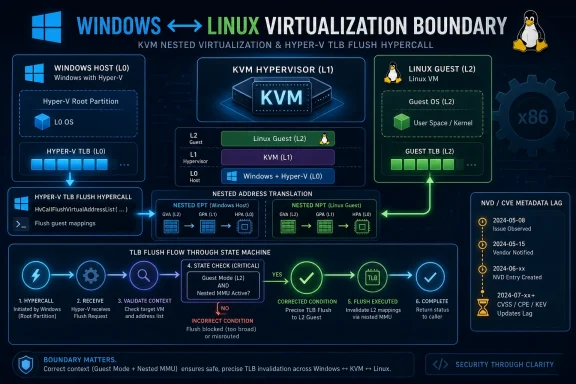
CVE-2026-46131 is a newly published Linux kernel KVM vulnerability, disclosed by kernel.org and recorded by NVD on May 28, 2026, involving incorrect handling of nested Intel EPT and AMD NPT state during slow Hyper-V TLB flush hypercalls on x86 hosts. The bug is not a Windows flaw, but it lives exactly where Windows and Linux virtualization increasingly meet: Hyper-V enlightenment paths, nested guests, and KVM hosts running Windows workloads. Its practical lesson is less about panic than about precision. A one-line kernel fix can still matter when that line decides which address space a hypervisor believes it is reading.
The public record for CVE-2026-46131 is sparse in the way modern kernel CVEs often are. NVD has the entry, the publication date, the kernel.org source, and the upstream description, but it has not yet assigned a CVSS score or completed enrichment. That means there is no official NVD severity label to wave around, no confirmed exploitability narrative, and no neatly packaged “affected products” table for scanners to digest.
What we do have is the kernel fix itself. The vulnerable logic sat in KVM’s x86 Hyper-V emulation code, where KVM handles TLB flush hypercalls from guests using Microsoft’s Hyper-V interface. The patch changes a condition from “is this vCPU in guest mode?” to “is this vCPU using nested MMU translation?” before translating a nested guest physical address.
That sounds microscopic, and in source-code terms it is. But virtualization bugs often live in the gap between two states that look equivalent until they are not. An L2 guest may be running under an L1 hypervisor, but that does not automatically mean the nested paging machinery — Intel’s nested EPT or AMD’s nested NPT — is active in the way a helper function expects.
The kernel maintainers’ description is unusually direct: checking
Nested virtualization adds another layer. Instead of a host running a guest, the host runs a guest that itself runs another guest. Administrators see this in lab environments, cloud test beds, CI pipelines, security sandboxes, and developer machines where Hyper-V, WSL, Windows Server, Linux, and KVM all end up stacked together in creative ways.
Nested EPT and nested NPT are the hardware-assisted page-translation features that make those stacks tractable. They help translate memory references across the L2 guest, the L1 hypervisor, and the real L0 host without turning every memory operation into a software archaeology dig. When those features are disabled or unavailable, KVM has to treat address translation differently.
CVE-2026-46131 appears to be rooted in a mistaken shortcut: if KVM is handling a nested guest, then translate the incoming address as nested. But the correct condition is narrower. KVM should do that translation only when the nested MMU mode is actually active.
That distinction is not pedantry. Hypervisors are built from state machines, and state machines punish sloppy equivalence. “The vCPU is in guest mode” and “the vCPU has nested paging enabled” are related facts, not interchangeable facts.
Those interfaces exist because Windows knows how to talk to Hyper-V. When KVM exposes compatible Hyper-V enlightenments, Windows guests can avoid slower generic virtualization paths and use optimized calls for timing, interrupts, TLB flushing, and other low-level chores. This is one reason Windows VMs on KVM can perform well when configured correctly.
The CVE lands in that compatibility layer. A guest issues a Hyper-V-style TLB flush hypercall, and KVM must interpret the input. For “fast” hypercalls, parameters are passed directly in registers or synthetic register state. For “slow” hypercalls, input may live in guest memory, and KVM has to read it from the correct guest physical address.
The vulnerable path concerns that slow form. If the hypercall comes from an L2 guest, KVM may need to translate the nested guest physical address before reading it. But that translation makes sense only when nested paging is actually in play.
That is the bridge to WindowsForum readers. The issue is not that Windows clients are suddenly vulnerable because they use Hyper-V. It is that Linux hosts running KVM, especially those running Windows guests or nested Hyper-V scenarios, rely on a compatibility layer sophisticated enough that small state bugs become security-relevant.
Kernel.org already treated the bug as a resolved kernel vulnerability. The patch was tagged for stable backporting, and multiple stable commit references exist. That tells administrators more than an empty NVD scorecard does: the maintainers considered the fix appropriate for supported kernel lines, not merely for future development trees.
Still, there is a difference between “patch this” and “drop everything.” The public description does not state that the bug allows host escape, guest-to-host code execution, privilege escalation, information disclosure, or denial of service. It describes an invalid condition around nested address translation in a specific KVM Hyper-V hypercall path.
That specificity matters. Some kernel CVEs are broad, easy-to-trigger local privilege escalations. This one appears more constrained: x86 KVM, nested virtualization state, slow Hyper-V TLB flush hypercalls, and nested paging conditions. The most exposed environments are likely virtualization hosts and cloud-style platforms that deliberately enable nested virtualization and Hyper-V enlightenments.
Security teams should resist two bad instincts. One is to ignore the CVE because there is no score yet. The other is to invent a catastrophic score because the word “KVM” appears next to “vulnerability.” The sane response is to map the feature path, identify hosts using nested KVM or Windows guests with Hyper-V enlightenments, and apply vendor kernels as they ship.
Virtualization code is full of such pairs. Guest physical addresses are not host physical addresses. L2 guest state is not always equivalent to nested MMU state. Hyper-V compatibility is not the same thing as Hyper-V itself. A flush request may target a virtual address space, a guest address space, or a nested address space depending on who is speaking and how the call is delivered.
The fix also sits in a performance-sensitive path. TLB flushing is part of the machinery that keeps virtual memory coherent. Hypervisors invest heavily in avoiding unnecessary flushes because excessive flushing can make guests crawl, especially on large multi-vCPU systems. Hyper-V enlightenments exist partly to make those operations less expensive and more precise.
That makes the code both fast and subtle. It has to distinguish fast and slow hypercalls, direct and nested flushes, guest and nested guest addresses, and vendor-specific translation behavior. A condition that is “close enough” can pass ordinary testing until a less common nested configuration crosses the streams.
The industry has spent years pushing nested virtualization from lab curiosity into daily infrastructure. Developers run hypervisors inside cloud instances. Security teams detonate malware inside layered sandboxes. Windows developers run WSL, Docker, Hyper-V, and Linux tooling on the same workstation. That spread gives small nested-state bugs more practical reach than they had a decade ago.
Those Windows guests often expose or consume Hyper-V-compatible features. In KVM configuration files, that can show up as Hyper-V time, relaxed timing, vapic, spinlock, synthetic interrupt, and TLB-flush capabilities. Many admins enable them because they are recommended for performance or because management tooling does it automatically.
Nested virtualization widens the circle. A Windows Server VM may host Hyper-V inside KVM. A developer may run a Windows VM on a Linux workstation and then enable Windows features that themselves depend on virtualization. A lab may simulate a cloud environment by stacking guest hypervisors. These are no longer exotic arrangements reserved for kernel engineers.
That does not mean every Windows VM on KVM is affected in a meaningful way. The CVE’s described condition is narrower than ordinary Windows guest execution. The concerning path requires nested guest handling and the slow Hyper-V flush hypercall logic where KVM decides whether to translate an input guest physical address as nested.
But administrators should not dismiss it as “Linux only” if they operate Linux hypervisors that carry Windows workloads. The vulnerable component is Linux, but the exercised interface is one Windows guests and Hyper-V-aware guest stacks may use. In mixed estates, ownership boundaries are often where patching falls through.
Distribution kernels will matter. Ubuntu, Debian, Fedora, Arch, SUSE, Red Hat family distributions, Proxmox-oriented kernels, and cloud-provider kernels each have their own cadence for pulling stable fixes. Some will integrate the patch quickly through routine kernel updates; others may classify and ship it according to their security process once severity and affected configurations are clearer.
For sysadmins, the action item is not to stare at NVD until a number appears. It is to check the kernel advisory stream for the distributions that actually run your hypervisors. If your virtualization hosts use vendor-supported kernels, your safest route is usually to consume the vendor’s patched kernel package and reboot into it.
That reboot is the operational sting. KVM lives in the kernel. Updating QEMU, libvirt, or virt-manager will not replace the vulnerable kernel code path. Live migration can reduce downtime in clusters, but standalone hosts and homelabs still need the old-fashioned maintenance window.
Cloud users are in a different position. If you only consume VMs from a provider, the host kernel is the provider’s problem. If you run nested virtualization inside those VMs, your guest kernel may still matter. If you operate bare-metal cloud hosts or self-managed virtualization nodes, you are back in the same patching chair as everyone else.
Linux kernel CVEs are especially awkward. The “product” is not just Linux; it is a distribution kernel, a stable branch, a vendor backport, a cloud kernel, an appliance kernel, or a custom build. A fix may be present in a vendor kernel whose version number looks old because the vendor backported the patch without rebasing to a newer upstream release.
That reality makes naive version checks dangerous. An appliance may report a kernel version that appears vulnerable but includes the specific KVM fix. A rolling distribution may show a newer upstream version but lack a given stable backport for a short window. A custom kernel may identify itself in a way that tells the scanner almost nothing.
Security teams should treat CVE-2026-46131 as a case study in why kernel patch verification often requires more than a dashboard. The important question is whether the shipped kernel contains the fix that gates slow Hyper-V TLB flush nested address translation on the nested MMU condition. If your vendor advisory says it does, the upstream version string is secondary.
For organizations with serious virtualization exposure, this is also a good place to test scanner assumptions. If your tooling cannot distinguish “Linux desktop with no KVM usage” from “production KVM host running nested Windows virtualization workloads,” it will produce either noise or false comfort.
The higher-value targets are multi-tenant or semi-trusted virtualization platforms. Anywhere untrusted or less-trusted users can control guests on a KVM host, KVM bugs deserve attention. That includes hosting providers, university labs, CI farms, security research environments, and internal platforms where developers are allowed to upload or configure their own VM images.
The public description does not prove an escape scenario. It does, however, describe a bug in hypervisor handling of guest-supplied hypercall input. That is enough to put it in the category administrators should patch without waiting for exploit drama.
Nested virtualization can also blur tenant assumptions. An L1 guest running its own hypervisor may pass through behaviors the L0 host must emulate. If an organization allows nested virtualization for customers or developers, it has expanded the number of states KVM must safely handle. CVE-2026-46131 lives in precisely that expanded state space.
The pragmatic risk model is therefore configuration-sensitive. A KVM host that never enables nested virtualization and never exposes Hyper-V enlightenments to Windows guests is not in the same position as a lab platform designed to run Hyper-V inside Windows Server VMs. Treating them identically wastes time.
That distinction matters for patching. Windows Update will not fix a Linux KVM host. A Windows guest administrator cannot remediate the host kernel by changing guest policy. Microsoft’s Hyper-V on Windows is not the component identified by the CVE record.
At the same time, the Microsoft compatibility layer is why the bug is interesting to Windows administrators. Hyper-V enlightenments have become part of the common performance contract for Windows guests on non-Microsoft hypervisors. KVM implements enough of that contract to make Windows behave well, and that implementation becomes part of the Linux host’s trusted computing base.
This is the modern virtualization bargain. Cross-platform compatibility improves performance and manageability, but it also imports complexity. KVM is not merely running Windows as an opaque black box; it is participating in a conversation Windows understands. Every synthetic interrupt, paravirtual clock, and TLB flush hint is another sentence in that conversation.
CVE-2026-46131 is a reminder that compatibility code is security code. It handles untrusted guest requests, interprets guest-controlled addresses, and maps them onto host-managed memory operations. The better the compatibility, the more carefully those boundaries must be policed.
Start with hosts that run KVM on x86 and permit nested virtualization. Then prioritize hosts that run Windows guests with Hyper-V enlightenments enabled, hosts that allow tenants or developers to bring their own VM images, and lab platforms where L1 hypervisors are routinely tested. Those are the places most likely to line up with the described code path.
If nested virtualization is not required, consider disabling it. That is not a substitute for patching, but it reduces the number of nested-state transitions KVM must handle. In production, nested virtualization should be a deliberate feature, not an accidental default left on because a template once needed it.
Administrators should also document which guests depend on Hyper-V enlightenments. Disabling those features blindly can harm Windows VM performance or break assumptions in a nested Hyper-V lab. But knowing where they are used turns future KVM advisories from a fire drill into a targeted maintenance task.
Finally, do not overfit on this one CVE. The deeper lesson is inventory. If you cannot answer which hosts run KVM, which enable nested virtualization, which run Windows guests, and which expose Hyper-V synthetic features, CVE-2026-46131 is not the main problem. It is the messenger.
The concrete takeaways are straightforward:
 A Small KVM Patch Lands in a Very Crowded Part of the Stack
The public record for CVE-2026-46131 is sparse in the way modern kernel CVEs often are. NVD has the entry, the publication date, the kernel.org source, and the upstream description, but it has not yet assigned a CVSS score or completed enrichment. That means there is no official NVD severity label to wave around, no confirmed exploitability narrative, and no neatly packaged “affected products” table for scanners to digest.What we do have is the kernel fix itself. The vulnerable logic sat in KVM’s x86 Hyper-V emulation code, where KVM handles TLB flush hypercalls from guests using Microsoft’s Hyper-V interface. The patch changes a condition from “is this vCPU in guest mode?” to “is this vCPU using nested MMU translation?” before translating a nested guest physical address.
That sounds microscopic, and in source-code terms it is. But virtualization bugs often live in the gap between two states that look equivalent until they are not. An L2 guest may be running under an L1 hypervisor, but that does not automatically mean the nested paging machinery — Intel’s nested EPT or AMD’s nested NPT — is active in the way a helper function expects.
The kernel maintainers’ description is unusually direct: checking
is_guest_mode(vcpu) was incorrect because translate_nested_gpa() is valid only when an L2 guest is running with nested EPT or NPT enabled. The fix is to use the same condition the translation path itself expects. In other words, KVM was asking the right question too broadly.The Bug Is About Trusting the Wrong Virtualization State
To understand why this matters, it helps to strip away the alphabet soup. KVM is the Linux kernel’s built-in hypervisor. On x86, it leans on Intel VT-x or AMD-V to run virtual machines efficiently, and it contains special support for guests that expect Hyper-V behaviors, because Windows performs better when those synthetic interfaces are available.Nested virtualization adds another layer. Instead of a host running a guest, the host runs a guest that itself runs another guest. Administrators see this in lab environments, cloud test beds, CI pipelines, security sandboxes, and developer machines where Hyper-V, WSL, Windows Server, Linux, and KVM all end up stacked together in creative ways.
Nested EPT and nested NPT are the hardware-assisted page-translation features that make those stacks tractable. They help translate memory references across the L2 guest, the L1 hypervisor, and the real L0 host without turning every memory operation into a software archaeology dig. When those features are disabled or unavailable, KVM has to treat address translation differently.
CVE-2026-46131 appears to be rooted in a mistaken shortcut: if KVM is handling a nested guest, then translate the incoming address as nested. But the correct condition is narrower. KVM should do that translation only when the nested MMU mode is actually active.
That distinction is not pedantry. Hypervisors are built from state machines, and state machines punish sloppy equivalence. “The vCPU is in guest mode” and “the vCPU has nested paging enabled” are related facts, not interchangeable facts.
Hyper-V Enlightenments Are the Windows Angle Hiding in the Linux CVE
The phrase “Hyper-V TLB flush hypercall” may make this sound like a Microsoft bug at first glance. It is not. The affected code is in the Linux kernel’s KVM implementation, specifically the code that emulates Hyper-V interfaces for guest operating systems.Those interfaces exist because Windows knows how to talk to Hyper-V. When KVM exposes compatible Hyper-V enlightenments, Windows guests can avoid slower generic virtualization paths and use optimized calls for timing, interrupts, TLB flushing, and other low-level chores. This is one reason Windows VMs on KVM can perform well when configured correctly.
The CVE lands in that compatibility layer. A guest issues a Hyper-V-style TLB flush hypercall, and KVM must interpret the input. For “fast” hypercalls, parameters are passed directly in registers or synthetic register state. For “slow” hypercalls, input may live in guest memory, and KVM has to read it from the correct guest physical address.
The vulnerable path concerns that slow form. If the hypercall comes from an L2 guest, KVM may need to translate the nested guest physical address before reading it. But that translation makes sense only when nested paging is actually in play.
That is the bridge to WindowsForum readers. The issue is not that Windows clients are suddenly vulnerable because they use Hyper-V. It is that Linux hosts running KVM, especially those running Windows guests or nested Hyper-V scenarios, rely on a compatibility layer sophisticated enough that small state bugs become security-relevant.
The Absence of a CVSS Score Is Not the Same as the Absence of Risk
NVD’s record currently says the vulnerability is awaiting enrichment, with no CVSS 4.0, 3.x, or 2.0 score provided by NIST. For patch triage teams, that is inconvenient. For everyone else, it should be a reminder that severity metadata often lags behind the code reality.Kernel.org already treated the bug as a resolved kernel vulnerability. The patch was tagged for stable backporting, and multiple stable commit references exist. That tells administrators more than an empty NVD scorecard does: the maintainers considered the fix appropriate for supported kernel lines, not merely for future development trees.
Still, there is a difference between “patch this” and “drop everything.” The public description does not state that the bug allows host escape, guest-to-host code execution, privilege escalation, information disclosure, or denial of service. It describes an invalid condition around nested address translation in a specific KVM Hyper-V hypercall path.
That specificity matters. Some kernel CVEs are broad, easy-to-trigger local privilege escalations. This one appears more constrained: x86 KVM, nested virtualization state, slow Hyper-V TLB flush hypercalls, and nested paging conditions. The most exposed environments are likely virtualization hosts and cloud-style platforms that deliberately enable nested virtualization and Hyper-V enlightenments.
Security teams should resist two bad instincts. One is to ignore the CVE because there is no score yet. The other is to invent a catastrophic score because the word “KVM” appears next to “vulnerability.” The sane response is to map the feature path, identify hosts using nested KVM or Windows guests with Hyper-V enlightenments, and apply vendor kernels as they ship.
The One-Line Fix Shows Why Nested Virtualization Is Hard to Audit
The patch changes a single conditional. That is exactly why this class of bug is uncomfortable. The defect is not a missing bounds check in a visibly dangerous buffer copy; it is a semantic mismatch between two internal concepts that sound nearly the same to anyone outside the subsystem.Virtualization code is full of such pairs. Guest physical addresses are not host physical addresses. L2 guest state is not always equivalent to nested MMU state. Hyper-V compatibility is not the same thing as Hyper-V itself. A flush request may target a virtual address space, a guest address space, or a nested address space depending on who is speaking and how the call is delivered.
The fix also sits in a performance-sensitive path. TLB flushing is part of the machinery that keeps virtual memory coherent. Hypervisors invest heavily in avoiding unnecessary flushes because excessive flushing can make guests crawl, especially on large multi-vCPU systems. Hyper-V enlightenments exist partly to make those operations less expensive and more precise.
That makes the code both fast and subtle. It has to distinguish fast and slow hypercalls, direct and nested flushes, guest and nested guest addresses, and vendor-specific translation behavior. A condition that is “close enough” can pass ordinary testing until a less common nested configuration crosses the streams.
The industry has spent years pushing nested virtualization from lab curiosity into daily infrastructure. Developers run hypervisors inside cloud instances. Security teams detonate malware inside layered sandboxes. Windows developers run WSL, Docker, Hyper-V, and Linux tooling on the same workstation. That spread gives small nested-state bugs more practical reach than they had a decade ago.
Windows Guests on KVM Are Not an Edge Case Anymore
For a Windows audience, the most important practical point is that KVM is no longer just a Linux-on-Linux story. It is the foundation under many Windows VMs in hosting platforms, private clouds, developer rigs, and homelabs. Proxmox, libvirt, QEMU/KVM, OpenStack, and custom virtualization stacks routinely run Windows Server and Windows client guests.Those Windows guests often expose or consume Hyper-V-compatible features. In KVM configuration files, that can show up as Hyper-V time, relaxed timing, vapic, spinlock, synthetic interrupt, and TLB-flush capabilities. Many admins enable them because they are recommended for performance or because management tooling does it automatically.
Nested virtualization widens the circle. A Windows Server VM may host Hyper-V inside KVM. A developer may run a Windows VM on a Linux workstation and then enable Windows features that themselves depend on virtualization. A lab may simulate a cloud environment by stacking guest hypervisors. These are no longer exotic arrangements reserved for kernel engineers.
That does not mean every Windows VM on KVM is affected in a meaningful way. The CVE’s described condition is narrower than ordinary Windows guest execution. The concerning path requires nested guest handling and the slow Hyper-V flush hypercall logic where KVM decides whether to translate an input guest physical address as nested.
But administrators should not dismiss it as “Linux only” if they operate Linux hypervisors that carry Windows workloads. The vulnerable component is Linux, but the exercised interface is one Windows guests and Hyper-V-aware guest stacks may use. In mixed estates, ownership boundaries are often where patching falls through.
The Patch Pipeline Matters More Than the CVE Page
The NVD entry lists several stable kernel commit references, which is typical for a fix that lands across maintained branches. That is the real remediation path for most users. Very few administrators should be cherry-picking KVM patches by commit hash unless they already maintain custom kernels.Distribution kernels will matter. Ubuntu, Debian, Fedora, Arch, SUSE, Red Hat family distributions, Proxmox-oriented kernels, and cloud-provider kernels each have their own cadence for pulling stable fixes. Some will integrate the patch quickly through routine kernel updates; others may classify and ship it according to their security process once severity and affected configurations are clearer.
For sysadmins, the action item is not to stare at NVD until a number appears. It is to check the kernel advisory stream for the distributions that actually run your hypervisors. If your virtualization hosts use vendor-supported kernels, your safest route is usually to consume the vendor’s patched kernel package and reboot into it.
That reboot is the operational sting. KVM lives in the kernel. Updating QEMU, libvirt, or virt-manager will not replace the vulnerable kernel code path. Live migration can reduce downtime in clusters, but standalone hosts and homelabs still need the old-fashioned maintenance window.
Cloud users are in a different position. If you only consume VMs from a provider, the host kernel is the provider’s problem. If you run nested virtualization inside those VMs, your guest kernel may still matter. If you operate bare-metal cloud hosts or self-managed virtualization nodes, you are back in the same patching chair as everyone else.
Scanners Will Struggle Until the Metadata Catches Up
The NVD enrichment gap is not cosmetic. A large amount of enterprise vulnerability management still depends on machine-readable mappings: affected products, CPEs, CVSS vectors, CWE categories, and reference tags. When those fields are empty or delayed, scanners may either miss the issue or flag it in ways that lack context.Linux kernel CVEs are especially awkward. The “product” is not just Linux; it is a distribution kernel, a stable branch, a vendor backport, a cloud kernel, an appliance kernel, or a custom build. A fix may be present in a vendor kernel whose version number looks old because the vendor backported the patch without rebasing to a newer upstream release.
That reality makes naive version checks dangerous. An appliance may report a kernel version that appears vulnerable but includes the specific KVM fix. A rolling distribution may show a newer upstream version but lack a given stable backport for a short window. A custom kernel may identify itself in a way that tells the scanner almost nothing.
Security teams should treat CVE-2026-46131 as a case study in why kernel patch verification often requires more than a dashboard. The important question is whether the shipped kernel contains the fix that gates slow Hyper-V TLB flush nested address translation on the nested MMU condition. If your vendor advisory says it does, the upstream version string is secondary.
For organizations with serious virtualization exposure, this is also a good place to test scanner assumptions. If your tooling cannot distinguish “Linux desktop with no KVM usage” from “production KVM host running nested Windows virtualization workloads,” it will produce either noise or false comfort.
The Real Attack Surface Is the Hosted Platform, Not the Laptop
Most Windows enthusiasts reading about a Linux KVM CVE will first think of their own machine: a desktop with WSL, VirtualBox, VMware Workstation, Hyper-V, or perhaps a KVM-based Linux host running a Windows guest. For home users, the exposure is likely limited unless they intentionally run nested virtualization with KVM and Hyper-V-compatible guest features.The higher-value targets are multi-tenant or semi-trusted virtualization platforms. Anywhere untrusted or less-trusted users can control guests on a KVM host, KVM bugs deserve attention. That includes hosting providers, university labs, CI farms, security research environments, and internal platforms where developers are allowed to upload or configure their own VM images.
The public description does not prove an escape scenario. It does, however, describe a bug in hypervisor handling of guest-supplied hypercall input. That is enough to put it in the category administrators should patch without waiting for exploit drama.
Nested virtualization can also blur tenant assumptions. An L1 guest running its own hypervisor may pass through behaviors the L0 host must emulate. If an organization allows nested virtualization for customers or developers, it has expanded the number of states KVM must safely handle. CVE-2026-46131 lives in precisely that expanded state space.
The pragmatic risk model is therefore configuration-sensitive. A KVM host that never enables nested virtualization and never exposes Hyper-V enlightenments to Windows guests is not in the same position as a lab platform designed to run Hyper-V inside Windows Server VMs. Treating them identically wastes time.
Microsoft Is Present as an Interface, Not as the Vendor at Fault
There is a temptation in mixed-platform vulnerabilities to assign brand blame. Hyper-V appears in the affected path, Windows workloads may exercise the interface, and the function lives in KVM’s Hyper-V emulation code. But the flaw, as published, is in the Linux kernel implementation.That distinction matters for patching. Windows Update will not fix a Linux KVM host. A Windows guest administrator cannot remediate the host kernel by changing guest policy. Microsoft’s Hyper-V on Windows is not the component identified by the CVE record.
At the same time, the Microsoft compatibility layer is why the bug is interesting to Windows administrators. Hyper-V enlightenments have become part of the common performance contract for Windows guests on non-Microsoft hypervisors. KVM implements enough of that contract to make Windows behave well, and that implementation becomes part of the Linux host’s trusted computing base.
This is the modern virtualization bargain. Cross-platform compatibility improves performance and manageability, but it also imports complexity. KVM is not merely running Windows as an opaque black box; it is participating in a conversation Windows understands. Every synthetic interrupt, paravirtual clock, and TLB flush hint is another sentence in that conversation.
CVE-2026-46131 is a reminder that compatibility code is security code. It handles untrusted guest requests, interprets guest-controlled addresses, and maps them onto host-managed memory operations. The better the compatibility, the more carefully those boundaries must be policed.
Administrators Should Patch the Kernel and Audit Nested Exposure
For most environments, the remediation story is refreshingly conventional: install a kernel containing the upstream stable fix and reboot the host. The harder part is deciding how urgently to schedule that reboot across a fleet.Start with hosts that run KVM on x86 and permit nested virtualization. Then prioritize hosts that run Windows guests with Hyper-V enlightenments enabled, hosts that allow tenants or developers to bring their own VM images, and lab platforms where L1 hypervisors are routinely tested. Those are the places most likely to line up with the described code path.
If nested virtualization is not required, consider disabling it. That is not a substitute for patching, but it reduces the number of nested-state transitions KVM must handle. In production, nested virtualization should be a deliberate feature, not an accidental default left on because a template once needed it.
Administrators should also document which guests depend on Hyper-V enlightenments. Disabling those features blindly can harm Windows VM performance or break assumptions in a nested Hyper-V lab. But knowing where they are used turns future KVM advisories from a fire drill into a targeted maintenance task.
Finally, do not overfit on this one CVE. The deeper lesson is inventory. If you cannot answer which hosts run KVM, which enable nested virtualization, which run Windows guests, and which expose Hyper-V synthetic features, CVE-2026-46131 is not the main problem. It is the messenger.
The Patch Says More Than the Scorecard
The useful reading of CVE-2026-46131 is not “critical until proven otherwise” or “irrelevant until NVD scores it.” It is a narrow kernel virtualization flaw with enough placement in the stack to deserve timely host patching. Its importance comes from where it sits, not from the length of the diff.The concrete takeaways are straightforward:
- CVE-2026-46131 affects the Linux kernel’s x86 KVM code path for slow Hyper-V TLB flush hypercalls, not Microsoft Hyper-V itself.
- The fix changes KVM’s condition from general nested guest mode to the narrower nested MMU state required for nested EPT or nested NPT translation.
- NVD published the record on May 28, 2026, but had not yet provided CVSS scoring or completed enrichment at the time of publication.
- The most relevant systems are x86 KVM hosts using nested virtualization, especially where Windows guests or Hyper-V-compatible features are part of the workload.
- Remediation should come through patched distribution or vendor kernels, followed by a reboot into the fixed kernel.
- Vulnerability scanners may lag or misclassify exposure until downstream metadata catches up, so configuration-aware triage matters.
References
- Primary source: NVD / Linux Kernel
Published: 2026-05-29T01:03:10-07:00
NVD - CVE-2026-46131
 nvd.nist.gov
- Security advisory: MSRC
Published: 2026-05-29T01:03:10-07:00
Original feed URL
Security Update Guide - Microsoft Security Response Center
 msrc.microsoft.com
- Related coverage: spinics.net

[PATCH] KVM: x86: check for nEPT/nNPT in slow flush hypercalls — Linux Kernel
Linux Kernel: [PATCH] KVM: x86: check for nEPT/nNPT in slow flush hypercalls
www.spinics.net
- Related coverage: android.googlesource.com
- Related coverage: android-kvm.googlesource.com
- Related coverage: gbmc.googlesource.com
- Related coverage: codebrowser.dev
x86.c source code [linux/arch/x86/kvm/x86.c] - Codebrowser
Source code of linux/arch/x86/kvm/x86.c linux v6.19-r on KDAB Codebrowsercodebrowser.dev - Related coverage: mail-archive.com
[RFC Patch 3/3] KVM/x86: Add tlb_remote_flush callback support for vmcs
www.mail-archive.com
- Related coverage: kernel.org
- Related coverage: labs.cloudsecurityalliance.org
NVD Enrichment Triage: Enterprise Vulnerability Programs Must Adapt
PDF documentlabs.cloudsecurityalliance.org
