

CVE-2026-46149 is a newly published Linux kernel flaw, disclosed by kernel.org on May 28, 2026, in the SCSI target configfs code where an overlong iSCSI name can make a sysfs read copy bytes beyond a 256-byte stack buffer. The bug is not a flashy remote-code-execution headline, and that is precisely why it is worth attention. It sits in the plumbing that storage administrators rarely want to think about once it works: LIO, configfs, target portal groups, and the long chain of string handling that turns kernel state into something readable from user space. The lesson is familiar but still uncomfortable: a one-line bounds check can separate ordinary observability from a kernel panic or an information leak.
The immediate problem in CVE-2026-46149 is almost banal. A kernel function named
That semantic trap has caught kernel code before. Here, the path can grow too long because iSCSI Qualified Names can be lengthy, and the function’s later check only ensured the destination page would not overflow. It did not ensure the source buffer actually contained as many valid bytes as the copy operation was told to read.
The result is a source-side over-read:
This is not the kind of vulnerability that tells every desktop Linux user to drop everything. It is the kind that reminds storage and virtualization shops that kernel attack surface often hides in “read-only” reporting paths, especially where long protocol identifiers meet fixed local buffers.
That distinction is why this bug is easy to underestimate. Developers are trained to look for writes that run off the end of a destination; administrators are trained to look for interfaces that accept obviously dangerous input. CVE-2026-46149 lives in the in-between space: the text formatting function truncates its local buffer safely, but returns a length that represents the untruncated output.
In ordinary application code, that can produce bad strings, misreported lengths, or parser weirdness. In kernel code, it can become a memory disclosure or a crash, because the next operation trusts the length and reads from memory that does not belong to the local buffer. A correct destination bound does not save you when the source accounting is wrong.
The patch is correspondingly tiny. The fix adds a check that rejects a
That is the kernel’s uncomfortable bargain with C. The pieces are fast, explicit, and battle-tested, but their contracts are sharp enough that one misplaced assumption can turn a display helper into a security bug.
That makes this bug less exotic than it first appears. The trigger condition is not “invent a bizarre string no sane deployment would use.” It is “make the fabric WWN long enough that the formatted LUN path exceeds the local helper’s assumptions.” Kernel subsystems that translate enterprise naming conventions into compact internal buffers need to be pessimistic, because administrators will use the naming latitude the protocols give them.
The SCSI target subsystem, better known in Linux circles as LIO, is also not a toy subsystem. It is used to present block storage over fabrics such as iSCSI and Fibre Channel-like target implementations, and it is commonly configured through configfs. That means its management interfaces are close to the kind of infrastructure where Linux is not a hobby OS but a storage appliance, a virtualization backend, or part of a lab that mirrors production SAN behavior.
CVE-2026-46149 is therefore a storage-administration bug as much as a kernel-memory bug. The exposed interface is sysfs/configfs-facing, not an Internet-facing daemon with a friendly banner. But if an attacker has enough local access to interact with the relevant configuration and read the affected attribute, the boundary between “local management detail” and “security primitive” starts to blur.
For operators, a panic is still a service event. A storage target that falls over because a reader touches a malformed or overlong sysfs path is not meaningfully reassured by the fact that the kernel chose death over disclosure. In environments where a Linux host is presenting shared storage to virtual machines or test infrastructure, availability is part of the security story.
On builds without the same hardening behavior, the concern shifts toward information disclosure. The CVE description says adjacent stack contents may be copied to the sysfs reader. The practical value of that disclosure will depend on layout, compiler behavior, kernel configuration, and what sensitive material is nearby at the time.
That uncertainty should not be converted into panic. There is no public basis here for treating CVE-2026-46149 as a universal privilege-escalation button. But information leaks in the kernel are rarely dismissed by serious defenders, because they can be chained with other bugs, used to defeat address-randomization assumptions, or simply expose data that was never meant to leave kernel memory.
The interesting phrase in the advisory is not “buffer overflow,” even though that language appears in the history of the related fix. It is source read. The destination may be safe, the formatted string may be truncated, and the attribute may be nominally read-only; the kernel can still hand back bytes from somewhere else on the stack.
Software rarely has one copy of a dangerous pattern. It has cousins. A fix lands in one function, a nearby function still carries the same assumption, and months later the second bug receives its own CVE. This is not incompetence; it is the predictable result of maintaining a huge C codebase whose subsystems have grown by repetition, specialization, and backport pressure.
The kernel community has improved dramatically at stable backports and at assigning CVEs to resolved flaws, but the CVE stream also exposes how much vulnerability management now consists of pattern archaeology. A single fix is no longer enough. Maintainers must ask where else the same idiom exists, which stable branches inherited it, and whether downstream vendors compiled the affected code path in a way that makes the issue reachable.
This is especially important for storage code because the vulnerable pathways are often symmetrical. A function that lists members of one group may have a sibling that lists members of another. A fix for logical unit groups can leave target portal groups behind if review focuses on the immediate reproducer rather than the broader pattern.
The one-line nature of the patch should not obscure the engineering cost of finding it. The hardest part of this vulnerability was probably not deciding that
For practical triage, the unanswered questions are straightforward. Is the kernel built with the affected SCSI target code? Is the system used as a Linux storage target, especially with iSCSI? Can untrusted or less-trusted local users read the relevant configfs/sysfs attributes or influence long fabric names? Is the system hardened with fortify options that would turn the bug into a panic? Are patched stable kernels already available from the distribution or appliance vendor?
Those questions matter more than the eventual decimal score. A laptop that never exposes LIO target functionality is in a different risk category from a lab SAN host, a virtualization storage node, or a custom appliance that allows delegated storage administration. CVSS will eventually compress that context into a vector; operators still have to map it back onto reality.
The kernel.org source also matters. This is not a speculative third-party write-up attempting to inflate a bug for marketing. The CVE came from the kernel security process, and the referenced fixes are in the stable kernel tree. That gives administrators something concrete to track: not a brand name, not a proof-of-concept video, but patched commits and eventual vendor kernels.
Still, the lack of NVD enrichment has a familiar side effect. Security scanners may lag. Distribution trackers may classify the bug differently. Appliance vendors may not mention it until a bundled kernel update ships. For WindowsForum readers who also administer Linux infrastructure, this is where cross-platform muscle memory helps: treat the CVE entry as the start of triage, not the end of it.
The Windows endpoint may be fully patched and managed through Intune or Configuration Manager while the storage target underneath depends on a Linux kernel maintained by a NAS vendor, a hypervisor distribution, or a team that only looks at kernel advisories during quarterly maintenance. That split ownership is where low-glamour vulnerabilities linger.
The impact also cuts across Windows testing and deployment environments. Many IT labs use Linux iSCSI targets because they are cheap, scriptable, and good enough for reproducing SAN-backed Windows scenarios. A bug in the target-side reporting path is unlikely to be triggered by ordinary Windows initiator traffic alone, but the infrastructure hosting those targets may still expose the vulnerable management files locally.
For mixed shops, the right mental model is not “Linux bug, ignore.” It is “infrastructure substrate bug, identify exposure.” If Linux is presenting storage to Windows systems, it is part of the Windows reliability story whether or not the affected code ever runs on a Windows machine.
That is especially true in smaller organizations where one admin owns everything from Active Directory to Proxmox hosts to the backup NAS. Kernel CVEs that look esoteric on paper are often exactly the ones that fall through the cracks because no team claims them as urgent.
A read operation can allocate, format, copy, traverse linked objects, and expose transient kernel state. It can also do all of that under assumptions about maximum names, page sizes, and object lifetimes. If any one of those assumptions is wrong, the “read-only” attribute becomes an active code path with security consequences.
This is not unique to the Linux kernel. Windows has its own long history of bugs in query APIs, registry enumeration, IOCTL output buffers, and status-reporting paths. Any interface that serializes privileged state for a less-privileged caller has to defend both sides of the copy: what it reads from and what it writes to.
The Linux wrinkle is that sysfs-style interfaces are often easy to script and easy to expose indirectly through automation. Monitoring agents, inventory tools, and configuration collectors may read attributes administrators never touch manually. A bug that requires a sysfs read can therefore be triggered by routine observability once the underlying object state is in the wrong shape.
That does not mean every monitoring agent is a threat. It means “only a read” is not a sufficient dismissal when the reader crosses a privilege boundary or exercises kernel formatting code built around fixed local buffers.
But specialized is not the same as rare in enterprise infrastructure. Storage targets, virtualization hosts, test labs, and appliances are exactly the machines where kernel updates can be delayed because downtime is inconvenient. They are also exactly the machines where a kernel panic can have broader blast radius than a single user session.
Administrators should first determine whether their systems use the Linux SCSI target framework and whether iSCSI target functionality is enabled. Distribution package names and kernel config details vary, but the operational question is simple: is this box presenting storage as a target, and is configfs involved in managing it? If the answer is no, the CVE probably drops in priority.
If the answer is yes, the next step is to track the vendor kernel, not merely upstream commits. The fix has landed in stable kernel commits, but production fleets usually run distribution kernels with backported patches and version strings that do not map neatly to upstream releases. A vendor may ship the fix without changing the apparent major kernel version.
For teams that build their own kernels, the patch is small enough to audit directly. For everyone else, the right control is boring and effective: apply the kernel update when it arrives, schedule reboot windows for storage hosts, and avoid granting unnecessary local access to storage-management interfaces in the meantime.
But small bugs can be analytically useful precisely because they are not spectacular. This one shows how a safe-looking formatting function can become unsafe when its return value is misunderstood. It shows how a fix in one sibling function can fail to cover another. It shows how hardening can turn a leak into a crash, improving confidentiality while still threatening availability.
Most of all, it shows that kernel security work is increasingly about eliminating pattern debt. The individual line matters, but the repeated idiom matters more. When maintainers fix one
That kind of work is unglamorous, and it rarely produces dramatic advisory prose. It is also how mature infrastructure gets safer. CVE-2026-46149 is less a five-alarm fire than a reminder that yesterday’s missed sibling can become tomorrow’s CVE.
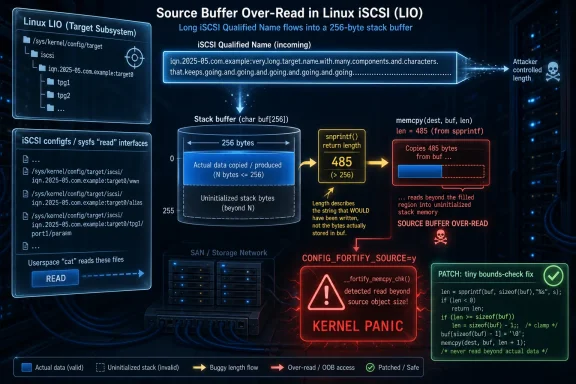 A Small Storage Bug Exposes a Large Kernel Habit
The immediate problem in CVE-2026-46149 is almost banal. A kernel function named target_tg_pt_gp_members_show() builds a textual representation of LUN paths into a fixed 256-byte stack buffer, then copies a length derived from snprintf() into the page returned to a sysfs reader. In C, that detail matters enormously, because snprintf() does not merely report how many bytes it actually placed in the buffer; it reports how long the output would have been if there had been enough space.That semantic trap has caught kernel code before. Here, the path can grow too long because iSCSI Qualified Names can be lengthy, and the function’s later check only ensured the destination page would not overflow. It did not ensure the source buffer actually contained as many valid bytes as the copy operation was told to read.
The result is a source-side over-read:
memcpy() can read past the end of the 256-byte stack buffer and copy adjacent stack contents out to the sysfs reader. On hardened builds using CONFIG_FORTIFY_SOURCE, the expected failure mode is less subtle but still operationally ugly: the fortify checks can trigger a panic instead of quietly disclosing memory.This is not the kind of vulnerability that tells every desktop Linux user to drop everything. It is the kind that reminds storage and virtualization shops that kernel attack surface often hides in “read-only” reporting paths, especially where long protocol identifiers meet fixed local buffers.
The Exploit Primitive Is in the Return Value, Not the Buffer
The most important fact about this CVE is that the vulnerable operation is not a classic destination overflow. The destination page has a guard. The missed check is on the source length.That distinction is why this bug is easy to underestimate. Developers are trained to look for writes that run off the end of a destination; administrators are trained to look for interfaces that accept obviously dangerous input. CVE-2026-46149 lives in the in-between space: the text formatting function truncates its local buffer safely, but returns a length that represents the untruncated output.
In ordinary application code, that can produce bad strings, misreported lengths, or parser weirdness. In kernel code, it can become a memory disclosure or a crash, because the next operation trusts the length and reads from memory that does not belong to the local buffer. A correct destination bound does not save you when the source accounting is wrong.
The patch is correspondingly tiny. The fix adds a check that rejects a
cur_len larger than the target portal group name buffer before the code proceeds to copy into the sysfs output page. It is the sort of change that looks obvious after the fact and yet can sit unnoticed for years because each local component appears defensible in isolation.That is the kernel’s uncomfortable bargain with C. The pieces are fast, explicit, and battle-tested, but their contracts are sharp enough that one misplaced assumption can turn a display helper into a security bug.
iSCSI’s Long Names Turn Accounting Into Attack Surface
The vulnerability depends on something storage people know and everyone else tends to forget: iSCSI identifiers are not short decorative labels. IQNs can be long, structured names that encode dates, domains, and organizational naming schemes. In large environments, names that look excessive to a kernel helper may be perfectly normal to a storage administrator trying to keep a fleet comprehensible.That makes this bug less exotic than it first appears. The trigger condition is not “invent a bizarre string no sane deployment would use.” It is “make the fabric WWN long enough that the formatted LUN path exceeds the local helper’s assumptions.” Kernel subsystems that translate enterprise naming conventions into compact internal buffers need to be pessimistic, because administrators will use the naming latitude the protocols give them.
The SCSI target subsystem, better known in Linux circles as LIO, is also not a toy subsystem. It is used to present block storage over fabrics such as iSCSI and Fibre Channel-like target implementations, and it is commonly configured through configfs. That means its management interfaces are close to the kind of infrastructure where Linux is not a hobby OS but a storage appliance, a virtualization backend, or part of a lab that mirrors production SAN behavior.
CVE-2026-46149 is therefore a storage-administration bug as much as a kernel-memory bug. The exposed interface is sysfs/configfs-facing, not an Internet-facing daemon with a friendly banner. But if an attacker has enough local access to interact with the relevant configuration and read the affected attribute, the boundary between “local management detail” and “security primitive” starts to blur.
Fortify Turns Silent Leakage Into Loud Failure
One of the stranger tensions in modern kernel hardening is that better defenses sometimes make vulnerabilities noisier. WithCONFIG_FORTIFY_SOURCE enabled, the kernel can detect certain unsafe memory operations and deliberately stop rather than continue after a bad copy. That is good security engineering, but it does not make the bug harmless.For operators, a panic is still a service event. A storage target that falls over because a reader touches a malformed or overlong sysfs path is not meaningfully reassured by the fact that the kernel chose death over disclosure. In environments where a Linux host is presenting shared storage to virtual machines or test infrastructure, availability is part of the security story.
On builds without the same hardening behavior, the concern shifts toward information disclosure. The CVE description says adjacent stack contents may be copied to the sysfs reader. The practical value of that disclosure will depend on layout, compiler behavior, kernel configuration, and what sensitive material is nearby at the time.
That uncertainty should not be converted into panic. There is no public basis here for treating CVE-2026-46149 as a universal privilege-escalation button. But information leaks in the kernel are rarely dismissed by serious defenders, because they can be chained with other bugs, used to defeat address-randomization assumptions, or simply expose data that was never meant to leave kernel memory.
The interesting phrase in the advisory is not “buffer overflow,” even though that language appears in the history of the related fix. It is source read. The destination may be safe, the formatted string may be truncated, and the attribute may be nominally read-only; the kernel can still hand back bytes from somewhere else on the stack.
The Missed Twin Fix Is the Real Process Story
The CVE record notes that an earlier commit,27e06650a5ea, added the same kind of bound to target_lu_gp_members_show(), but the target portal group variant was missed. That is the part security teams should sit with.Software rarely has one copy of a dangerous pattern. It has cousins. A fix lands in one function, a nearby function still carries the same assumption, and months later the second bug receives its own CVE. This is not incompetence; it is the predictable result of maintaining a huge C codebase whose subsystems have grown by repetition, specialization, and backport pressure.
The kernel community has improved dramatically at stable backports and at assigning CVEs to resolved flaws, but the CVE stream also exposes how much vulnerability management now consists of pattern archaeology. A single fix is no longer enough. Maintainers must ask where else the same idiom exists, which stable branches inherited it, and whether downstream vendors compiled the affected code path in a way that makes the issue reachable.
This is especially important for storage code because the vulnerable pathways are often symmetrical. A function that lists members of one group may have a sibling that lists members of another. A fix for logical unit groups can leave target portal groups behind if review focuses on the immediate reproducer rather than the broader pattern.
The one-line nature of the patch should not obscure the engineering cost of finding it. The hardest part of this vulnerability was probably not deciding that
cur_len must be bounded. It was noticing that another show function needed the same treatment.NVD’s Blank Score Is Not a Blank Risk
As of publication, NVD lists CVE-2026-46149 as awaiting enrichment, with no CVSS score assigned by NIST. That absence will frustrate dashboards that want a number before they want a judgment. It should not paralyze administrators.For practical triage, the unanswered questions are straightforward. Is the kernel built with the affected SCSI target code? Is the system used as a Linux storage target, especially with iSCSI? Can untrusted or less-trusted local users read the relevant configfs/sysfs attributes or influence long fabric names? Is the system hardened with fortify options that would turn the bug into a panic? Are patched stable kernels already available from the distribution or appliance vendor?
Those questions matter more than the eventual decimal score. A laptop that never exposes LIO target functionality is in a different risk category from a lab SAN host, a virtualization storage node, or a custom appliance that allows delegated storage administration. CVSS will eventually compress that context into a vector; operators still have to map it back onto reality.
The kernel.org source also matters. This is not a speculative third-party write-up attempting to inflate a bug for marketing. The CVE came from the kernel security process, and the referenced fixes are in the stable kernel tree. That gives administrators something concrete to track: not a brand name, not a proof-of-concept video, but patched commits and eventual vendor kernels.
Still, the lack of NVD enrichment has a familiar side effect. Security scanners may lag. Distribution trackers may classify the bug differently. Appliance vendors may not mention it until a bundled kernel update ships. For WindowsForum readers who also administer Linux infrastructure, this is where cross-platform muscle memory helps: treat the CVE entry as the start of triage, not the end of it.
Windows Shops Should Care Because Linux Often Runs the Storage Underneath
A Linux kernel SCSI target bug may sound outside the normal orbit of a Windows-focused community. In practice, it often lands closer than expected. Windows estates routinely sit on top of Linux-based storage appliances, lab targets, backup repositories, hypervisor hosts, CI systems, and developer infrastructure that exports block devices over iSCSI.The Windows endpoint may be fully patched and managed through Intune or Configuration Manager while the storage target underneath depends on a Linux kernel maintained by a NAS vendor, a hypervisor distribution, or a team that only looks at kernel advisories during quarterly maintenance. That split ownership is where low-glamour vulnerabilities linger.
The impact also cuts across Windows testing and deployment environments. Many IT labs use Linux iSCSI targets because they are cheap, scriptable, and good enough for reproducing SAN-backed Windows scenarios. A bug in the target-side reporting path is unlikely to be triggered by ordinary Windows initiator traffic alone, but the infrastructure hosting those targets may still expose the vulnerable management files locally.
For mixed shops, the right mental model is not “Linux bug, ignore.” It is “infrastructure substrate bug, identify exposure.” If Linux is presenting storage to Windows systems, it is part of the Windows reliability story whether or not the affected code ever runs on a Windows machine.
That is especially true in smaller organizations where one admin owns everything from Active Directory to Proxmox hosts to the backup NAS. Kernel CVEs that look esoteric on paper are often exactly the ones that fall through the cracks because no team claims them as urgent.
The Sysfs Read Path Deserves More Suspicion
Sysfs and configfs are often described in comforting administrative terms: virtual files, readable attributes, knobs, live kernel state. That framing is useful, but it can also lull teams into treating read paths as inherently less dangerous than write paths. CVE-2026-46149 shows why that shortcut fails.A read operation can allocate, format, copy, traverse linked objects, and expose transient kernel state. It can also do all of that under assumptions about maximum names, page sizes, and object lifetimes. If any one of those assumptions is wrong, the “read-only” attribute becomes an active code path with security consequences.
This is not unique to the Linux kernel. Windows has its own long history of bugs in query APIs, registry enumeration, IOCTL output buffers, and status-reporting paths. Any interface that serializes privileged state for a less-privileged caller has to defend both sides of the copy: what it reads from and what it writes to.
The Linux wrinkle is that sysfs-style interfaces are often easy to script and easy to expose indirectly through automation. Monitoring agents, inventory tools, and configuration collectors may read attributes administrators never touch manually. A bug that requires a sysfs read can therefore be triggered by routine observability once the underlying object state is in the wrong shape.
That does not mean every monitoring agent is a threat. It means “only a read” is not a sufficient dismissal when the reader crosses a privilege boundary or exercises kernel formatting code built around fixed local buffers.
Patch Management Starts With Inventory, Not Drama
The practical response to CVE-2026-46149 should be measured. There is no public CVSS score yet, and the description does not describe remote unauthenticated exploitation. The affected subsystem is specialized. Many systems will not be meaningfully exposed.But specialized is not the same as rare in enterprise infrastructure. Storage targets, virtualization hosts, test labs, and appliances are exactly the machines where kernel updates can be delayed because downtime is inconvenient. They are also exactly the machines where a kernel panic can have broader blast radius than a single user session.
Administrators should first determine whether their systems use the Linux SCSI target framework and whether iSCSI target functionality is enabled. Distribution package names and kernel config details vary, but the operational question is simple: is this box presenting storage as a target, and is configfs involved in managing it? If the answer is no, the CVE probably drops in priority.
If the answer is yes, the next step is to track the vendor kernel, not merely upstream commits. The fix has landed in stable kernel commits, but production fleets usually run distribution kernels with backported patches and version strings that do not map neatly to upstream releases. A vendor may ship the fix without changing the apparent major kernel version.
For teams that build their own kernels, the patch is small enough to audit directly. For everyone else, the right control is boring and effective: apply the kernel update when it arrives, schedule reboot windows for storage hosts, and avoid granting unnecessary local access to storage-management interfaces in the meantime.
The One-Line Fix Is a Warning About Pattern Debt
CVE-2026-46149 is likely to disappear quickly into the background noise of kernel CVEs. That would be understandable. The fix is small, the affected code path is narrow, and there is no assigned NVD score yet to wave in front of management.But small bugs can be analytically useful precisely because they are not spectacular. This one shows how a safe-looking formatting function can become unsafe when its return value is misunderstood. It shows how a fix in one sibling function can fail to cover another. It shows how hardening can turn a leak into a crash, improving confidentiality while still threatening availability.
Most of all, it shows that kernel security work is increasingly about eliminating pattern debt. The individual line matters, but the repeated idiom matters more. When maintainers fix one
snprintf() length bug, reviewers need to ask where else that length is trusted. When a subsystem has parallel show functions, a patch should prompt a search for the same shape elsewhere.That kind of work is unglamorous, and it rarely produces dramatic advisory prose. It is also how mature infrastructure gets safer. CVE-2026-46149 is less a five-alarm fire than a reminder that yesterday’s missed sibling can become tomorrow’s CVE.
The Storage Admin’s Patch Window Has a Clear Shape
This is a focused kernel flaw with a focused operational response. The danger is not that every Linux system is suddenly exposed; the danger is that the systems that are exposed are often the ones administrators are reluctant to reboot.- Systems using the Linux SCSI target subsystem, especially iSCSI target configurations managed through configfs, deserve the first look.
- The bug involves a source-buffer over-read caused by trusting an
snprintf()return length that may exceed the 256-byte stack buffer actually filled. - Hardened kernels with
CONFIG_FORTIFY_SOURCEmay convert the unsafe copy into a kernel panic, which makes availability part of the risk calculation. - The lack of an NVD CVSS score on May 28, 2026, should not delay local triage for storage hosts and appliances.
- Vendor kernels may receive the fix as a backport, so administrators should track distribution advisories and changelogs rather than relying only on upstream version numbers.
- Windows-heavy environments should still check Linux-backed storage, hypervisor, backup, and lab systems that support Windows workloads.
References
- Primary source: NVD / Linux Kernel
Published: 2026-05-29T01:05:21-07:00
NVD - CVE-2026-46149
 nvd.nist.gov
- Security advisory: MSRC
Published: 2026-05-29T01:05:21-07:00
Original feed URL
Security Update Guide - Microsoft Security Response Center
 msrc.microsoft.com
- Related coverage: spinics.net

[PATCH] scsi: target: configfs: bound snprintf return in tg_pt_gp_members_show — Linux Kernel
Linux Kernel: [PATCH] scsi: target: configfs: bound snprintf return in tg_pt_gp_members_show
www.spinics.net
- Related coverage: kernel.googlesource.com
- Related coverage: vulnerability.circl.lu
Vulnerability-Lookup
Vulnerability-Lookup - Fast vulnerability lookup correlation from different sources.vulnerability.circl.lu - Related coverage: labs.cloudsecurityalliance.org
CSA research note dirty frag linux lpe container 20260509 csa styled
PDF documentlabs.cloudsecurityalliance.org
