

CVE-2026-46151 is a Linux kernel information-disclosure flaw published by NVD on May 28, 2026, after kernel.org reported that the USB printer driver could leak stale heap memory through malformed IEEE 1284 device ID responses. The bug is not a Windows vulnerability, but it belongs squarely in the threat model of mixed fleets, developer workstations, print appliances, and Linux-powered endpoints that often sit beside Windows systems. Its lesson is old and uncomfortable: a peripheral that looks boring can still become a memory oracle. The printer port, long treated as infrastructure plumbing, is once again a reminder that trust boundaries do not end at the USB connector.
The immediate facts are narrow. The affected code lives in
That discrepancy is the core of the bug. The driver allocates a 1,024-byte buffer, receives only a short response, then trusts the device-supplied length field when later exposing the cached string to user space. The result is not code execution, not a remote worm, and not a spectacular kernel panic. It is a controlled leak of uninitialized heap content.
That sounds modest until you remember what kernel heap memory represents. It can contain fragments of prior allocations, structure fields, addresses, or data that help defeat other mitigations. Modern exploitation often depends less on a single dramatic overflow and more on small primitives chained together: a leak here, a write there, a timing window somewhere else. CVE-2026-46151 fits into that quieter category.
The fix is also revealing in its simplicity. The kernel change zeros the buffer before each request, so a short response leaves zeros behind instead of stale heap bytes. It is the sort of patch that makes the bug feel obvious in hindsight, which is exactly why it is worth paying attention to.
The vulnerable assumption was not that the device might be malicious in some grand adversarial sense. It was more mundane: the driver treated the length prefix in the returned data as meaningful even when the actual USB transfer had not delivered enough bytes to justify it. The helper function collapsed the USB control message result into a simple success-or-failure status, discarding the number of bytes actually transferred.
That is the engineering sin at the center of the advisory. A short transfer was not necessarily an error, but it was security-relevant. Once the byte count disappeared, the rest of the driver could not distinguish a complete 1,023-byte identifier from a two-byte response that merely claimed to be one.
The exploit sketch is almost embarrassingly small. A device sends two bytes, such as a big-endian length value claiming a 1,023-byte ID, and leaves the rest of the kernel allocation untouched. The driver later exposes bytes from that buffer as if they came from the printer. What the user receives is not just printer metadata; it is whatever stale kernel heap data happened to occupy that memory region.
That is why short reads are dangerous in kernel code. They are not merely incomplete I/O. They are places where yesterday’s memory can become today’s interface.
That difference matters operationally. A sysfs read may produce inconsistent, truncated, or seemingly harmless output depending on where the first zero byte appears in stale memory. The ioctl path is more direct because it can return the claimed payload length. According to the CVE description, the device can influence the leak size, with up to 1,021 bytes of uninitialized heap potentially exposed.
This is not the same as giving a random remote attacker direct read access to kernel memory. The attacker needs a device position, or at least a way to make the host talk to a malicious USB printer-class device. But in many modern environments, that is less far-fetched than it sounds. USB device emulation is cheap, embedded devices are everywhere, and “printer” is often shorthand for a surprisingly complicated piece of networked and USB-capable hardware.
The risk is also not limited to physical access in the cartoon sense of someone sneaking into a server room. Developer desktops, lab machines, shared workstations, kiosks, factory terminals, and print servers all create different paths for untrusted peripherals to meet privileged kernel drivers. In Windows-centric organizations, Linux machines often live in precisely those edge roles: CI runners, appliance controllers, security tools, print bridges, and admin workstations.
That is why “only via USB printer” should not be read as “irrelevant.” It should be read as “requires a specific foothold.” Good security engineering is the art of deciding which footholds are plausible in your environment.
If scored narrowly, it may land as a local or adjacent information disclosure requiring a malicious device and user-space access to the relevant interface. That does not sound urgent next to remote code execution in a web-facing service. But kernel memory disclosure bugs occupy an awkward middle ground: rarely the whole attack, often the missing ingredient.
The value of leaked heap data depends on context. If the exposed bytes include kernel pointers, allocator artifacts, or fragments useful for bypassing address-space randomization, the bug may help turn a separate corruption issue into a reliable exploit. If the bytes are mostly zeros or irrelevant remnants on a given system, the practical effect is far lower. Both outcomes can be true across different machines.
This is where enterprise vulnerability management often goes wrong. A scanner sees no score and no known exploitation and quietly deprioritizes the issue. A kernel engineer sees a device-controlled heap disclosure and recognizes a primitive. Neither view is complete without the deployment context.
The right response is not panic. It is classification. Systems that never load
There are other possible fixes one could imagine. The driver could preserve the actual transfer length and validate the length prefix against it. It could reject short responses. It could clamp based on bytes received rather than buffer size. In a perfect world, all of those patterns would be applied consistently across kernel drivers.
But zeroing the buffer is attractive because it is low-risk and easy to backport. Stable kernel fixes often favor changes that reduce exposure without reworking control flow. In mature subsystems, the safest patch is sometimes the least elegant one.
That trade-off is worth understanding. A surgical mitigation can close the leak while leaving some awkward semantics intact. The device may still complete short; the driver may still treat the transaction as successful in a broad sense; user space may still see odd printer metadata. What changes is that the odd metadata no longer contains uninitialized kernel heap.
For administrators, that distinction matters less than the practical outcome. Once the patched kernel is running, this specific leak path should be gone. Until then, risk depends on whether the vulnerable code is present, loaded, and reachable.
That can create the impression of a sudden collapse in kernel quality. The reality is more complicated. A sprawling kernel contains countless drivers, protocols, and device-specific assumptions, many of them written for hardware that predates today’s exploitation model. When maintainers attach CVEs to more of those fixes, the public record gets noisier.
CVE-2026-46151 is a good example of why that noise is still useful. It is not a headline-grabbing vulnerability, but it documents a real bug at a real trust boundary. It gives downstream distributions a concrete item to track. It gives administrators a way to ask whether their kernels have the fix. It gives researchers a breadcrumb about a class of driver mistakes.
The danger is fatigue. If every small kernel correctness issue appears in the same queue as critical remote vulnerabilities, defenders may tune out. But the answer is not fewer CVEs. The answer is better triage, grounded in exploitability, exposure, and the role of affected systems.
A WindowsForum audience should recognize the pattern from Microsoft’s own ecosystem. Patch Tuesday regularly includes bugs that are technically serious but operationally irrelevant to some environments, and others that look narrow but matter deeply in specific configurations. The kernel world is not different. It is just more visibly distributed.
But few serious Windows environments are purely Windows anymore. Linux underpins developer workstations, WSL-adjacent workflows, containers, network appliances, backup systems, monitoring nodes, print servers, and hypervisor-adjacent tooling. Even organizations that standardize on Windows desktops often rely on Linux in the infrastructure corners where asset inventory is weakest.
Those corners are exactly where peripheral assumptions linger. A print server installed years ago may be treated as an appliance rather than a managed Linux host. A lab workstation may accept random USB devices because that is how the team tests hardware. A kiosk or industrial controller may run an old kernel because vendor certification moves slowly.
The practical question is not whether CVE-2026-46151 threatens every Windows shop. It does not. The question is whether your Windows shop has Linux endpoints that accept USB printer-class devices, and whether those endpoints are patched with the relevant stable kernel fix. That is a much smaller question, but it is the one that matters.
There is also a broader architectural lesson. Peripheral-facing code is part of the attack surface, even when the peripheral seems harmless. The industry learned this repeatedly with USB storage, keyboards, Bluetooth stacks, webcams, and print spoolers. Printers are not exceptions; they are embedded systems with cables, firmware, parsers, network stacks, and long replacement cycles.
USB attacks have always lived in the messy space between local and remote. A malicious device may be plugged in by an attacker, by a curious user, by a contractor, by a supply-chain process, or by an employee who thinks they are connecting an ordinary peripheral. In test labs and shared offices, the boundary can be porous. In retail, healthcare, manufacturing, and education, exposed USB ports are often part of the environment.
CVE-2026-46151 does not prove that every printer is a threat. It proves that the host must treat device-provided metadata as untrusted input. That is the same principle behind decades of parser hardening, network protocol validation, and sandbox design. The medium changes; the rule does not.
The “broken printer” framing in the CVE description is important too. A device does not need to be malicious to trigger bad assumptions. Firmware bugs, counterfeit devices, marginal cables, odd hubs, and emulation tools can all produce malformed responses. Security fixes that handle malicious inputs often improve reliability for accidental weirdness as well.
Administrators should therefore resist two opposite mistakes. Do not treat this as a mass emergency unless your exposure justifies it. Do not dismiss it merely because it involves printers. The boring parts of computing are where long-lived assumptions go to retire, and attackers have a habit of visiting them.
Where patching is delayed, reducing exposure is possible. Systems that do not need USB printer support can avoid loading the
The harder part is inventory. Many organizations do not know which Linux systems have USB printers attached, which kernels they run, or whether user space can query the vulnerable interfaces. That is not a CVE-specific failure. It is the recurring tax of mixed infrastructure.
For desktop Linux users, the calculus is simpler. If you use a distribution kernel, take the normal security update when it lands. If you do not use USB printing, your practical exposure is limited. If you experiment with USB gadgets, printer emulation, or unknown peripherals, apply updates sooner rather than later.
For developers and researchers, the bug is a useful case study in driver API design. Returning only success or failure from an operation that also has a meaningful byte count can erase information that later code needs for safety. In C, that sort of lost context often becomes a vulnerability several functions downstream.
The most concrete points are simple:
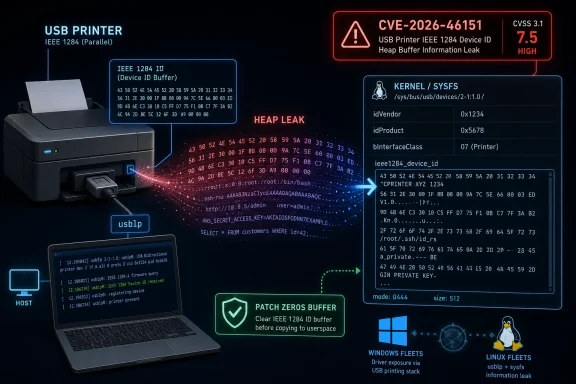 A Printer Bug With a Kernel-Shaped Blast Radius
The immediate facts are narrow. The affected code lives in usblp, the Linux USB printer driver, and the vulnerable path is triggered while asking a device for its IEEE 1284 identification string. A malicious or broken USB printer can return a response shorter than the driver expects, while still claiming a much larger device ID length inside the first two bytes of the response.That discrepancy is the core of the bug. The driver allocates a 1,024-byte buffer, receives only a short response, then trusts the device-supplied length field when later exposing the cached string to user space. The result is not code execution, not a remote worm, and not a spectacular kernel panic. It is a controlled leak of uninitialized heap content.
That sounds modest until you remember what kernel heap memory represents. It can contain fragments of prior allocations, structure fields, addresses, or data that help defeat other mitigations. Modern exploitation often depends less on a single dramatic overflow and more on small primitives chained together: a leak here, a write there, a timing window somewhere else. CVE-2026-46151 fits into that quieter category.
The fix is also revealing in its simplicity. The kernel change zeros the buffer before each request, so a short response leaves zeros behind instead of stale heap bytes. It is the sort of patch that makes the bug feel obvious in hindsight, which is exactly why it is worth paying attention to.
The Device ID Was Treated Like a Fact, Not a Claim
IEEE 1284 device IDs are not exotic. They are how printers identify themselves with strings that can include manufacturer, model, command set, and other descriptive fields. Operating systems and print stacks use that information to match devices with drivers, expose metadata, or smooth the plug-and-play path for users.The vulnerable assumption was not that the device might be malicious in some grand adversarial sense. It was more mundane: the driver treated the length prefix in the returned data as meaningful even when the actual USB transfer had not delivered enough bytes to justify it. The helper function collapsed the USB control message result into a simple success-or-failure status, discarding the number of bytes actually transferred.
That is the engineering sin at the center of the advisory. A short transfer was not necessarily an error, but it was security-relevant. Once the byte count disappeared, the rest of the driver could not distinguish a complete 1,023-byte identifier from a two-byte response that merely claimed to be one.
The exploit sketch is almost embarrassingly small. A device sends two bytes, such as a big-endian length value claiming a 1,023-byte ID, and leaves the rest of the kernel allocation untouched. The driver later exposes bytes from that buffer as if they came from the printer. What the user receives is not just printer metadata; it is whatever stale kernel heap data happened to occupy that memory region.
That is why short reads are dangerous in kernel code. They are not merely incomplete I/O. They are places where yesterday’s memory can become today’s interface.
Sysfs and Ioctl Turned a Local Leak Into an Interface Contract
The advisory identifies two exposure paths: theieee1284_id sysfs attribute and the IOCNR_GET_DEVICE_ID ioctl. Both matter because they turn the cached kernel buffer into something user space can request. One path formats the buffer as a string and may stop at the first NUL byte. The other can copy the claimed length to user space, allowing a larger leak that is not constrained by string termination in the same way.That difference matters operationally. A sysfs read may produce inconsistent, truncated, or seemingly harmless output depending on where the first zero byte appears in stale memory. The ioctl path is more direct because it can return the claimed payload length. According to the CVE description, the device can influence the leak size, with up to 1,021 bytes of uninitialized heap potentially exposed.
This is not the same as giving a random remote attacker direct read access to kernel memory. The attacker needs a device position, or at least a way to make the host talk to a malicious USB printer-class device. But in many modern environments, that is less far-fetched than it sounds. USB device emulation is cheap, embedded devices are everywhere, and “printer” is often shorthand for a surprisingly complicated piece of networked and USB-capable hardware.
The risk is also not limited to physical access in the cartoon sense of someone sneaking into a server room. Developer desktops, lab machines, shared workstations, kiosks, factory terminals, and print servers all create different paths for untrusted peripherals to meet privileged kernel drivers. In Windows-centric organizations, Linux machines often live in precisely those edge roles: CI runners, appliance controllers, security tools, print bridges, and admin workstations.
That is why “only via USB printer” should not be read as “irrelevant.” It should be read as “requires a specific foothold.” Good security engineering is the art of deciding which footholds are plausible in your environment.
This Is the Kind of CVE That Severity Scores Undersell
At publication, NVD had marked CVE-2026-46151 as awaiting enrichment and had not provided CVSS 4.0, CVSS 3.x, or CVSS 2.0 scoring. That absence is not unusual for a freshly published kernel CVE, but it creates a familiar problem for defenders. Dashboards like numbers. This bug resists being understood by number alone.If scored narrowly, it may land as a local or adjacent information disclosure requiring a malicious device and user-space access to the relevant interface. That does not sound urgent next to remote code execution in a web-facing service. But kernel memory disclosure bugs occupy an awkward middle ground: rarely the whole attack, often the missing ingredient.
The value of leaked heap data depends on context. If the exposed bytes include kernel pointers, allocator artifacts, or fragments useful for bypassing address-space randomization, the bug may help turn a separate corruption issue into a reliable exploit. If the bytes are mostly zeros or irrelevant remnants on a given system, the practical effect is far lower. Both outcomes can be true across different machines.
This is where enterprise vulnerability management often goes wrong. A scanner sees no score and no known exploitation and quietly deprioritizes the issue. A kernel engineer sees a device-controlled heap disclosure and recognizes a primitive. Neither view is complete without the deployment context.
The right response is not panic. It is classification. Systems that never load
usblp, never accept USB peripherals, and never expose printer-class devices have little practical exposure. Systems that do, especially where untrusted users can attach hardware or run code that queries the device ID path, deserve faster attention.The Patch Says More Than the Bug Report
The fix zeros the device ID buffer before making the request. That is a blunt but effective defense because it changes the failure mode. If the device lies about length after returning only two bytes, the remaining bytes are no longer stale heap; they are zeros. The claimed string may still be bogus, but the kernel is no longer laundering old memory into user space.There are other possible fixes one could imagine. The driver could preserve the actual transfer length and validate the length prefix against it. It could reject short responses. It could clamp based on bytes received rather than buffer size. In a perfect world, all of those patterns would be applied consistently across kernel drivers.
But zeroing the buffer is attractive because it is low-risk and easy to backport. Stable kernel fixes often favor changes that reduce exposure without reworking control flow. In mature subsystems, the safest patch is sometimes the least elegant one.
That trade-off is worth understanding. A surgical mitigation can close the leak while leaving some awkward semantics intact. The device may still complete short; the driver may still treat the transaction as successful in a broad sense; user space may still see odd printer metadata. What changes is that the odd metadata no longer contains uninitialized kernel heap.
For administrators, that distinction matters less than the practical outcome. Once the patched kernel is running, this specific leak path should be gone. Until then, risk depends on whether the vulnerable code is present, loaded, and reachable.
Kernel CVEs Are Becoming More Transparent, Not Necessarily More Catastrophic
The Linux kernel’s CVE process has become more visible in recent years, and that visibility changes the way security news feels. More bugs receive identifiers. More stable fixes arrive with vulnerability language attached. More advisories describe issues that previously might have been buried as routine correctness fixes.That can create the impression of a sudden collapse in kernel quality. The reality is more complicated. A sprawling kernel contains countless drivers, protocols, and device-specific assumptions, many of them written for hardware that predates today’s exploitation model. When maintainers attach CVEs to more of those fixes, the public record gets noisier.
CVE-2026-46151 is a good example of why that noise is still useful. It is not a headline-grabbing vulnerability, but it documents a real bug at a real trust boundary. It gives downstream distributions a concrete item to track. It gives administrators a way to ask whether their kernels have the fix. It gives researchers a breadcrumb about a class of driver mistakes.
The danger is fatigue. If every small kernel correctness issue appears in the same queue as critical remote vulnerabilities, defenders may tune out. But the answer is not fewer CVEs. The answer is better triage, grounded in exploitability, exposure, and the role of affected systems.
A WindowsForum audience should recognize the pattern from Microsoft’s own ecosystem. Patch Tuesday regularly includes bugs that are technically serious but operationally irrelevant to some environments, and others that look narrow but matter deeply in specific configurations. The kernel world is not different. It is just more visibly distributed.
Windows Shops Still Have to Care About Linux Peripheral Bugs
It is tempting for Windows administrators to file this under “Linux problem” and move on. That is only partly right. CVE-2026-46151 does not affect the Windows kernel, Windows printer drivers, or the Windows print spooler. If your estate is purely Windows and no Linux systems handle USB printing, this advisory is background noise.But few serious Windows environments are purely Windows anymore. Linux underpins developer workstations, WSL-adjacent workflows, containers, network appliances, backup systems, monitoring nodes, print servers, and hypervisor-adjacent tooling. Even organizations that standardize on Windows desktops often rely on Linux in the infrastructure corners where asset inventory is weakest.
Those corners are exactly where peripheral assumptions linger. A print server installed years ago may be treated as an appliance rather than a managed Linux host. A lab workstation may accept random USB devices because that is how the team tests hardware. A kiosk or industrial controller may run an old kernel because vendor certification moves slowly.
The practical question is not whether CVE-2026-46151 threatens every Windows shop. It does not. The question is whether your Windows shop has Linux endpoints that accept USB printer-class devices, and whether those endpoints are patched with the relevant stable kernel fix. That is a much smaller question, but it is the one that matters.
There is also a broader architectural lesson. Peripheral-facing code is part of the attack surface, even when the peripheral seems harmless. The industry learned this repeatedly with USB storage, keyboards, Bluetooth stacks, webcams, and print spoolers. Printers are not exceptions; they are embedded systems with cables, firmware, parsers, network stacks, and long replacement cycles.
Physical Access Is Not a Magic Downgrade
Security teams often use “requires physical access” as an informal severity reducer. Sometimes that is reasonable. A vulnerability that requires opening a locked chassis in a guarded data center is different from one reachable over the internet. But physical or device-mediated access is not a binary condition.USB attacks have always lived in the messy space between local and remote. A malicious device may be plugged in by an attacker, by a curious user, by a contractor, by a supply-chain process, or by an employee who thinks they are connecting an ordinary peripheral. In test labs and shared offices, the boundary can be porous. In retail, healthcare, manufacturing, and education, exposed USB ports are often part of the environment.
CVE-2026-46151 does not prove that every printer is a threat. It proves that the host must treat device-provided metadata as untrusted input. That is the same principle behind decades of parser hardening, network protocol validation, and sandbox design. The medium changes; the rule does not.
The “broken printer” framing in the CVE description is important too. A device does not need to be malicious to trigger bad assumptions. Firmware bugs, counterfeit devices, marginal cables, odd hubs, and emulation tools can all produce malformed responses. Security fixes that handle malicious inputs often improve reliability for accidental weirdness as well.
Administrators should therefore resist two opposite mistakes. Do not treat this as a mass emergency unless your exposure justifies it. Do not dismiss it merely because it involves printers. The boring parts of computing are where long-lived assumptions go to retire, and attackers have a habit of visiting them.
The Real Mitigation Is Patch Discipline Plus Device Discipline
The direct mitigation is straightforward: run a kernel that includes the stable fix forusblp. Distribution advisories will matter more than upstream commit IDs for most administrators, because enterprises patch through vendor kernels rather than mainline. The right action is to check Red Hat, Canonical, SUSE, Debian, Arch, or appliance vendor channels for the relevant backport.Where patching is delayed, reducing exposure is possible. Systems that do not need USB printer support can avoid loading the
usblp module. Environments with strict endpoint controls can block unapproved USB devices. Print servers can be treated as managed hosts rather than forgotten utilities. None of these steps is glamorous, but each narrows the conditions required to exploit the bug.The harder part is inventory. Many organizations do not know which Linux systems have USB printers attached, which kernels they run, or whether user space can query the vulnerable interfaces. That is not a CVE-specific failure. It is the recurring tax of mixed infrastructure.
For desktop Linux users, the calculus is simpler. If you use a distribution kernel, take the normal security update when it lands. If you do not use USB printing, your practical exposure is limited. If you experiment with USB gadgets, printer emulation, or unknown peripherals, apply updates sooner rather than later.
For developers and researchers, the bug is a useful case study in driver API design. Returning only success or failure from an operation that also has a meaningful byte count can erase information that later code needs for safety. In C, that sort of lost context often becomes a vulnerability several functions downstream.
The Small Leak That Belongs on the Patch Calendar
CVE-2026-46151 should land in the “patch deliberately, not theatrically” column. It is specific, bounded, and dependent on a USB printer-class interaction, but it exposes kernel heap data in a way defenders should not ignore. The absence of an NVD score on publication should not be mistaken for absence of risk.The most concrete points are simple:
- CVE-2026-46151 affects the Linux kernel USB printer driver, not Windows itself.
- A short IEEE 1284 device ID response can cause stale heap bytes to be exposed through sysfs or an ioctl path.
- The attacker’s practical position is device-mediated, so exposure depends heavily on whether vulnerable systems accept USB printer-class devices.
- The upstream fix zeros the buffer before each request, preventing stale heap contents from being returned after short transfers.
- Windows-centric organizations should check Linux print servers, lab machines, developer systems, appliances, and other mixed-fleet endpoints rather than treating the issue as irrelevant.
- Systems that do not need USB printer support can reduce exposure by preventing the affected driver path from being reachable while awaiting vendor patches.
References
- Primary source: NVD / Linux Kernel
Published: 2026-05-29T01:08:56-07:00
NVD - CVE-2026-46151
 nvd.nist.gov
- Security advisory: MSRC
Published: 2026-05-29T01:08:56-07:00
Original feed URL
Security Update Guide - Microsoft Security Response Center
 msrc.microsoft.com
- Related coverage: spinics.net
[PATCH 1/2] usb: usblp: fix heap leak in IEEE 1284 device ID via short response — Linux Kernel
Linux Kernel: [PATCH 1/2] usb: usblp: fix heap leak in IEEE 1284 device ID via short response www.spinics.net
- Related coverage: git.bybrooklyn.dev

Brook's Gitea instance
Gitea (Git with a cup of tea) is a painless self-hosted Git service written in Go
git.bybrooklyn.dev
- Related coverage: android.googlesource.com
- Related coverage: security.utoronto.ca
"Copy Fail" Linux kernel LPE and container escape - Information Security at University of Toronto
We’ve been notified of this local privilege escalation vulnerability, in Linux kernel 4.14 (introduced in 2017), that affects most flavours of Linux.security.utoronto.ca
- Related coverage: isrc.iscas.ac.cn
[PATCH] USB: Export IEEE-1284 device id in sysfs for usblp devices (a9714c84) · Commits · 方亚芬 / linux · GitLab
I looked at the userspace code which uses the LPIOC_GET_DEVICE_ID ioctl and I almost went blind. Let's export it in sysfs instead, and just as a string instead of with...isrc.iscas.ac.cn
- Related coverage: discourse.ubuntu.com
Fixes available for CVE-2026-31431 (Copy Fail) Linux Kernel Local Privilege Escalation Vulnerability - Announcements - Ubuntu Community Hub
A local privilege escalation (LPE) vulnerability affecting the Linux kernel has been publicly disclosed on April 29, 2026. The vulnerability has been assigned CVE ID CVE-2026-31431 and is referred to as Copy Fail. The af… discourse.ubuntu.com
- Related coverage: support.bull.com
- Related coverage: access.redhat.com
- Related coverage: docs.redhat.com
