

CVE-2026-46160, published by NVD on May 28, 2026, describes a Linux kernel Btrfs bug in which directory removal failed to update
The uncomfortable part is that the failure path looks almost boring. Make a directory, move a child out of it, remove the now-empty directory while a process still has it open, fsync that file descriptor, lose power, then watch Btrfs trip over its own log replay on the next mount. That is not an everyday user workflow, but it is also not science fiction in a world of containers, build systems, package managers, sync daemons, backup agents, and applications that keep directory handles open longer than humans expect.
The modern CVE feed has trained administrators to sort vulnerabilities by familiar instincts: network reachable is bad, local-only is less bad, code execution is worse than denial of service, and anything without a score can wait until tomorrow’s patch review. CVE-2026-46160 does not fit neatly into that triage rhythm because its practical risk is tied to filesystem state, crash timing, and workload behavior rather than a simple attacker checklist.
The bug lives in Btrfs, the copy-on-write filesystem used across parts of the Linux ecosystem for snapshots, checksumming, compression, subvolumes, and rollback-friendly system layouts. It is popular with enthusiasts and increasingly routine in distributions that lean into transactional updates or snapshot-based recovery. WindowsForum readers may know it less as a daily-driver Windows concern and more as the storage layer beneath Linux workstations, homelabs, WSL-adjacent workflows, NAS boxes, and dual-boot machines where a Linux volume quietly carries the important stuff.
The defect centers on a field called
That is why this CVE is best understood as an integrity and availability issue, not an exploit circus. The most credible bad outcome is a filesystem that refuses to mount normally after a crash-like event, with kernel logs reporting a corrupt leaf and invalid directory link count during tree-log replay. For an administrator, “not exploitable over the network” is cold comfort when the affected host is a workstation with the only recent copy of a project tree or a small server expected to survive a power hiccup.
That workflow exposes a subtle POSIX reality: removing a directory name from the filesystem namespace is not the same thing as every reference to that directory vanishing immediately. A process can hold a file descriptor to an object that no longer has a pathname. Filesystems have to account for those edge cases because Unix semantics deliberately allow them.
The failed accounting here is the missing update to
That mismatch showed up as an invalid link count for a directory during log replay. The kernel log excerpt in the CVE report is dense, but the important line is plain enough: Btrfs found a directory inode whose link count did not satisfy expected constraints. At that point, refusing to proceed is the safer behavior; the alternative would be trusting inconsistent metadata and risking deeper corruption.
Btrfs uses a tree log to accelerate fsync-heavy workloads. Instead of committing the entire filesystem transaction for every sync request, it can log enough metadata to replay the necessary changes after a crash. That optimization is central to the bug: a log is only as good as the dependency tracking that tells it what matters.
A missing
This is the kind of problem that tends to hide in edge conditions. If there is no crash, users may never notice. If the directory is not held open, the path may be different. If the timing is different, a full transaction commit may paper over the issue. But filesystems do not get to declare victory only on clean shutdowns.
CVE-2026-46160 is a good example of why that approach is both noisy and useful. On one hand, this is a highly specific filesystem consistency bug, and NVD had not supplied CVSS scoring in the initial record. It does not immediately tell a security team whether the issue is critical, high, medium, or an operational nuisance.
On the other hand, the CVE label ensures the fix enters vulnerability-management machinery that plain kernel commit messages often miss. Enterprises do not always track every stable kernel patch with the same urgency they apply to CVE-tagged advisories. Giving the bug an identifier makes it visible to scanners, dashboards, distro trackers, and patch governance processes.
The cost is ambiguity. Security teams now have to distinguish between a remotely exploitable kernel flaw, a local privilege escalation, and a crash-recovery filesystem bug that may require unusual sequencing. All three can arrive in the same vulnerability feed. Treating them identically is bad risk management, but ignoring the third category because it lacks drama is how storage incidents become weekend-long recovery exercises.
A laptop battery can die at the wrong moment. A desktop can lose power during a storm. A virtual machine host can reset. A test rig can crash under kernel development. A storage box can trip over a flaky controller. If the system happens to be running software that manipulates directories and calls fsync in the right sequence, the difference between “rare bug” and “real outage” is not malice; it is timing.
That framing should feel familiar to anyone who has administered Windows systems through NTFS dirty-bit checks, BitLocker recovery surprises, or update rollback failures. The operating systems differ, but the operational lesson is the same. Storage correctness bugs often become visible only when something else has already gone wrong.
The phrase “local denial of service” undersells that reality. A network daemon crash is annoying. A filesystem that fails log replay on mount can block boot, stall recovery, or force an administrator into rescue media and careful mount options. Even if data remains recoverable, the downtime is not theoretical.
For consumer systems, the practical risk is probably low unless Btrfs is the root filesystem or holds important working data. For Linux servers, NAS appliances, developer workstations, and lab machines using Btrfs features heavily, the risk deserves more attention. The bug is narrow, but it sits under everything else.
Copy-on-write filesystems must track relationships that simpler designs can sometimes avoid. A metadata update is not just an in-place write; it may create new tree blocks, update references, preserve old versions long enough for snapshots, and maintain replay information for fsync. That complexity is not a design flaw by itself. It is the cost of the feature set.
The CVE also shows why Btrfs bugs often sound more alarming than they are. Kernel logs that mention “corrupt leaf” can make users imagine random disk rot or catastrophic metadata collapse. In this case, the reported corruption is the filesystem detecting an impossible state during replay, not necessarily proof that the underlying storage device silently destroyed data.
That distinction is important for administrators deciding how to respond. A Btrfs consistency error after a known crash sequence is not automatically evidence of bad RAM, bad SSD firmware, or a failing disk. It can be software ordering logic doing the wrong thing under a specific replay path.
Still, perception matters. Filesystems live or die by trust, and trust is damaged less by the existence of bugs than by the uncertainty around their consequences. Btrfs has matured substantially over the years, but every replay or fsync bug reopens the old argument about whether its richer feature set is worth the operational complexity.
WSL has made Linux tooling ordinary on Windows machines, even if WSL’s default storage path is not Btrfs. Developers frequently move artifacts among Windows, Linux VMs, containers, external drives, NAS shares, and dual-boot partitions. Homelab users often run Windows clients against Linux storage servers. IT teams may support Windows fleets backed by Linux infrastructure that uses Btrfs for snapshots or backups.
The relevant question is not “does Windows use Btrfs?” It is “does any system in the chain that holds important data use a vulnerable Linux kernel with Btrfs?” If the answer is yes, then Windows users can still feel the outage indirectly. A Windows workstation cannot pull a backup from a Linux server that failed to mount its Btrfs volume cleanly.
There is also a cultural overlap. Windows administrators have spent years learning that update reliability, recovery partitions, filesystem checks, and rollback paths are security issues even when they are not intrusions. Linux storage bugs belong in the same mental bucket. Availability is part of security when a system’s job is to be there.
The CVE therefore matters less as a direct Windows threat and more as a cross-platform operations story. The boundary between Windows and Linux has blurred in the places where developers, sysadmins, and power users actually work. Storage incidents do not respect brand loyalty.
For administrators, the better signal is the existence of stable kernel references and the concrete failure mode. A kernel fix has been made available through the upstream stable process, and distributions will decide how quickly to carry it into their supported kernels. The exact package name and version will vary by distribution, kernel stream, and vendor backport policy.
This is where Linux patching becomes deceptively hard. A distribution may backport the fix without changing the headline kernel version in a way that makes upstream version comparisons obvious. Conversely, a system running a newer-looking kernel from a custom source may still need confirmation that the specific Btrfs patch is present. Version numbers alone are often an unreliable proxy for fix status.
Enterprise teams should therefore follow their distribution advisories rather than trying to map raw upstream commit hashes by hand. Fedora, SUSE, Debian, Ubuntu, Arch, enterprise rebuilds, appliance vendors, and cloud images all have different kernel packaging habits. If a system uses Btrfs for root, virtual machine images, container storage, backups, or user data, it belongs in the review set.
The most practical immediate step is boring: update to a kernel package that includes the fix once your vendor ships it, then reboot into that kernel. Kernel filesystem fixes do not help a running machine until the patched kernel is actually in use. On systems where uptime politics delay reboots indefinitely, “installed” and “protected” are two different states.
Package managers are obvious candidates for attention because they manipulate directory structures and care about durability. Build systems and test runners can create and delete thousands of directories in short periods. Sync clients and backup tools may hold descriptors while reconciling namespace changes. Container runtimes and image builders can generate filesystem churn that no human would produce manually.
The supplied reproduction uses
This is also why crash timing is the key multiplier. Without an interruption at the wrong moment, the bug may leave no visible symptom. With an interruption, the next mount becomes the test. Administrators should think in terms of systems that are both write-active and interruption-prone: laptops, lab machines, edge boxes, home servers without UPS protection, and virtual machines running on hosts that are not always gracefully maintained.
A UPS, sane shutdown behavior, and conservative storage hardware do not replace patching. They do, however, reduce the chance that any fsync replay bug becomes the incident of the week. Filesystem resilience is layered, and the kernel fix is only one layer.
Administrators should capture kernel logs, note the exact kernel version, record recent workload and power events, and determine whether the system is failing during log replay. If the data matters, image the block device before attempting invasive repairs. This is slow and unglamorous, but it is how you avoid converting downtime into data loss.
Mount options and recovery procedures vary by case, and they should be guided by current distribution documentation or upstream Btrfs guidance. The existence of this CVE does not mean every Btrfs mount error after a crash is CVE-2026-46160. Filesystems can fail for many reasons, including hardware faults, memory errors, controller bugs, firmware behavior, and unrelated kernel defects.
The better lesson is preventive. Keep backups that are not merely snapshots on the same filesystem. Test restore paths. Avoid treating Btrfs snapshots as a substitute for offline or remote backup. Snapshots are excellent for rollback and operational convenience, but they do not save you if the underlying filesystem cannot be mounted and no independent copy exists.
That point is not anti-Btrfs; it is anti-magical thinking. Every advanced filesystem feature is easier to enjoy when recovery does not depend on it being perfect.
Kernel engineering advances through these unromantic corrections. A field is updated earlier. A replay path becomes more conservative. A reference count is checked in a place it previously was not. A directory operation that only failed under crash timing gets a regression test. Users experience the result as nothing happening, which is exactly what a filesystem should deliver after power returns.
The CVE system tends to flatten those distinctions into a feed of identifiers. That is unfortunate, but it is also useful. Without the CVE, many administrators would never see the bug unless they read stable kernel mailing lists or Btrfs commit logs. With it, the problem enters the patch-management bloodstream.
The challenge for vendors is communication. “Btrfs: fix missing last_unlink_trans update when removing a directory” is precise for kernel developers and opaque for everyone else. The administrator-facing translation is simpler: under a particular directory removal and fsync sequence, a crash could leave Btrfs unable to replay its log cleanly, so update your kernel if you use Btrfs.
That translation is what security advisories too often fail to provide. They tell us the component and the identifier, but not the operational story. CVE-2026-46160 is all operational story.
CVE-2026-46160 will probably pass quietly for most users: a kernel update, a reboot, and no visible drama. That is the best outcome. But its lesson should stick around longer than the advisory: modern systems depend on layers of crash-recovery promises that users rarely see, and the smallest missing breadcrumb in those layers can decide whether a machine returns from failure as if nothing happened or stops cold at mount time.
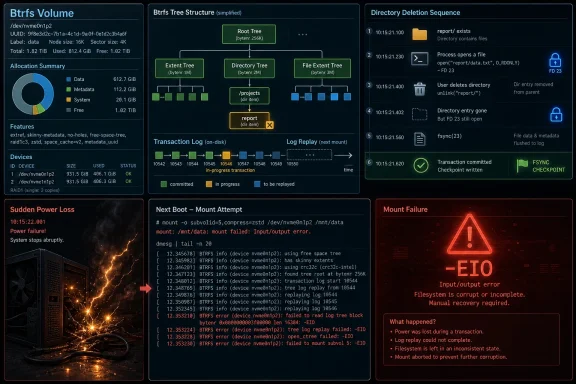
last_unlink_trans, allowing a narrow fsync-and-crash sequence to produce failed log replay and an -EIO mount error. This is not a remote-code-execution fire drill, and it is not the sort of vulnerability that turns every Linux desktop into a sitting duck overnight. But it is a reminder that filesystem bugs earn CVE numbers for a reason: when metadata ordering goes wrong, the blast radius is measured not in shell access, but in whether a machine comes back cleanly after power loss.The uncomfortable part is that the failure path looks almost boring. Make a directory, move a child out of it, remove the now-empty directory while a process still has it open, fsync that file descriptor, lose power, then watch Btrfs trip over its own log replay on the next mount. That is not an everyday user workflow, but it is also not science fiction in a world of containers, build systems, package managers, sync daemons, backup agents, and applications that keep directory handles open longer than humans expect.
 A Filesystem CVE Without the Usual Security Theater
The modern CVE feed has trained administrators to sort vulnerabilities by familiar instincts: network reachable is bad, local-only is less bad, code execution is worse than denial of service, and anything without a score can wait until tomorrow’s patch review. CVE-2026-46160 does not fit neatly into that triage rhythm because its practical risk is tied to filesystem state, crash timing, and workload behavior rather than a simple attacker checklist.The bug lives in Btrfs, the copy-on-write filesystem used across parts of the Linux ecosystem for snapshots, checksumming, compression, subvolumes, and rollback-friendly system layouts. It is popular with enthusiasts and increasingly routine in distributions that lean into transactional updates or snapshot-based recovery. WindowsForum readers may know it less as a daily-driver Windows concern and more as the storage layer beneath Linux workstations, homelabs, WSL-adjacent workflows, NAS boxes, and dual-boot machines where a Linux volume quietly carries the important stuff.
The defect centers on a field called
last_unlink_trans, which is exactly the kind of internal bookkeeping name that sounds harmless until it is not. In Btrfs, transaction IDs and log replay rules decide what must be reconstructed after a crash. If a directory deletion does not advertise its unlink history correctly, the filesystem can later make the wrong choice about what to log or replay.That is why this CVE is best understood as an integrity and availability issue, not an exploit circus. The most credible bad outcome is a filesystem that refuses to mount normally after a crash-like event, with kernel logs reporting a corrupt leaf and invalid directory link count during tree-log replay. For an administrator, “not exploitable over the network” is cold comfort when the affected host is a workstation with the only recent copy of a project tree or a small server expected to survive a power hiccup.
The Bug Is a Missing Breadcrumb, Not a Broken Lock
The submitted scenario is unusually helpful because it shows the bug in procedural form rather than burying it under a generic “local denial of service” label. A user creates nested directories, forces earlier state to disk, changes metadata on the parent, fsyncs it, moves the child directory elsewhere, opens a file descriptor on the emptied parent, removes that parent by path, then fsyncs the still-open descriptor. A simulated or real power failure after that sequence leaves Btrfs with a log replay problem on the next mount.That workflow exposes a subtle POSIX reality: removing a directory name from the filesystem namespace is not the same thing as every reference to that directory vanishing immediately. A process can hold a file descriptor to an object that no longer has a pathname. Filesystems have to account for those edge cases because Unix semantics deliberately allow them.
The failed accounting here is the missing update to
last_unlink_trans when removing a directory. In ordinary language, Btrfs failed to record a last-unlink transaction marker at the moment it needed one. Later, when fsync logic decided what had to be captured in the log, the stale marker could mislead the filesystem into a replay state that did not match the real directory topology.That mismatch showed up as an invalid link count for a directory during log replay. The kernel log excerpt in the CVE report is dense, but the important line is plain enough: Btrfs found a directory inode whose link count did not satisfy expected constraints. At that point, refusing to proceed is the safer behavior; the alternative would be trusting inconsistent metadata and risking deeper corruption.
Fsync Is Where Filesystem Promises Become Expensive
The public tends to think of a filesystem as a database of files and folders. Administrators know better: a filesystem is also a crash-recovery protocol. The interesting bugs appear where the filesystem’s promise to preserve ordering meets real machines that lose power, kernels that panic, batteries that die, and storage devices that reorder writes behind layers of caches.fsync is the user-space lever that asks the filesystem to turn pending state into a durable promise. Applications use it when they cannot tolerate losing a rename, directory entry, database commit, package update, or configuration write. On Btrfs, as on other modern filesystems, the implementation is more complicated than “write everything now,” because writing everything all the time would destroy performance.Btrfs uses a tree log to accelerate fsync-heavy workloads. Instead of committing the entire filesystem transaction for every sync request, it can log enough metadata to replay the necessary changes after a crash. That optimization is central to the bug: a log is only as good as the dependency tracking that tells it what matters.
A missing
last_unlink_trans update is not a bad pointer or a classic memory-safety flaw. It is a logical hole in the recovery story. The filesystem forgot to mark a directory-removal fact that later fsync behavior needed in order to make a safe replay decision.This is the kind of problem that tends to hide in edge conditions. If there is no crash, users may never notice. If the directory is not held open, the path may be different. If the timing is different, a full transaction commit may paper over the issue. But filesystems do not get to declare victory only on clean shutdowns.
The CVE Label Is Doing Two Jobs at Once
There is a recurring complaint in Linux circles that many kernel CVEs now look like ordinary bug fixes wearing security badges. The complaint is not entirely unfair. The kernel project’s CVE process has become more aggressive about assigning identifiers to fixes that may have security consequences, even when exploitation details are narrow or impact scoring is incomplete.CVE-2026-46160 is a good example of why that approach is both noisy and useful. On one hand, this is a highly specific filesystem consistency bug, and NVD had not supplied CVSS scoring in the initial record. It does not immediately tell a security team whether the issue is critical, high, medium, or an operational nuisance.
On the other hand, the CVE label ensures the fix enters vulnerability-management machinery that plain kernel commit messages often miss. Enterprises do not always track every stable kernel patch with the same urgency they apply to CVE-tagged advisories. Giving the bug an identifier makes it visible to scanners, dashboards, distro trackers, and patch governance processes.
The cost is ambiguity. Security teams now have to distinguish between a remotely exploitable kernel flaw, a local privilege escalation, and a crash-recovery filesystem bug that may require unusual sequencing. All three can arrive in the same vulnerability feed. Treating them identically is bad risk management, but ignoring the third category because it lacks drama is how storage incidents become weekend-long recovery exercises.
The Real Attacker May Be the Power Cord
The CVE description does not present a simple hostile-user exploit path. It presents a reproducible filesystem state transition followed by power failure. That matters because the most plausible trigger may not be an attacker at all.A laptop battery can die at the wrong moment. A desktop can lose power during a storm. A virtual machine host can reset. A test rig can crash under kernel development. A storage box can trip over a flaky controller. If the system happens to be running software that manipulates directories and calls fsync in the right sequence, the difference between “rare bug” and “real outage” is not malice; it is timing.
That framing should feel familiar to anyone who has administered Windows systems through NTFS dirty-bit checks, BitLocker recovery surprises, or update rollback failures. The operating systems differ, but the operational lesson is the same. Storage correctness bugs often become visible only when something else has already gone wrong.
The phrase “local denial of service” undersells that reality. A network daemon crash is annoying. A filesystem that fails log replay on mount can block boot, stall recovery, or force an administrator into rescue media and careful mount options. Even if data remains recoverable, the downtime is not theoretical.
For consumer systems, the practical risk is probably low unless Btrfs is the root filesystem or holds important working data. For Linux servers, NAS appliances, developer workstations, and lab machines using Btrfs features heavily, the risk deserves more attention. The bug is narrow, but it sits under everything else.
Btrfs’ Strengths Make Its Edge Cases More Visible
Btrfs invites scrutiny because it promises a lot. Checksums, snapshots, send/receive, reflinks, transparent compression, subvolumes, and online management features make it more ambitious than traditional filesystems. Those features are precisely why many users choose it, and precisely why its correctness model is complicated.Copy-on-write filesystems must track relationships that simpler designs can sometimes avoid. A metadata update is not just an in-place write; it may create new tree blocks, update references, preserve old versions long enough for snapshots, and maintain replay information for fsync. That complexity is not a design flaw by itself. It is the cost of the feature set.
The CVE also shows why Btrfs bugs often sound more alarming than they are. Kernel logs that mention “corrupt leaf” can make users imagine random disk rot or catastrophic metadata collapse. In this case, the reported corruption is the filesystem detecting an impossible state during replay, not necessarily proof that the underlying storage device silently destroyed data.
That distinction is important for administrators deciding how to respond. A Btrfs consistency error after a known crash sequence is not automatically evidence of bad RAM, bad SSD firmware, or a failing disk. It can be software ordering logic doing the wrong thing under a specific replay path.
Still, perception matters. Filesystems live or die by trust, and trust is damaged less by the existence of bugs than by the uncertainty around their consequences. Btrfs has matured substantially over the years, but every replay or fsync bug reopens the old argument about whether its richer feature set is worth the operational complexity.
Windows Users Are Not as Far Away From This as They Think
At first glance, a Linux kernel Btrfs CVE might seem misplaced on a Windows-centered forum. Windows does not ship Btrfs as a native system filesystem, and most Windows desktops will never mount a Btrfs volume. But the modern Windows enthusiast and IT pro lives in a mixed environment.WSL has made Linux tooling ordinary on Windows machines, even if WSL’s default storage path is not Btrfs. Developers frequently move artifacts among Windows, Linux VMs, containers, external drives, NAS shares, and dual-boot partitions. Homelab users often run Windows clients against Linux storage servers. IT teams may support Windows fleets backed by Linux infrastructure that uses Btrfs for snapshots or backups.
The relevant question is not “does Windows use Btrfs?” It is “does any system in the chain that holds important data use a vulnerable Linux kernel with Btrfs?” If the answer is yes, then Windows users can still feel the outage indirectly. A Windows workstation cannot pull a backup from a Linux server that failed to mount its Btrfs volume cleanly.
There is also a cultural overlap. Windows administrators have spent years learning that update reliability, recovery partitions, filesystem checks, and rollback paths are security issues even when they are not intrusions. Linux storage bugs belong in the same mental bucket. Availability is part of security when a system’s job is to be there.
The CVE therefore matters less as a direct Windows threat and more as a cross-platform operations story. The boundary between Windows and Linux has blurred in the places where developers, sysadmins, and power users actually work. Storage incidents do not respect brand loyalty.
Patch Management Has to Read Past the Score
At the time reflected in the record supplied, NVD had marked the CVE as awaiting enrichment and had not assigned CVSS vectors. That absence should not be mistaken for evidence that the issue is harmless. It means the vulnerability database had not yet completed its scoring and classification pass.For administrators, the better signal is the existence of stable kernel references and the concrete failure mode. A kernel fix has been made available through the upstream stable process, and distributions will decide how quickly to carry it into their supported kernels. The exact package name and version will vary by distribution, kernel stream, and vendor backport policy.
This is where Linux patching becomes deceptively hard. A distribution may backport the fix without changing the headline kernel version in a way that makes upstream version comparisons obvious. Conversely, a system running a newer-looking kernel from a custom source may still need confirmation that the specific Btrfs patch is present. Version numbers alone are often an unreliable proxy for fix status.
Enterprise teams should therefore follow their distribution advisories rather than trying to map raw upstream commit hashes by hand. Fedora, SUSE, Debian, Ubuntu, Arch, enterprise rebuilds, appliance vendors, and cloud images all have different kernel packaging habits. If a system uses Btrfs for root, virtual machine images, container storage, backups, or user data, it belongs in the review set.
The most practical immediate step is boring: update to a kernel package that includes the fix once your vendor ships it, then reboot into that kernel. Kernel filesystem fixes do not help a running machine until the patched kernel is actually in use. On systems where uptime politics delay reboots indefinitely, “installed” and “protected” are two different states.
The Workload Clues Matter More Than the Brand Name
Not every Btrfs system has equal exposure. A mostly idle desktop with clean shutdowns and modest directory churn is not in the same risk category as a build server, container host, snapshot-heavy workstation, or backup target that constantly creates, moves, removes, and syncs directory trees. The triggering sequence is narrow, but automation makes narrow sequences less rare.Package managers are obvious candidates for attention because they manipulate directory structures and care about durability. Build systems and test runners can create and delete thousands of directories in short periods. Sync clients and backup tools may hold descriptors while reconciling namespace changes. Container runtimes and image builders can generate filesystem churn that no human would produce manually.
The supplied reproduction uses
xfs_io to fsync and a deliberate sequence around rmdir. That does not mean only someone typing those commands is at risk. Reproduction cases are distilled versions of broader behavior. The real world hides similar patterns inside libraries, runtime environments, and services.This is also why crash timing is the key multiplier. Without an interruption at the wrong moment, the bug may leave no visible symptom. With an interruption, the next mount becomes the test. Administrators should think in terms of systems that are both write-active and interruption-prone: laptops, lab machines, edge boxes, home servers without UPS protection, and virtual machines running on hosts that are not always gracefully maintained.
A UPS, sane shutdown behavior, and conservative storage hardware do not replace patching. They do, however, reduce the chance that any fsync replay bug becomes the incident of the week. Filesystem resilience is layered, and the kernel fix is only one layer.
Recovery Is Not the Moment for Heroics
If a system does hit a Btrfs log replay failure, the first instinct should not be to start running repair commands found in a forum thread from three years ago. Btrfs repair tooling can be powerful, but it can also make a recoverable situation worse if used without a clear diagnosis. The safer posture is to preserve evidence, avoid unnecessary writes, and work from a known-good recovery plan.Administrators should capture kernel logs, note the exact kernel version, record recent workload and power events, and determine whether the system is failing during log replay. If the data matters, image the block device before attempting invasive repairs. This is slow and unglamorous, but it is how you avoid converting downtime into data loss.
Mount options and recovery procedures vary by case, and they should be guided by current distribution documentation or upstream Btrfs guidance. The existence of this CVE does not mean every Btrfs mount error after a crash is CVE-2026-46160. Filesystems can fail for many reasons, including hardware faults, memory errors, controller bugs, firmware behavior, and unrelated kernel defects.
The better lesson is preventive. Keep backups that are not merely snapshots on the same filesystem. Test restore paths. Avoid treating Btrfs snapshots as a substitute for offline or remote backup. Snapshots are excellent for rollback and operational convenience, but they do not save you if the underlying filesystem cannot be mounted and no independent copy exists.
That point is not anti-Btrfs; it is anti-magical thinking. Every advanced filesystem feature is easier to enjoy when recovery does not depend on it being perfect.
The Kernel’s Quiet Fixes Are Where Reliability Actually Improves
The upstream fix for CVE-2026-46160 is small in concept: make sure the unlink transaction state is propagated when a directory is removed, so later fsync behavior does not build an unsafe replay story. That is how many serious reliability fixes look. They rarely arrive with a new UI, a marketing diagram, or a keynote slot.Kernel engineering advances through these unromantic corrections. A field is updated earlier. A replay path becomes more conservative. A reference count is checked in a place it previously was not. A directory operation that only failed under crash timing gets a regression test. Users experience the result as nothing happening, which is exactly what a filesystem should deliver after power returns.
The CVE system tends to flatten those distinctions into a feed of identifiers. That is unfortunate, but it is also useful. Without the CVE, many administrators would never see the bug unless they read stable kernel mailing lists or Btrfs commit logs. With it, the problem enters the patch-management bloodstream.
The challenge for vendors is communication. “Btrfs: fix missing last_unlink_trans update when removing a directory” is precise for kernel developers and opaque for everyone else. The administrator-facing translation is simpler: under a particular directory removal and fsync sequence, a crash could leave Btrfs unable to replay its log cleanly, so update your kernel if you use Btrfs.
That translation is what security advisories too often fail to provide. They tell us the component and the identifier, but not the operational story. CVE-2026-46160 is all operational story.
The Practical Read for Btrfs Shops
For teams using Btrfs, the response should be measured but real. This is not a reason to panic-migrate filesystems, and it is not proof that Btrfs is uniquely unsafe. It is a reason to check kernel maintenance, reboot discipline, and recovery assumptions.- Systems using Btrfs should receive a vendor kernel update that includes the directory-removal
last_unlink_transfix. - Administrators should confirm that machines have rebooted into the patched kernel rather than merely installing the package.
- Hosts with heavy directory churn, container workloads, build automation, package operations, or snapshot-heavy workflows deserve priority in patch scheduling.
- Machines without reliable power protection face a higher practical risk because the failure depends on crash or power-loss timing.
- Recovery plans should rely on tested external backups, not only on Btrfs snapshots stored inside the same affected filesystem.
- NVD’s initial lack of CVSS scoring should not be treated as a clean bill of health, because the described failure mode is concrete even before enrichment is complete.
CVE-2026-46160 will probably pass quietly for most users: a kernel update, a reboot, and no visible drama. That is the best outcome. But its lesson should stick around longer than the advisory: modern systems depend on layers of crash-recovery promises that users rarely see, and the smallest missing breadcrumb in those layers can decide whether a machine returns from failure as if nothing happened or stops cold at mount time.
References
- Primary source: NVD / Linux Kernel
Published: 2026-05-29T01:04:08-07:00
NVD - CVE-2026-46160
 nvd.nist.gov
- Security advisory: MSRC
Published: 2026-05-29T01:04:08-07:00
Original feed URL
Security Update Guide - Microsoft Security Response Center
 msrc.microsoft.com
- Related coverage: spinics.net
Re: [PATCH] btrfs: fix missing last_unlink_trans update when removing a directory — Linux BTRFS
Linux BTRFS Storage: Re: [PATCH] btrfs: fix missing last_unlink_trans update when removing a directory www.spinics.net
- Related coverage: chromium.googlesource.com
- Related coverage: kernel.googlesource.com
- Related coverage: mail-archive.com
Re: [PATCH] Btrfs: fix log replay failure after unlink and link combination
www.mail-archive.com
- Related coverage: opennet.ru
- Related coverage: android.googlesource.com
- Related coverage: git.sceen.net
- Related coverage: kernel.org
