

Linux kernel maintainers have published CVE-2026-46319, a newly listed use-after-free flaw in the
The uncomfortable lesson is not that every Linux system is suddenly on fire. It is that modern networking stacks increasingly depend on delicate lifetime rules that are invisible to administrators until a CVE lands. CVE-2026-46319 is a small bug in a specialized component, but it belongs to a much larger class of failures: concurrency errors in privileged kernel paths that are hard to trigger, hard to reason about, and easy to underestimate.
The affected code sits in
The vulnerability turns on a familiar kernel pattern: find an object in a shared table, take a reference to keep it alive, then use it. The problem is that the lookup helper used here,
That interval is the bug. The returned
The official description says the vulnerability can lead to privilege escalation. That phrasing is important. It does not promise an easy, universal exploit, and the provided analysis notes that the race window is very short. But kernel UAFs do not need to be easy to deserve attention, especially when they live in code reachable from network configuration surfaces that may be exposed inside containers or delegated networking environments.
CVE-2026-46319 is a clean example of what happens when that contract is split across helper boundaries.
The subtlety is that the code looks reasonable at a glance. The lookup happens; the pointer is checked; the reference count is incremented only if the object is still alive. But
That distinction is why kernel memory-lifetime bugs are so persistent. The primitives are individually correct, but the composition is wrong. RCU, refcounts, mutexes, and delayed work can all appear in the same function, and the bug still hides in the few instructions between them.
The race arises when one CPU is attempting to acquire a reference to a flow table while another has already scheduled or completed the cleanup path. If the object is found during the RCU-protected lookup but freed before
The analysis included with the CVE says the race window is very short and notes that an artificial
The other practical point is that short races age poorly. A system under load, a container host with churn in network namespaces, or a fuzzing-inspired exploit path can widen opportunities that looked academic on a developer workstation. Timing bugs are not binary; they are probabilities wrapped in scheduler behavior, allocator state, CPU topology, and attacker patience.
WSL is the most visible bridge, but it is not necessarily the highest-risk one. Typical WSL users are less likely to expose privileged Linux traffic-control surfaces than a Kubernetes node, router appliance, or multi-tenant lab host. Still, developers often run elevated tooling, container engines, packet shapers, VPN clients, and experimental networking stacks on machines that also hold credentials and source code. The question is not whether CVE-2026-46319 is a Windows CVE. It is whether your Windows environment quietly depends on a vulnerable Linux kernel somewhere in the chain.
The same applies to enterprise appliances. Many “network” products are Linux systems with vendor skins, delayed patch cadences, and kernel modules that customers never directly inspect. If those devices expose traffic-control functionality internally or through orchestration layers, their risk profile may differ sharply from a generic desktop distribution. Administrators should care less about the logo on the console and more about whether the underlying kernel contains the fix.
This is also where vulnerability management gets messy. The NVD entry was newly published and had not yet received NVD CVSS scoring at the time of publication. That absence of a score should not be read as low severity. It means the enrichment process has not caught up, while kernel maintainers have already treated the issue as a real bug and pushed stable fixes.
The attack surface depends heavily on who can create, modify, or tear down traffic-control actions involving
That nuance matters for prioritization. If an attacker already has full root on the host, this CVE is not the interesting step. If an attacker has a constrained foothold in a container, namespace, lab account, or service with delegated network configuration, a kernel privilege-escalation primitive becomes much more interesting. The same bug can be boring on one machine and urgent on another.
The exploitability also depends on kernel allocator behavior and whether the freed object can be reclaimed in a useful way. A use-after-free is not automatically code execution, and modern kernels have hardening features that raise the bar. But defenders should not confuse “requires skill” with “requires magic.” The Linux kernel has a long history of difficult race bugs becoming usable under the right conditions.
The patch title says almost everything:
That is why backport coverage matters more than the exact upstream version in isolation. Enterprises rarely run pristine mainline kernels. They run distribution kernels, vendor kernels, cloud kernels, and appliance kernels with backported security fixes. A system may report an older version number and still contain the patch, or it may report a newer-looking vendor build and still be waiting for the relevant advisory. Version string archaeology is no substitute for vendor security notes and changelogs.
For administrators, the immediate job is to map exposure. Which systems run Linux kernels with traffic-control connection tracking available? Which ones allow containers, services, or users to configure qdiscs, filters, or actions? Which appliances depend on vendor kernels that lag upstream stable? The answer will not be the same across a fleet, and that is the point.
The critical operational question is not whether a random user can trigger the flaw on a default desktop. It is whether an environment has delegated enough networking authority to a workload, tenant, build job, or operator account for
This is especially relevant in CI and developer infrastructure. Build systems and test harnesses routinely create network namespaces, virtual Ethernet pairs, qdiscs, and firewall state. They may do so in ephemeral environments where the assumption is that teardown removes the risk. A race in object cleanup is a reminder that churn itself can be part of the exploit condition.
Cloud and hosting providers have a different problem. They may have strong external isolation but complex internal service layers that manipulate traffic control on behalf of customers. If those paths cross vulnerable code, the attacker may not need shell access to the host in the traditional sense. They may need only an API or workload action that causes privileged host-side networking code to execute in attacker-influenced patterns.
A missing score is not a missing vulnerability. The kernel.org source text says the issue can lead to privilege escalation, and the stable fixes exist. That is enough to begin triage, even if a dashboard has not yet colored the row orange or red. Security teams that wait for NVD scoring before acting on kernel privilege-escalation bugs are outsourcing judgment to a queue.
The better approach is contextual severity. A workstation fleet with no untrusted local users and no delegated networking may patch through the normal kernel cycle. A multi-tenant container host, network appliance, lab server, or CI runner with broad namespace churn should move faster. The same CVE can justify different timelines without pretending the underlying bug changes.
This is also a useful moment to revisit exception handling. Many Linux kernel CVEs arrive with sparse exploit detail, incomplete scoring, and a description that reads like a commit message. That does not mean defenders should ignore them. It means the defensive process must be able to translate kernel-maintainer language into operational risk before the vulnerability-industrial complex finishes decorating the entry.
This is why concurrency bugs are so often humbling. They are not always missing bounds checks or obvious null dereferences. They are violations of temporal logic: this object was valid then, but is it valid now? The answer can change between two lines of C, and on a busy kernel, “between two lines” is a real execution environment.
For kernel developers, CVE-2026-46319 is a reminder to be suspicious of helper APIs that hide synchronization. A function named
For administrators, the lesson is less philosophical. If your vendor ships a kernel update containing this fix, install it. If your distribution backports the patch without changing the major kernel version, verify by advisory rather than by version number alone. If your appliance vendor has not issued guidance, ask for it.
That does not mean every Windows user should panic about CVE-2026-46319. It means Windows professionals need enough Linux literacy to ask the right questions. Is WSL installed? Which kernel does it use? Are developers running privileged containers? Are Hyper-V Linux guests patched through the same discipline as Windows Server? Are network appliances tracked as software assets or merely as boxes with IP addresses?
The answer in many organizations is still uneven. Windows endpoints may be beautifully inventoried while the Linux VM running a crucial internal service is “owned by the app team.” Network appliances may sit outside normal patch SLAs. Developer laptops may run container stacks that security teams barely see. CVE-2026-46319 is not the biggest kernel bug imaginable, but it is a useful probe of whether those blind spots still exist.
It also highlights a cultural mismatch. Windows patching has trained many admins to think in monthly rollups, KB numbers, and centrally visible compliance states. Linux kernel patching is more fragmented: upstream commits, stable branches, distribution advisories, livepatch offerings, vendor kernels, and appliance firmware all overlap. Hybrid security requires fluency in both worlds.
Administrators should also resist the urge to hunt only for public exploit code. For a freshly published kernel CVE, absence of exploit chatter is a weak signal. Race vulnerabilities can move from theoretical to practical as researchers refine triggering conditions, especially when the vulnerable code sits in subsystems already familiar to kernel exploit developers.
The right mental model is “patchable local privilege-escalation risk in specialized networking code.” That is not as dramatic as a wormable remote bug. It is also not nothing. In hardened environments, local privilege escalation is often the bridge between an application compromise and host control.
That pressure is not going away. If anything, container networking, eBPF, smart NIC offloads, virtual switching, and service-mesh plumbing are making kernel networking more central to application delivery. The industry wants the kernel to be both a high-speed dataplane and a safely shared multi-tenant substrate. CVE-2026-46319 is one more reminder that those goals are in tension.
The hopeful part is that the kernel community finds and fixes these bugs constantly. The less comforting part is that the fixes often arrive as terse commit messages that only later become CVEs, scanner findings, and emergency tickets. Defenders need a workflow that recognizes security significance before the paperwork is fully dressed.
CVE-2026-46319 will probably not be remembered as a landmark vulnerability, and that is precisely why it is useful. It shows how modern infrastructure risk accumulates in small synchronization mistakes, hidden helper contracts, and privilege boundaries that looked reasonable until a kernel object was freed a few instructions too soon. The next phase of Windows administration will not be defined only by Patch Tuesday; it will be defined by how well Windows shops understand the Linux systems already inside their perimeter, and how quickly they can turn a terse kernel fix into a closed operational gap.
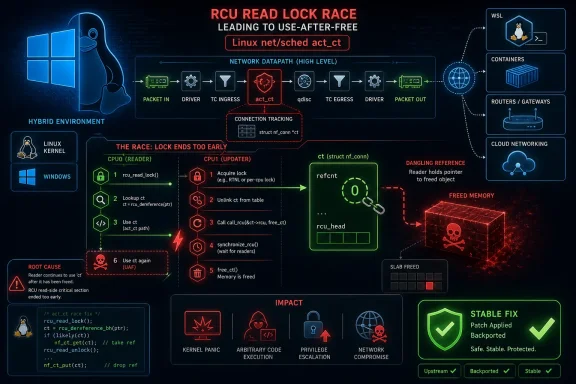
act_ct traffic-control connection-tracking action, after a race in flow-table lookup and reference acquisition was fixed across stable kernel branches on June 9, 2026. The bug is not a Windows vulnerability, but it matters to WindowsForum readers because Linux is now the substrate under so much of the Windows-adjacent world: WSL, containers, edge appliances, virtualization hosts, lab routers, cloud images, and security tooling. This is the kind of kernel flaw that looks microscopic in code review and disproportionate in operational impact. A pointer is looked up under RCU, the protection ends too early, and a narrow timing window becomes a privilege-escalation story.The uncomfortable lesson is not that every Linux system is suddenly on fire. It is that modern networking stacks increasingly depend on delicate lifetime rules that are invisible to administrators until a CVE lands. CVE-2026-46319 is a small bug in a specialized component, but it belongs to a much larger class of failures: concurrency errors in privileged kernel paths that are hard to trigger, hard to reason about, and easy to underestimate.
 A Tiny Race in Traffic Control Becomes a Kernel Security Problem
The affected code sits in net/sched, the Linux kernel’s traffic-control subsystem, specifically in act_ct, the action that integrates connection tracking with packet classification. In plain English, this is plumbing for systems that inspect, classify, redirect, police, or offload network traffic. It is not usually the part of Linux that desktop users think about, but it is exactly the part that shows up in routers, container hosts, network namespaces, firewalls, service meshes, and virtualized infrastructure.The vulnerability turns on a familiar kernel pattern: find an object in a shared table, take a reference to keep it alive, then use it. The problem is that the lookup helper used here,
rhashtable_lookup_fast(), internally opens and closes an RCU read-side critical section before returning the object pointer. By the time the caller tries to increment the object’s reference count with refcount_inc_not_zero(), the object may no longer be protected.That interval is the bug. The returned
ct_ft pointer can refer to a flow-table object that was valid during lookup but freed immediately afterward by cleanup work. If cleanup wins the race, the subsequent reference-count operation is performed on freed memory. In kernel security vocabulary, that is a use-after-free; in real-world risk vocabulary, it is a potential path from constrained local capability to broader control.The official description says the vulnerability can lead to privilege escalation. That phrasing is important. It does not promise an easy, universal exploit, and the provided analysis notes that the race window is very short. But kernel UAFs do not need to be easy to deserve attention, especially when they live in code reachable from network configuration surfaces that may be exposed inside containers or delegated networking environments.
RCU Did Its Job Until the Caller Stepped Outside the Guardrail
Read-copy-update, or RCU, is one of the kernel’s great performance compromises. It lets readers traverse shared data structures cheaply while writers remove objects in a delayed, carefully staged way. The bargain works only if code respects the lifetime contract: a pointer observed under RCU protection must either be used only while that protection is active or converted into a stable reference before protection ends.CVE-2026-46319 is a clean example of what happens when that contract is split across helper boundaries.
rhashtable_lookup_fast() performs the lookup while holding rcu_read_lock(), then drops the lock before returning the pointer. That is fine for callers that only need an ephemeral pointer or can otherwise guarantee lifetime. It is not fine for a caller that plans to take a reference after the helper returns.The subtlety is that the code looks reasonable at a glance. The lookup happens; the pointer is checked; the reference count is incremented only if the object is still alive. But
refcount_inc_not_zero() cannot protect an object that has already been freed between the lookup and the increment. It prevents resurrecting an object whose refcount has reached zero while the memory is still a valid object. It does not magically make a stale pointer safe.That distinction is why kernel memory-lifetime bugs are so persistent. The primitives are individually correct, but the composition is wrong. RCU, refcounts, mutexes, and delayed work can all appear in the same function, and the bug still hides in the few instructions between them.
The Cleanup Path Makes the Race More Than Theoretical
The free path described in the CVE record is straightforward enough to be alarming. Whentcf_ct_flow_table_put() drops the last reference, it removes the flow table from the hash table, initializes RCU work, and queues cleanup. That cleanup eventually calls nf_flow_table_free(), checks the flow block, frees the ct_ft object with kfree(), and releases the module reference.The race arises when one CPU is attempting to acquire a reference to a flow table while another has already scheduled or completed the cleanup path. If the object is found during the RCU-protected lookup but freed before
refcount_inc_not_zero() runs, the caller is now operating on memory that may have been returned to the allocator. In kernel exploit development, that is often where the story begins rather than ends.The analysis included with the CVE says the race window is very short and notes that an artificial
msleep(100) was inserted after the lookup to make triggering easier. That detail should temper panic, but it should not become an excuse for neglect. Many serious kernel exploits begin as “hard to win” races before researchers find shaping techniques, allocator grooming strategies, or workload patterns that make the timing less hostile.The other practical point is that short races age poorly. A system under load, a container host with churn in network namespaces, or a fuzzing-inspired exploit path can widen opportunities that looked academic on a developer workstation. Timing bugs are not binary; they are probabilities wrapped in scheduler behavior, allocator state, CPU topology, and attacker patience.
This Is a Linux Bug, but Windows Shops Still Need to Read the Advisory
For a Windows-first audience, the temptation is to file this under “not our platform.” That is increasingly a category error. Windows estates now routinely contain Linux kernels in places that are easy to forget: WSL instances on developer laptops, Linux VMs on Hyper-V, container hosts in CI pipelines, embedded appliances in branch offices, and cloud workloads managed by Windows-heavy teams.WSL is the most visible bridge, but it is not necessarily the highest-risk one. Typical WSL users are less likely to expose privileged Linux traffic-control surfaces than a Kubernetes node, router appliance, or multi-tenant lab host. Still, developers often run elevated tooling, container engines, packet shapers, VPN clients, and experimental networking stacks on machines that also hold credentials and source code. The question is not whether CVE-2026-46319 is a Windows CVE. It is whether your Windows environment quietly depends on a vulnerable Linux kernel somewhere in the chain.
The same applies to enterprise appliances. Many “network” products are Linux systems with vendor skins, delayed patch cadences, and kernel modules that customers never directly inspect. If those devices expose traffic-control functionality internally or through orchestration layers, their risk profile may differ sharply from a generic desktop distribution. Administrators should care less about the logo on the console and more about whether the underlying kernel contains the fix.
This is also where vulnerability management gets messy. The NVD entry was newly published and had not yet received NVD CVSS scoring at the time of publication. That absence of a score should not be read as low severity. It means the enrichment process has not caught up, while kernel maintainers have already treated the issue as a real bug and pushed stable fixes.
The Exploitability Argument Cuts Both Ways
There are two bad ways to talk about this vulnerability. One is to treat every kernel UAF as an imminent remote catastrophe. The other is to dismiss it because the proof path needs a carefully timed race. CVE-2026-46319 sits between those extremes, which is exactly where many operationally important bugs live.The attack surface depends heavily on who can create, modify, or tear down traffic-control actions involving
act_ct. On ordinary locked-down systems, that usually requires elevated privileges or capabilities such as network administration rights. In containerized environments, however, the boundary can become more complicated. A container with broad networking capabilities is not the same thing as an unprivileged process, but it is also not the same risk as root on the host being the only relevant actor.That nuance matters for prioritization. If an attacker already has full root on the host, this CVE is not the interesting step. If an attacker has a constrained foothold in a container, namespace, lab account, or service with delegated network configuration, a kernel privilege-escalation primitive becomes much more interesting. The same bug can be boring on one machine and urgent on another.
The exploitability also depends on kernel allocator behavior and whether the freed object can be reclaimed in a useful way. A use-after-free is not automatically code execution, and modern kernels have hardening features that raise the bar. But defenders should not confuse “requires skill” with “requires magic.” The Linux kernel has a long history of difficult race bugs becoming usable under the right conditions.
Stable Backports Tell Administrators Where the Real Priority Lies
The references attached to the CVE point to multiple stable kernel commits, which is the signal administrators should care about most. A fix that lands only upstream can be a future hygiene note. A fix that is propagated through maintained stable branches is a patch-management item.The patch title says almost everything:
net/sched: act_ct: Only release RCU read lock after ct_ft. The repair is not a new feature, a redesign, or a sweeping mitigation. It is a lifetime fix. The object must remain protected until the code has safely obtained the reference it needs.That is why backport coverage matters more than the exact upstream version in isolation. Enterprises rarely run pristine mainline kernels. They run distribution kernels, vendor kernels, cloud kernels, and appliance kernels with backported security fixes. A system may report an older version number and still contain the patch, or it may report a newer-looking vendor build and still be waiting for the relevant advisory. Version string archaeology is no substitute for vendor security notes and changelogs.
For administrators, the immediate job is to map exposure. Which systems run Linux kernels with traffic-control connection tracking available? Which ones allow containers, services, or users to configure qdiscs, filters, or actions? Which appliances depend on vendor kernels that lag upstream stable? The answer will not be the same across a fleet, and that is the point.
The Real Risk Lives in Delegated Networking
Traffic control is powerful because it lets Linux act like a programmable network dataplane. That power is why it appears in container networking, shaping, classification, ingress handling, and offload paths. It is also why mistakes innet/sched deserve more respect than their dry filenames suggest.The critical operational question is not whether a random user can trigger the flaw on a default desktop. It is whether an environment has delegated enough networking authority to a workload, tenant, build job, or operator account for
act_ct setup and teardown to become reachable. Capabilities such as CAP_NET_ADMIN are often handed out too casually because they feel narrower than full root. In practice, they expose large parts of kernel networking.This is especially relevant in CI and developer infrastructure. Build systems and test harnesses routinely create network namespaces, virtual Ethernet pairs, qdiscs, and firewall state. They may do so in ephemeral environments where the assumption is that teardown removes the risk. A race in object cleanup is a reminder that churn itself can be part of the exploit condition.
Cloud and hosting providers have a different problem. They may have strong external isolation but complex internal service layers that manipulate traffic control on behalf of customers. If those paths cross vulnerable code, the attacker may not need shell access to the host in the traditional sense. They may need only an API or workload action that causes privileged host-side networking code to execute in attacker-influenced patterns.
CVSS Silence Is Not a Security Strategy
At publication, the NVD listing did not include a CVSS v4, v3, or v2 base score from NIST. That is common for freshly published CVEs, particularly kernel issues where enrichment lags the original disclosure. But many organizations still use scanner severity as a proxy for urgency, and this is where the process can betray them.A missing score is not a missing vulnerability. The kernel.org source text says the issue can lead to privilege escalation, and the stable fixes exist. That is enough to begin triage, even if a dashboard has not yet colored the row orange or red. Security teams that wait for NVD scoring before acting on kernel privilege-escalation bugs are outsourcing judgment to a queue.
The better approach is contextual severity. A workstation fleet with no untrusted local users and no delegated networking may patch through the normal kernel cycle. A multi-tenant container host, network appliance, lab server, or CI runner with broad namespace churn should move faster. The same CVE can justify different timelines without pretending the underlying bug changes.
This is also a useful moment to revisit exception handling. Many Linux kernel CVEs arrive with sparse exploit detail, incomplete scoring, and a description that reads like a commit message. That does not mean defenders should ignore them. It means the defensive process must be able to translate kernel-maintainer language into operational risk before the vulnerability-industrial complex finishes decorating the entry.
The Patch Is Small Because the Invariant Is Big
The fix’s conceptual shape is simple: keep the RCU read lock held until after the flow-table pointer has been safely converted into a reference. In other words, do not let the object’s lifetime become unprotected between lookup and refcount acquisition. The code change may be small, but the invariant it restores is fundamental.This is why concurrency bugs are so often humbling. They are not always missing bounds checks or obvious null dereferences. They are violations of temporal logic: this object was valid then, but is it valid now? The answer can change between two lines of C, and on a busy kernel, “between two lines” is a real execution environment.
For kernel developers, CVE-2026-46319 is a reminder to be suspicious of helper APIs that hide synchronization. A function named
lookup_fast() may be correct, but the caller still has to understand whether the returned pointer has a lifetime beyond the helper’s internal critical section. Performance-friendly helpers are only safe when their contracts are impossible to misread or consistently enforced.For administrators, the lesson is less philosophical. If your vendor ships a kernel update containing this fix, install it. If your distribution backports the patch without changing the major kernel version, verify by advisory rather than by version number alone. If your appliance vendor has not issued guidance, ask for it.
Microsoft’s Linux Story Makes These Bugs Part of the Windows Conversation
The old platform boundaries have collapsed in both directions. Microsoft ships Linux integration as a first-class developer feature, Azure runs vast Linux fleets, Defender and Sentinel customers ingest Linux telemetry, and Windows admins increasingly manage hybrid estates whether they asked for them or not. A Linux kernel CVE can now be part of a Windows shop’s exposure simply because Windows is no longer a Windows-only operational universe.That does not mean every Windows user should panic about CVE-2026-46319. It means Windows professionals need enough Linux literacy to ask the right questions. Is WSL installed? Which kernel does it use? Are developers running privileged containers? Are Hyper-V Linux guests patched through the same discipline as Windows Server? Are network appliances tracked as software assets or merely as boxes with IP addresses?
The answer in many organizations is still uneven. Windows endpoints may be beautifully inventoried while the Linux VM running a crucial internal service is “owned by the app team.” Network appliances may sit outside normal patch SLAs. Developer laptops may run container stacks that security teams barely see. CVE-2026-46319 is not the biggest kernel bug imaginable, but it is a useful probe of whether those blind spots still exist.
It also highlights a cultural mismatch. Windows patching has trained many admins to think in monthly rollups, KB numbers, and centrally visible compliance states. Linux kernel patching is more fragmented: upstream commits, stable branches, distribution advisories, livepatch offerings, vendor kernels, and appliance firmware all overlap. Hybrid security requires fluency in both worlds.
The Practical Reading for CVE-2026-46319 Is Narrow, but Not Comforting
The responsible response is targeted action, not generalized alarm. CVE-2026-46319 appears to require access to kernel traffic-control paths involvingact_ct, and the race is described as difficult to trigger without widening the timing window. That reduces the likelihood of casual exploitation on ordinary systems. It does not eliminate the risk for systems where untrusted or semi-trusted actors can influence networking configuration.Administrators should also resist the urge to hunt only for public exploit code. For a freshly published kernel CVE, absence of exploit chatter is a weak signal. Race vulnerabilities can move from theoretical to practical as researchers refine triggering conditions, especially when the vulnerable code sits in subsystems already familiar to kernel exploit developers.
The right mental model is “patchable local privilege-escalation risk in specialized networking code.” That is not as dramatic as a wormable remote bug. It is also not nothing. In hardened environments, local privilege escalation is often the bridge between an application compromise and host control.
The Kernel’s Networking Layer Keeps Reminding Us That Complexity Has a Cost
The Linux networking stack is powerful precisely because it is programmable, extensible, and fast. Those are the same attributes that make its security model difficult. Each action, classifier, offload path, namespace boundary, and cleanup callback adds another place where memory lifetime must be exact.act_ct is not an exotic academic component. Connection tracking is a normal part of firewalling and packet handling, and traffic control is a normal part of Linux network engineering. The vulnerable path may be specialized, but the design pressure that created it is mainstream: do more packet work in kernel space, do it at speed, and make it flexible enough for modern infrastructure.That pressure is not going away. If anything, container networking, eBPF, smart NIC offloads, virtual switching, and service-mesh plumbing are making kernel networking more central to application delivery. The industry wants the kernel to be both a high-speed dataplane and a safely shared multi-tenant substrate. CVE-2026-46319 is one more reminder that those goals are in tension.
The hopeful part is that the kernel community finds and fixes these bugs constantly. The less comforting part is that the fixes often arrive as terse commit messages that only later become CVEs, scanner findings, and emergency tickets. Defenders need a workflow that recognizes security significance before the paperwork is fully dressed.
The Race Window Administrators Should Close First
CVE-2026-46319 is specific enough that the response can be concrete. It should not trigger indiscriminate rebuilds of every Linux-adjacent asset, but it should prompt a fast inventory of systems where Linux traffic control and connection tracking are part of the operating model.- Systems running vendor kernels should be checked against distribution or appliance advisories rather than judged only by upstream kernel version numbers.
- Container hosts, CI runners, lab machines, and network appliances deserve higher priority if untrusted workloads or delegated operators can exercise advanced networking features.
- WSL installations are worth inventorying, but typical desktop exposure is likely lower than on multi-tenant Linux hosts or infrastructure nodes with broad networking capabilities.
- Security teams should treat the lack of an NVD score on June 9, 2026, as an enrichment gap, not as evidence that the vulnerability is harmless.
- The most meaningful mitigation is to install a kernel containing the stable fix; reducing unnecessary
CAP_NET_ADMINexposure is the next best hardening move.
net/sched CVE arrives.CVE-2026-46319 will probably not be remembered as a landmark vulnerability, and that is precisely why it is useful. It shows how modern infrastructure risk accumulates in small synchronization mistakes, hidden helper contracts, and privilege boundaries that looked reasonable until a kernel object was freed a few instructions too soon. The next phase of Windows administration will not be defined only by Patch Tuesday; it will be defined by how well Windows shops understand the Linux systems already inside their perimeter, and how quickly they can turn a terse kernel fix into a closed operational gap.
References
- Primary source: NVD / Linux Kernel
Published: 2026-06-10T01:05:58-07:00
NVD - CVE-2026-46319
 nvd.nist.gov
- Security advisory: MSRC
Published: 2026-06-10T01:05:58-07:00
Original feed URL
Security Update Guide - Microsoft Security Response Center
 msrc.microsoft.com
- Related coverage: opennet.ru
- Related coverage: opennet.me
- Related coverage: windowsforum.com
act_gate RCU snapshot fix: stable patch for Linux traffic-control race (CVE-2026-23245) | Windows Forum
The Linux kernel’s act_gate traffic-control action is getting a focused security fix after maintainers identified a schedule-lifetime race that can appear...windowsforum.com - Related coverage: cvefeed.io
CVE-2026-23270 - net/sched: Only allow act_ct to bind to clsact/ingress qdiscs and shared blocks
In the Linux kernel, the following vulnerability has been resolved: net/sched: Only allow act_ct to bind to clsact/ingress qdiscs and shared blocks As Paolo said earlier [1]: "Since the blamed commit below, classify can return TC_ACT_CONSUMED while the current skb being held by the...cvefeed.io
- Related coverage: cve.imfht.com
CVE-2026-23270: net/sched: Only allow act_ct to bind to clsact/ingress qdiscs and shared blocks - Vulnerability Platform
[HIGH 7.8] Overview A vulnerability exists in the Linux kernel network scheduler (net/sched). When the action is attached to a qdisc other than or (specifically cve.imfht.com
- Related coverage: spinics.net

Re: [PATCH net v3 4/7] net/sched: act_gate: read schedule via RCU — Linux Kernel
Linux Kernel: Re: [PATCH net v3 4/7] net/sched: act_gate: read schedule via RCU
www.spinics.net
- Related coverage: kernel.org
- Related coverage: docs.redhat.com
