

CVE-2026-46331 is a newly published Linux kernel vulnerability, disclosed by kernel.org and added to NVD on June 16, 2026, that fixes a
The vulnerable code sits in the Linux traffic control subsystem, specifically in the
At the center of CVE-2026-46331 is
That is where the wording turns from routine to alarming. If a write lands in memory that remains shared with another object, the kernel can accidentally modify data it never meant to touch. In this case, the published description says the outcome could be page cache corruption, the same broad class of failure that has powered some of the most consequential Linux local privilege-escalation bugs of the past decade.
The fix is correspondingly surgical. Rather than trusting a precomputed range, the patch moves
This is the kind of patch that looks unremarkable until you understand what it is defending. It is not adding a new security framework or disabling a risky feature. It is making sure the kernel does not write into memory it has not first made private.
But when a vulnerability lets an attacker write into the page cache, the abstraction turns hostile. A file may be read-only on disk, protected by permissions, owned by root, or even sitting on a filesystem where writes should not be possible from the attacker’s account. If the cached copy of that file can be modified in memory, the system can be tricked into executing or reading altered content without the disk ever reflecting the change.
That is why Linux people still remember Dirty COW and Dirty Pipe. Those bugs were not identical to CVE-2026-46331, and this new CVE should not be casually described as another full replay of those attacks. But they taught the same architectural lesson: corruption of shared file-backed memory is not merely a stability bug. Under the right conditions, it can become an integrity break.
The kernel.org text for CVE-2026-46331 does not, on its own, claim a public exploit, active exploitation, or a ready-made route to root. NVD also had not assigned a CVSS score in the material available at publication time. That matters, because vulnerability coverage has a bad habit of turning every page-cache phrase into a five-alarm privilege-escalation headline.
Still, administrators should not dismiss it as academic. The affected function lives in a part of the kernel exposed to configured traffic-control rules, and the vulnerable behavior concerns writes at computed offsets inside packet buffers. Bugs in this space are often gated by privileges, capabilities, namespaces, distro configuration, or reachable code paths. Those gates may sharply limit exposure on one system and be surprisingly porous on another.
For WindowsForum readers, the Windows angle is indirect but real. Linux is no longer “some other operating system” in a Microsoft-centric environment. It is WSL, Azure fleet infrastructure, container hosts, Kubernetes nodes, appliances, CI runners, developer workstations, storage systems, and the little Debian or Ubuntu VM someone forgot was sitting under an important internal service.
The function involved,
But Linux privilege boundaries are rarely that tidy anymore. Containerized environments may grant network administration capabilities for legitimate reasons. Lab systems may loosen namespaces. Network appliances may expose packet-editing behavior through higher-level management interfaces. Cloud images may carry vendor kernels with backports that do not line up neatly with upstream version numbers.
That is why kernel CVEs should be triaged by reachable behavior, not by the emotional temperature of the CVE title. A laptop with no traffic-control rules and a distribution kernel already receiving automatic security updates is in a different category from a multi-tenant container host where workloads are granted elevated networking capabilities. A router-like Linux box using sophisticated ingress shaping is in a different category again.
The CVE’s version data also deserves careful reading. The record lists affected ranges around stable kernels including 4.19.244 through before 4.20, 5.4.195 through before 5.5, 5.10.117 through before 5.11, 5.15.41 through before 5.16, and 5.17.9 through before 5.18, along with git commit ranges and later affected status beginning at 5.18 in the record’s second affected-product block. That does not mean every distribution kernel with a similar version string is vulnerable in the same way, because enterprise vendors routinely backport fixes without changing the major kernel identity users see from
The uncomfortable result is familiar: the administrator cannot stop at “my kernel says 5.15.” The administrator must ask whether the distribution’s kernel package includes the relevant stable fix.
The problem is that typed keys added a runtime header offset the hint did not fully account for. Once the real offset diverged from the precomputed assumption, the kernel could perform only a partial copy-on-write. One part of the target write was safely private; another part could still alias memory that should not be modified.
Moving
The extra overflow checking is equally important. Kernel offset arithmetic is a graveyard of “this can never happen” assumptions. Add signed integers, negative offsets, packet headroom, header-relative addressing, and user-influenced configuration, and the code has to defend not only against malicious input but against the C language itself.
The explicit handling of
Traffic control is especially rich. It lets administrators classify, shape, drop, redirect, mark, and edit packets using a flexible collection of filters and actions. That flexibility is why it is useful in routers and container platforms. It is also why mistakes in its internals can be tricky to reason about from the outside.
The
The broader concern is not that
When packet-processing code touches memory shared across kernel abstractions, the security boundary becomes subtle. A bad length check is no longer merely a packet bug. A stale offset assumption is no longer merely a malformed-header problem. It can become a cross-object integrity failure.
WSL is the obvious bridge. A developer workstation running WSL may not look like production infrastructure, but it often holds source code, credentials, package tokens, SSH keys, test data, and access to internal systems. If a Linux kernel issue affects the WSL kernel or a supported distribution environment, it becomes part of the Windows security conversation.
The cloud angle is larger. Azure customers routinely run Linux VMs, Linux-based Kubernetes nodes, and Linux appliances beside Windows Server workloads. Hybrid shops may manage both from the same identity layer and monitoring stack. A local privilege escalation on one Linux host can become a lateral-movement problem for the entire environment.
Then there are the invisible Linux systems: NAS boxes, routers, security gateways, observability collectors, CI runners, hypervisor-adjacent appliances, and vendor-managed agents. These systems rarely announce themselves during patch-planning meetings. They do, however, contain kernels.
CVE-2026-46331 is a reminder that “Windows environment” is a misleading phrase in 2026. The endpoint fleet may be Windows. The identity provider may be Microsoft. The productivity stack may be Microsoft 365. But the operational substrate underneath modern IT is almost always mixed, and Linux kernel hygiene is now part of Windows estate hygiene.
This is where mature vulnerability management separates itself from dashboard theater. A missing CVSS score does not mean missing risk. It means the organization has to reason from affected code, exposure, exploit preconditions, and asset criticality rather than outsourcing urgency to a number.
Kernel.org’s CVE process has also changed the rhythm of Linux vulnerability disclosure. Many kernel fixes now receive CVE identifiers after being resolved upstream, sometimes before downstream vendors have finished advisory language or scoring. That is good for transparency, but it produces a flood of records that look sparse compared with old vendor advisories.
For administrators, the practical response is to track vendor kernel updates rather than wait for NVD enrichment. Ubuntu, Debian, Red Hat, SUSE, Oracle, Amazon Linux, Alpine, Arch, and appliance vendors each have their own backport practices. The same upstream issue may appear under different package versions, advisory IDs, and patch timelines.
The risk of waiting for a perfect CVSS score is that kernel bugs do not respect paperwork. Once a patch is public, the diff is public. Researchers, attackers, defenders, and automated tooling can all inspect the change and infer the vulnerable condition. In some cases, a careful patch diff is more useful than the CVE prose.
A distribution kernel is rarely just “Linux 5.15.” It may be a heavily patched 5.15-based kernel with hundreds or thousands of security and hardware backports. Conversely, a custom-built or vendor-frozen kernel may carry vulnerable code long after upstream stable has moved on. Version strings are clues, not verdicts.
The right workflow starts with the distribution’s security channel. If the vendor has issued a kernel update for CVE-2026-46331 or for the corresponding upstream stable patch, apply it according to normal maintenance policy. If the system uses a custom kernel, compare against the fixed commits or pull the relevant stable branch.
Container hosts deserve special attention because containers share the host kernel. Updating container images does not fix a host kernel vulnerability. Restarting pods does not fix it either. The node must boot into a patched kernel, which means maintenance windows, node draining, live-patching where supported, or fleet replacement.
Live patching may help if the vendor ships a live patch for the affected code path, but teams should not assume that every kernel flaw is live-patchable in their environment. Networking hot paths and data-structure-sensitive fixes can be more complicated than a simple function replacement. The safest validation remains confirming the running kernel contains the fix, not merely that a package has been downloaded.
A broad mitigation may involve limiting who can create or modify traffic-control actions. That generally means auditing use of capabilities such as network administration privileges, especially inside containers or delegated service accounts. If untrusted workloads have
Another mitigation path is to inspect whether hosts use
Namespaces complicate the story. A feature that appears restricted on the host may be reachable inside a network namespace if a process has the right capabilities there. Container platforms have spent years tightening defaults, but real-world deployments often deviate from defaults for performance, packet capture, service mesh integration, or custom networking.
The mitigation message is therefore not “turn off Linux networking magic.” It is “do not hand out networking magic casually.” If a workload does not need to shape, edit, or administer network traffic, it should not hold the capability to do so.
The caution is that family resemblance is not proof of exploit equivalence. Dirty COW, Dirty Pipe, Copy Fail, Fragnesia, and CVE-2026-46331 involve different subsystems, different primitives, different preconditions, and different exploitability profiles. A shared phrase does not mean a shared exploit.
Yet the pattern is real enough to influence triage. The page cache is a high-value target because it sits at the intersection of memory, files, permissions, and execution. Bugs that corrupt it violate assumptions administrators depend on every day: that read-only files remain read-only, that file permissions mediate modification, and that the kernel’s cached view of a file is faithful to storage.
The industry should also be honest about why these bugs keep surfacing. Linux is not suddenly “insecure” in a simplistic sense. Rather, researchers have become better at identifying logic flaws that produce constrained writes, and attackers have become better at weaponizing constrained writes. The floor has risen.
That makes patch latency more dangerous. A bug that once required deep manual analysis may now be easier to classify, reproduce, and adapt using improved fuzzing, symbolic analysis, code search, and AI-assisted review. The same tools that help maintainers find subtle arithmetic mistakes also help adversaries read patches.
For enterprise environments, the risk concentrates around systems that combine three properties: exposed or delegated networking control, multi-user or multi-tenant workloads, and delayed kernel patching. Container hosts are the obvious example. So are university compute clusters, shared development servers, packet-processing boxes, lab networks, and appliances that embed Linux kernels for years.
Network appliances are particularly uncomfortable because the vulnerable subsystem is networking-related. An appliance may use
Cloud-managed Linux images reduce some operational burden but do not eliminate it. The customer may still be responsible for rebooting into a new kernel. Managed Kubernetes services may automate parts of the process, but node pools can still lag if maintenance settings, disruption budgets, or custom images get in the way.
Security teams should also consider detection limits. Exploitation of kernel memory corruption often leaves little in ordinary application logs. If a proof of concept eventually emerges, it may look like a local process configuring traffic control and then triggering packet paths, not like a noisy network attack. Audit policy around privileged networking operations may be more useful than generic intrusion signatures.
On distribution-managed systems, administrators should look for kernel security updates from their vendor and schedule reboots accordingly. If a live-patching service is in use, verify that the specific CVE or upstream fix is covered, and do not assume that live patch status equals full remediation unless the vendor says so. If the kernel was built from source, pull the relevant stable branch or apply the upstream fix directly.
On container infrastructure, treat the host as the security boundary. Updating containers will not remediate this class of vulnerability. Node images, kernel packages, and reboot orchestration matter more than application redeployments.
For WSL users, the answer depends on Microsoft’s WSL kernel servicing and the user’s installed version. WSL’s convenience can obscure the fact that it is still a Linux kernel environment with its own update channel. Developers who use WSL for privileged networking experiments, packet tooling, or container workflows should keep it current rather than assuming Windows Update alone has handled every moving part.
For appliances, the only honest answer is vendor confirmation. If a product embeds Linux and performs traffic control or packet editing, customers should ask whether CVE-2026-46331 is applicable and whether an update is available. Silence from a vendor is not the same thing as immunity.
The larger habit change is to treat capabilities as attack surface. If users, services, or containers can administer network behavior, they are not “almost unprivileged.” They can reach code paths that were designed for trusted operators and high-performance packet manipulation. That does not mean no one should have those capabilities; it means every grant should be intentional.
The second habit change is to make kernel patching measurable. Organizations should know how quickly servers, workstations, container nodes, and appliances move from “vendor patch available” to “running patched kernel.” Package installation without reboot is not completion. Advisory ingestion without asset mapping is not completion. A green dashboard that ignores embedded Linux is not completion.
The third habit change is humility. Modern kernels are too complex for simple perimeter thinking. A local-only bug can matter if the host is multi-tenant. A networking-only bug can matter if containers have network capabilities. A page-cache phrase can matter even before exploit details are public.
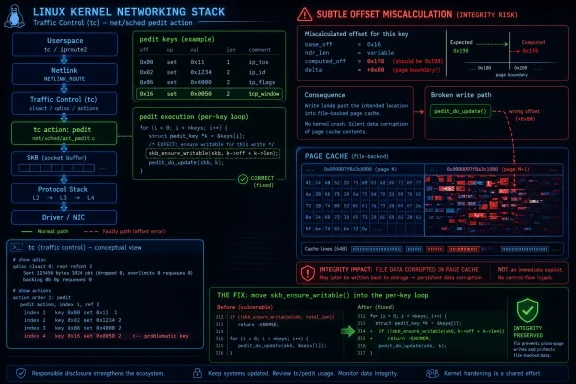
net/sched packet-editing bug where partial copy-on-write handling in pedit could corrupt the kernel page cache. The bug is narrow, deeply technical, and not yet scored by NVD, but its phrase “page cache corruption” is enough to make seasoned Linux administrators sit up straight. The lesson is not that every host is suddenly on fire; it is that the kernel’s networking fast paths keep producing exactly the kind of subtle write-primitive mistakes that modern privilege-escalation research loves.
 A Tiny Offset Bug Lands in a Very Dangerous Neighborhood
The vulnerable code sits in the Linux traffic control subsystem, specifically in the pedit action used to edit packet headers as packets move through the networking stack. That is not glamorous code in the way a browser sandbox escape or a cloud metadata bug is glamorous, but it is the sort of plumbing that real systems depend on: routers, firewalls, container hosts, network appliances, lab machines, and heavily tuned Linux servers.At the center of CVE-2026-46331 is
tcf_pedit_act(), a function that applies programmable edits to packet data. The bug described by kernel.org is that the function computed the copy-on-write range once, before looping over edit keys, using a maximum-offset hint that did not reflect the runtime header offset added by typed keys. In plain English, the kernel believed it had made the part of the packet buffer writable, but under some conditions the actual write could extend beyond the region that had been safely copied.That is where the wording turns from routine to alarming. If a write lands in memory that remains shared with another object, the kernel can accidentally modify data it never meant to touch. In this case, the published description says the outcome could be page cache corruption, the same broad class of failure that has powered some of the most consequential Linux local privilege-escalation bugs of the past decade.
The fix is correspondingly surgical. Rather than trusting a precomputed range, the patch moves
skb_ensure_writable() into the per-key loop, where the actual write offset is known. It also adds overflow checking to offset arithmetic, handles negative offsets by using skb_cow() for headroom, and guards against the INT_MIN edge case where negation is undefined in C.This is the kind of patch that looks unremarkable until you understand what it is defending. It is not adding a new security framework or disabling a risky feature. It is making sure the kernel does not write into memory it has not first made private.
Page Cache Corruption Is Not Just Another Kernel Oops
The Linux page cache is one of the operating system’s great performance tricks. It keeps file-backed data in memory so repeated reads do not have to hit disk, and it lets the kernel coordinate buffered I/O efficiently across processes. Most of the time, users never think about it, because that is the point.But when a vulnerability lets an attacker write into the page cache, the abstraction turns hostile. A file may be read-only on disk, protected by permissions, owned by root, or even sitting on a filesystem where writes should not be possible from the attacker’s account. If the cached copy of that file can be modified in memory, the system can be tricked into executing or reading altered content without the disk ever reflecting the change.
That is why Linux people still remember Dirty COW and Dirty Pipe. Those bugs were not identical to CVE-2026-46331, and this new CVE should not be casually described as another full replay of those attacks. But they taught the same architectural lesson: corruption of shared file-backed memory is not merely a stability bug. Under the right conditions, it can become an integrity break.
The kernel.org text for CVE-2026-46331 does not, on its own, claim a public exploit, active exploitation, or a ready-made route to root. NVD also had not assigned a CVSS score in the material available at publication time. That matters, because vulnerability coverage has a bad habit of turning every page-cache phrase into a five-alarm privilege-escalation headline.
Still, administrators should not dismiss it as academic. The affected function lives in a part of the kernel exposed to configured traffic-control rules, and the vulnerable behavior concerns writes at computed offsets inside packet buffers. Bugs in this space are often gated by privileges, capabilities, namespaces, distro configuration, or reachable code paths. Those gates may sharply limit exposure on one system and be surprisingly porous on another.
For WindowsForum readers, the Windows angle is indirect but real. Linux is no longer “some other operating system” in a Microsoft-centric environment. It is WSL, Azure fleet infrastructure, container hosts, Kubernetes nodes, appliances, CI runners, developer workstations, storage systems, and the little Debian or Ubuntu VM someone forgot was sitting under an important internal service.
The Exploitability Story Is Still Unwritten
The most responsible thing to say about CVE-2026-46331 is that the fix addresses a plausible memory-integrity flaw whose practical impact depends on conditions not fully spelled out by the CVE record. The least responsible thing would be to declare it either harmless or catastrophic before researchers and vendors finish mapping those conditions. Kernel vulnerabilities live in that uncomfortable middle.The function involved,
tcf_pedit_act(), is not something ordinary desktop users invoke by clicking a link. It is part of the traffic-control machinery typically configured with tools such as tc, often requiring elevated privileges or specific Linux capabilities. On many mainstream systems, that alone may reduce direct exposure from unprivileged local users.But Linux privilege boundaries are rarely that tidy anymore. Containerized environments may grant network administration capabilities for legitimate reasons. Lab systems may loosen namespaces. Network appliances may expose packet-editing behavior through higher-level management interfaces. Cloud images may carry vendor kernels with backports that do not line up neatly with upstream version numbers.
That is why kernel CVEs should be triaged by reachable behavior, not by the emotional temperature of the CVE title. A laptop with no traffic-control rules and a distribution kernel already receiving automatic security updates is in a different category from a multi-tenant container host where workloads are granted elevated networking capabilities. A router-like Linux box using sophisticated ingress shaping is in a different category again.
The CVE’s version data also deserves careful reading. The record lists affected ranges around stable kernels including 4.19.244 through before 4.20, 5.4.195 through before 5.5, 5.10.117 through before 5.11, 5.15.41 through before 5.16, and 5.17.9 through before 5.18, along with git commit ranges and later affected status beginning at 5.18 in the record’s second affected-product block. That does not mean every distribution kernel with a similar version string is vulnerable in the same way, because enterprise vendors routinely backport fixes without changing the major kernel identity users see from
uname.The uncomfortable result is familiar: the administrator cannot stop at “my kernel says 5.15.” The administrator must ask whether the distribution’s kernel package includes the relevant stable fix.
The Patch Tells the Real Story
The most revealing part of CVE-2026-46331 is not the CVE description’s headline; it is the shape of the fix. The old logic tried to compute a maximum writable range before processing individual edit keys. That is efficient, and it probably looked reasonable, because avoiding repeated writable checks in a packet path is exactly the sort of optimization kernel networking code is built around.The problem is that typed keys added a runtime header offset the hint did not fully account for. Once the real offset diverged from the precomputed assumption, the kernel could perform only a partial copy-on-write. One part of the target write was safely private; another part could still alias memory that should not be modified.
Moving
skb_ensure_writable() into the per-key loop is a classic security tradeoff. It may do more work, but it does the work at the point where the kernel has enough information to be correct. In low-level systems programming, correctness often arrives late and expensively, because early guesses are where edge cases hide.The extra overflow checking is equally important. Kernel offset arithmetic is a graveyard of “this can never happen” assumptions. Add signed integers, negative offsets, packet headroom, header-relative addressing, and user-influenced configuration, and the code has to defend not only against malicious input but against the C language itself.
The explicit handling of
INT_MIN is a tell. In two’s-complement arithmetic, the most negative integer cannot be represented as a positive integer of the same type. In C, negating it is undefined behavior, and undefined behavior in kernel code is not a philosophical curiosity. It is an invitation for compilers, optimizers, and assumptions to create results the programmer did not intend.The Networking Stack Keeps Being a Security Boundary
Linux networking code has always been a performance battlefield. It handles enormous packet rates, piles of protocol features, offload interactions, packet classifiers, namespace behavior, virtual devices, tunnels, and traffic shaping. Every one of those features is valuable, and every one makes the state space bigger.Traffic control is especially rich. It lets administrators classify, shape, drop, redirect, mark, and edit packets using a flexible collection of filters and actions. That flexibility is why it is useful in routers and container platforms. It is also why mistakes in its internals can be tricky to reason about from the outside.
The
pedit action is a good example of power hiding in plain sight. Packet editing is a normal networking function: rewrite a header field, adjust metadata, manipulate traffic as it enters or leaves an interface. But the implementation has to translate policy-level intent into byte writes at offsets inside kernel-managed buffers. That translation is where the vulnerability lives.The broader concern is not that
pedit is uniquely reckless. It is that networking subsystems increasingly serve as programmable execution environments. eBPF made that explicit, but traffic control had its own programmable tendencies long before eBPF became the star of the show.When packet-processing code touches memory shared across kernel abstractions, the security boundary becomes subtle. A bad length check is no longer merely a packet bug. A stale offset assumption is no longer merely a malformed-header problem. It can become a cross-object integrity failure.
Windows Shops Cannot Treat This as a Linux-Only Footnote
A decade ago, many Windows administrators could plausibly skim past a Linux kernel CVE. That world is gone. Microsoft’s ecosystem now assumes Linux is part of the enterprise fabric, whether as a first-class cloud workload, a developer substrate, or a container runtime underneath Windows-facing services.WSL is the obvious bridge. A developer workstation running WSL may not look like production infrastructure, but it often holds source code, credentials, package tokens, SSH keys, test data, and access to internal systems. If a Linux kernel issue affects the WSL kernel or a supported distribution environment, it becomes part of the Windows security conversation.
The cloud angle is larger. Azure customers routinely run Linux VMs, Linux-based Kubernetes nodes, and Linux appliances beside Windows Server workloads. Hybrid shops may manage both from the same identity layer and monitoring stack. A local privilege escalation on one Linux host can become a lateral-movement problem for the entire environment.
Then there are the invisible Linux systems: NAS boxes, routers, security gateways, observability collectors, CI runners, hypervisor-adjacent appliances, and vendor-managed agents. These systems rarely announce themselves during patch-planning meetings. They do, however, contain kernels.
CVE-2026-46331 is a reminder that “Windows environment” is a misleading phrase in 2026. The endpoint fleet may be Windows. The identity provider may be Microsoft. The productivity stack may be Microsoft 365. But the operational substrate underneath modern IT is almost always mixed, and Linux kernel hygiene is now part of Windows estate hygiene.
The NVD Gap Is a Process Problem, Not a Reason to Wait
At the time reflected in the submitted record, NVD had not assigned CVSS 4.0, CVSS 3.x, or CVSS 2.0 scores for CVE-2026-46331. That leaves security teams with an annoying but increasingly common problem: the CVE exists, upstream has fixed it, but the familiar severity machinery has not yet caught up.This is where mature vulnerability management separates itself from dashboard theater. A missing CVSS score does not mean missing risk. It means the organization has to reason from affected code, exposure, exploit preconditions, and asset criticality rather than outsourcing urgency to a number.
Kernel.org’s CVE process has also changed the rhythm of Linux vulnerability disclosure. Many kernel fixes now receive CVE identifiers after being resolved upstream, sometimes before downstream vendors have finished advisory language or scoring. That is good for transparency, but it produces a flood of records that look sparse compared with old vendor advisories.
For administrators, the practical response is to track vendor kernel updates rather than wait for NVD enrichment. Ubuntu, Debian, Red Hat, SUSE, Oracle, Amazon Linux, Alpine, Arch, and appliance vendors each have their own backport practices. The same upstream issue may appear under different package versions, advisory IDs, and patch timelines.
The risk of waiting for a perfect CVSS score is that kernel bugs do not respect paperwork. Once a patch is public, the diff is public. Researchers, attackers, defenders, and automated tooling can all inspect the change and infer the vulnerable condition. In some cases, a careful patch diff is more useful than the CVE prose.
The Version Maze Rewards Package Discipline
The affected-version block in CVE-2026-46331 is dense because Linux stable maintenance is dense. The record names source files, git commits, semver-style kernel ranges, and stable commit references. That is useful to kernel maintainers, but it can be treacherous for administrators who want a simple yes-or-no answer.A distribution kernel is rarely just “Linux 5.15.” It may be a heavily patched 5.15-based kernel with hundreds or thousands of security and hardware backports. Conversely, a custom-built or vendor-frozen kernel may carry vulnerable code long after upstream stable has moved on. Version strings are clues, not verdicts.
The right workflow starts with the distribution’s security channel. If the vendor has issued a kernel update for CVE-2026-46331 or for the corresponding upstream stable patch, apply it according to normal maintenance policy. If the system uses a custom kernel, compare against the fixed commits or pull the relevant stable branch.
Container hosts deserve special attention because containers share the host kernel. Updating container images does not fix a host kernel vulnerability. Restarting pods does not fix it either. The node must boot into a patched kernel, which means maintenance windows, node draining, live-patching where supported, or fleet replacement.
Live patching may help if the vendor ships a live patch for the affected code path, but teams should not assume that every kernel flaw is live-patchable in their environment. Networking hot paths and data-structure-sensitive fixes can be more complicated than a simple function replacement. The safest validation remains confirming the running kernel contains the fix, not merely that a package has been downloaded.
Mitigations Are Configuration-Specific, and That Is the Annoying Part
When a kernel vulnerability lives in a feature such as traffic control packet editing, the natural instinct is to look for a switch. Disable the feature, block unprivileged access, remove a module, restrict a capability, turn off namespaces. Sometimes that works. Often it only works after you prove exactly how your systems use the feature.A broad mitigation may involve limiting who can create or modify traffic-control actions. That generally means auditing use of capabilities such as network administration privileges, especially inside containers or delegated service accounts. If untrusted workloads have
CAP_NET_ADMIN, they already occupy a privileged risk category, and CVE-2026-46331 is one more reason to revisit that decision.Another mitigation path is to inspect whether hosts use
tc pedit rules at all. Many servers do not. Some network-heavy systems absolutely do. The difficulty is that traffic-control configuration may be applied dynamically by orchestration tools, container networking plugins, QoS agents, security products, or scripts rather than by a human typing tc commands at a shell.Namespaces complicate the story. A feature that appears restricted on the host may be reachable inside a network namespace if a process has the right capabilities there. Container platforms have spent years tightening defaults, but real-world deployments often deviate from defaults for performance, packet capture, service mesh integration, or custom networking.
The mitigation message is therefore not “turn off Linux networking magic.” It is “do not hand out networking magic casually.” If a workload does not need to shape, edit, or administer network traffic, it should not hold the capability to do so.
This CVE Arrives in the Shadow of Dirtier Bugs
CVE-2026-46331 lands in a period when page-cache corruption is already receiving heightened attention. Recent reporting around Linux vulnerabilities such as Copy Fail and Fragnesia has emphasized how small, reliable writes into the page cache can become local privilege escalation under the right conditions. That background matters because defenders are primed to view any page-cache corruption bug as potentially serious.The caution is that family resemblance is not proof of exploit equivalence. Dirty COW, Dirty Pipe, Copy Fail, Fragnesia, and CVE-2026-46331 involve different subsystems, different primitives, different preconditions, and different exploitability profiles. A shared phrase does not mean a shared exploit.
Yet the pattern is real enough to influence triage. The page cache is a high-value target because it sits at the intersection of memory, files, permissions, and execution. Bugs that corrupt it violate assumptions administrators depend on every day: that read-only files remain read-only, that file permissions mediate modification, and that the kernel’s cached view of a file is faithful to storage.
The industry should also be honest about why these bugs keep surfacing. Linux is not suddenly “insecure” in a simplistic sense. Rather, researchers have become better at identifying logic flaws that produce constrained writes, and attackers have become better at weaponizing constrained writes. The floor has risen.
That makes patch latency more dangerous. A bug that once required deep manual analysis may now be easier to classify, reproduce, and adapt using improved fuzzing, symbolic analysis, code search, and AI-assisted review. The same tools that help maintainers find subtle arithmetic mistakes also help adversaries read patches.
The Enterprise Risk Is Concentrated, Not Uniform
For most consumer Linux desktops, CVE-2026-46331 is likely to be handled as part of routine kernel updates. That does not make it irrelevant; it makes it operationally ordinary. Update, reboot, and move on.For enterprise environments, the risk concentrates around systems that combine three properties: exposed or delegated networking control, multi-user or multi-tenant workloads, and delayed kernel patching. Container hosts are the obvious example. So are university compute clusters, shared development servers, packet-processing boxes, lab networks, and appliances that embed Linux kernels for years.
Network appliances are particularly uncomfortable because the vulnerable subsystem is networking-related. An appliance may use
tc internally while hiding that fact behind a web UI or vendor policy engine. Customers may not have direct visibility into kernel configuration, patch status, or whether pedit is reachable through supported features.Cloud-managed Linux images reduce some operational burden but do not eliminate it. The customer may still be responsible for rebooting into a new kernel. Managed Kubernetes services may automate parts of the process, but node pools can still lag if maintenance settings, disruption budgets, or custom images get in the way.
Security teams should also consider detection limits. Exploitation of kernel memory corruption often leaves little in ordinary application logs. If a proof of concept eventually emerges, it may look like a local process configuring traffic control and then triggering packet paths, not like a noisy network attack. Audit policy around privileged networking operations may be more useful than generic intrusion signatures.
The Practical Patch Story Starts With the Running Kernel
The first operational question is not whether CVE-2026-46331 sounds scary. It is whether the running kernel on a given machine contains vulnerable code. That requires checking the actual kernel package, vendor advisory status, and running version after reboot.On distribution-managed systems, administrators should look for kernel security updates from their vendor and schedule reboots accordingly. If a live-patching service is in use, verify that the specific CVE or upstream fix is covered, and do not assume that live patch status equals full remediation unless the vendor says so. If the kernel was built from source, pull the relevant stable branch or apply the upstream fix directly.
On container infrastructure, treat the host as the security boundary. Updating containers will not remediate this class of vulnerability. Node images, kernel packages, and reboot orchestration matter more than application redeployments.
For WSL users, the answer depends on Microsoft’s WSL kernel servicing and the user’s installed version. WSL’s convenience can obscure the fact that it is still a Linux kernel environment with its own update channel. Developers who use WSL for privileged networking experiments, packet tooling, or container workflows should keep it current rather than assuming Windows Update alone has handled every moving part.
For appliances, the only honest answer is vendor confirmation. If a product embeds Linux and performs traffic control or packet editing, customers should ask whether CVE-2026-46331 is applicable and whether an update is available. Silence from a vendor is not the same thing as immunity.
The Small Patch That Should Change Big Habits
CVE-2026-46331 is not the biggest Linux kernel vulnerability of the year by public drama, but it is an excellent example of why kernel security has become a process discipline rather than an occasional emergency. A precomputed offset, a runtime adjustment, a partial copy-on-write, and a missing overflow guard are enough to turn an optimization into a corruption bug.The larger habit change is to treat capabilities as attack surface. If users, services, or containers can administer network behavior, they are not “almost unprivileged.” They can reach code paths that were designed for trusted operators and high-performance packet manipulation. That does not mean no one should have those capabilities; it means every grant should be intentional.
The second habit change is to make kernel patching measurable. Organizations should know how quickly servers, workstations, container nodes, and appliances move from “vendor patch available” to “running patched kernel.” Package installation without reboot is not completion. Advisory ingestion without asset mapping is not completion. A green dashboard that ignores embedded Linux is not completion.
The third habit change is humility. Modern kernels are too complex for simple perimeter thinking. A local-only bug can matter if the host is multi-tenant. A networking-only bug can matter if containers have network capabilities. A page-cache phrase can matter even before exploit details are public.
The Signal Hidden Inside CVE-2026-46331
The useful lesson from this CVE is narrower than panic and broader than trivia. It is a small kernel fix that points to a recurring class of integrity failures, and it gives administrators a concrete reason to audit both patch posture and delegated networking privilege.- CVE-2026-46331 was published on June 16, 2026, and concerns Linux kernel
net/schedpacket editing intcf_pedit_act(). - The flaw involved computing a copy-on-write range before the actual per-key write offset was known, which could leave part of a write region outside the copied buffer.
- The upstream fix moves writability checks into the per-key loop, adds overflow checks, handles negative offsets with headroom copy-on-write, and guards an
INT_MINarithmetic edge case. - NVD had not yet assigned a CVSS score in the supplied record, so defenders should triage from exposure and vendor patch status rather than waiting for a severity number.
- Systems granting networking administration capabilities to containers, services, or untrusted users deserve faster review than ordinary single-user desktops.
- Updating the running host kernel, not merely userspace packages or container images, is the remediation that matters.
References
- Primary source: NVD / Linux Kernel
Published: 2026-06-20T01:43:41-07:00
NVD - CVE-2026-46331
 nvd.nist.gov
- Security advisory: MSRC
Published: 2026-06-20T01:43:41-07:00
Original feed URL
Security Update Guide - Microsoft Security Response Center
 msrc.microsoft.com
- Related coverage: vuldb.com
CVE-2026-46331 Linux Kernel net tcf_pedit_act отказ в обслуживании
Была найдена уязвимость в Linux Kernel. Эта уязвимость известна как CVE-2026-46331. Рекомендуется применить патч для устранения этой проблемы.vuldb.com - Related coverage: techradar.com
Another major Linux security issue uncovered - new Fragnesia flaw allows attackers to run malicious code as root | TechRadar
The flaw is in the same family as Dirty Fragwww.techradar.com - Related coverage: tomshardware.com
CISA flags actively exploited ‘Copy Fail’ Linux kernel flaw enabling root takeover across major distros — unpatched systems may remain vulnerable to attack | Tom's Hardware
Researchers released a working exploit before patches were ready.www.tomshardware.com - Related coverage: thehackernews.com
New Fragnesia Linux Kernel LPE Grants Root Access via Page Cache Corruption
Fragnesia CVE-2026-46300 corrupts Linux page cache via XFRM ESP-in-TCP, enabling local root access on major distros.thehackernews.com
