

CVE-2026-4891 is a dnsmasq DNSSEC validation flaw disclosed on May 11, 2026, in which crafted DNS packets can trigger a heap-based out-of-bounds read, exposing memory information or contributing to service disruption in systems that rely on vulnerable dnsmasq builds. The oddity is not that a small DNS utility has another memory-safety bug; it is that the blast radius runs through home routers, Pi-hole boxes, Linux appliances, virtualization stacks, and the quiet network services Windows users often forget they depend on. Microsoft’s listing of the CVE in its Security Update Guide does not make this a Windows kernel story, but it does make it a Windows ecosystem story. For administrators, the lesson is blunt: the weakest link in a Windows network is often the Linux-flavored resolver sitting just upstream of it.
dnsmasq has always lived in the unglamorous part of the network: DNS forwarding, DHCP service, router firmware, small-office appliances, lab networks, and development environments. It is not the kind of component most desktop users can identify, but it is exactly the kind of software they trust dozens or hundreds of times a day. Every web request, software update, VPN tunnel, and cloud login begins with name resolution, and name resolution is where dnsmasq often sits.
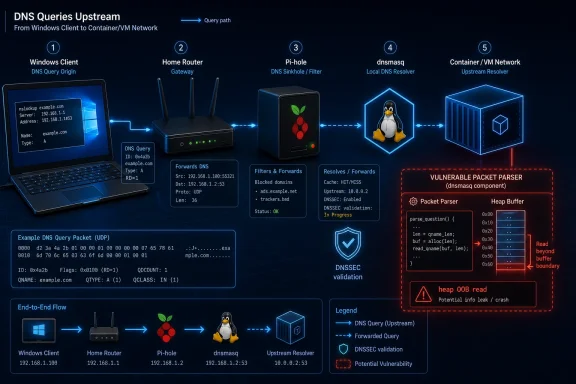
CVE-2026-4891 is part of a broader cluster of dnsmasq vulnerabilities disclosed through CERT/CC and vendor advisories in May 2026. The specific issue concerns DNSSEC validation, where a crafted DNS packet can cause a heap-based out-of-bounds read. In practical terms, that means an attacker may be able to make vulnerable dnsmasq read memory it should not read, with consequences described by advisories as information disclosure and, in some summaries, denial of service.
That distinction matters. A remote code execution bug gets the headlines, but a resolver memory disclosure bug can still have operational value to an attacker. It can reveal fragments of process memory, destabilize a service, or become one piece in a longer chain against network infrastructure that was never treated as a first-class security boundary.
The Security Update Guide entry supplied by Microsoft is therefore easy to misread. This is not a typical “install the latest Windows cumulative update” advisory. It is a reminder that Microsoft’s customer base now runs Windows alongside WSL, Hyper-V Linux guests, container stacks, edge appliances, Azure-connected devices, and third-party network hardware that may embed open-source components outside Microsoft’s direct patch pipeline.
CVE-2026-4891 illustrates that ambiguity. The root component is dnsmasq, a project commonly associated with Linux and embedded systems. Microsoft’s relevance comes from the environments its customers operate: Windows clients behind consumer routers, Windows Server estates using Linux-based DNS forwarders, developers running dnsmasq in containers or WSL-adjacent workflows, and enterprises that inventory vulnerabilities through Microsoft portals.
This is the modern patch-management problem in miniature. The old mental model said that Microsoft fixes Microsoft products, Linux vendors fix Linux packages, and router makers fix router firmware. The actual enterprise network says something messier: identity lives in Entra ID, endpoints run Windows, CI systems run Linux containers, developers use WSL, DNS may be handled by an appliance, and vulnerability visibility may arrive through a Microsoft dashboard.
That is why the disclaimer text attached to the Knowledge Base material feels more than boilerplate here. Microsoft is effectively saying: here is the security information, but the responsibility for how it applies to your estate is yours. In a mixed-platform environment, that is not legalese; it is the operating model.
The bug is described as a heap-based out-of-bounds read in DNSSEC validation. That phrasing may sound academic, but the attack path is conceptually simple. A vulnerable resolver processes a crafted DNS packet, walks memory incorrectly, and may expose or misuse data outside the intended buffer.
The immediate operational concern is not that every home network will be instantly compromised. It is that DNS resolvers are reachable by design, frequently unattended, and often updated less aggressively than endpoints. A laptop gets Defender signatures and cumulative updates; a router in a closet may run for years on firmware that nobody checks unless the Wi-Fi stops working.
DNSSEC also changes the risk calculus because administrators may have enabled it specifically to improve trust. If a site has turned on DNSSEC validation in dnsmasq, it may be the more security-conscious environments that are exposed to this particular bug. That is a recurring irony in infrastructure security: the more features a component performs, the more code paths it exposes.
But that narrow answer is not enough. Windows machines rarely operate in isolation. They depend on DNS services provided by consumer routers, mesh Wi-Fi systems, Linux firewalls, Pi-hole installations, NAS devices, Docker networks, virtualization labs, and cloud gateways. Many of those systems either use dnsmasq directly or have used it in certain builds.
A WindowsForum reader is especially likely to live in that mixed world. The same enthusiast who keeps Windows 11 Canary builds on one machine may run Pi-hole on a Raspberry Pi, OpenWrt on a router, Proxmox in a lab, and WSL on a development workstation. In that environment, the question is not “Is Windows vulnerable?” but “Which resolver is answering my Windows machines?”
That is also the enterprise angle. Windows administrators increasingly manage estates where the endpoint fleet is Microsoft-heavy but the network fabric is not. The resolver that feeds domain-joined laptops may be a Linux appliance. The DHCP service for a branch office may be embedded in a firewall. The developer workstation may spin up a local dnsmasq instance through containers. Inventory tools that stop at the Windows OS boundary will miss the path that DNS packets actually take.
A medium DNS vulnerability can still be a high-priority patch in the wrong environment. If dnsmasq is exposed to untrusted networks, used as a recursive resolver, or deployed in a branch office where outages translate into helpdesk calls, the business impact rises. DNS is one of those services where partial failure looks like everything else being broken.
The broader dnsmasq disclosure cluster also matters. CVE-2026-4891 did not arrive alone; CERT/CC described multiple vulnerabilities affecting dnsmasq, including denial-of-service, cache poisoning or redirection, information disclosure, and local privilege escalation scenarios. Administrators should therefore avoid treating this as a single-CVE checkbox exercise.
That is especially true for embedded and appliance vendors. A Linux distribution can ship a fixed package quickly. A router vendor may need to integrate, test, sign, and distribute firmware, assuming the device is still supported at all. A home user may never see a notification. A small business may not know the model number of the box providing DNS.
Pi-hole’s FTL component has had updates tied to the dnsmasq disclosure set, and users should check that their installations are current rather than assuming the web interface’s green lights mean all is well. The same logic applies to OpenWrt, DD-WRT-style router environments, Linux distributions, NAS packages, and any appliance that advertises DNS forwarding or DHCP service.
Home-lab culture sometimes treats infrastructure as disposable because it is not “production.” That is a mistake when the lab resolver is also the household resolver, the work-from-home resolver, or the VPN gateway’s first hop. A vulnerable dnsmasq instance may not hold crown-jewel data, but it may sit in a position where every device trusts it.
For Windows enthusiasts, this is where platform boundaries become silly. Your Windows PC can be fully patched and still ask an unpatched Linux resolver where to find your bank, your package repository, your corporate VPN endpoint, or your Microsoft account login page. Endpoint security begins after DNS has already answered.
It may appear in container images, network appliances, IoT gateways, development environments, virtualization hosts, and DHCP/DNS services supporting isolated test networks. It may be bundled by vendors who do not expose the component version in a friendly interface. It may also be present in Linux distributions that are not centrally managed by the Windows endpoint team.
That creates a familiar ownership problem. Is CVE-2026-4891 the responsibility of the network team, the Linux team, the Windows endpoint team, the security operations center, or the vendor management office? The honest answer is that all of them may own a piece of it, and none of them can close it alone.
This is where vulnerability management has to become more architectural. The useful question is not merely “Do we have dnsmasq?” but “Which DNS paths do our Windows endpoints and servers actually use, and which of those paths depend on vulnerable code?” In a mature environment, that answer should come from asset inventory, network telemetry, and resolver logs. In many environments, it will come from a frantic spreadsheet.
That is an important nuance. A distribution may backport a fix into an older-looking package version. An appliance may ship a firmware update that does not expose dnsmasq’s internal version in the UI. A container image may remain vulnerable even after the host OS is patched. A Windows administrator checking only Microsoft Update will not see any of that.
The safest operational approach is to identify where dnsmasq is present, then follow the relevant vendor’s advisory rather than assuming upstream version labels map cleanly onto every platform. For Linux servers, that usually means applying security updates from the distribution. For Pi-hole, it means updating Pi-hole components. For routers and appliances, it means checking firmware from the manufacturer or replacing unsupported hardware.
Unsupported gear is the ugly case. If a router, firewall, or NAS box embeds a vulnerable dnsmasq build and the vendor no longer ships updates, there may be no satisfying mitigation short of disabling affected features, moving DNS/DHCP elsewhere, or retiring the device. That is not alarmism; it is the normal consequence of running security-sensitive infrastructure on abandoned firmware.
CVE-2026-4891 does not need to be the most severe vulnerability of the month to matter. Its importance lies in the way it exposes dependency blindness. A Microsoft-facing advisory points to an open-source resolver flaw. A Windows user may be affected because of a router. A Linux package fix may protect Windows clients. A home-lab update may matter more than a desktop patch.
This is the future of vulnerability response: not platform silos, but dependency trails. The operating system brand on the laptop is only one layer of the stack. The resolver, the identity provider, the browser, the container runtime, the VPN client, the EDR sensor, and the cloud control plane all shape the real attack surface.
That makes CVE-2026-4891 a useful corrective to Patch Tuesday tunnel vision. Windows administrators should still patch Windows. But they also need to know what their Windows machines trust before the first TLS handshake ever begins.
CVE-2026-4891 will probably not be remembered as a watershed vulnerability, and that is exactly why it is worth taking seriously. The security incidents that exhaust administrators are often not the cinematic zero-days but the small flaws in ubiquitous components, discovered after years of quiet service and patched through a maze of downstream vendors. Windows users and IT pros should read this advisory less as a Microsoft emergency and more as a map of modern dependency risk: your PC may be patched, your OS may be current, and your browser may be hardened, but the network still begins with a resolver you may not have looked at since the day you plugged it in.
 The Vulnerability Is Small, but the Dependency Graph Is Not
dnsmasq has always lived in the unglamorous part of the network: DNS forwarding, DHCP service, router firmware, small-office appliances, lab networks, and development environments. It is not the kind of component most desktop users can identify, but it is exactly the kind of software they trust dozens or hundreds of times a day. Every web request, software update, VPN tunnel, and cloud login begins with name resolution, and name resolution is where dnsmasq often sits.CVE-2026-4891 is part of a broader cluster of dnsmasq vulnerabilities disclosed through CERT/CC and vendor advisories in May 2026. The specific issue concerns DNSSEC validation, where a crafted DNS packet can cause a heap-based out-of-bounds read. In practical terms, that means an attacker may be able to make vulnerable dnsmasq read memory it should not read, with consequences described by advisories as information disclosure and, in some summaries, denial of service.
That distinction matters. A remote code execution bug gets the headlines, but a resolver memory disclosure bug can still have operational value to an attacker. It can reveal fragments of process memory, destabilize a service, or become one piece in a longer chain against network infrastructure that was never treated as a first-class security boundary.
The Security Update Guide entry supplied by Microsoft is therefore easy to misread. This is not a typical “install the latest Windows cumulative update” advisory. It is a reminder that Microsoft’s customer base now runs Windows alongside WSL, Hyper-V Linux guests, container stacks, edge appliances, Azure-connected devices, and third-party network hardware that may embed open-source components outside Microsoft’s direct patch pipeline.
Microsoft’s Advisory Is a Map Pin, Not the Whole Map
The Microsoft Security Response Center has become a clearinghouse not only for Windows vulnerabilities but for risks that may intersect Microsoft customers’ environments. That is useful, but it can also create confusion. A CVE appearing on an MSRC page does not necessarily mean Windows itself contains the vulnerable code, nor does it mean Windows Update will fix every affected deployment.CVE-2026-4891 illustrates that ambiguity. The root component is dnsmasq, a project commonly associated with Linux and embedded systems. Microsoft’s relevance comes from the environments its customers operate: Windows clients behind consumer routers, Windows Server estates using Linux-based DNS forwarders, developers running dnsmasq in containers or WSL-adjacent workflows, and enterprises that inventory vulnerabilities through Microsoft portals.
This is the modern patch-management problem in miniature. The old mental model said that Microsoft fixes Microsoft products, Linux vendors fix Linux packages, and router makers fix router firmware. The actual enterprise network says something messier: identity lives in Entra ID, endpoints run Windows, CI systems run Linux containers, developers use WSL, DNS may be handled by an appliance, and vulnerability visibility may arrive through a Microsoft dashboard.
That is why the disclaimer text attached to the Knowledge Base material feels more than boilerplate here. Microsoft is effectively saying: here is the security information, but the responsibility for how it applies to your estate is yours. In a mixed-platform environment, that is not legalese; it is the operating model.
DNSSEC Turns a Resolver Into an Attack Surface
DNSSEC exists to make DNS more trustworthy by validating cryptographic signatures on DNS data. But every validation feature is also a parser, and every parser that handles attacker-influenced data deserves suspicion. CVE-2026-4891 sits in that uncomfortable space: a security feature whose implementation becomes a security liability.The bug is described as a heap-based out-of-bounds read in DNSSEC validation. That phrasing may sound academic, but the attack path is conceptually simple. A vulnerable resolver processes a crafted DNS packet, walks memory incorrectly, and may expose or misuse data outside the intended buffer.
The immediate operational concern is not that every home network will be instantly compromised. It is that DNS resolvers are reachable by design, frequently unattended, and often updated less aggressively than endpoints. A laptop gets Defender signatures and cumulative updates; a router in a closet may run for years on firmware that nobody checks unless the Wi-Fi stops working.
DNSSEC also changes the risk calculus because administrators may have enabled it specifically to improve trust. If a site has turned on DNSSEC validation in dnsmasq, it may be the more security-conscious environments that are exposed to this particular bug. That is a recurring irony in infrastructure security: the more features a component performs, the more code paths it exposes.
The Windows Angle Runs Through Everything Around Windows
For Windows users, the first instinct may be to ask whether Windows 10 or Windows 11 ships dnsmasq. In the normal desktop sense, no. Windows has its own DNS client and server components, and this CVE is not a Windows DNS Server vulnerability.But that narrow answer is not enough. Windows machines rarely operate in isolation. They depend on DNS services provided by consumer routers, mesh Wi-Fi systems, Linux firewalls, Pi-hole installations, NAS devices, Docker networks, virtualization labs, and cloud gateways. Many of those systems either use dnsmasq directly or have used it in certain builds.
A WindowsForum reader is especially likely to live in that mixed world. The same enthusiast who keeps Windows 11 Canary builds on one machine may run Pi-hole on a Raspberry Pi, OpenWrt on a router, Proxmox in a lab, and WSL on a development workstation. In that environment, the question is not “Is Windows vulnerable?” but “Which resolver is answering my Windows machines?”
That is also the enterprise angle. Windows administrators increasingly manage estates where the endpoint fleet is Microsoft-heavy but the network fabric is not. The resolver that feeds domain-joined laptops may be a Linux appliance. The DHCP service for a branch office may be embedded in a firewall. The developer workstation may spin up a local dnsmasq instance through containers. Inventory tools that stop at the Windows OS boundary will miss the path that DNS packets actually take.
The Severity Score Understates the Operational Annoyance
NVD had not fully enriched the record at the time of publication, while CISA-ADP listed a CVSS 3.1 vector giving the issue a medium score. That is plausible for an out-of-bounds read without integrity impact or confirmed arbitrary code execution. But severity scoring often compresses operational reality into a number that feels cleaner than the incident response work it produces.A medium DNS vulnerability can still be a high-priority patch in the wrong environment. If dnsmasq is exposed to untrusted networks, used as a recursive resolver, or deployed in a branch office where outages translate into helpdesk calls, the business impact rises. DNS is one of those services where partial failure looks like everything else being broken.
The broader dnsmasq disclosure cluster also matters. CVE-2026-4891 did not arrive alone; CERT/CC described multiple vulnerabilities affecting dnsmasq, including denial-of-service, cache poisoning or redirection, information disclosure, and local privilege escalation scenarios. Administrators should therefore avoid treating this as a single-CVE checkbox exercise.
That is especially true for embedded and appliance vendors. A Linux distribution can ship a fixed package quickly. A router vendor may need to integrate, test, sign, and distribute firmware, assuming the device is still supported at all. A home user may never see a notification. A small business may not know the model number of the box providing DNS.
Pi-hole and the Home-Lab Crowd Are the Canary
The Pi-hole reference in the CVE ecosystem is important because Pi-hole has become the friendly face of home DNS filtering. It is common in enthusiast homes, small offices, classrooms, and labs. It is also precisely the kind of service Windows power users deploy and then forget because, when it works, it becomes invisible.Pi-hole’s FTL component has had updates tied to the dnsmasq disclosure set, and users should check that their installations are current rather than assuming the web interface’s green lights mean all is well. The same logic applies to OpenWrt, DD-WRT-style router environments, Linux distributions, NAS packages, and any appliance that advertises DNS forwarding or DHCP service.
Home-lab culture sometimes treats infrastructure as disposable because it is not “production.” That is a mistake when the lab resolver is also the household resolver, the work-from-home resolver, or the VPN gateway’s first hop. A vulnerable dnsmasq instance may not hold crown-jewel data, but it may sit in a position where every device trusts it.
For Windows enthusiasts, this is where platform boundaries become silly. Your Windows PC can be fully patched and still ask an unpatched Linux resolver where to find your bank, your package repository, your corporate VPN endpoint, or your Microsoft account login page. Endpoint security begins after DNS has already answered.
The Enterprise Problem Is Inventory, Not Just Patching
Large organizations know how to patch Windows endpoints. They may grumble about restart windows, driver regressions, and cumulative update surprises, but the machinery exists. dnsmasq is harder because it hides in places that are not always represented as “servers.”It may appear in container images, network appliances, IoT gateways, development environments, virtualization hosts, and DHCP/DNS services supporting isolated test networks. It may be bundled by vendors who do not expose the component version in a friendly interface. It may also be present in Linux distributions that are not centrally managed by the Windows endpoint team.
That creates a familiar ownership problem. Is CVE-2026-4891 the responsibility of the network team, the Linux team, the Windows endpoint team, the security operations center, or the vendor management office? The honest answer is that all of them may own a piece of it, and none of them can close it alone.
This is where vulnerability management has to become more architectural. The useful question is not merely “Do we have dnsmasq?” but “Which DNS paths do our Windows endpoints and servers actually use, and which of those paths depend on vulnerable code?” In a mature environment, that answer should come from asset inventory, network telemetry, and resolver logs. In many environments, it will come from a frantic spreadsheet.
The Patch Path Depends on Who Packaged Your Resolver
The upstream dnsmasq project released fixed code, and CERT/CC pointed users toward dnsmasq 2.92rel2 as the release addressing the vulnerability cluster. Distribution and appliance timelines vary. Debian, Ubuntu, NixOS, Pi-hole, and other downstreams each have their own packaging and backport practices, which means version numbers alone may not tell the full story unless you understand the vendor’s advisory.That is an important nuance. A distribution may backport a fix into an older-looking package version. An appliance may ship a firmware update that does not expose dnsmasq’s internal version in the UI. A container image may remain vulnerable even after the host OS is patched. A Windows administrator checking only Microsoft Update will not see any of that.
The safest operational approach is to identify where dnsmasq is present, then follow the relevant vendor’s advisory rather than assuming upstream version labels map cleanly onto every platform. For Linux servers, that usually means applying security updates from the distribution. For Pi-hole, it means updating Pi-hole components. For routers and appliances, it means checking firmware from the manufacturer or replacing unsupported hardware.
Unsupported gear is the ugly case. If a router, firewall, or NAS box embeds a vulnerable dnsmasq build and the vendor no longer ships updates, there may be no satisfying mitigation short of disabling affected features, moving DNS/DHCP elsewhere, or retiring the device. That is not alarmism; it is the normal consequence of running security-sensitive infrastructure on abandoned firmware.
DNS Bugs Keep Teaching the Same Lesson
The industry has a long history of rediscovering that DNS is both critical and under-managed. It is easy to secure what appears in the endpoint console. It is harder to secure the plumbing that makes the endpoint useful.CVE-2026-4891 does not need to be the most severe vulnerability of the month to matter. Its importance lies in the way it exposes dependency blindness. A Microsoft-facing advisory points to an open-source resolver flaw. A Windows user may be affected because of a router. A Linux package fix may protect Windows clients. A home-lab update may matter more than a desktop patch.
This is the future of vulnerability response: not platform silos, but dependency trails. The operating system brand on the laptop is only one layer of the stack. The resolver, the identity provider, the browser, the container runtime, the VPN client, the EDR sensor, and the cloud control plane all shape the real attack surface.
That makes CVE-2026-4891 a useful corrective to Patch Tuesday tunnel vision. Windows administrators should still patch Windows. But they also need to know what their Windows machines trust before the first TLS handshake ever begins.
The Resolver in the Closet Deserves a Change Window
The practical response to CVE-2026-4891 is not panic; it is disciplined inventory and targeted updates. Treat the advisory as a prompt to trace DNS dependencies, especially in places where Windows clients rely on non-Windows infrastructure.- Verify whether dnsmasq is running on routers, firewalls, Pi-hole systems, Linux servers, NAS devices, lab hosts, container images, or virtualization networks that serve Windows clients.
- Apply vendor-provided updates for dnsmasq or downstream products that embed it, rather than relying only on upstream version numbers.
- Pay special attention to DNSSEC-enabled deployments, because CVE-2026-4891 sits in the DNSSEC validation path.
- Do not assume Microsoft Update remediates this issue simply because the CVE appears in Microsoft’s Security Update Guide.
- Replace or isolate unsupported appliances if the vendor cannot confirm whether affected dnsmasq code is present or fixed.
- Confirm resolver behavior after patching, because DNS failures often masquerade as browser, VPN, authentication, or application outages.
CVE-2026-4891 will probably not be remembered as a watershed vulnerability, and that is exactly why it is worth taking seriously. The security incidents that exhaust administrators are often not the cinematic zero-days but the small flaws in ubiquitous components, discovered after years of quiet service and patched through a maze of downstream vendors. Windows users and IT pros should read this advisory less as a Microsoft emergency and more as a map of modern dependency risk: your PC may be patched, your OS may be current, and your browser may be hardened, but the network still begins with a resolver you may not have looked at since the day you plugged it in.
References
- Primary source: MSRC
Published: 2026-05-27T01:39:47-07:00
Security Update Guide - Microsoft Security Response Center
 msrc.microsoft.com
- Related coverage: techradar.com
Microsoft confirms two major Defender security issues — so update now or face possible attack
CISA confirms two bugs being actively exploited in the wild, as Microsoft releases patches.www.techradar.com
- Official source: microsoft.com
MSRC - Microsoft Security Response Center
The Microsoft Security Response Center is part of the defender community and on the front line of security response evolution. For over twenty years, we have been engaged with security researchers working to protect customers and the broader ecosystem.www.microsoft.com
- Related coverage: cyber.gc.ca
Microsoft security advisory (AV26-489) - Canadian Centre for Cyber Security
Microsoft security advisory (AV26-489)www.cyber.gc.ca
- Official source: learn.microsoft.com
Security Advisories and Bulletins
learn.microsoft.com - Related coverage: soc.cyber.wa.gov.au

- Related coverage: csoonline.com
Microsoft patches two zero-day flaws in Defender | CSO Online
CISA has added the Microsoft Malware Protection Engine and Microsoft Defender Antimalware Platform vulnerabilities to its KEV catalog, suggesting exploitation in the wild.www.csoonline.com
- Related coverage: sra.io
