

CVE-2026-50403 is a newly patched Windows Runtime flaw that can let an authenticated local attacker elevate privileges on Windows 11 and Windows Server 2025. Microsoft released the fix on July 14 as part of its July 2026 Patch Tuesday updates, assigning the vulnerability an Important severity rating and a CVSS 3.1 base score of 7.0.
Detailed in Microsoft’s Security Update Guide and subsequently published by the National Vulnerability Database, the flaw involves a race condition and use-after-free memory error. It is not a remote entry point: an attacker needs existing access to the machine and low-level privileges before attempting exploitation.
That prerequisite limits the initial attack surface, but it does not make the vulnerability harmless. Local elevation-of-privilege bugs are frequently used after phishing, credential theft, malicious downloads, or another exploit has established a foothold. The practical defense is to deploy the July cumulative Windows updates, not to rely on the attack’s timing complexity.
Microsoft describes CVE-2026-50403 as improper synchronization during concurrent access to a shared Windows Runtime resource. The CVE record maps the defect to both CWE-362, covering race conditions, and CWE-416, covering use-after-free vulnerabilities.
A race condition occurs when the safety of an operation depends on two or more events happening in an expected sequence. An attacker who can repeatedly manipulate that timing may force Windows Runtime into a state its developers did not intend. The associated use-after-free classification indicates that code could continue accessing memory after the operating system has released it.
Microsoft has not publicly disclosed the affected Windows Runtime function, object type, or exploitation procedure. There is also no public proof-of-concept listed in the initial advisory, and the Zero Day Initiative’s July review records the vulnerability as neither publicly disclosed nor exploited in the wild when the updates were released.
The absence of exploit code should not be confused with uncertainty about whether the defect exists. Microsoft is the CVE Numbering Authority for this record and has confirmed both the weakness and the affected products. In CVSS terminology, a Report Confidence value of Confirmed means the vulnerability and its technical basis have been acknowledged by the vendor; it does not mean attacks have been observed.
The high-complexity rating is significant. It indicates that successful exploitation depends on conditions outside an attacker’s direct control—consistent with a race condition in which operations must be triggered within a narrow timing window. Attack reliability may vary across processor architectures, hardware configurations, system load, and Windows builds.
Successful exploitation can nevertheless have a substantial effect. Microsoft assigns High impact values to confidentiality, integrity, and availability, meaning an attacker who wins the race could potentially cross a Windows privilege boundary and gain broad control over the affected system.
The unchanged-scope rating means the compromised Windows Runtime component and the resulting security authority remain within the same security scope. That is a scoring distinction rather than a reassurance: local elevation may still allow malware to access protected data, modify system resources, interfere with security software, or establish persistence that survives a normal user sign-out.
No user interaction is required once the attacker has local execution. That makes the flaw more relevant on shared systems, developer workstations, administrative jump boxes, and endpoints where an initial compromise could leave malware running under a standard account.
The published version boundaries identify these builds as the security baselines:
The affected-product list is narrower than the full range of Windows versions serviced in July. Windows 10, Windows 11 23H2, Windows Server 2019, and Windows Server 2022 are not included in the initial CVE record. That distinction matters when vulnerability scanners produce broad findings based only on the words “Windows Runtime” rather than Microsoft’s version data.
Windows Server 2025 Core is explicitly affected, so removing the desktop interface does not mitigate the bug. The vulnerable code is part of the underlying Windows platform rather than a graphical management application.
For defenders, that places the vulnerability in the second stage of an intrusion. An initial-access technique gets an attacker onto the endpoint; CVE-2026-50403 could then help that attacker escape the restrictions of the compromised account. From there, elevated access may make credential theft, security-control tampering, lateral movement, and persistence easier.
This chaining potential is why CVSS scores alone are an incomplete deployment guide. A public-facing server may face little direct exposure to this particular flaw, yet a Windows Server 2025 application host running third-party code could still be a valuable target if another weakness provides local execution. Developer machines are similarly sensitive because they commonly hold source code, signing credentials, package-registry tokens, cloud sessions, and privileged management tools.
Organizations that cannot deploy the update immediately should concentrate temporary controls on preventing and detecting initial execution. Application control through Windows Defender Application Control or AppLocker, restricted administrative access, Microsoft Defender for Endpoint behavioral monitoring, and reduced exposure of interactive server accounts can all make the prerequisite foothold harder to obtain.
Those controls do not repair the memory-management defect. Microsoft has not published a registry workaround, Group Policy mitigation, or component-disable procedure for CVE-2026-50403, leaving the cumulative security update as the durable remediation.
It does not indicate that exploitation is confirmed in customer environments. Microsoft’s initial publication did not classify CVE-2026-50403 as exploited or publicly disclosed, and the Zero Day Initiative reported the same status in its July 14 review.
Those assessments are snapshots, not guarantees. Race-condition vulnerabilities can take time to reverse-engineer and turn into dependable exploits, particularly when exploitation must remain reliable across different processor architectures and system loads. Once patches are available, however, attackers can compare updated and unpatched binaries to narrow their search for the corrected code.
CVE-2026-50403 therefore belongs in the normal July 2026 patch cycle rather than an emergency internet-facing response. Its priority should rise on Windows 11 workstations used by administrators and developers, shared endpoints, Remote Desktop Session Host deployments, and Windows Server 2025 machines where untrusted or lower-privilege code can run.
The immediate milestone is straightforward: inventory the four affected Windows release families, deploy the July 14 cumulative updates, and confirm that each machine has reached its corrected build baseline.
Detailed in Microsoft’s Security Update Guide and subsequently published by the National Vulnerability Database, the flaw involves a race condition and use-after-free memory error. It is not a remote entry point: an attacker needs existing access to the machine and low-level privileges before attempting exploitation.
That prerequisite limits the initial attack surface, but it does not make the vulnerability harmless. Local elevation-of-privilege bugs are frequently used after phishing, credential theft, malicious downloads, or another exploit has established a foothold. The practical defense is to deploy the July cumulative Windows updates, not to rely on the attack’s timing complexity.
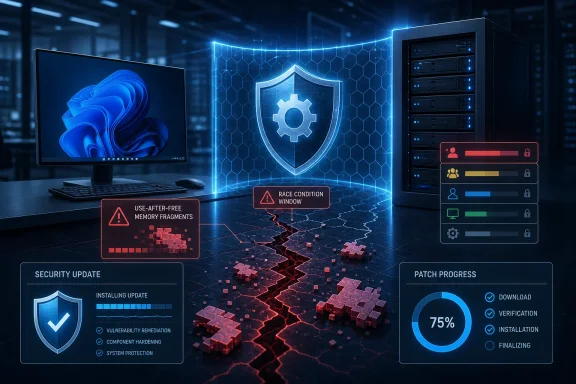 A Race Condition Opens the Privilege Boundary
Microsoft describes CVE-2026-50403 as improper synchronization during concurrent access to a shared Windows Runtime resource. The CVE record maps the defect to both CWE-362, covering race conditions, and CWE-416, covering use-after-free vulnerabilities.A race condition occurs when the safety of an operation depends on two or more events happening in an expected sequence. An attacker who can repeatedly manipulate that timing may force Windows Runtime into a state its developers did not intend. The associated use-after-free classification indicates that code could continue accessing memory after the operating system has released it.
Microsoft has not publicly disclosed the affected Windows Runtime function, object type, or exploitation procedure. There is also no public proof-of-concept listed in the initial advisory, and the Zero Day Initiative’s July review records the vulnerability as neither publicly disclosed nor exploited in the wild when the updates were released.
The absence of exploit code should not be confused with uncertainty about whether the defect exists. Microsoft is the CVE Numbering Authority for this record and has confirmed both the weakness and the affected products. In CVSS terminology, a Report Confidence value of Confirmed means the vulnerability and its technical basis have been acknowledged by the vendor; it does not mean attacks have been observed.
Exploitation Requires Access, Privileges, and Precise Timing
The CVSS vector isCVSS:3.1/AV:L/AC:H/PR:L/UI:N/S:U/C:H/I:H/A:H. That combination describes a local attack requiring low privileges, no additional user interaction, and high attack complexity.The high-complexity rating is significant. It indicates that successful exploitation depends on conditions outside an attacker’s direct control—consistent with a race condition in which operations must be triggered within a narrow timing window. Attack reliability may vary across processor architectures, hardware configurations, system load, and Windows builds.
Successful exploitation can nevertheless have a substantial effect. Microsoft assigns High impact values to confidentiality, integrity, and availability, meaning an attacker who wins the race could potentially cross a Windows privilege boundary and gain broad control over the affected system.
The unchanged-scope rating means the compromised Windows Runtime component and the resulting security authority remain within the same security scope. That is a scoring distinction rather than a reassurance: local elevation may still allow malware to access protected data, modify system resources, interfere with security software, or establish persistence that survives a normal user sign-out.
No user interaction is required once the attacker has local execution. That makes the flaw more relevant on shared systems, developer workstations, administrative jump boxes, and endpoints where an initial compromise could leave malware running under a standard account.
Windows 11 and Server 2025 Builds Need Checking
The initial CVE record identifies Windows 11 Version 24H2, Windows 11 Version 25H2, Windows 11 version 26H1, and Windows Server 2025 as affected. Both x64 and Arm64 editions of the listed Windows 11 releases are included, while Windows Server 2025 is affected on x64 systems in both Desktop Experience and Server Core installations.The published version boundaries identify these builds as the security baselines:
- Windows 11 Version 24H2 must be updated to build 26100.8875 or later.
- Windows 11 Version 25H2 must be updated to build 26200.8875 or later.
- Windows 11 version 26H1 must be updated to build 28000.2269 or later.
- Windows Server 2025 must be updated to build 26100.33158 or later.
winver, the Settings app, PowerShell inventory, Microsoft Intune, Configuration Manager, Windows Update for Business reporting, or an organization’s vulnerability-management platform.The affected-product list is narrower than the full range of Windows versions serviced in July. Windows 10, Windows 11 23H2, Windows Server 2019, and Windows Server 2022 are not included in the initial CVE record. That distinction matters when vulnerability scanners produce broad findings based only on the words “Windows Runtime” rather than Microsoft’s version data.
Windows Server 2025 Core is explicitly affected, so removing the desktop interface does not mitigate the bug. The vulnerable code is part of the underlying Windows platform rather than a graphical management application.
Local Bugs Become Serious After the First Compromise
CVE-2026-50403 cannot be exploited directly over the network according to Microsoft’s CVSS assessment. An attacker must already be able to execute code locally under an authorized, low-privilege account.For defenders, that places the vulnerability in the second stage of an intrusion. An initial-access technique gets an attacker onto the endpoint; CVE-2026-50403 could then help that attacker escape the restrictions of the compromised account. From there, elevated access may make credential theft, security-control tampering, lateral movement, and persistence easier.
This chaining potential is why CVSS scores alone are an incomplete deployment guide. A public-facing server may face little direct exposure to this particular flaw, yet a Windows Server 2025 application host running third-party code could still be a valuable target if another weakness provides local execution. Developer machines are similarly sensitive because they commonly hold source code, signing credentials, package-registry tokens, cloud sessions, and privileged management tools.
Organizations that cannot deploy the update immediately should concentrate temporary controls on preventing and detecting initial execution. Application control through Windows Defender Application Control or AppLocker, restricted administrative access, Microsoft Defender for Endpoint behavioral monitoring, and reduced exposure of interactive server accounts can all make the prerequisite foothold harder to obtain.
Those controls do not repair the memory-management defect. Microsoft has not published a registry workaround, Group Policy mitigation, or component-disable procedure for CVE-2026-50403, leaving the cumulative security update as the durable remediation.
Confirmed Does Not Mean Actively Exploited
The confidence language attached to the advisory can be easy to misread. Report Confidence measures certainty in the vulnerability’s existence and supporting technical details. A Confirmed rating reflects Microsoft’s acknowledgement and remediation of the issue.It does not indicate that exploitation is confirmed in customer environments. Microsoft’s initial publication did not classify CVE-2026-50403 as exploited or publicly disclosed, and the Zero Day Initiative reported the same status in its July 14 review.
Those assessments are snapshots, not guarantees. Race-condition vulnerabilities can take time to reverse-engineer and turn into dependable exploits, particularly when exploitation must remain reliable across different processor architectures and system loads. Once patches are available, however, attackers can compare updated and unpatched binaries to narrow their search for the corrected code.
CVE-2026-50403 therefore belongs in the normal July 2026 patch cycle rather than an emergency internet-facing response. Its priority should rise on Windows 11 workstations used by administrators and developers, shared endpoints, Remote Desktop Session Host deployments, and Windows Server 2025 machines where untrusted or lower-privilege code can run.
The immediate milestone is straightforward: inventory the four affected Windows release families, deploy the July 14 cumulative updates, and confirm that each machine has reached its corrected build baseline.
References
- Primary source: MSRC
Published: 2026-07-14T07:00:00-07:00
Security Update Guide - Microsoft Security Response Center
 msrc.microsoft.com
- Related coverage: aha.org
