

CVE-2026-50462, an elevation-of-privilege flaw in the Windows Ancillary Function Driver for WinSock, was patched in Microsoft’s July 14, 2026 security updates and should be treated as a priority on multi-user endpoints, servers, and systems where an attacker could gain an initial low-privilege foothold.
Microsoft rates the vulnerability Important, with a CVSS 3.1 base score of 7.8. Detailed in the Microsoft Security Response Center’s Security Update Guide and recorded by the National Vulnerability Database, the flaw affects supported Windows client and server releases across multiple generations.
The immediate action is straightforward: deploy the July cumulative security updates, reboot affected systems, and verify that the expected OS build has been installed. Microsoft has not published a workaround or mitigation that provides an equivalent substitute for patching.
Microsoft describes CVE-2026-50462 as an external control of file name or path vulnerability in the Windows Ancillary Function Driver for WinSock. The weakness is classified as CWE-73, which covers situations where software allows externally influenced input to control a path or file name without sufficient restriction.
The affected driver, commonly associated with
That location does not make CVE-2026-50462 remotely exploitable by itself. Microsoft’s CVSS vector is
No user interaction is required once those prerequisites are met. Attack complexity is rated low, and successful exploitation could produce high impacts to confidentiality, integrity, and availability.
In operational terms, this is a privilege-escalation building block rather than a complete initial-access attack. A malicious user, compromised application, or malware process running with restricted permissions could potentially exploit the flaw to obtain more powerful rights and escape the security boundary imposed on the original process.
That distinction matters, but it should not be mistaken for low risk. Attackers routinely combine an initial-access technique—such as phishing, credential theft, a browser vulnerability, or exploitation of an exposed service—with a local privilege-escalation flaw that provides control of the underlying Windows installation.
A confirmed rating means Microsoft has acknowledged the flaw and considers the available technical details or reproduction evidence sufficiently credible. It does not mean public proof-of-concept code exists, nor does it mean exploitation has been detected in customer environments.
At publication, Microsoft listed CVE-2026-50462 as not publicly disclosed and not exploited. Trend Micro’s Zero Day Initiative also recorded it as an Important-rated, 7.8-scored elevation-of-privilege vulnerability with no public disclosure or known exploitation.
The CVSS temporal vector marks exploit-code maturity as unproven and remediation as an official fix. Taken together, those assessments indicate that defenders have a patch and no confirmed active campaign to race against, but the underlying vulnerability is real and technically validated.
That window is useful, not permanent. Once administrators receive the patch, attackers can compare updated and unpatched binaries through patch diffing, potentially identifying the changed code and reconstructing a viable exploitation path. Local privilege-escalation vulnerabilities are especially attractive for malware operators because they can turn limited execution into durable control.
Server exposure includes Windows Server 2012 and 2012 R2, Windows Server 2016, Windows Server 2019, Windows Server 2022, and Windows Server 2025, including applicable Server Core installations. Some older releases remain eligible for updates only under specialized support arrangements such as Extended Security Updates, so administrators should confirm both servicing eligibility and successful deployment.
Microsoft’s affected-version data identifies several relevant fixed-build boundaries:
The continued appearance of Windows 10 21H2 and 22H2 in vulnerability records also does not mean every consumer installation remains supported. Applicable servicing depends on edition, lifecycle status, and whether the device participates in an Extended Security Updates program.
Security teams should pay particular attention to devices that commonly fall outside routine compliance reports: intermittently connected laptops, virtual desktop pools, development workstations, jump servers, kiosk systems, and servers placed in maintenance groups with delayed reboot policies.
CVE-2026-50462 does not require administrators to disable WinSock, remove networking features, or attempt to block access to
EDR telemetry can still reduce exposure while patching proceeds. Defenders can investigate suspicious transitions from ordinary user processes into SYSTEM-level execution, unusual child processes launched by network-facing applications, unexpected driver interactions, and persistence established immediately after low-privilege code execution. Those signals are not unique to this CVE, but they can reveal the broader attack chain in which a local escalation flaw would be used.
Installing and verifying the July 14, 2026 cumulative security updates remains the decisive fix. CVE-2026-50462 may not provide an attacker with remote entry, but on an already compromised Windows machine it could erase the distinction between a restricted account and control of the system.
Microsoft rates the vulnerability Important, with a CVSS 3.1 base score of 7.8. Detailed in the Microsoft Security Response Center’s Security Update Guide and recorded by the National Vulnerability Database, the flaw affects supported Windows client and server releases across multiple generations.
The immediate action is straightforward: deploy the July cumulative security updates, reboot affected systems, and verify that the expected OS build has been installed. Microsoft has not published a workaround or mitigation that provides an equivalent substitute for patching.
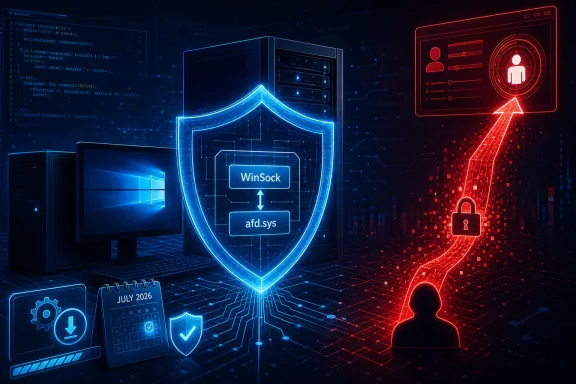 A Local Flaw With System-Level Consequences
Microsoft describes CVE-2026-50462 as an external control of file name or path vulnerability in the Windows Ancillary Function Driver for WinSock. The weakness is classified as CWE-73, which covers situations where software allows externally influenced input to control a path or file name without sufficient restriction.The affected driver, commonly associated with
afd.sys, sits in a sensitive part of the Windows networking stack. Applications use WinSock interfaces for network communication, while the Ancillary Function Driver mediates operations between user-mode networking software and kernel-mode components.That location does not make CVE-2026-50462 remotely exploitable by itself. Microsoft’s CVSS vector is
CVSS:3.1/AV:L/AC:L/PR:L/UI:N/S:U/C:H/I:H/A:H, meaning an attacker must already have local access and low-level privileges on the target.No user interaction is required once those prerequisites are met. Attack complexity is rated low, and successful exploitation could produce high impacts to confidentiality, integrity, and availability.
In operational terms, this is a privilege-escalation building block rather than a complete initial-access attack. A malicious user, compromised application, or malware process running with restricted permissions could potentially exploit the flaw to obtain more powerful rights and escape the security boundary imposed on the original process.
That distinction matters, but it should not be mistaken for low risk. Attackers routinely combine an initial-access technique—such as phishing, credential theft, a browser vulnerability, or exploitation of an exposed service—with a local privilege-escalation flaw that provides control of the underlying Windows installation.
Microsoft’s “Confirmed” Rating Is Not an Exploitation Warning
The Microsoft advisory lists the vulnerability’s report confidence as Confirmed. That metric addresses confidence in the technical finding, not evidence that attackers are currently exploiting it.A confirmed rating means Microsoft has acknowledged the flaw and considers the available technical details or reproduction evidence sufficiently credible. It does not mean public proof-of-concept code exists, nor does it mean exploitation has been detected in customer environments.
At publication, Microsoft listed CVE-2026-50462 as not publicly disclosed and not exploited. Trend Micro’s Zero Day Initiative also recorded it as an Important-rated, 7.8-scored elevation-of-privilege vulnerability with no public disclosure or known exploitation.
The CVSS temporal vector marks exploit-code maturity as unproven and remediation as an official fix. Taken together, those assessments indicate that defenders have a patch and no confirmed active campaign to race against, but the underlying vulnerability is real and technically validated.
That window is useful, not permanent. Once administrators receive the patch, attackers can compare updated and unpatched binaries through patch diffing, potentially identifying the changed code and reconstructing a viable exploitation path. Local privilege-escalation vulnerabilities are especially attractive for malware operators because they can turn limited execution into durable control.
The Affected Range Reaches From Windows 10 to Windows 11 26H1
The CVE record covers a broad set of Windows editions, including Windows 10, Windows 11, and Windows Server. The affected products listed in Microsoft-supplied vulnerability data include Windows 10 versions 1607, 1809, 21H2, and 22H2, along with Windows 11 versions 24H2, 25H2, and 26H1.Server exposure includes Windows Server 2012 and 2012 R2, Windows Server 2016, Windows Server 2019, Windows Server 2022, and Windows Server 2025, including applicable Server Core installations. Some older releases remain eligible for updates only under specialized support arrangements such as Extended Security Updates, so administrators should confirm both servicing eligibility and successful deployment.
Microsoft’s affected-version data identifies several relevant fixed-build boundaries:
- Windows 10 version 1607 systems are affected below build 14393.9339.
- Windows 10 version 1809 systems are affected below build 17763.9020.
- Windows 10 versions 21H2 and 22H2 are affected below builds 19044.7548 and 19045.7548, respectively.
- Windows 11 version 24H2 is affected below build 26100.8875.
- Windows 11 version 25H2 is affected below build 26200.8875.
- Windows 11 version 26H1 is included in Microsoft’s affected-product data and requires the applicable July servicing update.
The continued appearance of Windows 10 21H2 and 22H2 in vulnerability records also does not mean every consumer installation remains supported. Applicable servicing depends on edition, lifecycle status, and whether the device participates in an Extended Security Updates program.
Patch Verification Matters More Than an Approval Status
For managed environments, approving the July 2026 cumulative update in Windows Server Update Services, Microsoft Configuration Manager, or an endpoint-management platform is only the first step. The meaningful control is confirmation that the update installed, the machine restarted where required, and the resulting build meets or exceeds Microsoft’s fixed version.Security teams should pay particular attention to devices that commonly fall outside routine compliance reports: intermittently connected laptops, virtual desktop pools, development workstations, jump servers, kiosk systems, and servers placed in maintenance groups with delayed reboot policies.
CVE-2026-50462 does not require administrators to disable WinSock, remove networking features, or attempt to block access to
afd.sys. Such measures would carry substantial compatibility risk and are not presented by Microsoft as supported mitigations.EDR telemetry can still reduce exposure while patching proceeds. Defenders can investigate suspicious transitions from ordinary user processes into SYSTEM-level execution, unusual child processes launched by network-facing applications, unexpected driver interactions, and persistence established immediately after low-privilege code execution. Those signals are not unique to this CVE, but they can reveal the broader attack chain in which a local escalation flaw would be used.
Installing and verifying the July 14, 2026 cumulative security updates remains the decisive fix. CVE-2026-50462 may not provide an attacker with remote entry, but on an already compromised Windows machine it could erase the distinction between a restricted account and control of the system.
References
- Primary source: MSRC
Published: 2026-07-14T07:00:00-07:00
Security Update Guide - Microsoft Security Response Center
 msrc.microsoft.com
