

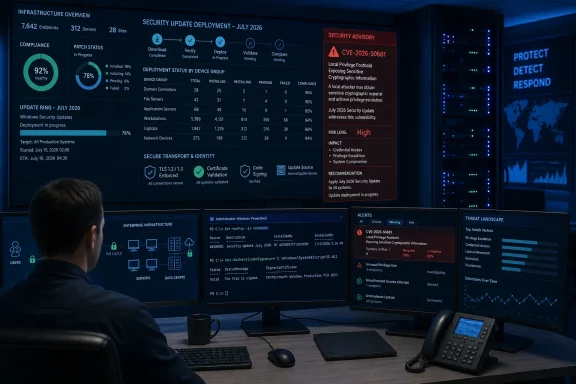
Detailed in the Microsoft Security Response Center’s Security Update Guide, the vulnerability affects supported Windows client and server releases, including Windows 11 24H2, Windows 11 25H2, Windows 11 26H1, and several Windows 10 and Windows Server branches. Administrators should deploy the July cumulative updates rather than wait for public proof-of-concept code, particularly on shared workstations, session hosts, development systems, and servers where an attacker may already possess an ordinary account.
The National Vulnerability Database describes the issue as an exposure of sensitive information in Windows Cryptographic Services that allows an authorized attacker to disclose information locally. Microsoft’s advisory title refers to Windows Secure Channel, while the CVE description uses the broader Cryptographic Services wording; neither public record currently explains the precise data structure, memory region, or cryptographic material that could be exposed.
Local Access Limits the Door, Not the Damage
Microsoft’s CVSS vector is CVSS:3.1/AV:L/AC:L/PR:L/UI:N/S:U/C:H/I:N/A:N. In practical terms, exploitation must originate locally, attack complexity is considered low, and the attacker needs an existing low-privilege foothold. A victim does not need to open a file, click a link, or approve a prompt.
The vulnerability is therefore not a direct wormable threat and cannot, based on the published vector, be launched anonymously across a network. That distinction matters for triage: CVE-2026-50681 should not displace an actively exploited remote-code-execution flaw at the front of an emergency patch queue.
However, the confidentiality impact is rated High. Microsoft assigns no direct integrity or availability impact, meaning successful exploitation is expected to expose information rather than modify data, execute code at a higher privilege level, or crash the affected computer.
That profile makes CVE-2026-50681 more relevant as a potential component in a longer attack chain. An intruder who has obtained a standard account through phishing, stolen credentials, a malicious installer, or another software vulnerability could attempt to use the flaw to retrieve information that should not be available at that privilege level.
Microsoft has not publicly identified what information can be recovered, so claims that the bug leaks private keys, authentication tokens, plaintext credentials, or TLS session secrets would be premature. The safe operational conclusion is narrower: the vendor considers the potential confidentiality loss severe, while the initial access needed to reach the vulnerable component keeps the overall score in the Medium range.
The July Builds Draw the Patch Boundary
The CVE record identifies vulnerable Windows versions by their pre-update build numbers. Systems at or above the listed corrected builds have crossed the security boundary for this vulnerability:
- Windows 11 24H2 is affected below build 26100.8875.
- Windows 11 25H2 is affected below build 26200.8875.
- Windows 11 26H1 is affected below build 28000.2269.
- Windows 10 22H2 is affected below build 19045.7548.
- Windows 10 21H2 is affected below build 19044.7548.
- Windows 10 version 1809 and Windows Server 2019-era servicing are affected below build 17763.9020.
- Windows 10 version 1607 and Windows Server 2016 are affected below build 14393.9339.
The presence of older Windows 10 releases in the affected-product data does not mean every consumer installation of those versions remains eligible for ordinary public support. Some branches persist through Enterprise LTSC, IoT, embedded, or other specialized servicing channels. Administrators need to match the installed edition and servicing entitlement to Microsoft’s corresponding July update rather than relying on the marketing version alone.
Build verification is especially useful where Windows Update reports success but centralized inventory has not yet reconciled. Administrators can check winver, query the operating-system build through PowerShell, or use Microsoft Intune, Configuration Manager, Windows Update for Business reporting, and their endpoint-management platform to locate machines below the corrected thresholds.
Because the fix ships through cumulative servicing, there is no need to locate a standalone Secure Channel component patch. Installing the applicable July 2026 cumulative security update—or a later cumulative update that supersedes it—should bring the corrected component onto the machine.
Report Confidence Is Not an Exploitation Warning
The advisory’s report confidence metric is Confirmed. That designation means Microsoft, as the affected vendor and assigning CVE Numbering Authority, has confirmed the vulnerability and supplied technical scoring information. It does not mean researchers have published a working exploit or that attackers are using the flaw in the wild.
CISA’s initial Stakeholder-Specific Vulnerability Categorization data recorded no known exploitation, assessed the issue as not readily automatable, and classified its technical impact as partial. The National Vulnerability Database was still awaiting its own enrichment as of July 15, one day after Microsoft published the advisory.
Those signals support measured patching rather than panic. There is no published basis for shutting down TLS services, disabling Secure Channel, rotating every certificate, or making disruptive registry changes. Microsoft’s public record does not list a workaround that provides an equivalent substitute for installing the security update.
Security teams should also avoid interpreting the CVSS score as a complete risk decision. A 5.5 local disclosure flaw can be comparatively modest on a locked-down single-user endpoint, yet more consequential on a Remote Desktop Session Host, jump server, administrative workstation, shared laboratory machine, or build server where multiple security contexts coexist.
Exposure is also shaped by the likelihood that attackers can first obtain local execution. Devices with untrusted users, permissive application controls, frequent use of unsigned tools, or weak endpoint protection give a local information-disclosure vulnerability more opportunities to become useful.
Enterprise Validation Should Focus on Authentication Workloads
Routine cumulative-update testing remains appropriate, but organizations running authentication-sensitive services should pay particular attention to Schannel and certificate-dependent workloads after deployment. These include IIS sites using HTTPS or mutual TLS, Remote Desktop gateways, LDAP over TLS, VPN products that call Windows cryptographic APIs, and line-of-business applications backed by the Windows certificate store.
That testing recommendation is precautionary, not evidence of a known regression. Microsoft has not identified a specific compatibility problem associated with the CVE fix. The objective is to validate the areas most closely connected to Windows cryptography before broad deployment, especially where an update failure could interrupt remote access or machine-to-machine authentication.
A practical rollout should verify that the July update installs, that the resulting OS build meets or exceeds Microsoft’s fixed build, and that the machine completes its required restart. Teams should then confirm that certificate enrollment, TLS negotiation, event collection, endpoint security agents, and business-critical authentication flows continue to operate normally.
On high-value systems, defenders should continue monitoring for unexplained local processes accessing credential, certificate, or cryptographic services. Public details are too limited to prescribe a reliable exploitation signature, and the absence of user interaction means awareness training offers no meaningful mitigation once an attacker has local access.
CVE-2026-50681 is ultimately a conventional cumulative-update problem with an unusually sensitive possible outcome: exploitation starts from a local foothold, but Microsoft scores the resulting information exposure as high. The immediate milestone for IT teams is concrete—move affected Windows installations to the July 14, 2026 builds or later, verify the reboot, and watch Microsoft’s advisory for any subsequent disclosure about the information at risk.
References
- CVE-2026-50681 Windows Secure Channel Information Disclosure Vulnerability MSRC · 2026-07-14T07:00:00-07:00