

On May 11, 2026, CVE-2026-5172 was published as a dnsmasq vulnerability in which malformed DNS responses can trigger a heap out-of-bounds read and crash the service, reducing availability without necessarily causing a complete, sustained denial of service. That wording matters because it places the bug in a familiar but often misunderstood class: the outage that is serious in practice even when the scoring language sounds restrained. For WindowsForum readers, this is not “a Windows bug,” but it is very much a Windows-adjacent infrastructure problem. DNS failures do not respect operating-system boundaries; they show up as broken logons, stalled updates, failed name resolution, and users blaming the nearest laptop.
dnsmasq has always occupied an odd place in the infrastructure stack. It is small, widely embedded, and often invisible until something goes wrong. It provides DNS forwarding, DHCP, and network boot services for home routers, lab networks, lightweight Linux servers, appliances, containers, and products that would rather ship a proven network component than build one from scratch.
That invisibility is why CVE-2026-5172 deserves more attention than a casual reading of “availability impact: low” might suggest. The vulnerability is not framed as a remote-code-execution apocalypse. It is a crash condition in a component many administrators do not inventory with the same rigor they apply to domain controllers, VPN concentrators, endpoint agents, or hypervisors.
The bug sits in dnsmasq’s
That does not automatically mean every network running dnsmasq is open to the Internet or trivially exploitable. It does mean defenders have to ask a more uncomfortable question: where, exactly, is dnsmasq quietly resolving names for systems that everyone assumes are being served by something else?
That phrasing is useful for scoring, but it is a poor description of how outages feel. DNS is binary from the user’s chair. If the resolver crashes at the wrong time, the application is “down,” the sign-in is “broken,” the printer “disappeared,” the update “hung,” and the help desk receives a ticket that says nothing about heap reads or malformed responses.
This is the gap between vulnerability taxonomy and operational reality. A low availability impact can still produce high irritation when it lands in a shared dependency. A DNS forwarder that restarts quickly may technically preserve partial availability, but repeated crashes can create intermittent failures that are harder to diagnose than a clean outage.
Intermittent infrastructure failures are often worse for administrators than obvious ones. A service that dies and stays dead points directly at itself. A service that crashes, restarts, and fails again under a narrow packet condition creates the classic support spiral: browser cache gets blamed, then Wi-Fi, then Group Policy, then “Microsoft is down,” before anyone checks the little resolver in the corner.
That distinction matters for patch ownership. Windows Update is not going to magically fix the dnsmasq binary embedded in a router, a Linux VM, a Pi-hole instance, a NAS appliance, a container image, a hypervisor-adjacent service, or a network appliance. The patch path runs through the product or distribution that shipped dnsmasq.
For Windows administrators, the risk is therefore indirect but real. A Windows endpoint estate can be perfectly patched and still depend on a vulnerable resolver upstream. A domain-joined Windows 11 machine does not care whether its DNS outage was caused by a flaw in a Linux daemon, an appliance firmware image, or a misconfigured forwarder; it simply cannot resolve the names it needs.
This is where modern Windows operations have become more heterogeneous than the branding suggests. Microsoft Entra ID, Intune, Defender, Windows Update for Business, hybrid join, VPN clients, line-of-business applications, and browser-based workflows all assume reliable name resolution. The resolver may be a Windows DNS Server role in one network and dnsmasq in another. The user impact does not follow the vendor label.
The headline risk in that cluster is not identical for every CVE. Some bugs involve DNSSEC validation. Others involve DHCPv6, cache poisoning, or information disclosure. CVE-2026-5172 is narrower: a malformed DNS response can crash dnsmasq. But vulnerability management works badly when teams treat each identifier as a disconnected event.
The sensible response is to update dnsmasq as a component, not to debate whether this one CVE alone crosses an internal emergency threshold. If a distribution, appliance vendor, or embedded product has shipped an updated dnsmasq package, that update should move through testing and deployment with the urgency appropriate for a network dependency.
There is also a versioning wrinkle. Public advisories point to dnsmasq 2.92rel2 as the release addressing the coordinated set of issues, while downstream distributions may backport fixes into older package versions. That means administrators should not rely only on the upstream version number. In enterprise Linux and appliance ecosystems, a “lower” version can still contain the security fix if the vendor has backported the patch.
Pi-hole is the obvious example because it is popular with enthusiasts and small offices that want DNS-based blocking without deploying a heavyweight resolver stack. But dnsmasq also appears in routers, virtualization setups, Linux networking services, containers, and embedded products. It is the kind of dependency that can be everywhere without appearing on a procurement spreadsheet.
That creates a patching problem. The person responsible for Windows endpoints may not own the DNS filtering box. The person who built the lab may have left. The router may be running vendor firmware that exposes no package-level detail. The DNS forwarder may live inside a container image that has not been rebuilt since the last time someone cared about ad blocking.
This is why “low availability impact” can become a high-friction operational issue. The vulnerable component may not be important enough to have a formal maintenance window, yet it may be important enough to break everything downstream when it fails. That is the classic shadow-infrastructure trap.
A dnsmasq instance acting as a local resolver for a tightly controlled LAN is not the same as one exposed in a hostile environment or forwarding traffic in a lab full of untrusted devices. DNSSEC configuration, upstream resolver behavior, firewalling, interface binding, and whether dnsmasq listens beyond the intended network all affect practical risk.
The important point is not to inflate the bug into something it is not. There is no need to pretend every dnsmasq deployment is one packet away from catastrophic compromise. The equally dangerous mistake is to dismiss it because the availability impact is not described as total.
Availability bugs live in the shape of the network. A crash on a redundant resolver pair may be a log entry. A crash on the only resolver for a remote office may be a business interruption. A crash on a home router may be a family wondering why “the Internet is down” while the fiber link is perfectly fine.
The appliance world is harder. Many routers, NAS devices, security gateways, IoT hubs, and vendor-managed boxes do not expose dnsmasq directly to administrators. They may contain the vulnerable code but require a firmware update. In some cases, vendors may determine that their build is not affected because a feature is disabled or the affected version range does not apply.
That uncertainty is normal, but it must be managed. Administrators should not assume safety simply because an appliance GUI does not mention dnsmasq. They should check vendor advisories, firmware release notes, and support bulletins, especially for devices that provide DHCP, DNS forwarding, guest-network isolation, or local name resolution.
For Windows-centric environments, the most practical move is to trace DNS dependency chains. Which resolver do clients actually use? What forwards to what? Are branch offices using local routers for DNS? Are developer VLANs using dnsmasq inside virtualization hosts? Are containers or WSL-adjacent workflows depending on a Linux resolver that nobody monitors?
A CVSS 7.3 score with low confidentiality, integrity, and availability impacts can still deserve prompt attention when the component is highly shared. The attack vector is network, attack complexity is low, privileges are not required, and user interaction is not required. Those properties should prevent complacency even if the stated availability effect is bounded.
There is also a useful lesson in the confidentiality and integrity fields. The CISA-provided vector gives low impacts there as well, which may reflect the broader consequences of malformed handling or adjacent behavior. But the clearest operational story for CVE-2026-5172 is still service stability: crash the resolver, disrupt dependent name resolution, and force administrators into response mode.
The right triage posture is therefore moderate urgency with good scoping. Internet-exposed or untrusted-network-facing deployments should move first. Single points of failure should move next. Lab, home, and noncritical systems should still be updated, but they do not need the theater of a midnight emergency unless they support something important.
Scanning for package versions on Linux servers is a start, not an end. Network administrators should also look at DHCP leases, DNS server settings pushed to clients, router configurations, container manifests, virtualization networking, and any device that offers “local DNS,” “DNS forwarding,” “DHCP server,” “network boot,” or “ad blocking” features.
Logs may help, but only if they exist and persist. A dnsmasq crash might show up as a service restart, a core dump, a systemd entry, or a sudden gap in query handling. In appliance land, the evidence may be reduced to vague uptime counters or nothing at all.
That is why defenders should focus on resilience as much as detection. If a single dnsmasq instance is the only resolver for a network segment, fix that architecture when possible. Redundant resolvers, sensible client failover, and monitoring that checks actual resolution rather than mere host reachability can turn a crash bug from an outage into an alert.
In hybrid environments, the noise can be even worse. A user may authenticate successfully but fail to reach internal services. A device may enroll or check in but fail to contact an update endpoint. A script may work by IP address but fail by hostname. None of those symptoms points naturally to dnsmasq unless the administrator already knows it is in the path.
This is why DNS dependency mapping is no longer optional plumbing work. It is part of endpoint reliability. Windows administrators do not need to become dnsmasq maintainers, but they do need to know whether dnsmasq is part of the route between a Windows client and the names it resolves.
The same logic applies to security tooling. Defender for Endpoint, EDR consoles, software distribution systems, remote management agents, and logging pipelines all depend on name resolution at some stage. A resolver crash can look like an endpoint health issue when the endpoint is merely stranded.
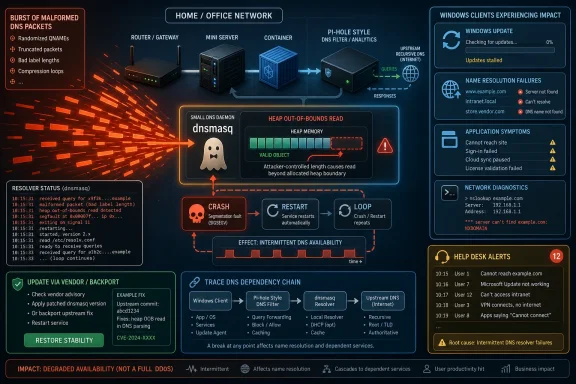 A Small DNS Daemon Becomes a Big Operational Dependency
dnsmasq has always occupied an odd place in the infrastructure stack. It is small, widely embedded, and often invisible until something goes wrong. It provides DNS forwarding, DHCP, and network boot services for home routers, lab networks, lightweight Linux servers, appliances, containers, and products that would rather ship a proven network component than build one from scratch.That invisibility is why CVE-2026-5172 deserves more attention than a casual reading of “availability impact: low” might suggest. The vulnerability is not framed as a remote-code-execution apocalypse. It is a crash condition in a component many administrators do not inventory with the same rigor they apply to domain controllers, VPN concentrators, endpoint agents, or hypervisors.
The bug sits in dnsmasq’s
extract_addresses() handling, where a malformed DNS response can cause pointer handling to run past the expected bounds of a record. The practical result is a heap out-of-bounds read and a crash. In plain English, an attacker who can get a crafted response into the right path may be able to knock over the dnsmasq process.That does not automatically mean every network running dnsmasq is open to the Internet or trivially exploitable. It does mean defenders have to ask a more uncomfortable question: where, exactly, is dnsmasq quietly resolving names for systems that everyone assumes are being served by something else?
The CVSS Language Undersells the User Experience
The user-supplied availability text is classic CVSS: careful, bounded, and intentionally unemotional. Performance is reduced, resources are interrupted, repeated exploitation may be possible, but the attacker does not fully deny service to legitimate users. The impacted component remains partially available all the time, or fully available only some of the time, with no direct serious consequence.That phrasing is useful for scoring, but it is a poor description of how outages feel. DNS is binary from the user’s chair. If the resolver crashes at the wrong time, the application is “down,” the sign-in is “broken,” the printer “disappeared,” the update “hung,” and the help desk receives a ticket that says nothing about heap reads or malformed responses.
This is the gap between vulnerability taxonomy and operational reality. A low availability impact can still produce high irritation when it lands in a shared dependency. A DNS forwarder that restarts quickly may technically preserve partial availability, but repeated crashes can create intermittent failures that are harder to diagnose than a clean outage.
Intermittent infrastructure failures are often worse for administrators than obvious ones. A service that dies and stays dead points directly at itself. A service that crashes, restarts, and fails again under a narrow packet condition creates the classic support spiral: browser cache gets blamed, then Wi-Fi, then Group Policy, then “Microsoft is down,” before anyone checks the little resolver in the corner.
This Is Not a Microsoft Patch Tuesday Story, but Microsoft Shops Still Care
The presence of an MSRC page for CVE-2026-5172 can make the issue look like a Microsoft-native vulnerability at first glance. The better reading is more nuanced. Microsoft tracks and surfaces vulnerability information through its security update ecosystem, and CERT/CC coordinated a broader disclosure involving dnsmasq and multiple vendors.That distinction matters for patch ownership. Windows Update is not going to magically fix the dnsmasq binary embedded in a router, a Linux VM, a Pi-hole instance, a NAS appliance, a container image, a hypervisor-adjacent service, or a network appliance. The patch path runs through the product or distribution that shipped dnsmasq.
For Windows administrators, the risk is therefore indirect but real. A Windows endpoint estate can be perfectly patched and still depend on a vulnerable resolver upstream. A domain-joined Windows 11 machine does not care whether its DNS outage was caused by a flaw in a Linux daemon, an appliance firmware image, or a misconfigured forwarder; it simply cannot resolve the names it needs.
This is where modern Windows operations have become more heterogeneous than the branding suggests. Microsoft Entra ID, Intune, Defender, Windows Update for Business, hybrid join, VPN clients, line-of-business applications, and browser-based workflows all assume reliable name resolution. The resolver may be a Windows DNS Server role in one network and dnsmasq in another. The user impact does not follow the vendor label.
The Broader dnsmasq Disclosure Is the Real Context
CVE-2026-5172 did not arrive alone. CERT/CC described a cluster of dnsmasq vulnerabilities covering denial of service, DNS redirection, information disclosure, and local privilege escalation under different conditions. That is the more important strategic fact: defenders are not triaging one isolated crash bug so much as a family of weaknesses in a component that often sits at the edge of trust.The headline risk in that cluster is not identical for every CVE. Some bugs involve DNSSEC validation. Others involve DHCPv6, cache poisoning, or information disclosure. CVE-2026-5172 is narrower: a malformed DNS response can crash dnsmasq. But vulnerability management works badly when teams treat each identifier as a disconnected event.
The sensible response is to update dnsmasq as a component, not to debate whether this one CVE alone crosses an internal emergency threshold. If a distribution, appliance vendor, or embedded product has shipped an updated dnsmasq package, that update should move through testing and deployment with the urgency appropriate for a network dependency.
There is also a versioning wrinkle. Public advisories point to dnsmasq 2.92rel2 as the release addressing the coordinated set of issues, while downstream distributions may backport fixes into older package versions. That means administrators should not rely only on the upstream version number. In enterprise Linux and appliance ecosystems, a “lower” version can still contain the security fix if the vendor has backported the patch.
Home Labs and Small Offices Are the Soft Center of the Blast Radius
Enterprise DNS is usually inventoried, monitored, and change-controlled. It may be messy, but it is visible. The more interesting exposure for CVE-2026-5172 is the small network, the branch office, the developer lab, the home lab, and the appliance-heavy environment where dnsmasq appears as a convenience layer.Pi-hole is the obvious example because it is popular with enthusiasts and small offices that want DNS-based blocking without deploying a heavyweight resolver stack. But dnsmasq also appears in routers, virtualization setups, Linux networking services, containers, and embedded products. It is the kind of dependency that can be everywhere without appearing on a procurement spreadsheet.
That creates a patching problem. The person responsible for Windows endpoints may not own the DNS filtering box. The person who built the lab may have left. The router may be running vendor firmware that exposes no package-level detail. The DNS forwarder may live inside a container image that has not been rebuilt since the last time someone cared about ad blocking.
This is why “low availability impact” can become a high-friction operational issue. The vulnerable component may not be important enough to have a formal maintenance window, yet it may be important enough to break everything downstream when it fails. That is the classic shadow-infrastructure trap.
Attackability Depends on Topology, Not Just the CVE
CVE descriptions often sound universal because they describe the vulnerable behavior in the software. Real-world exploitability is more conditional. An attacker needs a path to influence or deliver the malformed DNS response that reaches dnsmasq in a vulnerable code path. That path will vary dramatically by network design.A dnsmasq instance acting as a local resolver for a tightly controlled LAN is not the same as one exposed in a hostile environment or forwarding traffic in a lab full of untrusted devices. DNSSEC configuration, upstream resolver behavior, firewalling, interface binding, and whether dnsmasq listens beyond the intended network all affect practical risk.
The important point is not to inflate the bug into something it is not. There is no need to pretend every dnsmasq deployment is one packet away from catastrophic compromise. The equally dangerous mistake is to dismiss it because the availability impact is not described as total.
Availability bugs live in the shape of the network. A crash on a redundant resolver pair may be a log entry. A crash on the only resolver for a remote office may be a business interruption. A crash on a home router may be a family wondering why “the Internet is down” while the fiber link is perfectly fine.
The Patch Story Is Straightforward Until It Hits Appliances
For mainstream Linux distributions, the path is familiar: watch the vendor advisory, update the package, restart the service if needed, and verify the fixed build. Debian, SUSE, NixOS, and other ecosystems have tracked the issue through their own channels. Some distributions fix by moving to a newer upstream release; others backport patches into supported branches.The appliance world is harder. Many routers, NAS devices, security gateways, IoT hubs, and vendor-managed boxes do not expose dnsmasq directly to administrators. They may contain the vulnerable code but require a firmware update. In some cases, vendors may determine that their build is not affected because a feature is disabled or the affected version range does not apply.
That uncertainty is normal, but it must be managed. Administrators should not assume safety simply because an appliance GUI does not mention dnsmasq. They should check vendor advisories, firmware release notes, and support bulletins, especially for devices that provide DHCP, DNS forwarding, guest-network isolation, or local name resolution.
For Windows-centric environments, the most practical move is to trace DNS dependency chains. Which resolver do clients actually use? What forwards to what? Are branch offices using local routers for DNS? Are developer VLANs using dnsmasq inside virtualization hosts? Are containers or WSL-adjacent workflows depending on a Linux resolver that nobody monitors?
The Availability Score Is a Triage Input, Not a Permission Slip
Security teams love scores because scores scale. They let a small team sort thousands of findings into a queue that humans can survive. CVE-2026-5172 is a reminder that scoring systems describe technical impact, not business context.A CVSS 7.3 score with low confidentiality, integrity, and availability impacts can still deserve prompt attention when the component is highly shared. The attack vector is network, attack complexity is low, privileges are not required, and user interaction is not required. Those properties should prevent complacency even if the stated availability effect is bounded.
There is also a useful lesson in the confidentiality and integrity fields. The CISA-provided vector gives low impacts there as well, which may reflect the broader consequences of malformed handling or adjacent behavior. But the clearest operational story for CVE-2026-5172 is still service stability: crash the resolver, disrupt dependent name resolution, and force administrators into response mode.
The right triage posture is therefore moderate urgency with good scoping. Internet-exposed or untrusted-network-facing deployments should move first. Single points of failure should move next. Lab, home, and noncritical systems should still be updated, but they do not need the theater of a midnight emergency unless they support something important.
Defenders Should Hunt for dnsmasq Before They Hunt for Exploits
The hardest part of this issue may not be patching; it may be discovery. Many organizations have a clean inventory of Windows devices and a much dirtier inventory of embedded Linux services. dnsmasq can hide in places that vulnerability scanners see only partially, especially when it is bundled into firmware or container images.Scanning for package versions on Linux servers is a start, not an end. Network administrators should also look at DHCP leases, DNS server settings pushed to clients, router configurations, container manifests, virtualization networking, and any device that offers “local DNS,” “DNS forwarding,” “DHCP server,” “network boot,” or “ad blocking” features.
Logs may help, but only if they exist and persist. A dnsmasq crash might show up as a service restart, a core dump, a systemd entry, or a sudden gap in query handling. In appliance land, the evidence may be reduced to vague uptime counters or nothing at all.
That is why defenders should focus on resilience as much as detection. If a single dnsmasq instance is the only resolver for a network segment, fix that architecture when possible. Redundant resolvers, sensible client failover, and monitoring that checks actual resolution rather than mere host reachability can turn a crash bug from an outage into an alert.
Windows Symptoms Will Be Noisy and Misleading
When DNS breaks, Windows often reports the symptom rather than the cause. Applications time out. Outlook or Teams may appear flaky. Browsers may claim a site cannot be reached. Windows Update may fail. Domain resources may become unreachable. VPN-connected users may see split-DNS weirdness that looks like a client configuration problem.In hybrid environments, the noise can be even worse. A user may authenticate successfully but fail to reach internal services. A device may enroll or check in but fail to contact an update endpoint. A script may work by IP address but fail by hostname. None of those symptoms points naturally to dnsmasq unless the administrator already knows it is in the path.
This is why DNS dependency mapping is no longer optional plumbing work. It is part of endpoint reliability. Windows administrators do not need to become dnsmasq maintainers, but they do need to know whether dnsmasq is part of the route between a Windows client and the names it resolves.
The same logic applies to security tooling. Defender for Endpoint, EDR consoles, software distribution systems, remote management agents, and logging pipelines all depend on name resolution at some stage. A resolver crash can look like an endpoint health issue when the endpoint is merely stranded.
The Practical Lesson Is to Patch the Resolver You Forgot You Had
The concrete response to CVE-2026-5172 is refreshingly old-fashioned: find dnsmasq, determine whether the vendor says your build is affected, and apply the update or firmware that contains the fix. The less obvious response is to treat this as a rehearsal for the next embedded-networking bug, because the next one will probably arrive through the same inventory gaps.- Organizations should identify every dnsmasq deployment that provides DNS, DHCP, forwarding, filtering, network boot, or local name services for Windows clients or infrastructure.
- Administrators should prioritize updates for deployments exposed to untrusted networks, serving branch offices, supporting remote access, or acting as a single resolver for important workloads.
- Teams should verify vendor-specific fixes rather than relying only on upstream version numbers, because Linux distributions and appliance vendors may backport patches into older-looking releases.
- Windows support teams should add resolver health to troubleshooting paths for intermittent sign-in, update, VPN, browser, and application failures.
- Networks that depend on one lightweight resolver should use this incident to add redundancy, monitoring, and clearer ownership before the next availability bug turns into a business outage.
References
- Primary source: MSRC
Published: 2026-05-27T01:40:10-07:00
Security Update Guide - Microsoft Security Response Center
 msrc.microsoft.com
- Official source: microsoft.com
MSRC - Microsoft Security Response Center
The Microsoft Security Response Center is part of the defender community and on the front line of security response evolution. For over twenty years, we have been engaged with security researchers working to protect customers and the broader ecosystem.www.microsoft.com
- Related coverage: echelongraph.io
CVE-2026-5172: CVE-2026-5172 | EchelonGraph
[Medium] Microsoft Security Response Center (MSRC) security advisory CVE-2026-5172 — CVE-2026-5172. CVE-2026-5172echelongraph.io
- Official source: msrc-ppe.microsoft.com
- Related coverage: osv.dev

OSV - Open Source Vulnerabilities
Comprehensive vulnerability database for your open source projects and dependencies.
osv.dev
- Related coverage: sra.io
