

CVE-2026-53284 is a newly published Linux kernel vulnerability in Btrfs, disclosed in the NVD on June 26, 2026 and modified on June 28, that fixes a transaction writeback bug where dirty metadata tracking could be cleared after failed writes, leaving cleanup code unable to release dirty extent buffers correctly. The result is not a flashy remote-code-execution story, but a storage-layer availability flaw with a kernel.org CVSS 3.1 score of 7.5, rated High because a successful trigger can drive the filesystem into error handling and forced-read-only behavior. For WindowsForum readers, the lesson is bigger than one Linux CVE: modern storage stacks increasingly fail at the seams between correctness, recovery, and automation, and those seams matter even when the affected code lives outside Windows.
The CVE description reads like a kernel developer’s lab notebook, not a breach report. It talks about Btrfs transaction writeback, dirty extent buffers, unmount-time warnings, and a test case called generic/388. There is no mention of ransomware, credential theft, sandbox escape, or a nation-state actor burning a zero-day against enterprise Linux servers.
That is precisely why this CVE is worth paying attention to. The security industry has trained users to look for the spectacular: memory corruption, exploit chains, authentication bypasses, and “wormable” network services. But filesystems are where operating systems make promises they cannot afford to break. If the filesystem loses track of dirty metadata during a failure path, the machine may not be “owned” in the conventional sense, but it can become unavailable, inconsistent, or operationally untrustworthy.
CVE-2026-53284 lands in that category. The bug is in the Linux kernel’s Btrfs code, specifically around when Btrfs releases the
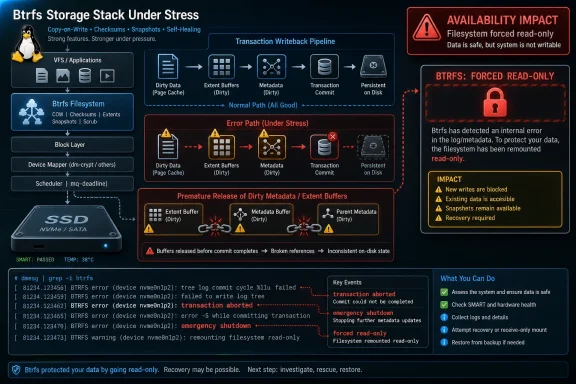
That gives us a classic kernel reliability problem with a security label attached. The system is already in distress — the log excerpt shows emergency shutdown, transaction abort, and a forced read-only filesystem — and then a cleanup path lacks the records needed to fully clean up dirty extent buffers. That produces warnings at unmount and leaves administrators staring at precisely the kind of storage diagnostic that turns a routine outage into a forensic exercise.
The CVE text describes the sequence plainly. Inside
That is the kind of bug that tends to hide for a long time. Happy-path testing does not reveal it, because happy-path testing writes successfully. Even ordinary failure testing may miss it if the timing is not just so. The report says the warning became easier to trigger with an additional warning on dirty extent buffers at unmount, and that a stripped-down fsstress workload plus a forced shutdown path could reproduce it more reliably.
This is also why storage bugs often look underwhelming until they happen to you. A stack trace at unmount is not a press-release-friendly exploit primitive. But from an administrator’s chair, it means the filesystem has gone through a failed transaction, entered forced-read-only mode, and then emitted warnings while trying to shut down. That is downtime, triage, and the possibility of conservative recovery procedures — all of which count as impact.
Filesystems that detect an unrecoverable metadata write failure have limited options. Continuing as if nothing happened would be reckless. Btrfs, like other serious filesystems, is built around transactional metadata updates, and when a transaction cannot be safely committed, the conservative move is to abort and prevent further writes. That is painful, but it is often preferable to silent corruption.
CVE-2026-53284 is uncomfortable because it sits one layer deeper. The filesystem correctly recognizes that something has gone wrong and tries to clean up. But because the dirty-pages I/O tree may have been released too early, cleanup loses the internal list of dirty extent buffers it needs to process. The result is not merely “there was an I/O error.” It is “there was an I/O error, and then the cleanup machinery did not have the information it expected.”
That distinction matters for risk assessment. If a drive fails, a cable flakes out, a dm target injects errors, or a test harness forces a shutdown, administrators expect the filesystem to complain. They do not expect the filesystem’s own recovery path to trip over missing bookkeeping. The patch narrows that gap by preserving the dirty-pages tree until writes have succeeded.
This is where CVSS often frustrates practitioners. A High availability score can sound like a remotely exploitable denial-of-service flaw in a network daemon. But the CVE’s technical description is about Btrfs transaction writeback and error handling, not an HTTP endpoint or unauthenticated packet parser. The scoring system compresses a messy operational risk into a vector string, and the resulting number can travel farther than the nuance.
The right read is neither panic nor dismissal. If you run Linux systems with Btrfs on paths that can experience attacker-influenced or workload-induced write failures, this is worth patching. If you are running consumer Linux desktops on Btrfs, it is still worth taking through the normal kernel update channel. If you are not using Btrfs at all, the affected code path is irrelevant to your fleet, though the broader lesson about filesystem failure paths remains relevant.
The word availability deserves its full weight here. Availability bugs in storage code are not minor simply because they do not leak data. A filesystem forced read-only at the wrong time can take down services, corrupt application assumptions, interrupt package updates, wedge containers, and trigger incident response. Even if the fix is just a few lines of kernel code, the blast radius of storage unavailability can be large.
For administrators, the practical question is rarely “which commit introduced this?” It is “which kernel package in my distribution contains the fix?” The CVE data gives upstream anchors, but distributions will map those anchors into their own kernel packages, changelogs, and errata. A Red Hat, Ubuntu, Debian, SUSE, Arch, Fedora, Proxmox, or NAS-appliance kernel may carry backports without matching the upstream version number exactly.
That is especially important with Linux kernel CVEs. Enterprise distributions frequently maintain older kernel version numbers while backporting fixes from much newer upstream releases. A system running a vendor kernel that reports an old base version may still be fixed. Conversely, a system tracking fast-moving kernels from a third-party repository may cross affected and fixed boundaries faster than an enterprise patch dashboard expects.
The cleanest policy is to treat the upstream fixed versions as evidence, not as the sole source of truth. Check your distribution’s security tracker, kernel changelog, or package advisory. If you build kernels yourself, verify that one of the referenced stable commits, or an equivalent patch, is present. If you ship an appliance or embedded image with Btrfs enabled, do not assume the absence of user complaints means the error path is safe.
But the risk profile is not uniform. A laptop with Btrfs on a single NVMe drive is different from a VM host with Btrfs-backed images, which is different from a backup server using Btrfs snapshots, which is different again from a storage appliance under heavy write pressure. The bug described here is tied to transaction writeback failure handling, so environments that regularly exercise error paths — test rigs, thin-provisioned storage, flaky virtual block devices, fault-injection environments, or systems under abrupt shutdown conditions — deserve more attention.
The reported reproduction used
A conservative administrator should therefore ask three questions. Do we run Btrfs? Are any Btrfs-backed systems exposed to untrusted workloads or aggressive multi-tenant write activity? Do we have monitoring that would catch forced-read-only transitions and Btrfs transaction aborts before users report an outage? The CVE does not require every Linux machine to be treated as burning down, but it does reward knowing where Btrfs actually sits in your estate.
WSL itself does not make typical Windows users direct Btrfs users. WSL distributions usually live inside virtual disks on NTFS or ReFS-hosted storage, and the Windows host filesystem remains outside the Linux kernel’s Btrfs implementation. But power users can attach disks, run custom kernels, experiment with filesystems, and build development environments that look less like “Windows plus Ubuntu” and more like a small virtualization lab.
Hyper-V and Azure scenarios matter more. A Linux VM using Btrfs for root, application data, container storage, or backups is still a Linux system with Btrfs semantics, even if the underlying block device ultimately lives on Windows-managed or cloud-managed infrastructure. If that guest kernel hits a Btrfs transaction failure and mishandles dirty metadata cleanup, the service impact appears as a VM problem, not a Windows host problem — but the outage still lands on the same operations team.
This is the modern platform lesson. Windows administrators increasingly need enough Linux literacy to distinguish a guest filesystem bug from a host storage issue. A Btrfs forced-read-only message inside a Linux VM is not evidence that NTFS is corrupt. A kernel CVE in Btrfs is not patched by Windows Update. But both may be part of the same operational surface.
That is why this bug is more interesting than the line count of the patch. Filesystem code is a web of invariants: which buffers are dirty, which transaction owns them, which writes have been submitted, which errors are fatal, and which cleanup path is allowed to release which state. The dirty-pages tree is one of those internal structures whose lifetime must match the transaction’s real progress, not merely the function’s intended sequence.
When a write fails, the system has not reached the same state as it would after a successful write-and-wait cycle. Releasing the tracking tree as though it had reached that state creates a false accounting entry. Later code looks for dirty buffers that still exist, cannot find the records in the expected tree, and the unmount path complains that extent buffers remain unreleased.
This is the kind of bug that good test infrastructure is designed to expose. The CVE text references generic/388, part of the xfstests universe used to beat on Linux filesystems under adverse conditions. That matters because the fix did not emerge from speculation about theoretical exploitability. It emerged from a reproducible failure mode in the machinery developers use to make filesystems less surprising.
CVE-2026-53284 is a good example of why kernel CVEs need triage context. A scanner may say “Linux kernel vulnerable.” The meaningful question is whether the affected Btrfs code is compiled, loaded, mounted, and used in a way that matters. A server running ext4 or XFS for all filesystems may carry a kernel package that includes Btrfs code but never exercises it. A container host using Btrfs as a storage driver or backing store may be much more exposed.
That does not mean administrators should suppress the finding wholesale. Kernel updates are security updates, and this one corrects a real failure path. But the remediation order should reflect actual deployment. Internet-facing services with Btrfs-backed storage, multi-tenant Linux hosts, storage appliances, CI systems that run untrusted workloads, and machines already showing Btrfs transaction errors deserve priority over dormant lab machines with no Btrfs mounts.
The more mature response is to enrich the ticket. Add whether Btrfs is in use. Add the running kernel package and vendor advisory status. Add whether the system has recent Btrfs errors in logs. Add whether the environment can tolerate rebooting into a patched kernel immediately or needs a maintenance window. That turns a raw CVE into operational security.
In a desktop scenario, forced read-only may show up as failed downloads, broken package updates, application crashes, or a system that needs a reboot and filesystem check. In a server scenario, it can mean databases stop committing, logs stop writing, containers fail, and orchestration layers start killing and restarting workloads in ways that obscure the original cause. By the time a human logs in, the first visible problem may be several layers above Btrfs.
CVE-2026-53284 does not say Btrfs will silently corrupt user data. It says that after a writeback error, dirty metadata cleanup could be mishandled because tracking state was cleared too early. That is an availability and recovery-path problem. The right monitoring posture is therefore to alert on Btrfs transaction aborts, emergency shutdown messages, forced-read-only transitions, and repeated extent-buffer warnings.
This is a place where Windows and Linux operational habits converge. A Windows admin would not ignore NTFS corruption events, disk timeout storms, or a volume unexpectedly flipping into a protective state. Linux Btrfs deserves the same treatment. Filesystem warnings are not background noise; they are often the first honest witness in a storage incident.
For practitioners, the better mental model is that a CVE record is a routing slip, not a complete incident report. It tells you what to look for and where the fix lives. It does not know your mount table, your distribution’s backport policy, your maintenance windows, your storage topology, or your tolerance for downtime. Treating it as final truth is as risky as ignoring it.
Kernel CVEs are especially prone to this mismatch. The upstream Linux tree moves fast, stable trees backport selectively, and vendors ship kernels that may diverge substantially in version number while still carrying the security fix. A vulnerability scanner that relies only on
The submitted record also includes a truncated description, which is a reminder that automated feeds often reduce rich technical context into fields. The useful detail is in the sequence: write dirty extent buffers, encounter an error, release dirty-pages tracking anyway, lose cleanup metadata, warn during unmount. That sequence tells administrators what failure mode to look for and why the fix changes behavior.
It deserves a narrower reading. This is a specific transaction cleanup bug in the Linux kernel’s Btrfs implementation. It does not prove that Btrfs is uniquely unsafe, nor does it prove that every Btrfs deployment is one write error away from disaster. Filesystem code across platforms has historically produced severe bugs because filesystem code is hard. NTFS, ReFS, APFS, XFS, ext4, ZFS, and Btrfs all live under the same brutal constraint: they must be correct when hardware, power, memory, drivers, and users are not.
The more useful conclusion is that Btrfs continues to mature in public, through testing and stable backports. The fact that a forced error path produced warnings, received a targeted fix, and was published as a CVE is evidence of maintenance, not just fragility. But users choosing Btrfs should also accept the operational bargain it offers: advanced features require serious backup discipline, kernel hygiene, and log monitoring.
For Windows users experimenting with Linux filesystems in dual-boot, WSL-adjacent, or home-lab contexts, that bargain is often underestimated. Btrfs snapshots are not backups. Checksums are not a substitute for hardware health. A fixed kernel is not a substitute for tested recovery. CVE-2026-53284 is a useful prompt to revisit those assumptions.
Administrators should also remember that installing a kernel package is not the same as running it. Linux systems often accumulate multiple installed kernels, and the vulnerable one remains active until reboot. In virtualized and clustered environments, that means remediation is a scheduling problem as much as a package problem. Live patching may not cover filesystem changes like this, depending on vendor support and patch mechanics.
After updating, verify the running kernel, not just the installed package. Check Btrfs logs on systems that previously showed transaction aborts or forced-read-only events. If a filesystem has already gone through serious writeback errors, treat the patch as preventing the known cleanup bug from recurring; do not assume it retroactively proves the filesystem healthy. Run the vendor-recommended checks and restore from backup if integrity is in doubt.
This is also a good moment to test alerting. If your monitoring platform cannot tell you when a Linux system logs “BTRFS critical,” “Transaction aborted,” or “forced readonly,” it is not giving you enough visibility into storage health. A patch closes the CVE. Observability closes the next surprise.
The dirty-pages I/O tree in this story is a small internal detail with a large responsibility. Release it at the wrong time, and the cleanup path loses the map. Lose the map, and the unmount path finds dirty extent buffers it cannot release cleanly. The public artifact is a warning trace; the operational artifact is lost confidence in a storage stack during an already bad day.
That is why administrators should resist the temptation to sort CVEs only by glamour. A remote code execution flaw may deserve top billing, but a storage availability flaw can still be urgent on the systems that matter most. If your backup server, VM host, build farm, or container platform depends on Btrfs, boring kernel fixes are part of the security perimeter.
 A Filesystem Bug Becomes a Security Story Because Availability Is Security
The CVE description reads like a kernel developer’s lab notebook, not a breach report. It talks about Btrfs transaction writeback, dirty extent buffers, unmount-time warnings, and a test case called generic/388. There is no mention of ransomware, credential theft, sandbox escape, or a nation-state actor burning a zero-day against enterprise Linux servers.That is precisely why this CVE is worth paying attention to. The security industry has trained users to look for the spectacular: memory corruption, exploit chains, authentication bypasses, and “wormable” network services. But filesystems are where operating systems make promises they cannot afford to break. If the filesystem loses track of dirty metadata during a failure path, the machine may not be “owned” in the conventional sense, but it can become unavailable, inconsistent, or operationally untrustworthy.
CVE-2026-53284 lands in that category. The bug is in the Linux kernel’s Btrfs code, specifically around when Btrfs releases the
dirty_pages I/O tree during transaction writeback. The fixed behavior is simple to state: only release that tree after successful writes. The reason it matters is more subtle. The old behavior could clear internal state that later cleanup code still needed in order to unwind dirty metadata after a write failure.That gives us a classic kernel reliability problem with a security label attached. The system is already in distress — the log excerpt shows emergency shutdown, transaction abort, and a forced read-only filesystem — and then a cleanup path lacks the records needed to fully clean up dirty extent buffers. That produces warnings at unmount and leaves administrators staring at precisely the kind of storage diagnostic that turns a routine outage into a forensic exercise.
The Bug Is in the Error Path, Which Is Where Storage Code Earns Its Keep
The core failure is not that Btrfs cannot write data under perfect conditions. It is that, when a transaction write encounters an error, the code could still release the data structure tracking dirty pages. That tree is not decorative bookkeeping. It is the map the cleanup path uses to find and clean dirty extent buffers after a failed transaction.The CVE text describes the sequence plainly. Inside
btrfs_write_and_wait_transaction(), Btrfs first tries to write all dirty extent buffers, then waits for them to finish. After that, it calls btrfs_extent_io_tree_release() to free all extent states from the transaction’s dirty-pages I/O tree. The flaw appears when btrfs_write_marked_extent() returns an error: the code still releases the tree, even though it may contain dirty records for metadata that was never submitted successfully.That is the kind of bug that tends to hide for a long time. Happy-path testing does not reveal it, because happy-path testing writes successfully. Even ordinary failure testing may miss it if the timing is not just so. The report says the warning became easier to trigger with an additional warning on dirty extent buffers at unmount, and that a stripped-down fsstress workload plus a forced shutdown path could reproduce it more reliably.
This is also why storage bugs often look underwhelming until they happen to you. A stack trace at unmount is not a press-release-friendly exploit primitive. But from an administrator’s chair, it means the filesystem has gone through a failed transaction, entered forced-read-only mode, and then emitted warnings while trying to shut down. That is downtime, triage, and the possibility of conservative recovery procedures — all of which count as impact.
Btrfs Is Doing the Right Kind of Self-Defense, but the Accounting Went Wrong
The kernel log in the CVE tells a story of Btrfs trying to protect itself. It reports an emergency shutdown, an error writing out a transaction, an aborted transaction, a read-only filesystem, and a forced read-only transition. Those messages are not cosmetic panic. They are guardrails designed to keep a bad situation from becoming a worse one.Filesystems that detect an unrecoverable metadata write failure have limited options. Continuing as if nothing happened would be reckless. Btrfs, like other serious filesystems, is built around transactional metadata updates, and when a transaction cannot be safely committed, the conservative move is to abort and prevent further writes. That is painful, but it is often preferable to silent corruption.
CVE-2026-53284 is uncomfortable because it sits one layer deeper. The filesystem correctly recognizes that something has gone wrong and tries to clean up. But because the dirty-pages I/O tree may have been released too early, cleanup loses the internal list of dirty extent buffers it needs to process. The result is not merely “there was an I/O error.” It is “there was an I/O error, and then the cleanup machinery did not have the information it expected.”
That distinction matters for risk assessment. If a drive fails, a cable flakes out, a dm target injects errors, or a test harness forces a shutdown, administrators expect the filesystem to complain. They do not expect the filesystem’s own recovery path to trip over missing bookkeeping. The patch narrows that gap by preserving the dirty-pages tree until writes have succeeded.
The CVSS Score Says High, but the Real-World Trigger Story Is Narrower
Kernel.org assigned CVE-2026-53284 a CVSS 3.1 vector of AV:N/AC:L/PR:N/UI:N/S:U/C:N/I:N/A:H, producing a 7.5 High score. In plain English, that vector says the modeled impact is availability-only, with no confidentiality or integrity loss, and that exploitation is considered network-adjacent in the CVSS abstraction. NVD had not yet supplied its own score in the detail provided, which means the kernel.org CNA score is the concrete severity data administrators will see first.This is where CVSS often frustrates practitioners. A High availability score can sound like a remotely exploitable denial-of-service flaw in a network daemon. But the CVE’s technical description is about Btrfs transaction writeback and error handling, not an HTTP endpoint or unauthenticated packet parser. The scoring system compresses a messy operational risk into a vector string, and the resulting number can travel farther than the nuance.
The right read is neither panic nor dismissal. If you run Linux systems with Btrfs on paths that can experience attacker-influenced or workload-induced write failures, this is worth patching. If you are running consumer Linux desktops on Btrfs, it is still worth taking through the normal kernel update channel. If you are not using Btrfs at all, the affected code path is irrelevant to your fleet, though the broader lesson about filesystem failure paths remains relevant.
The word availability deserves its full weight here. Availability bugs in storage code are not minor simply because they do not leak data. A filesystem forced read-only at the wrong time can take down services, corrupt application assumptions, interrupt package updates, wedge containers, and trigger incident response. Even if the fix is just a few lines of kernel code, the blast radius of storage unavailability can be large.
The Affected-Version Data Points to Stable Kernel Backports, Not Just Mainline Hygiene
The affected data supplied with the CVE identifies Linux kernel source files underfs/btrfs/disk-io.c and fs/btrfs/transaction.c. It also lists stable-tree fixes by Git commit and semver-style version boundaries, showing affected versions below 6.18.33 and below 7.0.10, with 6.18.33, 7.0.10, and the 7.1 fix line marked unaffected. That is the operationally useful part of the record.For administrators, the practical question is rarely “which commit introduced this?” It is “which kernel package in my distribution contains the fix?” The CVE data gives upstream anchors, but distributions will map those anchors into their own kernel packages, changelogs, and errata. A Red Hat, Ubuntu, Debian, SUSE, Arch, Fedora, Proxmox, or NAS-appliance kernel may carry backports without matching the upstream version number exactly.
That is especially important with Linux kernel CVEs. Enterprise distributions frequently maintain older kernel version numbers while backporting fixes from much newer upstream releases. A system running a vendor kernel that reports an old base version may still be fixed. Conversely, a system tracking fast-moving kernels from a third-party repository may cross affected and fixed boundaries faster than an enterprise patch dashboard expects.
The cleanest policy is to treat the upstream fixed versions as evidence, not as the sole source of truth. Check your distribution’s security tracker, kernel changelog, or package advisory. If you build kernels yourself, verify that one of the referenced stable commits, or an equivalent patch, is present. If you ship an appliance or embedded image with Btrfs enabled, do not assume the absence of user complaints means the error path is safe.
Btrfs Users Are Not All the Same Risk Group
Btrfs has become common enough that a kernel CVE in its code is not automatically niche. Fedora uses Btrfs by default for desktop installations. openSUSE has long leaned into Btrfs, particularly with snapshot-based workflows. Many home-lab users, NAS builders, and container-heavy systems use it for subvolumes, checksums, compression, snapshots, and send/receive workflows.But the risk profile is not uniform. A laptop with Btrfs on a single NVMe drive is different from a VM host with Btrfs-backed images, which is different from a backup server using Btrfs snapshots, which is different again from a storage appliance under heavy write pressure. The bug described here is tied to transaction writeback failure handling, so environments that regularly exercise error paths — test rigs, thin-provisioned storage, flaky virtual block devices, fault-injection environments, or systems under abrupt shutdown conditions — deserve more attention.
The reported reproduction used
fsstress, a Btrfs filesystem created with mkfs.btrfs, a mounted test device, a forced “godown” action, and an unmount while checking dmesg for warnings. That is not a normal desktop workflow. It is a deliberate filesystem stress scenario designed to flush out correctness bugs. Still, stress tests exist because production eventually invents its own stress tests, usually at 3 a.m. and usually with worse logging.A conservative administrator should therefore ask three questions. Do we run Btrfs? Are any Btrfs-backed systems exposed to untrusted workloads or aggressive multi-tenant write activity? Do we have monitoring that would catch forced-read-only transitions and Btrfs transaction aborts before users report an outage? The CVE does not require every Linux machine to be treated as burning down, but it does reward knowing where Btrfs actually sits in your estate.
The Windows Angle Is WSL, Virtualization, and the Reality of Mixed Fleets
WindowsForum readers may reasonably ask why a Linux Btrfs CVE belongs on a Windows site. The answer is that Windows environments are no longer Windows-only environments. Developers run Linux inside WSL. Enterprises run Linux VMs on Hyper-V, Azure, VMware, and Proxmox. Security teams collect logs from mixed fleets. Storage administrators manage appliances, containers, backup targets, and cloud images that may all contain Linux kernels.WSL itself does not make typical Windows users direct Btrfs users. WSL distributions usually live inside virtual disks on NTFS or ReFS-hosted storage, and the Windows host filesystem remains outside the Linux kernel’s Btrfs implementation. But power users can attach disks, run custom kernels, experiment with filesystems, and build development environments that look less like “Windows plus Ubuntu” and more like a small virtualization lab.
Hyper-V and Azure scenarios matter more. A Linux VM using Btrfs for root, application data, container storage, or backups is still a Linux system with Btrfs semantics, even if the underlying block device ultimately lives on Windows-managed or cloud-managed infrastructure. If that guest kernel hits a Btrfs transaction failure and mishandles dirty metadata cleanup, the service impact appears as a VM problem, not a Windows host problem — but the outage still lands on the same operations team.
This is the modern platform lesson. Windows administrators increasingly need enough Linux literacy to distinguish a guest filesystem bug from a host storage issue. A Btrfs forced-read-only message inside a Linux VM is not evidence that NTFS is corrupt. A kernel CVE in Btrfs is not patched by Windows Update. But both may be part of the same operational surface.
The Patch Is Small Because the Invariant Is Simple
The fix implied by the CVE title is almost disarmingly straightforward: only release the dirty-pages I/O tree after successful writes. In kernel development, however, simple invariants often require painful discovery. The code has to preserve just enough state through failure paths so later cleanup can do the right thing, without leaking memory, double-cleaning buffers, or holding stale metadata forever.That is why this bug is more interesting than the line count of the patch. Filesystem code is a web of invariants: which buffers are dirty, which transaction owns them, which writes have been submitted, which errors are fatal, and which cleanup path is allowed to release which state. The dirty-pages tree is one of those internal structures whose lifetime must match the transaction’s real progress, not merely the function’s intended sequence.
When a write fails, the system has not reached the same state as it would after a successful write-and-wait cycle. Releasing the tracking tree as though it had reached that state creates a false accounting entry. Later code looks for dirty buffers that still exist, cannot find the records in the expected tree, and the unmount path complains that extent buffers remain unreleased.
This is the kind of bug that good test infrastructure is designed to expose. The CVE text references generic/388, part of the xfstests universe used to beat on Linux filesystems under adverse conditions. That matters because the fix did not emerge from speculation about theoretical exploitability. It emerged from a reproducible failure mode in the machinery developers use to make filesystems less surprising.
Security Automation Will Overreact Unless Humans Add Context
A newly published High CVE with a 7.5 score can light up dashboards quickly. Vulnerability scanners ingest NVD data, correlate affected software, assign service-level agreements, and generate remediation tickets. In many organizations, that pipeline is intentionally blunt because speed matters. But bluntness has costs.CVE-2026-53284 is a good example of why kernel CVEs need triage context. A scanner may say “Linux kernel vulnerable.” The meaningful question is whether the affected Btrfs code is compiled, loaded, mounted, and used in a way that matters. A server running ext4 or XFS for all filesystems may carry a kernel package that includes Btrfs code but never exercises it. A container host using Btrfs as a storage driver or backing store may be much more exposed.
That does not mean administrators should suppress the finding wholesale. Kernel updates are security updates, and this one corrects a real failure path. But the remediation order should reflect actual deployment. Internet-facing services with Btrfs-backed storage, multi-tenant Linux hosts, storage appliances, CI systems that run untrusted workloads, and machines already showing Btrfs transaction errors deserve priority over dormant lab machines with no Btrfs mounts.
The more mature response is to enrich the ticket. Add whether Btrfs is in use. Add the running kernel package and vendor advisory status. Add whether the system has recent Btrfs errors in logs. Add whether the environment can tolerate rebooting into a patched kernel immediately or needs a maintenance window. That turns a raw CVE into operational security.
Forced Read-Only Is a Symptom Administrators Should Treat as a Page
One of the most important phrases in the log excerpt is “forced readonly.” Filesystems use read-only fallback as a containment strategy when they cannot safely continue writes. It is a protective move, but it is also a service-impacting event. Applications do not typically behave gracefully when a writable filesystem suddenly stops accepting writes.In a desktop scenario, forced read-only may show up as failed downloads, broken package updates, application crashes, or a system that needs a reboot and filesystem check. In a server scenario, it can mean databases stop committing, logs stop writing, containers fail, and orchestration layers start killing and restarting workloads in ways that obscure the original cause. By the time a human logs in, the first visible problem may be several layers above Btrfs.
CVE-2026-53284 does not say Btrfs will silently corrupt user data. It says that after a writeback error, dirty metadata cleanup could be mishandled because tracking state was cleared too early. That is an availability and recovery-path problem. The right monitoring posture is therefore to alert on Btrfs transaction aborts, emergency shutdown messages, forced-read-only transitions, and repeated extent-buffer warnings.
This is a place where Windows and Linux operational habits converge. A Windows admin would not ignore NTFS corruption events, disk timeout storms, or a volume unexpectedly flipping into a protective state. Linux Btrfs deserves the same treatment. Filesystem warnings are not background noise; they are often the first honest witness in a storage incident.
The NVD Record Is Useful, but It Is Not the Whole Advisory
The NVD entry provides the headline metadata: CVE identifier, publication date, modification date, description, severity fields, and affected-version data. It also shows the reality of modern vulnerability publication, where the CNA — in this case kernel.org — may provide the first meaningful score and affected matrix while NVD enrichment lags or remains incomplete. That is not a scandal; it is how the pipeline increasingly works.For practitioners, the better mental model is that a CVE record is a routing slip, not a complete incident report. It tells you what to look for and where the fix lives. It does not know your mount table, your distribution’s backport policy, your maintenance windows, your storage topology, or your tolerance for downtime. Treating it as final truth is as risky as ignoring it.
Kernel CVEs are especially prone to this mismatch. The upstream Linux tree moves fast, stable trees backport selectively, and vendors ship kernels that may diverge substantially in version number while still carrying the security fix. A vulnerability scanner that relies only on
uname -r can be wrong in either direction. Package-level advisory data is usually better than raw version comparison.The submitted record also includes a truncated description, which is a reminder that automated feeds often reduce rich technical context into fields. The useful detail is in the sequence: write dirty extent buffers, encounter an error, release dirty-pages tracking anyway, lose cleanup metadata, warn during unmount. That sequence tells administrators what failure mode to look for and why the fix changes behavior.
The Btrfs Reputation Problem Is Not the Same as This Bug
Any Btrfs vulnerability inevitably stirs old arguments. Some users swear by Btrfs snapshots, checksums, compression, and send/receive. Others still remember earlier eras of rough edges, especially around RAID5/6, recovery tooling, or frightening forum posts full of tree-checker errors. CVE-2026-53284 will be folded into that debate whether it deserves to be or not.It deserves a narrower reading. This is a specific transaction cleanup bug in the Linux kernel’s Btrfs implementation. It does not prove that Btrfs is uniquely unsafe, nor does it prove that every Btrfs deployment is one write error away from disaster. Filesystem code across platforms has historically produced severe bugs because filesystem code is hard. NTFS, ReFS, APFS, XFS, ext4, ZFS, and Btrfs all live under the same brutal constraint: they must be correct when hardware, power, memory, drivers, and users are not.
The more useful conclusion is that Btrfs continues to mature in public, through testing and stable backports. The fact that a forced error path produced warnings, received a targeted fix, and was published as a CVE is evidence of maintenance, not just fragility. But users choosing Btrfs should also accept the operational bargain it offers: advanced features require serious backup discipline, kernel hygiene, and log monitoring.
For Windows users experimenting with Linux filesystems in dual-boot, WSL-adjacent, or home-lab contexts, that bargain is often underestimated. Btrfs snapshots are not backups. Checksums are not a substitute for hardware health. A fixed kernel is not a substitute for tested recovery. CVE-2026-53284 is a useful prompt to revisit those assumptions.
The Practical Fix Is Boring, Which Is Exactly What You Want
The remediation story is conventional: update to a kernel that contains the fix, or apply the stable patch if you maintain your own kernel. The upstream affected data identifies fixed lines at 6.18.33 and 7.0.10, with 7.1 carrying the original fix. Most users should not manually cherry-pick kernel commits unless they already run a custom kernel workflow. They should wait for, or move to, the appropriate distribution kernel update.Administrators should also remember that installing a kernel package is not the same as running it. Linux systems often accumulate multiple installed kernels, and the vulnerable one remains active until reboot. In virtualized and clustered environments, that means remediation is a scheduling problem as much as a package problem. Live patching may not cover filesystem changes like this, depending on vendor support and patch mechanics.
After updating, verify the running kernel, not just the installed package. Check Btrfs logs on systems that previously showed transaction aborts or forced-read-only events. If a filesystem has already gone through serious writeback errors, treat the patch as preventing the known cleanup bug from recurring; do not assume it retroactively proves the filesystem healthy. Run the vendor-recommended checks and restore from backup if integrity is in doubt.
This is also a good moment to test alerting. If your monitoring platform cannot tell you when a Linux system logs “BTRFS critical,” “Transaction aborted,” or “forced readonly,” it is not giving you enough visibility into storage health. A patch closes the CVE. Observability closes the next surprise.
The Real Lesson Is Hidden in the Cleanup Path
CVE-2026-53284 is not a blockbuster vulnerability, and that is the point. It is a reminder that operating-system security is not only about stopping attackers from executing code. It is also about ensuring that the machine keeps its promises under failure, especially when the component making the promise is the filesystem.The dirty-pages I/O tree in this story is a small internal detail with a large responsibility. Release it at the wrong time, and the cleanup path loses the map. Lose the map, and the unmount path finds dirty extent buffers it cannot release cleanly. The public artifact is a warning trace; the operational artifact is lost confidence in a storage stack during an already bad day.
That is why administrators should resist the temptation to sort CVEs only by glamour. A remote code execution flaw may deserve top billing, but a storage availability flaw can still be urgent on the systems that matter most. If your backup server, VM host, build farm, or container platform depends on Btrfs, boring kernel fixes are part of the security perimeter.
The Patch Window Is Also a Chance to Clean Up Assumptions
CVE-2026-53284 gives Linux administrators a concrete patch target, but it also gives mixed-platform shops a chance to tighten their storage story before the next filesystem advisory arrives. The useful response is not drama; it is inventory, patching, reboot planning, and better log visibility.- Systems running Btrfs should be checked against distribution advisories or upstream fixed versions, especially if they are on kernels older than the fixed 6.18.33 and 7.0.10 stable lines.
- Systems that do not mount Btrfs should generally be lower priority, even if their kernel package technically contains the affected code.
- Any machine that has logged Btrfs transaction aborts, emergency shutdowns, forced-read-only transitions, or extent-buffer release warnings deserves immediate investigation.
- Kernel updates must be followed by a reboot into the fixed kernel unless a vendor explicitly provides an applicable live-patching path.
- Windows administrators responsible for Hyper-V, Azure, WSL experiments, or Linux-based appliances should treat this as a guest Linux kernel issue, not a Windows Update issue.
- Backups and restore tests remain the real safety net, because filesystem patches reduce future risk but do not turn past storage errors into non-events.
References
- Primary source: NVD / Linux Kernel
Published: 2026-06-28T01:03:01-07:00
NVD - CVE-2026-53284
 nvd.nist.gov
- Security advisory: MSRC
Published: 2026-06-28T01:03:01-07:00
Original feed URL
Security Update Guide - Microsoft Security Response Center
 msrc.microsoft.com
- Official source: nist.gov
National Vulnerability Database
NIST maintains the National Vulnerability Database (NVD), a repository of information on software and hardware flaws that can compromise computer security. This is a key piece of the nation’s cybersecurity infrastructure.www.nist.gov - Related coverage: stack.watch
Linux Kernel Security Vulnerabilities in 2026
 stack.watch
- Related coverage: btrfs.readthedocs.io
- Related coverage: android.googlesource.com
- Related coverage: lkml.iu.edu
Linux-Kernel Archive: [GIT PULL] Btrfs fixes for 7.1-rc4
[GIT PULL] Btrfs fixes for 7.1-rc4lkml.iu.edu - Related coverage: labs.cloudsecurityalliance.org
CSA research note nist nvd riskbased enrichment governance 20260426 csa styled
PDF documentlabs.cloudsecurityalliance.org
- Related coverage: kernel.org
