

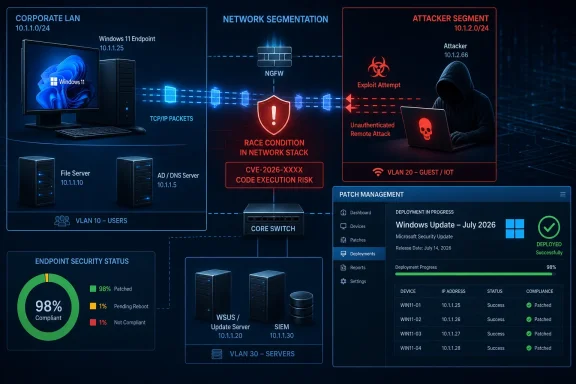
Detailed in Microsoft’s Security Update Guide, the vulnerability stems from improper synchronization when the Windows networking stack performs concurrent operations on a shared resource. The weakness is classified as CWE-362, commonly described as a race condition, and affects supported Windows client and server releases.
The immediate action is straightforward: install the July 2026 Windows security updates on exposed endpoints and servers. The more complicated task for administrators is determining which systems have meaningful adjacent-network exposure and where an attacker could reliably trigger the race.
Remote Code Execution, but Not From Anywhere
Microsoft describes CVE-2026-54999 as allowing an unauthorized attacker to execute code over an adjacent network. That attack vector is narrower than a conventional network vulnerability reachable from any Internet address, but it should not be mistaken for a requirement that the attacker already have a Windows account.
In CVSS terminology, adjacent generally means the attacker must occupy a network position with direct or logically local access to the vulnerable system. Depending on the affected protocol path and an organization’s architecture, that could include the same Ethernet segment, Wi-Fi network, virtual network, or another closely connected broadcast or routing domain.
The reported CVSS vector is consistent with an attack requiring:
- The attacker to be on an adjacent network.
- No prior privileges on the Windows machine.
- No action from the targeted user.
- Low attack complexity.
- Potentially high impact to confidentiality, integrity, and availability.
That combination produces the 8.8 score. The adjacent-network limitation pulls the rating below the scores normally assigned to remotely exploitable, unauthenticated flaws reachable across arbitrary routed networks.
Microsoft has not publicly documented the exact packet sequence, Windows TCP/IP state transition, or timing window needed to exploit CVE-2026-54999. There is also no broadly documented public proof of concept in the initial disclosure. Administrators should therefore avoid turning the phrase “adjacent network” into an assumption about a specific TCP port or firewall rule that Microsoft has not identified.
A Race Inside a Foundational Windows Component
Race conditions appear when two or more operations use the same resource without sufficient synchronization, allowing their order or timing to produce an unsafe state. In a networking stack, those operations may involve connection objects, buffers, timers, packet-processing state, or resources being created and released by different execution paths.
Exploitation is often less deterministic than triggering a straightforward bounds error because an attacker may need to reproduce a precise timing condition. Microsoft nevertheless assigned CVE-2026-54999 low attack complexity, indicating that the conditions required for exploitation are not considered a major practical barrier once an attacker can reach the vulnerable network path.
That matters because Windows TCP/IP is not an optional desktop application that administrators can simply uninstall. It sits underneath core operating-system networking, including routine client connections, server workloads, management traffic, and communications between virtualized systems.
The component’s position also increases the potential value of a successful exploit. Code execution in a low-level networking context can expose more of the operating system than a flaw confined to a sandboxed application, although Microsoft’s initial advisory does not provide enough technical detail to state the exact execution context or privileges that reliable exploitation would obtain.
The distinction is important. “Remote code execution” describes the possible security impact, but it does not by itself prove that an attacker immediately receives SYSTEM privileges or that every malformed packet will compromise a machine. Those details require either additional guidance from Microsoft or independent technical analysis.
The Affected Estate Reaches Across Client and Server Windows
Public CVE records identify affected product families including Windows 10, Windows 11, Windows Server 2012, Windows Server 2016, Windows Server 2019, Windows Server 2022, and Windows Server 2025. Administrators should use Microsoft’s Security Update Guide and their update-management platform to match specific editions, architectures, and servicing releases rather than relying only on the abbreviated product-family list.
The presence of Windows Server 2012 in public affected-product data is particularly relevant to organizations using Extended Security Updates. Older servers are frequently placed on supposedly trusted internal networks, where flat segmentation and broad east-west connectivity may make an adjacent-network vulnerability more useful to an attacker who has already compromised another device.
Windows 10 systems deserve similar scrutiny. Some installations may be covered by Microsoft’s Extended Security Updates program, while unsupported editions or builds will not necessarily receive the same remediation path. A successful cumulative-update deployment report is therefore not a substitute for checking whether every detected Windows version is still entitled to security fixes.
For Windows 11 and currently serviced Windows Server releases, the fix should arrive through the normal July cumulative update channel. Organizations using Windows Update for Business, Windows Server Update Services, Microsoft Intune, Configuration Manager, Azure Update Manager, or third-party patching products should confirm installation by update state and resulting OS build, not merely by update approval.
Administrators should prioritize systems connected to networks where untrusted or weakly managed devices can obtain local access. That includes guest-access environments, shared office networks, labs, manufacturing networks, hosting platforms, virtual desktop infrastructure, and segments containing unmanaged appliances or contractor devices.
Segmentation Is a Brake, Not the Repair
The adjacent attack vector gives defenders useful containment options while updates are being tested. Separating clients from servers, blocking unnecessary east-west traffic, enforcing wireless client isolation, and restricting access between virtual network segments can reduce the number of systems an attacker can directly reach.
Those controls are not equivalent to installing the patch. The vulnerable code remains present, and assumptions about network adjacency can change when VPN concentrators, virtual switches, overlay networks, containers, failover systems, or cloud networking services are involved.
Network intrusion prevention may also be difficult to rely on before technical packet details become public. A race condition can depend on sequences and timing rather than a single obviously malformed field, making a precise signature less likely at the start of the disclosure cycle.
Administrators unable to deploy immediately should focus first on reducing local exposure and monitoring for unusual connection churn, malformed traffic, unexpected system instability, or crashes involving Windows networking components. Such events would not prove exploitation, but they could justify packet capture and deeper endpoint investigation.
There is no vendor-published workaround in the information currently available that cleanly disables the vulnerable behavior without disrupting Windows networking. Disabling TCP/IP is not a realistic mitigation for ordinary endpoints or servers, leaving the cumulative security update as the durable remedy.
Patch Quickly, Then Verify the Network Assumptions
CVE-2026-54999 is not presented as an Internet-wide wormable flaw, and its High rating should not be inflated into a Critical one. Its combination of unauthenticated access, no user interaction, low stated complexity, and code-execution impact still makes it a meaningful July 2026 patching priority.
For enterprise IT, the practical sequence is to deploy the relevant cumulative updates, confirm the resulting Windows build numbers, identify unsupported systems, and review whether supposedly adjacent-only networks are genuinely isolated. Servers on flat internal networks and endpoints sharing connectivity with unmanaged devices should move toward the front of the rollout.
Microsoft may later expand the Security Update Guide with exploitation assessments, acknowledgements, FAQs, or revised affected-product information. Until then, the concrete consequence is clear: Windows systems left on pre-July 2026 patch levels retain a networking-stack race condition that an unauthenticated attacker on a neighboring network may be able to turn into code execution.
References
- CVE-2026-54999 Windows TCP/IP Remote Code Execution Vulnerability MSRC · 2026-07-14T07:00:00-07:00