

Microsoft’s Security Update Guide does not identify CVE-2026-54993 as publicly disclosed or exploited in the wild at release. The Zero Day Initiative’s July Patch Tuesday review independently lists the same 7.8 score and exploitation status, placing this bug below the actively exploited vulnerabilities that demand immediate incident-response attention—but not outside a normal expedited Windows deployment cycle.
The practical action is straightforward: install the July 2026 cumulative security update for every supported Windows release in scope. Administrators should prioritize endpoints and servers that routinely download, preview, transcode, index, scan, or otherwise process media supplied by untrusted users.
Media Processing Turns a File into an Attack Surface
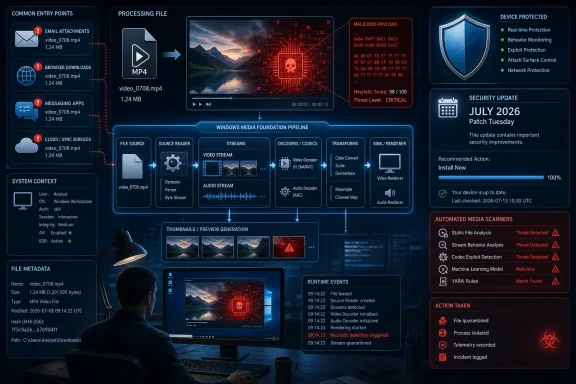
Windows Media Foundation is Microsoft’s multimedia framework for handling audio, video, codecs, media pipelines, and related content. It is used beneath applications rather than presented as a single program that administrators can simply remove, which means exposure is not limited to users deliberately launching a traditional media player.
A specially crafted media object may reach vulnerable code through an application that invokes Windows media-processing components. Plausible entry points include downloaded files, email attachments, browser-delivered content, messaging clients, document-management systems, collaboration platforms, and applications that generate previews or metadata.
Microsoft’s public classification establishes remote code execution as the potential impact, but the CVSS score provides important context. A 7.8 rating is commonly associated with an attack that requires local processing and user interaction rather than an unauthenticated attacker sending one packet directly to an exposed Windows service.
That distinction limits automation but does not make the vulnerability harmless. File-based attacks fit naturally into phishing, malvertising, compromised websites, and internal messaging campaigns, especially when the attacker can disguise media as business content or bundle it into an archive.
Successful exploitation would execute code in the security context of the process handling the file. On a standard-user workstation, that may constrain the immediate result, while a user operating with administrative privileges could expose the device to a broader compromise. Attackers may also pair the bug with a separate elevation-of-privilege vulnerability after gaining initial execution.
Microsoft Leaves the Exploit Mechanics Private
The initial Microsoft Security Response Center entry names the affected component and impact but does not publish enough technical detail to reproduce the vulnerability. There is no public proof of concept, detailed root-cause analysis, or confirmed attack chain associated with CVE-2026-54993 at publication time.
That limited disclosure is normal for a newly fixed vulnerability, particularly when technical specifics could make exploit development easier before Windows devices have received the update. It also means defenders should resist filling gaps with assumptions about one particular codec, container format, or Windows application.
The vulnerability’s confidence should not be confused with certainty about every exploit detail. Microsoft has confirmed and patched a flaw in Windows Media Foundation, but the public record does not yet establish which media format triggers it, whether preview generation is sufficient, or which third-party applications expose the vulnerable path.
The absence of those details creates an operational problem for organizations looking for compensating controls. Blocking one file extension may be ineffective if the flaw sits in shared parsing or object-management code used by multiple formats. File renaming, archive delivery, and embedded content can also undermine extension-based filtering.
For the moment, patching is the reliable remediation. Security teams can tighten attachment policies and reduce unnecessary media handling, but those steps should supplement the Windows update rather than replace it.
“Important” Does Not Mean Low Priority
Microsoft’s Important rating can look modest beside the Critical Media Foundation vulnerabilities also included in the July 2026 release. Zero Day Initiative documented several additional Windows Media Foundation remote code execution bugs this month, some carrying scores as high as 8.8 and Microsoft’s Critical classification.
CVE-2026-54993 nevertheless crosses the line from data exposure or denial of service into arbitrary code execution. That makes it valuable as an initial-access primitive even if an attacker must first persuade someone—or an automated application—to process a malicious file.
The strongest risk factors are environmental:
- Systems that ingest media from customers, contractors, or anonymous internet users have more exposure than locked-down administrative workstations.
- Shared terminal servers and virtual desktops can magnify the impact when many users process email and web content on the same infrastructure.
- Content-management, digital-asset, help-desk, and moderation systems may process files automatically before an employee opens them.
- Devices where users retain local administrator rights give successful code execution a more powerful starting context.
- Unsupported Windows installations remain exposed because they do not receive the July 2026 cumulative update through ordinary servicing channels.
Administrators should also account for applications outside Microsoft’s own media tools. A third-party program can still reach vulnerable Windows code if it relies on Media Foundation APIs for decoding, playback, thumbnail generation, or metadata extraction. An inventory based only on whether Windows Media Player is installed will therefore understate exposure.
Deployment Should Follow the Cumulative Update, Not the CVE Alone
CVE-2026-54993 is serviced through Windows cumulative updates rather than a standalone Media Foundation installer. Enterprises should map the vulnerability to the July 2026 security update applicable to each Windows version, then confirm successful installation using the resulting OS build rather than relying solely on a patch-management job’s completion status.
For Windows 11 24H2 and 25H2, the July cumulative update is KB5101650, bringing the respective servicing branches to OS builds 26100.8875 and 26200.8875. Older supported Windows and Windows Server releases have their own July packages and build numbers, all of which should be validated against Microsoft’s Security Update Guide and support documentation.
Microsoft has also documented a limited compatibility hold affecting KB5101650 on certain Dell devices with Intel processors. Those systems may not immediately receive the package because of reported risks involving unexpected shutdowns, heat, battery consumption, and reduced performance. Organizations encountering that safeguard should not force deployment without checking current Microsoft and Dell guidance.
That exception makes accurate reporting particularly important. A dashboard showing “no applicable update” is not the same as a fully patched endpoint when a safeguard hold is blocking delivery. IT teams should isolate held devices in their compliance reporting and apply additional controls until Microsoft offers the update safely.
After deployment, administrators should verify that the expected July build is installed, reboot where required, and test media-heavy line-of-business applications. Security operations teams can also watch for unusual child processes launched by browsers, mail clients, collaboration software, media applications, thumbnail handlers, and content-ingestion services.
Endpoint detection rules should focus on behavior rather than a guessed malicious extension. Suspicious indicators include a media-processing application spawning PowerShell, Windows Command Processor, script hosts, credential tools, or binaries from user-writable directories.
The Patch Window Is Open Before Exploit Details Arrive
There was no evidence on July 14 that CVE-2026-54993 had been exploited or publicly disclosed before Microsoft’s update. That gives administrators a valuable period in which patch availability is ahead of known weaponization.
The window may not remain open. Researchers and attackers can compare patched and unpatched Windows binaries, a process known as patch diffing, to identify the changed Media Foundation code and work backward toward a triggering file. The July release’s unusually large number of fixes may slow analysis, but the remote code execution label makes this vulnerability a credible target.
Organizations should deploy the relevant July 2026 cumulative updates during their accelerated workstation cycle, with earlier attention for media-processing servers, shared desktops, privileged-user devices, and systems that accept external files. The next meaningful milestone will be any MSRC revision identifying active exploitation, public disclosure, or more precise attack requirements; until then, installation status and OS build verification are the controls that matter.
References
- CVE-2026-54993 Microsoft Windows Media Foundation Remote Code Execution Vulnerability MSRC · 2026-07-14T07:00:00-07:00