

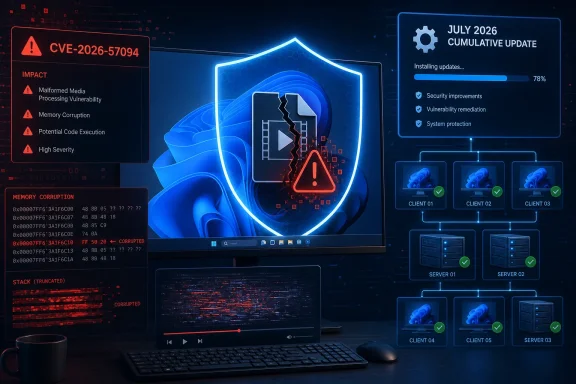
Microsoft’s July 14, 2026 security updates fix CVE-2026-57094, a critical Windows Media Foundation flaw that can let an unauthenticated attacker run code on a target system after user interaction with malicious media content. The vulnerability carries a CVSS 3.1 score of 8.8 and affects supported Windows client and server releases, including Windows 11 24H2 and 25H2, Windows 11 26H1, and Windows 10 systems still receiving servicing.
Microsoft’s Security Response Center describes the bug as a heap-based buffer overflow in Windows Media Foundation. The National Vulnerability Database record additionally lists an out-of-bounds read, placing the issue in a familiar but serious class of memory-safety defects: malformed input can drive a component to access or overwrite memory incorrectly, potentially handing execution to an attacker.
For Windows users and administrators, the immediate takeaway is straightforward: deploy the July cumulative update for each affected Windows release, rather than treating this as a media-player-only issue. Media Foundation is a Windows platform component, and the attack surface can extend beyond someone consciously opening a video in a standalone player.
The most important nuance in CVE-2026-57094 is encoded in Microsoft’s CVSS vector. The vulnerability is rated network reachable, low complexity, requires no attacker privileges, and can compromise confidentiality, integrity, and availability. But it is also marked user interaction required.
That does not mean an attacker needs local access or an existing account on the victim PC. It means the likely delivery route involves convincing a user to process attacker-controlled media or media-bearing content: a downloaded file, an attachment, a link that initiates playback or preview, or content accessed from a shared location. The public advisory does not identify a specific file format, application, or triggering workflow, so administrators should resist filling in those blanks with assumptions.
Calling this “remote code execution” can also create the wrong mental image. CVE-2026-57094 is not described as a wormable Windows service exposed directly to the internet. The network designation reflects that malicious content can be delivered remotely; user interaction is still a meaningful barrier. In practical risk terms, that makes it a strong candidate for phishing, file-sharing, and drive-by delivery chains—not evidence that every unpatched PC can be compromised without a user doing anything.
Microsoft’s 8.8 rating nevertheless deserves attention because a successful exploit can provide the attacker with the rights of the current user. On endpoints where people routinely operate with elevated permissions, or where an initial foothold can be combined with a separate privilege-escalation flaw, the impact rises quickly.
That cluster changes the patching conversation. Even if an organization judges one individual CVE as requiring user interaction and therefore not an emergency, the same monthly update closes a larger collection of media-processing weaknesses. The sensible operational unit is the cumulative update, not a debate over whether one specific parser or codec is deployed in a particular workflow.
Trend Micro’s Zero Day Initiative categorized CVE-2026-57094 as critical and reported no known public exploitation or public disclosure at release. The CISA-maintained decision metadata attached to the NVD record similarly says exploitation is not known and the flaw is not automatable, while identifying the potential technical impact as total.
Those fields are useful prioritization signals, but not a reason to defer indefinitely. Public patch availability gives defenders remediation material; it also gives researchers and attackers a fixed before-and-after target for reverse engineering. The absence of a known exploit on July 15 is a statement about reported activity, not a guarantee about what will circulate next week.
Windows 10 deserves special scrutiny. Microsoft Support notes that Windows 10 version 22H2 reached end of support on October 14, 2025, though eligible systems can remain covered through Extended Security Updates and long-term servicing channels. A Windows 10 fleet that is outside ESU or LTSC servicing is not merely missing this Media Foundation fix; it is accumulating a broader security debt with each monthly release.
For organizations that cannot patch immediately, the short-term objective should be exposure reduction while the deployment window is arranged. Treat unsolicited media files and archive-delivered media as higher-risk content; enforce download and attachment scanning; restrict execution from user-writable locations; and ensure endpoint detection tooling is operating across workstations and shared-use systems. These are layers, not fixes.
Administrators should also account for the broader behavior changes bundled into July’s Windows updates. Microsoft documents networking hardening around unregistered third-party TDI transports, which may affect legacy applications that use sockets through those transports. That is not a reason to avoid deployment, but it is a reason to test the cumulative update against older line-of-business software before a wide rollout—particularly in organizations with specialized networking stacks.
The practical deadline is the next patch deployment cycle, accelerated for endpoints that handle email attachments, downloaded media, shared folders, or content from external partners. Once systems report the July 2026 cumulative-update build for their Windows release, this particular Media Foundation exposure is closed; until then, every malicious file that reaches an unpatched device remains a possible entry point.
Microsoft’s Security Response Center describes the bug as a heap-based buffer overflow in Windows Media Foundation. The National Vulnerability Database record additionally lists an out-of-bounds read, placing the issue in a familiar but serious class of memory-safety defects: malformed input can drive a component to access or overwrite memory incorrectly, potentially handing execution to an attacker.
For Windows users and administrators, the immediate takeaway is straightforward: deploy the July cumulative update for each affected Windows release, rather than treating this as a media-player-only issue. Media Foundation is a Windows platform component, and the attack surface can extend beyond someone consciously opening a video in a standalone player.
 A network-rated flaw that still needs a click
The most important nuance in CVE-2026-57094 is encoded in Microsoft’s CVSS vector. The vulnerability is rated network reachable, low complexity, requires no attacker privileges, and can compromise confidentiality, integrity, and availability. But it is also marked user interaction required.That does not mean an attacker needs local access or an existing account on the victim PC. It means the likely delivery route involves convincing a user to process attacker-controlled media or media-bearing content: a downloaded file, an attachment, a link that initiates playback or preview, or content accessed from a shared location. The public advisory does not identify a specific file format, application, or triggering workflow, so administrators should resist filling in those blanks with assumptions.
Calling this “remote code execution” can also create the wrong mental image. CVE-2026-57094 is not described as a wormable Windows service exposed directly to the internet. The network designation reflects that malicious content can be delivered remotely; user interaction is still a meaningful barrier. In practical risk terms, that makes it a strong candidate for phishing, file-sharing, and drive-by delivery chains—not evidence that every unpatched PC can be compromised without a user doing anything.
Microsoft’s 8.8 rating nevertheless deserves attention because a successful exploit can provide the attacker with the rights of the current user. On endpoints where people routinely operate with elevated permissions, or where an initial foothold can be combined with a separate privilege-escalation flaw, the impact rises quickly.
Several Media Foundation bugs landed at once
CVE-2026-57094 did not arrive alone. Microsoft’s July 2026 release includes multiple Windows Media Foundation remote code execution fixes, with CVE-2026-57087 and CVE-2026-57090 also rated 8.8. Two further Media Foundation RCE entries, CVE-2026-56189 and CVE-2026-50655, are rated 7.8.That cluster changes the patching conversation. Even if an organization judges one individual CVE as requiring user interaction and therefore not an emergency, the same monthly update closes a larger collection of media-processing weaknesses. The sensible operational unit is the cumulative update, not a debate over whether one specific parser or codec is deployed in a particular workflow.
Trend Micro’s Zero Day Initiative categorized CVE-2026-57094 as critical and reported no known public exploitation or public disclosure at release. The CISA-maintained decision metadata attached to the NVD record similarly says exploitation is not known and the flaw is not automatable, while identifying the potential technical impact as total.
Those fields are useful prioritization signals, but not a reason to defer indefinitely. Public patch availability gives defenders remediation material; it also gives researchers and attackers a fixed before-and-after target for reverse engineering. The absence of a known exploit on July 15 is a statement about reported activity, not a guarantee about what will circulate next week.
The July updates are the fix
Microsoft has shipped the remediation through its July 14 cumulative updates. The relevant build levels documented in Microsoft’s affected-product data include:- Windows 11 24H2 reaches OS Build 26100.8875 through KB5101650.
- Windows 11 25H2 is serviced through KB5101650, reaching the 26200.8875 branch.
- Windows 11 26H1 reaches OS Build 28000.2525 through KB5101649.
- Windows 10 22H2 and Enterprise LTSC 2021 reach OS Build 19045.7548 through KB5099539.
- Windows 10 version 1607 and Windows Server 2016 reach OS Build 14393.9339 through KB5099535.
- Windows 10 version 1809 and Windows Server 2019 require the July package that reaches OS Build 17763.9020.
Windows 10 deserves special scrutiny. Microsoft Support notes that Windows 10 version 22H2 reached end of support on October 14, 2025, though eligible systems can remain covered through Extended Security Updates and long-term servicing channels. A Windows 10 fleet that is outside ESU or LTSC servicing is not merely missing this Media Foundation fix; it is accumulating a broader security debt with each monthly release.
Don’t confuse mitigation with remediation
There is no published workaround for CVE-2026-57094 that provides an equivalent substitute for updating. Disabling a preferred media player, blocking a handful of attachment extensions, or telling users not to open unfamiliar video files may reduce opportunity, but none proves that Windows Media Foundation cannot be invoked by another application or preview path.For organizations that cannot patch immediately, the short-term objective should be exposure reduction while the deployment window is arranged. Treat unsolicited media files and archive-delivered media as higher-risk content; enforce download and attachment scanning; restrict execution from user-writable locations; and ensure endpoint detection tooling is operating across workstations and shared-use systems. These are layers, not fixes.
Administrators should also account for the broader behavior changes bundled into July’s Windows updates. Microsoft documents networking hardening around unregistered third-party TDI transports, which may affect legacy applications that use sockets through those transports. That is not a reason to avoid deployment, but it is a reason to test the cumulative update against older line-of-business software before a wide rollout—particularly in organizations with specialized networking stacks.
The risk is in the unpatched gap
CVE-2026-57094 is a critical memory-corruption vulnerability with a credible remote delivery path, no authentication requirement, and potentially complete compromise of the affected user context. Its user-interaction requirement and lack of known exploitation make it different from an internet-facing, no-click emergency, but neither detail makes it routine.The practical deadline is the next patch deployment cycle, accelerated for endpoints that handle email attachments, downloaded media, shared folders, or content from external partners. Once systems report the July 2026 cumulative-update build for their Windows release, this particular Media Foundation exposure is closed; until then, every malicious file that reaches an unpatched device remains a possible entry point.
References
- Primary source: MSRC
Published: 2026-07-14T07:00:00-07:00
Security Update Guide - Microsoft Security Response Center
 msrc.microsoft.com
- Official source: support.microsoft.com
July 14, 2026—KB5101649 (OS Build 28000.2525) | Microsoft Support
July 14, 2026—KB5101649 (OS Build 28000.2525)support.microsoft.com
