

An attacker could exploit CVE-2026-58524 over the network by hosting a specially crafted website, luring a Microsoft Edge user to visit it, and abusing the browser’s handling of generated page content to create a spoofing condition without needing authentication or local access. Microsoft’s Security Update Guide frames this as a network-reachable, user-interaction-required Edge vulnerability, and third-party vulnerability databases list affected Chromium-based Edge versions before 150.0.4078.48. The important part is not that the attacker can magically reach into the browser; it is that the modern browser remains a high-trust interface where a convincing page can make a victim believe something false. For defenders, this is a reminder that “medium” browser bugs are often social-engineering bugs with a technical payload.
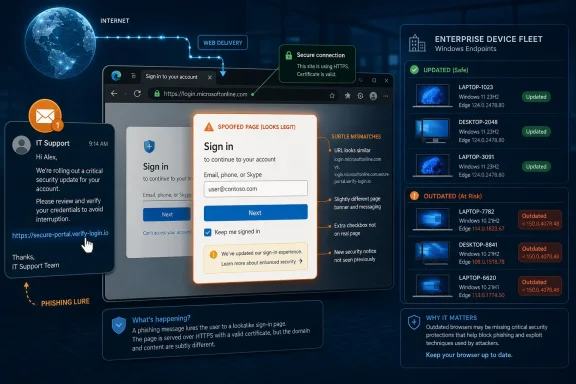
The word Network in Microsoft’s CVSS entry can sound more dramatic than the actual exploitation path. It does not mean an attacker can send a packet to an exposed Edge service and compromise the machine without the user doing anything. In this case, Microsoft says the attacker would host malicious web content and persuade the user to open it.
That distinction matters because Edge is not a listening server in the ordinary enterprise sense. The vulnerable component is reached when the browser processes attacker-controlled web content. The network is the delivery path, while the human click is the ignition source.
Microsoft’s own FAQ language is careful on this point. The attacker has no way to force the victim to view the page; the attacker must convince the user through an email, instant message, malicious attachment, or another lure. That places CVE-2026-58524 squarely in the familiar territory of phishing, watering-hole pages, help-desk impersonation, fake login portals, and “view this document” bait.
The result is still a real browser security issue. A vulnerability that requires user interaction is not harmless when the entire consumer and enterprise web is built around asking users to interact with links all day.
Spoofing bugs are often less cinematic than remote code execution, but they are not trivial. A spoofing flaw can cause the browser to present attacker-controlled content in a way that misleads the user about origin, identity, context, or trust. In a browser, those are not cosmetic details; they are part of the security boundary users actually understand.
The web’s trust model is already overloaded. Users are told to inspect domains, look for padlocks, distrust unexpected prompts, avoid odd downloads, and verify sign-in pages. A browser spoofing flaw weakens that model by helping malicious content look more legitimate than it is.
That is why the exploit path Microsoft describes is so mundane. The attacker sends a message, hosts a page, and waits. The vulnerability’s job is to make the trap more convincing once the victim arrives.
Then comes the limiting factor: user interaction is required. The victim has to browse to the attacker’s content, open the malicious page, or otherwise trigger Edge’s processing of that content. Scope is listed as unchanged, which suggests the impact remains within the vulnerable security authority rather than crossing into a broader privilege boundary.
The listed confidentiality, integrity, and availability impacts are low. That does not sound like a disaster, and it probably is not one in isolation. But browser flaws rarely live in isolation in real campaigns; they are often used to improve the odds of credential theft, prompt deception, malicious OAuth consent, fake support workflows, or secondary payload delivery.
For IT teams, the severity label should not be treated as a reason to ignore the update. A medium browser spoofing issue on a widely deployed default browser is different from a medium flaw in a niche tool used by five people.
Once the user clicks, Edge loads the page and the crafted content attempts to trigger the spoofing condition. Depending on the exact bug, the attacker’s goal could be to misrepresent a page’s identity, display misleading generated content, obscure the true source of an action, or make a fake interface appear more trustworthy. Microsoft has not published exploit-level details, which is normal for an advisory intended to get users patched before attackers have a blueprint.
The advisory language also mentions attachments as a possible enticement. That does not necessarily mean the vulnerability is in file parsing. It means an attachment could be the social-engineering wrapper that points the user toward attacker-controlled content or opens content in the browser.
This is the uncomfortable middle ground of browser security. The technical vulnerability may be narrow, but the delivery model is broad, cheap, and proven.
Microsoft’s Edge release notes for Stable Channel version 150.0.4078.48 say the July 2026 build incorporates the latest security updates from the Chromium project, while the Microsoft Update Catalog lists Edge Stable and Extended Stable 150.0.4078.48 packages dated July 2, 2026. Third-party CVE trackers list CVE-2026-58524 as affecting Edge versions before 150.0.4078.48.
That version number is the practical boundary for administrators. If endpoints are still running earlier Edge builds, they should be treated as exposed. If Edge auto-update is working normally, many consumer and unmanaged systems may already be protected, but enterprise fleets are rarely that simple.
WebView2 complicates the picture further. Many Windows desktop applications embed the Edge WebView2 runtime for web content, identity flows, dashboards, help panes, and admin consoles. Not every Edge browser CVE automatically translates into a WebView2 exposure, but administrators should verify the runtime update state rather than assuming the visible browser version tells the whole story.
A spoofing bug is useful precisely because it can reduce the user’s chance of noticing something is wrong. If a crafted page can blur the distinction between trusted and untrusted content, it can make a credential prompt, consent screen, notification, or fake browser chrome look more plausible. The vulnerability does not need to own the machine outright to contribute to compromise.
This is especially relevant in organizations that have trained users to trust browser-mediated identity flows. Single sign-on, passkeys, conditional access prompts, device compliance checks, and SaaS login redirects all run through the browser. Attackers increasingly do not need to defeat the whole identity stack; they need to trick a user into taking one action in the wrong place.
That is why CVE-2026-58524 belongs in the patch queue even without public reports of active exploitation. A browser spoofing flaw is a credibility amplifier for lures attackers already use.
On unmanaged Windows PCs, Edge usually updates itself through Microsoft Edge Update. In managed environments, however, update rings, maintenance windows, network egress rules, endpoint management tools, and change freezes can all delay browser patching. Some organizations also treat browsers as ordinary applications rather than fast-moving security components, which is a mistake in 2026.
Administrators should check both Stable and Extended Stable populations. Microsoft’s Update Catalog lists version 150 updates for both channels, and Extended Stable can lag feature churn while still needing security coverage. A fleet split across channels is not automatically unsafe, but it is harder to reason about during a vulnerability response.
The other audit target is policy. Edge update policies that pin, defer, disable, or redirect updates may have been set years ago for a compatibility emergency and then forgotten. Those policies become security debt the moment a browser CVE lands.
That is the right way to think about browser security updates. They are not substitutes for phishing-resistant authentication, attachment controls, link rewriting, isolation, or user reporting workflows. They are the base layer that prevents a normal lure from getting a technical advantage inside the browser.
Defenders should also resist the urge to wait for proof-of-concept code. By the time a browser spoofing proof of concept is circulating, attackers have had the same information. The vulnerability’s low attack complexity metric is a warning that exploitation may not require heroic reverse engineering once enough patch detail is available.
For home users, the advice is less elaborate but just as urgent. Open Edge’s About page, let it update, and restart the browser. Browser updates that sit pending until restart are a familiar weak spot.
A polished exploit page may look like a normal SharePoint file preview, a Microsoft account sign-in, a security notification, or a vendor portal. The malicious part may be invisible to the user until the spoofing condition changes what Edge displays or how the user interprets the page. That is the point of spoofing: the victim’s perception becomes part of the exploit chain.
Network delivery also enables scale. Attackers can rotate domains, use compromised legitimate sites, abuse ad networks, seed links into chat platforms, or target specific organizations with pages that match internal branding. A browser vulnerability does not need worm-like propagation to matter when the web itself is the distribution system.
The best defensive posture is therefore layered. Patch quickly, reduce exposure to unknown links, harden identity flows, and monitor for credential-phishing behavior that may follow a successful lure.
The concrete takeaways are straightforward:
 The Exploit Starts With a Link, Not a Socket
The word Network in Microsoft’s CVSS entry can sound more dramatic than the actual exploitation path. It does not mean an attacker can send a packet to an exposed Edge service and compromise the machine without the user doing anything. In this case, Microsoft says the attacker would host malicious web content and persuade the user to open it.That distinction matters because Edge is not a listening server in the ordinary enterprise sense. The vulnerable component is reached when the browser processes attacker-controlled web content. The network is the delivery path, while the human click is the ignition source.
Microsoft’s own FAQ language is careful on this point. The attacker has no way to force the victim to view the page; the attacker must convince the user through an email, instant message, malicious attachment, or another lure. That places CVE-2026-58524 squarely in the familiar territory of phishing, watering-hole pages, help-desk impersonation, fake login portals, and “view this document” bait.
The result is still a real browser security issue. A vulnerability that requires user interaction is not harmless when the entire consumer and enterprise web is built around asking users to interact with links all day.
Spoofing Is the Browser Bug That Attacks the User’s Eyes
CVE-2026-58524 is classified as a spoofing vulnerability in Microsoft Edge Chromium-based. SecurityVulnerability.io describes the underlying weakness as improper input neutralization during web page generation and lists the CVSS 3.1 score as 5.4, with network attack vector, low attack complexity, no privileges required, and required user interaction. Microsoft’s Security Update Guide is the originating advisory, even if its public web interface remains characteristically JavaScript-heavy.Spoofing bugs are often less cinematic than remote code execution, but they are not trivial. A spoofing flaw can cause the browser to present attacker-controlled content in a way that misleads the user about origin, identity, context, or trust. In a browser, those are not cosmetic details; they are part of the security boundary users actually understand.
The web’s trust model is already overloaded. Users are told to inspect domains, look for padlocks, distrust unexpected prompts, avoid odd downloads, and verify sign-in pages. A browser spoofing flaw weakens that model by helping malicious content look more legitimate than it is.
That is why the exploit path Microsoft describes is so mundane. The attacker sends a message, hosts a page, and waits. The vulnerability’s job is to make the trap more convincing once the victim arrives.
Microsoft’s CVSS Tells a More Useful Story Than the Severity Label
The CVSS score of 5.4 lands in “medium” territory, but the individual metrics are more informative than the headline severity. Network attack vector means the malicious content can be delivered remotely. Low attack complexity means the attacker does not need rare environmental conditions. No privileges required means the attacker does not need an account on the target system.Then comes the limiting factor: user interaction is required. The victim has to browse to the attacker’s content, open the malicious page, or otherwise trigger Edge’s processing of that content. Scope is listed as unchanged, which suggests the impact remains within the vulnerable security authority rather than crossing into a broader privilege boundary.
The listed confidentiality, integrity, and availability impacts are low. That does not sound like a disaster, and it probably is not one in isolation. But browser flaws rarely live in isolation in real campaigns; they are often used to improve the odds of credential theft, prompt deception, malicious OAuth consent, fake support workflows, or secondary payload delivery.
For IT teams, the severity label should not be treated as a reason to ignore the update. A medium browser spoofing issue on a widely deployed default browser is different from a medium flaw in a niche tool used by five people.
The Attacker’s Playbook Is Boring Because It Works
The most likely exploitation scenario is not a zero-click espionage chain. It is a crafted page behind a persuasive message. The attacker might send an email claiming to be a Microsoft 365 document share, a Teams notification, a payroll portal, a shipping update, or a password-expiration warning.Once the user clicks, Edge loads the page and the crafted content attempts to trigger the spoofing condition. Depending on the exact bug, the attacker’s goal could be to misrepresent a page’s identity, display misleading generated content, obscure the true source of an action, or make a fake interface appear more trustworthy. Microsoft has not published exploit-level details, which is normal for an advisory intended to get users patched before attackers have a blueprint.
The advisory language also mentions attachments as a possible enticement. That does not necessarily mean the vulnerability is in file parsing. It means an attachment could be the social-engineering wrapper that points the user toward attacker-controlled content or opens content in the browser.
This is the uncomfortable middle ground of browser security. The technical vulnerability may be narrow, but the delivery model is broad, cheap, and proven.
Edge’s Chromium Foundation Cuts Both Ways
Microsoft Edge’s Chromium base gives it enormous compatibility benefits and a fast security-update pipeline. It also means Edge lives in the same high-tempo browser threat environment as Chrome and other Chromium-derived browsers. Vulnerabilities can originate in Microsoft-specific Edge code, Chromium upstream code, WebView2-adjacent behavior, or the complicated seams where browser features meet enterprise identity and policy.Microsoft’s Edge release notes for Stable Channel version 150.0.4078.48 say the July 2026 build incorporates the latest security updates from the Chromium project, while the Microsoft Update Catalog lists Edge Stable and Extended Stable 150.0.4078.48 packages dated July 2, 2026. Third-party CVE trackers list CVE-2026-58524 as affecting Edge versions before 150.0.4078.48.
That version number is the practical boundary for administrators. If endpoints are still running earlier Edge builds, they should be treated as exposed. If Edge auto-update is working normally, many consumer and unmanaged systems may already be protected, but enterprise fleets are rarely that simple.
WebView2 complicates the picture further. Many Windows desktop applications embed the Edge WebView2 runtime for web content, identity flows, dashboards, help panes, and admin consoles. Not every Edge browser CVE automatically translates into a WebView2 exposure, but administrators should verify the runtime update state rather than assuming the visible browser version tells the whole story.
“User Interaction Required” Is Not a Comfort Blanket
Security teams sometimes down-rank vulnerabilities that require a click. Attackers do not. The entire phishing economy exists because users click, and because many clicks happen in contexts that feel normal: an HR notice, a contractor invoice, a customer support ticket, a vendor portal, a shared spreadsheet.A spoofing bug is useful precisely because it can reduce the user’s chance of noticing something is wrong. If a crafted page can blur the distinction between trusted and untrusted content, it can make a credential prompt, consent screen, notification, or fake browser chrome look more plausible. The vulnerability does not need to own the machine outright to contribute to compromise.
This is especially relevant in organizations that have trained users to trust browser-mediated identity flows. Single sign-on, passkeys, conditional access prompts, device compliance checks, and SaaS login redirects all run through the browser. Attackers increasingly do not need to defeat the whole identity stack; they need to trick a user into taking one action in the wrong place.
That is why CVE-2026-58524 belongs in the patch queue even without public reports of active exploitation. A browser spoofing flaw is a credibility amplifier for lures attackers already use.
Enterprise Risk Lives in Update Plumbing, Not Advisory Reading
The immediate fix is simple: update Microsoft Edge to a non-vulnerable build, with 150.0.4078.48 listed by third-party vulnerability databases as the fixed threshold. The operational challenge is proving that every relevant Edge installation and runtime actually got there.On unmanaged Windows PCs, Edge usually updates itself through Microsoft Edge Update. In managed environments, however, update rings, maintenance windows, network egress rules, endpoint management tools, and change freezes can all delay browser patching. Some organizations also treat browsers as ordinary applications rather than fast-moving security components, which is a mistake in 2026.
Administrators should check both Stable and Extended Stable populations. Microsoft’s Update Catalog lists version 150 updates for both channels, and Extended Stable can lag feature churn while still needing security coverage. A fleet split across channels is not automatically unsafe, but it is harder to reason about during a vulnerability response.
The other audit target is policy. Edge update policies that pin, defer, disable, or redirect updates may have been set years ago for a compatibility emergency and then forgotten. Those policies become security debt the moment a browser CVE lands.
The Patch Is Necessary, but It Does Not Retire the Attack
Patching Edge closes the known vulnerability, but it does not remove the social-engineering path Microsoft describes. Attackers can still host fake pages, send enticing messages, and imitate services. The patch reduces what the crafted page can do through this specific spoofing flaw.That is the right way to think about browser security updates. They are not substitutes for phishing-resistant authentication, attachment controls, link rewriting, isolation, or user reporting workflows. They are the base layer that prevents a normal lure from getting a technical advantage inside the browser.
Defenders should also resist the urge to wait for proof-of-concept code. By the time a browser spoofing proof of concept is circulating, attackers have had the same information. The vulnerability’s low attack complexity metric is a warning that exploitation may not require heroic reverse engineering once enough patch detail is available.
For home users, the advice is less elaborate but just as urgent. Open Edge’s About page, let it update, and restart the browser. Browser updates that sit pending until restart are a familiar weak spot.
The Web Page Is the Payload Surface
The phrase “specially crafted website” is doing a lot of work in Microsoft’s advisory. It means the attacker controls the HTML, script, redirects, framing, generated content, or related browser inputs needed to trigger the vulnerable behavior. It does not necessarily mean the page looks suspicious.A polished exploit page may look like a normal SharePoint file preview, a Microsoft account sign-in, a security notification, or a vendor portal. The malicious part may be invisible to the user until the spoofing condition changes what Edge displays or how the user interprets the page. That is the point of spoofing: the victim’s perception becomes part of the exploit chain.
Network delivery also enables scale. Attackers can rotate domains, use compromised legitimate sites, abuse ad networks, seed links into chat platforms, or target specific organizations with pages that match internal branding. A browser vulnerability does not need worm-like propagation to matter when the web itself is the distribution system.
The best defensive posture is therefore layered. Patch quickly, reduce exposure to unknown links, harden identity flows, and monitor for credential-phishing behavior that may follow a successful lure.
The Practical Reading for WindowsForum Readers
CVE-2026-58524 is not the sort of bug that should send administrators into emergency rebuild mode. It is the sort of bug that should make them ask whether their browser update process is actually as automatic as they think. Microsoft’s advisory describes a remote, network-delivered exploit path that still depends on user action, and that combination is common enough to be dangerous.The concrete takeaways are straightforward:
- An attacker would exploit the vulnerability by hosting malicious web content and persuading an Edge user to open it.
- The vulnerability is network-reachable because the attack content can be delivered over the web, not because Edge exposes a remotely callable service.
- User interaction is required, so phishing, instant messages, malicious attachments, and compromised websites are the realistic delivery routes.
- Edge versions before 150.0.4078.48 should be treated as vulnerable based on the available vulnerability listings.
- Administrators should verify both Microsoft Edge and relevant WebView2 runtime update status across managed devices.
- The patch addresses this spoofing flaw, but organizations still need phishing-resistant authentication and browser-hardening controls.
References
- Primary source: MSRC
Published: 2026-07-03T07:00:00-07:00
Security Update Guide - Microsoft Security Response Center
 msrc.microsoft.com
- Related coverage: securityvulnerability.io
CVE-2026-58524 : Cross-Site Scripting in Microsoft Edge (Chromium-based)
Learn about a cross-site scripting vulnerability in Microsoft Edge (Chromium-based) that allows unauthorized spoofing. CVE-2026-58524 details.securityvulnerability.io - Related coverage: www2.gov.bc.ca
- Related coverage: manuals.supernaeyeglass.com
- Official source: microsoft.com
MSRC - Microsoft Security Response Center
The Microsoft Security Response Center is part of the defender community and on the front line of security response evolution. For over twenty years, we have been engaged with security researchers working to protect customers and the broader ecosystem.www.microsoft.com
- Related coverage: stackoverflow.com
security - Python Error while Scraping Microsoft CVE Webpage - Stack Overflow
So, I read the question below. The answer provides some codes for further testing.
How can I scrape through the Microsoft CVE Webpage that assigns its content dynamically (preferably using Python)?...stackoverflow.com
- Official source: learn.microsoft.com
- Related coverage: cert.gov.vu
Advisory 118 CVE 2026 21509 Microsoft Office Security Feature Bypass Vulnerability
PDF documentcert.gov.vu
- Related coverage: sra.io
- Related coverage: techspot.com
Microsoft Edge Download Free - 150.0.4078.48 | TechSpot
Download Microsoft Edge - Edge browser lets you enjoy extended battery life and get to what you are looking for quickly.www.techspot.com - Related coverage: softexia.com
Microsoft Edge 150.0.4078.48 | Download Free
Discover the browsing experience across all your devices with Microsoft Edge - the advanced AI web browser for Windows, macOS, Android, iOS.www.softexia.com
- Official source: catalog.update.microsoft.com
- Official source: developer.microsoft.com

Microsoft Edge WebDriver | Microsoft Edge Developer
developer.microsoft.com
- Related coverage: windowsforum.com
CVE-2026-57988: Patch Microsoft Edge to 150.0.4078.48 Now | Windows Forum
Microsoft has published CVE-2026-57988 as a Microsoft Edge Chromium-based remote code execution vulnerability in the MSRC Security Update Guide, with the...windowsforum.com - Related coverage: ik1-439-51743.vs.sakura.ne.jp
- Related coverage: aha.org
h isac tlp white microsoft edge addresses exploited zero day vulnerability cve 2024 7971 8 23 2024
PDF documentwww.aha.org
