

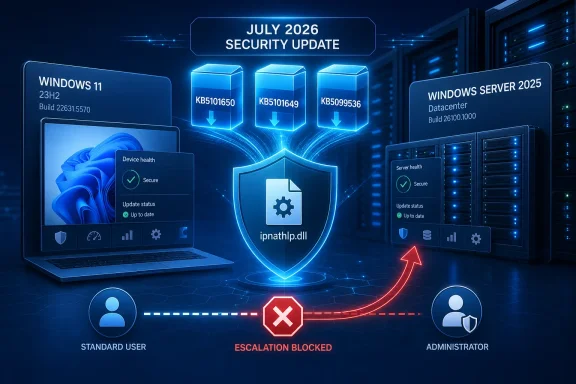
ipnathlp.dll. The immediate action for Windows administrators is to deploy the July cumulative updates: the vulnerability affects supported Windows 11 24H2, 25H2, and 26H1 installations as well as Windows Server 2025, including Server Core.Microsoft describes the issue as a use-after-free memory-safety vulnerability. According to the Microsoft Security Response Center’s advisory, an authorized attacker could exploit it locally to elevate privileges. The National Vulnerability Database records Microsoft’s CVSS 3.1 assessment as 7.8 High, with low attack complexity, low privileges required, no user interaction, and high potential impact on confidentiality, integrity, and availability.
That combination matters: this is not a network-reachable, unauthenticated entry point, but it can be valuable after an attacker already has a foothold on a machine. Malware running as a standard user, a compromised developer workstation account, or an untrusted local user on a shared server are more realistic starting conditions than an internet-wide attack.
Microsoft published the advisory as part of its July 2026 Patch Tuesday release. BleepingComputer’s broader July update coverage lists CVE-2026-58537 among the Windows vulnerabilities addressed in the release, while Microsoft’s own update documentation ties the fix to the month’s cumulative packages.
The builds that close the hole
For Windows 11 fleets, the relevant patched builds are delivered by the July 14 cumulative updates:
- Windows 11 24H2 and Windows 11 25H2 receive the fix through KB5101650, taking systems to OS builds 26100.8875 and 26200.8875 respectively.
- Windows 11 26H1 receives the fix through KB5101649, taking systems to OS build 28000.2525.
- Windows Server 2025, including Server Core, receives the fix through KB5099536, taking systems to OS build 26100.33158.
Microsoft’s affected-product data identifies Windows 11 24H2 on x64 and ARM64 as vulnerable below build 26100.8875. Windows 11 26H1 is vulnerable below build 28000.2525, while Windows Server 2025 x64 systems are vulnerable below build 26100.33158. The July support pages confirm those destination builds and describe the releases as cumulative security updates.
For most consumer PCs, Windows Update should deliver the appropriate package automatically. Enterprise administrators should confirm deployment through Windows Update for Business, Windows Server Update Services, Microsoft Configuration Manager, or their endpoint management platform rather than assuming that an approved update has reached every device.
Why a local privilege bug still deserves priority
Elevation-of-privilege vulnerabilities often become the second stage of an intrusion. A phishing attachment, malicious browser extension, trojanized installer, stolen low-privilege credential, or remote-access session may give an attacker limited execution first. A reliable local escalation bug can then turn that limited access into administrative control.
The CVSS vector for CVE-2026-58537 makes that distinction clear. An attacker needs local access and at least low privileges, so the flaw does not independently bypass Windows sign-in or expose a device directly to the internet. But it also does not require a victim to click an additional prompt once the attacker is in position, and Microsoft rates the potential impact across the confidentiality, integrity, and availability triad as high.
The affected component is specifically named in Microsoft’s advisory as ipnathlp.dll, not a generic Windows kernel designation. That precision should help security teams correlate vulnerability-scanner findings, baseline reports, and file or build inventories. It should not, however, invite reliance on ad hoc DLL replacement or component removal: the supported remediation is the cumulative Windows update, which delivers the corrected component alongside the month’s other fixes.
For server teams, this should be handled as an endpoint-hardening issue rather than dismissed because it is local. Shared administration servers, jump hosts, application servers with developer or operator logons, and Server Core deployments running management agents can all become attractive privilege-escalation targets if a lower-privilege process lands there.
Public detail remains limited — and that is useful context
Microsoft’s public description is intentionally concise: a use-after-free condition in NAT Helper Components can enable local privilege elevation. The NVD has accepted the Microsoft record and classifies the weakness as CWE-416, the standard category for use-after-free flaws, but its entry is still awaiting fuller NVD enrichment.
There is no public proof-of-concept, exploit code, or detailed root-cause analysis cited in the Microsoft advisory or the NVD record at publication. Administrators should therefore avoid two opposite mistakes: treating the lack of a public exploit as a reason to defer patching, or describing the CVE as an actively exploited zero-day without evidence.
The confidence picture is stronger than the available exploit detail. Microsoft is the CVE’s assigning authority and published a concrete affected-product list, severity vector, weakness category, and corrected build thresholds. In practical terms, the existence and impact class of the bug are confirmed by the vendor, while the publicly available information does not yet show a mature attack chain or broad exploitation.
That makes the patching decision relatively straightforward. A local EoP flaw with low complexity and no user interaction is worth closing during the normal July deployment window, especially on devices where users can execute arbitrary code, install developer tools, access removable media, or connect through remote support channels.
Verify the update rather than the CVE name
Because Windows cumulative updates address many vulnerabilities at once, operations teams should verify installed build numbers and update compliance, not search for a standalone “CVE-2026-58537 patch.” On Windows 11, winver, Settings’ Windows Update history, endpoint-management inventory, or PowerShell build reporting can establish whether a device has reached the July target build.
The same principle applies to Windows Server 2025. Microsoft began using separate KB identifiers and build numbers for Windows Server 2025 in early 2026, so administrators should not assume that a Windows 11 24H2 or 25H2 package maps directly to the server release merely because the platforms share portions of the 26100 build lineage. For this vulnerability, KB5099536 and build 26100.33158 are the relevant Server 2025 markers.
A measured rollout still makes sense for business-critical systems. Test VPN and connectivity-dependent workflows, remote administration, endpoint security tools, and line-of-business applications in the pilot ring, then expand deployment quickly. Microsoft’s support documentation for KB5101649 states that it was not aware of known issues at publication, but that is not a substitute for validating an organization’s own drivers, management agents, and workload dependencies.
CVE-2026-58537 is not the headline-grabbing remote compromise bug that forces an emergency shutdown of exposed services. It is the kind of vulnerability that can make an initial compromise far more consequential. By moving Windows 11 devices to builds 26100.8875, 26200.8875, or 28000.2525 as appropriate — and Windows Server 2025 to 26100.33158 — administrators remove that escalation path along with the rest of Microsoft’s July 14 security fixes.
References
- CVE-2026-58537 Microsoft NAT Helper Components (ipnathlp.dll) Elevation of Privilege Vulnerability MSRC · 2026-07-14T07:00:00-07:00