

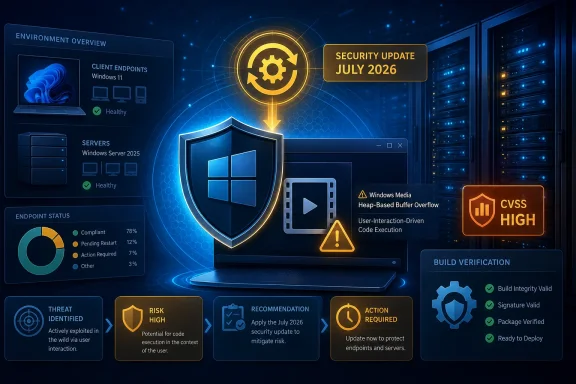
Microsoft’s Security Update Guide lists Windows 11 version 24H2, Windows 11 version 25H2, Windows 11 version 26H1, Windows Server 2025, and Windows Server 2025 Server Core as affected. The National Vulnerability Database, which imported Microsoft’s record on July 14, classifies the underlying weakness as CWE-122, a heap-based buffer overflow. That is the familiar class of memory-safety defect where a crafted input can overwrite data in heap memory and potentially redirect execution.
For Windows admins, the immediate instruction is conventional but important: deploy the July 2026 cumulative security updates to the affected Windows fleet, then verify that endpoints and servers have reached the post-update build level Microsoft specifies. The unusual part is not the remediation path; it is the distinction between the vulnerability’s “remote code execution” label and the attack path the CVSS vector actually describes.
The “Remote” Label Does Not Mean a Wormable Network Attack
CVE names often use “remote code execution” to describe an attacker’s ability to cause arbitrary code to run on a victim machine. That phrase alone does not establish that a target can be compromised directly over the network, without credentials, or without a victim opening anything. In this case, Microsoft’s CVSS vector is AV:L/AC:L/PR:N/UI:R/S:U/C:H/I:H/A:H.
In plain English, the vector says an attacker does not need an account on the target system and does not need a difficult exploit condition, but the attack is categorized as local and requires user interaction. The resulting code execution could have high impact on confidentiality, integrity, and availability within the security scope of the logged-in user.
That matters in triage. A vulnerable Windows Media component can still become a delivery path in a phishing campaign, download-by-file scenario, removable-media incident, or an intrusion where attackers already have a way to place or persuade a user to open malicious content. It is not, based on the current public record, a reason to treat every exposed Server 2025 host as if it were accepting unauthenticated hostile media traffic from the internet.
Microsoft has not publicly described the particular media format, handler, application workflow, or file-delivery mechanism involved. Administrators should resist filling that gap with assumptions. “Windows Media” may evoke Windows Media Player, but the advisory’s product wording and NVD record do not establish that the flaw is limited to, or necessarily triggered through, that one application.
The safest operational interpretation is broader: Windows should be patched; users should continue to treat unsolicited media files and unexpected downloads as untrusted; security teams should avoid claiming a specific exploit chain until Microsoft or credible technical research publishes one.
The Confidence Signal Is Stronger Than the Exploit Signal
The vulnerability is not a rumor or a third-party claim awaiting vendor acknowledgement. Microsoft is the assigning CNA and published the advisory as part of its July 2026 security release. NVD’s record reflects the vendor-supplied description, severity vector, affected-product data, and heap-buffer-overflow classification.
That establishes high confidence that Microsoft fixed a real Windows Media vulnerability. It does not establish that exploit code exists publicly or that the flaw is being exploited in the wild.
CISA’s SSVC enrichment, added to the NVD entry on July 15, currently records exploitation as “none,” automation as “no,” and technical impact as “total.” SSVC is a decision-support framework rather than a replacement for CVSS: it helps defenders distinguish the potential consequence of a successful exploit from the evidence that attackers can readily and repeatedly use one.
The combination is instructive. “Technical impact: total” is serious because successful exploitation may enable full compromise in the current user context. But “exploitation: none” means CISA has not identified known active exploitation, while “automatable: no” argues against a broad, hands-off attack scenario based on the available information.
Those fields can change. Security advisories are living records: researchers may release proof-of-concept code, Microsoft may revise exploitability guidance, or defenders may observe campaigns carrying weaponized files. On July 15, however, the published evidence supports prompt patching rather than emergency incident response solely because of this CVE.
Build Verification Has an Important Footnote
The NVD’s Microsoft-supplied affected-product listing identifies the following fixed thresholds:
- Windows 11 version 24H2 is affected below build 10.0.26100.8875 on x64 and Arm64 systems.
- Windows 11 version 26H1 is affected below build 10.0.28000.2525 on x64 and Arm64 systems.
- Windows Server 2025 and Windows Server 2025 Server Core are affected below build 10.0.26100.33158 on x64 systems.
The Windows 11 version 25H2 entry deserves care. The record identifies version 10.0.26200.0 as affected while also showing a threshold of 10.0.26100.8875. Because that comparison crosses distinct build branches, it should not be used as a simplistic numerical compliance test. Organizations running 25H2 should use their normal Windows Update, Windows Update for Business, WSUS, Microsoft Configuration Manager, or endpoint-management reporting to confirm installation of the July 2026 cumulative update applicable to their exact release.
This is a practical example of why security operations should track both KB deployment status and OS build numbers, rather than attempting to infer patch state from a single version comparison. A device can report a familiar feature-update label while sitting on a servicing build that tells a different story; conversely, raw build sequencing may not translate cleanly across enablement-package or branch transitions.
For a fast validation pass, administrators should check that managed endpoints have received the July 2026 quality update, review failed-update and reboot-pending states, and separate the few unpatched systems into a deployment ring with compensating controls. That includes especially shared workstations, kiosk-like systems, VDI pools, and devices used to open externally received media, because those are the places where a user-interaction requirement can become less reassuring in practice.
A Patch-Now Item, Not a Panic Item
CVE-2026-58542 belongs in the July deployment wave even though it is not the month’s highest-scoring Windows issue. The Cyber Security Agency of Singapore’s July Microsoft patch advisory lists it among the High-severity fixes at 7.8, alongside another Windows Media remote code execution CVE, CVE-2026-50327, and several Media Foundation issues. That clustering is another reason to deploy the full cumulative update rather than trying to isolate one media-related fix.
There is no public workaround in Microsoft’s advisory that substitutes for the update, and disabling or removing random media applications is not a reliable mitigation for an issue described only as “Windows Media.” Security teams should avoid creating unsupported configuration drift in an attempt to compensate for a patch that is already available.
The next meaningful milestone is whether Microsoft adds technical detail or changes its exploitation assessment, and whether independent researchers identify the triggering content type. Until then, the actionable conclusion is straightforward: **treat CVE-2026-58542 as a confirmed, user-interaction-driven Windows code-execution flaw, deploy the July 2026 updates, and verify servicing compliance rather than overreacting to the RCE label alone.