

CVE-2026-64133 is a newly published Linux kernel vulnerability in the ALSA driver for AudioScience ASI professional audio hardware, and its practical significance is far narrower than its 7.8 High CVSS v3.1 score first suggests. The flaw is a potential out-of-bounds array access in the
CVE-2026-64133 was published to the CVE List on July 19, 2026, with subsequent record updates on July 20, 2026. The vulnerability affects code in the Linux kernel’s Advanced Linux Sound Architecture, better known as ALSA, specifically the AudioScience HPI driver located under the
ALSA is Linux’s central audio framework. It provides drivers and kernel interfaces for ordinary consumer audio devices, USB audio gear, embedded audio controllers, MIDI equipment, DSP hardware, and specialized professional sound cards. That breadth matters because ALSA contains both heavily deployed drivers for laptops and desktop motherboards and more specialized drivers retained for niche hardware used in studios, broadcast facilities, industrial deployments, and legacy infrastructure.
The vulnerable component is not the ubiquitous generic ALSA stack. It is the
A kernel driver is not merely another application component. It runs with elevated privileges and shares the kernel’s trust boundary. If an attacker can reliably transform an out-of-bounds access into controlled memory corruption or information disclosure, the potential impact can be substantial. The score should therefore not be dismissed simply because the hardware ecosystem is specialized.
At the same time, CVSS is not a measure of universal real-world exposure. A High score for a local kernel flaw in a hardware-specific driver does not mean every Linux computer—or every Windows computer running Linux tooling—is equally exposed. The actual risk depends on whether the driver is present, enabled, loaded, connected to relevant hardware, and reachable through a realistic local attack path.
An array is a fixed collection of entries stored contiguously in memory. In safe operation, code must ensure that a requested index lies between zero and the array’s last valid entry. If code accepts an invalid index and reads beyond those bounds, it can inspect unrelated memory, trigger a crash, or—depending on surrounding code and system conditions—contribute to a more serious exploitation chain.
However, the available CVE description does not establish a public proof of concept, a demonstrated privilege-escalation chain, remote reachability, or confirmed exploitation in the wild. Treating the issue as remotely exploitable or automatically equivalent to arbitrary code execution would go beyond what the record supports.
Caching is legitimate and usually beneficial. It can lower latency, minimize device transactions, and produce more coherent behavior for user-space mixers and control applications. But cache handling introduces a responsibility: identifiers originating from a caller, device response, or internal mapping must be reconciled with the cache’s actual size before indexing occurs.
CVE-2026-64133 illustrates a classic systems-programming truth. Fast paths and helper functions often look harmless because they exist to simplify access to known data. Yet a single unchecked integer at a boundary can invalidate those assumptions.
AudioScience equipment has historically been associated with professional audio contexts, especially installations where multichannel playback or capture needs to operate continuously and predictably. Those environments can include radio automation, broadcast playout, studio production, audio logging, public-address distribution, fixed media installations, and specialized communications workflows.
The CVSS vector’s local-access requirement should not be interpreted as “someone must be standing in front of the rack.” Local access can arise through a legitimate but compromised user account, a vulnerable service that grants a foothold, an exposed remote desktop or SSH path, malware delivered through administrative tooling, or privileged operations performed by a third-party support account.
The next question is whether the module is loaded, built into a custom kernel, or merely available on disk. A module that is installed but never loaded reduces immediate exposure, although organizations should still patch the kernel rather than rely indefinitely on non-use. A built-in or automatically loaded driver paired with the matching device warrants a more urgent maintenance response.
The vulnerability has been fixed in several stable kernel release lines. The listed fixed versions are:
That is why administrators should not use a simplistic rule such as “anything below 6.18.34 is vulnerable.” The better rule is: identify the running vendor kernel package, check the vendor’s security bulletin or changelog, and determine whether the CVE’s underlying patch has been backported.
For example, a long-term-support distribution may carry a custom kernel package name, a vendor revision suffix, and an internal patch stream. The visible upstream baseline tells part of the story; the distribution’s security metadata tells the rest.
That pattern matters in professional audio environments, where kernel upgrades must be balanced against driver certification, firmware interoperability, low-latency configuration, out-of-tree modules, and scheduled production windows. A narrowly targeted stable update is often far easier to validate than a platform migration.
The critical distinction is that CVE-2026-64133 does not directly affect the Windows kernel, Windows audio stack, or standard Windows driver model. It is not a vulnerability in Windows 10, Windows 11, Windows Server, the Windows Audio service, WASAPI, DirectSound, or a typical Windows audio driver.
That makes direct exposure in ordinary WSL installations highly unlikely. The usual WSL audio pathway relies on virtualization and integration layers rather than direct ownership of a professional PCI audio card by the Linux guest. Still, advanced users with custom kernels, unusual hardware-passthrough arrangements, or laboratory virtualization setups should verify their configuration rather than rely on assumptions.
A useful operational principle is this: vulnerability management should follow assets and trust relationships, not operating-system silos. If a Linux audio appliance is joined to the corporate network, accessed using centralized credentials, or connected to Windows-hosted storage and management services, it belongs in the same risk conversation.
Yet this should not be confused with a statement that exploitation is easy in practice. Kernel-memory flaws are often heavily dependent on architecture, compiler configuration, memory layout, hardening features, driver behavior, actual device state, and the ability to reach the vulnerable function with attacker-controlled values.
This is significant because many production environments grant broad device access to audio automation services, studio applications, or support accounts. Least privilege is often difficult in legacy media workflows, where an application may run with extensive permissions to guarantee uninterrupted access to audio hardware.
The most defensible interpretation is that this is a credible local kernel-security issue in a narrow driver, with high potential impact if an attacker can construct a viable trigger path. It is serious enough to prioritize in affected environments, but not a reason for general Windows users or unrelated Linux desktop users to assume compromise.
Such assets often fall into a difficult lifecycle category. They are business-critical, may have strict uptime requirements, and can depend on a particular driver, firmware version, audio-routing configuration, or vendor-certified kernel build. That combination can delay patching even after a security fix becomes available.
Administrators should validate that the system recognizes the AudioScience card after reboot, that the appropriate driver module loads, that firmware initializes, and that expected channels and controls are present. They should also conduct a basic end-to-end audio test, including playback, capture where applicable, routing, level control, synchronization, and monitoring.
For Windows-only users, the direct impact is effectively none. Updating Windows will not address this issue because Windows is not the affected platform. Conversely, installing a Linux kernel update will not alter the security posture of a standard Windows audio driver stack.
Users can inspect loaded audio modules and PCI hardware through their distribution’s normal administrative tools. They should avoid attempting to unload an active audio driver in the middle of a recording session or live workflow. If the hardware is absent, no special action related to this CVE is generally required beyond routine kernel maintenance.
The right habit is not to chase every CVE individually with anxiety. It is to maintain supported releases, apply vendor-tested updates on a sensible cadence, and reserve urgent intervention for vulnerabilities that match one’s actual hardware, exposure, and threat model.
The vulnerable lookup path reportedly used a caller-supplied index to retrieve cached control information. The fix adds an explicit sanity check before the access. That is a compact correction, but it reinforces a broad defensive coding pattern: validate an identifier at the point where it becomes a memory offset, even if an earlier layer was expected to sanitize it.
Good defensive engineering includes checking ranges, using types that express expected limits, initializing cache entries safely, invalidating stale state carefully, and treating hardware-facing data as potentially unreliable. It also includes tests that exercise unusual control indices, device resets, firmware failures, and partial initialization.
This does not indicate poor maintenance by itself. Open-source kernel development routinely finds and fixes long-standing edge cases through review, fuzzing, static analysis, syzbot-style reporting, hardening efforts, and the simple fact that more people inspect code over time. The important outcome is that the issue was identified, corrected, assigned a CVE, and backported into supported stable lines.
In that sense, the vulnerability is not just a patching event. It is a useful catalyst for modernization of maintenance processes around equipment that can be operationally indispensable but administratively invisible.
Overstating the threat creates unnecessary work and reduces trust in security communications. Understating it is equally unhelpful for the organizations that do run the affected hardware. Effective messaging should say plainly: this is a high-impact local kernel flaw with a constrained driver and hardware scope, and affected systems should be patched through their supported vendor channel.
Organizations should also monitor whether further technical analysis emerges. A public proof of concept, evidence of active exploitation, or clarification about conditions needed to reach the vulnerable control-cache path could change prioritization. Until then, the documented issue supports timely remediation without implying that exploitation is known to be widespread.
Windows-focused IT teams should include Linux appliances in those same disciplines. The operating system may differ, but the underlying management principles do not: know what is deployed, know who can access it, keep it supported, test changes, and verify that security fixes do not quietly break the service the machine exists to provide.
CVE-2026-64133 is therefore best understood as a targeted but legitimate kernel-security maintenance event. Most Windows users can safely treat it as informational, while Linux administrators responsible for AudioScience-based audio systems should identify affected hosts, obtain the appropriate vendor-backed kernel update, validate the specialized audio workflow, and close the gap before a local foothold can become a deeper compromise.
snd-asihpi driver’s cached-control lookup path, fixed by adding a sanity check before an index is used. For most Windows PC owners, this is not a direct Windows vulnerability; for the comparatively small set of organizations operating Linux-based broadcast, radio, production, telephony, or specialist audio systems with AudioScience cards, it is a patching and asset-discovery issue that deserves prompt attention.
 Background
CVE-2026-64133 was published to the CVE List on July 19, 2026, with subsequent record updates on July 20, 2026. The vulnerability affects code in the Linux kernel’s Advanced Linux Sound Architecture, better known as ALSA, specifically the AudioScience HPI driver located under the sound/pci/asihpi portion of the kernel tree.ALSA is Linux’s central audio framework. It provides drivers and kernel interfaces for ordinary consumer audio devices, USB audio gear, embedded audio controllers, MIDI equipment, DSP hardware, and specialized professional sound cards. That breadth matters because ALSA contains both heavily deployed drivers for laptops and desktop motherboards and more specialized drivers retained for niche hardware used in studios, broadcast facilities, industrial deployments, and legacy infrastructure.
The vulnerable component is not the ubiquitous generic ALSA stack. It is the
snd-asihpi module, which supports AudioScience ASI sound cards through the company’s Hardware Programming Interface, or HPI. These are PCI and PCI Express cards designed for applications where deterministic multichannel audio, dense I/O, synchronization, low latency, and professional operational reliability matter more than mainstream desktop compatibility.Why a niche driver still receives a High score
The Common Vulnerability Scoring System score supplied by kernel.org is 7.8 High under CVSS v3.1, with a vector of local attack, low attack complexity, low privileges required, no user interaction, unchanged scope, and high impacts to confidentiality, integrity, and availability. That score reflects the theoretical consequences of memory-safety failure in kernel-mode code.A kernel driver is not merely another application component. It runs with elevated privileges and shares the kernel’s trust boundary. If an attacker can reliably transform an out-of-bounds access into controlled memory corruption or information disclosure, the potential impact can be substantial. The score should therefore not be dismissed simply because the hardware ecosystem is specialized.
At the same time, CVSS is not a measure of universal real-world exposure. A High score for a local kernel flaw in a hardware-specific driver does not mean every Linux computer—or every Windows computer running Linux tooling—is equally exposed. The actual risk depends on whether the driver is present, enabled, loaded, connected to relevant hardware, and reachable through a realistic local attack path.
What the Vulnerability Fixes
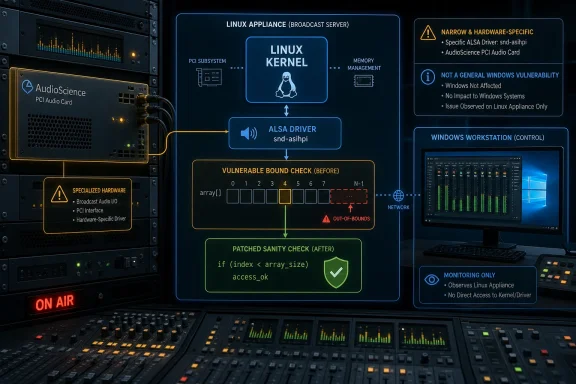
The kernel’s description is admirably concise: thefind_control() function could retrieve cached information by accessing an array using a supplied index without first validating that the index falls within the array’s permitted bounds. The remediation adds a sanity check to prevent that unsafe access.An array is a fixed collection of entries stored contiguously in memory. In safe operation, code must ensure that a requested index lies between zero and the array’s last valid entry. If code accepts an invalid index and reads beyond those bounds, it can inspect unrelated memory, trigger a crash, or—depending on surrounding code and system conditions—contribute to a more serious exploitation chain.
Reading cache versus writing memory
The wording “at reading cache” is important. The documented problem is an out-of-bounds read during access to cached control information, rather than an explicitly described out-of-bounds write. In general, an invalid read may result in information disclosure, unexpected behavior, a kernel warning, or system instability. It can also become security-relevant when the read value influences later execution or enables an attacker to learn memory contents useful for bypassing defenses.However, the available CVE description does not establish a public proof of concept, a demonstrated privilege-escalation chain, remote reachability, or confirmed exploitation in the wild. Treating the issue as remotely exploitable or automatically equivalent to arbitrary code execution would go beyond what the record supports.
The role of cached control information
Professional audio cards expose numerous controls: input and output gains, routing decisions, clock settings, mixer states, channel configurations, source selections, and other device-specific parameters. Drivers often cache control metadata or values to reduce repeated hardware queries and coordinate state between the ALSA control layer and the underlying device interface.Caching is legitimate and usually beneficial. It can lower latency, minimize device transactions, and produce more coherent behavior for user-space mixers and control applications. But cache handling introduces a responsibility: identifiers originating from a caller, device response, or internal mapping must be reconciled with the cache’s actual size before indexing occurs.
CVE-2026-64133 illustrates a classic systems-programming truth. Fast paths and helper functions often look harmless because they exist to simplify access to known data. Yet a single unchecked integer at a boundary can invalidate those assumptions.
The Affected Driver and Hardware Scope
Thesnd-asihpi module is intended for AudioScience ASI sound cards. Linux kernel documentation identifies it as the module for AudioScience ASI hardware and notes that firmware-loader support is required for the driver. This is not a generic driver that would ordinarily service an integrated Realtek codec, a common USB headset, HDMI audio on a consumer graphics card, or a typical gaming sound device.AudioScience equipment has historically been associated with professional audio contexts, especially installations where multichannel playback or capture needs to operate continuously and predictably. Those environments can include radio automation, broadcast playout, studio production, audio logging, public-address distribution, fixed media installations, and specialized communications workflows.
Why professional audio systems have a distinctive threat model
A broadcast appliance may be physically local, but it is not necessarily operationally isolated. Engineers, automation software, remote-management platforms, directory services, monitoring agents, and vendor tools may all interact with the host. In some organizations, a Linux machine with a specialist audio card is one node in a larger Windows-managed environment.The CVSS vector’s local-access requirement should not be interpreted as “someone must be standing in front of the rack.” Local access can arise through a legitimate but compromised user account, a vulnerable service that grants a foothold, an exposed remote desktop or SSH path, malware delivered through administrative tooling, or privileged operations performed by a third-party support account.
Hardware presence is the first gating condition
The first question for defenders is straightforward: Does any deployed Linux system use AudioScience ASI hardware and thesnd-asihpi driver? If the answer is no, the vulnerability does not affect that system in the meaningful operational sense, even if its kernel version falls within a vulnerable version range.The next question is whether the module is loaded, built into a custom kernel, or merely available on disk. A module that is installed but never loaded reduces immediate exposure, although organizations should still patch the kernel rather than rely indefinitely on non-use. A built-in or automatically loaded driver paired with the matching device warrants a more urgent maintenance response.
Affected Kernel Versions and Fixed Releases
The CVE record identifies the vulnerability as affecting Linux kernel code dating back to version 2.6.35. That historical range is notable, but it should not be read as a demand to investigate every old installation ever deployed. In modern operations, the priority is the currently supported kernel estate and any long-lived appliances or embedded systems that have remained in production.The vulnerability has been fixed in several stable kernel release lines. The listed fixed versions are:
- Linux 5.10.258
- Linux 5.15.209
- Linux 6.1.175
- Linux 6.6.142
- Linux 6.12.92
- Linux 6.18.34
- Linux 7.0.11
Distribution kernels complicate version matching
Enterprise Linux distributions, appliance vendors, and cloud images frequently backport security patches without changing the kernel’s visible version to the exact upstream stable number. A distribution might remain on a kernel with an older-looking base version while incorporating dozens or hundreds of security fixes from later upstream releases.That is why administrators should not use a simplistic rule such as “anything below 6.18.34 is vulnerable.” The better rule is: identify the running vendor kernel package, check the vendor’s security bulletin or changelog, and determine whether the CVE’s underlying patch has been backported.
For example, a long-term-support distribution may carry a custom kernel package name, a vendor revision suffix, and an internal patch stream. The visible upstream baseline tells part of the story; the distribution’s security metadata tells the rest.
Stable backports are operationally valuable
The presence of fixes across multiple stable branches is good news for administrators. It means organizations are not forced to make a disruptive leap to the newest mainline kernel simply to obtain this correction. A system on an established long-term-support branch can generally update within its supported channel.That pattern matters in professional audio environments, where kernel upgrades must be balanced against driver certification, firmware interoperability, low-latency configuration, out-of-tree modules, and scheduled production windows. A narrowly targeted stable update is often far easier to validate than a platform migration.
Why This Matters to Windows Users
At first glance, a Linux ALSA driver CVE may seem outside the remit of a Windows-focused community. In practice, Windows administrators and enthusiasts increasingly manage mixed environments that include Linux servers, virtual machines, containers, media appliances, dual-boot workstations, and Windows Subsystem for Linux deployments.The critical distinction is that CVE-2026-64133 does not directly affect the Windows kernel, Windows audio stack, or standard Windows driver model. It is not a vulnerability in Windows 10, Windows 11, Windows Server, the Windows Audio service, WASAPI, DirectSound, or a typical Windows audio driver.
WSL 2 is not automatically exposed
Windows Subsystem for Linux 2 runs a real Linux kernel in a lightweight virtualized environment, so Linux kernel CVEs can be relevant to WSL in principle. But this particular flaw is tied to a PCI AudioScience driver. Typical WSL 2 environments do not expose a physical AudioScience PCI device to the Linux guest, nor do they routinely load thesnd-asihpi module.That makes direct exposure in ordinary WSL installations highly unlikely. The usual WSL audio pathway relies on virtualization and integration layers rather than direct ownership of a professional PCI audio card by the Linux guest. Still, advanced users with custom kernels, unusual hardware-passthrough arrangements, or laboratory virtualization setups should verify their configuration rather than rely on assumptions.
Mixed Windows-Linux estates need asset context
The more relevant Windows angle is administrative. A Windows Server domain may manage identities used to access Linux broadcast boxes. Microsoft Endpoint Configuration Manager, remote monitoring tools, backup systems, virtualization platforms, and SIEM products may inventory or indirectly govern Linux endpoints. A security issue in a Linux driver can therefore matter to a Windows-centric IT team even where no Windows endpoint is directly vulnerable.A useful operational principle is this: vulnerability management should follow assets and trust relationships, not operating-system silos. If a Linux audio appliance is joined to the corporate network, accessed using centralized credentials, or connected to Windows-hosted storage and management services, it belongs in the same risk conversation.
Exploitability: Serious but Not Yet Fully Characterized
The CVSS v3.1 vector indicates local attack vector, low complexity, low privileges, and no user interaction. Those characteristics imply that an attacker who already has some level of access to an affected system may not need to persuade a user to open a file or click a malicious link in order to attempt exploitation.Yet this should not be confused with a statement that exploitation is easy in practice. Kernel-memory flaws are often heavily dependent on architecture, compiler configuration, memory layout, hardening features, driver behavior, actual device state, and the ability to reach the vulnerable function with attacker-controlled values.
What “low privileges required” means
The score indicates that an attacker requires low privileges, not no privileges. In a realistic scenario, the attacker would need an account or process context that can interact with the relevant device controls or driver interfaces. The precise accessibility of those interfaces may vary depending on device permissions, group membership, service design, desktop stack configuration, and local policy.This is significant because many production environments grant broad device access to audio automation services, studio applications, or support accounts. Least privilege is often difficult in legacy media workflows, where an application may run with extensive permissions to guarantee uninterrupted access to audio hardware.
No evidence of active exploitation
As of July 21, 2026, the public CVE information describes the code defect and patch, but it does not establish active exploitation, a public exploit, or a confirmed attack campaign. Defenders should patch based on sound risk management, not panic.The most defensible interpretation is that this is a credible local kernel-security issue in a narrow driver, with high potential impact if an attacker can construct a viable trigger path. It is serious enough to prioritize in affected environments, but not a reason for general Windows users or unrelated Linux desktop users to assume compromise.
Enterprise Impact: Broadcast, Media, and Appliance Fleets
Enterprise impact will be concentrated among organizations that use Linux hosts with AudioScience hardware. These systems may not look like conventional servers. They may be purpose-built playout engines, studio workstations, audio capture boxes, content-delivery appliances, or long-lived rackmount systems maintained by a small specialist team.Such assets often fall into a difficult lifecycle category. They are business-critical, may have strict uptime requirements, and can depend on a particular driver, firmware version, audio-routing configuration, or vendor-certified kernel build. That combination can delay patching even after a security fix becomes available.
Maintenance windows must protect production continuity
For a general-purpose server, a kernel update may be routine. For a live broadcast system, an update can threaten playback timing, input routing, synchronization, or device discovery. The right response is not to avoid updates; it is to make testing and rollback planning proportionate to the workload.Administrators should validate that the system recognizes the AudioScience card after reboot, that the appropriate driver module loads, that firmware initializes, and that expected channels and controls are present. They should also conduct a basic end-to-end audio test, including playback, capture where applicable, routing, level control, synchronization, and monitoring.
A practical enterprise response sequence
Organizations with potentially affected systems should follow a disciplined sequence:- Inventory the hardware and driver. Identify systems containing AudioScience ASI cards, then confirm whether
snd-asihpiis loaded or built into the kernel. - Determine the vendor-fixed package. Check the Linux distribution, appliance supplier, or managed-service provider for a kernel update that incorporates the CVE-2026-64133 fix.
- Assess operational dependency. Document firmware versions, routing profiles, automation integrations, out-of-tree modules, and recovery procedures.
- Test the update in a representative environment. Verify both security patch level and functional audio behavior before broad deployment.
- Deploy in a controlled maintenance window. Reboot where required, confirm the new running kernel, and retain a known-good rollback path.
- Review local access controls. Limit device access and privileged shell access to only the applications and users that genuinely require it.
Consumer and Enthusiast Impact
For ordinary Linux desktop users, the chance of encountering this vulnerability is low unless their system contains an AudioScience ASI device. Most consumer systems use integrated audio controllers, USB DACs, Bluetooth stacks, HDMI or DisplayPort audio, gaming-oriented PCIe sound cards, or standard audio interfaces from other vendors.For Windows-only users, the direct impact is effectively none. Updating Windows will not address this issue because Windows is not the affected platform. Conversely, installing a Linux kernel update will not alter the security posture of a standard Windows audio driver stack.
Dual-boot users should check the Linux side
Dual-boot enthusiasts who use Linux for audio production, streaming, radio automation, SDR-adjacent workflows, or legacy hardware support should verify their Linux hardware inventory. The simplest question is whether the system has an AudioScience card and uses the ALSA HPI driver.Users can inspect loaded audio modules and PCI hardware through their distribution’s normal administrative tools. They should avoid attempting to unload an active audio driver in the middle of a recording session or live workflow. If the hardware is absent, no special action related to this CVE is generally required beyond routine kernel maintenance.
The value of routine kernel updates
This vulnerability is also a reminder that consumer Linux systems benefit from regular updates even when they are not visibly affected by a specific advisory. Kernel stable updates frequently bundle fixes across filesystems, networking, drivers, memory management, hardware enablement, and security subsystems.The right habit is not to chase every CVE individually with anxiety. It is to maintain supported releases, apply vendor-tested updates on a sensible cadence, and reserve urgent intervention for vulnerabilities that match one’s actual hardware, exposure, and threat model.
Technical Lessons from an Index Validation Failure
Unchecked array indexing is among the oldest classes of programming error, but it remains relevant in low-level code because C does not automatically enforce array bounds. The language offers performance and direct memory control, both of which are valuable in kernel work, but those strengths require disciplined validation.The vulnerable lookup path reportedly used a caller-supplied index to retrieve cached control information. The fix adds an explicit sanity check before the access. That is a compact correction, but it reinforces a broad defensive coding pattern: validate an identifier at the point where it becomes a memory offset, even if an earlier layer was expected to sanitize it.
Defense in depth in kernel drivers
A robust driver should avoid relying on a single assumption about where data originated. IDs can cross multiple layers: user-space APIs, ALSA control abstractions, firmware messages, device discovery, cache rebuilds, error recovery paths, and concurrent state changes. Each transition creates opportunities for stale, malformed, or inconsistent values to appear.Good defensive engineering includes checking ranges, using types that express expected limits, initializing cache entries safely, invalidating stale state carefully, and treating hardware-facing data as potentially unreliable. It also includes tests that exercise unusual control indices, device resets, firmware failures, and partial initialization.
Why old code deserves ongoing scrutiny
The affected code lineage dates to Linux 2.6.35, demonstrating that longevity does not equal proof of safety. Mature drivers can accumulate assumptions that were reasonable when written but become harder to audit as APIs, compiler protections, device behavior, and threat models evolve.This does not indicate poor maintenance by itself. Open-source kernel development routinely finds and fixes long-standing edge cases through review, fuzzing, static analysis, syzbot-style reporting, hardening efforts, and the simple fact that more people inspect code over time. The important outcome is that the issue was identified, corrected, assigned a CVE, and backported into supported stable lines.
Strengths and Opportunities
The handling of CVE-2026-64133 offers several positive signals for defenders and maintainers.- The remediation is focused and understandable. Adding a range check before accessing cached array data is a direct mitigation for the documented defect rather than a vague workaround.
- The fix has reached multiple stable kernel branches. Organizations can update within established support tracks instead of adopting an entirely new kernel family.
- The affected component is clearly identified. The
snd-asihpimodule and its source location make inventory and triage more practical than they would be for a broadly described subsystem issue. - The hardware scope is narrow. Most Linux systems and virtually all ordinary Windows endpoints will not use this driver, allowing security teams to prioritize based on actual exposure.
- The issue can improve asset management. Organizations that struggle to identify specialized PCI audio hardware should use this advisory to document appliance ownership, support contracts, kernel provenance, and recovery procedures.
An opportunity to improve media-system resilience
Professional audio systems are often maintained for years because they work reliably and support expensive, specialized workflows. That stability can become a liability when security ownership is unclear. A targeted review prompted by this CVE can reveal unsupported operating systems, undocumented administrative accounts, obsolete remote-access methods, or missing rollback images.In that sense, the vulnerability is not just a patching event. It is a useful catalyst for modernization of maintenance processes around equipment that can be operationally indispensable but administratively invisible.
Risks and Concerns
Despite its limited scope, CVE-2026-64133 should not be minimized in environments that match the affected profile.- Kernel context magnifies possible consequences. An out-of-bounds read in a kernel driver can produce instability, expose sensitive memory, or become part of a more capable exploit chain.
- Specialized appliances are often patched slowly. Broadcast and media systems may have limited maintenance windows, vendor dependencies, and strict validation needs that delay updates.
- Low-privilege local access can still be meaningful. A compromised account, vulnerable local service, or overly permissive audio-control application could provide a starting point for an attacker.
- Visible kernel versions can mislead. Distribution backports mean administrators must confirm package-level remediation rather than compare only the apparent upstream version number.
- Niche hardware can escape inventory tools. General endpoint-management systems may not capture PCI device details, loaded kernel modules, or custom appliance configurations adequately.
Avoiding overreaction
The main risk in the broader community is misunderstanding the advisory. It would be incorrect to characterize CVE-2026-64133 as a Windows audio vulnerability, a generic ALSA flaw affecting every Linux sound device, or a confirmed remote compromise vector.Overstating the threat creates unnecessary work and reduces trust in security communications. Understating it is equally unhelpful for the organizations that do run the affected hardware. Effective messaging should say plainly: this is a high-impact local kernel flaw with a constrained driver and hardware scope, and affected systems should be patched through their supported vendor channel.
What to Watch Next
The immediate item to watch is distribution and vendor advisory coverage. Mainline and stable kernel fixes are essential, but many administrators consume kernels through Red Hat-derived platforms, Debian-family distributions, Ubuntu releases, SUSE products, appliance images, managed hosting stacks, or specialist media-software vendors. Their package availability and support guidance will determine real deployment timing.Organizations should also monitor whether further technical analysis emerges. A public proof of concept, evidence of active exploitation, or clarification about conditions needed to reach the vulnerable control-cache path could change prioritization. Until then, the documented issue supports timely remediation without implying that exploitation is known to be widespread.
Questions security teams should answer now
Security and operations teams should be able to answer the following questions quickly:- Do we operate Linux systems with AudioScience ASI cards?
- Is the
snd-asihpimodule loaded, available, or built into their kernels? - Which team owns patching responsibility for those machines?
- Does our distribution or appliance supplier provide a kernel package containing the fix?
- Can we validate audio routing and device initialization before production deployment?
- Are local accounts, service identities, and remote support channels appropriately restricted?
Longer-term hardening priorities
Beyond this individual CVE, professional Linux audio environments should adopt a repeatable lifecycle model: documented hardware inventories, supported kernel baselines, regular maintenance windows, tested restoration plans, minimal local privileges, controlled remote administration, and monitoring that notices unexpected driver or device state.Windows-focused IT teams should include Linux appliances in those same disciplines. The operating system may differ, but the underlying management principles do not: know what is deployed, know who can access it, keep it supported, test changes, and verify that security fixes do not quietly break the service the machine exists to provide.
CVE-2026-64133 is therefore best understood as a targeted but legitimate kernel-security maintenance event. Most Windows users can safely treat it as informational, while Linux administrators responsible for AudioScience-based audio systems should identify affected hosts, obtain the appropriate vendor-backed kernel update, validate the specialized audio workflow, and close the gap before a local foothold can become a deeper compromise.
References
- Primary source: NVD / Linux Kernel
Published: 2026-07-21T01:01:42-07:00
NVD - CVE-2026-64133
 nvd.nist.gov
- Security advisory: MSRC
Published: 2026-07-21T01:01:42-07:00
Original feed URL
Security Update Guide - Microsoft Security Response Center
 msrc.microsoft.com
