

Schneider Electric and CISA disclosed on June 9, 2026, that EcoStruxure Panel Server devices used in commercial facilities, critical manufacturing, and energy environments are affected by CVE-2026-6866, a high-severity authentication weakness fixed in firmware version 002.006.000 for supported PAS models. The bug is not the loudest kind of industrial control system vulnerability, but it is the kind defenders dislike most: a quiet failure of identity at the edge of operational technology. When credentials can revert to known initial settings, the perimeter stops being a firewall problem and becomes a trust problem. For WindowsForum readers who manage mixed IT and OT estates, this advisory is another reminder that “smart infrastructure” is only as mature as its update discipline.
EcoStruxure Panel Server is not a consumer gadget bolted onto a breaker panel for convenience. Schneider positions it as a modular gateway connecting electrical infrastructure and edge systems to cloud or local applications. In plain terms, it sits where power monitoring, building operations, industrial telemetry, and enterprise visibility increasingly meet.
That placement is precisely why this advisory matters. A gateway that translates, aggregates, or forwards operational data becomes a privileged witness to the physical environment. Even when it does not directly trip a relay or rewrite a controller program, it can expose information that helps an attacker understand the installation, identify downstream assets, and plan a more surgical intrusion.
The disclosed vulnerability, CVE-2026-6866, is classified as CWE-1188, Initialization of a Resource with an Insecure Default. Schneider describes a rare condition in which credentials can revert to initial settings, allowing unauthorized authentication using known credentials. CISA’s republication gives the issue a CVSS 3.1 base score of 7.5, high severity, with a network attack vector, low attack complexity, no privileges required, and no user interaction required.
That scoring tells its own story. This is not a bug that requires phishing an operator, winning a race condition, or first gaining a foothold on an engineering workstation. If the exposed device is reachable and falls into the vulnerable state, authentication may become a formality rather than a defense.
And yet this vulnerability shows why the problem keeps returning under new names. The danger here is not merely that a product shipped with a bad password, but that credentials could revert to an initial state in unusual circumstances. That is a subtler class of failure because it undermines the assumption that a device, once commissioned, stays commissioned.
Operational technology environments are especially vulnerable to this kind of regression. Devices often live for years, sometimes decades, in cabinets and plant rooms where change is treated as risk. Firmware upgrades are scheduled around maintenance windows, not Patch Tuesday. If a credential state silently rolls backward after a reboot, reset, upgrade path, or exceptional fault condition, the people responsible for the asset may not notice until someone tests access.
For attackers, known credentials are not mysterious. They circulate through manuals, installer notes, leaked documentation, old forum posts, and inherited service procedures. Even when vendors remove or obscure them, the installed base remembers. That institutional memory is useful to technicians and dangerous in the hands of adversaries.
CISA’s role here is part warning siren, part translation layer. The agency is not writing a new vulnerability report so much as pushing Schneider’s Common Security Advisory Framework disclosure into the public ICS advisory pipeline. That matters for asset owners whose patch governance depends on CISA feeds, managed detection providers, vulnerability scanners, or compliance workflows keyed to federal advisories.
The advisory also lands in a more mature, more nervous OT security environment than the one that existed a decade ago. Energy operators, manufacturers, building automation teams, and critical facility managers now understand that remote access pathways and edge gateways are not secondary systems. They are often the first systems an attacker can enumerate from the outside and the last systems a stretched operations team wants to reboot.
CISA’s standard mitigation language may look boilerplate, but it is the right boilerplate: minimize exposure, isolate control networks, place remote devices behind firewalls, and use secure remote access when it is genuinely required. Those recommendations are repeated because they keep applying. In industrial security, repetition is not laziness; it is an admission that the same architectural sins keep showing up under different product names.
Panel servers are not usually sitting on a desk beside a helpdesk technician. They may be embedded in electrical rooms, industrial cabinets, building management systems, data-center power chains, distributed energy deployments, or multi-site facilities where the “owner” of the device is not obvious. A Windows admin may see the traffic. A facilities contractor may own the configuration. A security team may inherit the risk. A plant manager may control the maintenance window.
That organizational ambiguity is one reason vulnerabilities in operational gateways linger. Everyone agrees the device should be patched; no one is certain who is allowed to touch it. Firmware updates that require rebooting may also interrupt monitoring, telemetry, or upstream integrations, even if the underlying electrical system continues operating. In a critical manufacturing or energy setting, even a short interruption can require planning.
The advisory’s inclusion of commercial facilities alongside critical manufacturing and energy should also catch the attention of IT teams outside classic industrial environments. Modern office towers, hospitals, campuses, airports, logistics hubs, and data centers increasingly run on networked infrastructure that looks operational but depends on ordinary IP networking. The attack surface is no longer confined to the plant floor.
But confidentiality in OT is not a small prize. Sensitive operational data can reveal load profiles, device identities, network architecture, site names, energy patterns, firmware versions, and integration pathways. For an attacker, that information can be reconnaissance fuel. For a competitor, extortion crew, or nation-state actor, it can help map what matters.
Security teams sometimes under-rank information disclosure in industrial environments because it lacks the immediate drama of a crash or command injection flaw. That is a mistake. In enterprise IT, data leakage can expose credentials, topology, or business secrets. In OT, it can also expose the rhythms and dependencies of physical operations.
The more connected the facility, the more valuable the telemetry becomes. A gateway that summarizes power, device, or infrastructure state can become a lens into business continuity. If known credentials allow access to sensitive information, the attacker may not need to break the machine to learn how to pressure the organization.
A rare state may appear after a failed upgrade, a configuration restore, a reset event, an unexpected power condition, or a maintenance workflow that nobody has repeated since commissioning. The advisory does not enumerate every trigger in the public text, and defenders should avoid inventing certainty where the vendor has not provided it. Still, the security implication is clear: credential state must be verified, not assumed.
This is where OT patching diverges from standard endpoint management. In a Windows fleet, admins can often query configuration state at scale, enforce policy with management tooling, and validate compliance through a central console. In OT, especially with mixed-vendor installations, teams may need to combine asset inventory, vendor portals, local access, network scanning, and contractor coordination.
The most practical question is not “Are we vulnerable?” in the abstract. It is “Which specific PAS devices do we operate, what firmware are they running, are they reachable from networks they should not be reachable from, and can anyone prove their credentials are not in an initial or known state?” That turns a vulnerability advisory into a field exercise.
A good response also avoids the false binary between patching and segmentation. Firmware 002.006.000 addresses the vulnerability, but network architecture still decides how exposed the device is before, during, and after the update. If an unauthenticated network attacker can reach a panel server management interface from a broad enterprise segment, the organization already has a design problem.
That creates two-way risk. A compromised enterprise Windows environment can become the launchpad for probing operational gateways. Conversely, a poorly secured OT edge device can provide attackers with information that helps them move toward Windows-based management systems. The old mental model of “the plant network” and “the IT network” as separate worlds is increasingly fictional.
This is especially true in organizations adopting cloud dashboards, energy analytics, predictive maintenance, and centralized facilities management. The business wants visibility, and vendors provide gateways to deliver it. The result is a hybrid estate where Windows identity, VPN access, firewall policy, and OT firmware hygiene all become part of the same security conversation.
For sysadmins, the lesson is not that they should personally patch every panel server. It is that they should know whether these devices exist on networks they route, monitor, authenticate, or expose. If the answer is “facilities handles that,” the next question is whether facilities has the same incident response clock as the SOC.
In operational terms, the work is less clean. Firmware updates must be matched to the correct model, staged according to site requirements, and tested against connected applications. Teams must plan for reboot impact, confirm post-update function, and document that credentials remain controlled afterward. A fix that takes minutes on a bench can take weeks across a distributed estate.
There is also a sequencing issue. Administrators should not wait for a perfect maintenance window before reducing exposure. If devices are reachable from broad corporate networks or the internet, segmentation and firewall changes can reduce immediate risk while firmware work is scheduled. If remote access is required, it should be tightly scoped, logged, and dependent on hardened systems rather than informal VPN sprawl.
The advisory’s standard recommendation to avoid internet exposure deserves special emphasis. Internet-facing OT devices are rarely exposed because someone made a careful risk decision. More often, they are exposed because of temporary troubleshooting, vendor access, flat network design, forgotten NAT rules, or inherited infrastructure. CVE-2026-6866 is exactly the kind of issue that turns such shortcuts into incidents.
But the disclosure also illustrates the limits of what public advisories can provide. The phrase “rare circumstances” is operationally significant but technically incomplete for defenders. Asset owners want to know the triggers, the likelihood, whether logging reveals the event, whether configuration backups are implicated, and whether credential resets leave artifacts. Vendors often withhold details to reduce exploitability, but that leaves operators balancing urgency against uncertainty.
This tension is not unique to Schneider. ICS vendors must serve customers who demand actionable detail and customers who fear that detail will help attackers. CISA’s republication widens the audience but does not resolve the tradeoff. The result is a public document that tells organizations what to fix, but not always enough about how to prioritize one vulnerable cabinet over another.
In that vacuum, architecture becomes the deciding factor. A vulnerable panel server buried behind a well-segmented control network, reachable only through monitored jump infrastructure, is a different risk from the same model exposed to a facilities VLAN shared with ordinary workstations. The CVSS score is the beginning of prioritization, not the end.
Industrial environments often rely on shared knowledge because it is practical. A technician called at 2 a.m. needs access. A vendor needs to service a device. A plant cannot wait for a corporate password reset workflow when production is down. Those realities are not imaginary, but they do create durable security debt.
The answer is not simply to lecture OT teams with IT policies. It is to build access models that respect uptime while eliminating permanent shared secrets. That means unique credentials, documented ownership, emergency access procedures, logging, periodic verification, and a clear process for decommissioning vendor or contractor access. It also means treating firmware state as part of identity state.
CVE-2026-6866 is a useful case study because it collapses the distinction between configuration hygiene and vulnerability management. If a device can return to an insecure initial condition, then the organization’s security control is not only the password it set last year. It is the process that detects when last year’s assumption stops being true.
Modern facilities are increasingly built from gateways, sensors, controllers, cloud connectors, and management consoles that create dense webs of dependency. A single gateway vulnerability may not bring down a factory, but it can expose enough information to make the next step easier. Security failures increasingly compound rather than explode.
The advisory also tests whether organizations have an accurate inventory of the devices they depend on. Many can list domain controllers faster than they can list panel servers. Many can report Windows patch compliance faster than firmware status for electrical monitoring hardware. Attackers do not care which budget funded the asset.
That is why this Schneider issue deserves attention beyond Schneider customers. It is a representative problem: edge infrastructure with operational relevance, connected for visibility, patched through vendor firmware, and governed across departmental boundaries. The specific CVE will fade; the pattern will not.
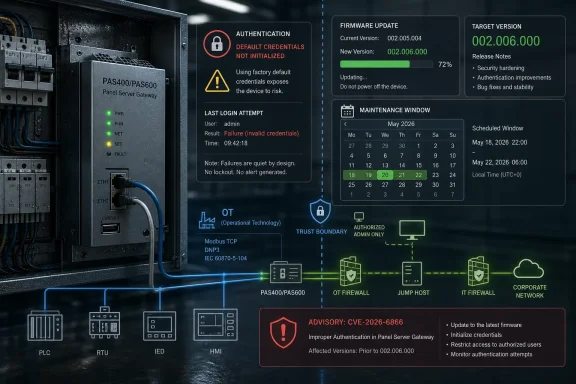 The Gateway Is Now Part of the Attack Surface
EcoStruxure Panel Server is not a consumer gadget bolted onto a breaker panel for convenience. Schneider positions it as a modular gateway connecting electrical infrastructure and edge systems to cloud or local applications. In plain terms, it sits where power monitoring, building operations, industrial telemetry, and enterprise visibility increasingly meet.That placement is precisely why this advisory matters. A gateway that translates, aggregates, or forwards operational data becomes a privileged witness to the physical environment. Even when it does not directly trip a relay or rewrite a controller program, it can expose information that helps an attacker understand the installation, identify downstream assets, and plan a more surgical intrusion.
The disclosed vulnerability, CVE-2026-6866, is classified as CWE-1188, Initialization of a Resource with an Insecure Default. Schneider describes a rare condition in which credentials can revert to initial settings, allowing unauthorized authentication using known credentials. CISA’s republication gives the issue a CVSS 3.1 base score of 7.5, high severity, with a network attack vector, low attack complexity, no privileges required, and no user interaction required.
That scoring tells its own story. This is not a bug that requires phishing an operator, winning a race condition, or first gaining a foothold on an engineering workstation. If the exposed device is reachable and falls into the vulnerable state, authentication may become a formality rather than a defense.
Default Credentials Are the Ghosts OT Never Quite Exorcised
The industrial security world has spent years telling itself that default credentials are a solved problem. Procurement checklists demand password changes. Hardening guides warn against factory settings. Auditors ask for evidence. Vendors increasingly force setup flows that require initial credential rotation.And yet this vulnerability shows why the problem keeps returning under new names. The danger here is not merely that a product shipped with a bad password, but that credentials could revert to an initial state in unusual circumstances. That is a subtler class of failure because it undermines the assumption that a device, once commissioned, stays commissioned.
Operational technology environments are especially vulnerable to this kind of regression. Devices often live for years, sometimes decades, in cabinets and plant rooms where change is treated as risk. Firmware upgrades are scheduled around maintenance windows, not Patch Tuesday. If a credential state silently rolls backward after a reboot, reset, upgrade path, or exceptional fault condition, the people responsible for the asset may not notice until someone tests access.
For attackers, known credentials are not mysterious. They circulate through manuals, installer notes, leaked documentation, old forum posts, and inherited service procedures. Even when vendors remove or obscure them, the installed base remembers. That institutional memory is useful to technicians and dangerous in the hands of adversaries.
CISA’s Republication Turns a Vendor Advisory Into an Operational Deadline
Schneider Electric originally published the advisory on May 12, 2026, and CISA republished it on June 9, 2026, as ICSA-26-160-03. That timing matters because many organizations still treat vendor advisories as inbox noise until a national cyber authority amplifies them. The republication does not necessarily mean exploitation has been observed; it does mean the issue has graduated into the broader ICS risk stream.CISA’s role here is part warning siren, part translation layer. The agency is not writing a new vulnerability report so much as pushing Schneider’s Common Security Advisory Framework disclosure into the public ICS advisory pipeline. That matters for asset owners whose patch governance depends on CISA feeds, managed detection providers, vulnerability scanners, or compliance workflows keyed to federal advisories.
The advisory also lands in a more mature, more nervous OT security environment than the one that existed a decade ago. Energy operators, manufacturers, building automation teams, and critical facility managers now understand that remote access pathways and edge gateways are not secondary systems. They are often the first systems an attacker can enumerate from the outside and the last systems a stretched operations team wants to reboot.
CISA’s standard mitigation language may look boilerplate, but it is the right boilerplate: minimize exposure, isolate control networks, place remote devices behind firewalls, and use secure remote access when it is genuinely required. Those recommendations are repeated because they keep applying. In industrial security, repetition is not laziness; it is an admission that the same architectural sins keep showing up under different product names.
The Affected List Is Narrow, but the Deployment Footprint Is Not
The affected products are Schneider Electric EcoStruxure Panel Server PAS400, PAS600, PAS600V2, PAS800, and PAS800V2 devices running versions 002.005.000 and earlier. Schneider’s remediation is firmware version 002.006.000, with a reboot required. That sounds straightforward until you picture where these boxes often live.Panel servers are not usually sitting on a desk beside a helpdesk technician. They may be embedded in electrical rooms, industrial cabinets, building management systems, data-center power chains, distributed energy deployments, or multi-site facilities where the “owner” of the device is not obvious. A Windows admin may see the traffic. A facilities contractor may own the configuration. A security team may inherit the risk. A plant manager may control the maintenance window.
That organizational ambiguity is one reason vulnerabilities in operational gateways linger. Everyone agrees the device should be patched; no one is certain who is allowed to touch it. Firmware updates that require rebooting may also interrupt monitoring, telemetry, or upstream integrations, even if the underlying electrical system continues operating. In a critical manufacturing or energy setting, even a short interruption can require planning.
The advisory’s inclusion of commercial facilities alongside critical manufacturing and energy should also catch the attention of IT teams outside classic industrial environments. Modern office towers, hospitals, campuses, airports, logistics hubs, and data centers increasingly run on networked infrastructure that looks operational but depends on ordinary IP networking. The attack surface is no longer confined to the plant floor.
High Severity Does Not Mean Hollywood Impact
The CVSS vector is precise: confidentiality impact is high, while integrity and availability impacts are listed as none. That distinction is important. This advisory does not claim that CVE-2026-6866 lets an attacker directly shut down equipment, rewrite controller logic, or cause physical damage.But confidentiality in OT is not a small prize. Sensitive operational data can reveal load profiles, device identities, network architecture, site names, energy patterns, firmware versions, and integration pathways. For an attacker, that information can be reconnaissance fuel. For a competitor, extortion crew, or nation-state actor, it can help map what matters.
Security teams sometimes under-rank information disclosure in industrial environments because it lacks the immediate drama of a crash or command injection flaw. That is a mistake. In enterprise IT, data leakage can expose credentials, topology, or business secrets. In OT, it can also expose the rhythms and dependencies of physical operations.
The more connected the facility, the more valuable the telemetry becomes. A gateway that summarizes power, device, or infrastructure state can become a lens into business continuity. If known credentials allow access to sensitive information, the attacker may not need to break the machine to learn how to pressure the organization.
The Real Risk Is the Exception Path
Schneider’s wording includes an important qualifier: credentials revert to initial settings in rare circumstances. That phrase should not comfort administrators too much. Rare circumstances are exactly where production systems become difficult to reason about.A rare state may appear after a failed upgrade, a configuration restore, a reset event, an unexpected power condition, or a maintenance workflow that nobody has repeated since commissioning. The advisory does not enumerate every trigger in the public text, and defenders should avoid inventing certainty where the vendor has not provided it. Still, the security implication is clear: credential state must be verified, not assumed.
This is where OT patching diverges from standard endpoint management. In a Windows fleet, admins can often query configuration state at scale, enforce policy with management tooling, and validate compliance through a central console. In OT, especially with mixed-vendor installations, teams may need to combine asset inventory, vendor portals, local access, network scanning, and contractor coordination.
The most practical question is not “Are we vulnerable?” in the abstract. It is “Which specific PAS devices do we operate, what firmware are they running, are they reachable from networks they should not be reachable from, and can anyone prove their credentials are not in an initial or known state?” That turns a vulnerability advisory into a field exercise.
A good response also avoids the false binary between patching and segmentation. Firmware 002.006.000 addresses the vulnerability, but network architecture still decides how exposed the device is before, during, and after the update. If an unauthenticated network attacker can reach a panel server management interface from a broad enterprise segment, the organization already has a design problem.
Windows Shops Are Closer to This Problem Than They Think
WindowsForum readers may reasonably ask why an industrial Schneider advisory belongs in a Windows-centered publication. The answer is that Windows environments remain the administrative fabric around much of OT. Engineering workstations, jump boxes, remote access gateways, historian servers, building management consoles, domain services, certificate infrastructure, SIEM pipelines, and patch dashboards frequently run on Windows.That creates two-way risk. A compromised enterprise Windows environment can become the launchpad for probing operational gateways. Conversely, a poorly secured OT edge device can provide attackers with information that helps them move toward Windows-based management systems. The old mental model of “the plant network” and “the IT network” as separate worlds is increasingly fictional.
This is especially true in organizations adopting cloud dashboards, energy analytics, predictive maintenance, and centralized facilities management. The business wants visibility, and vendors provide gateways to deliver it. The result is a hybrid estate where Windows identity, VPN access, firewall policy, and OT firmware hygiene all become part of the same security conversation.
For sysadmins, the lesson is not that they should personally patch every panel server. It is that they should know whether these devices exist on networks they route, monitor, authenticate, or expose. If the answer is “facilities handles that,” the next question is whether facilities has the same incident response clock as the SOC.
The Fix Is Simple; the Program Around It Is Not
Schneider’s remediation is unambiguous: update affected EcoStruxure Panel Server models to firmware version 002.006.000, with a reboot required. The affected line includes PAS400, PAS600, PAS600V2, PAS800, and PAS800V2 devices at versions 002.005.000 and earlier. In product-security terms, that is a clean advisory.In operational terms, the work is less clean. Firmware updates must be matched to the correct model, staged according to site requirements, and tested against connected applications. Teams must plan for reboot impact, confirm post-update function, and document that credentials remain controlled afterward. A fix that takes minutes on a bench can take weeks across a distributed estate.
There is also a sequencing issue. Administrators should not wait for a perfect maintenance window before reducing exposure. If devices are reachable from broad corporate networks or the internet, segmentation and firewall changes can reduce immediate risk while firmware work is scheduled. If remote access is required, it should be tightly scoped, logged, and dependent on hardened systems rather than informal VPN sprawl.
The advisory’s standard recommendation to avoid internet exposure deserves special emphasis. Internet-facing OT devices are rarely exposed because someone made a careful risk decision. More often, they are exposed because of temporary troubleshooting, vendor access, flat network design, forgotten NAT rules, or inherited infrastructure. CVE-2026-6866 is exactly the kind of issue that turns such shortcuts into incidents.
The Disclosure Shows the Value and Limits of Vendor Transparency
Schneider deserves credit for publishing a fix and identifying affected product families clearly. The advisory names the models, versions, vulnerability class, CVSS score, and remediation path. It also credits Schneider Electric CPCERT and a Schneider partner, which suggests the issue emerged through internal coordination or partner reporting rather than a public exploit drama.But the disclosure also illustrates the limits of what public advisories can provide. The phrase “rare circumstances” is operationally significant but technically incomplete for defenders. Asset owners want to know the triggers, the likelihood, whether logging reveals the event, whether configuration backups are implicated, and whether credential resets leave artifacts. Vendors often withhold details to reduce exploitability, but that leaves operators balancing urgency against uncertainty.
This tension is not unique to Schneider. ICS vendors must serve customers who demand actionable detail and customers who fear that detail will help attackers. CISA’s republication widens the audience but does not resolve the tradeoff. The result is a public document that tells organizations what to fix, but not always enough about how to prioritize one vulnerable cabinet over another.
In that vacuum, architecture becomes the deciding factor. A vulnerable panel server buried behind a well-segmented control network, reachable only through monitored jump infrastructure, is a different risk from the same model exposed to a facilities VLAN shared with ordinary workstations. The CVSS score is the beginning of prioritization, not the end.
Known Credentials Are a Governance Failure, Not Just a Technical One
The phrase “known credentials” should make executives uncomfortable. It implies that authentication can become detached from ownership. If multiple installers, contractors, service providers, and internal teams know or can infer a credential, then the system no longer has a meaningful identity boundary.Industrial environments often rely on shared knowledge because it is practical. A technician called at 2 a.m. needs access. A vendor needs to service a device. A plant cannot wait for a corporate password reset workflow when production is down. Those realities are not imaginary, but they do create durable security debt.
The answer is not simply to lecture OT teams with IT policies. It is to build access models that respect uptime while eliminating permanent shared secrets. That means unique credentials, documented ownership, emergency access procedures, logging, periodic verification, and a clear process for decommissioning vendor or contractor access. It also means treating firmware state as part of identity state.
CVE-2026-6866 is a useful case study because it collapses the distinction between configuration hygiene and vulnerability management. If a device can return to an insecure initial condition, then the organization’s security control is not only the password it set last year. It is the process that detects when last year’s assumption stops being true.
The Small Advisory That Tests Big Assumptions
This is not the kind of vulnerability that will dominate mainstream headlines. There is no wormable Windows bug, no mass ransomware campaign attached to the advisory, and no confirmed exploitation described in the public text. But for infrastructure defenders, the absence of spectacle should not be confused with low importance.Modern facilities are increasingly built from gateways, sensors, controllers, cloud connectors, and management consoles that create dense webs of dependency. A single gateway vulnerability may not bring down a factory, but it can expose enough information to make the next step easier. Security failures increasingly compound rather than explode.
The advisory also tests whether organizations have an accurate inventory of the devices they depend on. Many can list domain controllers faster than they can list panel servers. Many can report Windows patch compliance faster than firmware status for electrical monitoring hardware. Attackers do not care which budget funded the asset.
That is why this Schneider issue deserves attention beyond Schneider customers. It is a representative problem: edge infrastructure with operational relevance, connected for visibility, patched through vendor firmware, and governed across departmental boundaries. The specific CVE will fade; the pattern will not.
The Patch Window Is Really an Inventory Window
Organizations that operate Schneider EcoStruxure Panel Server devices should treat firmware 002.006.000 as the immediate remediation target, but the better outcome is a cleaner understanding of their OT edge. The work should produce not only patched devices, but a better map of who owns them, how they are reached, and what happens when they reboot.- Organizations should identify all PAS400, PAS600, PAS600V2, PAS800, and PAS800V2 devices and confirm whether any are running firmware 002.005.000 or earlier.
- Administrators should plan installation of firmware 002.006.000 for affected devices and account for the required reboot during an approved maintenance window.
- Security teams should verify that panel server management interfaces are not reachable from the public internet or unnecessarily broad enterprise network segments.
- Operators should confirm that credentials have not reverted to initial or otherwise known settings after maintenance, reboot, restoration, or update activity.
- IT and facilities teams should document ownership, remote access paths, and monitoring expectations for these devices before the next advisory forces the same conversation under pressure.
References
- Primary source: CISA
Published: 2026-06-09T12:00:00+00:00

Schneider Electric EcoStruxure Panel Server | CISA
www.cisa.gov
- Related coverage: feed.craftedsignal.io

Multiple Vulnerabilities in Schneider Electric Products – CraftedSignal Threat Feed
Multiple vulnerabilities in Schneider Electric products can allow an attacker to perform privilege escalation, data confidentiality breaches, and data integrity breaches.
feed.craftedsignal.io
- Related coverage: productinfo.schneider-electric.com
- Related coverage: vulners.com
Schnieider Electric EcoStruxure Machine Expert HVAC (SEVD-... - vulnerability database | Vulners.com
1. GENERAL SECURITY RECOMMENDATIONS We strongly recommend the following industry cybersecurity best practices. Locate control and safety system networks and remote devices behind firewalls and isolate them from the business network. Install physic...vulners.com - Related coverage: cve.imfht.com
CVE Database & AI Vulnerability Analysis - Vulnerability Platform
Free CVE database with AI-powered vulnerability analysis, daily intelligence, and AI-generated PoC analyses. Search 340K+ CVEs across vendors, products, and CWE categories. cve.imfht.com
- Related coverage: app.opencve.io
Schneider-electric CVEs and Security Vulnerabilities - OpenCVE
Explore the latest vulnerabilities and security issues of Schneider-electric in the CVE databaseapp.opencve.io
- Related coverage: cyber.gc.ca
[Control systems] Schneider Electric security advisory (AV26-449) - Canadian Centre for Cyber Security
[Control systems] Schneider Electric security advisory (AV26-449)www.cyber.gc.ca - Related coverage: download.schneider-electric.com
- Related coverage: media.distributordatasolutions.com
