

CVE-2026-8711 is a high-severity NGINX JavaScript vulnerability disclosed in May 2026 that can let an unauthenticated network attacker crash NGINX worker processes when
The first mistake administrators can make with CVE-2026-8711 is to treat the word “NGINX” as meaning every NGINX instance is automatically exposed. The flaw sits in NGINX JavaScript, commonly called njs, and more specifically in a configuration pattern where
That makes this a conditional vulnerability, not a universal one. An ordinary static NGINX reverse proxy that never loads njs and never invokes
But conditional does not mean academic. The dangerous configurations are plausible in real deployments because njs is exactly the sort of tool engineers reach for when NGINX’s declarative configuration language is not quite enough. It lets teams add programmable request handling without moving the entire edge layer into a heavier application stack.
That convenience is also the trap. Once client-controlled values flow into proxy behavior, the boundary between “configuration” and “input handling” becomes less clean. CVE-2026-8711 is the kind of bug that punishes that blurred boundary with a worker-process crash and, in less hardened environments, potentially worse.
For an internet-facing proxy, availability is the product. If NGINX sits in front of application servers, identity portals, APIs, software update endpoints, or customer-facing services, crashing worker processes is not a nuisance; it is a direct attack on the business function the proxy exists to provide. The user-supplied description gets this right: a total loss of availability can be sustained while the attacker keeps sending malicious traffic, and even partial availability loss can become serious if it blocks new connections or repeatedly destabilizes the service.
NGINX’s process model helps, but it is not magic. Worker restarts are designed to preserve service resilience, and a crash does not automatically mean the entire daemon disappears. Yet a remotely triggerable crash loop can still translate into elevated latency, failed requests, noisy logs, exhausted error budgets, and cascading failures in dependent systems.
The real-world question is not whether one crafted request can destroy the server forever. The question is whether an attacker can make the edge unreliable at will. For many services, that is enough.
F5’s njs security model has long treated JavaScript code as trusted, in the same general category as
CVE-2026-8711 appears in precisely that seam. The vulnerable pattern involves
That matters for Windows-centric shops because NGINX often arrives as part of someone else’s platform decision. It may be embedded in a container image, bundled in an ingress controller, placed in front of a Windows-hosted application, or maintained by a DevOps team separate from endpoint and server administrators. The people responsible for patching Windows Server may not even own the proxy that determines whether users can reach the application.
Security teams should resist the urge to market this internally as instant unauthenticated RCE against all NGINX servers. That is how vulnerability programs lose credibility. If the affected configuration is absent, the issue is not exploitable; if modern memory protections are intact, exploitation beyond crashing a worker is significantly harder.
At the same time, memory corruption bugs deserve more respect than ordinary logic flaws. Exploitability can change as researchers publish proof-of-concept work, attackers chain primitives, or defenders discover that some production build disabled mitigations for performance, compatibility, or legacy packaging reasons. A vulnerability that begins life as “mostly DoS” can still become a high-priority emergency in a particular environment.
The sane position is to patch and audit without panic. Treat the code-execution angle as a reason to move quickly, not as a reason to invent certainty where the public record does not support it.
That is useful, but it can also confuse accountability. A Microsoft listing does not necessarily mean Windows Update will fix the vulnerable component. If NGINX is running inside a Linux VM, a Kubernetes ingress container, a vendor appliance, or a manually installed package, remediation follows that supply chain, not the Patch Tuesday muscle memory.
This is where Windows administrators often get surprised. The application may be a .NET service, the clients may be Windows 11 laptops, the identity plane may be Entra ID, and the monitoring may live in Microsoft Sentinel — but the exposed reverse proxy may still be an NGINX package maintained through Debian, Ubuntu, Alpine, Red Hat, a container registry, or a vendor image. The blast radius crosses organizational boundaries faster than the ticketing system does.
For IT pros, the lesson is not that Microsoft is responsible for every listed CVE. The lesson is that Microsoft’s security ecosystem increasingly surfaces vulnerabilities in components that Windows shops rely on, even when remediation happens elsewhere.
The key risk pattern is not merely the presence of
This is also a good moment to revisit how dynamic proxy selection is implemented. In many environments, clever edge logic accumulates over time: a quick workaround for one upstream, a header-based routing rule for another, a compatibility shim for a partner integration. Each change is rational in isolation, but the combined configuration becomes hard to reason about.
The useful audit is therefore both mechanical and architectural. Search the files, yes. But also ask why the proxy target or fetch path is dynamic, whether client-supplied values are constrained, and whether the same outcome can be achieved with static upstream definitions or a safer allowlist.
This distinction matters because NGINX deployments are not uniform. Some environments install NGINX and njs from distribution repositories. Others build custom images. Some use NGINX Plus. Some inherit the module through an appliance or managed platform where the visible NGINX version is only part of the story.
The safest operational path is to update through the vendor-supported channel for the specific deployment. If the server uses distribution packages, track the distribution advisory and update the relevant njs package. If it is a container, rebuild from a patched base image rather than hot-fixing a running container and calling the job done. If it is a commercial or appliance-backed deployment, wait for and apply the vendor’s supported update rather than mixing unsupported binaries into a managed stack.
Temporary mitigations are possible but should be treated as temporary. Removing client-controlled variables from
That is why CVE-2026-8711 belongs in a WindowsForum discussion. Windows environments are rarely Windows-only environments anymore. They are hybrid estates, and hybrid estates fail at the seams: identity crosses into Linux, Windows apps hide behind open-source proxies, and cloud-native components sit outside traditional server patch baselines.
For Microsoft-oriented administrators, the practical hunt starts in a few predictable places. Check Azure VMs and scale sets that run NGINX as a reverse proxy. Check AKS clusters and ingress configurations. Check Docker hosts used by development teams. Check WSL-based prototypes that quietly became internal services. Check vendor appliances and packaged applications that expose HTTP or API front ends.
The phrase to fear is “we don’t run NGINX,” because it is often shorthand for “the Windows team does not knowingly administer NGINX.” Attackers do not care about the org chart. They care about the edge process parsing their request.
The right prioritization model starts with reachability. Internet-facing NGINX instances with njs enabled and the vulnerable directive pattern deserve immediate attention. Internal proxies may still be important, especially if they front identity, management, CI/CD, or production APIs, but the urgency depends on who can send traffic to the vulnerable location.
Next comes configuration. If njs is absent, the risk collapses. If njs is present but
Finally, consider resilience. A load-balanced fleet may tolerate worker crashes better than a single edge node, but repeated crashing can still create degraded service and operational noise. Autoscaling does not solve a deterministic crash condition if every new instance is built from the same vulnerable image.
At minimum, operators should know whether NGINX worker exits are logged, whether crash loops trigger alerts, and whether error rates are separated by location or upstream. Generic CPU and memory graphs will not tell the full story. A repeated request-triggered crash may show up as intermittent 502s, upstream resets, or unexplained latency spikes before it is recognized as a security event.
The logs also need to be useful without becoming a liability. Because client-controlled headers, arguments, and cookies are relevant to the vulnerable pattern, defenders may be tempted to log everything. That can create privacy and credential-handling problems if cookies or tokens end up in long-retention log stores. The better approach is targeted telemetry: enough request metadata to identify suspicious patterns, not a wholesale dump of sensitive values.
Security teams should also review whether web application firewalls, rate limits, and upstream protections would slow repeated exploitation. These controls are not substitutes for patching, but they can reduce the effectiveness of sustained denial-of-service attempts while remediation is underway.
That complexity is not going away. If anything, it is expanding as organizations push more policy to the edge and expect infrastructure to make smarter decisions before traffic reaches the application. But every programmable edge feature needs the same discipline as application development: input validation, threat modeling, code review, test coverage, and least privilege.
For njs specifically, teams should treat JavaScript handlers as production code rather than decorative config snippets. If a script consumes request-derived values, those values should be constrained. If a fetch target is dynamic, the allowed destinations should be explicit. If a proxy directive can be influenced by a header or cookie, the design should be challenged before it is merged.
The most robust fix is not merely “upgrade to a non-vulnerable version.” It is to make the vulnerable pattern less likely to recur. An edge layer that only three people understand is a future incident waiting for a CVE number.
The audit, however, should continue after the immediate update. Teams should identify who owns njs code, where it is stored, how it is reviewed, and how quickly affected images or packages can be rebuilt. If the answer is “we changed it by hand on the box,” CVE-2026-8711 has already uncovered a process problem.
There is also a dependency-management angle. If njs is installed as a separate module package, it should be visible in asset inventory. If it is baked into a container image, the image scanner should detect it. If it is supplied by a vendor appliance, the vendor’s advisory stream should be mapped into the organization’s vulnerability workflow.
The organizations that handle this well will not be the ones that merely install the fix fastest. They will be the ones that can prove where the vulnerable module existed, which configurations were exploitable, and which owners changed what.
For Windows administrators, that means the scope of responsibility has widened. Even if the vulnerable process runs on Linux, its failure may take down Windows-hosted applications, block Windows clients, or disrupt Microsoft-cloud-integrated workflows. The operational consequence lands in the help desk queue regardless of which kernel was underneath the proxy.
This is also why vulnerability feeds can feel noisy but still be valuable. A single MSRC entry for an open-source proxy module may seem peripheral until it maps to the front door of a production service. The discipline is to convert the alert into a concrete exposure question: do we run this module, in this configuration, on a reachable path?
That question is answerable. And when it is answerable quickly, the organization is doing vulnerability management rather than vulnerability theater.
js_fetch_proxy uses client-controlled variables and JavaScript handlers call ngx.fetch(). The headline risk is denial of service, but the uncomfortable footnote is memory corruption: under weaker platform conditions, especially where ASLR is disabled or bypassed, the bug moves closer to code execution. For WindowsForum readers, this is not “some Linux web-server thing” to ignore; it is a reminder that modern Windows estates are full of reverse proxies, containers, WSL-adjacent tooling, Azure workloads, and third-party appliances that quietly depend on NGINX.
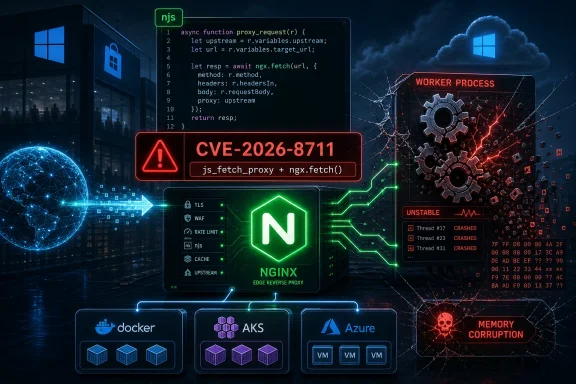 The Vulnerability Is Narrower Than the Score, but Sharper Than It Looks
The first mistake administrators can make with CVE-2026-8711 is to treat the word “NGINX” as meaning every NGINX instance is automatically exposed. The flaw sits in NGINX JavaScript, commonly called njs, and more specifically in a configuration pattern where js_fetch_proxy includes variables that can be influenced by the client request, such as HTTP headers, query arguments, or cookies.That makes this a conditional vulnerability, not a universal one. An ordinary static NGINX reverse proxy that never loads njs and never invokes
ngx.fetch() is not in the same risk bucket as an edge service that uses JavaScript logic to fetch upstream resources through a dynamically selected proxy. The exposure comes from the combination of module, directive, variable source, and request path.But conditional does not mean academic. The dangerous configurations are plausible in real deployments because njs is exactly the sort of tool engineers reach for when NGINX’s declarative configuration language is not quite enough. It lets teams add programmable request handling without moving the entire edge layer into a heavier application stack.
That convenience is also the trap. Once client-controlled values flow into proxy behavior, the boundary between “configuration” and “input handling” becomes less clean. CVE-2026-8711 is the kind of bug that punishes that blurred boundary with a worker-process crash and, in less hardened environments, potentially worse.
Denial of Service Is the Practical Attack, Not the Boring One
Availability bugs are often treated as second-class citizens in vulnerability management. They do not have the immediate drama of credential theft or remote shell access, and they rarely make for cinematic incident reports. That attitude is outdated.For an internet-facing proxy, availability is the product. If NGINX sits in front of application servers, identity portals, APIs, software update endpoints, or customer-facing services, crashing worker processes is not a nuisance; it is a direct attack on the business function the proxy exists to provide. The user-supplied description gets this right: a total loss of availability can be sustained while the attacker keeps sending malicious traffic, and even partial availability loss can become serious if it blocks new connections or repeatedly destabilizes the service.
NGINX’s process model helps, but it is not magic. Worker restarts are designed to preserve service resilience, and a crash does not automatically mean the entire daemon disappears. Yet a remotely triggerable crash loop can still translate into elevated latency, failed requests, noisy logs, exhausted error budgets, and cascading failures in dependent systems.
The real-world question is not whether one crafted request can destroy the server forever. The question is whether an attacker can make the edge unreliable at will. For many services, that is enough.
The JavaScript Module Changes the Threat Model at the Edge
NGINX earned its reputation as a fast, predictable, configuration-driven web server and reverse proxy. njs extends that model by embedding a JavaScript runtime into request handling. That is powerful, but it also imports a more complex programming surface into a layer many administrators still think of as “just config.”F5’s njs security model has long treated JavaScript code as trusted, in the same general category as
nginx.conf and certificates. That is a reasonable posture when the script is written by administrators and deployed as infrastructure code. It becomes more delicate when trusted code consumes untrusted request data and uses it to influence fetch behavior.CVE-2026-8711 appears in precisely that seam. The vulnerable pattern involves
js_fetch_proxy, client-derived NGINX variables, and a location whose JavaScript handler invokes ngx.fetch(). In other words, the bug is not just “JavaScript is risky”; it is that programmable edge behavior can create input paths that are easy to underestimate during configuration review.That matters for Windows-centric shops because NGINX often arrives as part of someone else’s platform decision. It may be embedded in a container image, bundled in an ingress controller, placed in front of a Windows-hosted application, or maintained by a DevOps team separate from endpoint and server administrators. The people responsible for patching Windows Server may not even own the proxy that determines whether users can reach the application.
The RCE Footnote Should Not Be Oversold, but It Should Not Be Ignored
The most careful reading of CVE-2026-8711 is that denial of service is the expected impact, while remote code execution is conditional. The public descriptions point to code execution on systems where Address Space Layout Randomization is disabled or where an attacker can bypass it. That is a materially higher bar than simply sending a crash-triggering request.Security teams should resist the urge to market this internally as instant unauthenticated RCE against all NGINX servers. That is how vulnerability programs lose credibility. If the affected configuration is absent, the issue is not exploitable; if modern memory protections are intact, exploitation beyond crashing a worker is significantly harder.
At the same time, memory corruption bugs deserve more respect than ordinary logic flaws. Exploitability can change as researchers publish proof-of-concept work, attackers chain primitives, or defenders discover that some production build disabled mitigations for performance, compatibility, or legacy packaging reasons. A vulnerability that begins life as “mostly DoS” can still become a high-priority emergency in a particular environment.
The sane position is to patch and audit without panic. Treat the code-execution angle as a reason to move quickly, not as a reason to invent certainty where the public record does not support it.
Microsoft’s Listing Is a Signal About Supply Chains, Not Ownership
The user-provided source is Microsoft’s Security Update Guide entry, but this is not a Windows kernel flaw, a Defender bypass, or an IIS vulnerability. The affected technology is NGINX JavaScript, maintained in the NGINX ecosystem under F5’s stewardship. Microsoft’s appearance in the story reflects how vulnerability intelligence is now consumed: enterprises expect one dashboard to tell them about risks across operating systems, cloud services, open-source components, and third-party infrastructure.That is useful, but it can also confuse accountability. A Microsoft listing does not necessarily mean Windows Update will fix the vulnerable component. If NGINX is running inside a Linux VM, a Kubernetes ingress container, a vendor appliance, or a manually installed package, remediation follows that supply chain, not the Patch Tuesday muscle memory.
This is where Windows administrators often get surprised. The application may be a .NET service, the clients may be Windows 11 laptops, the identity plane may be Entra ID, and the monitoring may live in Microsoft Sentinel — but the exposed reverse proxy may still be an NGINX package maintained through Debian, Ubuntu, Alpine, Red Hat, a container registry, or a vendor image. The blast radius crosses organizational boundaries faster than the ticketing system does.
For IT pros, the lesson is not that Microsoft is responsible for every listed CVE. The lesson is that Microsoft’s security ecosystem increasingly surfaces vulnerabilities in components that Windows shops rely on, even when remediation happens elsewhere.
The Affected Pattern Is Something You Can Actually Hunt
Some vulnerabilities force defenders into vague asset inventory exercises: “Find everywhere this library might exist.” CVE-2026-8711 is friendlier than that, at least at the configuration level. Administrators can look for njs usage,ngx_http_js_module, js_import, js_content, js_set, and especially js_fetch_proxy.The key risk pattern is not merely the presence of
js_fetch_proxy; it is the use of that directive with client-controlled variables and a JavaScript path that calls ngx.fetch(). Variables like $http_*, $arg_*, and $cookie_* are the obvious warning signs because they derive from headers, query parameters, and cookies. If those values influence proxy behavior, the service deserves immediate scrutiny.This is also a good moment to revisit how dynamic proxy selection is implemented. In many environments, clever edge logic accumulates over time: a quick workaround for one upstream, a header-based routing rule for another, a compatibility shim for a partner integration. Each change is rational in isolation, but the combined configuration becomes hard to reason about.
The useful audit is therefore both mechanical and architectural. Search the files, yes. But also ask why the proxy target or fetch path is dynamic, whether client-supplied values are constrained, and whether the same outcome can be achieved with static upstream definitions or a safer allowlist.
Patch Management Has to Follow the Module, Not Just the Server Brand
The fixed njs release is the anchor for remediation. Public NGINX change information identifies the security fix in njs 0.9.9, with affected njs versions reported in the 0.9.4 through 0.9.8 range by advisories tracking the issue. That means administrators should not stop at “What version of NGINX am I running?” They also need to know which njs module version is present and how it was packaged.This distinction matters because NGINX deployments are not uniform. Some environments install NGINX and njs from distribution repositories. Others build custom images. Some use NGINX Plus. Some inherit the module through an appliance or managed platform where the visible NGINX version is only part of the story.
The safest operational path is to update through the vendor-supported channel for the specific deployment. If the server uses distribution packages, track the distribution advisory and update the relevant njs package. If it is a container, rebuild from a patched base image rather than hot-fixing a running container and calling the job done. If it is a commercial or appliance-backed deployment, wait for and apply the vendor’s supported update rather than mixing unsupported binaries into a managed stack.
Temporary mitigations are possible but should be treated as temporary. Removing client-controlled variables from
js_fetch_proxy, disabling affected njs locations, or replacing dynamic fetch behavior with static proxy configuration can reduce exposure while patching is scheduled. Those changes should be reviewed carefully, because emergency proxy edits can break routing just as effectively as an attacker can.Windows Shops Should Look in the Places Their CMDB Forgets
The most vulnerable asset in a Windows-heavy organization may not be a Windows machine. It may be the small Linux reverse proxy standing in front of a line-of-business app, the containerized ingress service managed by a platform team, or the NGINX instance bundled into a third-party product that nobody has logged into since deployment.That is why CVE-2026-8711 belongs in a WindowsForum discussion. Windows environments are rarely Windows-only environments anymore. They are hybrid estates, and hybrid estates fail at the seams: identity crosses into Linux, Windows apps hide behind open-source proxies, and cloud-native components sit outside traditional server patch baselines.
For Microsoft-oriented administrators, the practical hunt starts in a few predictable places. Check Azure VMs and scale sets that run NGINX as a reverse proxy. Check AKS clusters and ingress configurations. Check Docker hosts used by development teams. Check WSL-based prototypes that quietly became internal services. Check vendor appliances and packaged applications that expose HTTP or API front ends.
The phrase to fear is “we don’t run NGINX,” because it is often shorthand for “the Windows team does not knowingly administer NGINX.” Attackers do not care about the org chart. They care about the edge process parsing their request.
Severity Scores Are Useful, but Configuration Is the Decider
Reports around CVE-2026-8711 have described a high CVSS v3.1 score and a critical CVSS v4.0 score. That reflects the seriousness of an unauthenticated network-triggered heap overflow in a web-facing component. It does not mean every organization should rank it above all other work without looking at exposure.The right prioritization model starts with reachability. Internet-facing NGINX instances with njs enabled and the vulnerable directive pattern deserve immediate attention. Internal proxies may still be important, especially if they front identity, management, CI/CD, or production APIs, but the urgency depends on who can send traffic to the vulnerable location.
Next comes configuration. If njs is absent, the risk collapses. If njs is present but
js_fetch_proxy is not used, the known trigger path is missing. If js_fetch_proxy is used only with static values, the specific client-controlled variable condition may not apply. If ngx.fetch() is invoked in a reachable location and the proxy directive consumes $http_*, $arg_*, or $cookie_*, the risk becomes concrete.Finally, consider resilience. A load-balanced fleet may tolerate worker crashes better than a single edge node, but repeated crashing can still create degraded service and operational noise. Autoscaling does not solve a deterministic crash condition if every new instance is built from the same vulnerable image.
This Is a Good Test of Edge Observability
A vulnerability that crashes worker processes is also a test of whether administrators can see their edge layer misbehaving. If NGINX workers restart under load and nobody notices until customers complain, the monitoring problem is almost as serious as the patching problem. CVE-2026-8711 gives teams a reason to inspect what signals they actually collect.At minimum, operators should know whether NGINX worker exits are logged, whether crash loops trigger alerts, and whether error rates are separated by location or upstream. Generic CPU and memory graphs will not tell the full story. A repeated request-triggered crash may show up as intermittent 502s, upstream resets, or unexplained latency spikes before it is recognized as a security event.
The logs also need to be useful without becoming a liability. Because client-controlled headers, arguments, and cookies are relevant to the vulnerable pattern, defenders may be tempted to log everything. That can create privacy and credential-handling problems if cookies or tokens end up in long-retention log stores. The better approach is targeted telemetry: enough request metadata to identify suspicious patterns, not a wholesale dump of sensitive values.
Security teams should also review whether web application firewalls, rate limits, and upstream protections would slow repeated exploitation. These controls are not substitutes for patching, but they can reduce the effectiveness of sustained denial-of-service attempts while remediation is underway.
The Safer Configuration Is the One Future Engineers Can Understand
The deeper issue behind CVE-2026-8711 is not only a memory bug. It is the growing complexity of edge configuration. Reverse proxies now authenticate users, rewrite requests, call APIs, fetch resources, transform headers, enforce policy, and sometimes run programmable logic that looks uncomfortably like application code.That complexity is not going away. If anything, it is expanding as organizations push more policy to the edge and expect infrastructure to make smarter decisions before traffic reaches the application. But every programmable edge feature needs the same discipline as application development: input validation, threat modeling, code review, test coverage, and least privilege.
For njs specifically, teams should treat JavaScript handlers as production code rather than decorative config snippets. If a script consumes request-derived values, those values should be constrained. If a fetch target is dynamic, the allowed destinations should be explicit. If a proxy directive can be influenced by a header or cookie, the design should be challenged before it is merged.
The most robust fix is not merely “upgrade to a non-vulnerable version.” It is to make the vulnerable pattern less likely to recur. An edge layer that only three people understand is a future incident waiting for a CVE number.
The Patch Window Should Be Short, but the Audit Should Be Longer
For exposed systems matching the vulnerable pattern, the patch window should be measured in days, not quarters. The combination of unauthenticated network access and worker-process memory corruption is too serious to leave parked in a routine maintenance backlog. Even if an organization assesses code execution as unlikely, reliable service disruption is enough to justify accelerated handling.The audit, however, should continue after the immediate update. Teams should identify who owns njs code, where it is stored, how it is reviewed, and how quickly affected images or packages can be rebuilt. If the answer is “we changed it by hand on the box,” CVE-2026-8711 has already uncovered a process problem.
There is also a dependency-management angle. If njs is installed as a separate module package, it should be visible in asset inventory. If it is baked into a container image, the image scanner should detect it. If it is supplied by a vendor appliance, the vendor’s advisory stream should be mapped into the organization’s vulnerability workflow.
The organizations that handle this well will not be the ones that merely install the fix fastest. They will be the ones that can prove where the vulnerable module existed, which configurations were exploitable, and which owners changed what.
The CVE’s Real Message for Administrators Is Hiding in Plain Sight
CVE-2026-8711 is not a reason to abandon NGINX, njs, or programmable infrastructure. It is a reason to stop pretending that the edge is simple. The modern reverse proxy is a security boundary, an application component, and an operations dependency at the same time.For Windows administrators, that means the scope of responsibility has widened. Even if the vulnerable process runs on Linux, its failure may take down Windows-hosted applications, block Windows clients, or disrupt Microsoft-cloud-integrated workflows. The operational consequence lands in the help desk queue regardless of which kernel was underneath the proxy.
This is also why vulnerability feeds can feel noisy but still be valuable. A single MSRC entry for an open-source proxy module may seem peripheral until it maps to the front door of a production service. The discipline is to convert the alert into a concrete exposure question: do we run this module, in this configuration, on a reachable path?
That question is answerable. And when it is answerable quickly, the organization is doing vulnerability management rather than vulnerability theater.
The Admin’s Short List for This Specific NGINX Bug
For all the complexity around njs and dynamic proxy behavior, the immediate operational response can be boiled down to a few concrete checks. The important thing is to keep the scope tied to the actual vulnerable pattern rather than treating every NGINX banner as equally dangerous.- Inventory NGINX deployments that load NGINX JavaScript and verify whether njs versions 0.9.4 through 0.9.8 are present.
- Search configurations for
js_fetch_proxyand determine whether it uses client-controlled variables such as headers, query arguments, or cookies. - Confirm whether reachable JavaScript handlers invoke
ngx.fetch()in locations tied to those proxy settings. - Upgrade affected njs deployments to a fixed release, using the supported package, container, appliance, or commercial vendor channel for that environment.
- Remove or constrain dynamic proxy behavior that depends on untrusted request values, especially on internet-facing services.
- Monitor for worker crashes, repeated 5xx responses, and suspicious request patterns while remediation is underway.
References
- Primary source: MSRC
Published: 2026-05-27T01:40:27-07:00
Security Update Guide - Microsoft Security Response Center
 msrc.microsoft.com
- Related coverage: sentinelone.com
CVE-2026-8711: NGINX JavaScript Buffer Overflow Flaw
CVE-2026-8711 is a heap buffer overflow vulnerability in NGINX JavaScript. Learn about its impact, affected versions, and mitigation methods.www.sentinelone.com
- Related coverage: thecyberedition.com
CVE-2026-8711: NGINX JavaScript Flaw Allows RCE on Servers
A high-severity heap buffer overflow vulnerability in NGINX's JavaScript (njs) module has been disclosed by F5, exposing web servers running affected configurations to denial-of-service attacks and — under specific conditions — full remote code execution (RCE).thecyberedition.com - Related coverage: csirt.telconet.net
- Official source: microsoft.com
MSRC - Microsoft Security Response Center
The Microsoft Security Response Center is part of the defender community and on the front line of security response evolution. For over twenty years, we have been engaged with security researchers working to protect customers and the broader ecosystem.www.microsoft.com
- Related coverage: soc.cyber.wa.gov.au

F5 NGINX Vulnerability - 20260520001 - WA Cyber Security Unit (DGOV Technical)
soc.cyber.wa.gov.au

- Related coverage: adsecvn.com
Lỗ hổng CVE-2026-8711 nguy hiểm trong NGINX njs
Lỗ hổng CVE-2026-8711 trong NGINX njs có thể gây heap overflow, DoS và remote code execution. Cần nâng cấp lên njs 0.9.9.adsecvn.com - Related coverage: mytech-blog.com
NGINX njs の CVE-2026-8711 と関連脆弱性のリスク評価 | MY TECH BLOG
2026 年 5 月に公開された NGINX njs の脆弱性 CVE-2026-8711 について、影響範囲(js_fetch_proxy 設定条件)・関連脆弱性 NGINX Rift との比較・暫定対処を実務目線で解説します。mytech-blog.com - Related coverage: nginx.org
- Related coverage: labs.cloudsecurityalliance.org
CSA research note nginx cve 2026 42945 ai discovery 20260517 csa styled
PDF documentlabs.cloudsecurityalliance.org
- Related coverage: www2.gov.bc.ca
- Related coverage: securityonline.info
Critical 9.2 CVSS: NGINX JavaScript Module Flaw (CVE-2026-8711) Triggers Heap Buffer Overflows • Daily CyberSecurity
F5 warns of a critical 9.2 CVSS flaw (CVE-2026-8711) in NGINX JavaScript (njs). Unauthenticated attackers can trigger heap overflows and potential RCE.securityonline.info - Related coverage: wiz.io
CVE-2025-8711 Impact, Exploitability, and Mitigation Steps | Wiz
Understand the critical aspects of CVE-2025-8711 with a detailed vulnerability assessment, exploitation potential, affected technologies, and remediation guidance.www.wiz.io - Related coverage: calinadev.store
New NGINX Vulnerability Exposes Servers to Malicious Code Execution
NGINX has disclosed a new high‑severity vulnerability in its JavaScript module that can allow remote attackers to crash servers and, in specific conditions, execute arbitrary code on vulnerable systems. F5 has published a security advisory (K000161307) describing a flaw in the NGINX JavaScript...www.calinadev.store
- Related coverage: linuxmaster.jp
nginx 1.30.1/1.31.0 公開とnjs CVE-2026-8711|js_fetch_proxyヒープオーバーフローのstable系影響範囲とアップグレード手順
2026年5月13日に nginx 1.30.1 stable と 1.31.0 mainline が公開され、続く5月19日に njs 0.9.9 がリリースされました。njs 側で塞がれたのが CVE-2026-8711 。www.linuxmaster.jp
