

Dell, Microsoft, and AMD used Dell Technologies World 2026 in Las Vegas to sharpen a shared enterprise AI pitch built around hybrid infrastructure, local agent development, CPU-heavy orchestration, Azure Local, and SQL Server’s emerging AI data role. The message is not that one vendor owns the AI stack. It is that the stack is becoming too expensive, too distributed, and too operationally messy for enterprises to assemble from disconnected parts.
That is the useful part of the story, and also the part that deserves the most scrutiny. Dell is selling infrastructure, Microsoft is selling a control plane and data gravity, and AMD is arguing that the AI era is not merely a GPU land grab. Together, they are trying to move the enterprise AI conversation away from model demos and toward the less glamorous work of placement, cost control, data access, and lifecycle management.
For the first two years of the generative AI boom, the industry’s favorite image was the GPU cluster: dense, hot, expensive, and somehow inevitable. That image is still accurate, but it is no longer complete. Enterprises now have enough experience with pilots to know that the hard part is not getting a model to answer a question; it is putting the answer-generating system near the right data, inside the right governance boundary, at a cost that does not make the CFO ask whether anyone is awake.
That is why Dell’s partnership story matters. The company is not simply saying it can ship servers, workstations, storage, and networking. It is saying that enterprise AI will be bought as a set of jointly engineered platforms, with Dell hardware, Microsoft cloud and database services, AMD CPUs and accelerators, and partner-led services filling the gaps between aspiration and production.
Arthur Lewis, Dell’s infrastructure chief, framed the partner ecosystem as a major opportunity because AI deployments come surrounded by services: data preparation, day-two operations, governance, optimization, and workload tuning. That is a practical admission. The AI boom has created enormous demand for infrastructure, but infrastructure alone does not create a production AI system.
For WindowsForum readers, the interesting angle is that this vision looks a lot like the enterprise IT world many admins already know. The winning AI deployment may not be a magical greenfield supercomputer. It may be a hybrid estate with Windows Server, SQL Server, Azure management, on-premises hardware, endpoint-class AI PCs, and a mess of security and compliance requirements that refuse to disappear just because the model is impressive.
Kenny Lowe of Dell pointed to memory and storage cost volatility as a force pushing customers to think harder about design. That sounds dry, but it captures the new anxiety around AI infrastructure. Memory capacity, storage throughput, model size, retrieval pipelines, token volume, and data locality all shape the final bill.
Token costs are the most visible symptom because they map directly to model usage. But the deeper issue is that AI turns ordinary software behavior into metered behavior. A poorly designed agent does not merely waste time. It may call tools, query databases, retry failed plans, summarize intermediate steps, and consume inference capacity repeatedly before producing an answer.
That makes “run it in the cloud” less satisfying as a default answer. Cloud AI remains essential, especially for elastic capacity and access to frontier models, but it is not automatically the cheapest place to run every workload. Dell’s argument for local and deskside agentic AI depends on this tension: some development, testing, fine-tuning, and inference can happen closer to the user or the data, without paying for every experimental loop in a remote service.
This is not a return to old-fashioned on-prem triumphalism. It is a placement argument. The workload should run where the cost, latency, data sensitivity, and operational model make sense. That idea is hardly new in enterprise computing, but AI gives it new urgency because small inefficiencies can scale brutally when agents become persistent, chatty, and autonomous.
A local sandbox changes the economics of experimentation. Developers and data teams can build, test, and iterate on agents without sending every prompt, tool call, retrieval request, or evaluation loop into a public cloud meter. For organizations still trying to understand which workflows are worth automating, that matters.
It also changes the security conversation. Many enterprises have data that cannot casually leave a workstation, lab, branch office, factory floor, or regulated environment. Running agent experiments locally does not solve governance by itself, but it reduces one of the obvious objections: that every prototype must involve pushing sensitive data into an external service.
This is why the “PC is a great place to start” line is more than marketing. The PC has become a candidate AI execution environment again, not because it will replace data-center infrastructure, but because not every AI task begins life as a centralized workload. Windows workstations with enough CPU, GPU, NPU, memory, and local storage may become the workshop where agents are built before IT decides which ones deserve heavier infrastructure.
There is a catch. Local agentic AI is useful only if enterprises can manage it. A workstation full of experimental agents, local models, cached data, and credentials is not automatically safer than a cloud service. For admins, the governance challenge moves from “who can access the cloud model?” to “who can run what model, against which data, on which endpoint, under which policy?”
That argument is plausible because agents are not just matrix multiplication engines. They plan, call tools, inspect results, branch, retry, validate, query databases, invoke APIs, manage context, and coordinate across systems. Some of that work benefits from GPUs, especially model inference and training. Much of it looks like conventional orchestration, application logic, and systems integration.
Robert Hormuth of AMD described agentic AI as goal-oriented software that uses many tools to achieve an outcome. Suresh Andani sharpened the point by arguing that planning and orchestration are often serial tasks better suited to CPUs than massively parallel GPUs. If a GPU is waiting while the system performs tool execution or control-flow work elsewhere, the expensive accelerator is underused.
This matters for buyers because AI infrastructure planning often begins with the accelerator bill. AMD’s argument is that the rest of the system can make or break that investment. CPU cores, memory bandwidth, I/O, networking, storage, and scheduling all influence whether the GPU is constantly fed or frequently idle.
The message is also competitive. AMD is pushing back against a worldview in which enterprise AI infrastructure is defined almost entirely by Nvidia-class acceleration. Dell benefits from broadening the conversation because it sells the whole system. Microsoft benefits because distributed AI orchestration leans heavily on the operating environment, database layer, and cloud control plane. AMD benefits because it has a deep CPU portfolio and wants agentic workloads to be understood as full-system workloads, not just GPU workloads.
That is a familiar pattern in computing. Faster processors reveal slower storage. Faster storage reveals weaker networks. Faster networks reveal poor software architecture. AI is now doing the same thing across the enterprise stack.
Agentic workloads intensify the problem because they combine inference with coordination. A single user request may trigger retrieval from a database, calls to SaaS systems, document parsing, policy checks, code execution, summarization, and multiple model invocations. The model may be the brain, but the body is distributed across ordinary enterprise systems.
This is where AMD’s CPU argument and Dell’s platform argument overlap. If the surrounding infrastructure is poorly balanced, the enterprise pays for premium accelerators while waiting on mundane dependencies. The waste may not appear as an obvious outage. It may appear as slow response times, inconsistent throughput, runaway token usage, or disappointing utilization metrics.
For IT pros, the lesson is straightforward: do not let the accelerator SKU become the whole architecture discussion. Ask what feeds it, what surrounds it, what governs it, and what happens when an agent turns one request into twenty operations across the estate.
That is a subtle but important shift. Enterprises do not lack places to run compute. They lack coherent ways to connect models to governed data without turning every AI project into a bespoke integration exercise. Microsoft’s advantage is that many organizations already have identity, endpoint management, SQL Server, Windows Server, developer tools, and Azure practices embedded deeply in their operations.
Bob Ward’s comments about integrating embedding models, vector search, chat completion models, and AI agents inside the SQL Server engine reflect Microsoft’s broader database strategy. SQL Server 2025 has moved toward native vector capabilities and AI-adjacent functions, making the database itself part of the retrieval and grounding layer. That does not eliminate specialized vector databases, but it gives Microsoft shops a familiar place to begin.
This will appeal to conservative enterprises because data movement is one of the quiet killers of AI projects. The more copies, pipelines, stores, and synchronization jobs a system needs, the harder it becomes to secure, audit, and troubleshoot. If SQL Server can handle more AI retrieval patterns in place, Microsoft can argue that customers do not need to dismantle existing data estates to build useful AI applications.
The counterargument is that embedding AI features into the database also expands the database’s responsibility. DBAs and security teams will need to understand model access, embedding generation, vector indexes, retrieval quality, and new abuse cases. The database becomes more powerful, but also more exposed.
Robert Sonders’ description starts “at the tin,” which is the right place to start. Firmware updates, hardware maintenance, cluster configuration, workload deployment, and policy alignment are not glamorous, but they determine whether an AI platform survives contact with production. AI does not exempt infrastructure from patching, drift, capacity planning, or operational hygiene.
For Windows and Azure administrators, this is the most familiar part of the story. Azure Local is a continuation of Microsoft’s long-running effort to bring Azure-style management to on-premises environments. The AI twist is that the workloads now include model-serving, retrieval, database-backed agents, and hybrid data flows that may span workstations, branch deployments, edge locations, and centralized data centers.
Dell’s role is to reduce the number of moving parts customers must assemble themselves. That is valuable if the integration is real and the operational boundaries are clear. It is less valuable if customers still end up debugging vendor handoffs among hardware, cloud services, drivers, firmware, model frameworks, and database features.
Dell can present Microsoft and AMD as proof that its AI platform is not a one-vendor cul-de-sac. Microsoft can present Dell as a validated path for customers that cannot or will not put everything in Azure. AMD can present Dell as an enterprise route to workloads that need balanced CPU, GPU, memory, and platform design.
That triangulation matters because enterprise AI is still full of uncertainty. The model landscape is changing quickly. Cost models are unstable. Regulatory expectations are tightening. Many organizations do not yet know whether their best AI returns will come from coding assistants, support automation, document intelligence, industrial workflows, security operations, or internal search.
A partnership stack promises optionality. It tells customers they can start locally, scale into the data center, connect to Azure, use familiar databases, and avoid betting the company on one deployment pattern. That is an attractive message, even if it should be examined with the usual procurement skepticism.
The risk is that “integrated” becomes another word for “bundled.” IT teams should ask where the integration is tested, where support responsibility begins and ends, how upgrades are coordinated, and what happens if one layer changes faster than another. AI partnerships are useful only if they reduce operational friction after the purchase order is signed.
That could make AI adoption easier for Microsoft-centric organizations. Existing skills in Active Directory or Entra ID, SQL Server, endpoint management, PowerShell, Windows Server, Azure operations, and compliance tooling can transfer into AI projects more naturally than a greenfield stack would allow. Enterprises rarely want to replace their operational backbone just to run a chatbot.
It could also make the environment more complex. AI agents need permissions. They need access to data. They may act across systems. They may generate code, move documents, call APIs, or summarize privileged information. The old problem of user access control becomes more complicated when the “user” is partly software acting on behalf of a human or workflow.
That is where Windows admins and security teams will become more important, not less. The AI team may build the agent, but IT will be asked to make it reliable, governed, patched, observed, and recoverable. The closer AI gets to core enterprise data, the more it looks like infrastructure.
The real world will be messier. Some workloads will belong in the public cloud because they need elasticity, managed services, or access to the largest models. Some will belong on-premises because the data is sensitive, latency-sensitive, or already embedded in local systems. Some will belong on powerful workstations because experimentation is cheaper and faster there. Some will fail because the business process was never worth automating.
The most dangerous mistake is to treat “agentic AI” as a universal justification for infrastructure spending. Agents can be useful, but they also multiply the need for evaluation, policy, logging, rollback, and human oversight. A brittle script with a language model attached is not automatically a reliable business process.
The second mistake is assuming that local AI equals private AI. Local execution helps, but privacy depends on data handling, model behavior, telemetry, credentials, logs, and administrative controls. A deskside AI system can leak value just as surely as a cloud service if it is badly governed.
Can the platform run small, frequent, iterative agent tests without turning experimentation into a cost crisis? Can it keep sensitive data where policy says it should remain? Can it connect to SQL Server and other enterprise data sources without spawning a fragile shadow data architecture? Can it feed accelerators efficiently enough to justify their cost? Can admins patch and observe it with tools they already understand?
These are not abstract questions. They determine whether AI moves from pilot to production. Dell, Microsoft, and AMD are effectively arguing that the answer will come from integrated hybrid platforms rather than isolated model endpoints.
That view is probably right in broad strokes. Enterprise computing rarely standardizes on the purest architecture. It standardizes on the architecture that can be bought, managed, secured, supported, and explained to auditors. Hybrid AI may be less elegant than the cloud-native dream, but it is closer to how large organizations actually operate.
That is the useful part of the story, and also the part that deserves the most scrutiny. Dell is selling infrastructure, Microsoft is selling a control plane and data gravity, and AMD is arguing that the AI era is not merely a GPU land grab. Together, they are trying to move the enterprise AI conversation away from model demos and toward the less glamorous work of placement, cost control, data access, and lifecycle management.
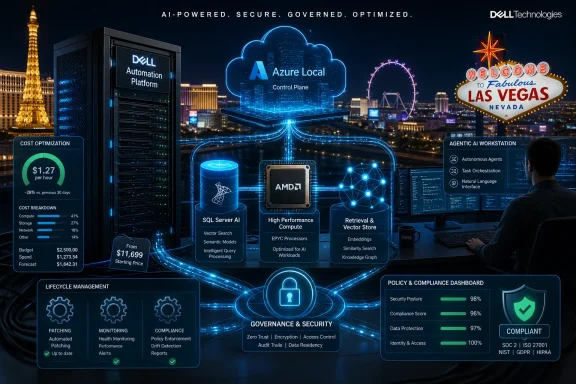 The AI Stack Is Becoming a Partnership Product
For the first two years of the generative AI boom, the industry’s favorite image was the GPU cluster: dense, hot, expensive, and somehow inevitable. That image is still accurate, but it is no longer complete. Enterprises now have enough experience with pilots to know that the hard part is not getting a model to answer a question; it is putting the answer-generating system near the right data, inside the right governance boundary, at a cost that does not make the CFO ask whether anyone is awake.That is why Dell’s partnership story matters. The company is not simply saying it can ship servers, workstations, storage, and networking. It is saying that enterprise AI will be bought as a set of jointly engineered platforms, with Dell hardware, Microsoft cloud and database services, AMD CPUs and accelerators, and partner-led services filling the gaps between aspiration and production.
Arthur Lewis, Dell’s infrastructure chief, framed the partner ecosystem as a major opportunity because AI deployments come surrounded by services: data preparation, day-two operations, governance, optimization, and workload tuning. That is a practical admission. The AI boom has created enormous demand for infrastructure, but infrastructure alone does not create a production AI system.
For WindowsForum readers, the interesting angle is that this vision looks a lot like the enterprise IT world many admins already know. The winning AI deployment may not be a magical greenfield supercomputer. It may be a hybrid estate with Windows Server, SQL Server, Azure management, on-premises hardware, endpoint-class AI PCs, and a mess of security and compliance requirements that refuse to disappear just because the model is impressive.
Cost Has Become the First Architecture Constraint
The most revealing part of the Dell-Microsoft-AMD storyline is that cost is no longer being treated as a procurement issue at the end of the project. It is becoming an architectural input at the beginning. That is a sign of a maturing market.Kenny Lowe of Dell pointed to memory and storage cost volatility as a force pushing customers to think harder about design. That sounds dry, but it captures the new anxiety around AI infrastructure. Memory capacity, storage throughput, model size, retrieval pipelines, token volume, and data locality all shape the final bill.
Token costs are the most visible symptom because they map directly to model usage. But the deeper issue is that AI turns ordinary software behavior into metered behavior. A poorly designed agent does not merely waste time. It may call tools, query databases, retry failed plans, summarize intermediate steps, and consume inference capacity repeatedly before producing an answer.
That makes “run it in the cloud” less satisfying as a default answer. Cloud AI remains essential, especially for elastic capacity and access to frontier models, but it is not automatically the cheapest place to run every workload. Dell’s argument for local and deskside agentic AI depends on this tension: some development, testing, fine-tuning, and inference can happen closer to the user or the data, without paying for every experimental loop in a remote service.
This is not a return to old-fashioned on-prem triumphalism. It is a placement argument. The workload should run where the cost, latency, data sensitivity, and operational model make sense. That idea is hardly new in enterprise computing, but AI gives it new urgency because small inefficiencies can scale brutally when agents become persistent, chatty, and autonomous.
Deskside AI Is Dell’s Bet Against Cloud-Only Experimentation
Dell’s Deskside Agentic AI pitch is easy to dismiss as another hardware vendor trying to wrap workstations in the latest buzzword. That would be too simple. The more interesting claim is that agent development needs a local proving ground before it becomes a production cloud or data-center workload.A local sandbox changes the economics of experimentation. Developers and data teams can build, test, and iterate on agents without sending every prompt, tool call, retrieval request, or evaluation loop into a public cloud meter. For organizations still trying to understand which workflows are worth automating, that matters.
It also changes the security conversation. Many enterprises have data that cannot casually leave a workstation, lab, branch office, factory floor, or regulated environment. Running agent experiments locally does not solve governance by itself, but it reduces one of the obvious objections: that every prototype must involve pushing sensitive data into an external service.
This is why the “PC is a great place to start” line is more than marketing. The PC has become a candidate AI execution environment again, not because it will replace data-center infrastructure, but because not every AI task begins life as a centralized workload. Windows workstations with enough CPU, GPU, NPU, memory, and local storage may become the workshop where agents are built before IT decides which ones deserve heavier infrastructure.
There is a catch. Local agentic AI is useful only if enterprises can manage it. A workstation full of experimental agents, local models, cached data, and credentials is not automatically safer than a cloud service. For admins, the governance challenge moves from “who can access the cloud model?” to “who can run what model, against which data, on which endpoint, under which policy?”
AMD Wants the AI Conversation to Remember the CPU
The AI hardware market has been dominated by GPU supply, GPU roadmaps, and GPU allocation. AMD has its own accelerator story, but its comments at Dell Technologies World highlight another angle: agentic AI increases demand for CPU-side work.That argument is plausible because agents are not just matrix multiplication engines. They plan, call tools, inspect results, branch, retry, validate, query databases, invoke APIs, manage context, and coordinate across systems. Some of that work benefits from GPUs, especially model inference and training. Much of it looks like conventional orchestration, application logic, and systems integration.
Robert Hormuth of AMD described agentic AI as goal-oriented software that uses many tools to achieve an outcome. Suresh Andani sharpened the point by arguing that planning and orchestration are often serial tasks better suited to CPUs than massively parallel GPUs. If a GPU is waiting while the system performs tool execution or control-flow work elsewhere, the expensive accelerator is underused.
This matters for buyers because AI infrastructure planning often begins with the accelerator bill. AMD’s argument is that the rest of the system can make or break that investment. CPU cores, memory bandwidth, I/O, networking, storage, and scheduling all influence whether the GPU is constantly fed or frequently idle.
The message is also competitive. AMD is pushing back against a worldview in which enterprise AI infrastructure is defined almost entirely by Nvidia-class acceleration. Dell benefits from broadening the conversation because it sells the whole system. Microsoft benefits because distributed AI orchestration leans heavily on the operating environment, database layer, and cloud control plane. AMD benefits because it has a deep CPU portfolio and wants agentic workloads to be understood as full-system workloads, not just GPU workloads.
The GPU Is Still the Star, but the Supporting Cast Is Getting Expensive
None of this means GPUs are suddenly less important. Large-scale training, high-throughput inference, multimodal models, and dense numerical workloads remain accelerator-heavy. The point is that production AI is exposing bottlenecks outside the accelerator.That is a familiar pattern in computing. Faster processors reveal slower storage. Faster storage reveals weaker networks. Faster networks reveal poor software architecture. AI is now doing the same thing across the enterprise stack.
Agentic workloads intensify the problem because they combine inference with coordination. A single user request may trigger retrieval from a database, calls to SaaS systems, document parsing, policy checks, code execution, summarization, and multiple model invocations. The model may be the brain, but the body is distributed across ordinary enterprise systems.
This is where AMD’s CPU argument and Dell’s platform argument overlap. If the surrounding infrastructure is poorly balanced, the enterprise pays for premium accelerators while waiting on mundane dependencies. The waste may not appear as an obvious outage. It may appear as slow response times, inconsistent throughput, runaway token usage, or disappointing utilization metrics.
For IT pros, the lesson is straightforward: do not let the accelerator SKU become the whole architecture discussion. Ask what feeds it, what surrounds it, what governs it, and what happens when an agent turns one request into twenty operations across the estate.
Microsoft’s Role Is Data Gravity, Not Just Cloud Gravity
Microsoft’s part in the Dell partnership is not simply Azure as a place to run things. It is Azure as a management model, SQL Server as an AI-aware data engine, and Azure Local as a way to stretch cloud-style operations back into the data center.That is a subtle but important shift. Enterprises do not lack places to run compute. They lack coherent ways to connect models to governed data without turning every AI project into a bespoke integration exercise. Microsoft’s advantage is that many organizations already have identity, endpoint management, SQL Server, Windows Server, developer tools, and Azure practices embedded deeply in their operations.
Bob Ward’s comments about integrating embedding models, vector search, chat completion models, and AI agents inside the SQL Server engine reflect Microsoft’s broader database strategy. SQL Server 2025 has moved toward native vector capabilities and AI-adjacent functions, making the database itself part of the retrieval and grounding layer. That does not eliminate specialized vector databases, but it gives Microsoft shops a familiar place to begin.
This will appeal to conservative enterprises because data movement is one of the quiet killers of AI projects. The more copies, pipelines, stores, and synchronization jobs a system needs, the harder it becomes to secure, audit, and troubleshoot. If SQL Server can handle more AI retrieval patterns in place, Microsoft can argue that customers do not need to dismantle existing data estates to build useful AI applications.
The counterargument is that embedding AI features into the database also expands the database’s responsibility. DBAs and security teams will need to understand model access, embedding generation, vector indexes, retrieval quality, and new abuse cases. The database becomes more powerful, but also more exposed.
Azure Local Is the Hybrid Cloud Pitch Rewritten for AI
Azure Local is Microsoft’s attempt to make on-premises infrastructure feel less like an island. In Dell’s framing, the Dell Automation Platform can deploy Microsoft Azure Local on-premises and carry customers from hardware and firmware management through cloud control-plane connection and workload deployment. That is exactly the kind of lifecycle story enterprises want to hear, because AI infrastructure without lifecycle management is just expensive metal.Robert Sonders’ description starts “at the tin,” which is the right place to start. Firmware updates, hardware maintenance, cluster configuration, workload deployment, and policy alignment are not glamorous, but they determine whether an AI platform survives contact with production. AI does not exempt infrastructure from patching, drift, capacity planning, or operational hygiene.
For Windows and Azure administrators, this is the most familiar part of the story. Azure Local is a continuation of Microsoft’s long-running effort to bring Azure-style management to on-premises environments. The AI twist is that the workloads now include model-serving, retrieval, database-backed agents, and hybrid data flows that may span workstations, branch deployments, edge locations, and centralized data centers.
Dell’s role is to reduce the number of moving parts customers must assemble themselves. That is valuable if the integration is real and the operational boundaries are clear. It is less valuable if customers still end up debugging vendor handoffs among hardware, cloud services, drivers, firmware, model frameworks, and database features.
The Real Sale Is Confidence, Not Just Hardware
Enterprise AI buyers are not only buying performance. They are buying confidence that the platform will not strand them when the next model, framework, compliance requirement, or budget review arrives. This is where partnerships become a sales instrument.Dell can present Microsoft and AMD as proof that its AI platform is not a one-vendor cul-de-sac. Microsoft can present Dell as a validated path for customers that cannot or will not put everything in Azure. AMD can present Dell as an enterprise route to workloads that need balanced CPU, GPU, memory, and platform design.
That triangulation matters because enterprise AI is still full of uncertainty. The model landscape is changing quickly. Cost models are unstable. Regulatory expectations are tightening. Many organizations do not yet know whether their best AI returns will come from coding assistants, support automation, document intelligence, industrial workflows, security operations, or internal search.
A partnership stack promises optionality. It tells customers they can start locally, scale into the data center, connect to Azure, use familiar databases, and avoid betting the company on one deployment pattern. That is an attractive message, even if it should be examined with the usual procurement skepticism.
The risk is that “integrated” becomes another word for “bundled.” IT teams should ask where the integration is tested, where support responsibility begins and ends, how upgrades are coordinated, and what happens if one layer changes faster than another. AI partnerships are useful only if they reduce operational friction after the purchase order is signed.
The Windows Estate Moves Closer to the AI Control Plane
For WindowsForum’s core audience, the Dell-Microsoft-AMD story has a clear implication: the Windows and Microsoft infrastructure estate is being pulled directly into AI operations. This is not just about Copilot on the desktop. It is about Windows endpoints, SQL Server databases, Azure-connected on-prem systems, identity controls, management tooling, and hardware refresh cycles becoming part of the enterprise AI substrate.That could make AI adoption easier for Microsoft-centric organizations. Existing skills in Active Directory or Entra ID, SQL Server, endpoint management, PowerShell, Windows Server, Azure operations, and compliance tooling can transfer into AI projects more naturally than a greenfield stack would allow. Enterprises rarely want to replace their operational backbone just to run a chatbot.
It could also make the environment more complex. AI agents need permissions. They need access to data. They may act across systems. They may generate code, move documents, call APIs, or summarize privileged information. The old problem of user access control becomes more complicated when the “user” is partly software acting on behalf of a human or workflow.
That is where Windows admins and security teams will become more important, not less. The AI team may build the agent, but IT will be asked to make it reliable, governed, patched, observed, and recoverable. The closer AI gets to core enterprise data, the more it looks like infrastructure.
Vendor Positioning Meets the Mess of Real Deployments
Every vendor in this story has an incentive to make AI deployment sound more coherent than it is. Dell wants to sell platforms. Microsoft wants hybrid customers to stay inside the Azure orbit. AMD wants the market to value CPUs and system balance alongside accelerators. None of those incentives are illegitimate, but they should shape how buyers interpret the pitch.The real world will be messier. Some workloads will belong in the public cloud because they need elasticity, managed services, or access to the largest models. Some will belong on-premises because the data is sensitive, latency-sensitive, or already embedded in local systems. Some will belong on powerful workstations because experimentation is cheaper and faster there. Some will fail because the business process was never worth automating.
The most dangerous mistake is to treat “agentic AI” as a universal justification for infrastructure spending. Agents can be useful, but they also multiply the need for evaluation, policy, logging, rollback, and human oversight. A brittle script with a language model attached is not automatically a reliable business process.
The second mistake is assuming that local AI equals private AI. Local execution helps, but privacy depends on data handling, model behavior, telemetry, credentials, logs, and administrative controls. A deskside AI system can leak value just as surely as a cloud service if it is badly governed.
The Procurement Checklist Is Now an Architecture Argument
The practical buying conversation around enterprise AI is changing. It is no longer enough to ask how many GPUs a platform has or which model it can run. The better questions are about the behavior of the whole system over time.Can the platform run small, frequent, iterative agent tests without turning experimentation into a cost crisis? Can it keep sensitive data where policy says it should remain? Can it connect to SQL Server and other enterprise data sources without spawning a fragile shadow data architecture? Can it feed accelerators efficiently enough to justify their cost? Can admins patch and observe it with tools they already understand?
These are not abstract questions. They determine whether AI moves from pilot to production. Dell, Microsoft, and AMD are effectively arguing that the answer will come from integrated hybrid platforms rather than isolated model endpoints.
That view is probably right in broad strokes. Enterprise computing rarely standardizes on the purest architecture. It standardizes on the architecture that can be bought, managed, secured, supported, and explained to auditors. Hybrid AI may be less elegant than the cloud-native dream, but it is closer to how large organizations actually operate.
The Fine Print Behind Dell’s AI Partnership Moment
The most concrete lesson from Dell Technologies World is that enterprise AI is being reshaped by cost, locality, and orchestration rather than model spectacle alone. Dell’s Microsoft and AMD alliances point toward a market where infrastructure vendors win by making AI less exotic and more operational.- Dell is positioning AI as a hybrid infrastructure problem that spans workstations, data centers, edge locations, and cloud-connected management.
- Microsoft’s strongest contribution is the combination of Azure Local, SQL Server, and existing enterprise control planes rather than raw cloud capacity alone.
- AMD’s CPU argument is strongest in agentic workflows where planning, tool execution, orchestration, and validation can leave GPUs waiting on the rest of the system.
- Deskside agentic AI is best understood as a cost and data-control sandbox for experimentation, not as a replacement for centralized AI infrastructure.
- IT teams should evaluate these partnership stacks by lifecycle management, governance, support boundaries, and utilization, not by launch-stage performance claims alone.
- The Windows and SQL Server estate is becoming a first-class participant in enterprise AI architecture, which will pull traditional admins deeper into AI operations.
References
- Primary source: SiliconANGLE
Published: 2026-06-10T21:51:14.038451
AI partnerships drive Dell, Microsoft & AMD strategy - SiliconANGLE
AI partnerships between Dell, Microsoft, and AMD are reshaping enterprise infrastructure, cutting costs, and powering the full AI deployment lifecycle. siliconangle.com
- Related coverage: dell.com
Dell Technologies World: A Bright and Beautiful Road Ahead | Dell
Michael Dell declared AI is no longer coming — it's here. See every major announcement from Dell Technologies World 2026, from agentic AI to PowerEdge XE.www.dell.com - Related coverage: nvidia.com
NVIDIA at Dell Technologies World
Join NVIDIA at Dell Technologies World, May 18-21, 2026 in Las Vegas. See Jensen Huang keynote, explore Dell AI Factory innovations, and attend NVIDIA sessions on enterprise AI.www.nvidia.com - Related coverage: crn.com
Dell Technologies World 2026: Biggest Dell AI Factory With Nvidia Innovation
Dell unveils new AI Factory with Nvidia offerings, including a deskside agentic AI platform promising up to 87% cost savings while tackling data privacy and hybrid AI deployment challenges.www.crn.com - Related coverage: amd.com
AMD at Dell Technologies World 2026: Built for Enterprise AI
Dell Technologies World 2026 kicks off in two weeks and promises to be a great show. Take a peek at what we're demoing and plan to stop at Booth 827.www.amd.com - Related coverage: itpro.com
Dell unveils Deskside Agentic AI at Dell Technologies World 2026 | IT Pro
Deskside Agentic AI is the latest in the Dell AI Factory with Nvidia stable, with the company saying it further demonstrates its end-to-end enterprise AI capabilitywww.itpro.com
- Related coverage: creativebloq.com
"AI’s role is to augment human creativity, not replace it": Dell is going all-in on AI PCs | Creative Bloq
We spoke to Dell's UK Senior Director Louise Quennell about the possibilities - and threats - of the AI revolution.www.creativebloq.com - Related coverage: delltechnologies.com
Dell Technologies Logo
Dell Technologies logo, horizontal orientation. Digital RGB. Online use only.www.delltechnologies.com
- Official source: learn.microsoft.com
Vector Search & Vector Index - SQL Server | Microsoft Learn
How to create, manage, and search vectors in the SQL Database Engine.learn.microsoft.com - Official source: microsoft.com
Announcing SQL Server 2025 (preview): The AI-ready enterprise database from ground to cloud - Microsoft SQL Server Blog
Announcing SQL Server 2025—empowering customers to develop modern AI applications securely using their data, complete with best-in-class security, performance, and availability.www.microsoft.com - Official source: devblogs.microsoft.com
SQL Server 2025 Embraces Vectors: setting the foundation for empowering your data with AI - Azure SQL Dev Corner
Discover how SQL Server 2025 vector support released in RTM enhances data management with native VECTOR functions. devblogs.microsoft.com
- Official source: techcommunity.microsoft.com
Announcing Public Preview of DiskANN in SQL Server 2025 | Microsoft Community Hub
We are excited to announce the public preview of DiskANN in SQL Server 2025, a significant advancement in our AI capabilities. This release comes with full... techcommunity.microsoft.com
- Official source: cdn-dynmedia-1.microsoft.com
