

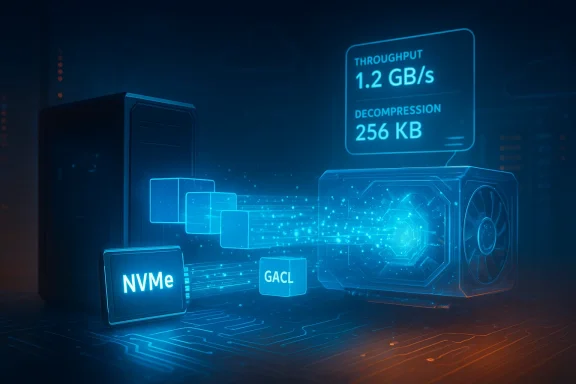
Microsoft’s DirectStorage 1.4 public preview, announced at GDC and published on March 11, 2026, introduces native support for Zstandard (Zstd) compression and ships an initial public preview of a new Game Asset Conditioning Library (GACL) — changes designed to shrink compressed asset size, speed decompression, and make high-throughput NVMe streaming more predictable and practical for modern AAA asset pipelines.
DirectStorage started as the Xbox Velocity architecture’s answer to a perennial PC problem: games got bigger, GPUs got hungrier for high-resolution textures and models, and the CPU-and-block-layer I/O path on Windows became a bottleneck in streaming scenarios. Microsoft’s DirectStorage API family aims to reduce CPU overhead for I/O, enable GPU-accelerated decompression, and let developers stream many small compressed assets from NVMe drives into GPU memory with far lower CPU cost than traditional techniques. The feature set has evolved across several releases — earlier updates added GPU decompression and HDD optimizations; 1.4 doubles down on compression formats and pipeline tooling.
At GDC 2026 Microsoft framed DirectStorage 1.4 as a practical pivot: instead of asking developers to invent bespoke compression workflows for streaming, the platform now supports an open, tunable compression format (Zstd) plus a dedicated conditioning library (GACL) that helps game studios prepare assets so they decompress faster and compress better in production pipelines. The goal is both load-time reduction and steadier in-play streaming for content-rich titles.
The GACL model is particularly important because it reframes compression as a pipeline problem, not purely a runtime one. Conditioning assets at build time to make them friendlier to general-purpose compressors is an engineering pattern borrowed from other domains (e.g., pre-tokenization in data systems), and applying it to game streaming is a forward-thinking move.
But the broad success of DirectStorage 1.4 depends on three things aligning: (1) developer willingness to rework large asset pipelines, (2) GPU vendor and driver support to keep decompression shaders fast and non-intrusive, and (3) a critical mass of releases that actually ship Zstd + GACL content. If those three are present, players will see materially faster loads, smaller installs, and smoother streaming — and the PC gaming experience will inch closer to the near-instant streaming consoles already deliver in many scenarios. If those pieces don’t align quickly, the benefits will be real but incremental, concentrated in titles that prioritize the investment.
DirectStorage 1.4’s public previews — the SDK/NuGet preview and the GACL initial release — mean the tooling is now in developers’ hands. The next 12–24 months will be decisive: expect adoption during remasters and large AAA content updates first, followed by broader engine-level integrations as studios validate the trade-offs and tune their pipelines. In that sense, 1.4 is the practical lever Microsoft needed to take compression beyond a marketing bullet point and into studio workflows that actually change the player experience.
Source: TechPowerUp Microsoft DirectStorage 1.4 Brings Quicker Load Times and Smoother Asset Streaming | TechPowerUp}
 Background / Overview
DirectStorage started as the Xbox Velocity architecture’s answer to a perennial PC problem: games got bigger, GPUs got hungrier for high-resolution textures and models, and the CPU-and-block-layer I/O path on Windows became a bottleneck in streaming scenarios. Microsoft’s DirectStorage API family aims to reduce CPU overhead for I/O, enable GPU-accelerated decompression, and let developers stream many small compressed assets from NVMe drives into GPU memory with far lower CPU cost than traditional techniques. The feature set has evolved across several releases — earlier updates added GPU decompression and HDD optimizations; 1.4 doubles down on compression formats and pipeline tooling.At GDC 2026 Microsoft framed DirectStorage 1.4 as a practical pivot: instead of asking developers to invent bespoke compression workflows for streaming, the platform now supports an open, tunable compression format (Zstd) plus a dedicated conditioning library (GACL) that helps game studios prepare assets so they decompress faster and compress better in production pipelines. The goal is both load-time reduction and steadier in-play streaming for content-rich titles.
What’s new in DirectStorage 1.4
Zstandard (Zstd) support: modern compression for game assets
DirectStorage 1.4 adds Zstd compression and decompression support in the public preview. Zstd is a modern, widely used compression algorithm with a configurable compression vs. decompression-speed trade-off. By adopting Zstd, Microsoft is offering developers:- Better compression ratios than many legacy game compressors at comparable or faster decompression speeds.
- Tunable presets so teams can choose a point on the size/performance curve that fits a game’s streaming profile.
- Interoperability with numerous tooling ecosystems, because Zstd is an open, well-supported standard.
Game Asset Conditioning Library (GACL)
The Game Asset Conditioning Library is a major addition that deserves separate emphasis. GACL is a pipeline-oriented library intended to sit in a studio’s build tools and pre-process assets before shipping. The key ideas are:- Conditioning transforms (like shuffling) that rearrange bitstreams to expose better redundancy to Zstd without increasing runtime cost.
- Entropy reduction techniques at the block and component level (BLER and CLER) — including perceptual and ML‑guided approaches — to make the compressed result smaller while controlling visual quality for lossy conditioning.
- A clear, supported integration path: GACL performs conditioning during the content build and DirectStorage reverses the transforms after decompression at runtime, so no runtime artifacting or manual undo steps are required.
Developer orchestration and D3D12 CreatorID
DirectStorage 1.4 extends developer control over synchronization and execution by adding D3D12 CreatorID support. CreatorIDs are associated with the D3D12 command queues DirectStorage manages on a per-device basis; this enables better grouping and accounting of DirectStorage-related GPU work. In practice, that helps GPU schedulers and drivers make more predictable decisions about when streaming decompression work runs relative to rendering and compute tasks — an important detail for studios that want consistent frame pacing while streaming large volumes of data. The SDK and NuGet preview packages reflect this change.Why these changes matter — practical benefits
- Smaller downloads, faster installs, and cheaper patching. Zstd’s improved compression ratios and GACL’s conditioning mean the same visual fidelity can occupy fewer bytes on disk and in distribution archives. That reduces storage footprint and network bandwidth for patches and game downloads.
- Faster loading and reduced CPU load. Because Zstd is designed for efficient decompression and because DirectStorage supports GPU decompression pipelines, games can recover scenes and textures faster while freeing CPU cycles for gameplay logic, AI, or physics.
- Smoother in-play streaming. Conditioned assets and tuned chunking help maintain steady throughput from NVMe to GPU memory; this is the key to reducing texture pop-in, hitches, and micro-stutters in open-world or streaming-heavy scenarios.
- Tooling standardization. GACL provides a repeatable, engine-agnostic way to condition assets — something studios previously had to build in-house if they wanted production-grade compression tuned for streaming.
How this will play out in the real world — developer perspective
Integration steps (high level)
- Add DirectStorage 1.4 SDK (preview) to the engine/toolchain and validate runtime decompression paths.
- Integrate GACL into the content build pipeline and test conditioning parameters across representative assets.
- Repackage or chunk assets to the recommended sizes (initial shader is tuned for ≤256 KB chunks) and benchmark throughput on target hardware.
- Use the updated GPU decompression benchmarks and PIX tooling to verify that decompression throughput and GPU/CPU utilization meet expectations.
- Iterate on visual quality vs. compression trade-offs for any lossy conditioning techniques.
Tooling and pipeline considerations
- Conditioning belongs at build time. Ship-time and install-time recompression of existing archives is possible, but the ideal moment to adopt Zstd+GACL is during a content refresh or re-packaging cycle.
- Per-asset testing is essential. Conditioning techniques that help textures may be harmful for some compressed geometry formats or pre-compressed audio; studios must validate each asset type.
- CI/CD and storage: adding a conditioning stage will change build storage needs and potentially the time it takes to produce releases; studios should plan for increased build CPU or GPU work during packaging.
What gamers and PC builders should know
- DirectStorage benefits still depend on a full stack: a DirectStorage-capable OS build, compatible GPU drivers, and — for the best streaming bandwidth — a fast NVMe SSD. Historically, Microsoft’s Windows-side I/O optimizations favor newer Windows builds and driver stacks for maximum throughput; keep OS and GPU drivers up to date.
- Immediate consumer impact will be incremental. The platform pieces are now in Microsoft’s hands, but the concrete player experience depends on developers converting existing installed content to the new compression pipeline or shipping new titles built around Zstd/GACL.
- Don’t expect instant “loadless” gameplay everywhere. DirectStorage reduces load time and CPU overhead and can dramatically improve streaming steadiness — but it won’t eliminate every bottleneck. GPU memory (VRAM), shader compilation, and runtime CPU work still matter; DirectStorage is one piece of a multi-dimensional performance puzzle.
Strengths: why Microsoft’s approach is smart
- Open, modern compression (Zstd). Choosing Zstd — an open, widely used standard — reduces lock-in and takes advantage of a mature compression ecosystem.
- Practical pipeline tooling (GACL). By supplying a conditioning library, Microsoft acknowledges that raw compression alone is not enough; how assets are prepared matters for streaming workloads. GACL’s conditioning + DirectStorage’s reversal at runtime is an elegant architecture for balancing build-time expense and runtime predictability.
- Developer control and predictability (CreatorID). Exposing CreatorIDs to D3D12 lets studios better orchestrate when decompression work runs relative to rendering, improving predictability for frame-time-sensitive titles.
- Ecosystem alignment. Microsoft’s messaging at GDC emphasizes partnership across GPU vendors and tooling vendors. Standardizing the stack increases the odds of cross-vendor shader and driver support that scales to the entire PC ecosystem.
Risks, limitations, and open questions
- Pipeline cost and migration effort. For live games with millions of installed copies, reconditioning and redistributing assets is a non-trivial project. Smaller studios may delay adoption until major updates or re-releases.
- GPU load vs. rendering load trade-offs. Offloading decompression to the GPU frees CPU cycles, but it must not contend with rendering or other GPU tasks at critical times. The addition of CreatorID helps, but real-world scheduling conflicts on memory- or compute-bound GPUs are still possible and must be benchmarked per title.
- Chunking assumptions. Microsoft’s initial shader is optimized for ≤256 KB chunks. Games using different packaging strategies (very large archive blobs, uncommon asset layouts) may need to change chunking or accept sub-optimal performance until shader support broadens.
- Vendor driver maturity and platform parity. Early previews run on a subset of driver stacks; cross-vendor parity (NVIDIA, AMD, Intel) for optimized Zstd shader performance will determine how broadly and uniformly players see improvements.
- Testing and quality assurance for lossy conditioning. GACL’s lossy CLER techniques use perceptual transforms and ML. These must be validated extensively to avoid visible artifacts — and QA costs may rise accordingly.
- Security and integrity checks. Any new runtime path that ingests and decompresses external streams increases the attack surface for malformed or malicious assets. Studios must ensure strong integrity checks and fail-safe behavior in the event of decompression errors.
Measured expectations: what gains are realistic?
Historically, DirectStorage demos have shown large wins in specific scenarios — for example, certain presentations indicated multi-fold reductions in scene-load time when the whole chain (fast NVMe + GPU decompression + tuned asset packaging) was aligned. However, independent reviews of earlier DirectStorage releases found that gains vary widely by game, engine, packaging, and storage device. The most realistic expectation going forward is this:- For newly authored games or remasters that adopt Zstd + GACL from the start, substantial improvements in install size, load times, and streaming predictability are reachable.
- For existing titles, gains will be meaningful where developers repackage and re-condition assets, but the effort/reward calculation needs studio-specific benchmarking.
- For players on slower storage (SATA SSDs, HDDs), DirectStorage still helps but absolute gains will be limited by the storage medium; NVMe Gen4/Gen5 hardware delivers the largest practical benefits.
Recommendations — for developers, studios, and gamers
For developers and studios
- Evaluate GACL in a small, representative pipeline first. Measure both compression ratio improvements and end-to-end decompression costs on target hardware.
- Rechunk assets to the 256 KB pattern recommended for the initial shader, then rerun benchmarks; don’t assume current packaging is optimal.
- Plan a staged rollout: internal beta → opt-in test branch → full adoption on a major content update.
- Watch driver releases and collaborate with GPU vendors to ensure the shader performance matures across platforms.
For PC gamers and system builders
- Prioritize driver and OS updates: keep GPU drivers and Windows builds current, as DirectStorage improvements frequently rely on driver-level optimizations.
- Expect the biggest benefits on fast NVMe drives and modern GPUs; older hardware will see smaller relative improvements.
- Be patient: many titles will only adopt Zstd+GACL during major updates, and immediate, universal benefits are unlikely.
Final analysis — what 1.4 means for the industry
DirectStorage 1.4 is a pragmatic and technically solid step forward: Microsoft is not just adding another compression flag — it’s delivering an integrated system (Zstd + conditioning + scheduling controls) designed to align studio build pipelines with runtime streaming realities. That approach acknowledges the practical work required inside studios to convert marketing promises into stable, cross-hardware improvements.The GACL model is particularly important because it reframes compression as a pipeline problem, not purely a runtime one. Conditioning assets at build time to make them friendlier to general-purpose compressors is an engineering pattern borrowed from other domains (e.g., pre-tokenization in data systems), and applying it to game streaming is a forward-thinking move.
But the broad success of DirectStorage 1.4 depends on three things aligning: (1) developer willingness to rework large asset pipelines, (2) GPU vendor and driver support to keep decompression shaders fast and non-intrusive, and (3) a critical mass of releases that actually ship Zstd + GACL content. If those three are present, players will see materially faster loads, smaller installs, and smoother streaming — and the PC gaming experience will inch closer to the near-instant streaming consoles already deliver in many scenarios. If those pieces don’t align quickly, the benefits will be real but incremental, concentrated in titles that prioritize the investment.
DirectStorage 1.4’s public previews — the SDK/NuGet preview and the GACL initial release — mean the tooling is now in developers’ hands. The next 12–24 months will be decisive: expect adoption during remasters and large AAA content updates first, followed by broader engine-level integrations as studios validate the trade-offs and tune their pipelines. In that sense, 1.4 is the practical lever Microsoft needed to take compression beyond a marketing bullet point and into studio workflows that actually change the player experience.
Closing thoughts
DirectStorage 1.4 is not a silver bullet — but it is a carefully engineered step toward solving one of modern PC gaming’s thorniest problems: how to stream richer worlds without paying a continuous CPU or storage penalty. By standardizing on Zstd and shipping a conditioning library, Microsoft has given developers a sensible toolkit rather than a vague promise. The immediate winners will be teams willing to invest in their build pipelines and test aggressively across hardware. For players, the payoff will arrive as titles repackage or ship new content using these tools — and when that happens, loading screens and texture pop-in will finally see a believable path to long-term reduction.Source: TechPowerUp Microsoft DirectStorage 1.4 Brings Quicker Load Times and Smoother Asset Streaming | TechPowerUp}
