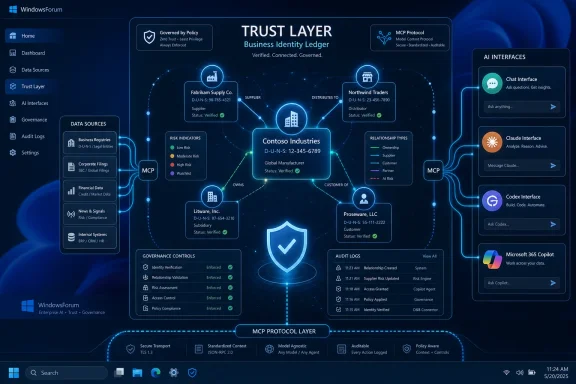
Dun & Bradstreet’s June 2026 integrations put its Commercial Graph inside ChatGPT, Codex, Microsoft 365 Copilot and Claude, giving enterprise users a way to call verified business identity, ownership, finance, risk and compliance data from AI workflows. The announcement is not just another “AI partnership” press release. It is a sign that the next enterprise AI fight is moving away from raw model cleverness and toward the data rails that make agents safe enough to use in production. For Windows shops already evaluating Copilot, ChatGPT Enterprise, Claude, Codex, and internal agents, the message is blunt: the model may write the answer, but the data layer increasingly decides whether the answer can be trusted.
For much of the generative AI boom, vendors sold the idea that large language models could reason across messy corporate knowledge with only a prompt and a document dump. That was always an overstatement. In regulated workflows, the hard part is not producing fluent prose; it is knowing whether “ACME Holdings Ltd.” in one country is the same counterparty as “Acme Holdings Limited” in another, whether its parent changed last quarter, whether a supplier is tied to a sanctioned entity, or whether a credit decision is being made from stale records.
Dun & Bradstreet is trying to position itself as the missing trust layer for that problem. Its Commercial Graph is built around the D-U-N-S Number, the long-running business identifier first introduced in 1963, and is pitched as a continuously validated map of company identity, corporate relationships, ownership, supplier links, financial data and risk signals. In plain terms, D&B wants to be the source an AI agent calls when it needs to know which business it is actually talking about.
That distinction matters. A chatbot can summarize a filing. An enterprise agent is supposed to make progress inside a workflow: screen a vendor, validate a customer, enrich a CRM record, assess credit risk, generate a due diligence packet, or prepare a compliance review. Those actions require structured data, lineage, permissions and repeatability, not just a confident paragraph.
The new integrations span OpenAI, Microsoft and Anthropic, which makes the announcement more interesting than a single-platform connector. D&B is not betting on one assistant. It is betting that companies will use multiple agent environments and will need a common commercial identity layer across them.
For finance teams, the attraction is obvious. Credit origination, portfolio review, supplier analysis and due diligence are full of repetitive information-gathering tasks that have traditionally lived in spreadsheets, portals, PDFs and internal risk systems. If D&B-hosted MCP servers can expose verified identity, ownership, linkage, credit and risk information directly inside ChatGPT or Codex, the AI interface becomes less of a writing assistant and more of a front end for structured commercial intelligence.
That does not mean the agent gets to replace underwriting policy. The smarter reading is that OpenAI’s tools can become an orchestration surface for finance professionals who still need governed data and rules. D&B’s own Finance Analytics tools, according to the announcement, can be accessed through MCP to support automated business credit decisions using real-time insight and rules-based logic.
That “rules-based” phrase is doing important work. In enterprise finance, a model-generated recommendation without deterministic controls is not enough. Auditors, risk officers and regulators care how a decision was reached, what data was used, whether the policy was applied consistently, and whether a human can explain the outcome after the fact. A language model can help assemble and interpret the work, but the decisioning substrate still needs structure.
Codex adds another wrinkle. By extending the same data access pattern to developer workflows, D&B is acknowledging that agentic work is not confined to chat windows. Developers building internal finance and risk tools may want AI-assisted code that can reason about real business entities, call governed APIs, and automate validation logic. The risk, as always, is that “move faster” becomes “ship a compliance hole faster” unless identity, permissions and logging are treated as first-class parts of the system.
This is a beachhead strategy. Microsoft 365 Copilot already sits where many employees work: Outlook, Teams, Word, Excel, PowerPoint, SharePoint and the broader Microsoft Graph environment. By surfacing D&B data through Copilot, the company is trying to make business identification a native part of knowledge work rather than a separate lookup step.
For WindowsForum readers, this is where the announcement intersects most directly with the Microsoft ecosystem. Copilot’s enterprise pitch has always depended on combining model capability with organizational context. A user asks for a customer brief, a supplier summary or a market list, and Copilot draws from tenant data. D&B’s connector adds external commercial context to that internal graph.
That is useful, but it also sharpens the governance question. Once external business data appears inside everyday productivity workflows, administrators need to know who can access it, where generated outputs are stored, how stale records are handled, and whether users understand the difference between a curated sample and a licensed authoritative dataset. A connector that looks frictionless to a user can still create policy decisions for IT.
Microsoft’s advantage is distribution. If D&B wants business identity data to become ambient in enterprise work, Microsoft 365 is the obvious place to start. The drawback is that Copilot adoption has been uneven in many organizations, with cost, training, data hygiene and measurable ROI all creating friction. A better data source can improve Copilot’s usefulness, but it cannot fix a tenant where permissions, SharePoint sprawl and information architecture are already a mess.
The practical use cases are familiar to banks, insurers, procurement departments and global enterprises. Know-your-business checks, vendor onboarding, ownership analysis, sanctions-adjacent screening, risk review and audit documentation are all areas where AI can reduce clerical drag. They are also areas where mistakes are expensive.
That is why the language around “verified” data is not marketing fluff, even if the press release naturally leans hard into it. Compliance workflows cannot depend on a model’s memory of the world. They need current company records, linkage structures, risk indicators and an audit trail that can be defended when someone asks why a counterparty was approved or rejected.
Anthropic’s MCP roots also matter. The protocol began in Anthropic’s orbit as a way to connect models to external tools and resources, and its broader adoption has made MCP a shorthand for the agent ecosystem’s plumbing layer. D&B’s presence in Claude through this pattern reinforces the idea that enterprise AI is becoming less about isolated assistants and more about governed toolchains.
Still, compliance officers should resist the temptation to confuse integration with assurance. Claude can help assemble a workflow; D&B can provide commercial data; neither absolves the enterprise from validating policy, access control, record retention, regional data handling and escalation paths. The agent can make the process faster. The organization still owns the risk.
That list may read like regional product plumbing, but it points to an important reality. Enterprise AI will not standardize on one model, one assistant or one cloud. Global companies will operate across jurisdictions, productivity suites, coding tools, local AI platforms and regulatory regimes. The data layer that survives will be the one that can be reached from many places while preserving governance.
D&B says its business data covers nearly 900 million companies worldwide. Whether every customer needs that breadth is beside the point. The value proposition is that a multinational can use a consistent identifier and relationship model across customer acquisition, supplier management, trade compliance, risk analysis and expansion planning.
For IT leaders, this is where agentic AI starts to look less like a software category and more like middleware. The agent is the visible part. The durable architecture is identity, permissions, data quality, logging, API contracts, and system-to-system orchestration. In that world, a company like D&B is not trying to be the smartest model in the room; it is trying to be the verified commercial memory that every model calls.
This shift creates a more complicated buying process. A CIO may approve Copilot. A finance leader may want ChatGPT for analysis. A compliance department may prefer Claude for document-heavy workflows. A developer team may adopt Codex-style tooling. The shared concern becomes whether each environment can access the same trusted entity records without creating inconsistent answers.
That is the nightmare scenario D&B is implicitly selling against. One agent says a supplier is low risk because it found an old profile. Another flags the same company because it sees a newer ownership link. A third fails to distinguish a subsidiary from a parent. In human workflows, those inconsistencies are annoying. In automated workflows, they become operational risk.
The answer is not simply “buy D&B.” Many enterprises already use a mix of internal master data management systems, CRM enrichment vendors, procurement platforms, risk databases, sanctions tools and sector-specific intelligence providers. The more important point is architectural: agents need authoritative sources, and those sources need to be explicitly chosen.
For Windows and Microsoft administrators, this will increasingly become a tenant governance issue. If Copilot can reach external business data, if Claude can connect to Microsoft 365, if ChatGPT and Codex can call MCP servers, then admins need policies that describe which connectors are approved, which data classes may leave the tenant, which users can invoke which tools, and how outputs are retained. The age of “we blocked consumer ChatGPT” as an AI policy is already over.
Business data is messy because businesses are messy. Companies merge, rename themselves, spin off divisions, hide ownership structures, operate through affiliates, maintain outdated public records and differ across jurisdictions in what must be disclosed. Even a heavily validated commercial graph can contain gaps, delays or conflicting signals. The right enterprise posture is to treat a trusted dataset as a controlled source, not an oracle.
There is also a transparency question. When an AI assistant produces a recommendation based partly on D&B data, partly on internal documents and partly on model reasoning, the user needs to know which part came from where. Without that distinction, “AI says” becomes a dangerous blur. The governance win only arrives if the workflow exposes provenance clearly enough for humans to review it.
Cost and access will matter as well. Microsoft’s curated sample in Copilot is a low-friction entry point, but serious risk, finance and compliance workloads usually require deeper licensed data and stronger integration. Organizations should expect the business case to depend on actual process redesign, not simply turning on a connector and waiting for productivity to appear.
Security teams will have their own concerns. MCP servers and graph connectors are powerful precisely because they let AI systems interact with outside tools and data. That means they expand the blast radius of bad permissions, prompt injection, misconfigured connectors and overbroad access. The more useful an agent becomes, the more carefully it must be contained.
That direction is consistent with Microsoft’s broader strategy. Microsoft Graph already gives Copilot a privileged view into organizational context. Connectors extend that world outward. Once third-party commercial data becomes available in Copilot, users can ask richer business questions without leaving their productivity environment.
The upside is real. A sales operations analyst can enrich a target account list. A procurement manager can identify a supplier’s corporate parent. A finance user can prepare a credit review with fewer manual lookups. An executive assistant can build a company briefing that includes both internal correspondence and external business identity context.
The downside is that Copilot’s usefulness depends on the hygiene of the surrounding environment. If access permissions are sloppy, Copilot may surface information too broadly. If users do not understand which data is sampled, licensed, current or authoritative, they may overtrust polished summaries. If connectors proliferate without governance, IT inherits an agent ecosystem it does not fully control.
That is why Windows and Microsoft 365 admins should treat D&B’s connector as part of a wider pattern. Every new AI data integration should trigger the same practical questions: who can use it, what can it access, what can it write, where does output go, how is activity logged, and how will the organization know when it is wrong?
OpenAI wants ChatGPT and Codex to become places where knowledge workers and developers do real work. Microsoft wants Copilot to become the AI layer across the Office estate and beyond. Anthropic wants Claude to be the trustworthy assistant for complex enterprise reasoning and tool use. D&B wants to be the commercial truth source all of them can call.
That multi-platform posture reflects how enterprises actually buy technology. Few large organizations will standardize every AI use case on one vendor. Legal may use one tool, developers another, sales another, finance another, while Microsoft 365 remains the operating environment for day-to-day productivity. The challenge is not choosing a single winner; it is preventing data fragmentation across many winners.
This is where the phrase agentic workflows earns some substance. An agentic workflow is not magic autonomy. It is a sequence of tool calls, data retrieval, reasoning steps, policy checks and outputs wrapped in a conversational or semi-automated interface. If the data layer is weak, the workflow is weak no matter how impressive the model benchmark looks.
D&B’s announcement is therefore less about novelty than about normalization. Business identity, credit risk, supplier linkage and compliance intelligence are being packaged for AI agents the way APIs were packaged for SaaS applications. That is a sign the market is maturing.
Enterprises should begin by identifying the workflows where verified commercial data materially changes the outcome. A general “ask Copilot about companies” scenario is interesting, but the stronger cases are narrower: vendor onboarding, supplier risk triage, credit memo preparation, customer identity validation, portfolio monitoring, or sanctions-adjacent escalation. The more specific the workflow, the easier it is to measure whether AI is improving speed, accuracy or consistency.
They should also separate retrieval from decisioning. An agent that retrieves D&B data and drafts a memo is different from an agent that approves a credit line or clears a supplier. The former can often be deployed with human review and strong logging. The latter requires deeper controls, policy validation and auditability.
Data provenance should be visible in the user experience. If a user cannot tell whether a claim came from D&B, an internal spreadsheet, a public website or the model’s synthesis, the organization has merely wrapped uncertainty in better prose. AI governance depends on making sources legible without overwhelming the worker.
Finally, administrators need to treat connectors as privileged infrastructure. MCP servers, graph connectors and agent tools deserve the same scrutiny as enterprise apps with API permissions. They should be inventoried, approved, monitored and periodically reviewed. Shadow AI was the first problem. Shadow connectors may be the next one.
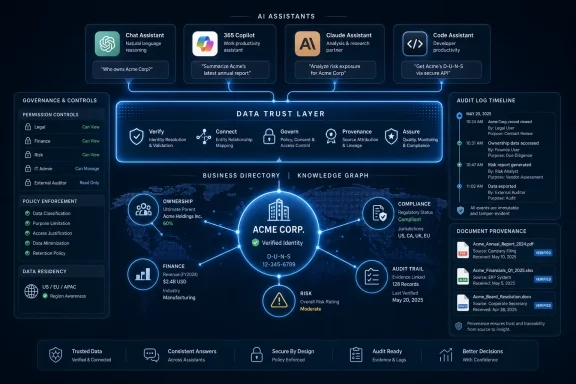 The AI Agent Finally Meets the Business Directory
For much of the generative AI boom, vendors sold the idea that large language models could reason across messy corporate knowledge with only a prompt and a document dump. That was always an overstatement. In regulated workflows, the hard part is not producing fluent prose; it is knowing whether “ACME Holdings Ltd.” in one country is the same counterparty as “Acme Holdings Limited” in another, whether its parent changed last quarter, whether a supplier is tied to a sanctioned entity, or whether a credit decision is being made from stale records.Dun & Bradstreet is trying to position itself as the missing trust layer for that problem. Its Commercial Graph is built around the D-U-N-S Number, the long-running business identifier first introduced in 1963, and is pitched as a continuously validated map of company identity, corporate relationships, ownership, supplier links, financial data and risk signals. In plain terms, D&B wants to be the source an AI agent calls when it needs to know which business it is actually talking about.
That distinction matters. A chatbot can summarize a filing. An enterprise agent is supposed to make progress inside a workflow: screen a vendor, validate a customer, enrich a CRM record, assess credit risk, generate a due diligence packet, or prepare a compliance review. Those actions require structured data, lineage, permissions and repeatability, not just a confident paragraph.
The new integrations span OpenAI, Microsoft and Anthropic, which makes the announcement more interesting than a single-platform connector. D&B is not betting on one assistant. It is betting that companies will use multiple agent environments and will need a common commercial identity layer across them.
OpenAI Gets the Finance Workflow, Not Just the Prompt Box
The OpenAI piece gives D&B customers access to the Commercial Graph in ChatGPT and Codex through Model Context Protocol servers. That phrasing is easy to skim past, but it is the core of the story. MCP has become a common way for AI applications to reach external tools and data sources without every vendor inventing a one-off connector model.For finance teams, the attraction is obvious. Credit origination, portfolio review, supplier analysis and due diligence are full of repetitive information-gathering tasks that have traditionally lived in spreadsheets, portals, PDFs and internal risk systems. If D&B-hosted MCP servers can expose verified identity, ownership, linkage, credit and risk information directly inside ChatGPT or Codex, the AI interface becomes less of a writing assistant and more of a front end for structured commercial intelligence.
That does not mean the agent gets to replace underwriting policy. The smarter reading is that OpenAI’s tools can become an orchestration surface for finance professionals who still need governed data and rules. D&B’s own Finance Analytics tools, according to the announcement, can be accessed through MCP to support automated business credit decisions using real-time insight and rules-based logic.
That “rules-based” phrase is doing important work. In enterprise finance, a model-generated recommendation without deterministic controls is not enough. Auditors, risk officers and regulators care how a decision was reached, what data was used, whether the policy was applied consistently, and whether a human can explain the outcome after the fact. A language model can help assemble and interpret the work, but the decisioning substrate still needs structure.
Codex adds another wrinkle. By extending the same data access pattern to developer workflows, D&B is acknowledging that agentic work is not confined to chat windows. Developers building internal finance and risk tools may want AI-assisted code that can reason about real business entities, call governed APIs, and automate validation logic. The risk, as always, is that “move faster” becomes “ship a compliance hole faster” unless identity, permissions and logging are treated as first-class parts of the system.
Microsoft 365 Copilot Turns the Business Graph Into Office Context
The Microsoft integration is different in shape and probably broader in reach. D&B’s Graph Connector for Microsoft 365 Copilot gives developers and enterprises no-cost access to a curated sample of Commercial Graph data, including company summaries, locations, contact information, employee and revenue ranges, and foundational information on tens of thousands of public and private companies.This is a beachhead strategy. Microsoft 365 Copilot already sits where many employees work: Outlook, Teams, Word, Excel, PowerPoint, SharePoint and the broader Microsoft Graph environment. By surfacing D&B data through Copilot, the company is trying to make business identification a native part of knowledge work rather than a separate lookup step.
For WindowsForum readers, this is where the announcement intersects most directly with the Microsoft ecosystem. Copilot’s enterprise pitch has always depended on combining model capability with organizational context. A user asks for a customer brief, a supplier summary or a market list, and Copilot draws from tenant data. D&B’s connector adds external commercial context to that internal graph.
That is useful, but it also sharpens the governance question. Once external business data appears inside everyday productivity workflows, administrators need to know who can access it, where generated outputs are stored, how stale records are handled, and whether users understand the difference between a curated sample and a licensed authoritative dataset. A connector that looks frictionless to a user can still create policy decisions for IT.
Microsoft’s advantage is distribution. If D&B wants business identity data to become ambient in enterprise work, Microsoft 365 is the obvious place to start. The drawback is that Copilot adoption has been uneven in many organizations, with cost, training, data hygiene and measurable ROI all creating friction. A better data source can improve Copilot’s usefulness, but it cannot fix a tenant where permissions, SharePoint sprawl and information architecture are already a mess.
Anthropic Gets the Compliance Story It Was Built to Tell
The Anthropic collaboration focuses on onboarding, risk and compliance workflows in Claude. That framing fits Claude’s enterprise reputation: less about flashy consumer features, more about long-context analysis, document-heavy work and cautious process execution. D&B says the Commercial Graph integration will let users access verified business information, corporate linkage data and risk intelligence inside a unified workflow.The practical use cases are familiar to banks, insurers, procurement departments and global enterprises. Know-your-business checks, vendor onboarding, ownership analysis, sanctions-adjacent screening, risk review and audit documentation are all areas where AI can reduce clerical drag. They are also areas where mistakes are expensive.
That is why the language around “verified” data is not marketing fluff, even if the press release naturally leans hard into it. Compliance workflows cannot depend on a model’s memory of the world. They need current company records, linkage structures, risk indicators and an audit trail that can be defended when someone asks why a counterparty was approved or rejected.
Anthropic’s MCP roots also matter. The protocol began in Anthropic’s orbit as a way to connect models to external tools and resources, and its broader adoption has made MCP a shorthand for the agent ecosystem’s plumbing layer. D&B’s presence in Claude through this pattern reinforces the idea that enterprise AI is becoming less about isolated assistants and more about governed toolchains.
Still, compliance officers should resist the temptation to confuse integration with assurance. Claude can help assemble a workflow; D&B can provide commercial data; neither absolves the enterprise from validating policy, access control, record retention, regional data handling and escalation paths. The agent can make the process faster. The organization still owns the risk.
The China Angle Shows the Race Is Also About Local Ecosystems
Dun & Bradstreet China’s portion of the announcement broadens the story beyond the familiar U.S. enterprise AI stack. The company says its global data and China Data by Topics via MCP servers support integrations with international platforms and developer tools including Microsoft Copilot, Cursor, Claude Code and OpenClaw, while also working with local AI ecosystems such as Trae, WorkBuddy, QoderWork, Coze and CherryStudio.That list may read like regional product plumbing, but it points to an important reality. Enterprise AI will not standardize on one model, one assistant or one cloud. Global companies will operate across jurisdictions, productivity suites, coding tools, local AI platforms and regulatory regimes. The data layer that survives will be the one that can be reached from many places while preserving governance.
D&B says its business data covers nearly 900 million companies worldwide. Whether every customer needs that breadth is beside the point. The value proposition is that a multinational can use a consistent identifier and relationship model across customer acquisition, supplier management, trade compliance, risk analysis and expansion planning.
For IT leaders, this is where agentic AI starts to look less like a software category and more like middleware. The agent is the visible part. The durable architecture is identity, permissions, data quality, logging, API contracts, and system-to-system orchestration. In that world, a company like D&B is not trying to be the smartest model in the room; it is trying to be the verified commercial memory that every model calls.
Agentic AI Is Becoming a Data Procurement Problem
The first wave of generative AI procurement was model-centric. Enterprises compared output quality, context windows, licensing terms, indemnity language, hosting models and admin controls. Those choices still matter, but D&B’s announcement shows the next layer of procurement emerging: which external data sources are allowed to feed agents that make or influence business decisions?This shift creates a more complicated buying process. A CIO may approve Copilot. A finance leader may want ChatGPT for analysis. A compliance department may prefer Claude for document-heavy workflows. A developer team may adopt Codex-style tooling. The shared concern becomes whether each environment can access the same trusted entity records without creating inconsistent answers.
That is the nightmare scenario D&B is implicitly selling against. One agent says a supplier is low risk because it found an old profile. Another flags the same company because it sees a newer ownership link. A third fails to distinguish a subsidiary from a parent. In human workflows, those inconsistencies are annoying. In automated workflows, they become operational risk.
The answer is not simply “buy D&B.” Many enterprises already use a mix of internal master data management systems, CRM enrichment vendors, procurement platforms, risk databases, sanctions tools and sector-specific intelligence providers. The more important point is architectural: agents need authoritative sources, and those sources need to be explicitly chosen.
For Windows and Microsoft administrators, this will increasingly become a tenant governance issue. If Copilot can reach external business data, if Claude can connect to Microsoft 365, if ChatGPT and Codex can call MCP servers, then admins need policies that describe which connectors are approved, which data classes may leave the tenant, which users can invoke which tools, and how outputs are retained. The age of “we blocked consumer ChatGPT” as an AI policy is already over.
The Trust Layer Still Has to Earn Trust
D&B’s argument rests on the idea that verified commercial data will improve confidence, consistency and governance in AI-powered outcomes. That is plausible. It is also not automatic.Business data is messy because businesses are messy. Companies merge, rename themselves, spin off divisions, hide ownership structures, operate through affiliates, maintain outdated public records and differ across jurisdictions in what must be disclosed. Even a heavily validated commercial graph can contain gaps, delays or conflicting signals. The right enterprise posture is to treat a trusted dataset as a controlled source, not an oracle.
There is also a transparency question. When an AI assistant produces a recommendation based partly on D&B data, partly on internal documents and partly on model reasoning, the user needs to know which part came from where. Without that distinction, “AI says” becomes a dangerous blur. The governance win only arrives if the workflow exposes provenance clearly enough for humans to review it.
Cost and access will matter as well. Microsoft’s curated sample in Copilot is a low-friction entry point, but serious risk, finance and compliance workloads usually require deeper licensed data and stronger integration. Organizations should expect the business case to depend on actual process redesign, not simply turning on a connector and waiting for productivity to appear.
Security teams will have their own concerns. MCP servers and graph connectors are powerful precisely because they let AI systems interact with outside tools and data. That means they expand the blast radius of bad permissions, prompt injection, misconfigured connectors and overbroad access. The more useful an agent becomes, the more carefully it must be contained.
Windows Shops Should Read This as a Copilot Governance Warning
The Microsoft portion of this story may sound like a niche data connector, but it is a preview of where Microsoft 365 Copilot is heading. Copilot will not remain a single assistant answering questions about your files. It is becoming a workbench for internal and external knowledge, line-of-business systems, third-party data, and increasingly autonomous task execution.That direction is consistent with Microsoft’s broader strategy. Microsoft Graph already gives Copilot a privileged view into organizational context. Connectors extend that world outward. Once third-party commercial data becomes available in Copilot, users can ask richer business questions without leaving their productivity environment.
The upside is real. A sales operations analyst can enrich a target account list. A procurement manager can identify a supplier’s corporate parent. A finance user can prepare a credit review with fewer manual lookups. An executive assistant can build a company briefing that includes both internal correspondence and external business identity context.
The downside is that Copilot’s usefulness depends on the hygiene of the surrounding environment. If access permissions are sloppy, Copilot may surface information too broadly. If users do not understand which data is sampled, licensed, current or authoritative, they may overtrust polished summaries. If connectors proliferate without governance, IT inherits an agent ecosystem it does not fully control.
That is why Windows and Microsoft 365 admins should treat D&B’s connector as part of a wider pattern. Every new AI data integration should trigger the same practical questions: who can use it, what can it access, what can it write, where does output go, how is activity logged, and how will the organization know when it is wrong?
The Model Wars Are Giving Way to the Workflow Wars
The most telling part of the announcement is that D&B is integrating with OpenAI, Microsoft and Anthropic at once. A year ago, much of the enterprise AI conversation still sounded like a horse race among foundation models. Today, the more durable contest is over workflows.OpenAI wants ChatGPT and Codex to become places where knowledge workers and developers do real work. Microsoft wants Copilot to become the AI layer across the Office estate and beyond. Anthropic wants Claude to be the trustworthy assistant for complex enterprise reasoning and tool use. D&B wants to be the commercial truth source all of them can call.
That multi-platform posture reflects how enterprises actually buy technology. Few large organizations will standardize every AI use case on one vendor. Legal may use one tool, developers another, sales another, finance another, while Microsoft 365 remains the operating environment for day-to-day productivity. The challenge is not choosing a single winner; it is preventing data fragmentation across many winners.
This is where the phrase agentic workflows earns some substance. An agentic workflow is not magic autonomy. It is a sequence of tool calls, data retrieval, reasoning steps, policy checks and outputs wrapped in a conversational or semi-automated interface. If the data layer is weak, the workflow is weak no matter how impressive the model benchmark looks.
D&B’s announcement is therefore less about novelty than about normalization. Business identity, credit risk, supplier linkage and compliance intelligence are being packaged for AI agents the way APIs were packaged for SaaS applications. That is a sign the market is maturing.
The Fine Print Belongs in the Deployment Plan
There is a temptation to see these integrations as plug-and-play productivity boosters. That is the wrong lens. The right lens is deployment architecture.Enterprises should begin by identifying the workflows where verified commercial data materially changes the outcome. A general “ask Copilot about companies” scenario is interesting, but the stronger cases are narrower: vendor onboarding, supplier risk triage, credit memo preparation, customer identity validation, portfolio monitoring, or sanctions-adjacent escalation. The more specific the workflow, the easier it is to measure whether AI is improving speed, accuracy or consistency.
They should also separate retrieval from decisioning. An agent that retrieves D&B data and drafts a memo is different from an agent that approves a credit line or clears a supplier. The former can often be deployed with human review and strong logging. The latter requires deeper controls, policy validation and auditability.
Data provenance should be visible in the user experience. If a user cannot tell whether a claim came from D&B, an internal spreadsheet, a public website or the model’s synthesis, the organization has merely wrapped uncertainty in better prose. AI governance depends on making sources legible without overwhelming the worker.
Finally, administrators need to treat connectors as privileged infrastructure. MCP servers, graph connectors and agent tools deserve the same scrutiny as enterprise apps with API permissions. They should be inventoried, approved, monitored and periodically reviewed. Shadow AI was the first problem. Shadow connectors may be the next one.
The Practical Read for IT Pros Is Written in the Connectors
D&B’s announcement is easy to dismiss as a vendor declaring itself “trusted” in the middle of an AI land rush. But the integrations are concrete enough to matter, and they point to several practical conclusions for organizations already piloting enterprise AI.- Dun & Bradstreet is placing its Commercial Graph inside ChatGPT, Codex, Microsoft 365 Copilot and Claude, making verified business identity data available across several major AI work environments.
- The OpenAI integration uses MCP servers to support finance, credit, due diligence and risk workflows inside ChatGPT and Codex.
- The Microsoft integration gives Copilot users and developers access to a curated sample of D&B business data through a Graph Connector, making external company context available inside Microsoft 365 workflows.
- The Anthropic integration focuses on Claude-based onboarding, risk and compliance workflows where entity verification and corporate linkage data are central.
- The real enterprise value depends less on the chat interface and more on governance, provenance, permissions, auditability and the quality of the underlying data.
- IT teams should treat AI connectors as high-impact enterprise integrations, not harmless productivity add-ons.
References
- Primary source: digitalmore.co
Published: 2026-06-16T08:12:15.389585
Dun & Bradstreet Becomes the Trusted Partner for Global Agentic Workflows Through Integrations with Anthropic, OpenAI and Microsoft | Digital More
HONG KONG, June 16, 2026 /PRNewswire/ -- Dun & Bradstreet recently announced a series of collaborations with OpenAI, Microsoft and Anthropic, bringing thedigitalmore.co - Related coverage: dnb.com
Dun & Bradstreet and OpenAI Power Finance Workflows
Access trusted D&B Commercial Graph data in ChatGPT and Codex to automate credit decisions and improve financial risk management.www.dnb.com
- Related coverage: treasurytoday.com
Press release: Dun & Bradstreet and OpenAI collaborate to power finance workflows for enterprises and small businesses | Treasury Today
A website for Finance treasurytoday.com
- Related coverage: pymnts.com
PYMNTS | Dun & Bradstreet Partners With Anthropic on Business Onboarding
Dun & Bradstreet said it will collaborate with AI startup Anthropic to embed its proprietary commercial risk data into the Claude AI platform. www.pymnts.com
- Related coverage: tbsnews.net
Dun & Bradstreet, Anthropic partner to strengthen AI-driven compliance
Dun & Bradstreet has announced a collaboration with Anthropic to bring Dun & Bradstreet risk data directly into Claude, in a move expected to reshape how enterprises manage onboarding and compliance. The partnership will embed Dun & Bradstreet's Commercial Graph, a...www.tbsnews.net
- Related coverage: techintelpro.com
Dun & Bradstreet Integrates D&B Data With OpenAI
Dun & Bradstreet brings D&B Commercial Graph data to ChatGPT and Codex to support AI-driven finance and risk workflows.techintelpro.com
- Related coverage: prnewswire.com
Dun & Bradstreet Brings Risk & Compliance Workflows to Anthropic's Claude
/PRNewswire/ -- Dun & Bradstreet today announced that it will collaborate with Anthropic to bring D&B risk data directly inside Claude to speed up businesses'... www.prnewswire.com
- Related coverage: techradar.com
Microsoft 365 users can now choose between ChatGPT and Claude for their AI needs | TechRadar
Copilot users can now use Claude models, should they want towww.techradar.com - Related coverage: windowscentral.com
Microsoft diversifies Copilot 355 AI stack beyond OpenAI | Windows Central
Microsoft’s Copilot 365 AI stack just got a Claude infusion. Here's why OpenAI should be concerned.www.windowscentral.com - Related coverage: letsdatascience.com
Dun & Bradstreet Integrates Risk Data into Anthropic Claude | Let's Data Science
Dun & Bradstreet has partnered with Anthropic to embed its proprietary commercial risk dataset, the **Commercial Graph**, into Anthropic's `Claude` via a `Model Context Protocol (MCP) server`, according to a Dun & Bradstreet press release and reporting by PYMNTS and Dealroom. The... letsdatascience.com
- Related coverage: marketscreener.com
- Related coverage: aiinnovisory.com