

Microsoft Edge became the unlikely subject of a Mac browser fight in late June 2026 after an X post mocking Edge on macOS drew replies from users defending Microsoft’s browser as fast, efficient, manageable, and surprisingly practical on Apple hardware. The obvious culture-war frame is Microsoft versus Apple, Edge versus Safari, Redmond invading Cupertino. But the more important story is that browser choice has quietly stopped being a matter of operating-system loyalty and has become a test of what users value most: performance, privacy, control, compatibility, or convenience.
That is why the viral debate is both entertaining and incomplete. Edge on a Mac is not the punchline it might have been 15 years ago, and Safari is not the automatic answer just because the laptop has an Apple logo on the lid. Yet if the argument is about the browser that best preserves user agency across platforms, Firefox still has the strongest claim.
The original joke worked because it leaned on an old instinct: Apple users use Safari, Windows users tolerate Edge, and anyone mixing the two must be doing something perverse. That instinct belongs to a different internet. The modern browser is no longer merely the program that opens web pages; it is a sync service, a password manager, an enterprise policy endpoint, an extension platform, an identity layer, and increasingly an AI front end.
In that world, Microsoft Edge on macOS is not strange. It is a Chromium browser with Microsoft account integration, enterprise controls, support for many Chrome-compatible extensions, and enough performance work behind it to make it a plausible daily driver. For Mac users who live in Microsoft 365, Teams, SharePoint, Outlook, Entra ID, and managed corporate environments, Edge can be the path of least resistance rather than an act of brand betrayal.
The surprise in the X debate was not that some people mocked Edge. Mocking Edge is practically a browser-war reflex, inherited from decades of Internet Explorer jokes and reinforced by Microsoft’s sometimes exhausting attempts to push Edge inside Windows. The surprise was how many Mac users answered with practical reasons rather than tribal ones.
Some said Edge felt faster than Chrome. Others said it handled memory better. Some pointed to work requirements, internal sites, certificates, or security policies that assume Edge is present. That is the boring explanation, and boring explanations are often the real ones.
The Mac has become a serious enterprise machine, not just a designer’s workstation or a developer’s Unix laptop with a better screen. Once Macs are enrolled, managed, audited, and integrated into the same identity and compliance stack as Windows PCs, the browser stops being a lifestyle accessory. It becomes another controllable surface.
That matters. On a MacBook, battery life is not a benchmark vanity metric; it is the difference between getting through a flight or hunting for an outlet. Safari’s deep WebKit integration gives Apple a credible claim to superior efficiency and smoothness on its own machines. If your computing life begins and ends inside Apple’s garden, Safari is a rational default.
But the same integration that makes Safari feel native also makes it less compelling for users who do not live entirely inside that garden. Safari exists on macOS, iOS, and iPadOS, but not on Windows or Linux. That instantly complicates life for anyone who crosses between a MacBook and a Windows desktop, a corporate PC and a personal iPhone, or a Linux workstation and an iPad.
Apple’s browser strategy has always been inseparable from Apple’s platform strategy. Safari is excellent at making Apple devices feel like one coherent organism. It is less interested in being the neutral layer across everybody else’s hardware.
That is not a flaw from Apple’s perspective. It is the point. Safari is a browser, but it is also an argument for staying inside Apple’s ecosystem.
That compatibility is central to why Edge has a real constituency on Mac. The web is largely tested against Chromium because Chrome is dominant, and Edge benefits from that gravitational pull. A site that behaves in Chrome will usually behave in Edge, while users still get Microsoft-specific features layered on top.
That is not a trivial proposition. For users who dislike Chrome’s resource profile or Google’s data appetite but still need Chromium compatibility, Edge can look like a compromise with fewer sacrifices. It gives them the web’s de facto standard engine without fully surrendering to Google’s browser.
Microsoft has also invested heavily in performance features such as sleeping tabs and energy-saving modes. These are the kind of features that sound minor until you are working with 40 tabs, a video call, a document editor, and a laptop fan that sounds like a drone. Browser efficiency has become a user-experience feature, not just an engineering footnote.
Still, Edge carries Microsoft’s baggage. On Windows, Microsoft has often promoted Edge in ways that feel less like persuasion and more like pressure. Default-browser prompts, search nudges, and system-level integration have trained many users to distrust even good Edge features because they arrive wrapped in Microsoft’s growth tactics.
That is the irony of Edge on Mac. Away from Windows, where Microsoft cannot lean as heavily on operating-system defaults, Edge has to compete more honestly. On macOS, people who install Edge usually have a reason. That makes their defense of it more credible.
That reality makes Edge’s success more complicated. Edge may be better than Chrome for many users in memory management, enterprise administration, or Microsoft integration, but it still reinforces Chromium’s centrality. Every user who chooses Edge over Safari or Firefox may be escaping Google’s browser, but not necessarily Google’s browser engine monoculture.
For web developers, Chromium dominance can be convenient. One engine target reduces testing pain and makes bugs easier to reproduce. For the open web, that convenience has a cost. When too much of the web is built around one rendering engine’s behavior, standards become less like shared rules and more like descriptions of what Chromium already does.
This is where Firefox matters beyond personal preference. Mozilla’s browser is not just another user interface around Chromium. It represents an independent engine, an independent governance model, and an independent set of priorities. In a browser market increasingly organized around Chrome and Chrome-derived alternatives, that independence is not nostalgia. It is infrastructure.
Safari also provides engine diversity through WebKit, but its practical reach is constrained by Apple’s platform boundaries. Firefox is the cross-platform independent browser that still tries to meet users wherever they are. That combination is rarer than it should be.
That distinction matters more in 2026 than it did when browser choice mostly meant arguing about speed. Today, browsers mediate identity, payments, passwords, notifications, profiles, extensions, AI assistants, shopping tools, and anti-tracking systems. A browser is where the operating system, the ad industry, the enterprise, and the user all collide.
Firefox’s advantage is philosophical as much as technical. Mozilla has spent years positioning privacy not as a premium add-on, but as a default expectation. Features such as Total Cookie Protection and Enhanced Tracking Protection are not perfect shields, but they reflect a browser built around limiting cross-site tracking rather than monetizing behavioral knowledge.
That is why long-term Firefox users often sound less like fans and more like holdouts. They are not necessarily claiming that every page loads faster or every interface decision is superior. They are saying that the browser’s center of gravity is closer to the user than to an advertising business, a hardware ecosystem, or a productivity suite.
Firefox also handles the cross-device problem without demanding that every device come from the same vendor. A user can run Firefox on macOS, Windows, Linux, Android, and iOS, sync tabs and bookmarks, and keep a familiar workflow across machines. Apple can do that beautifully inside Apple’s world. Firefox does it across the messy world people actually inhabit.
Google’s Chrome problem is obvious: it is made by the company most closely associated with web advertising and behavioral data. Chrome can and does include security and privacy features, but its parent company’s incentives are impossible to ignore. Users do not need to believe in a cartoon villain version of Google to understand the tension.
Microsoft’s incentives are different but still complex. Edge supports enterprise management, Microsoft account services, Copilot integration, Bing, shopping features, sidebar tools, and a growing set of services that make the browser feel like a portal into Microsoft’s commercial universe. Some users like that. Others see clutter and telemetry dressed as convenience.
Apple’s privacy pitch is stronger, but Safari’s privacy posture is tied to Apple’s larger ecosystem strategy. Apple can use privacy as both a user benefit and a competitive moat. Its browser helps make the iPhone, iPad, and Mac feel safer and more coherent, but the price is that the best experience remains Apple-shaped.
Mozilla is not free from financial realities; no browser maker is. But Firefox’s privacy posture is less entangled with selling ads, hardware lock-in, or office-suite adoption. That gives its claims a different texture. They sound less like a feature battle and more like an institutional purpose.
This does not mean Firefox is magically private in all situations. Users can still install bad extensions, log into tracking-heavy services, disable protections, or identify themselves through ordinary behavior. But Firefox starts from a better premise: the browser should reduce tracking by default instead of making the user hunt for escape hatches.
Edge has a strong hand there. Microsoft can tie browser management into the same administrative world many organizations already use for Windows, Microsoft 365, identity, compliance, and endpoint security. Even on macOS, that matters. A browser that works cleanly with enterprise policy is easier to bless than a browser that makes every exception feel handcrafted.
Safari can be managed too, especially in Apple-focused environments, but it does not solve the cross-platform browser standardization problem for organizations with mixed fleets. Chrome solves that problem but introduces Google’s ecosystem. Edge gives Microsoft-centric organizations a Chromium-compatible browser that feels aligned with the stack they already pay for.
Firefox has historically been respected by technical users, but enterprises often choose defaults that reduce support complexity rather than maximize philosophical independence. Mozilla offers enterprise policy support, but it lacks the same gravitational pull Microsoft enjoys in organizations already standardized around Entra ID, Intune, Defender, and Microsoft 365. In IT, integration often beats affection.
That is why Edge on a Mac is not weird in the office. It is predictable. The company bought the Microsoft stack, the browser fits the stack, and the Mac is just another endpoint.
But the enterprise argument should not be confused with the personal-computing argument. What makes sense for a managed fleet does not automatically define the best browser for an individual user. Corporate convenience and user autonomy often overlap, but they are not the same thing.
The new browser war is quieter and more structural. It is fought through defaults, sync prompts, account sign-ins, preinstalled apps, search deals, mobile platform rules, enterprise policies, and subtle nudges that shape behavior before users make an explicit choice. The best browser does not always win. The most conveniently placed browser often does.
Microsoft knows this. Apple knows this. Google practically wrote the modern playbook. Browser share is not just earned through affection; it is accumulated through operating-system placement, ecosystem reinforcement, and the cost of switching.
That is why the viral Edge-on-Mac exchange struck a nerve. It exposed how much browser identity is still tied to platform identity, even as real usage has become more fluid. A Mac user running Edge violates an old mental model. A Windows user running Firefox violates a different one. A developer running three browsers at once violates none; they are simply living in reality.
For power users, the right response is not to swap one default religion for another. It is to ask what the browser is optimizing for. Safari optimizes for Apple integration. Edge optimizes for Microsoft integration plus Chromium compatibility. Chrome optimizes for Google’s web. Firefox optimizes, imperfectly but meaningfully, for the user and the open web.
That is the real comparison.
Firefox also lacks the marketing muscle of its largest competitors. Google can push Chrome through search, Android, Workspace, and relentless brand recognition. Microsoft can place Edge inside Windows and court enterprise admins. Apple can make Safari the default on every iPhone and Mac. Mozilla has to win in a market where distribution itself is a weapon.
That makes Firefox’s continued relevance more impressive, but also more fragile. Browser diversity depends on users choosing something other than the easiest option. That is a difficult ask in a world where most people do not want to think about browsers at all.
Yet Firefox does not need to be the majority browser to be the most important browser for certain users. It needs to remain credible, modern, secure, and independent. It needs to be good enough that choosing it is not an act of sacrifice. For many users, it already is.
The argument for Firefox is therefore not sentimental. It is strategic. If you care about an internet where one engine does not dictate the shape of the web, where privacy is not merely an ecosystem marketing claim, and where your browser can follow you across platforms without dragging you deeper into a megacorporate stack, Firefox remains the browser to beat.
That is healthy. Browser choice should be a real choice, not a costume worn by platform loyalists. The best outcome is not a world where every Mac user picks Safari, every Windows user picks Edge, and every Android user picks Chrome. That is just platform feudalism with nicer icons.
Firefox benefits from that more mature view of browser choice. It asks users to think less about which company made their laptop and more about what kind of web they want to inhabit. It is not the most vertically integrated browser. It is not the most aggressively promoted browser. It is not the browser most likely to be preinstalled in the most advantageous spot.
But it is the browser that most directly resists the idea that your web experience should be an extension of someone else’s ecosystem strategy. That is why the Edge-versus-Safari frame misses the larger point. The real alternative to platform loyalty is not switching from Apple’s browser to Microsoft’s. It is choosing a browser whose best argument is independence.
That is why the viral debate is both entertaining and incomplete. Edge on a Mac is not the punchline it might have been 15 years ago, and Safari is not the automatic answer just because the laptop has an Apple logo on the lid. Yet if the argument is about the browser that best preserves user agency across platforms, Firefox still has the strongest claim.
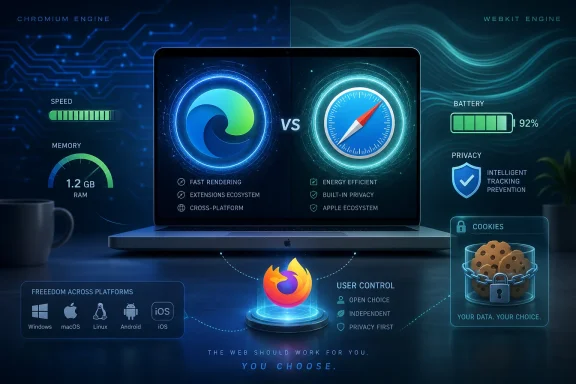 Edge on a Mac Is No Longer a Contradiction
The original joke worked because it leaned on an old instinct: Apple users use Safari, Windows users tolerate Edge, and anyone mixing the two must be doing something perverse. That instinct belongs to a different internet. The modern browser is no longer merely the program that opens web pages; it is a sync service, a password manager, an enterprise policy endpoint, an extension platform, an identity layer, and increasingly an AI front end.In that world, Microsoft Edge on macOS is not strange. It is a Chromium browser with Microsoft account integration, enterprise controls, support for many Chrome-compatible extensions, and enough performance work behind it to make it a plausible daily driver. For Mac users who live in Microsoft 365, Teams, SharePoint, Outlook, Entra ID, and managed corporate environments, Edge can be the path of least resistance rather than an act of brand betrayal.
The surprise in the X debate was not that some people mocked Edge. Mocking Edge is practically a browser-war reflex, inherited from decades of Internet Explorer jokes and reinforced by Microsoft’s sometimes exhausting attempts to push Edge inside Windows. The surprise was how many Mac users answered with practical reasons rather than tribal ones.
Some said Edge felt faster than Chrome. Others said it handled memory better. Some pointed to work requirements, internal sites, certificates, or security policies that assume Edge is present. That is the boring explanation, and boring explanations are often the real ones.
The Mac has become a serious enterprise machine, not just a designer’s workstation or a developer’s Unix laptop with a better screen. Once Macs are enrolled, managed, audited, and integrated into the same identity and compliance stack as Windows PCs, the browser stops being a lifestyle accessory. It becomes another controllable surface.
Safari Wins the Home-Field Advantage, but Not the Whole Game
Safari remains Apple’s strongest browser argument because it is not just an app sitting on macOS. It is part of the operating system’s rhythm. Apple can optimize Safari against its own hardware, its own media stack, its own power-management assumptions, and its own ecosystem services in a way no rival can fully match.That matters. On a MacBook, battery life is not a benchmark vanity metric; it is the difference between getting through a flight or hunting for an outlet. Safari’s deep WebKit integration gives Apple a credible claim to superior efficiency and smoothness on its own machines. If your computing life begins and ends inside Apple’s garden, Safari is a rational default.
But the same integration that makes Safari feel native also makes it less compelling for users who do not live entirely inside that garden. Safari exists on macOS, iOS, and iPadOS, but not on Windows or Linux. That instantly complicates life for anyone who crosses between a MacBook and a Windows desktop, a corporate PC and a personal iPhone, or a Linux workstation and an iPad.
Apple’s browser strategy has always been inseparable from Apple’s platform strategy. Safari is excellent at making Apple devices feel like one coherent organism. It is less interested in being the neutral layer across everybody else’s hardware.
That is not a flaw from Apple’s perspective. It is the point. Safari is a browser, but it is also an argument for staying inside Apple’s ecosystem.
Microsoft Has Rebuilt Edge Into Something Users Can Defend
Edge’s rehabilitation is one of the stranger turns in browser history. Microsoft went from the company that turned Internet Explorer into a cautionary tale to the company shipping a capable Chromium browser that many users grudgingly admit is good. The Chromium rebuild stripped away much of the technical isolation that doomed the old EdgeHTML version and gave Microsoft a browser with broad site compatibility almost overnight.That compatibility is central to why Edge has a real constituency on Mac. The web is largely tested against Chromium because Chrome is dominant, and Edge benefits from that gravitational pull. A site that behaves in Chrome will usually behave in Edge, while users still get Microsoft-specific features layered on top.
That is not a trivial proposition. For users who dislike Chrome’s resource profile or Google’s data appetite but still need Chromium compatibility, Edge can look like a compromise with fewer sacrifices. It gives them the web’s de facto standard engine without fully surrendering to Google’s browser.
Microsoft has also invested heavily in performance features such as sleeping tabs and energy-saving modes. These are the kind of features that sound minor until you are working with 40 tabs, a video call, a document editor, and a laptop fan that sounds like a drone. Browser efficiency has become a user-experience feature, not just an engineering footnote.
Still, Edge carries Microsoft’s baggage. On Windows, Microsoft has often promoted Edge in ways that feel less like persuasion and more like pressure. Default-browser prompts, search nudges, and system-level integration have trained many users to distrust even good Edge features because they arrive wrapped in Microsoft’s growth tactics.
That is the irony of Edge on Mac. Away from Windows, where Microsoft cannot lean as heavily on operating-system defaults, Edge has to compete more honestly. On macOS, people who install Edge usually have a reason. That makes their defense of it more credible.
Chrome’s Shadow Is the Debate Nobody Escapes
The Edge-versus-Safari argument looks like a Microsoft-and-Apple story, but Google is the absent giant in the room. Chrome’s dominance reshaped the web so thoroughly that even Microsoft chose Chromium rather than continue fighting with its own engine. Many alternative browsers now compete less by challenging Chrome’s technical foundation than by repackaging it with different defaults, policies, privacy claims, and ecosystem hooks.That reality makes Edge’s success more complicated. Edge may be better than Chrome for many users in memory management, enterprise administration, or Microsoft integration, but it still reinforces Chromium’s centrality. Every user who chooses Edge over Safari or Firefox may be escaping Google’s browser, but not necessarily Google’s browser engine monoculture.
For web developers, Chromium dominance can be convenient. One engine target reduces testing pain and makes bugs easier to reproduce. For the open web, that convenience has a cost. When too much of the web is built around one rendering engine’s behavior, standards become less like shared rules and more like descriptions of what Chromium already does.
This is where Firefox matters beyond personal preference. Mozilla’s browser is not just another user interface around Chromium. It represents an independent engine, an independent governance model, and an independent set of priorities. In a browser market increasingly organized around Chrome and Chrome-derived alternatives, that independence is not nostalgia. It is infrastructure.
Safari also provides engine diversity through WebKit, but its practical reach is constrained by Apple’s platform boundaries. Firefox is the cross-platform independent browser that still tries to meet users wherever they are. That combination is rarer than it should be.
Firefox Is the Browser for People Who Refuse the Ecosystem Trap
The strongest case for Firefox is not that it wins every benchmark or ships every trendy feature first. It does not. The strongest case is that Firefox remains the best browser for users who want a consistent, privacy-forward, cross-platform experience without turning their browser into a loyalty pledge to Apple, Google, or Microsoft.That distinction matters more in 2026 than it did when browser choice mostly meant arguing about speed. Today, browsers mediate identity, payments, passwords, notifications, profiles, extensions, AI assistants, shopping tools, and anti-tracking systems. A browser is where the operating system, the ad industry, the enterprise, and the user all collide.
Firefox’s advantage is philosophical as much as technical. Mozilla has spent years positioning privacy not as a premium add-on, but as a default expectation. Features such as Total Cookie Protection and Enhanced Tracking Protection are not perfect shields, but they reflect a browser built around limiting cross-site tracking rather than monetizing behavioral knowledge.
That is why long-term Firefox users often sound less like fans and more like holdouts. They are not necessarily claiming that every page loads faster or every interface decision is superior. They are saying that the browser’s center of gravity is closer to the user than to an advertising business, a hardware ecosystem, or a productivity suite.
Firefox also handles the cross-device problem without demanding that every device come from the same vendor. A user can run Firefox on macOS, Windows, Linux, Android, and iOS, sync tabs and bookmarks, and keep a familiar workflow across machines. Apple can do that beautifully inside Apple’s world. Firefox does it across the messy world people actually inhabit.
Privacy Is Not a Checkbox When the Browser Is the Business Model
Every major browser now talks about privacy. That is partly because users care, partly because regulators care, and partly because “privacy” has become a necessary marketing word in a world where everyone knows they are being watched. But browser privacy claims are not equal, because browser business models are not equal.Google’s Chrome problem is obvious: it is made by the company most closely associated with web advertising and behavioral data. Chrome can and does include security and privacy features, but its parent company’s incentives are impossible to ignore. Users do not need to believe in a cartoon villain version of Google to understand the tension.
Microsoft’s incentives are different but still complex. Edge supports enterprise management, Microsoft account services, Copilot integration, Bing, shopping features, sidebar tools, and a growing set of services that make the browser feel like a portal into Microsoft’s commercial universe. Some users like that. Others see clutter and telemetry dressed as convenience.
Apple’s privacy pitch is stronger, but Safari’s privacy posture is tied to Apple’s larger ecosystem strategy. Apple can use privacy as both a user benefit and a competitive moat. Its browser helps make the iPhone, iPad, and Mac feel safer and more coherent, but the price is that the best experience remains Apple-shaped.
Mozilla is not free from financial realities; no browser maker is. But Firefox’s privacy posture is less entangled with selling ads, hardware lock-in, or office-suite adoption. That gives its claims a different texture. They sound less like a feature battle and more like an institutional purpose.
This does not mean Firefox is magically private in all situations. Users can still install bad extensions, log into tracking-heavy services, disable protections, or identify themselves through ordinary behavior. But Firefox starts from a better premise: the browser should reduce tracking by default instead of making the user hunt for escape hatches.
Enterprise IT Understands Why Edge Keeps Showing Up
For WindowsForum readers, the most revealing part of the Edge-on-Mac debate may be the number of users who cited work. That is where browser ideology meets operational reality. In managed environments, the “best” browser is often the one that can be configured, patched, audited, and supported with the least friction.Edge has a strong hand there. Microsoft can tie browser management into the same administrative world many organizations already use for Windows, Microsoft 365, identity, compliance, and endpoint security. Even on macOS, that matters. A browser that works cleanly with enterprise policy is easier to bless than a browser that makes every exception feel handcrafted.
Safari can be managed too, especially in Apple-focused environments, but it does not solve the cross-platform browser standardization problem for organizations with mixed fleets. Chrome solves that problem but introduces Google’s ecosystem. Edge gives Microsoft-centric organizations a Chromium-compatible browser that feels aligned with the stack they already pay for.
Firefox has historically been respected by technical users, but enterprises often choose defaults that reduce support complexity rather than maximize philosophical independence. Mozilla offers enterprise policy support, but it lacks the same gravitational pull Microsoft enjoys in organizations already standardized around Entra ID, Intune, Defender, and Microsoft 365. In IT, integration often beats affection.
That is why Edge on a Mac is not weird in the office. It is predictable. The company bought the Microsoft stack, the browser fits the stack, and the Mac is just another endpoint.
But the enterprise argument should not be confused with the personal-computing argument. What makes sense for a managed fleet does not automatically define the best browser for an individual user. Corporate convenience and user autonomy often overlap, but they are not the same thing.
The Browser War Has Become a War Over Defaults
The old browser wars were loud because the stakes were visible. Internet Explorer, Netscape, Firefox, Chrome, and Safari competed over speed, standards, tabs, pop-up blocking, extensions, and rendering accuracy. Users could feel the differences immediately because the web itself was rougher.The new browser war is quieter and more structural. It is fought through defaults, sync prompts, account sign-ins, preinstalled apps, search deals, mobile platform rules, enterprise policies, and subtle nudges that shape behavior before users make an explicit choice. The best browser does not always win. The most conveniently placed browser often does.
Microsoft knows this. Apple knows this. Google practically wrote the modern playbook. Browser share is not just earned through affection; it is accumulated through operating-system placement, ecosystem reinforcement, and the cost of switching.
That is why the viral Edge-on-Mac exchange struck a nerve. It exposed how much browser identity is still tied to platform identity, even as real usage has become more fluid. A Mac user running Edge violates an old mental model. A Windows user running Firefox violates a different one. A developer running three browsers at once violates none; they are simply living in reality.
For power users, the right response is not to swap one default religion for another. It is to ask what the browser is optimizing for. Safari optimizes for Apple integration. Edge optimizes for Microsoft integration plus Chromium compatibility. Chrome optimizes for Google’s web. Firefox optimizes, imperfectly but meaningfully, for the user and the open web.
That is the real comparison.
Firefox’s Weaknesses Are Real, but They Are Not Fatal
A serious defense of Firefox has to admit where it struggles. Some sites still behave as if Chromium is the only browser that matters. Some web apps are tested less thoroughly in Firefox. Some users find Chromium extension compatibility more convenient. Others simply prefer the feel of Safari on a Mac or Edge inside a Microsoft-heavy workflow.Firefox also lacks the marketing muscle of its largest competitors. Google can push Chrome through search, Android, Workspace, and relentless brand recognition. Microsoft can place Edge inside Windows and court enterprise admins. Apple can make Safari the default on every iPhone and Mac. Mozilla has to win in a market where distribution itself is a weapon.
That makes Firefox’s continued relevance more impressive, but also more fragile. Browser diversity depends on users choosing something other than the easiest option. That is a difficult ask in a world where most people do not want to think about browsers at all.
Yet Firefox does not need to be the majority browser to be the most important browser for certain users. It needs to remain credible, modern, secure, and independent. It needs to be good enough that choosing it is not an act of sacrifice. For many users, it already is.
The argument for Firefox is therefore not sentimental. It is strategic. If you care about an internet where one engine does not dictate the shape of the web, where privacy is not merely an ecosystem marketing claim, and where your browser can follow you across platforms without dragging you deeper into a megacorporate stack, Firefox remains the browser to beat.
The Mac Debate Accidentally Made Firefox’s Case
The X debate began as a jab at Edge users on Mac, but it ended up proving something broader: users are no longer satisfied with the browser their operating system hands them. They will use Edge on a Mac if it solves a work problem. They will use Safari if battery life and Apple integration matter most. They will use Chrome if compatibility and Google sync outweigh the downsides.That is healthy. Browser choice should be a real choice, not a costume worn by platform loyalists. The best outcome is not a world where every Mac user picks Safari, every Windows user picks Edge, and every Android user picks Chrome. That is just platform feudalism with nicer icons.
Firefox benefits from that more mature view of browser choice. It asks users to think less about which company made their laptop and more about what kind of web they want to inhabit. It is not the most vertically integrated browser. It is not the most aggressively promoted browser. It is not the browser most likely to be preinstalled in the most advantageous spot.
But it is the browser that most directly resists the idea that your web experience should be an extension of someone else’s ecosystem strategy. That is why the Edge-versus-Safari frame misses the larger point. The real alternative to platform loyalty is not switching from Apple’s browser to Microsoft’s. It is choosing a browser whose best argument is independence.
The Browser Choice Hidden Inside the Edge-on-Mac Pile-On
The practical lesson from the viral debate is not that Edge is secretly bad or Safari is secretly obsolete. It is that browser choice has become contextual, and users should be honest about the context they are choosing for.- Edge on macOS makes sense for users who need Chromium compatibility, Microsoft 365 integration, enterprise policy support, or a less Google-centric alternative to Chrome.
- Safari remains the strongest choice for users who live entirely inside Apple’s ecosystem and prioritize battery life, native integration, and platform polish.
- Chrome remains hard to avoid because many sites and workflows assume Chromium first, but its dominance is precisely why alternatives matter.
- Firefox is still the best fit for users who want cross-platform continuity without handing their browser life to Apple, Google, or Microsoft.
- The healthiest browser market is one where users choose based on values and use cases, not operating-system tribalism.
References
- Primary source: TechRadar
Published: 2026-06-29T12:12:12.215748
'The best browser for Macs': Some Mac users are surprisingly defending Microsoft Edge, but here's why I use Firefox instead of both | TechRadar
What’s the best web browser today?www.techradar.com - Related coverage: windowslatest.com
Microsoft Edge claps back at users mocking Mac usage, calls itself the best browser
Microsoft Edge called itself "best freakin' browser" after Mac user mocked it on X, and surprisingly, hundreds of replies agree, with reasons www.windowslatest.com
- Official source: apple.com
Safari - Apple
Safari is the world’s fastest browser. Enjoy more third-party extensions, powerful privacy protections, and industry-leading battery life.www.apple.com - Official source: learn.microsoft.com
Microsoft Edge Browser Policy Documentation EfficiencyMode | Microsoft Learn
Windows and Mac documentation for supported Microsoft Edge Browser policy: Configure when energy saver (previously named efficiency mode) should become activelearn.microsoft.com - Official source: support.microsoft.com
Learn about performance features in Microsoft Edge | Microsoft Support
Learn about performance features in Microsoft Edge, such as sleeping tabs, efficiency mode, and performance detector.support.microsoft.com - Official source: blog.mozilla.org
Firefox Rolls Out Total Cookie Protection By Default
With Total Cookie Protection by default, Firefox is now the most private and secure major browser available across Windows and Mac.blog.mozilla.org
- Related coverage: techrepublic.com
Running Microsoft Edge on a Mac: The pros and cons - TechRepublic
Mac users have many choices when it comes to selecting a Web browser. But is Microsoft Edge worth the download? Erik Eckel explores just how well Microsoft Edge serves Mac users.www.techrepublic.com
- Official source: support.mozilla.org
Firefox privacy and security features | Firefox Help
Check Firefox's most advanced features and settings for safe, private online browsing. support.mozilla.org
- Related coverage: firefox.com
Protection — Firefox.com
 www.firefox.com
- Related coverage: scscc.club
</rdf:Alt> </dc:title> <dc:description> <rdf:Alt> <rdf:li xml:lang="x-default"/> </rdf:Alt> </dc:description> <dc:creator> <rdf:Seq> <rdf:li>Microso
</rdf:Alt> </dc:description> <dc:creator> <rdf:Seq> <rdf:li>Microsoft Accountwww.scscc.club
- Official source: cdn-dynmedia-1.microsoft.com
