

EPC Group said on June 1, 2026, that it has been named a Leader in G2’s Summer 2026 Grid Report for Business Intelligence Consulting Providers, marking the Houston Microsoft consultancy’s sixth consecutive quarterly Leader designation in the BI consulting category. The announcement is, on its surface, another vendor award release in a market full of them. But the timing matters because Microsoft’s analytics stack has moved from a familiar Power BI-centered world into a Fabric-and-Copilot era where consulting claims are harder to separate from operational reality. EPC Group is using the badge to argue that governed analytics, not dashboard production, is now the center of the BI services market.
The most interesting thing about EPC Group’s sixth straight G2 Leader designation is not the badge itself. It is the way the company frames the recognition as proof that BI consulting has become a full-stack governance problem.
For years, Power BI consulting was often sold in the language of reports, dashboards, DAX optimization, and executive visibility. Those things still matter, and EPC Group’s announcement leans heavily on them. But the firm is now putting Microsoft Fabric, OneLake, lakehouse architecture, Dataflow Gen2 migration, semantic model certification, and AI orchestration into the same commercial package.
That shift tracks the broader movement in Microsoft’s data strategy. Microsoft Fabric became generally available in November 2023, bringing Power BI, Data Factory, Synapse-style analytics, Real-Time Intelligence, and OneLake into a single SaaS analytics platform. Microsoft’s pitch was not simply that users would get another BI tool; it was that the seams between ingestion, storage, modeling, governance, and reporting would be reduced.
That is exactly the terrain where consultants either become more valuable or more exposed. A Power BI report can be visually impressive and still rest on weak lineage, brittle refreshes, unclear ownership, and insecure access patterns. Fabric raises the stakes because the BI layer is now closer to the data engineering layer, the governance layer, and the AI layer than many organizations are prepared to manage.
EPC Group’s announcement understands that. The company is not merely saying it builds dashboards. It is saying it can help enterprises survive Microsoft’s analytics consolidation without losing control of the data estate.
That is the traditional work, and for many organizations it is still where the pain is most visible. Executives complain about slow reports. Analysts complain about duplicated measures. Security teams complain that business users have built workspaces with unclear permissions. Finance teams complain that two dashboards disagree about revenue.
But the center of gravity is moving. In a Fabric environment, the dashboard is only the visible tip of a much larger stack. The quality of the Power BI experience depends on lakehouse design, workspace strategy, capacity governance, semantic model discipline, data product ownership, and whether the organization can distinguish certified truth from experimental noise.
That is why EPC Group’s emphasis on Fabric consulting is more than marketing adjacency. The firm is positioning itself around OneLake architecture, Direct Lake configuration, lakehouse and warehouse design, deployment pipelines, and migration from legacy dataflow patterns. Those are not decorative add-ons; they are the practical plumbing that determines whether Microsoft’s unified analytics story works in production.
The uncomfortable reality for many Microsoft customers is that Power BI adoption often grew faster than governance. Departments bought licenses, built reports, shared datasets, and created shadow analytical systems because the tool was accessible. Fabric asks those same organizations to take a more integrated approach, and that means revisiting choices they made when “just build the report” was good enough.
That is where EPC Group’s announcement is most clearly aimed at enterprise buyers. The firm is selling not only implementation capacity but a model of control. It references capacity governance, workspace policy, certified semantic models, audit-ready lineage, and Microsoft Purview integration as part of its business intelligence practice.
For WindowsForum readers who sit closer to infrastructure and administration than marketing, those phrases are worth slowing down over. Fabric is not just an analytics product that happens to live in Microsoft’s cloud. It is a platform that touches identity, compliance, storage, licensing, tenant administration, and data movement. The people who own the dashboards are not always the same people who own those risks.
The migration path from old BI habits to Fabric-native architecture is therefore not a simple upgrade. It is a governance negotiation. Who can create workspaces? Who owns semantic models? Which data products are certified? Which workloads consume capacity? Which business units pay for that capacity? Which AI features are allowed to touch regulated data?
A services firm that can answer those questions is doing more than Power BI consulting. It is performing platform architecture under the banner of BI.
This is where the press release shifts from a conventional consulting award story into a more revealing snapshot of the enterprise AI market. Customers do not merely want dashboards anymore. They want to ask plain-English questions of governed business data and receive explanations, summaries, anomaly narratives, and executive briefings without manually clicking through filters.
The appeal is obvious. A regional sales leader should not need to understand the difference between a visual-level filter and a model-level relationship to ask why margin dropped in a territory. A compliance officer should not need to hunt through workspace metadata to understand where protected health information appears. A CFO should not need to wait three days for an analyst to convert a dashboard into a board-ready narrative.
But this is also where BI gets dangerous. Natural language makes analytics feel easier, but it can conceal the machinery behind the answer. If the model is wrong, if permissions are misapplied, if lineage is incomplete, or if an AI system summarizes beyond the data it is allowed to see, the friendly interface becomes a liability.
EPC Group is trying to preempt that objection by tying its AI story to governance. The company says sensitivity labels, row-level security, audit lineage, and Microsoft Purview remain part of the architecture. That is the correct answer on paper. The harder question is whether enterprises can validate those controls continuously across multiple AI models, multiple data domains, and a changing Microsoft roadmap.
This is a point many organizations will learn the hard way. A human analyst can sometimes spot that “customer,” “account,” and “tenant” mean different things in different systems. A language model may produce a confident answer unless the semantic layer is designed to constrain interpretation. The more natural the interface becomes, the more important the underlying definitions become.
EPC Group’s language about certified semantic models is therefore not incidental. In a Copilot-driven analytics environment, certification is not just a badge inside Power BI. It is part of the trust boundary. It tells users and AI systems which models represent sanctioned business logic and which are exploratory.
That distinction matters because the future of BI is conversational. Users will increasingly expect to ask for trends, exceptions, explanations, and forecasts in plain English. If the underlying model is a mess, Copilot does not magically turn it into truth. It simply gives the mess a better user interface.
This is the paradox of AI in business intelligence. The front end becomes more forgiving, while the back end becomes less tolerant of ambiguity. Consultants that understand that paradox will have a market. Consultants that treat AI as a chatbot bolted onto reports will create expensive confusion.
That distinction matters because vendor award language can flatten the difference between reputation and capability. A Leader designation tells buyers that a provider has earned enough favorable market feedback to stand out in the category. It does not tell a CIO whether the provider can secure a Fabric deployment in a regulated environment, rationalize a broken semantic layer, or build an AI interface that survives audit scrutiny.
EPC Group’s sixth consecutive quarter as a Leader is still meaningful. Consistency across multiple quarters suggests the company is not benefiting from a one-off burst of reviews or a transient campaign. It also suggests that customers are willing to associate the firm with business intelligence outcomes over time.
But the award should be read as the beginning of evaluation, not the end. Enterprise buyers should still ask for reference architectures, security documentation, migration plans, Purview integration details, capacity modeling assumptions, and examples of how the firm handles failure modes. In the Fabric era, the best question is not “Can you build this dashboard?” It is “Can you prove this environment will remain governed after go-live?”
EPC Group appears to understand that expectation. Its announcement repeatedly returns to governance, auditability, and security. That repetition is a tell: the firm knows the BI consulting market is no longer won by screenshots alone.
Most companies are not structured like Microsoft’s product diagram. BI teams sit in finance or analytics. Data engineers sit in IT or a data office. Security teams own identity and compliance. Business units own reporting requirements. Procurement owns licensing. Legal owns data risk. Nobody owns the whole thing until something breaks.
Fabric forces those groups into the same room. A lakehouse decision can affect Power BI performance. A capacity decision can affect cost and adoption. A Purview decision can affect AI readiness. An Entra ID decision can affect who sees what in a report. A semantic model decision can affect whether Copilot gives useful answers.
That is why consulting firms are trying to sell operating models, not just project plans. EPC Group’s release mentions named owners, control cadences, and board-ready reporting. Those phrases may sound like consulting boilerplate, but they point to a genuine problem. The technology can unify the stack; it cannot automatically unify the organization.
For IT pros, this is where the practical stakes live. The failure mode is not that Fabric will be unusable. The failure mode is that it will be adopted piecemeal, with premium capacity bills rising, duplicate data products multiplying, AI features enabled without clear policy, and administrators left to impose order after business teams have already built dependencies.
Dataflows have long been one of those underappreciated pieces of the Power BI ecosystem. They let teams centralize transformation logic and reuse prepared data across reports. In many organizations, they became a lightweight ETL layer built by analysts who did not want to wait for a central data engineering backlog.
Fabric changes the context. Dataflow Gen2 aligns with the newer platform direction, but migration is not always a trivial find-and-replace exercise. Refresh behavior, licensing requirements, workspace configuration, capacity planning, downstream dependencies, and governance expectations can all change the project scope.
This is precisely the sort of work that creates consulting demand. Legacy BI estates rarely advertise their complexity. It hides in refresh schedules, undocumented M queries, shared datasets, personal workspaces, gateway configurations, and reports that nobody wants to own but everyone still uses.
A consulting firm that can inventory those dependencies and move them into a governed Fabric architecture has a clearer value proposition than a firm that simply promises “modern analytics.” EPC Group is trying to claim that ground. Whether customers experience that as a smooth modernization or an expensive reckoning will depend on how honestly the existing estate is assessed before migration begins.
In regulated environments, the question is not whether a natural-language interface can produce a useful answer. The question is whether the organization can prove who asked, what data was accessed, which model was used, which controls applied, what answer was generated, and whether the answer stayed within policy. That is a much higher bar than a dashboard prototype.
Microsoft Purview, sensitivity labels, row-level security, object-level security, audit logs, and lineage features are all part of the answer. But tools are not the same as governance. Somebody has to design the taxonomy, define ownership, map regulatory requirements, test permissions, certify models, monitor drift, and respond when users find creative ways to ask risky questions.
This is where EPC Group’s “Governed AI on Microsoft Framework” becomes the most commercially important part of the announcement. The name is less important than the claim: that the firm can connect Microsoft Purview, Fabric, Power BI, Microsoft 365, Entra ID, Copilot, and Defender into one operating approach for analytics and AI.
That is a compelling pitch because enterprise AI has moved beyond experimentation. The first wave was about proving that generative AI could summarize, draft, and answer. The next wave is about proving that it can do so inside the rules of enterprise data governance. BI is one of the hardest tests because business data is both valuable and politically contested.
The company says it was founded in 1997 and positions itself as a long-running Microsoft consultancy with deep Power BI and SharePoint roots. It also emphasizes founder Errin O’Connor’s Microsoft Press authorship, NASA architecture background, and participation in Microsoft beta programs. Those details are not random biography. They are trust signals aimed at buyers wary of AI-era opportunism.
That wariness is justified. The market is full of firms that discovered “AI consulting” as soon as budgets appeared. Many can build a prototype. Fewer can explain how identity, data classification, audit logging, model routing, and semantic governance interact under enterprise pressure.
EPC Group’s advantage, if the claims hold, is that it can connect the older Microsoft consulting world to the new AI analytics world. SharePoint governance, Power BI adoption, Microsoft 365 identity, Fabric architecture, and Copilot readiness are not separate conversations anymore. They are increasingly one conversation about how work, data, and AI meet inside the Microsoft cloud.
That does not mean EPC Group’s approach is the only viable one. Large systems integrators, boutique Fabric specialists, and internal data teams will all compete for the same work. But the G2 recognition gives EPC Group a customer-sentiment credential at a moment when buyers are trying to distinguish mature Microsoft practices from AI rebranding exercises.
For two decades, dashboards were treated as the destination: gather requirements, build visuals, publish reports, iterate. The dashboard was where business users went to understand performance. It was also where many BI projects stalled, because users still needed to know what to click, what to filter, and how to interpret what they saw.
AI changes that relationship. The report becomes a structured evidence base that a conversational interface can query, summarize, and explain. Visuals still matter, but they are no longer the only way users consume insight. A user may begin with a question and receive a narrative, a chart, a filtered report page, and a suggested follow-up path.
That sounds like progress, and in many cases it will be. But it also means BI teams must design for machine interpretation as well as human interpretation. Measure names, descriptions, synonyms, hierarchies, relationships, sensitivity labels, and lineage metadata become part of the user experience. Sloppy models will not merely confuse analysts; they will confuse the AI layer.
This is the next frontier of Power BI consulting. The winning firms will not just make reports look good. They will make analytical environments legible to humans, machines, auditors, and administrators at the same time.
EPC Group’s announcement is therefore less a victory lap than a marker of where the Microsoft data market is heading. The next phase of Power BI and Fabric adoption will reward firms that can make governance feel enabling rather than punitive, and it will punish organizations that confuse AI convenience with analytical trust. For Windows and Microsoft shops, the message is clear: the dashboard era is not ending, but it is being absorbed into something broader, more automated, and much less forgiving of weak foundations.
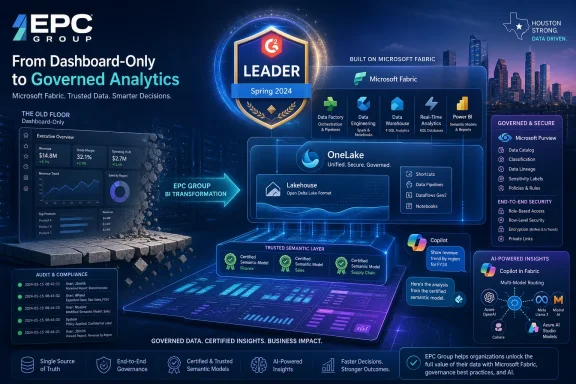 A Badge Becomes a Proxy for the Fabric Transition
The most interesting thing about EPC Group’s sixth straight G2 Leader designation is not the badge itself. It is the way the company frames the recognition as proof that BI consulting has become a full-stack governance problem.For years, Power BI consulting was often sold in the language of reports, dashboards, DAX optimization, and executive visibility. Those things still matter, and EPC Group’s announcement leans heavily on them. But the firm is now putting Microsoft Fabric, OneLake, lakehouse architecture, Dataflow Gen2 migration, semantic model certification, and AI orchestration into the same commercial package.
That shift tracks the broader movement in Microsoft’s data strategy. Microsoft Fabric became generally available in November 2023, bringing Power BI, Data Factory, Synapse-style analytics, Real-Time Intelligence, and OneLake into a single SaaS analytics platform. Microsoft’s pitch was not simply that users would get another BI tool; it was that the seams between ingestion, storage, modeling, governance, and reporting would be reduced.
That is exactly the terrain where consultants either become more valuable or more exposed. A Power BI report can be visually impressive and still rest on weak lineage, brittle refreshes, unclear ownership, and insecure access patterns. Fabric raises the stakes because the BI layer is now closer to the data engineering layer, the governance layer, and the AI layer than many organizations are prepared to manage.
EPC Group’s announcement understands that. The company is not merely saying it builds dashboards. It is saying it can help enterprises survive Microsoft’s analytics consolidation without losing control of the data estate.
Power BI Is No Longer the Whole Story
Power BI remains the most recognizable name in Microsoft analytics, and EPC Group’s release still treats it as the front door. The company points to dashboarding, semantic model design, DAX optimization, row-level security, object-level security, deployment pipelines, and Power BI Center of Excellence frameworks as core services.That is the traditional work, and for many organizations it is still where the pain is most visible. Executives complain about slow reports. Analysts complain about duplicated measures. Security teams complain that business users have built workspaces with unclear permissions. Finance teams complain that two dashboards disagree about revenue.
But the center of gravity is moving. In a Fabric environment, the dashboard is only the visible tip of a much larger stack. The quality of the Power BI experience depends on lakehouse design, workspace strategy, capacity governance, semantic model discipline, data product ownership, and whether the organization can distinguish certified truth from experimental noise.
That is why EPC Group’s emphasis on Fabric consulting is more than marketing adjacency. The firm is positioning itself around OneLake architecture, Direct Lake configuration, lakehouse and warehouse design, deployment pipelines, and migration from legacy dataflow patterns. Those are not decorative add-ons; they are the practical plumbing that determines whether Microsoft’s unified analytics story works in production.
The uncomfortable reality for many Microsoft customers is that Power BI adoption often grew faster than governance. Departments bought licenses, built reports, shared datasets, and created shadow analytical systems because the tool was accessible. Fabric asks those same organizations to take a more integrated approach, and that means revisiting choices they made when “just build the report” was good enough.
Fabric Turns BI Consulting Into Platform Architecture
Microsoft Fabric’s promise is elegant: one data lake, one security model, one set of integrated workloads, and a smoother path from raw data to business insight. In practice, that elegance depends on architecture. A badly governed Fabric tenant can become just as chaotic as the fragmented systems it was supposed to replace.That is where EPC Group’s announcement is most clearly aimed at enterprise buyers. The firm is selling not only implementation capacity but a model of control. It references capacity governance, workspace policy, certified semantic models, audit-ready lineage, and Microsoft Purview integration as part of its business intelligence practice.
For WindowsForum readers who sit closer to infrastructure and administration than marketing, those phrases are worth slowing down over. Fabric is not just an analytics product that happens to live in Microsoft’s cloud. It is a platform that touches identity, compliance, storage, licensing, tenant administration, and data movement. The people who own the dashboards are not always the same people who own those risks.
The migration path from old BI habits to Fabric-native architecture is therefore not a simple upgrade. It is a governance negotiation. Who can create workspaces? Who owns semantic models? Which data products are certified? Which workloads consume capacity? Which business units pay for that capacity? Which AI features are allowed to touch regulated data?
A services firm that can answer those questions is doing more than Power BI consulting. It is performing platform architecture under the banner of BI.
The AI Layer Is the New Sales Pitch—and the New Risk Surface
EPC Group’s announcement makes its boldest move when it describes “Multi-Model AI” layered on top of Power BI and Microsoft Fabric. The company says it combines Microsoft Copilot for Power BI with additional large language models such as Claude, ChatGPT, Perplexity, and Gemini, routed through an orchestration layer depending on the task.This is where the press release shifts from a conventional consulting award story into a more revealing snapshot of the enterprise AI market. Customers do not merely want dashboards anymore. They want to ask plain-English questions of governed business data and receive explanations, summaries, anomaly narratives, and executive briefings without manually clicking through filters.
The appeal is obvious. A regional sales leader should not need to understand the difference between a visual-level filter and a model-level relationship to ask why margin dropped in a territory. A compliance officer should not need to hunt through workspace metadata to understand where protected health information appears. A CFO should not need to wait three days for an analyst to convert a dashboard into a board-ready narrative.
But this is also where BI gets dangerous. Natural language makes analytics feel easier, but it can conceal the machinery behind the answer. If the model is wrong, if permissions are misapplied, if lineage is incomplete, or if an AI system summarizes beyond the data it is allowed to see, the friendly interface becomes a liability.
EPC Group is trying to preempt that objection by tying its AI story to governance. The company says sensitivity labels, row-level security, audit lineage, and Microsoft Purview remain part of the architecture. That is the correct answer on paper. The harder question is whether enterprises can validate those controls continuously across multiple AI models, multiple data domains, and a changing Microsoft roadmap.
Copilot Makes the Semantic Model More Important, Not Less
The rise of Copilot in Power BI and Fabric does not eliminate the need for disciplined semantic modeling. It increases it. AI is only as useful as the governed definitions it can rely on.This is a point many organizations will learn the hard way. A human analyst can sometimes spot that “customer,” “account,” and “tenant” mean different things in different systems. A language model may produce a confident answer unless the semantic layer is designed to constrain interpretation. The more natural the interface becomes, the more important the underlying definitions become.
EPC Group’s language about certified semantic models is therefore not incidental. In a Copilot-driven analytics environment, certification is not just a badge inside Power BI. It is part of the trust boundary. It tells users and AI systems which models represent sanctioned business logic and which are exploratory.
That distinction matters because the future of BI is conversational. Users will increasingly expect to ask for trends, exceptions, explanations, and forecasts in plain English. If the underlying model is a mess, Copilot does not magically turn it into truth. It simply gives the mess a better user interface.
This is the paradox of AI in business intelligence. The front end becomes more forgiving, while the back end becomes less tolerant of ambiguity. Consultants that understand that paradox will have a market. Consultants that treat AI as a chatbot bolted onto reports will create expensive confusion.
G2 Recognition Is Useful, but It Is Not an Audit
G2’s Grid reports are built around verified user reviews and market presence indicators. That makes them useful as a signal of customer sentiment and visibility. It does not make them a substitute for technical diligence.That distinction matters because vendor award language can flatten the difference between reputation and capability. A Leader designation tells buyers that a provider has earned enough favorable market feedback to stand out in the category. It does not tell a CIO whether the provider can secure a Fabric deployment in a regulated environment, rationalize a broken semantic layer, or build an AI interface that survives audit scrutiny.
EPC Group’s sixth consecutive quarter as a Leader is still meaningful. Consistency across multiple quarters suggests the company is not benefiting from a one-off burst of reviews or a transient campaign. It also suggests that customers are willing to associate the firm with business intelligence outcomes over time.
But the award should be read as the beginning of evaluation, not the end. Enterprise buyers should still ask for reference architectures, security documentation, migration plans, Purview integration details, capacity modeling assumptions, and examples of how the firm handles failure modes. In the Fabric era, the best question is not “Can you build this dashboard?” It is “Can you prove this environment will remain governed after go-live?”
EPC Group appears to understand that expectation. Its announcement repeatedly returns to governance, auditability, and security. That repetition is a tell: the firm knows the BI consulting market is no longer won by screenshots alone.
Microsoft’s Analytics Stack Is Consolidating Faster Than Customers Can Reorganize
The deeper story behind EPC Group’s announcement is Microsoft’s pace. Fabric, Copilot, Power BI, Purview, Entra ID, Defender, and Microsoft 365 are increasingly part of one enterprise control plane. That convergence is strategically coherent, but it is organizationally disruptive.Most companies are not structured like Microsoft’s product diagram. BI teams sit in finance or analytics. Data engineers sit in IT or a data office. Security teams own identity and compliance. Business units own reporting requirements. Procurement owns licensing. Legal owns data risk. Nobody owns the whole thing until something breaks.
Fabric forces those groups into the same room. A lakehouse decision can affect Power BI performance. A capacity decision can affect cost and adoption. A Purview decision can affect AI readiness. An Entra ID decision can affect who sees what in a report. A semantic model decision can affect whether Copilot gives useful answers.
That is why consulting firms are trying to sell operating models, not just project plans. EPC Group’s release mentions named owners, control cadences, and board-ready reporting. Those phrases may sound like consulting boilerplate, but they point to a genuine problem. The technology can unify the stack; it cannot automatically unify the organization.
For IT pros, this is where the practical stakes live. The failure mode is not that Fabric will be unusable. The failure mode is that it will be adopted piecemeal, with premium capacity bills rising, duplicate data products multiplying, AI features enabled without clear policy, and administrators left to impose order after business teams have already built dependencies.
The Dataflow Gen1 Shadow Hangs Over the Migration Story
EPC Group’s announcement references the retirement timeline for Dataflow Gen1 and migration to Dataflow Gen2. That is a small phrase with large implications for Power BI-heavy organizations.Dataflows have long been one of those underappreciated pieces of the Power BI ecosystem. They let teams centralize transformation logic and reuse prepared data across reports. In many organizations, they became a lightweight ETL layer built by analysts who did not want to wait for a central data engineering backlog.
Fabric changes the context. Dataflow Gen2 aligns with the newer platform direction, but migration is not always a trivial find-and-replace exercise. Refresh behavior, licensing requirements, workspace configuration, capacity planning, downstream dependencies, and governance expectations can all change the project scope.
This is precisely the sort of work that creates consulting demand. Legacy BI estates rarely advertise their complexity. It hides in refresh schedules, undocumented M queries, shared datasets, personal workspaces, gateway configurations, and reports that nobody wants to own but everyone still uses.
A consulting firm that can inventory those dependencies and move them into a governed Fabric architecture has a clearer value proposition than a firm that simply promises “modern analytics.” EPC Group is trying to claim that ground. Whether customers experience that as a smooth modernization or an expensive reckoning will depend on how honestly the existing estate is assessed before migration begins.
Regulated Industries Will Decide Whether Governed AI Is Real
EPC Group says it serves sectors including healthcare, financial services, government, manufacturing, energy, education, retail, and federal agencies. That matters because those customers cannot treat AI-powered analytics as a demo feature.In regulated environments, the question is not whether a natural-language interface can produce a useful answer. The question is whether the organization can prove who asked, what data was accessed, which model was used, which controls applied, what answer was generated, and whether the answer stayed within policy. That is a much higher bar than a dashboard prototype.
Microsoft Purview, sensitivity labels, row-level security, object-level security, audit logs, and lineage features are all part of the answer. But tools are not the same as governance. Somebody has to design the taxonomy, define ownership, map regulatory requirements, test permissions, certify models, monitor drift, and respond when users find creative ways to ask risky questions.
This is where EPC Group’s “Governed AI on Microsoft Framework” becomes the most commercially important part of the announcement. The name is less important than the claim: that the firm can connect Microsoft Purview, Fabric, Power BI, Microsoft 365, Entra ID, Copilot, and Defender into one operating approach for analytics and AI.
That is a compelling pitch because enterprise AI has moved beyond experimentation. The first wave was about proving that generative AI could summarize, draft, and answer. The next wave is about proving that it can do so inside the rules of enterprise data governance. BI is one of the hardest tests because business data is both valuable and politically contested.
EPC Group Is Selling Confidence in a Moment of Platform Ambiguity
There is a reason the announcement spends so much time on Microsoft credentials, founder background, and long operating history. EPC Group wants customers to believe it has seen enough Microsoft platform cycles to guide them through the current one.The company says it was founded in 1997 and positions itself as a long-running Microsoft consultancy with deep Power BI and SharePoint roots. It also emphasizes founder Errin O’Connor’s Microsoft Press authorship, NASA architecture background, and participation in Microsoft beta programs. Those details are not random biography. They are trust signals aimed at buyers wary of AI-era opportunism.
That wariness is justified. The market is full of firms that discovered “AI consulting” as soon as budgets appeared. Many can build a prototype. Fewer can explain how identity, data classification, audit logging, model routing, and semantic governance interact under enterprise pressure.
EPC Group’s advantage, if the claims hold, is that it can connect the older Microsoft consulting world to the new AI analytics world. SharePoint governance, Power BI adoption, Microsoft 365 identity, Fabric architecture, and Copilot readiness are not separate conversations anymore. They are increasingly one conversation about how work, data, and AI meet inside the Microsoft cloud.
That does not mean EPC Group’s approach is the only viable one. Large systems integrators, boutique Fabric specialists, and internal data teams will all compete for the same work. But the G2 recognition gives EPC Group a customer-sentiment credential at a moment when buyers are trying to distinguish mature Microsoft practices from AI rebranding exercises.
The Dashboard Is Becoming the Interface, Not the Destination
Perhaps the most revealing line in EPC Group’s announcement is the idea that “the dashboard becomes the floor, not the ceiling.” That phrase captures the direction of the BI market better than most product roadmaps.For two decades, dashboards were treated as the destination: gather requirements, build visuals, publish reports, iterate. The dashboard was where business users went to understand performance. It was also where many BI projects stalled, because users still needed to know what to click, what to filter, and how to interpret what they saw.
AI changes that relationship. The report becomes a structured evidence base that a conversational interface can query, summarize, and explain. Visuals still matter, but they are no longer the only way users consume insight. A user may begin with a question and receive a narrative, a chart, a filtered report page, and a suggested follow-up path.
That sounds like progress, and in many cases it will be. But it also means BI teams must design for machine interpretation as well as human interpretation. Measure names, descriptions, synonyms, hierarchies, relationships, sensitivity labels, and lineage metadata become part of the user experience. Sloppy models will not merely confuse analysts; they will confuse the AI layer.
This is the next frontier of Power BI consulting. The winning firms will not just make reports look good. They will make analytical environments legible to humans, machines, auditors, and administrators at the same time.
What Six Quarters of G2 Leadership Really Signals for Microsoft BI Shops
EPC Group’s sixth consecutive G2 Leader designation is best understood as a market signal rather than a final verdict. It says customers are rewarding firms that can speak across Power BI, Fabric, governance, and AI without treating them as separate sales motions.- EPC Group’s latest recognition lands at a moment when Microsoft BI projects are expanding from report delivery into data platform architecture.
- Microsoft Fabric has made lakehouse design, OneLake strategy, capacity governance, and semantic model certification central to Power BI success.
- Copilot and multi-model AI raise the value of governed semantic models because natural-language analytics depends on trusted business definitions.
- G2 Leader status is a useful customer-sentiment signal, but enterprise buyers still need technical validation, security review, and referenceable implementation detail.
- Dataflow Gen1 migration, Fabric adoption, and AI governance will create real operational work for administrators, not just new dashboard features.
- The firms most likely to matter in this market will be the ones that can connect analytics modernization to identity, compliance, auditability, and cost control.
EPC Group’s announcement is therefore less a victory lap than a marker of where the Microsoft data market is heading. The next phase of Power BI and Fabric adoption will reward firms that can make governance feel enabling rather than punitive, and it will punish organizations that confuse AI convenience with analytical trust. For Windows and Microsoft shops, the message is clear: the dashboard era is not ending, but it is being absorbed into something broader, more automated, and much less forgiving of weak foundations.
References
- Primary source: Weekly Voice
Published: 2026-06-01T13:58:25.487599
EPC Group Named G2 Leader in BI Consulting for 6th Consecutive Quarter
EPC Group Power BI Consulting and Microsoft Fabric Consulting Practice Experts Top G2 Rated in North America EPC Group - Governed AI on Microsoft Framework Consulting Services - EPC Group AI Consul… weeklyvoice.com
- Related coverage: epcgroup.net
EPC Group G2 Leader Recognition for BI | EPC Group
EPC Group earns triple G2 Leader designation for BI Consulting with 4.4/5 G2 rating across 15 verified reviews. 1,500+ Power BI implementations for Fortune 500.www.epcgroup.net - Related coverage: prnewswire.com
Vertice Named No. 1 Procurement Orchestration Platform in G2 Summer 2026 Grid Report
/PRNewswire/ -- Vertice, the AI procurement platform for the modern enterprise, today announced it has been named the No. 1 provider in the Procurement... www.prnewswire.com
