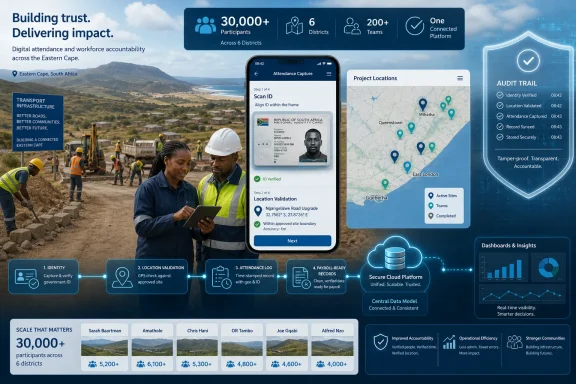
NKUSI IT Siyasebenza announced on June 2, 2026, that EPWP Smart Track, a Microsoft Power Platform-based workforce management system, is now in production with South Africa’s Eastern Cape Department of Transport for more than 30,000 Expanded Public Works Programme participants across six districts. The launch is not merely another low-code customer win for Microsoft’s partner channel. It is a test case for whether public employment administration can be modernized without turning a poverty-relief programme into a surveillance machine. The promise is sharper payroll discipline, faster reporting, and fewer paper trails; the risk is that digitization becomes a substitute for institutional trust rather than a tool for rebuilding it.
For years, Microsoft Power Platform has been marketed as the connective tissue between business users and IT departments: Power Apps for front-end forms, Power Automate for workflow, Dataverse for structured data, and Power BI for dashboards. That pitch often lands in the familiar territory of expense approvals, inspection checklists, field-service forms, and internal reporting. EPWP Smart Track pushes the same ingredients into a more politically charged arena: government employment, attendance, identity, and payment.
That matters because public works programmes are operationally messy by design. They involve large numbers of temporary participants, distributed worksites, local supervisors, paper sign-in sheets, stipend calculations, changing rosters, and reporting obligations that stretch across municipal, provincial, and national layers. A spreadsheet can cope with a pilot project; it starts to buckle when the programme covers tens of thousands of people across geographically dispersed districts.
The Eastern Cape deployment gives Microsoft and NKUSI IT Siyasebenza a story that is more concrete than the usual “digital transformation” abstraction. The system is described as handling attendance management, payroll alignment, and operational oversight for more than 30,000 EPWP participants. If those numbers hold in day-to-day use, EPWP Smart Track is not a departmental convenience app. It is a production workforce system sitting close to the point where attendance records become money.
That proximity is why the platform is significant. In government technology, the boring systems are often the consequential ones. A mobile check-in app that verifies a worker’s identity and location may not sound as glamorous as generative AI, but it has direct consequences for whether a person is marked present, whether a supervisor can defend a claim, whether an administrator can detect anomalies, and whether payroll can be reconciled without weeks of manual cleanup.
Paper-based administration is not just inefficient in that setting. It is a weak control environment. Paper registers can be lost, duplicated, filled in late, disputed, or captured into digital systems after the fact with errors already baked in. The longer the gap between attendance and reporting, the more the system depends on trust in local intermediaries rather than verifiable records.
EPWP Smart Track is designed to collapse that gap. According to the launch material, participants check in through a mobile-first experience built on Power Apps. ID scanning verifies the participant at the site. Azure Maps provides GPS and reverse geocoding so the system can validate that the check-in occurred at a verified job location. Dataverse stores attendance, identity, and site data in real time, while Power Automate moves the record through logging, location validation, and payroll integration.
The architectural point is not that any one of these pieces is novel. Mobile check-ins, geolocation, workflow triggers, and dashboards are standard enterprise software patterns. The novelty is their assembly around a public employment programme where attendance is both a welfare-adjacent entitlement record and an operational management signal. That makes the system a form of civic infrastructure, even if it is built from commercially familiar components.
Power Apps provides the mobile check-in surface. Power Automate handles the “if this, then that” logic between attendance events, validation steps, and downstream payroll systems. Dataverse gives the implementation a governed data layer rather than scattering records across inboxes and spreadsheets. Power BI turns the resulting operational data into dashboards for supervisors and administrators.
In other words, Power Platform’s value here is not low-code as a novelty. It is low-code as a deployment model for institutions that need to move faster than conventional procurement and software development cycles often allow. A provincial department does not necessarily need a bespoke attendance platform written from scratch. It needs a controlled, auditable system that can be configured to match sites, participants, roles, and reporting lines without waiting years for a custom application to mature.
That is the strongest version of Microsoft’s argument. The weaker version is that low-code can become a shortcut around the hard work of systems architecture, data governance, and long-term support. EPWP Smart Track will be judged not by whether a demo works, but by whether it remains reliable when devices fail, network coverage is poor, supervisors change, payroll deadlines arrive, and exceptions outnumber the happy path.
Attendance systems are often politically sensitive because they expose competing claims. Participants want to be paid for work performed. Supervisors want records that reflect operational reality. Administrators want clean data for payroll and reporting. Auditors want a trail that shows who did what, when, where, and under which authority. A useful system must serve all of these interests without quietly privileging the most powerful actor in the chain.
Audit logs can help, but only if they are designed as more than a compliance checkbox. A timestamped check-in tied to an identity record and a geocoded site is stronger evidence than a signature on paper. Yet it also creates new obligations: retention policies, access controls, dispute processes, correction workflows, and clear rules for what happens when the technology fails.
That last point is not theoretical. Field attendance systems encounter dead batteries, damaged phones, intermittent mobile data, incorrect GPS readings, and participants whose documents do not scan cleanly. If the platform treats every exception as suspicious, it risks punishing the very workers the programme is meant to support. If it treats exceptions too loosely, it recreates the weaknesses of the paper process in digital form.
The best public-sector platforms do not pretend exceptions will disappear. They make exceptions visible, bounded, and reviewable. EPWP Smart Track’s success will depend on whether its audit trail supports fair administration as much as fraud prevention.
A digital attendance system can improve payment accuracy by reducing the lag between check-in data and payroll processing. It can also make discrepancies easier to identify before payday rather than after complaints arrive. If attendance records flow through Power Automate into payroll integration steps, administrators have a better chance of catching missing records, duplicate entries, or site-level anomalies early.
But payroll alignment also raises the burden of correctness. Once a system becomes the authoritative source for payment eligibility, errors acquire institutional force. A bad scan, a misconfigured site boundary, or a wrongly assigned participant can move from technical glitch to missed income. That means the governance around EPWP Smart Track must include human appeal paths, not just dashboards.
This is where many digitization projects stumble. They optimize for managerial visibility while underinvesting in participant recourse. A supervisor can see the dashboard; a worker may only see that the payment did not arrive. If the system is to improve trust, it must make the record explainable to those being recorded.
Yet location data is inherently sensitive. Even when used for a narrow operational purpose, it can become tempting to repurpose. A system built to confirm presence at a worksite should not quietly become a broader movement-tracking tool. Public-sector deployments need explicit boundaries around when location is collected, how precise it is, how long it is retained, and who can see it.
The launch material says role-based access control restricts sensitive workforce data to appropriate stakeholders. That is important, and it aligns with the way Dataverse and Power Platform can enforce permissions across environments, tables, rows, and fields. But access control is only one layer. Policy choices still determine whether the platform practices data minimization or merely stores everything because it can.
For administrators, the temptation will be to treat more telemetry as inherently better governance. For participants, the perception may be different. If workers understand that location is captured only at check-in and only to validate attendance at a specific site, the system is easier to justify. If the boundaries are vague, the system risks being seen as surveillance dressed up as efficiency.
That partner-led model is how Microsoft often scales into public-sector niches. The platform vendor supplies the tools, compliance posture, identity stack, data services, and licensing framework. The partner translates those tools into a domain-specific application. The customer gets something more tailored than a generic SaaS product but less risky than building every layer independently.
For the Eastern Cape Department of Transport, the immediate benefit is operational visibility across six districts. For NKUSI IT Siyasebenza, the deployment becomes a reference customer. The company is already engaging other provincial and municipal entities interested in the platform, which suggests EPWP Smart Track is being positioned not as a one-off custom build but as a repeatable public-sector solution.
That raises the obvious scaling question. South Africa’s EPWP is not confined to one department or province. It cuts across sectors and public bodies, with different administrative cultures and local realities. A platform that works in one provincial transport context may need significant configuration elsewhere. The commercial opportunity is real, but so is the implementation risk if expansion outruns institutional readiness.
This is a familiar danger in public administration. Once a dashboard becomes the managerial cockpit, organizations begin optimizing for the dashboard. Attendance becomes a compliance metric. Site performance becomes a color-coded tile. Exceptions become red flags. The messy human reasons behind the data can disappear behind a clean interface.
That does not mean dashboards are bad. In a programme serving more than 30,000 participants, leaders need aggregated visibility. The alternative is not humane nuance; it is often administrative fog. The question is whether the dashboard is treated as a decision-support tool or as a substitute for local judgment.
Good dashboards invite follow-up. Bad dashboards invite punishment. EPWP Smart Track will be most valuable if it helps managers ask better questions: Why is one district showing unusual absenteeism? Are certain sites suffering from transport barriers? Are payroll discrepancies clustered around particular supervisors or workflows? Are participants being excluded because of technical validation failures? Those are governance questions, not merely IT metrics.
The launch also arrives at a time when Microsoft is trying to make its cloud stack feel less abstract. Azure, Dataverse, Power Apps, Power Automate, Power BI, and Azure Maps can sound like a catalog of services until they are tied to a concrete outcome. A workforce platform for a large public employment programme gives the stack a human-scale story: people check in, data is validated, payroll is aligned, supervisors see the picture.
There is a competitive subtext as well. Public-sector cloud adoption is not only about infrastructure hosting. It is about who owns the workflow layer where government employees actually do their jobs. If Power Platform becomes the place where departments build field systems, case management tools, inspection apps, and reporting workflows, Microsoft gains a durable position far above commodity compute.
That position comes with responsibility. The more Microsoft’s platforms mediate public services, the more questions of licensing, data residency, vendor lock-in, accessibility, resilience, and exit planning move from procurement footnotes to democratic concerns. A successful EPWP Smart Track rollout will strengthen Microsoft’s case. A poorly governed one would strengthen critics who argue that public administration is becoming too dependent on proprietary cloud ecosystems.
Training will matter. Supervisors must understand not only how to use the mobile check-in workflow but why the data must be captured correctly. Administrators must understand how to interpret exceptions without turning every anomaly into an accusation. Participants must understand what data is collected and how it affects payment. IT teams must monitor availability, permissions, integrations, and support tickets.
Device strategy will matter too. A mobile-first system can be empowering if field teams have reliable hardware and connectivity. It can become a bottleneck if check-ins depend on too few devices, undertrained operators, or unstable mobile coverage. Rural and semi-rural worksites can expose assumptions that look harmless in a boardroom.
Licensing and lifecycle management will also matter. Power Platform solutions can grow organically, which is both their virtue and their danger. Without disciplined environment management, role assignment, testing, change control, and documentation, a useful low-code solution can become difficult to govern over time. The same speed that makes Power Platform attractive can create technical debt if every urgent change is pushed directly into production.
A fair digital system should reduce opportunities for manipulation while protecting participants from arbitrary exclusion. It should make supervisors more accountable without assuming every supervisor is corrupt. It should give administrators clearer data without pretending data is self-interpreting. It should help payroll run more accurately without making the technology the unchallengeable judge of whether work occurred.
That balance is difficult, but it is achievable. The ingredients described in EPWP Smart Track are sensible: identity verification, verified worksite location, real-time data capture, workflow automation, dashboard reporting, role-based access, and audit logs. The unresolved question is how those ingredients are governed in practice.
The answer will not be found in a launch quote. It will be found in missed-payment disputes, audit reviews, supervisor adoption rates, exception handling, data-access reviews, and whether other provinces and municipalities can deploy the platform without simply copying the software while neglecting the operating model.
 Microsoft’s Low-Code Stack Moves From Office Automation to Public Works Infrastructure
For years, Microsoft Power Platform has been marketed as the connective tissue between business users and IT departments: Power Apps for front-end forms, Power Automate for workflow, Dataverse for structured data, and Power BI for dashboards. That pitch often lands in the familiar territory of expense approvals, inspection checklists, field-service forms, and internal reporting. EPWP Smart Track pushes the same ingredients into a more politically charged arena: government employment, attendance, identity, and payment.That matters because public works programmes are operationally messy by design. They involve large numbers of temporary participants, distributed worksites, local supervisors, paper sign-in sheets, stipend calculations, changing rosters, and reporting obligations that stretch across municipal, provincial, and national layers. A spreadsheet can cope with a pilot project; it starts to buckle when the programme covers tens of thousands of people across geographically dispersed districts.
The Eastern Cape deployment gives Microsoft and NKUSI IT Siyasebenza a story that is more concrete than the usual “digital transformation” abstraction. The system is described as handling attendance management, payroll alignment, and operational oversight for more than 30,000 EPWP participants. If those numbers hold in day-to-day use, EPWP Smart Track is not a departmental convenience app. It is a production workforce system sitting close to the point where attendance records become money.
That proximity is why the platform is significant. In government technology, the boring systems are often the consequential ones. A mobile check-in app that verifies a worker’s identity and location may not sound as glamorous as generative AI, but it has direct consequences for whether a person is marked present, whether a supervisor can defend a claim, whether an administrator can detect anomalies, and whether payroll can be reconciled without weeks of manual cleanup.
The Paper Register Was Always a Governance Problem
The Expanded Public Works Programme is meant to provide income relief, skills development, and temporary work opportunities for unemployed South Africans, including young people, women, and people with disabilities. It is one of those programmes that carries a heavy social mandate while depending on very ordinary administrative routines. Someone must know who showed up, where they showed up, whether the worksite was legitimate, whether the participant was eligible, and whether the stipend record matches the attendance record.Paper-based administration is not just inefficient in that setting. It is a weak control environment. Paper registers can be lost, duplicated, filled in late, disputed, or captured into digital systems after the fact with errors already baked in. The longer the gap between attendance and reporting, the more the system depends on trust in local intermediaries rather than verifiable records.
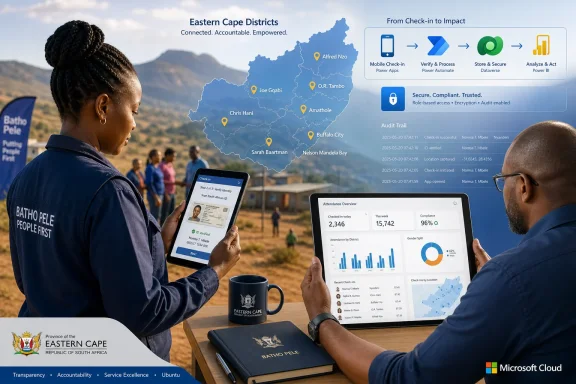
EPWP Smart Track is designed to collapse that gap. According to the launch material, participants check in through a mobile-first experience built on Power Apps. ID scanning verifies the participant at the site. Azure Maps provides GPS and reverse geocoding so the system can validate that the check-in occurred at a verified job location. Dataverse stores attendance, identity, and site data in real time, while Power Automate moves the record through logging, location validation, and payroll integration.
The architectural point is not that any one of these pieces is novel. Mobile check-ins, geolocation, workflow triggers, and dashboards are standard enterprise software patterns. The novelty is their assembly around a public employment programme where attendance is both a welfare-adjacent entitlement record and an operational management signal. That makes the system a form of civic infrastructure, even if it is built from commercially familiar components.
Power Platform Wins Because the Problem Is Fragmented
This is precisely the kind of workload Microsoft wants Power Platform to own. The problem is structured enough to benefit from a database and workflow engine, but localized enough that a monolithic custom system could become expensive, slow, and brittle. There are field users, supervisors, departmental administrators, compliance staff, and project managers, each needing a different view of the same underlying reality.Power Apps provides the mobile check-in surface. Power Automate handles the “if this, then that” logic between attendance events, validation steps, and downstream payroll systems. Dataverse gives the implementation a governed data layer rather than scattering records across inboxes and spreadsheets. Power BI turns the resulting operational data into dashboards for supervisors and administrators.
In other words, Power Platform’s value here is not low-code as a novelty. It is low-code as a deployment model for institutions that need to move faster than conventional procurement and software development cycles often allow. A provincial department does not necessarily need a bespoke attendance platform written from scratch. It needs a controlled, auditable system that can be configured to match sites, participants, roles, and reporting lines without waiting years for a custom application to mature.
That is the strongest version of Microsoft’s argument. The weaker version is that low-code can become a shortcut around the hard work of systems architecture, data governance, and long-term support. EPWP Smart Track will be judged not by whether a demo works, but by whether it remains reliable when devices fail, network coverage is poor, supervisors change, payroll deadlines arrive, and exceptions outnumber the happy path.
The Real Innovation Is Auditability, Not the App
The launch language emphasizes that every transaction is logged and audit-ready. That phrase deserves more attention than the mobile app itself. In public-sector workforce management, auditability is the difference between a system that merely records activity and one that can survive scrutiny.Attendance systems are often politically sensitive because they expose competing claims. Participants want to be paid for work performed. Supervisors want records that reflect operational reality. Administrators want clean data for payroll and reporting. Auditors want a trail that shows who did what, when, where, and under which authority. A useful system must serve all of these interests without quietly privileging the most powerful actor in the chain.
Audit logs can help, but only if they are designed as more than a compliance checkbox. A timestamped check-in tied to an identity record and a geocoded site is stronger evidence than a signature on paper. Yet it also creates new obligations: retention policies, access controls, dispute processes, correction workflows, and clear rules for what happens when the technology fails.
That last point is not theoretical. Field attendance systems encounter dead batteries, damaged phones, intermittent mobile data, incorrect GPS readings, and participants whose documents do not scan cleanly. If the platform treats every exception as suspicious, it risks punishing the very workers the programme is meant to support. If it treats exceptions too loosely, it recreates the weaknesses of the paper process in digital form.
The best public-sector platforms do not pretend exceptions will disappear. They make exceptions visible, bounded, and reviewable. EPWP Smart Track’s success will depend on whether its audit trail supports fair administration as much as fraud prevention.
Payroll Alignment Is Where the Stakes Become Personal
“Payroll alignment” sounds like back-office jargon until one remembers that EPWP participants are often relying on stipends as immediate income relief. Late or incorrect payments are not minor administrative inconveniences. They can affect transport costs, household budgets, food, and the willingness of participants to continue showing up for work that may already be temporary and physically demanding.A digital attendance system can improve payment accuracy by reducing the lag between check-in data and payroll processing. It can also make discrepancies easier to identify before payday rather than after complaints arrive. If attendance records flow through Power Automate into payroll integration steps, administrators have a better chance of catching missing records, duplicate entries, or site-level anomalies early.
But payroll alignment also raises the burden of correctness. Once a system becomes the authoritative source for payment eligibility, errors acquire institutional force. A bad scan, a misconfigured site boundary, or a wrongly assigned participant can move from technical glitch to missed income. That means the governance around EPWP Smart Track must include human appeal paths, not just dashboards.
This is where many digitization projects stumble. They optimize for managerial visibility while underinvesting in participant recourse. A supervisor can see the dashboard; a worker may only see that the payment did not arrive. If the system is to improve trust, it must make the record explainable to those being recorded.
Location Validation Is Powerful, and That Is Exactly Why It Needs Limits
Azure Maps adds one of the platform’s most consequential features: location validation. GPS and reverse geocoding can confirm whether a check-in happened at a verified job site. For a dispersed public works programme, that can help distinguish legitimate attendance from remote or fraudulent entries.Yet location data is inherently sensitive. Even when used for a narrow operational purpose, it can become tempting to repurpose. A system built to confirm presence at a worksite should not quietly become a broader movement-tracking tool. Public-sector deployments need explicit boundaries around when location is collected, how precise it is, how long it is retained, and who can see it.
The launch material says role-based access control restricts sensitive workforce data to appropriate stakeholders. That is important, and it aligns with the way Dataverse and Power Platform can enforce permissions across environments, tables, rows, and fields. But access control is only one layer. Policy choices still determine whether the platform practices data minimization or merely stores everything because it can.
For administrators, the temptation will be to treat more telemetry as inherently better governance. For participants, the perception may be different. If workers understand that location is captured only at check-in and only to validate attendance at a specific site, the system is easier to justify. If the boundaries are vague, the system risks being seen as surveillance dressed up as efficiency.
The Eastern Cape Becomes a Proving Ground for Partner-Led GovTech
NKUSI IT Siyasebenza’s role as a South African technology implementation company and Microsoft Partner Network member is central to the story. This is not Microsoft selling a finished EPWP product from Redmond. It is a local partner building on Microsoft cloud components for a local public-sector use case, with Microsoft South Africa endorsing the outcome as an example of cloud technologies delivering community impact.That partner-led model is how Microsoft often scales into public-sector niches. The platform vendor supplies the tools, compliance posture, identity stack, data services, and licensing framework. The partner translates those tools into a domain-specific application. The customer gets something more tailored than a generic SaaS product but less risky than building every layer independently.
For the Eastern Cape Department of Transport, the immediate benefit is operational visibility across six districts. For NKUSI IT Siyasebenza, the deployment becomes a reference customer. The company is already engaging other provincial and municipal entities interested in the platform, which suggests EPWP Smart Track is being positioned not as a one-off custom build but as a repeatable public-sector solution.
That raises the obvious scaling question. South Africa’s EPWP is not confined to one department or province. It cuts across sectors and public bodies, with different administrative cultures and local realities. A platform that works in one provincial transport context may need significant configuration elsewhere. The commercial opportunity is real, but so is the implementation risk if expansion outruns institutional readiness.
Dashboards Can Clarify Reality or Flatten It
Power BI dashboards are likely to be the part of EPWP Smart Track that senior officials see most often. Dashboards can show attendance trends, compliance indicators, site performance, and district-level comparisons. They can also create the illusion that what is measurable is what matters.This is a familiar danger in public administration. Once a dashboard becomes the managerial cockpit, organizations begin optimizing for the dashboard. Attendance becomes a compliance metric. Site performance becomes a color-coded tile. Exceptions become red flags. The messy human reasons behind the data can disappear behind a clean interface.
That does not mean dashboards are bad. In a programme serving more than 30,000 participants, leaders need aggregated visibility. The alternative is not humane nuance; it is often administrative fog. The question is whether the dashboard is treated as a decision-support tool or as a substitute for local judgment.
Good dashboards invite follow-up. Bad dashboards invite punishment. EPWP Smart Track will be most valuable if it helps managers ask better questions: Why is one district showing unusual absenteeism? Are certain sites suffering from transport barriers? Are payroll discrepancies clustered around particular supervisors or workflows? Are participants being excluded because of technical validation failures? Those are governance questions, not merely IT metrics.
The Microsoft Angle Is Bigger Than One South African Deployment
For Microsoft, EPWP Smart Track fits a broader strategy: make Power Platform the default operating layer for organizations that need custom applications but do not want to become software companies. In the public sector, that message has particular force. Governments are full of line-of-business processes that are too specific for off-the-shelf software and too urgent for traditional development timelines.The launch also arrives at a time when Microsoft is trying to make its cloud stack feel less abstract. Azure, Dataverse, Power Apps, Power Automate, Power BI, and Azure Maps can sound like a catalog of services until they are tied to a concrete outcome. A workforce platform for a large public employment programme gives the stack a human-scale story: people check in, data is validated, payroll is aligned, supervisors see the picture.
There is a competitive subtext as well. Public-sector cloud adoption is not only about infrastructure hosting. It is about who owns the workflow layer where government employees actually do their jobs. If Power Platform becomes the place where departments build field systems, case management tools, inspection apps, and reporting workflows, Microsoft gains a durable position far above commodity compute.
That position comes with responsibility. The more Microsoft’s platforms mediate public services, the more questions of licensing, data residency, vendor lock-in, accessibility, resilience, and exit planning move from procurement footnotes to democratic concerns. A successful EPWP Smart Track rollout will strengthen Microsoft’s case. A poorly governed one would strengthen critics who argue that public administration is becoming too dependent on proprietary cloud ecosystems.
The Hard Part Starts After the Launch
Technology launches tend to compress the story into a neat before-and-after. Before, paper. After, digital. Before, opacity. After, dashboards. Real deployments are less tidy. The hard part begins once the platform is embedded in daily routines and users discover the edge cases.Training will matter. Supervisors must understand not only how to use the mobile check-in workflow but why the data must be captured correctly. Administrators must understand how to interpret exceptions without turning every anomaly into an accusation. Participants must understand what data is collected and how it affects payment. IT teams must monitor availability, permissions, integrations, and support tickets.
Device strategy will matter too. A mobile-first system can be empowering if field teams have reliable hardware and connectivity. It can become a bottleneck if check-ins depend on too few devices, undertrained operators, or unstable mobile coverage. Rural and semi-rural worksites can expose assumptions that look harmless in a boardroom.
Licensing and lifecycle management will also matter. Power Platform solutions can grow organically, which is both their virtue and their danger. Without disciplined environment management, role assignment, testing, change control, and documentation, a useful low-code solution can become difficult to govern over time. The same speed that makes Power Platform attractive can create technical debt if every urgent change is pushed directly into production.
A Smart Track Still Needs a Fair Track
The most important test for EPWP Smart Track is not whether it digitizes attendance. It is whether it makes the programme more accountable without making it less humane. Public employment programmes operate at the intersection of administration and vulnerability. Their participants are not abstract resources in an enterprise resource planning system; they are citizens navigating temporary work, income insecurity, and government bureaucracy.A fair digital system should reduce opportunities for manipulation while protecting participants from arbitrary exclusion. It should make supervisors more accountable without assuming every supervisor is corrupt. It should give administrators clearer data without pretending data is self-interpreting. It should help payroll run more accurately without making the technology the unchallengeable judge of whether work occurred.
That balance is difficult, but it is achievable. The ingredients described in EPWP Smart Track are sensible: identity verification, verified worksite location, real-time data capture, workflow automation, dashboard reporting, role-based access, and audit logs. The unresolved question is how those ingredients are governed in practice.
The answer will not be found in a launch quote. It will be found in missed-payment disputes, audit reviews, supervisor adoption rates, exception handling, data-access reviews, and whether other provinces and municipalities can deploy the platform without simply copying the software while neglecting the operating model.
The Eastern Cape Pilot Turns Low-Code Into a Public-Sector Stress Test
The practical lesson from EPWP Smart Track is that low-code has entered a more serious phase. It is no longer just about helping a department replace a form. It is about whether configurable cloud platforms can support high-volume, high-consequence public administration.- EPWP Smart Track is now in production with the Eastern Cape Department of Transport and is described as supporting more than 30,000 EPWP participants across six districts.
- The platform uses Power Apps, Azure Maps, Dataverse, Power Automate, and Power BI to connect mobile check-ins, identity verification, location validation, payroll alignment, and reporting.
- The strongest case for the system is auditability, because paper attendance records are weak evidence in a programme where attendance affects payment and compliance.
- The biggest governance risk is that identity and location validation could become punitive or overly intrusive if data-use boundaries and appeal processes are not clear.
- The deployment gives Microsoft and NKUSI IT Siyasebenza a repeatable public-sector template, but scaling it to other entities will require operational discipline rather than simple software reuse.
- The system’s long-term credibility will depend on exception handling, participant recourse, data minimization, role-based access, and reliable field support.
References
- Primary source: ITWeb
Published: 2026-06-02T07:30:10.225900
NKUSI IT Siyasebenza launches EPWP Smart Track, a digital workforce management platform built on Microsoft Power Platform
The digital workforce management platform is built on Microsoft Power Platform and is now in production with the Eastern Cape Department of Transport. www.itweb.co.za
- Related coverage: epwp.gov.za
- Related coverage: westerncape.gov.za
Expanded Public Works Programme (EPWP)
The Expanded Public Works Programme (EPWP) focuses on skills development and providing work opportunities. It is one of the important ways the Western Cape Gove...www.westerncape.gov.za
- Related coverage: george.gov.za
Extended Public Works Programme (EPWP) - George Municipality
More Contact Information: For any inquiries about the EPWP database application/appointment enquiries, please contact the following EPWP Office officials: For inquiries, to verify job-related communications, or to report suspicious activity, please contact the EPWP Office: Shaneeze Kiewietz –... www.george.gov.za
- Related coverage: publicworks.gov.za
- Related coverage: socdev.ncpg.gov.za
- Related coverage: futurepolicy.org
South Africa’s Expanded Public Works Programme - futurepolicy.org
Launched in the context of endemic unemployment, the Expanded Public Works Programme (EPWP) provides income relief through temporary work.www.futurepolicy.org
- Related coverage: parliament.gov.za